



Your Guide to Digital Maturity Assessment Consulting
In today’s market, just throwing money at new technology is a surefire way to fall behind. The real winners are the ones who achieve digital maturity: that sweet spot where your people, processes, and technology are all in sync, pulling in the same direction to drive business results.
Before you jump into a major transformation, especially one powered by AI, a formal assessment isn’t just a good idea; it’s a critical first step.
Why Digital Maturity Is Your New Competitive Edge
Too many companies think “digital transformation” means buying the latest software. This tech-first approach almost always leads to expensive projects that fizzle out because the rest of the business, the people, the workflows, simply aren’t ready for the change.
Digital maturity is about getting your house in order first.
Think of it like building a custom home. You wouldn’t let the builders start putting up walls without a solid foundation and a detailed blueprint. A digital maturity assessment is the blueprint for your business. It goes way beyond a simple tech audit to give you a 360-degree view of your organization’s readiness, highlighting strengths you didn’t know you had and uncovering gaps you absolutely need to fix.
Beyond the Technology Checklist
A proper assessment digs into how your organization actually functions across several key areas. It’s not about what tools you have, but how you use them to get things done. This process gives you a clear, honest baseline of where you stand right now.
Without that starting point, you’re just guessing. The goal is to get a realistic picture of today so you can build an achievable roadmap for tomorrow.
A digital maturity assessment provides the strategic blueprint that ensures your transformation journey is built to succeed. It helps you avoid expensive mistakes, align investments with clear business goals, and build a solid foundation for sustainable innovation.
The Growing Demand for Strategic Insight
Don’t just take our word for it – the market tells the same story. The global Digital Maturity Consulting market was valued at a cool USD 1.5 billion in 2024. It’s projected to explode to USD 8.54 billion by 2033, growing at a blistering compound annual growth rate (CAGR) of 28.2%.
That kind of growth sends a clear message: businesses everywhere are realizing that without a solid digital foundation, they’re at risk of being left in the dust.
This foundational insight is what helps you sidestep costly missteps and make sure every dollar you invest is tied to a clear business objective. For any company looking to weave AI into its operations, this step is non-negotiable. It’s about building a transformation that lasts, ideally with an expert AI solutions partner to guide you. As we’ve covered before, a successful strategy is always built on proven digital transformation best practices.
Understanding The Five Pillars Of Digital Maturity
A real digital maturity assessment goes way beyond just looking at your tech stack. It’s about digging into how every part of your business works together or doesn’t to create value. To get the full picture, any serious evaluation needs to break down the five essential pillars that form the bedrock of digital readiness.
Think of it like building a high-performance car. You can have the most powerful engine in the world, but if the transmission is clunky, the tires are bald, or the driver isn’t trained, you’re not going anywhere fast. Effective digital transformation consulting gives you that 360-degree diagnostic, making sure no single weak point holds you back.
This map shows how these core concepts connect and drive a truly holistic assessment.
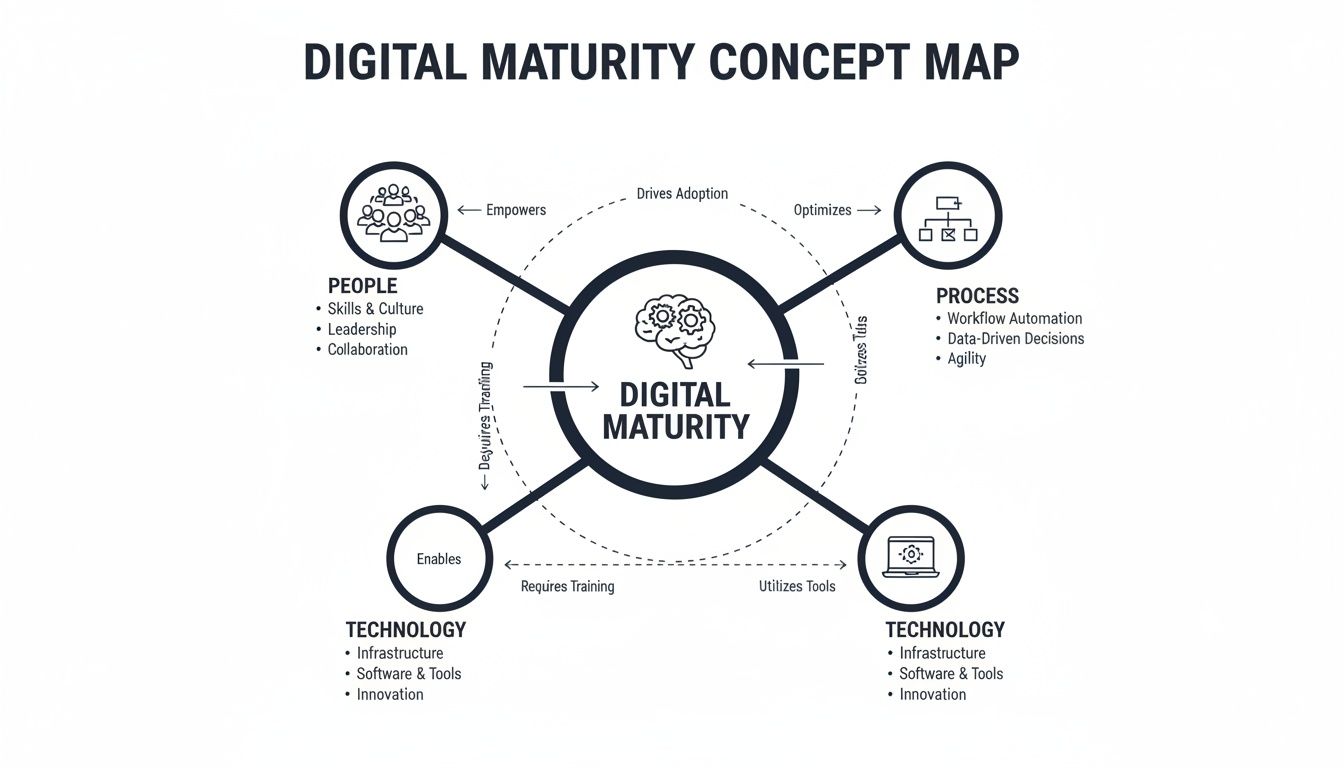
As you can see, genuine digital maturity isn’t just about one thing. It’s the sweet spot where your people, processes, and technology all click into place.
To get more specific, let’s break down exactly what we look at when evaluating an organization’s digital capabilities. The table below outlines the five core dimensions or pillars that we assess.
The Five Pillars of Digital Maturity
| Pillar | Focus Area | Example Metrics & Questions |
|---|---|---|
| People & Culture | The human element: skills, mindset, leadership, and adoption. | How digitally literate are our employees? Is leadership actively sponsoring change? Do we have a culture that rewards experimentation? |
| Processes & Workflows | How work actually gets done, from daily tasks to major operations. | Are our core processes automated or manual? Where are the biggest bottlenecks? Are we still using disconnected spreadsheets for critical tasks? |
| Technology & Infrastructure | The hardware, software, and systems that power the business. | Are legacy systems creating data silos? Can our infrastructure scale with demand? How well do our different software platforms talk to each other? |
| Data & Analytics | The ability to collect, manage, analyze, and act on information. | Is our data clean and accessible? Are we using analytics for predictive insights or just rearview reporting? Do teams have the tools to self-serve data? |
| Governance & Strategy | The leadership, rules, and vision that guide digital efforts. | Is our digital strategy clearly tied to business goals? Who owns data privacy and security? How do we prioritize new tech investments? |
Looking at these pillars together prevents the common mistake of focusing on just one area, like technology, while ignoring the others that are just as crucial for success.
Pillar 1: People and Culture
Technology is just a tool; your people are the ones who wield it. This pillar dives into the human side of your digital readiness, from the skills your team possesses to the kind of culture that leadership fosters. We look at everything from digital literacy and employee buy-in to how committed executives are to genuine innovation.
A classic mistake we see is companies spending a fortune on new software but completely overlooking the need to train their teams or address the natural resistance to new ways of working. An organization with high maturity here has a culture of continuous learning baked into its DNA.
Pillar 2: Processes and Workflows
Here, we get under the hood to see how work actually gets done. It’s all about mapping out your current workflows to spot the bottlenecks, redundant steps, and prime opportunities for automation. Inefficient, manual processes can bring even the most advanced technology to its knees.
For instance, a business might have a powerful CRM, but if the sales team still tracks leads in a dozen different spreadsheets, the process is fundamentally broken. A key goal here is to streamline these operations, making them faster, more consistent, and less reliant on manual effort, often through strategic custom software development to fill the gaps.
A mature organization doesn't just digitize old processes; it reimagines them. The goal is to create lean, agile workflows that are built for the digital era from the ground up.
Pillar 3: Technology and Infrastructure
While it’s not the only piece of the puzzle, technology is, of course, a massive one. This pillar is a deep dive into your entire tech stack, from foundational infrastructure like cloud services to your customer-facing apps. The assessment zeroes in on whether your systems are integrated, scalable, and secure.
We’re asking tough questions like:
-
Legacy Systems: Are outdated platforms holding you back and creating frustrating data silos?
-
Integration: Do your essential tools actually talk to each other, or are you stuck with manual data transfers?
-
Scalability: Can your current setup handle a sudden spike in demand or support your 5-year growth plan?
An expert AI solutions partner can be invaluable here, helping you figure out if your foundation is strong enough to support advanced tools like machine learning – a major focus of modern AI development services.
Pillar 4: Data and Analytics
Data is the fuel for any modern business, but having a ton of raw data is like having a tanker full of crude oil; it's useless until you refine it. This pillar measures your ability to effectively collect, manage, analyze, and, most importantly, act on information. A mature organization uses data not just to report on what happened last quarter, but to predict what's coming next and make proactive decisions.
We see this over and over in our client cases: businesses that truly master their data don't just compete, they dominate. Getting there means having clean data, powerful analytics tools, and a data-driven mindset that permeates every department.
Pillar 5: Governance and Strategy
Finally, governance is the strategic glue that holds everything together. This pillar ensures your digital projects are actually aligned with your core business objectives, not just "tech for tech's sake." It also covers the critical, non-negotiable stuff like cybersecurity, data privacy, and navigating regulatory compliance.
Without strong governance, digital efforts become chaotic and fragmented. A solid framework ensures that investments are prioritized intelligently, risks are managed, and everyone is pulling in the same direction, with rigorous software quality assurance built into every single project from day one.
How AI Integration Accelerates Your Maturity
Artificial Intelligence and Machine Learning have moved from science fiction to the boardroom. Today, they're the most potent forces we have for pushing digital maturity forward. Bringing AI into your business isn't just about plugging in a new piece of software; it's about fundamentally changing how your organization thinks and works. AI makes each of the five pillars of maturity: people, processes, technology, data, and governance, smarter and more agile.
A crucial part of a digital maturity assessment consulting engagement is pinpointing where AI can make the biggest difference. Maybe that’s using generative AI to spark new ideas in your marketing department or using predictive analytics to get a shockingly clear view of future market trends. The aim is to build a business that doesn't just keep up with change but stays one step ahead of it.
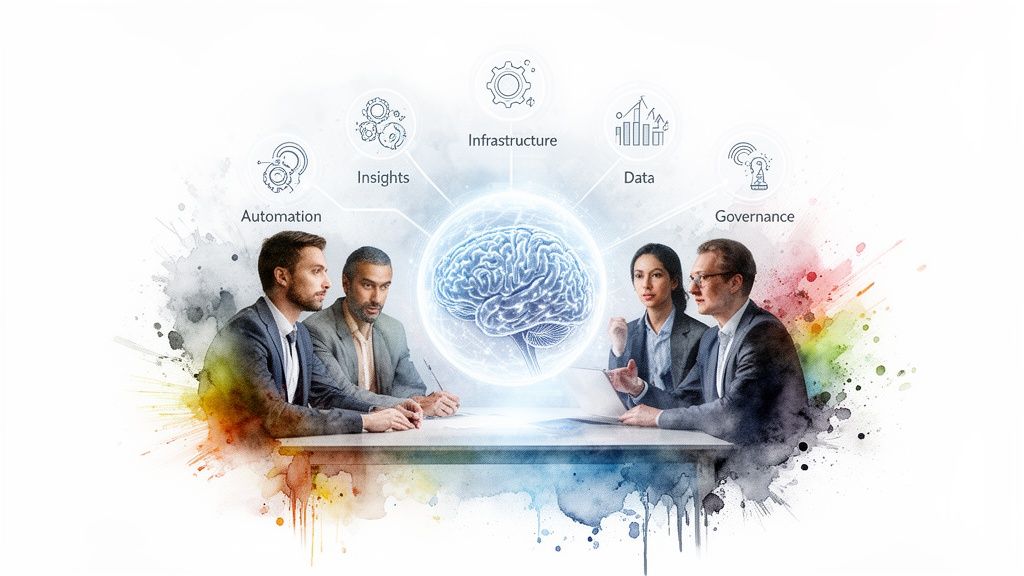
This is where the real work begins, and specialized AI development services are key to translating the assessment’s findings into powerful, real-world business tools.
Supercharging Your People and Processes
Think of AI as a force multiplier for your team. It takes on the repetitive, soul-crushing tasks that bog people down, freeing them up to focus on the things humans do best: strategic thinking, creative problem-solving, and building relationships. This doesn’t just make your company more productive; it makes your employees’ jobs more meaningful.
Imagine a customer service workflow powered by AI. It can instantly route support tickets, figure out which ones are urgent, and even suggest the best way to respond. The AI isn't replacing the support agent; it's giving them superpowers. It provides the context and speed they need to deliver fantastic service, turning a clunky manual process into a smart, efficient system.
Optimizing Your Technology and Data
AI can completely revitalize your existing tech and data infrastructure. On the technology side, it can predict system failures before they happen, intelligently manage cloud spending, and optimize your network on the fly. This shifts your IT team from a reactive, fire-fighting mode to a proactive, forward-looking one.
The true power of AI lies in its ability to unlock the hidden value within your data. It can identify patterns, anomalies, and opportunities that are impossible for humans to spot across massive datasets.
This capability turns data from something you just store into your most powerful strategic asset. As an expert AI solutions partner, we’ve seen firsthand how this shift creates a genuine competitive edge. It’s no longer about just having data; it's about putting that data to work with intelligence.
Strengthening Governance Through Intelligent Insights
Finally, AI brings a new level of clarity to governance and big-picture decisions. By giving leaders data-driven forecasts and models of different scenarios, AI takes a lot of the guesswork out of strategic planning. It helps ensure you’re putting your money and effort into projects that have the best chance of paying off.
For instance, an AI model could analyze market trends, competitor moves, and your own performance data to recommend the smartest way to enter a new market. This data-backed guidance makes sure your strategy is both ambitious and grounded in reality, with clear ways to measure success.
The numbers tell the same story. AI and Machine Learning are set to dominate the digital transformation space, grabbing a 28.05% market share in 2025 and growing at a staggering 23.9% CAGR. In a broader digital transformation market projected to hit USD 12.5 trillion by 2035, working with an expert is the only way to accurately diagnose what’s holding you back and build a plan to fix it. You can read the full research about the digital transformation market to grasp the sheer scale of this opportunity.
Ultimately, bringing AI into your operations is the final leap from being a digitally capable company to becoming a digitally dominant one. It’s about creating a business that is always learning, adapting, and improving – embedding intelligence right into its DNA.
Your Step-By-Step Assessment Journey
So, what’s it actually like to go through a digital maturity assessment? It’s not some cryptic, behind-the-scenes audit. Think of it more like a guided expedition where we map out your company’s digital terrain together, pinpointing both hidden opportunities and the tricky spots to navigate.
The whole process is designed to be a collaboration. We want you to see exactly what we’re doing and why every step of the way. This ensures the final roadmap isn't just a document that sits on a shelf; it's a practical, data-backed plan you can actually put into motion.
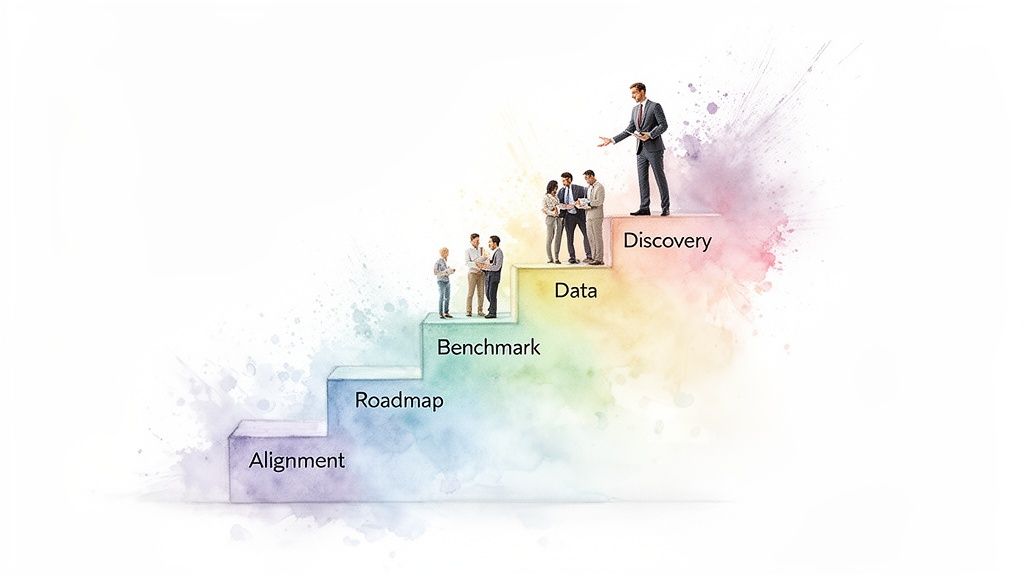
Phase 1: Discovery and Goal Setting
Every journey needs a destination. We kick things off with a deep dive into your business, but we don't show up with a generic checklist. The first thing we do is listen. We sit down with your leadership to get a crystal-clear picture of what "success" means for your company.
During this discovery phase, we focus on a few key things:
-
Defining Your Vision: Where do you see the business in the next three to five years?
-
Pinpointing Objectives: What are the absolute must-win battles for your company?
-
Mapping Stakeholders: Who are the key people, the decision-makers, champions, and influencers, that need to be part of this?
This first step is all about building a solid strategic foundation, making sure everything that follows is perfectly aligned with your core business goals.
Phase 2: Data Collection and Analysis
With our objectives set, we roll up our sleeves and start gathering information. This isn’t just about numbers; we use a mix of methods to get a full, 360-degree view of your organization, capturing both the hard data and the human experience.
Our approach includes interactive workshops with teams from different departments, one-on-one interviews with key leaders and subject-matter experts, and a thorough review of your current technology and documentation. A crucial piece of this puzzle is often a detailed Legacy Assessment, which helps us understand any technical debt that might be holding you back or find opportunities within your existing systems.
Phase 3: Benchmarking and Gap Analysis
Once we have the data, it's time to see where you stand. How does your company’s digital know-how compare to your direct competitors or even the top performers in your industry? This is where benchmarking comes into play.
We measure your capabilities across those five key pillars: people, processes, technology, data, and governance, against established industry standards. This process clearly shows where you’re leading the pack and, more importantly, reveals the gaps between where you are today and where you want to be. As we’ve explored in our guide, a specific AI readiness assessment is often a key part of this phase, helping us zero in on prime opportunities for intelligent automation.
This isn't about pointing out flaws. It's about identifying the highest-impact opportunities for improvement so you can focus your resources where they’ll make the biggest strategic difference.
Phase 4: Strategic Roadmap Development
Here’s where all that analysis transforms into a concrete plan. The roadmap is the heart of the engagement; it’s a practical, step-by-step guide that turns our findings into your path forward.
A solid roadmap always includes:
-
Prioritized Initiatives: A clear list of projects, from "quick wins" that build early momentum to larger, long-term strategic shifts.
-
Clear Timelines: A realistic schedule for getting things done, broken down into manageable phases.
-
Defined KPIs: Specific, measurable metrics to track your progress and prove the ROI for each initiative.
This plan ensures every dollar you invest, whether it’s in technology or training, is tied directly to a meaningful business outcome.
Phase 5: Executive Alignment and Activation
A brilliant plan is useless without the team to execute it. In this final phase, we present the strategic roadmap to your entire leadership team. The goal is to create a shared vision and secure the commitment needed to bring the plan to life.
We walk everyone through the findings, the strategic recommendations, and the business case for each proposed project. This makes sure everyone is on the same page and ready to champion the changes ahead. It’s this structured, transparent approach that builds a plan that not only gets implemented but also delivers powerful, lasting results.
Turning Your Assessment into an Actionable Roadmap
Think of your digital maturity assessment as the "You Are Here" marker on a map. It’s a crucial piece of information, but it’s not the destination. The real magic happens when you use those findings to chart a course forward – a dynamic, actionable roadmap that guides your organization from where it is today to where it needs to be tomorrow.
This is where sharp digital maturity assessment consulting truly proves its worth. It’s about moving beyond the diagnostic report and crafting a practical, phased plan. The goal is a guide that’s both ambitious enough to inspire and realistic enough to execute, ensuring every single step creates tangible business value along the way.
What a Great Roadmap Includes
A powerful roadmap is so much more than a simple project list. It’s a strategic document that artfully balances immediate needs with long-term vision, making sure everyone from the C-suite to the front lines is aligned and understands the mission.
A truly effective roadmap will always lay out:
-
Prioritized Initiatives: A clear breakdown of projects, ranked by their potential impact and how feasible they are to implement. This should include both 'quick wins' to build momentum and the foundational, long-term shifts your business needs.
-
Technology and Tooling Recommendations: Specific suggestions for new software, platforms, or upgrades required to hit your goals. This might be anything from a new CRM system to launching specialized custom ecommerce solutions.
-
Talent and Skill Development Plans: A game plan for the training, hiring, or upskilling needed to make sure your team can actually use the new tools and processes to their full potential.
-
Realistic Timelines and Milestones: A phased schedule with clear deadlines, dependencies, and deliverables. This makes progress visible and keeps everyone accountable.
This kind of structured approach guarantees that every dollar you invest in something like custom software development is directly tied to a strategic goal, maximizing your return.
Balancing Quick Wins with Long-Term Strategy
One of the most critical jobs of a roadmap is to build and maintain momentum. It’s a classic mistake to focus only on massive, multi-year projects that don’t show any results for ages. This is a surefire way to cause stakeholder fatigue and lose support.
A well-crafted roadmap is designed to deliver immediate value while paving the way for future innovation. By identifying and executing 'quick wins': high-impact, low-effort projects, consultants help demonstrate progress early and often, which builds confidence and secures buy-in for the larger transformation ahead.
For instance, a quick win could be as simple as automating a single, tedious manual report. That one small change might free up dozens of hours for a key team, proving the value of the broader strategy and energizing everyone for the more complex work to come.
Setting KPIs to Track Progress and Prove ROI
A roadmap without metrics is just a wishlist. To keep your transformation on track and ensure it delivers real business impact, every initiative needs to be connected to clear Key Performance Indicators (KPIs). These are the vital signs of your digital journey.
Effective KPIs for a digital roadmap often include:
-
Operational Efficiency: Reductions in how long it takes to complete a process or a drop in manual effort.
-
Customer Experience: Improvements in scores like Net Promoter Score (NPS) or overall customer satisfaction.
-
Revenue Growth: Measurable increases in online sales or higher lead conversion rates.
-
Employee Adoption: Tracking how many people are actively using the new digital tools and platforms.
Setting these KPIs from the very beginning isn't optional. They are what allow you to measure progress, justify your spending, and make smart, data-driven adjustments to the plan as you go. It also means embedding rigorous software quality assurance from day one, so you know the solutions you build are reliable enough to actually hit those KPIs.
Making progress here is essential for staying in the game. Since 2019, the corporate world has only seen modest gains in digital maturity. While about 16% of companies have made notable strides, a huge gap remains. This growing divide between digital leaders and laggards is exactly why companies are turning to expert consulting. You can discover more insights about the Global Digital Maturity Index on deloitte.com. An actionable roadmap is the key to making sure your organization lands on the right side of that divide.
Choosing the Right Consulting Partner
Picking the right partner for your digital maturity assessment is one of the most important calls you'll make. This isn't just about hiring a vendor; it's about finding a guide who genuinely understands your industry's unique pressures and can act as a true extension of your team. A great partner doesn’t just hand you a cookie-cutter report; they give you sharp, practical advice that comes from years of experience.
The right consultant brings far more than a fancy methodology to the table. They should have a solid history of success, a transparent way of working, and a laser focus on turning raw data into concrete actions. Their main goal should be helping you win in the long run, not just ticking off a project on a checklist.
Evaluating a Consultant’s Track Record
When you're looking at potential partners, you need to see proof that they've done this before and done it well. A top-notch consulting firm will have a portfolio that clearly shows how they've helped businesses like yours get real, measurable results.
Here’s what to look for:
-
Industry-Specific Experience: Do they really get your market? Do they understand your competitors and the regulatory hoops you have to jump through?
-
AI and Data Expertise: Can they show you how they've used AI and complex analytics to solve actual business problems, not just talk about it?
-
Client Testimonials and Case Studies: What do their past clients say? Look for stories about their hands-on approach and their ability to follow through on what they promised.
Getting these things right ensures the advice you get is strategic, practical, and actually fits the world your business operates in.
The Bridge Global Difference
As an experienced AI solutions partner, we take a hands-on, collaborative approach. We don't just assess your business from a distance; we get in the trenches with you to build a clear, achievable roadmap. Our deep knowledge of AI development services helps us spot high-impact opportunities that others might overlook, making sure your plan is ready for what's next. We've helped companies of all sizes, from scrappy startups to large enterprises needing sophisticated custom ecommerce solutions, move up the digital maturity ladder.
Our entire process is built on being transparent and completely committed to your success. As you can see from our client cases, we excel at turning assessment findings into tangible business value; whether that means building new custom software development or fine-tuning the systems you already have.
A truly valuable consulting partner acts as a catalyst for change. They provide a clear vision of what’s possible and the momentum to turn that vision into a reality, supported by data-driven insights and a shared sense of purpose.
As we explored in our guide, you can learn more about how we work in our detailed guide on digital transformation consulting services. Choosing the right firm for your digital maturity assessment is the first real step toward building a smarter, more resilient organization that’s ready to thrive. We make sure every single recommendation we make is backed by a solid strategy and a clear path to get it done.
Answering Your Questions: A Quick FAQ
If you're thinking about a digital maturity assessment, you probably have some questions. We've put together answers to a few of the ones we hear most often.
How Long Does a Digital Maturity Assessment Take?
This is a common first question, and the honest answer is: it depends. For a typical mid-sized business, you can expect the entire process to take somewhere between 4 and 8 weeks.
That timeline gives us enough room to do a deep dive, from the initial discovery calls and data gathering all the way to delivering your final strategic roadmap. We work hard to make the process thorough but also to keep it from getting in the way of your day-to-day business.
What Is the Expected ROI from This Type of Consulting?
The return on investment shows up in a few key places: smarter tech spending, smoother operations, and a much-improved customer experience. You'll see direct financial gains from things like automation or new digital revenue streams, but one of the biggest wins is often in what you avoid.
A solid assessment helps you sidestep expensive project failures. It makes sure your transformation budget is funnelled into initiatives that actually move the needle, preventing you from wasting money and time. It’s about investing wisely in areas like custom software development or AI development services, where it will truly count.
How Can Our Team Best Prepare for an Assessment?
A little prep work goes a long way. To get the most out of the assessment, your team can take a few simple steps beforehand:
-
Assemble a core project team: Pull in key people from IT, marketing, operations, and finance. Getting different viewpoints is crucial.
-
Communicate the purpose: Let everyone know what the assessment is for and why it’s important. This helps get honest cooperation.
-
Gather relevant documents: Start collecting things like process maps, recent performance reports, and system architecture diagrams.
-
Foster an open culture: Encourage your team to be candid about the real-world challenges and opportunities they see. The more honest the input, the better the outcome.
Is This Assessment Only for Large Enterprises?
Absolutely not. We’ve found that organizations of every size benefit from this. For small and mid-sized businesses, it’s a powerful way to build a strategic framework that lets you compete with bigger players by making smart, targeted investments.
The whole methodology is flexible. We can scale it to fit your specific needs, budget, and goals, ensuring you get real value no matter how large or small your company is. Our client cases are full of examples of businesses of all sizes finding success with this approach.
Ready to figure out where your business really stands and map out a path to a smarter future? As an experienced team at Bridge Global, we offer the expert digital transformation consulting you need to turn those insights into real action.

About Upendra Jith
Upendrajith completed his Master's in English and has been a commercial content developer for the past three years. He's more inclined to develop content with a 'street-smart' delivery on topics such as technology, media, or anything he can get his hands on. He has a fixation on lyrics, dark poetry, media, technology, and flow arts.
View all posts by Upendra Jith →