



Your Guide to a High-Impact AI Readiness Assessment
An AI readiness assessment is essentially a deep-dive audit that gauges your company’s real capacity to adopt and scale artificial intelligence. It’s about looking far beyond the tech itself. We’re talking about a comprehensive analysis of everything from your business strategy and data quality to your team’s skills and existing infrastructure. The whole point is to spot the strengths, uncover the weaknesses, and flag potential roadblocks before you sink serious money into a project.
It’s how you build a clear, actionable game plan for making AI work.
Why an AI Readiness Assessment Is Not Optional
I’ve seen it happen too many times: a company gets excited about the promise of AI, dives in headfirst, and ends up with a failed project and a lot of wasted cash. Why? They jumped into the technology without first figuring out if they were actually prepared to support it. This classic misstep leads to initiatives that fizzle out, miss their targets, or simply don’t connect with what the business is trying to achieve.
Think of an AI readiness assessment as the solid foundation for your entire AI strategy. It grounds your ambition in reality.

This isn’t just some technical checklist. It’s a critical business evaluation that ties your AI aspirations to tangible outcomes. By systematically digging into your organization’s current state, you can find those hidden gaps—in data governance, infrastructure, or talent—that could easily derail a project months down the road. A proper assessment delivers the clarity you need to build a practical, phased roadmap that actually leads to success.
The True Cost of Skipping This Step
Deciding to “wing it” and skip this crucial first step is a massive gamble. Without a clear picture of where you stand, you might invest in a sophisticated AI solution that your messy data can’t support or that your team has no idea how to manage. The data doesn’t lie: a staggering number of data science projects never even make it to production, and it’s often because of a fundamental disconnect between the tech and the business’s readiness.
A proactive assessment transforms your AI journey from a shot in the dark into a calculated strategy. It’s about managing risk, justifying every dollar with hard data, and ensuring each step you take moves you closer to a measurable return on investment.
To give you a clearer picture, the assessment typically breaks down into several core areas. Each one is a critical piece of the puzzle.
Key Dimensions of AI Readiness at a Glance
| Assessment Dimension | What It Evaluates | Why It’s Critical |
|---|---|---|
| Business Strategy | How well defined are your AI goals? Do they align with overall business objectives and stakeholder expectations? | Without strategic alignment, AI projects become science experiments, not business drivers. |
| Data & Analytics | The quality, accessibility, and governance of your data. Do you have the right data to solve the problem? | AI models are only as good as the data they’re trained on. Garbage in, garbage out. |
| Technology & Infrastructure | Your current tech stack, including cloud platforms, data storage, and processing capabilities. Can it handle AI workloads? | Your infrastructure must be able to support the demanding computational needs of AI and ML. |
| People & Organization | The skills and AI literacy of your teams, from data scientists to business users. Is your culture ready for change? | Technology is just a tool. Your people are the ones who will make it succeed or fail. |
Looking at these dimensions helps you understand the holistic nature of AI adoption. It’s never just about the algorithm.
Aligning Your Strategy with Your Capabilities
Ultimately, the assessment process forces those tough, necessary conversations about what you really want to accomplish with AI and what it’s realistically going to take. It’s the perfect opportunity to get your entire leadership team on the same page, ensuring your tech goals are directly fueling broader business objectives. This alignment is absolutely fundamental for securing the buy-in and resources you’ll need for the long haul.
As you start seriously considering how to bring AI for your business, this initial audit is truly indispensable. It sets the stage for everything that comes next, from picking the right pilot projects to scaling your wins across the entire company. For organizations that want expert guidance, partnering with a trusted AI solutions partner can provide the structure and objective viewpoint needed to navigate this essential first step with confidence.
The Core Pillars of Your AI Readiness Framework
A proper AI readiness assessment isn’t some abstract thought exercise; it’s a hands-on audit of your organization’s real-world capacity. To get a true picture, you have to break it down into several core pillars. Looking at each one gives you a complete, 360-degree view of where you stand.
Think of it like building a house. You wouldn’t dream of putting up walls without first pouring a solid foundation, finalizing the blueprints, and making sure you have the right crew and materials. Each pillar of your AI readiness framework is one of those non-negotiable building blocks.
1. Strategic and Business Alignment
This is where everything has to start. If an AI project isn’t directly tied to a clear business goal, it’s just an expensive science experiment waiting to happen. Before you get lost in algorithms and data sets, you have to ask some fundamental questions.
The entire point here is to make sure every AI initiative has a rock-solid “why” behind it.
- What are our biggest business priorities right now? Are we trying to drive revenue, slash operational costs, make customers happier, or break into a new market?
- How, exactly, can AI help us get there? For instance, if cutting costs is the goal, an AI model could optimize supply chain logistics. That’s a direct link.
- Who are the key players? Is there genuine buy-in from the executive team and across departments? Without it, even the most promising projects die on the vine from a lack of resources or internal turf wars.
A project to build a customer churn prediction model, for example, is a perfect match for a business goal of boosting customer retention. An AI project without that clear line of sight is just drifting, and it’s almost guaranteed not to deliver any real ROI.
2. Data Readiness and Governance
Let’s be blunt: data is the fuel for any AI system. Without high-quality, accessible, and well-governed data, even the most sophisticated models are useless. This is often the biggest hurdle for companies, and it’s arguably the most critical pillar to get right.
You have to take a hard look at your entire data lifecycle.
An organization’s AI maturity is a direct reflection of its data maturity. You simply cannot build sophisticated AI on a foundation of messy, siloed, and untrustworthy data.
Here’s what to zero in on:
- Data Quality: Is your data accurate, complete, and consistent? Do you have actual processes for cleaning and validating it, or is it the Wild West?
- Data Accessibility: Is your data sitting in a central, usable spot (like a data warehouse or lake), or is it scattered across dozens of disconnected silos? Can your data science teams actually get their hands on what they need without a month-long battle?
- Data Governance: Who owns the data? What are the rules for how it’s used, who can see it, and how it’s secured? A strong governance framework isn’t optional—it’s essential for building trust and staying out of trouble.
3. Technology and Infrastructure
AI and machine learning models are power-hungry. They need a robust and scalable tech stack to handle everything from crunching data and training models to deploying and monitoring them in the real world. Your current IT setup might not be up to the task.
This is where you audit your technical foundation. Can your systems actually support your AI ambitions?
- Cloud Computing: Do you have access to scalable cloud resources from providers like AWS, Azure, or GCP?
- Data Processing Tools: Are you using modern tools for ingesting, transforming, and processing data, or are you still relying on scripts from a decade ago?
- MLOps Platforms: Do you have systems in place to manage the machine learning lifecycle from experimentation all the way to production? Or is deployment a manual, hope-for-the-best process?
For companies that uncover major gaps here, getting help from experts in custom AI development services can be the fastest way to get the technical guidance and resources needed to build an infrastructure that’s ready for the future.
4. Talent and Organizational Skills
Technology is only half the equation. At the end of the day, it’s your people who will make or break your AI efforts. A successful AI program needs a smart mix of deep technical expertise and sharp business sense across the entire organization.
It’s time for an honest inventory of your internal talent.
- Technical Skills: Do you have data scientists, machine learning engineers, and data engineers on your team? If not, what’s the plan? Are you going to hire, upskill your current staff, or bring in a partner?
- AI Literacy: Do your business leaders and non-technical staff have a basic grasp of what AI can and cannot do? Creating a data-savvy culture is absolutely essential for spotting new opportunities and getting people on board.
- Domain Expertise: Do your tech teams have direct access to subject matter experts who actually understand the business context and can help validate the models?
5. Governance, Ethics, and Responsible AI
As AI gets more powerful, the need for strong governance and clear ethical lines becomes critical. This pillar is all about making sure your AI systems are fair, transparent, and accountable. If you ignore this, you’re exposing yourself to massive reputational damage and serious legal risks. As we’ve covered before, a proactive strategy is key for responsible AI implementation.
This is about building trust—both inside your company and with your customers. Your assessment needs to ask:
- Model Transparency: Can you actually explain how your AI models are making their decisions?
- Bias and Fairness: What are you actively doing to find and fix bias in your data and algorithms?
- Regulatory Compliance: Are you keeping up with regulations like GDPR and other industry-specific rules?
6. Culture and Change Management
Finally, your company’s culture has to be ready to embrace change. AI will inevitably automate tasks, shake up workflows, and demand new ways of thinking. A culture that resists change will kill AI adoption, no matter how great the technology is.
Here, you’re looking at the human side of the transformation.
- Innovation Mindset: Does your culture encourage people to experiment and learn from failure, or does it punish them?
- Collaboration: Do your business and technology teams actually work together, or do they operate in separate worlds?
- Communication: Do you have a clear plan to explain the benefits of AI and address the very real concerns your employees will have?
These pillars aren’t just theory. Look at the 2025 Government AI Readiness Index from Oxford Insights. It structures national AI readiness around the very same ideas: governance, infrastructure, data, and skills. The index shows that top-ranking countries like Singapore (score of 88/100) and the United States (86/100) are ahead because of strong national AI strategies, big investments in infrastructure, and solid data governance. It’s the same playbook businesses need to follow to win. You can dig into the full research on these global AI readiness findings.
How to Score Your AI Readiness with a Practical Model
Alright, you’ve done the qualitative work. Now it’s time to put some numbers to your findings. Turning your AI readiness assessment into a scoring model is where the abstract becomes concrete. Think of it as creating a dashboard for your organization’s AI capabilities—a quick, visual way to see where you’re strong and, more importantly, where the gaps are.
Assigning a score to each pillar of your framework gives you a tangible baseline. This isn’t just for a report; it’s a powerful tool for justifying strategic investments and, crucially, for tracking your progress down the line.
Defining the Maturity Scale
To keep things simple and effective, let’s use a straightforward 1-to-5 maturity scale. This isn’t about passing or failing. It’s about honestly pinpointing where you are on the journey across those six core pillars we discussed, from high-level strategy to your team’s day-to-day culture.
Here’s a breakdown of what each level actually means in practice:
- Level 1: Nascent
You’re at ground zero. Any AI-related activities are completely ad-hoc, if they exist at all. There’s little awareness of its potential, and the fundamentals—like clean data or a clear strategy—are missing. - Level 2: Emerging
Pockets of interest are popping up, usually driven by enthusiastic individuals or specific teams. While awareness is growing, these efforts are siloed and lack any real coordination or formal support from the top. - Level 3: Defined
Things are getting serious. The organization has started to establish formal processes and standards. You have a documented AI strategy, dedicated teams are in place, and you’re actively building out the foundational data and tech infrastructure. - Level 4: Managed
Your AI initiatives are now measured against clear metrics. Processes are followed consistently across the board, and you can reliably predict the outcomes of your AI projects. You’re in control. - Level 5: Optimized
AI is no longer a project; it’s part of your DNA. The focus is on continuous improvement and innovation. AI is deeply woven into business operations, driving real value and giving you a sustainable competitive edge.
Applying Scores to the Pillars: A Real-World Example
Let’s make this tangible. Imagine an eCommerce company assessing its Data Readiness. A score of 1 might apply if their data is a mess, while a score of 5 means they leverage advanced ML models for everything from personalization to demand forecasting, likely using custom ecommerce solutions to achieve this.
A score of 1 (Nascent) would mean their customer data is a mess. It’s scattered across their marketing platform, sales CRM, and order management system with no single source of truth. The data is incomplete, riddled with duplicates, and completely ungoverned. It’s useless for any real analysis, let alone machine learning.
On the flip side, a score of 5 (Optimized) would look completely different. This company has a centralized data lakehouse that captures, cleans, and governs every customer interaction in near real-time. Data scientists have secure, on-demand access to high-quality data, and automated pipelines feed advanced ML models for everything from personalization to demand forecasting.
The goal of scoring isn’t to achieve a perfect ‘5’ in every category overnight. It’s about gaining an honest, objective understanding of your starting point so you can build a realistic and effective roadmap for improvement.
This isn’t just an internal exercise. On a global scale, you can see how this plays out. The latest Government AI Readiness Index shows countries like Singapore, the USA, and Finland leading the pack because they’ve invested heavily in strategy and infrastructure.
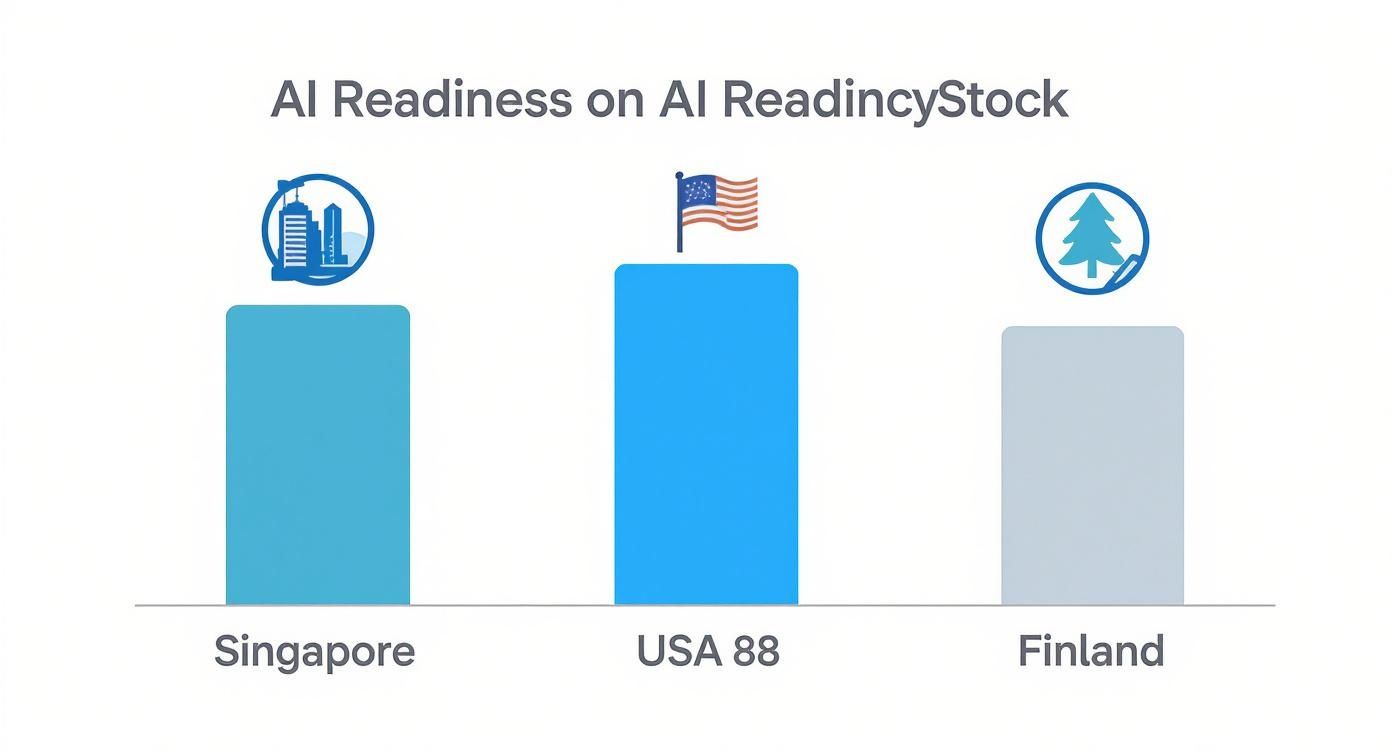
The data makes it clear: high readiness scores are directly linked to focused effort in governance, data infrastructure, and strategic planning. These maturity models are common for assessing capabilities, and for another perspective, you can see similar principles applied in this guide on Mastering DevOps Maturity Levels.
Visualizing Your Results
Once you’ve scored each of the six pillars, the real magic happens when you visualize it. A simple radar or spider chart is perfect for this. It gives you an immediate, at-a-glance snapshot of your AI readiness profile.
You might instantly see that your organization scores a 4 in Strategic Alignment and a 4 in Talent, but is critically lagging with a 2 in both Data Readiness and Technology Infrastructure.
That kind of visual clarity is incredibly powerful. It cuts through the noise and shows you exactly where to focus your resources for the biggest impact, making it much easier to build a compelling business case for specific projects. As you start planning what’s next, our guide on implementing AI in business offers some great advice for turning these insights into action. This scoring model is the bridge between knowing where you are today and building a targeted plan to get where you want to be.
From Assessment to Action: Building Your AI Roadmap
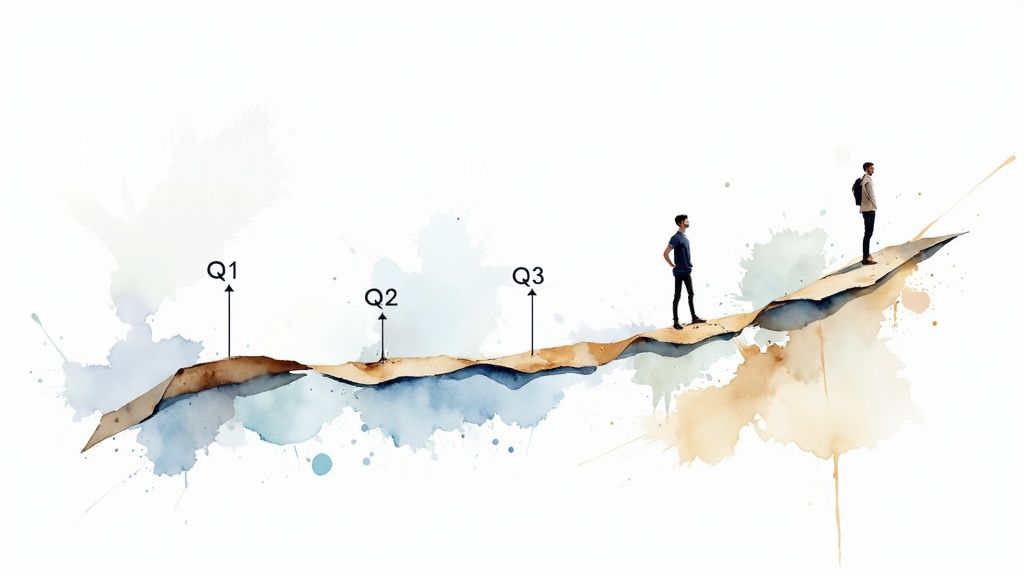
An AI readiness assessment isn’t just an academic exercise—it’s a launchpad. Once you’ve scored your capabilities and have an honest picture of where you stand, it’s time to shift from analysis to action. This is where you build a practical, quarter-by-quarter plan to guide your company’s AI journey.
Seeing a list of gaps can feel daunting at first. The trick is to resist the urge to fix everything at once. Instead, you need to be strategic, zeroing in on the most critical weaknesses that are holding you back.
A Simple Framework for Setting Priorities
A fantastic way to decide where to start is the classic Effort vs. Impact matrix. This simple tool helps you categorize potential projects based on how much work they’ll take versus the value they’ll deliver.
This isn’t complicated. You just plot each potential action—like “Cleanse CRM Data” or “Train Staff on AI Basics”—onto the grid.
- Quick Wins (Low Effort, High Impact): These are your no-brainers. Start here. They build momentum and get people excited, which helps secure buy-in for the bigger, more complex projects down the line.
- Major Projects (High Effort, High Impact): These are your big, strategic bets. Think of something like overhauling your entire data governance model. These are the initiatives that will define your long-term success.
- Fill-Ins (Low Effort, Low Impact): These are nice-to-haves. Tackle them when you have a spare moment or extra resources, but don’t let them distract you from the main event.
- Reconsider (High Effort, Low Impact): Steer clear of these. They’re resource drains with little to no payoff.
Focus on “Quick Wins” first. Success breeds confidence and makes it much easier to get the support and budget needed for those more demanding “Major Projects.”
What a Sample AI Roadmap Looks Like
With your priorities straight, you can start laying them out on a timeline. A good roadmap sets tangible, achievable goals for each quarter, starting with foundational work and building toward more advanced applications of AI for your business.
Here’s a snapshot of a first-year roadmap for a company that discovered it was weak on data readiness and organizational skills:
Quarter 1: Laying the Groundwork
- Goal: Establish a cross-functional Data Governance Council.
- Action: Define data quality standards, assign data stewards, and pick a pilot department for a data cleansing project.
- Metric: Council is formed, and the pilot department has its first data quality report.
Quarter 2: Building Skills and Getting Our Feet Wet
- Goal: Launch an internal AI literacy program for business leaders.
- Action: Hold workshops on AI fundamentals. At the same time, identify a low-risk, high-impact pilot project, like an AI-powered marketing analytics dashboard. This might even be a chance to explore custom software development for a proof-of-concept.
- Metric: 75% of targeted leaders complete the training, and the pilot project charter is officially approved.
This phased approach prevents you from diving into complex projects your organization simply isn’t ready for. It’s about building capabilities sustainably.
The Elephant in the Room: Finding the Right People
As you map all this out, one challenge will quickly become obvious: talent. The market for AI skills is incredibly tight. Recent data shows that hiring for AI positions takes an average of 77 days.
An AI Readiness Index that analyzed over 953,000 job postings found that crucial skills like machine learning and Python are mentioned in 68% and 62% of ads, respectively. This just goes to show that any successful roadmap must include a realistic plan for hiring or upskilling your team. You can discover more insights about these global AI readiness patterns to see just how much talent availability can impact your timelines.
Finding the Right Partner to Guide Your AI Journey
So, you’ve completed your AI readiness assessment. That’s a huge first step, but it’s really just the starting line. Now comes the real work: turning all those scores and insights into actual progress. The truth is, you don’t have to go it alone. For most companies I’ve worked with, the smartest move is finding a seasoned partner to help navigate what comes next.
A good partner does more than just plug a few skill gaps. They bring a fresh, objective pair of eyes to your organization. They’ve been down this road before with other companies, they know where the common traps are, and they can help you turn your assessment report into a practical, prioritized plan. It’s about building momentum from day one and avoiding those costly early missteps.
Why a Partnership Can Be Your Best Bet
Let’s be realistic: building a world-class AI team from scratch is incredibly difficult and expensive. Working with the right ally gives you instant access to specialized expertise that would otherwise take years to develop internally. A dedicated partner can guide you from refining your initial findings all the way through a full-scale implementation, which is absolutely critical when your roadmap points toward complex, custom solutions.
At Bridge Global, we approach this as a true collaboration. Our background in data engineering and building AI-powered solutions means we can support you end-to-end. We’re here to help you move beyond theory and start building practical tools that actually drive business value.
A strong partnership fundamentally de-risks your AI initiatives. When you can lean on proven expertise, you can make bolder bets with more confidence, knowing your investments are tied directly to real-world outcomes.
From Assessment to Action with an Expert Guide
The path from your readiness score to a fully baked AI strategy has a few key milestones where having an expert guide in your corner is a game-changer.
- Validating the Roadmap: We’ll help you pressure-test your plan. Is it realistic? Are you truly focusing on the initiatives that will deliver the biggest bang for your buck first?
- Choosing the Right Tools: With your readiness established, you need to pick the right tech. We can help you sort through the noise, whether it’s off-the-shelf platforms or some of the best AI tools for small businesses.
- Building Custom Solutions: Sometimes, an off-the-shelf tool just won’t cut it. For those unique challenges, we design and build custom systems from the ground up.
- Execution and Scaling: A great plan means nothing without great execution. We focus on building solutions that not only work today but can also scale as your business grows.
This collaborative model isn’t just a good idea; it’s what the most successful innovators do. Take a look at Salesforce’s 2025 Global AI Readiness Index. It shows that leading countries like the U.S. and Singapore are pulling ahead because they have strong innovation ecosystems, solid investment, and widespread AI adoption. Their success comes from a well-orchestrated strategy built on a solid foundation—a lesson every business can learn from.
Ultimately, this isn’t about creating dependency. A great partner empowers your team, shares knowledge, and helps you build a lasting culture of innovation. As you weigh your options, our guide on AI integration consulting offers a deeper look at how the right collaboration can make all the difference.
Frequently Asked Questions About AI Readiness
Getting started with an AI readiness assessment always brings up a lot of good, practical questions. Let’s walk through some of the most common ones we hear from leaders who are just beginning to explore what AI can do for their business.
How Long Does an AI Readiness Assessment Take?
The timeline really hinges on the size and complexity of your organization. For a small business focusing on a single department, a clear picture can often be achieved in just a few weeks. However, for a large enterprise with many different business units, a comprehensive assessment can take anywhere from two to three months to properly dig into disparate data sources, understand complex infrastructure, and align with the unique goals of each department.
What are the Common Mistakes to Avoid in an Assessment?
The biggest mistake is treating the assessment as just an IT project. When the focus is purely on technology, you miss the business goals, cultural shifts, and strategic alignment that make AI successful. Another common error is failing to secure genuine executive sponsorship, which can cause even the best recommendations to stall. Finally, avoid using a generic, one-size-fits-all checklist; a valuable assessment must be tailored to your specific industry, business model, and strategic goals.
Ready to get some answers for your own organization? At Bridge Global, we guide companies through their AI transformation every day, starting with a comprehensive readiness assessment. Our background in custom software development and dedicated AI development services means we can help you build a roadmap that’s both ambitious and perfectly achievable.
Contact us today for a complimentary consultation and take the first step toward unlocking your AI potential.

About Preethi Saro Philip
Preethi Saro Philip is a Post Graduate Research Degree holder in Economics with more than 10 years of experience in writing, editing, research and teaching. She has an intense passion for content crafting and calls herself a ‘wordsmith’. She enjoys writing on wide-ranging topics including business, technology, health & lifestyle, education, environment etc.
View all posts by Preethi Saro Philip →