



Developer Experience Guide: Strategy, Metrics, and ROI
Most developer experience advice starts in the wrong place. It tells engineering leaders to buy a faster CI platform, add an AI copilot, or replace the IDE, then treats unchanged delivery speed as an adoption problem. In regulated and product engineering teams, the larger constraint usually sits elsewhere: unclear ownership, fragmented information, slow approvals, overloaded reviewers, and workflows that force developers to reconstruct context before they can make a safe change.
Developer experience is the system developers move through to turn intent into reliable software. Atlassian's 2025 research surveyed 3,500 developers and managers across six countries. It found that 50% lose 10 or more hours each week to non-coding work, while 90% lose six or more hours, with information discovery, adapting to new technology, and switching between tools among the biggest time-wasters. The same research found that 63% say leaders don't understand their pain points, up from 44% the year before.
That evidence changes the executive question. Don't ask which tool will make developers faster. Ask where work waits, where decisions get repeated, where ownership becomes ambiguous, and where governance arrives too late. This guide treats developer experience as an organizational operating problem first, then shows how to measure and improve the technical systems that support it.
Why Developer Experience Is Mostly an Organizational Problem
Teams often chase DevEx improvements through tooling because tools are visible, purchasable, and easy to announce. A new build service creates a launch moment. A new coding assistant creates usage dashboards. Neither one fixes a release process in which product, security, architecture, and compliance each approve the same change at different points.
The friction usually begins with coordination. Developers wait for another team to clarify service ownership, locate an architectural decision, review a pull request, approve a production change, or explain an exception to a policy. A tool can shorten a build, but it can't decide who has authority to merge, which team owns a failing dependency, or whether a compliance review should happen continuously instead of at the end.
Practical rule: Treat every recurring wait state as a design flaw in the system of work before treating it as an individual performance issue.
The organizational diagnosis is supported by the pattern in Atlassian's research. Developers identify finding information, adapting to new technology, and switching between tools as major sources of lost time, not just slow typing or inadequate coding environments. Those problems point toward documentation ownership, team boundaries, decision rights, and integrated workflows.
What leaders should change first
Start with four questions:
-
Who owns the outcome?
A service, platform, data contract, or approval path needs a named owner with authority to improve it.
-
Where does work wait?
Separate review queues, CI duration, security approval, environment provisioning, and handoff time instead of hiding them inside one lead-time number.
-
Which decisions repeat?
Convert recurring Slack discussions and meeting explanations into versioned documentation, templates, or automated checks.
-
Where does governance interrupt flow?
Move evidence collection and policy validation into delivery paths so teams can meet controls without discovering them at release time.
Tooling still matters. Standard environments, reliable CI, searchable documentation, and good observability reduce friction when they reinforce a coherent operating model. But tools amplify existing workflows. They won't repair unclear accountability, and they can make a poorly designed process move faster in the wrong direction.
What Developer Experience Actually Means
Developer experience is the cumulative effect of the conditions surrounding software work. It includes the speed of feedback, the effort required to understand a change, the ease of finding an answer, and the confidence a developer has when taking action in a production-connected system.
The concept became more distinct from generic productivity tracking through scholarly work in 2012, which framed developer experience around how developers think and feel about their working environments. By 2024, enterprise research had moved the idea into mainstream engineering practice. Atlassian reported a survey of more than 2,100 developers and managers worldwide, while a separate State of Developer Experience report found 69% of developers lose eight or more hours each week to inefficiencies and 63% consider DevEx important or very important when deciding whether to stay in a job.
Productivity asks what a team produced. DevEx asks what developers had to work through to produce it. That distinction prevents leaders from interpreting low output as a motivation problem when the actual cause is a long chain of waiting, searching, switching, and rework.
Three conditions developers feel every day
Feedback loops determine how quickly a developer learns whether a change works. Local builds, unit tests, CI, code review, deployment, and monitoring all provide feedback. A slow or noisy loop forces context switching and makes small changes feel risky.
Cognitive load is the mental effort required to understand the system and choose the right action. Unclear ownership, stale architecture documentation, inconsistent environments, and opaque deployment rules increase that load. Developers spend energy reconstructing context instead of solving the product problem.
Flow state describes the ability to work through a meaningful task without unnecessary interruption. Meetings, urgent messages, unplanned support requests, and approval queues break that continuity. A team can have excellent tools and still have poor flow if its operating rhythm constantly pulls engineers away from focused work.
The ACM's peer-reviewed framework recommends combining developer sentiment with operational engineering data rather than relying on output-only metrics. It connects DevEx to feedback loops, cognitive load, and flow, and points to practical actions such as automated testing, standardized environments, clearer service boundaries, and better documentation.
The Five Components of a Strong DevEx Program
A durable program covers more than the toolchain. It designs the full path from a developer joining the team to a change being observed safely in production.
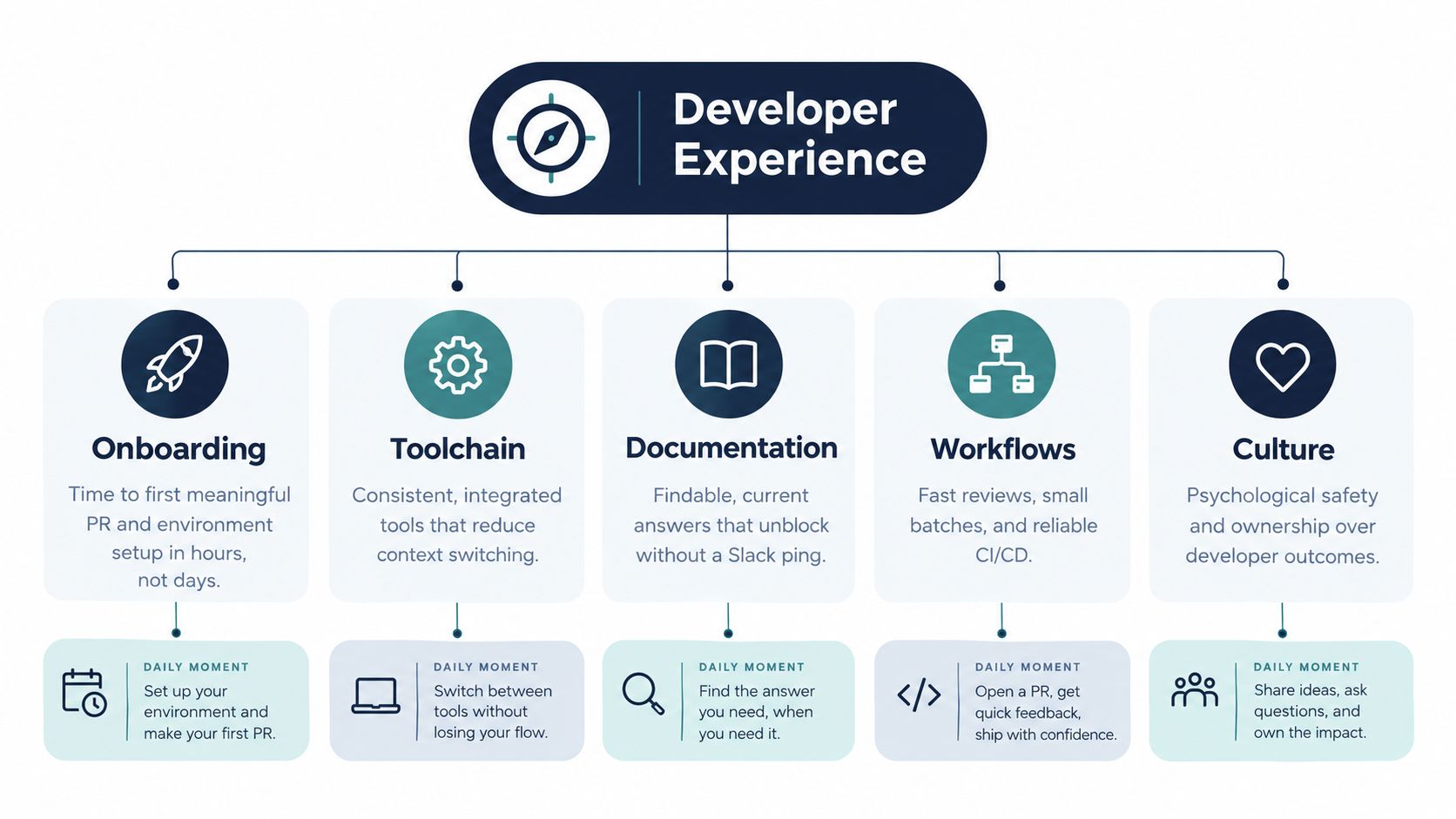
Onboarding
Onboarding should end with a meaningful first pull request, not merely access to repositories and chat channels. Give new engineers a documented path through local setup, architecture orientation, test execution, review, and deployment. Track time to first meaningful contribution and whether the developer needed repeated help from a particular person.
Environment setup is a design test. If it takes days, the organization has likely embedded undocumented assumptions in credentials, dependencies, scripts, or service access. A reproducible development environment reduces both onboarding friction and the support burden placed on senior engineers.
Toolchain
The toolchain spans build, test, deploy, and observe. Measure the cycle time and failure rate of each stage, not just whether a pipeline eventually succeeds. A fast build with unreliable tests still damages trust, while a stable pipeline that takes too long still interrupts flow.
Standardize the common path, but preserve escape hatches for legitimate exceptions. Platform teams should provide templates, reusable workflows, and clear ownership rather than forcing every product team into an opaque platform contract.
Documentation
Documentation must be findable, current, example-driven, and owned. A page without an owner becomes an archive. A page without examples becomes a glossary. A page hidden in a private channel becomes institutional memory that disappears when someone changes teams.
Use service READMEs, architecture decision records, runbooks, and troubleshooting guides. Link them from repositories and deployment interfaces, and review them when service-level changes make them inaccurate.
Workflows
Review policies, branching conventions, release authority, incident response, and on-call rotations shape developer experience directly. Set explicit review expectations, keep change batches small, and make the path to production obvious. In regulated environments, automated evidence collection should sit inside the workflow instead of creating a separate manual queue.
Culture
Culture determines whether developers report friction early or silently work around it. Psychological safety, blameless retrospectives, and protected time for platform improvements make problems visible before they become outages or attrition risks. Platform work needs explicit capacity and ownership, or product delivery will consume it indefinitely.
These components cascade into one another. Weak documentation lengthens onboarding. Poor onboarding increases support interruptions. Unclear ownership breaks the toolchain. Slow reviews damage flow, and a culture that discourages escalation leaves leadership with incomplete data.
Measuring Developer Experience With Metrics That Matter
A single DevEx score is attractive because it fits on an executive dashboard. It's also too blunt to guide engineering decisions. Use a stack that combines delivery outcomes, flow bottlenecks, developer perception, and feedback-loop performance.
Start with the four DORA metrics: deployment frequency, lead time for changes, change failure rate, and mean time to recovery. They remain the baseline for software delivery performance, and IBM's overview defines the metrics while tracing DORA to Google's DevOps Research and Assessments team.
Add stage-level flow signals. Break lead time into review wait, CI time, merge delay, and deployment wait. A team can have acceptable aggregate lead time while losing most of its capacity in one approval queue. Track work in progress, review age, and cycle time by stage to identify the queue that needs redesign.
Layer in developer perception through a quarterly pulse survey. Ask about focus time, confidence in making changes, documentation discoverability, build and test speed, and the effort required to get help. The SPACE framework is useful here because it considers satisfaction, performance, activity, communication, and efficiency rather than treating activity as output.
A practical starting stack
| Metric Family | Key Signals | Target Threshold | Collection Method |
|---|---|---|---|
| DORA | Deployment frequency, lead time for changes, change failure rate, MTTR | Establish a baseline, then improve without sacrificing reliability | Deployment and incident data |
| Flow | PR review wait, cycle time by stage, WIP, merge delay | Less than 24 hours average review wait is a useful operating target | Git provider and workflow telemetry |
| SPACE and sentiment | Satisfaction, cognitive load, communication friction, focus time | Quarterly pulse survey with consistent questions | Lightweight anonymous survey |
| Feedback loops | Local setup, build time, test time, CI feedback | Under 10 minutes for CI feedback; use tighter local targets where practical | Build, test, and environment telemetry |
| Documentation | Search success, unanswered questions, stale pages | Define an ownership and review policy, then monitor age and usage | Knowledge base analytics and service reviews |
One industry guide recommends tracking PR cycle time, self-reported focus time, quarterly satisfaction, and the components of lead time separately. Another metrics guide recommends keeping full local builds under five minutes, incremental builds under 30 seconds, CI builds under 10 minutes, unit tests under two minutes, and integration tests under 10 minutes. Treat those as practical engineering targets, not universal laws.
For a broader view of engineering performance, Bridge Global's developer productivity guide for teams provides useful context for connecting developer experience with throughput without reducing engineers to activity counts.
The Business Case and ROI of Investing in DevEx
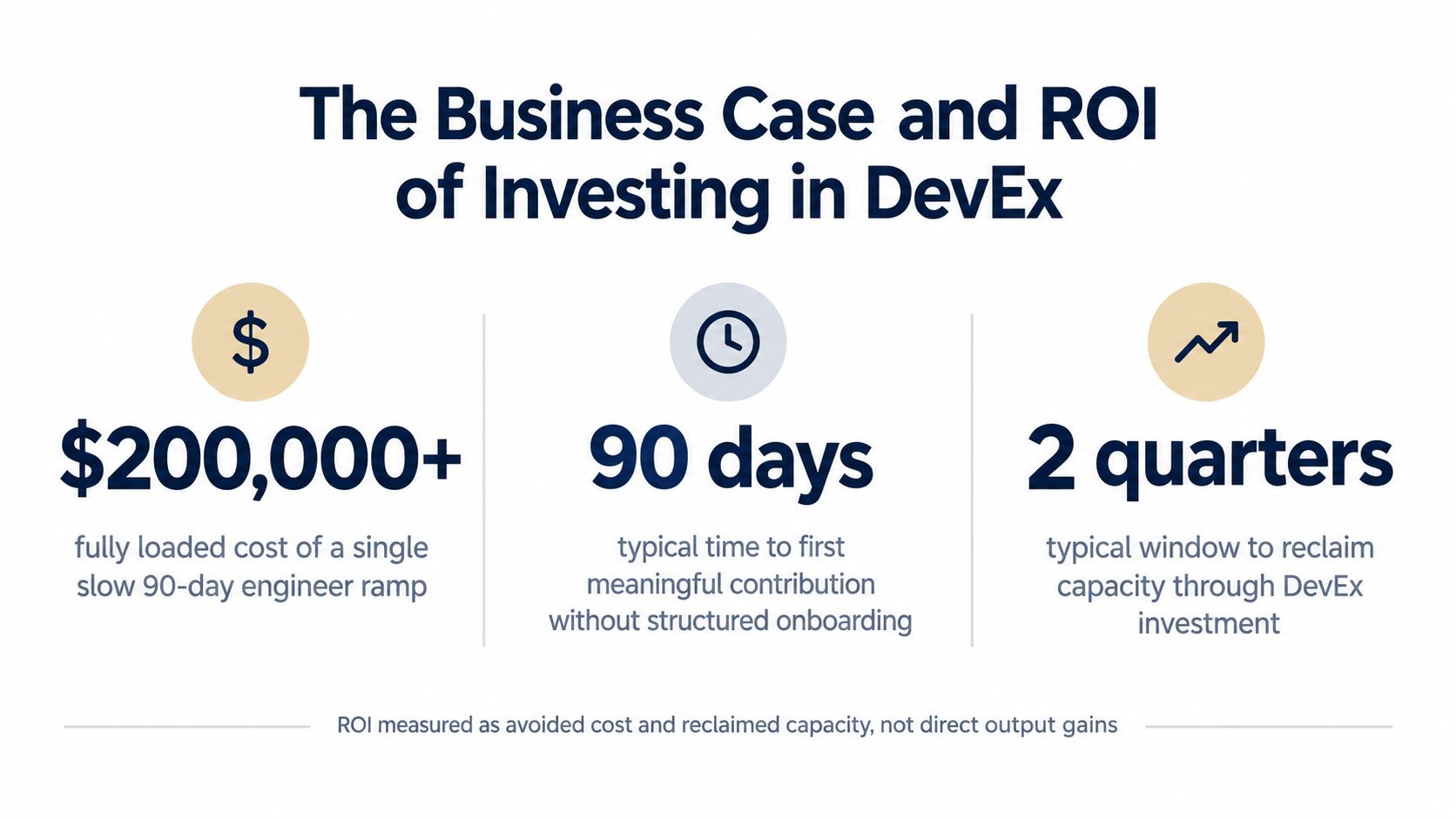
DevEx ROI is best measured as avoided cost and reclaimed capacity, not as a promise that every engineer will produce more code. The strongest business case connects a specific friction point to a measurable operational consequence: slower onboarding, longer review queues, delayed releases, more incidents, or avoidable attrition.
Atlassian and Wakefield surveyed more than 2,100 developers and managers worldwide and found that 97% of developers lose significant time to inefficiencies. Microsoft's study of more than 2,000 developers linked improved DevEx with job performance, creativity, learning, code quality, lower technical debt, retention, innovation, profitability, and goal attainment.
Calculate reclaimed capacity honestly
Use observed time loss rather than speculative productivity multipliers. If review data shows a recurring queue, calculate the engineering hours spent waiting and compare that with the effort required to change reviewer ownership, batch size, or approval rules. If onboarding interviews show repeated environment failures, measure support demand and time to first meaningful contribution before funding a platform change.
Avoid attributing every improvement to DevEx. Delivery performance also depends on product scope, architecture, staffing, incident load, and market conditions. A credible business case names the intervention, establishes a baseline, measures the affected workflow, and checks quality and reliability alongside speed.
Retention is an operating outcome
Developer experience affects whether engineers can do sustainable work. The 2024 Atlassian findings connect DevEx with retention, while the 2025 research shows that many developers believe leaders misunderstand their daily obstacles. That gap is a management risk because teams can't fix friction they don't accurately see.
Prioritize investments that remove recurring work without weakening control. A standardized environment, clear service ownership, integrated compliance checks, and a reliable review policy can return capacity across many projects. The business value comes from fewer repeated interruptions and more predictable delivery, not from asking engineers to work harder.
A Practical Implementation Roadmap for Engineering Leaders
A DevEx program needs a bounded rollout, visible ownership, and enough time to distinguish a real improvement from a temporary launch effect. Use the following four phases across roughly two quarters, adjusting scope to team size and risk.
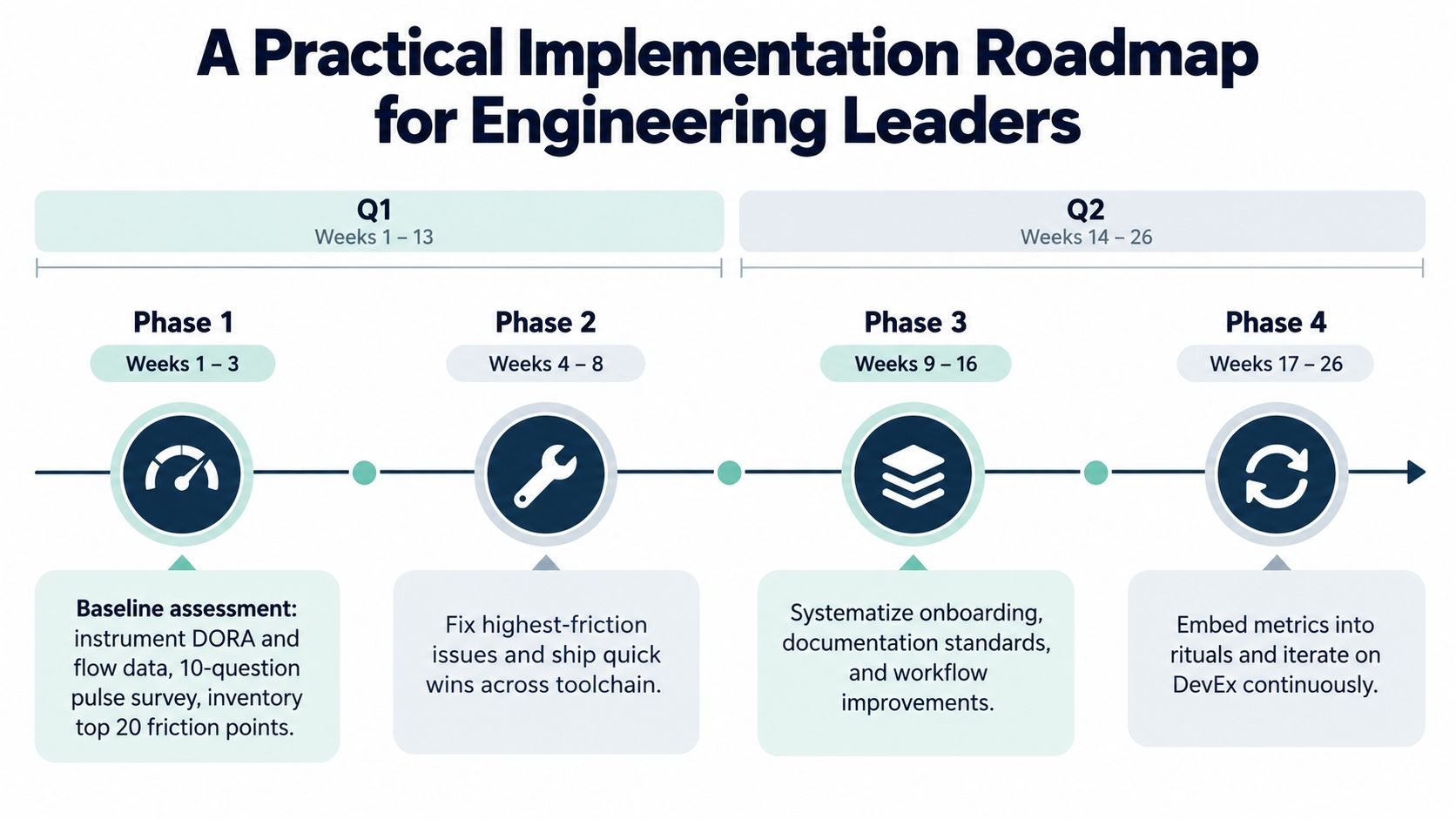
Phase one runs from weeks 1 to 3
Establish a baseline. Instrument DORA and stage-level flow data, run a 10-question pulse survey, and inventory the top 20 friction points by team. Don't ask developers to rank abstract satisfaction alone. Ask where they wait, what they search for, which workflow requires the most manual work, and what repeatedly interrupts focus.
Assign each friction point an owner, affected teams, evidence, and a proposed measure of success. This prevents the program from becoming a backlog of complaints without decision rights.
Phase two runs from weeks 4 to 8
Ship quick wins with a high signal-to-effort ratio. Standardize local environments, establish review expectations, and consolidate CI templates. Remove redundant approval steps where policy allows, and automate evidence collection where policy requires it.
For security-sensitive product work, involve a threat modeling team at DevArmor when you design the paved road. Threat modeling belongs close to architecture and workflow decisions, not as a late-stage obstacle discovered before release.
Phase three runs from weeks 9 to 16
Address structural causes. Build internal developer platform capabilities where repeated friction justifies them, create paved-road abstractions for common services, and refresh documentation alongside service ownership agreements. Tie documentation quality to operational responsibilities, not to a one-time content campaign.
In healthtech and finance, embed compliance hooks early. SOC 2, HIPAA, and PCI evidence collection should run through approved delivery paths so developers can satisfy governance without creating a separate manual process for every release.
Phase four runs from weeks 17 to 24
Institutionalize the program. Give a permanent team or named engineering leaders responsibility for DevEx, review the metrics quarterly, and include friction trends in engineering operating reviews. Publish what changed, what didn't, and which teams still experience the bottleneck.
AI belongs inside this roadmap, but only behind an evaluation harness. Test copilot rollout, spec-to-test generation, and documentation question-answering against accuracy, security, maintainability, and review effort before expanding access. Bridge Global's engineering productivity leaders guide offers related context for connecting productivity initiatives with leadership practice.
Where AI Improves Developer Experience and Where It Does Not
AI can improve developer experience when it removes repetitive work and preserves a trustworthy feedback loop. It can generate boilerplate, scaffold tests, summarize logs, draft migration scripts, and triage pull requests. Those uses reduce manual effort when developers can inspect the output quickly and the surrounding workflow records what happened.
AI creates new friction when teams confuse generation with verification. A model can invent an API that passes a type check, expose sensitive code through an unsafe prompt path, produce non-deterministic output that breaks golden-path tests, or create an audit trail that another engineer can't reproduce. In regulated environments, an apparently faster change can create more review and evidence work later.
Stack Overflow's 2025 survey covered nearly 50,000 developers across 177 countries. It found rapid AI adoption alongside declining trust linked to accuracy and reliability concerns, while community-based knowledge remained the most trusted way to solve problems.
| Area | Where AI Improves DevEx | Where AI Creates Friction |
|---|---|---|
| Code creation | Boilerplate, repetitive transformations, migration drafts | Incorrect APIs, hidden assumptions, insecure patterns |
| Testing | Test scaffolding, edge-case suggestions, specification drafts | Tests that verify implementation rather than behavior |
| Operations | Log summaries, incident search, runbook discovery | Unsupported conclusions and missing operational context |
| Documentation | Q&A over approved repositories and service content | Stale answers, unclear provenance, confidentiality risk |
| Governance | Evidence classification and checklist assistance | Unreproducible outputs, weak audit trails, unclear accountability |
Before rollout, require prompt logging where permitted, model versioning, human verification for production-impacting changes, and data residency controls appropriate to the workload. Evaluate accuracy on representative repositories, measure review effort, and define a rollback path. AI should shorten the path to a safe decision, not merely shorten the path to generated text.
For a broader treatment of the trade-offs, Bridge Global’s article on AI copilots beyond coding examines how assistants affect the wider development lifecycle.
Frequently Asked Questions About Developer Experience
Who should own developer experience?
A platform engineering lead can own the technical foundations, while a staff engineer can coordinate improvements across teams. A dedicated team makes sense when friction spans many products and requires continuous measurement. Whatever the structure, give the owner authority, access to workflow data, and an obligation to publish outcomes.
What should teams fix when budgets are flat?
Choose the bottleneck with the clearest evidence and broadest reach. Review queues, local environment failures, unclear service ownership, and missing documentation often cost more than a new license. Fund small workflow changes before funding a large platform replacement.
What is the minimum measurement stack for a team under 50 engineers?
Track the four DORA metrics, PR review wait, CI feedback time, and one quarterly pulse survey. Add a short qualitative review so developers can explain why a metric moved. This stack is enough to identify whether the constraint is delivery, coordination, feedback, or cognitive load.
How can leaders protect DevEx work during layoffs or a reorganization?
Tie each initiative to an operating cost or risk that leadership already understands. Show the queue, the repeated support burden, the incident exposure, or the delayed release decision. Keep ownership explicit, because unfunded improvement work disappears when responsibilities become ambiguous.
What should leaders do when they need quick ROI evidence?
Run a 30-day starter plan. Pick three feedback-loop metrics, conduct one developer pain-point survey, and ship one targeted workflow fix. Measure the affected path before and after the change, then decide whether the evidence justifies a broader investment.
Bridge Global can help product and engineering leaders assess workflow friction, design AI-enabled software delivery, and build custom systems for regulated and complex environments. Visit Bridge Global to discuss a practical DevEx improvement plan grounded in your teams, delivery data, and governance needs.

About Upendra Jith
Upendrajith completed his Master's in English and has been a commercial content developer for the past three years. He's more inclined to develop content with a 'street-smart' delivery on topics such as technology, media, or anything he can get his hands on. He has a fixation on lyrics, dark poetry, media, technology, and flow arts.
View all posts by Upendra Jith →