



A Guide To Compliance-First Software Development
Think of compliance-first software development as weaving regulatory and security rules into the very fabric of your product, right from the initial sketch on a whiteboard to the final push into production. It’s a complete flip of the old model. Instead of treating compliance like a final, often painful, checkpoint, you make it a core part of your strategy and how your teams build things.
Why Compliance-First Is Your New Competitive Edge
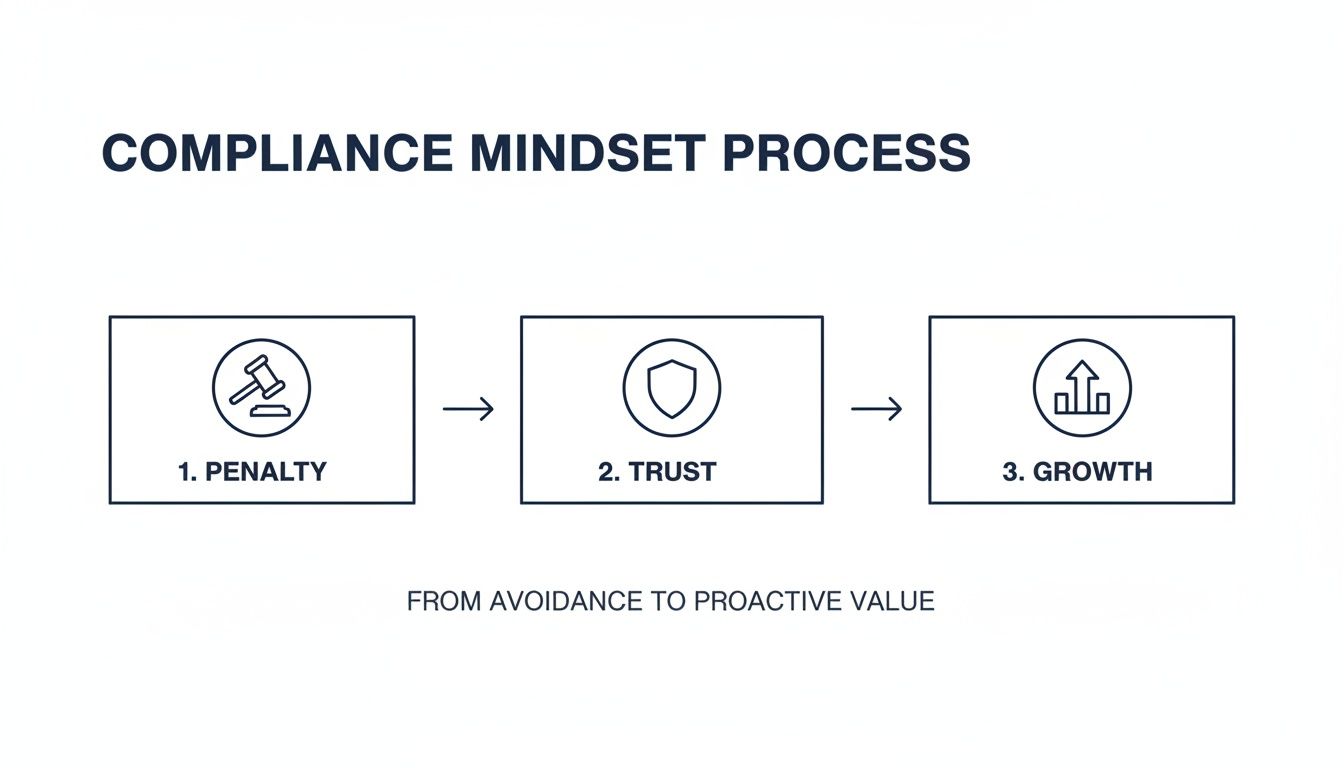
In the not-so-distant past, compliance was the dreaded final boss battle. Development teams would race to the finish line, only to be stopped by a mountain of paperwork and last-minute fixes. This approach was slow, expensive, and created a ton of friction. That way of thinking is a relic. Today, a compliance-first strategy isn’t just about avoiding trouble; it’s a powerful tool for building trust and driving real growth.
Let’s be blunt: tacking compliance on at the end is a recipe for disaster. The financial and brand risks are just too massive to ignore. For example, over a recent 12-month span, banks were slammed with an incredible $19.3 billion in fines for compliance failures. And the pressure is only mounting. In the first half of just one year, financial institutions paid out $1.23 billion in penalties, more than five times the amount from the previous year. You can dig deeper into these compliance trends to get a sense of the scale.
The table below breaks down the fundamental shift from the old, reactive way of doing things to a modern, proactive strategy.
The Shift From Reactive To Proactive Compliance
| Aspect | Reactive Compliance (The Old Way) | Compliance-First (The Modern Strategy) |
|---|---|---|
| Timing | Addressed at the end of the development cycle, just before release. | Integrated from the very beginning (ideation and design). |
| Mindset | A bureaucratic hurdle; a “cost of doing business.” | A strategic advantage and a core product feature. |
| Team Involvement | Primarily the responsibility of legal, security, or a separate compliance team. | A shared responsibility across engineering, product, and security. |
| Activities | Last-minute audits, manual checks, and stressful pre-launch fixes. | Automated scanning, threat modeling, and continuous monitoring. |
| Business Impact | Delays releases, increases rework costs, and introduces significant risk. | Accelerates market entry, builds customer trust, and reduces overall costs. |
This isn’t just a minor tweak in process; it’s a complete change in culture and philosophy that pays dividends across the board.
From Cost Center to Business Enabler
When you adopt a compliance-first mindset, you fundamentally change the conversation. It stops being a defensive, budget-draining activity and becomes a proactive strategy for building superior, more secure products. As a trusted AI solutions partner, we’ve seen this shift deliver real, measurable value time and again.
Here’s how embedding compliance from day one gives you a serious leg up:
- Faster Access to Big Markets: When your product is built to meet strict standards from the get-go, you’re ready for highly regulated sectors like finance, healthcare, and government. This unlocks valuable revenue streams that are off-limits to competitors who didn’t plan ahead.
- Builds Rock-Solid Customer Trust: We live in an age of near-constant data breach headlines. Proving you take security and privacy seriously is a massive differentiator that helps you win and keep customers.
- Slashes Rework and Unexpected Costs: Finding a security flaw in the design phase might cost a few hours of an engineer’s time. Finding that same flaw after launch can cost millions in fines, fixes, and lost reputation. It’s a no-brainer.
- Gives You a Competitive Moat: When enterprise customers are vetting vendors, a solid compliance posture is often a deal-breaker. In fact, for 35% of enterprises with over $1 billion in revenue, compliance is a top reason they choose one partner over another.
A proactive compliance strategy doesn’t slow you down, it gives you the solid foundation to build faster and safer. When you invest in custom software development this way, you’re not just shipping features; you’re building market credibility and resilience that lasts.
Weaving Compliance into Your Software Development Lifecycle
A genuine compliance-first approach isn’t about passing an audit at the finish line. It’s about building governance and security into the very fabric of your development process, making it a daily habit for your team. This mindset transforms compliance from a frustrating gatekeeper into a helpful guardrail, ensuring every step of the software development lifecycle (SDLC) contributes to a product people can trust.
Instead of a last-minute scramble, this method integrates compliance checks from the earliest design mockups all the way through long-term maintenance. When you “shift left” and address compliance early, you’re tackling potential issues at their source, where they are exponentially cheaper and faster to fix. It’s a non-negotiable strategy for any modern software project, especially if you’re handling sensitive data.
The whole point is to move compliance from being a cost center to a value driver. When you stop seeing it as just avoiding penalties, you start building real customer trust, which is the ultimate engine for growth.
Design Phase: Privacy by Design
The journey starts long before anyone writes a single line of code. Your design and architecture phase is where you lay the foundation for a secure application. This is where the principle of Privacy by Design is critical—it’s about making data protection the default, not an afterthought.
Your team should be asking some tough questions right from the get-go:
- Data Minimization: Are we collecting only the absolute minimum data required for this feature to work? Seriously, do we really need that?
- Purpose Limitation: Is it crystal clear why we’re collecting this data? And have we put technical controls in place to prevent it from being used for anything else?
- Access Controls: Who actually needs access to this information? Architecting with Role-Based Access Control (RBAC) from day one is the only way to go.
This is also the time to map specific features to regulatory controls. For example, digging into the specific GDPR compliance requirements shows just how important it is to bake data protection measures into the entire system. Likewise, as we cover in our guide to HIPAA compliant software development, any feature handling patient data must be designed with strict technical safeguards in mind from the very beginning.
Development Phase: Secure Coding Practices
Once developers start building, the focus shifts to writing clean, secure, and maintainable code. A compliance-first culture empowers developers to be the first line of defense. It’s less about memorizing every vulnerability and more about fostering a security-conscious mindset.
A few key practices make all the difference here:
- Use Secure Frameworks: Lean on modern, well-vetted frameworks with built-in protections against common threats like SQL injection and Cross-Site Scripting (XSS). Don’t reinvent the wheel.
- Mandate Peer Code Reviews: Make it a rule: all code gets reviewed by at least one other developer before it’s merged. You’d be amazed at how many logical errors and security blind spots this simple step catches.
- Manage Your Secrets: Never, ever hardcode API keys, passwords, or other credentials in your source code. Use a dedicated secrets management tool like HashiCorp Vault or AWS Secrets Manager.
Pro Tip: Create and enforce a secure coding standard for your organization. When you document best practices for input validation, error handling, and authentication, you ensure consistency and take the guesswork out of it for your developers.
Testing Phase: Automated Security in Your CI/CD
The testing phase is where compliance-first principles really get a chance to shine through automation. Manual testing has its place, but it simply can’t keep up with the pace of modern development. The key is to integrate automated security testing directly into your Continuous Integration/Continuous Deployment (CI/CD) pipeline.
This creates an automated “compliance gate” that stops insecure code from ever making it to production. Essential tools for this stage include:
- Static Application Security Testing (SAST): These tools are like a spell-checker for security flaws, scanning your source code for vulnerabilities before it’s even compiled.
- Software Composition Analysis (SCA): Modern apps are built with open-source libraries. SCA tools scan your dependencies for known vulnerabilities: a crucial step since over 75% of codebases contain open-source components.
- Dynamic Application Security Testing (DAST): DAST tools act like an ethical hacker, testing your running application from the outside to find vulnerabilities that only show up at runtime.
By building these checks right into the pipeline, developers get instant feedback. They can fix issues immediately while the code is still fresh in their minds, which is far more effective than getting a long report from an external team weeks later.
Deployment and Maintenance: Continuous Vigilance
The work doesn’t stop once the application is live. Deployment and maintenance require constant monitoring and a solid incident response plan. Your infrastructure needs to be just as secure as your code.
Here’s what that looks like in practice:
- Infrastructure as Code (IaC): Use tools like Terraform or CloudFormation to define your infrastructure in code. This makes your security configurations repeatable, auditable, and easy to review.
- Continuous Monitoring: Set up logging and monitoring tools to spot unusual activity in real-time. Alerts should be configured to ping the right teams the moment a potential security event is detected.
- Regular Patching: Don’t let this slip. Establish a consistent schedule for updating servers, containers, and all dependencies to protect against newly discovered vulnerabilities.
Ultimately, embedding compliance across the SDLC creates a powerful, reinforcing cycle. Secure design leads to secure code, which is verified by automated testing and protected by a secure infrastructure. This holistic approach turns compliance into an accelerator for quality, not a roadblock to innovation.
A Practical Framework For Mapping Risks To Regulations
Let’s get practical. Connecting abstract legal text from regulations to the actual features your team is building is where the rubber meets the road—and where most compliance initiatives stumble. A simple user login screen, a data export button, or a patient intake form aren’t just features; they’re collections of potential compliance risks.
The whole point of a compliance-first software development mindset is to translate those high-level rules into concrete engineering requirements. This creates a shared, unambiguous language between your developers, legal counsel, and security teams, moving everyone out of their silos.
This isn’t just a box-ticking exercise for the legal department anymore. The C-suite is watching. A staggering 77% of global leaders now view compliance as essential for hitting business goals. But there’s a disconnect, as 69% of organizations admit they’re drowning in overly complex regulations. The priority shift is dramatic: 21% of executives recently named regulatory compliance their top concern, a massive leap from just 2% the year before. You can dive deeper into these compliance statistics and their business impact.
Identifying And Categorizing Software Risks
Before you can map anything, you have to know what you’re looking for. Most software risks boil down to how you handle data. I find it helpful to think about the data’s journey in three distinct states.
- Data at Rest: This is all about storage. Is the database encrypted? What about the backups? An unencrypted S3 bucket full of user data is a classic, high-severity risk that’s painfully easy to avoid.
- Data in Transit: This covers data on the move. When your mobile app talks to your backend API, is that traffic locked down with modern TLS? A weak or missing encryption layer here is like sending sensitive postcards through the mail for anyone to read.
- Data in Use (Access Control): This is about who gets to see what, and when. Does a customer support agent really need to see a user’s full credit card number? Or just the last four digits? Over-privileged access is one of the most common causes of both accidental and malicious data breaches.
Framing risks this way gives your team a simple but powerful mental model. Every new feature can be quickly assessed through this lens, sparking the right questions about storage, transmission, and access from day one.
Creating A Risk-To-Control Matrix
With your risks identified, the next move is to build a risk-to-control matrix. Think of this as the Rosetta Stone for your compliance program—a living document that translates risk into action. It directly connects a specific software risk to the exact rule or control it touches across every regulation you care about.
This matrix ensures that when a developer is building a feature, they aren’t just thinking about how it should work. They’re actively thinking about the specific HIPAA, GDPR, or SOC 2 controls that apply to their code. For companies pursuing certifications, this level of detail is a must-have. As we’ve covered before, truly understanding the SOC 2 compliance requirements is fundamental to proving your system’s security and reliability.
This table is a great starting point for mapping common software risks to major regulations. It provides a clear line of sight from a technical weakness to a specific compliance failure.
Risk Mapping Across Major Compliance Frameworks
| Software Risk | HIPAA Control Area | GDPR Principle | PCI DSS Requirement |
|---|---|---|---|
| Insecure Data Storage | § 164.312(a)(2)(iv) Encryption and Decryption | Article 32 Security of Processing | Requirement 3 Protect Stored Cardholder Data |
| Insufficient Access Control | § 164.312(a)(1) Access Control | Article 5(1)(f) Integrity and Confidentiality | Requirement 7 Restrict Access by Business Need to Know |
| Inadequate Audit Logging | § 164.312(b) Audit Controls | Article 30 Records of Processing Activities | Requirement 10 Track and Monitor All Access |
See how this approach demystifies compliance? The conversation shifts from a vague “we need to be HIPAA compliant” to a specific, actionable task like, “this new API endpoint must implement strong encryption at rest to satisfy HIPAA Security Rule § 164.312(a)(2)(iv).” That’s something an engineer can build, and a QA analyst can test.
By translating regulatory legalese into engineering tasks, you empower your developers to become the first line of defense. The matrix becomes a living document that evolves with your product and the regulatory environment.
This practical framework is at the heart of the AI for your business solutions we build. By mapping risks from the very start, we ensure the platforms we deliver meet the highest industry standards for security and governance, a commitment you can see in our client cases.
Using AI And Automation To Power Modern Compliance
Let’s be honest: manual compliance checks are a dead end. In the world of fast-paced development, they’re too slow, too inconsistent, and frankly, too easy to get wrong. This is exactly why AI and automation are stepping in, shifting compliance from a painful, periodic audit into a constant, real-time part of your workflow.
Instead of dreading a quarterly review, modern teams are using intelligent tools that act as a second pair of eyes—ones that never get tired. This proactive approach isn’t just a nice-to-have anymore. Almost two-thirds of organizations now see AI as critical for their compliance efforts, with 65% of compliance teams directly involved in guiding how it’s used. The market for this technology, often called RegTech, is projected to hit $70.64 billion by 2030. Yet, a surprising 32% of companies haven’t even started experimenting with AI for these tasks, leaving a huge opening for those who get it right. You can find more on these AI-driven compliance statistics if you’re curious.

Shifting Left With Policy As Code
One of the most practical ways to bring automation into the fold is with Policy-as-Code (PaC). This is a game-changer. It means you define your compliance and security rules in simple, human-readable code. That code gets checked into source control, reviewed, and automatically enforced.
Think about it. A rule like “all S3 buckets must be encrypted” no longer lives in a dusty Word document. It’s a policy file that your CI/CD pipeline checks on every single commit. If a developer tries to deploy something that breaks the rule, the build fails instantly, and they get immediate, actionable feedback.
The benefits here are massive:
- Total Consistency: The same rules apply to every single deployment. No more human error or the classic “it worked on my machine” defense.
- Blazing Speed: Checks that used to take days now happen in seconds. Developers can stay in their flow without compromising on security.
- Clear Auditability: Your entire compliance posture is documented as code, giving you an ironclad, unchangeable audit trail.
AI-Powered Code Scanning And Threat Detection
AI is pushing automated security far beyond what we thought was possible. Old-school static analysis tools are decent at spotting known vulnerabilities, but AI-powered systems are on another level. They can actually understand the context of your code, pinpointing complex logical flaws and even predicting potential zero-day threats by recognizing patterns learned from analyzing billions of lines of code.
These intelligent scanners are a cornerstone of modern AI development services, where security is baked in from day one. They plug right into a developer’s environment, offering real-time tips and fixes directly in their IDE. It’s this immediate feedback loop that really builds a culture of compliance-first software development.
It doesn’t stop at the code, either. AI-driven monitoring tools constantly watch logs and network traffic for anything that looks out of place. Instead of just reacting to predefined alert rules, these systems learn what “normal” looks like for your application and flag any strange deviations. That’s how you catch the sophisticated threats that would otherwise slip right through.
By embedding AI and automation, compliance stops being a disruptive, painful event. It becomes an ambient, always-on part of the development process—a low-friction guardrail that helps teams build safer products, faster.
The Rise Of Responsible AI Governance
As we lean more on AI, a new challenge has emerged: making sure our AI systems themselves are compliant and ethical. This isn’t optional anymore. You absolutely need a framework for responsible AI. As we’ve detailed in our guide to building a responsible AI framework, this means having clear governance around how you use data, how your models make decisions, and whether they’re fair.
Fortunately, automated tools can help here, too, by monitoring models for bias or performance drift. They ensure the AI operates within the ethical guardrails you’ve set. As an AI solutions partner, this focus on intelligent, built-in controls is central to how we help companies innovate safely and responsibly.
Building a Culture of Compliance with Clear Roles and KPIs
Let’s be honest: automated tools are fantastic, but they can’t create a culture of compliance on their own. Technology is only one piece of the puzzle. To truly build a compliance-first software development practice, you need a fundamental shift where security and governance become a shared responsibility, owned by everyone from the CTO down to the newest junior developer.
This is about moving away from the old, siloed mindset where compliance was someone else’s problem. When it’s baked into everyone’s daily work, it becomes a proactive, collective effort. Without that cultural foundation, even the most sophisticated tools will fall short. It’s all about empowering your teams to build securely from the very first line of code.
Defining Roles for Shared Ownership
The first step toward building this culture is crystal-clear communication. Ambiguity is the enemy of good governance. Everyone on your team needs to know exactly what their role is and how their daily actions directly affect the company’s security posture.
Here’s how responsibilities typically break down in a well-oiled machine:
- CTO / VP of Engineering: This leader has to champion the vision. They set the tone from the top, secure the budget for tools and training, and ultimately hold the entire engineering org accountable for hitting security targets.
- Security & Compliance Officers: Think of these folks as your in-house experts. They’re the ones who translate dense regulations into clear, actionable requirements for the engineering team, manage the risk-control matrix, and take the lead when an incident occurs.
- Product Managers: They are crucial for making compliance a core feature, not an afterthought. This means weaving security and privacy acceptance criteria right into user stories and ensuring these requirements are prioritized in the product backlog.
- Developers & Engineers: As your first line of defense, developers are on the hook for writing secure code. This also means taking peer reviews seriously and promptly fixing vulnerabilities flagged by automated scans.
- QA & Test Engineers: This team is the final checkpoint. They need to design and execute tests that specifically hunt for vulnerabilities, verifying that security controls work as intended and that all security gates are properly integrated into the pipeline. Partnering with quality software testing services can be a game-changer here.
Establishing a Strong Governance Framework
A solid governance framework provides the structure—the rules of the road—that makes your compliance culture stick. It creates consistency and clarifies the process for making decisions and handling exceptions. This isn’t about adding red tape; it’s about making security predictable and reliable.
This framework should include regular risk assessments, ongoing training, and a well-defined process for managing exceptions. The need for this is more urgent than ever. As attack surfaces expand with cloud and IoT, a staggering 78% of companies expect compliance demands to get tougher every year. Yet, there’s a major skills gap: 58% of engineers are now tasked with security work without any formal training, losing 10-20 hours a week to process friction.
A robust governance framework turns abstract compliance goals into a daily, operational reality. It ensures that security isn’t just a document. It’s an active, ongoing practice embedded in your team’s workflow.
Tracking Progress with Actionable KPIs
You can’t improve what you don’t measure. Key Performance Indicators (KPIs) are what turn your compliance efforts from a vague goal into a data-driven, accountable practice. They give you tangible proof of what’s working and shine a light on where you need to improve.
Good compliance KPIs are specific, measurable, and tied directly to your development process. Here are a few I always recommend starting with:
- Time to Remediate Critical Vulnerabilities: How fast is your team jumping on high-priority security flaws? This is a direct measure of your responsiveness.
- Percentage of Builds Passing Automated Compliance Gates: This tells you how often builds succeed without tripping any security wires in your CI/CD pipeline. A rising percentage is a great sign.
- Mean Time to Detect (MTTD) Security Incidents: When a breach or violation does happen, how quickly do your systems catch it? Shorter is always better.
- Security Training Completion Rate: A simple but powerful metric. Are your team members actually completing the required security and compliance training?
By tracking these numbers, you create a powerful feedback loop that drives accountability and continuous improvement. It makes your compliance program visible, effective, and part of the daily conversation. As a leading AI solutions partner, we’ve seen firsthand how this data-driven approach is essential for building truly resilient systems.
Frequently Asked Questions (FAQs)
Making the switch to a compliance-first mindset naturally brings up a lot of questions. Let’s walk through some of the most common ones I hear from teams who are just getting started or trying to refine their process.
Where Do We Even Begin with a Compliance-First Model?
It all starts with a change in perspective, usually driven from the top. Leadership has to champion the idea that compliance isn’t just a cost center or a box to check, it’s a genuine strategic advantage.
Practically speaking, your first move is a comprehensive risk assessment. You can’t protect what you don’t understand. You need to know exactly which regulations apply to you, map out how data moves through your systems from the moment it’s created to when it’s deleted, and then take a hard, honest look at your current development practices against those rules. This initial audit gives you a baseline and shows you exactly where the biggest fires are.
Won’t This Just Slow Everything Down?
This is probably the biggest myth out there. The honest answer is that yes, there’s an upfront investment of time and resources to get the right processes and tools in place. But a mature compliance-first software development approach actually makes you faster in the long run.
Think about it: by catching compliance and security problems early in the process – the whole “shift left” idea -you’re fixing them when it’s cheapest and easiest. This prevents those all-hands-on-deck emergencies right before a release and the massive technical debt that comes from post-launch fixes. The result is a more predictable, reliable, and ultimately faster delivery cadence.
Building it right the first time is always faster than scrambling to fix it later. That’s a core philosophy we bring to every custom software development project.
How Does This Fit with Agile or DevOps?
It fits perfectly. In fact, a compliance-first approach and a modern DevOps culture are two sides of the same coin. The secret is treating compliance just like you treat your application code. You codify your policies and automate them.
Instead of waiting weeks for a manual review that grinds everything to a halt, you define your security and compliance rules in code. That code gets versioned, tested, and automatically enforced every single time someone commits a change.
This means integrating tools for static analysis (SAST), dependency scanning, and infrastructure security right into the CI/CD pipeline. Developers get instant feedback in the tools they already use, making compliance a continuous part of their daily workflow, not a dreaded gate at the end of the line.
What are the “Must-Have” Tools for This?
Your toolchain needs to give you visibility and control across your entire software supply chain. While the specific stack will depend on your needs, a solid foundation always includes a few key categories:
- Software Composition Analysis (SCA): You absolutely need to know what’s in the open-source libraries you’re using. These tools find and help you manage those third-party risks.
- Static Application Security Testing (SAST): This is for scanning your own code for security bugs before you even compile it. It’s your first line of defense.
- Dynamic Application Security Testing (DAST): DAST tools test your application while it’s running, catching vulnerabilities that are impossible to find in static code.
- Secrets Management Platforms: Hardcoding credentials is a huge no-go. You need a centralized, secure way to manage API keys, database passwords, and other secrets.
- Infrastructure-as-Code (IaC) Scanners: These tools check your cloud configuration templates (like Terraform or CloudFormation) to make sure you aren’t deploying insecure infrastructure.
At Bridge Global, we’ve built our reputation on the belief that secure, compliant software is the bedrock of real innovation. As a dedicated AI solutions partner, we weave governance and security into the fabric of development from day one, helping our clients build products their customers can truly trust. Reach out to us to get help to build your compliance-first software or digital tools.

About Preethi Saro Philip
Preethi Saro Philip is a Post Graduate Research Degree holder in Economics with more than 10 years of experience in writing, editing, research and teaching. She has an intense passion for content crafting and calls herself a ‘wordsmith’. She enjoys writing on wide-ranging topics including business, technology, health & lifestyle, education, environment etc.
View all posts by Preethi Saro Philip →