



Cloud Migration Consulting Services Explained
Cloud migration consulting services assess your estate, select a strategy for each component, build the landing zone, and move workloads in controlled waves. They should leave your team with a cost model and an operating model it can run after handover.
What if the best outcome for a critical workload is a documented decision to keep it where it is? A useful engagement answers that question before anyone starts copying virtual machines.
What Cloud Migration Consulting Services Cover
A consultant's scope should extend from portfolio assessment to operational ownership. Moving infrastructure without resolving dependencies or assigning incident ownership leaves engineering with a different hosting bill and many of the same problems.
In Flexera's 2024 State of the Cloud survey, 89% of organizations had a multi-cloud strategy, and 53% outsourced at least some public-cloud work. Buyers therefore need consulting that accounts for the environment around an application as carefully as the application itself.
A complete scope includes the following work.
-
Assessment inventories applications, databases, integrations, licences, business owners, and current operating costs.
-
Strategy assigns migration patterns to components and sequences dependencies around business constraints.
-
Landing-zone engineering establishes accounts, identity boundaries, network segmentation, logging, backup, and policy controls.
-
Migration execution produces transfer procedures, validation evidence, cutover instructions, and executable rollback.
-
Optimization and handover establish rightsizing, cost accountability, incident response, and operational documentation.
The client still needs an accountable technical sponsor. Consultants can prepare decisions, but product owners must accept disruption windows and security leaders must approve exceptions.
Practical rule: The statement of work should name the artifacts your engineers will own when the engagement ends.
When evaluating cloud services, distinguish advisory work from implementation and ongoing operations.
Healthcare buyers also need clinical and integration-specific planning. As we explored in our guides to healthcare cloud migration services and the healthcare cloud migration playbook, those requirements deserve dedicated treatment rather than a generic infrastructure checklist.
Seven Migration Strategies and When Each Fits
| Strategy | What changes | Use it when | Main risk |
|---|---|---|---|
| Retire | The application is removed. | No users remain, or another system covers the job. | A hidden dependency still calls it. |
| Retain | The component stays on current infrastructure for a defined period. | Licence, latency, hardware, or regulatory constraints block a sound move. | The exception becomes permanent and drifts. |
| Rehost | The same architecture runs on cloud virtual machines. | The application is stable and speed of exit matters more than redesign. | Run cost rises with little operational gain. |
| Relocate | Virtual machines move at the hypervisor level, such as VMware to a provider VMware service. | A data-centre exit is required and rewriting is out of scope. | The estate remains tied to that hypervisor model. |
| Replatform | Limited changes introduce a managed database or operating-system upgrade. | Less operational toil is valuable and the core design can stay. | The component becomes partly dependent on a managed service. |
| Refactor | The system is redesigned for cloud-native runtimes and deployment. | Scaling, change frequency, or reliability targets require architectural changes. | Engineering effort and regression risk increase. |
| Repurchase | A SaaS product replaces the existing application. | An available product matches the business process. | Data migration coincides with process change for users. |
Apply each row to a component, rather than the product name. AWS Prescriptive Guidance recommends establishing portfolio baselines and allocating migration strategies to application components.
Consider an insurance policy administration system. You might rehost its stable administration interface, replatform its database onto a managed service, and refactor a stateless rating service. Meanwhile, retain a tightly coupled mainframe core until its interface contract is ready, and retire a report job whose users have moved elsewhere.
That example produces separate engineering backlogs and acceptance criteria. The database needs compatibility and restore testing; the rating service needs behavioral regression tests; the retained core needs a supported connection and a review trigger.
A platform example should inform discovery, rather than become the default pattern for unrelated workloads.
Select the strategy against business value, technical constraints, risk appetite, and the team's ability to operate the result. A proposal that labels every component rehost without documenting alternatives hasn't demonstrated a meaningful assessment.
Phases, Deliverables, and What Drives Time
Migration is a portfolio programme with acceptance gates. A 2024 CDW survey summarized by BizTech, covering nearly 1,000 technology leaders, found that approximately 45% of organizations had moved at least half their applications to public clouds.
The remaining estate can contain large databases and tightly coupled legacy systems. Plan around their constraints rather than treating every migration wave as interchangeable.
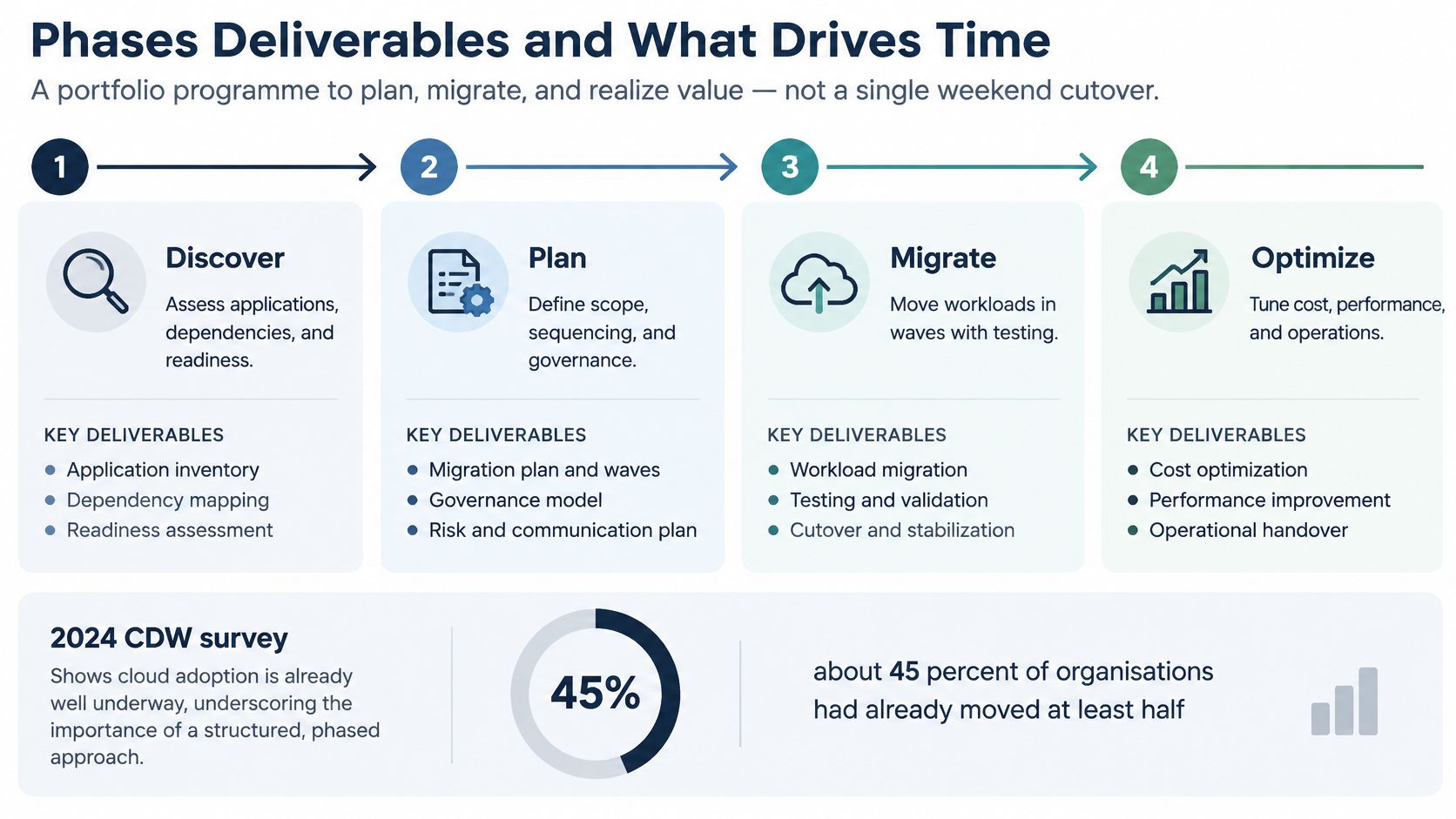
Deliverables at each acceptance gate
-
Discovery and dependency mapping produce an application and data inventory with owners, interfaces, and utilization evidence.
-
Strategy and wave planning produce a component strategy register and sequencing plan, including retained components.
-
Landing-zone implementation produces the target architecture and deployed controls. Pipeline and observability work belongs here, supported by DevOps services.
-
The pilot wave produces a cutover runbook, recovery-point and recovery-time objectives, and tested rollback evidence.
-
Subsequent waves produce repeatable migration records and acceptance evidence. Independent software quality assurance helps separate successful deployment from correct business behavior.
-
Hypercare and handover produce operational runbooks, an operating budget, and explicit service ownership.
Before the pilot, baseline incident counts by severity, recovery time, change failure rate, deployment frequency, unit cost, and utilization. Repeat those measurements after stabilization using equivalent definitions.
What changes the schedule
Data volume, integration complexity, licence portability, and available cutover windows drive elapsed time. Refactoring adds product-engineering work; regulated workloads add evidence preparation and approval dependencies.
Require an indicative schedule tied to assumptions, then update it after discovery. A deadline without an agreed dependency map is a procurement target rather than an engineering forecast.
Use the cloud enablement checklist to prepare the target environment. Where physical infrastructure retirement is also involved, Beyond Surplus's data center migration planning tips provide a separate planning reference for that workstream.
AWS Azure Google Cloud and EU Residency
| Option | Often fits | Constraint to test | Residency question |
|---|---|---|---|
| AWS | A wide service catalogue and large tool market. | Service sprawl and egress charges. | Which EU region is used, who operates the control plane, and where are keys held? |
| Azure | Microsoft identity, Windows, and Microsoft 365 estates. | Licence mobility and hybrid-design complexity. | How do the EU Data Boundary and chosen region pair apply to each service? |
| Google Cloud | Analytics-heavy or container-heavy estates. | A smaller enterprise footprint in some industries. | Which EU region and key-control options does the contract include? |
| Sovereign or local partner cloud | Contracts requiring an EU-operated control plane. | Fewer services and a thinner skills market. | Who runs operations, and where can support staff access metadata? |
Treat these as shortlisting criteria, rather than a provider ranking. Validate service availability and operational fit against your actual workloads.
All three hyperscalers offer EU regions, but storage location doesn't answer every sovereignty question. Establish who administers the control plane, who can access support metadata, and which entity controls encryption keys. Read the current terms for every service in scope because umbrella commitments may have service-specific qualifications.
According to IDC's Q3 2024 Cloud Pulse Survey, 88% of cloud buyers were deploying or operating hybrid cloud, while 79% were already using multiple providers. That makes connectivity and cross-environment operations relevant even when the initial migration targets a single provider.
Test portability before committing
Inventory dependencies on managed databases, proprietary queues, identity policies, observability agents, network constructs, and key services. For each critical workload, require a tested export path and an automated infrastructure rebuild procedure.
A second provider account isn't an exit strategy. Your team needs a usable data export and a demonstrated way to rebuild the service.
Avoid making every component provider-neutral at any cost. A managed service can justify its dependency when the operating benefit exceeds the switching burden and the exit procedure is credible.
The multi-cloud strategy guide provides additional context for deciding where multiple environments are worth the operational overhead.
Cost Control and the Case to Stay Put
Some workloads should stay where they are for now. Stable, highly utilized systems can be poor migration candidates when licensing, latency, or integration costs outweigh the expected operating benefit.
The 2026 Flexera State of the Cloud report identifies assessing on-premises versus cloud costs as a major migration challenge for 43% of organizations, while selecting the right cloud instance affects 40%.
Build a workload-level business case with explicit assumptions.
-
Current operating cost should include infrastructure, licences, staffing, backup, and facilities allocations.
-
Target operating cost should include resilience, data transfer, observability, support, and ongoing engineering.
-
Migration effort should include validation, temporary parallel operation, remediation, and eventual decommissioning.
-
Sensitivity analysis should test higher egress, longer parallel operation, and greater refactoring effort.
Mark forecast amounts as indicative estimates. Where refactoring requires custom software development, budget that engineering separately from infrastructure provisioning.
Assign financial ownership before production
Name a FinOps owner accountable to both finance and engineering. Product teams should explain demand changes; platform engineers should explain infrastructure efficiency; finance should reconcile commitments and invoices.
Mandatory ownership tags, budget alarms, and scheduled rightsizing reviews make that accountability actionable. Require approval for new managed services and investigate unattached disks, idle environments, cross-zone traffic, marketplace licences, and excessive log retention.
Decision standard: A retain recommendation should include its rationale, an owner, and a review trigger.
The pilot must prove an acceptable cost per business unit, such as a processed claim or completed order. An application starting successfully doesn't establish that it's economical to operate.
Security Compliance for Regulated Workloads
The provider secures the underlying cloud infrastructure within the chosen service model. The customer still owns its application and must configure the identity, network, encryption, logging, and backup controls assigned to it.
NIST's cloud computing guidance identifies authentication, authorization, identity management, confidentiality, integrity, audit, monitoring, and incident response as cloud security requirements. Turn those categories into acceptance evidence with named owners.
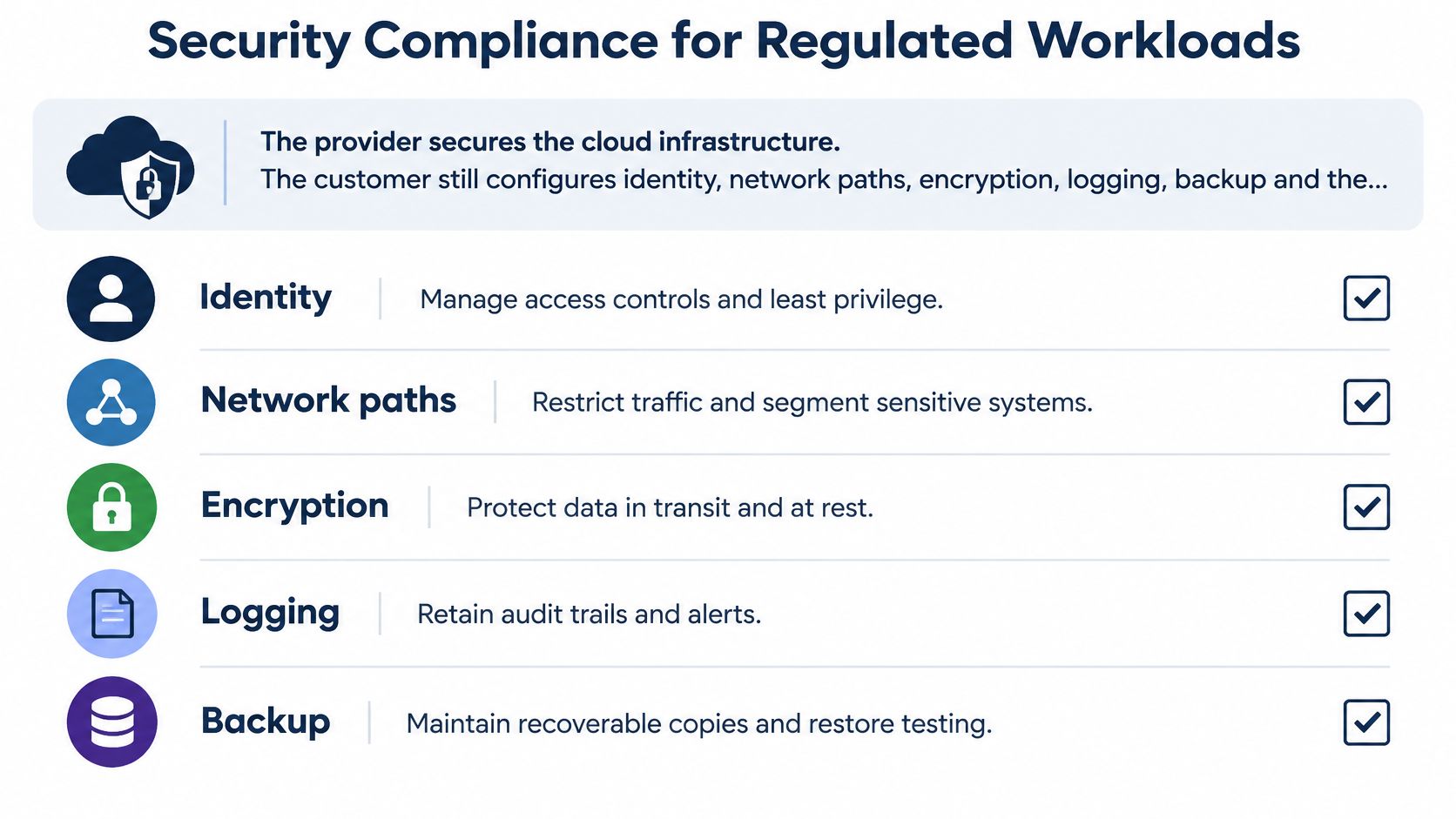
Security evidence to request
-
Data flows identify storage locations, subprocessors, and administrative access paths.
-
Identity reviews demonstrate least privilege and controlled emergency access.
-
Encryption records establish protection in transit and at rest, including key ownership.
-
Recovery evidence demonstrates backup restoration against agreed recovery objectives.
-
Audit records establish retention decisions and usable incident investigation trails.
-
Incident procedures name escalation contacts and customer-provider responsibilities.
Use counsel and compliance owners to establish applicability before design approval. The review should address GDPR processor and international-transfer terms, NIS2 applicability, DORA obligations for financial operations, and relevant ICT supplier arrangements. For US healthcare and medical-device products, include HIPAA and applicable MDR or FDA requirements; treat ISO 27001 as a management-system framework rather than legal clearance.
Apply controls to the business workflow
Healthtech teams should connect custom healthcare software development decisions with the behavior of healthcare integrations, including failed-message handling and access to clinical data.
For insurance software development, include underwriting and claims audit trails in acceptance testing. The published Canadian cyber insurer case is a separate reference for buyers evaluating insurance delivery.
For ecommerce development services, define payment-system boundaries and protect peak trading windows. Establish policy ownership through documented cloud governance, including approval of exceptions and new services.
Migration Risks and How to Control Them
Technical risk becomes manageable when the team agrees what evidence will stop a wave. A status report that says migration is progressing doesn't establish whether the next cutover is safe.
| Risk | Early signal | Control |
|---|---|---|
| Hidden dependency | A batch job fails after cutover. | Build the dependency map from flow logs and configuration before the initial wave. |
| Cost drift | Unit cost rises across successive monthly reviews. | Apply mandatory tags, budget alarms, and a monthly FinOps review. |
| Skills gap | Tickets wait on a single engineer. | Require runbooks and paired operation before handover. |
| Compliance drift | A new service stores regulated data outside the approved region. | Enforce policy guardrails and approval for new managed services. |
| Failed rollback | Nobody has executed rollback in testing. | Run a timed rollback test during the pilot and name the decision owner. |
A hidden caller may be a reporting extract or scheduled integration that nobody mentioned in discovery. Use interviews to check machine-derived evidence, and place components with unclear ownership on the retain register until responsibility is resolved.
Make rollback a business decision
The cutover commander needs authority to stop the migration. Agree the decision rule before the window opens, including unacceptable error rates, data-reconciliation failures, and time remaining for recovery.
Rollback also needs a data-consistency boundary. Restoring the old application is insufficient if customers have already written transactions into the new database and the team has no reconciliation procedure.
Hand over through paired operation. The receiving engineers should execute routine maintenance and incident procedures while the migration team is still available to correct gaps.
How to Choose a Migration Consultant
Evaluate the proposed delivery team through artifacts and technical questioning. Sales credentials alone won’t establish whether your engineers can operate the result.
-
Assessment evidence should include retained or retired components and their rationale.
-
Client ownership should cover infrastructure code, documentation, and platform access.
-
Execution evidence should include wave acceptance criteria and tested recovery procedures.
-
Operational accountability should identify financial and incident owners.
-
Regulated delivery should show relevant control evidence without implying automatic compliance.
Questions for the technical interview
-
How do you map dependencies before choosing the strategy?
-
Show a workload you advised against moving, and explain why.
-
How do you estimate egress and licence costs before migration?
-
Who joins the rollback call, and what triggers the decision?
-
How will our engineers run the platform after you leave?
A fixed-scope assessment can establish the backlog, followed by time-and-materials migration waves and a support retainer. Compare software development service models against your internal capacity.
Choose full-cycle software delivery when you need end-to-end programme delivery, or co-creation with in-house teams when your engineers retain architecture ownership.
Bridge Global, a software development partner, offers Cloud Consulting, Cloud Migration, Cloud Native Apps, and Cloud Monitoring through flexible engagement models; explore its software development services to discuss delivery ownership and post-migration support.
Frequently Asked Questions
How long does a cloud migration consulting engagement take?
The schedule depends on discovery quality, data volume, integration dependencies, and refactoring scope. Request an indicative plan with acceptance gates, then revise it when the assessment establishes the actual estate.
What should a cloud migration proposal include?
It should include discovery scope, component strategies, landing-zone design, a wave plan, test evidence, rollback procedures, and a cost model with assumptions. It should also identify who operates the environment after cutover and what handover acceptance requires.
Is rehosting enough on its own?
Rehosting can suit a stable application when a data-centre exit takes priority over redesign. Record its operating constraints and decide whether later modernization is justified rather than assuming every rehost needs a rewrite.
Who should own the cloud bill after go-live?
A named FinOps owner should coordinate finance and engineering before production migration. Product owners remain accountable for demand, while platform engineers manage efficiency and explain infrastructure changes.
We offer cloud consulting, migration, cloud-native application development, and monitoring, with standard support or AI-assisted monitoring and 24/7 incident coverage after go-live. Visit Bridge Global to discuss an assessment that identifies what should move, what should stay, and who will operate the result.

About Preethi Saro Philip
Preethi Saro Philip is a Post Graduate Research Degree holder in Economics with more than 10 years of experience in writing, editing, research and teaching. She has an intense passion for content crafting and calls herself a ‘wordsmith’. She enjoys writing on wide-ranging topics including business, technology, health & lifestyle, education, environment etc.
View all posts by Preethi Saro Philip →