



Care Coordination Software: Features, HIPAA and FHIR
Care coordination software tracks who needs to act on a patient across organisations and keeps care plans, referrals, transitions of care, and follow-up tasks visible to every team involved. A working FHIR connection won't deliver that result on its own. Coordination happens when an event creates an owned task, the right person completes it, and your system can prove what happened afterward.
What Care Coordination Software Does and Who Relies on It
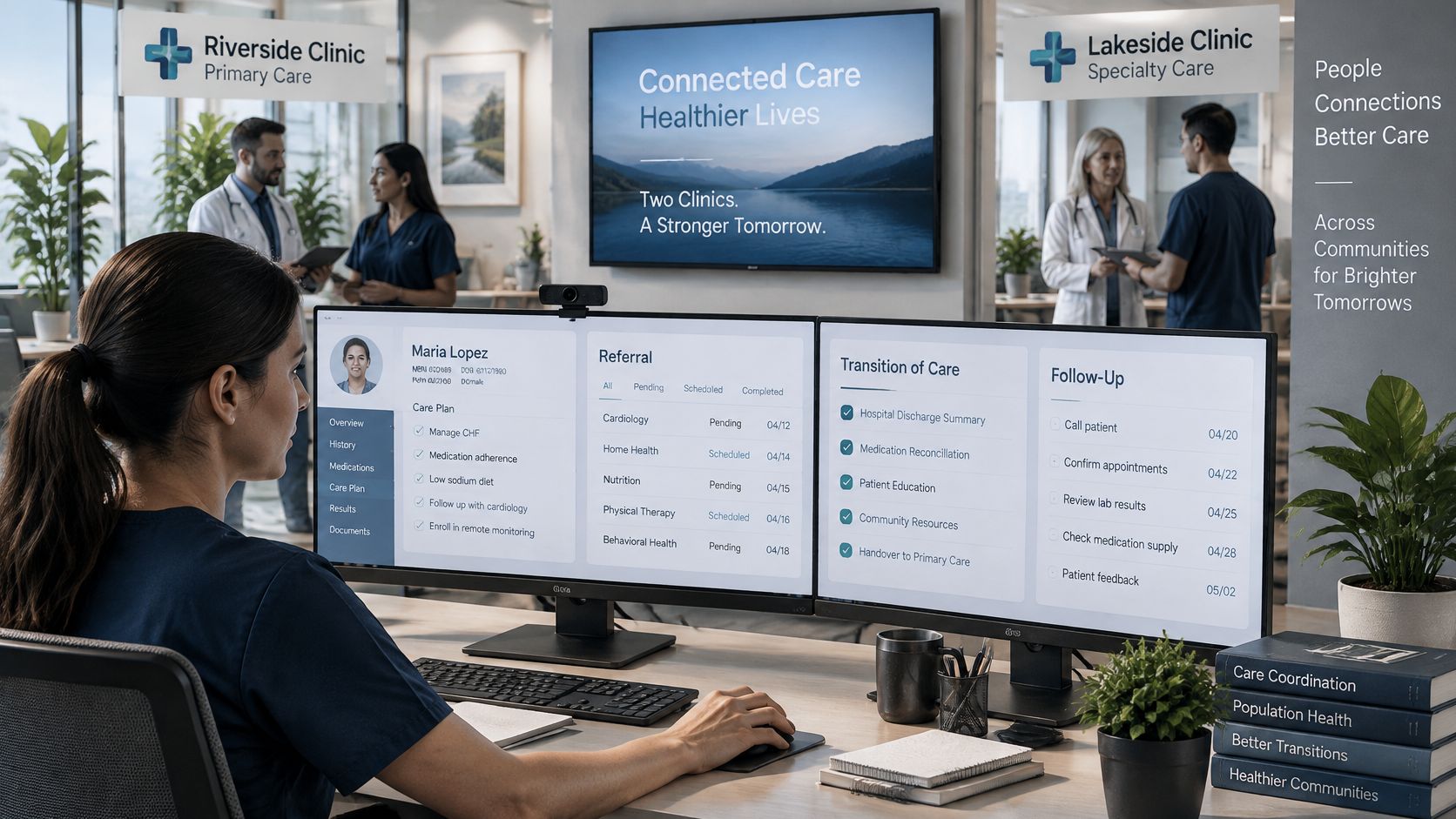
Say a hospital discharges a patient with heart failure on a Friday afternoon. The discharge summary lands in the electronic health record, the home health agency needs to accept a referral, and a care manager needs to call the patient within two days. The EHR holds the clinical record for that episode. Care coordination software manages the handoffs between organisations and the tasks those handoffs create.
Think of it as a ward handover whiteboard that follows the patient out of the building and into other organisations. Everyone with a legitimate role can see the current plan, the open tasks, and who owns each one.
Who uses it in practice?
Hospitals running discharge programmes: They need admission, discharge, and transfer follow-up queues with clear ownership.
Accountable care organisations: They need shared care plans across an attributed population that spans many providers.
Home health agencies: They need referral intake that staff can accept or decline quickly, with the reason recorded.
Payers: They need outreach and task routing for high-cost members, plus evidence that contact happened.
We covered the broader market view in our guide to digital care management platforms. This article concentrates on build, integration, and compliance decisions for product and engineering teams who have to ship the coordination layer itself.
Core Features Mapped to Coordination Workflows
Core features by coordination workflow
| Feature | Workflow it supports | Primary user | Data or standard involved |
|---|---|---|---|
| Care plan builder | Shared goals, interventions, owners and due dates | Care managers and clinicians | FHIR CarePlan resource |
| Referral management | Referral sent through to accepted or completed | Referring and receiving staff | Referral records and FHIR Task status |
| Transitions-of-care tracking | Admission, discharge and transfer follow-up | Discharge coordinators | HL7 v2 ADT event messages |
| Task routing and escalation | Assigning and escalating work by role and timer | Team leads and care managers | Internal rules engine and task audit trail |
| Secure messaging | Patient-linked messages across the care team | All care team members | Role-based access and message audit log |
| Patient outreach | Scheduled contact and response tracking | Care navigators | Consent status checked before each contact |
| Consent management | Permitted sharing between organisations | Privacy and compliance officers | Consent and authorisation records |
What separates a basic product from a production one
A basic product displays information. A production product closes work. Closed-loop acknowledgement means every task has a named owner and a close state, and the system escalates when a timer expires. Without that state machine, you've built a shared inbox that nobody trusts.
Audit logs need to be written at the point of access rather than assembled later from application logs. When a privacy officer asks who viewed a record and why, an engineer shouldn't have to reconstruct the answer from trace data.
If a task can't be acknowledged, escalated, and closed inside the product, your users will finish the work in email, and the audit trail will have a gap exactly where it matters.
Role-based views matter just as much. A discharge coordinator needs medications, follow-up appointments, and the receiving provider's response. A billing user needs none of that clinical detail. Building one screen for both roles guarantees that at least one group gets data it shouldn't see or can't use.
For sequencing, I'd rank features by the workflow with the highest monthly volume and build those first. In practice, referrals or discharge follow-up dominate volume. Ship that path end to end with acknowledgement and audit before you add a second workflow.
Connecting ADT Alerts, FHIR CarePlans and Direct Messaging
Exchange patterns in care coordination
| Pattern | Trigger or purpose | Who acts on it | Standard |
|---|---|---|---|
| ADT notification | Admission, discharge and transfer events | Coordinator work queue | HL7 v2 ADT messages |
| Shared care plan | Goals, interventions, owners and due dates | Care team across organisations | FHIR CarePlan resource |
| Referral tracking | Referral from sent to accepted, declined or completed | Referring and receiving staff | FHIR ServiceRequest and Task status |
| Document exchange | Summaries and records where no API exists | Providers on the Direct network | Direct messaging (SMTP with S/MIME) |
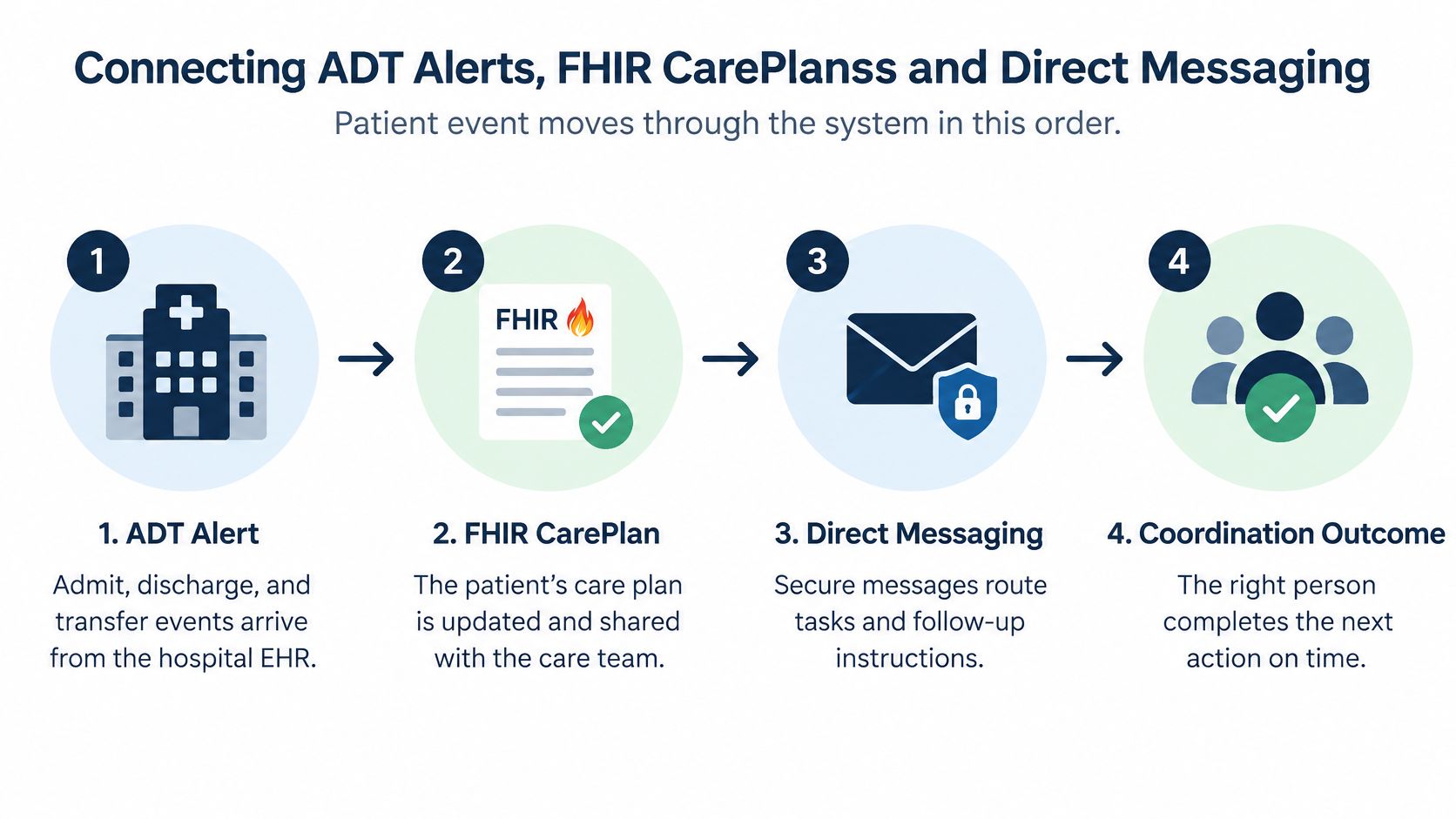
Follow a single event through the system. An ADT message arrives from the hospital EHR when a patient is discharged. Your platform matches that event to a known patient, creates a task in the coordinator's queue, and starts the follow-up timer. The message shouldn't sit unread in an inbox waiting for someone to notice it.
Next, the shared FHIR CarePlan carries goals and interventions to other organisations. Identity matching and consent checks decide whether a receiving system can read that resource at all. Get either one wrong and you either block legitimate care or expose data to the wrong party.
Direct messaging still earns its place where no API exists, mainly for document exchange with smaller providers. Referral tracking then closes the remaining gap, because the referral only counts as coordinated when the receiving provider accepts, declines, or completes it.
The adoption warning
An AHRQ-supported implementation involving children and youth with special healthcare needs recorded a median of 13.6 data transfers per month, yet only 33.3% of participants were sustained adopters. Technical problems and missing features blocked long-term use even though FHIR exchange worked.
That case produces three engineering requirements. Build durable patient identity matching that survives name changes and duplicate records. Add retry and reconciliation logic so failed messages surface in a queue instead of disappearing. Record resource-level provenance so every exchanged item shows its source organisation and timestamp.
As we explored in our guide to healthcare interoperability, scope design for SMART launches deserves the same rigour, and our article on SMART on FHIR launch scopes and security covers that detail. Our page on healthcare integrations describes how this integration work is delivered in practice.
Compliance Rules for HIPAA, GDPR and Cross-Organisation Consent
Start with the rule that shapes your data model. Under HIPAA, a covered provider may disclose protected health information to another covered provider for that recipient's treatment activities without written authorisation. The regulatory definition of treatment covers referrals, provider consultations and shared care plans, so you don't need a separate consent step for every treatment transaction.
Case management and care coordination disclosures carry a minimum necessary condition. The Office of the National Coordinator summary of HIPAA permitted uses states that entities must have or have had a relationship with the individual, the requested information must relate to that relationship, and the discloser must limit the information to the minimum necessary for the healthcare operation.
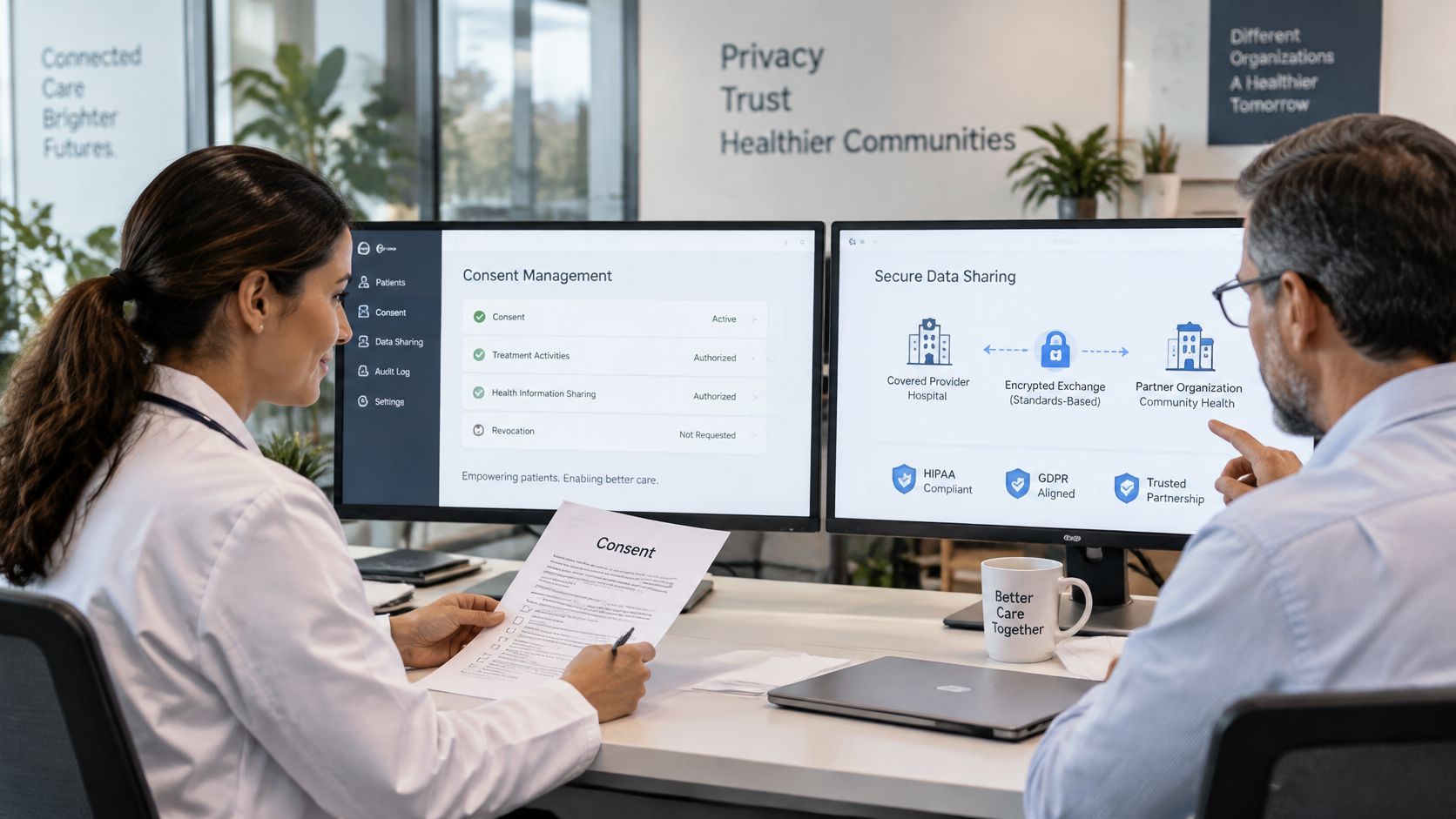
In product terms, a discharge coordinator may need medication and follow-up information while another operational user needs only appointment status. Role-based access and field-level minimisation should follow each workflow's purpose, and the US treatment and consent provisions sit in 45 CFR 164.506.
Requirements that follow
Consent and authorisation records: Store who granted what, when, and for which organisations.
Purpose tag on every access: Record the requesting organisation, patient relationship, purpose, data released, recipient and transmission method.
Separation of datasets: Keep coordination data apart from secondary-use analytics so a treatment permission can't implicitly authorise unrelated analysis.
For EU deployments, health data is special category data under Article 9 of Regulation (EU) 2016/679. Article 9(2)(h) covers processing needed for health care provision and management under professional secrecy; Article 6 supplies the lawful basis, and national rules such as the Dutch UAVG need confirmation for Netherlands deployments. UK deployments follow UK GDPR and the Data Protection Act 2018 with the same structure. In Canada, PIPEDA governs commercial handling, and provincial statutes such as Ontario's PHIPA can apply to providers, so confirm the rules province by province.
Whether your software falls under medical device rules depends on its intended purpose, so check that with regulatory counsel early. Our guide to HIPAA-compliant software covers the control set in more depth.
Choosing Between Build, Buy and Customise Paths
You have three delivery paths. Build the coordination layer from scratch, buy a platform and configure it, or customise a product on a shared core. Each one moves ownership of identity matching, conformance testing, and audit evidence to a different team.
Build, buy and customise compared on delivery criteria
| Criterion | Build from scratch | Buy off the shelf | Customise a platform |
|---|---|---|---|
| Time to first live workflow | Longest, depends on team size and scope | Shortest for standard workflows | Medium, depends on extension points |
| Control over referral and task logic | Full control | Limited to vendor configuration | High within the platform's extension points |
| Ownership of identity matching and consent | Your team | Vendor, reviewed against your rules | Shared, with the boundary set in contract and code |
| Maintenance of HL7 and FHIR conformance | Your team | Vendor | Shared, agreed per interface |
| Compliance evidence for HIPAA and GDPR | You produce all of it | Vendor baseline, you verify | Split, with named evidence owners |
| Cost shape (indicative only) | Front-loaded engineering spend, depends on team size and scope | Recurring licence and configuration fees, depends on terms | Mixed build and licence effort, depends on extension points |
| Best fit | Unique workflow is the core product | Standard workflows and a small team | Common core with one differentiating workflow |
The cost row is indicative only. Budget from your own assumptions about team size, scope, and licence terms, and include governance and exception handling in that estimate. Licence fees rarely account for training, alert tuning, or the manual reconciliation work that lands on care managers when matching fails.
How the trade-offs shift with scale
A buy path reaches a first workflow faster, and that speed is real. It also limits how you can model referral logic and consent, which becomes a serious constraint when a large customer demands a workflow your vendor won't support.
A build path gives full control. Your team then owns identity matching, HL7 and FHIR conformance testing, and audit evidence for every release, forever. That ownership is worth it when the coordination workflow is the product you're selling.
The customized path works when a platform's extension points match your differentiating workflow. The MDT treatment planning app case shows a focused build of this kind, and our overview of software development service models helps teams compare delivery options.
Decision test: List the workflows you cannot change without vendor approval. If that list contains the workflow your customers pay for, you're on the wrong path.
For SaaS vendors, this choice also shapes your SaaS product development roadmap, because tenant-level consent rules and per-customer interface variants multiply quickly once you pass a handful of deployments.
Measuring Readmissions, Referral Leakage and Time to Follow-Up
Track interface health and workflow outcomes separately. A successful transfer doesn't prove that coordination worked, and reporting both numbers side by side stops a rising message count from hiding a growing unresolved queue.
KPIs for care coordination platforms
| KPI | What it measures | Data source | How to set the target |
|---|---|---|---|
| 30-day readmissions | Share of discharges readmitted within 30 days | ADT events from the same cohort | Set from a pre-launch baseline |
| Referral leakage | Referrals sent with no accepted or completed status | Referral records and task status | Set from baseline, review unclosed items each week |
| Time to follow-up | Hours from discharge to first completed contact | ADT event and task timestamps | Set per workflow from baseline |
| Duplicate entry rate | Records entered more than once across systems | Audit log and reconciliation queue | Track the trend, agree the target with clinical leads |
| Alert acknowledgement time | Time from ADT event to acknowledged task | Task audit trail | Set per escalation path |
| Unresolved task volume | Open tasks past their due date, by role | Task queue | Set against each role's capacity |
| Adoption by role | Share of licensed users completing tasks each month | Application analytics | Track monthly by role from go-live |
Two calculations need care. Readmissions should use discharges from the same cohort, measured before and after go-live with the same inclusion rules. Referral leakage counts referrals sent that never reach an accepted or completed status, which makes the weekly review of unclosed items an operational habit rather than a reporting exercise.
Time to follow-up runs from the discharge event to the first completed contact. Duplicate entry rate and unresolved task volume show whether automation is moving work onto nurses or care managers instead of removing it.
A systematic review of health information exchange found generally low-quality evidence that exchange reduces duplicative laboratory and radiology testing, emergency-department costs, and hospital admissions, and it did not establish effects on mortality or morbidity. A separate updated review found stronger evidence in more rigorous studies for fewer duplicated procedures and reduced imaging.
That evidence points to one evaluation habit. Compare pre- and post rates for each outcome instead of counting connections, and set targets from a baseline taken before launch and agreed with clinical leads. Our guide to healthcare operational analytics covers dashboard design for this kind of measurement.
Keep the minimum dashboard small. One interface metric, one adoption metric by role, and one outcome metric for each live workflow will tell you whether tasks are finishing.
Confirm Your Build Path With This Implementation Checklist
Choose the delivery path and confirm the minimum scope before any code is written. Work through these items in order, because each one constrains the decisions after it.
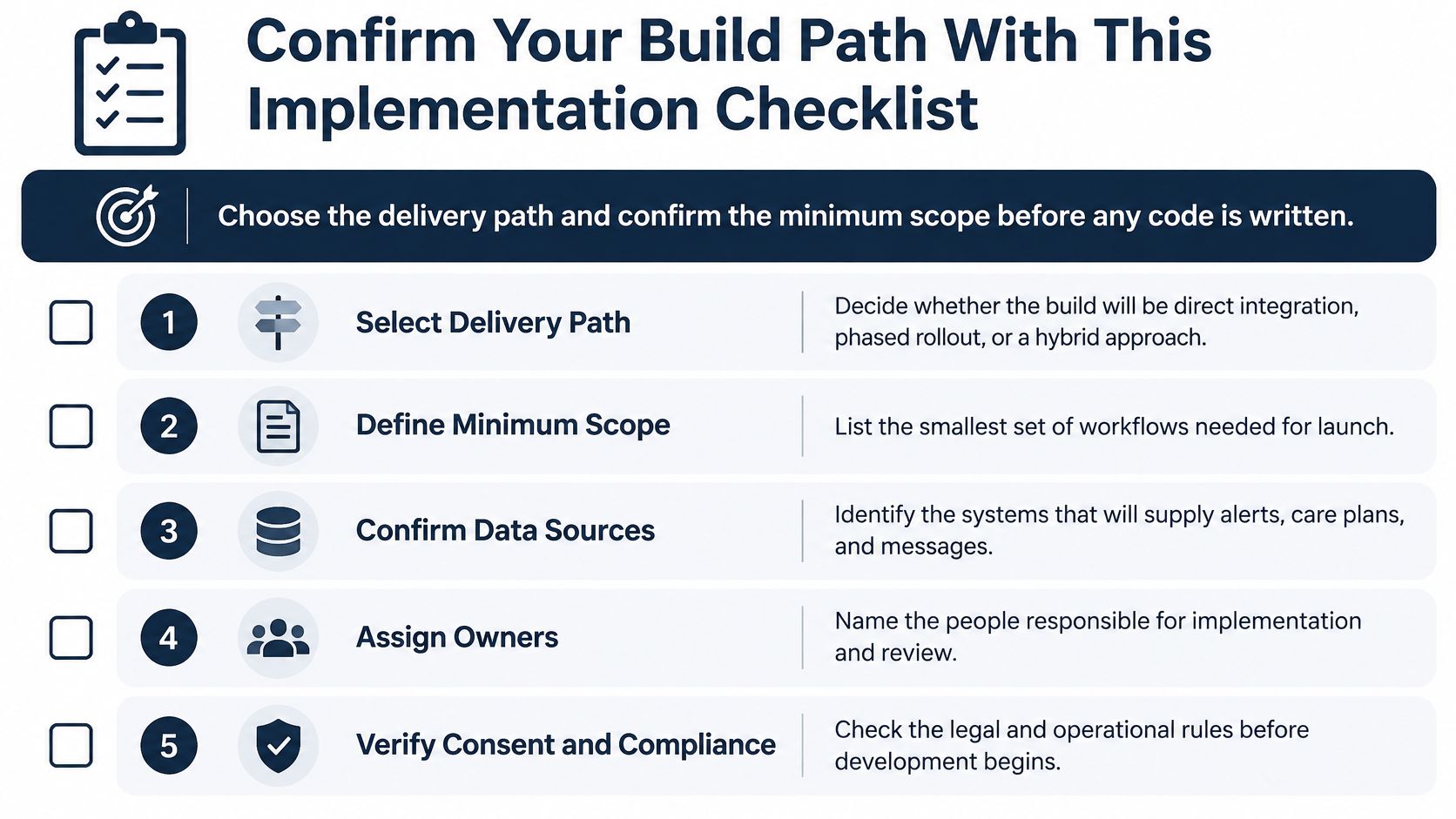
Map the top workflows: Name the roles that own referral, discharge, and outreach work in each organisation.
Confirm standards per interface: Record where you need HL7 v2 ADT, FHIR CarePlan and referral resources, and Direct messaging.
Define identity matching rules: Write down the failure path for unmatched or ambiguous records.
Write the consent and purpose model: State which organisations may see which data elements under which legal basis.
Specify audit fields: Capture requesting organisation, patient relationship, purpose, data released, recipient and transmission method.
Take KPI baselines: Measure referral leakage and time to follow-up before go-live.
Measure workload effects: Track duplicate entry and unresolved tasks during the first live cycle.
Name an evidence owner: Assign each compliance control to a person who produces its evidence.
Teams with limited engineering capacity can use full-cycle delivery, where an outside partner takes complete ownership of the product journey from discovery to delivery. Co-creation is the alternative, and solutions designed to work alongside a client's in-house tech team fit into its existing development workflow.
Bridge Global works as a healthtech software development partner with a healthcare practice, so teams evaluating that route can review custom healthcare software development as the next step. Building the coordination layer through custom software development also keeps referral logic under your control.
Frequently Asked Questions
Does HIPAA require patient authorisation before a provider shares a care plan with another provider for treatment?
Treatment-related disclosures between covered providers can proceed without written authorisation. Minimum necessary limits and secure transmission still apply, so the workflow needs recipient verification and an audit record.
Do EU, UK and Canadian deployments need a different consent model from US deployments?
The core data model can stay the same. The lawful basis, special category conditions, and national or provincial rules must be mapped per jurisdiction before launch, so plan that mapping as a configuration exercise rather than a rewrite.
Does care coordination software count as a medical device?
Classification depends on intended purpose. Regulatory counsel should confirm it under EU MDR Rule 11, FDA guidance, or the relevant local rules before you finalise product claims.
How is care coordination software different from an EHR?
The EHR holds the clinical record for an organisation's own care. Coordination software manages referrals, tasks, and handoffs between organisations, and it tracks whether each handoff finished.
Which KPI should a team track first?
Start with time to follow-up and referral leakage, since both show whether a handoff finished. Add readmissions once a pre-launch baseline exists for the same cohort.
If you're building a coordination platform and need engineering capacity for FHIR interfaces, consent-aware workflows, or audit-ready task routing, we'd be glad to discuss your architecture and delivery path. Visit Bridge Global to see how our healthcare team supports healthtech SaaS companies from discovery through release.

About Upendra Jith
Upendrajith completed his Master's in English and has been a commercial content developer for the past three years. He's more inclined to develop content with a 'street-smart' delivery on topics such as technology, media, or anything he can get his hands on. He has a fixation on lyrics, dark poetry, media, technology, and flow arts.
View all posts by Upendra Jith →