



Application Modernization Services: A Practical Guide
Your core application still processes claims, supports clinical workflows, or accepts orders. Yet every product change requires someone to interpret undocumented rules, coordinate fragile integrations, and negotiate a release window. You're evaluating application modernization services because keeping the system running no longer means keeping the business moving.
The right partner won't start by selling you a cloud destination or a rewrite. They'll establish what the application does, who depends on it, what it costs to retain, and which changes you can safely make first.
Why Application Modernization Is a Discovery Problem First
Consider a healthcare platform that delivers reliable appointment scheduling but delays every new integration. The architecture diagram is outdated, a scheduled job updates records outside the application, and the engineer who understands that job has moved on. This is a hypothetical scenario, but it captures the decision you need to make: preserve working behavior while exposing the dependencies that make change risky.
Operational stability isn't evidence of modernization readiness. In its 2025 review, GAO found that eight of 11 critical legacy systems used outdated programming languages, four relied on unsupported hardware or software, and seven had known cybersecurity vulnerabilities. GAO's critical legacy systems assessment also warns that incomplete modernization planning increases the risk of overruns, delays, and failure.
Establish the economics before the destination
Portfolio discovery should connect applications to infrastructure, licensing, business ownership, and operational obligations. Texas identified more than 4,130 business applications, over 13,000 server instances, and approximately 100,000 software-product instances, with legacy support and licensing exceeding $300 million annually and estimated portfolio remediation of approximately $450 million, according to its 2014 Legacy Systems Study.
Those figures aren't a pricing benchmark for your project. They demonstrate why an application-only estimate misses the surrounding estate.
-
Include recurring expenditure: Support, infrastructure, licensing, and specialist staffing belong in the business case.
-
Expose deferred change: Identify product launches, security improvements, and operational changes that the current system prevents.
-
Separate symptoms from causes: Use the distinction between maintenance work and technical debt in software development to prioritize structural problems.
Practical rule: Don't approve a target architecture until someone can explain the current application's critical dependencies and business rules.
Once that evidence exists, plan any infrastructure move around it. Keep infrastructure movement downstream of discovery, not a substitute for it.
What Application Modernization Services Actually Cover
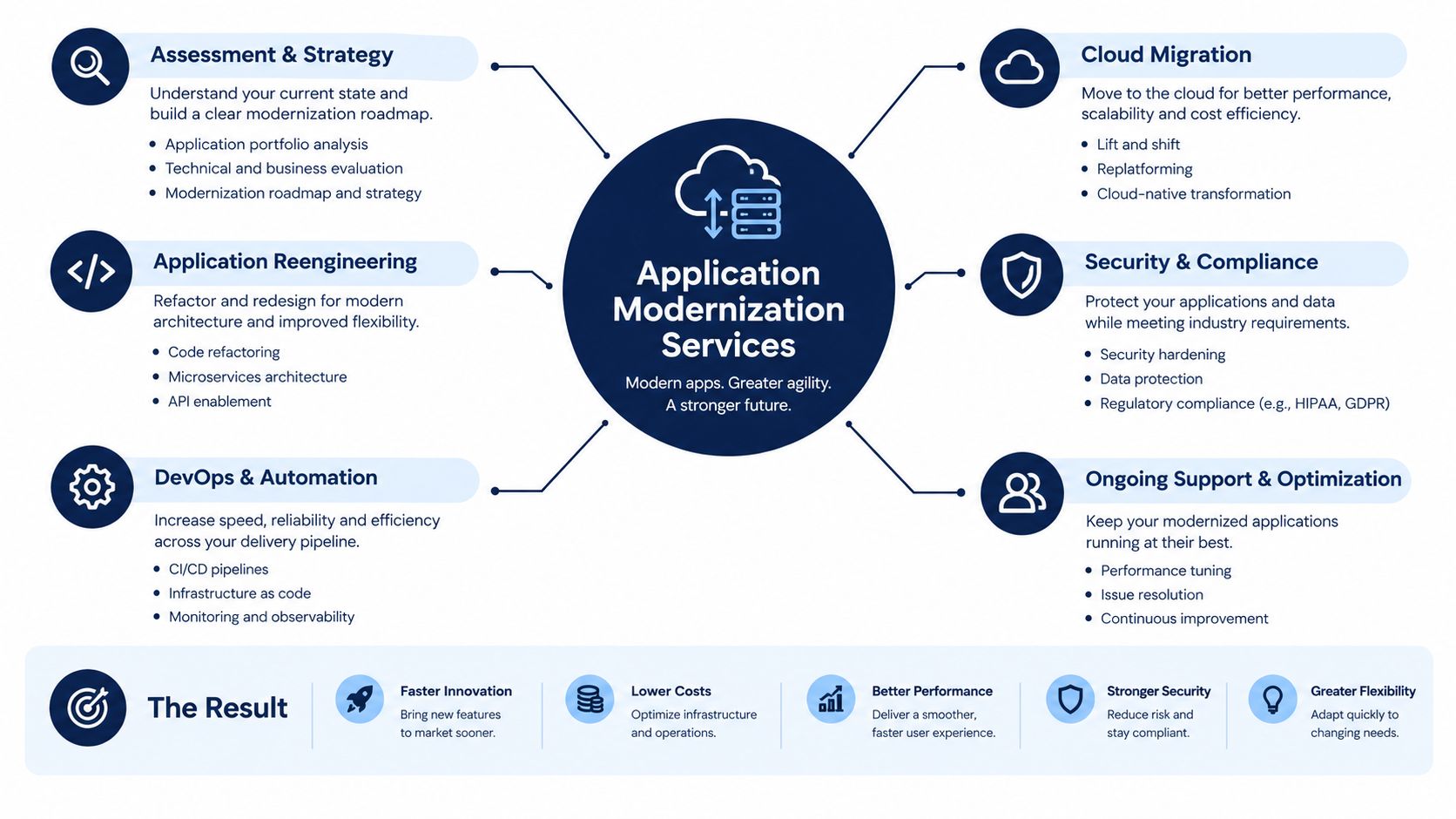
Application modernization services should improve an existing application's architecture, components, integrations, delivery process, and operational maintainability while protecting business-critical behavior. Buy a defined transition, not a collection of technology tasks.
A credible scope connects assessment, engineering, and handover. This diagram provides a useful overview of that lifecycle.
Require evidence-producing deliverables
Start with an application and data inventory, dependency maps, named owners, and business-criticality scores. Ask the assessment team to identify undocumented rules through source inspection, runtime observation, support records, and interviews with business operators.
Then require a recommendation per application. Each recommendation should identify the modernization pattern, its business justification, unresolved assumptions, and the proposed treatment of the legacy system.
The implementation scope should include:
-
Data transition: Mapping, transformation, reconciliation, archival, and cutover responsibilities.
-
Security and compliance design: Access controls, evidence requirements, and accountable reviewers.
-
Verification: Functional, interface-contract, performance, and security testing.
-
Delivery and operations: CI/CD implementation, observability, runbooks, support ownership, and operational acceptance.
For example, before refactoring an insurer's claims platform, we’d require contract tests around policy lookup, payment instructions, and downstream reporting. For an ecommerce storefront with well-documented integrations, we’d narrow discovery to the actual migration risks rather than commission an unnecessarily broad assessment. These are sequencing recommendations, not claims about specific client projects.
Distinguish modernization from adjacent work
A lift-and-shift proposal may address infrastructure without addressing application constraints. A rewrite may replace code without recovering business knowledge. An AI initiative may add functionality while leaving the underlying platform unchanged.
Ask vendors to connect their proposal to the full product lifecycle, covering discovery, implementation, and ongoing product work, rather than treating deployment as the finish line.
For governance, adopt GAO's requirement that a plan contain milestones, a description of the work, and the legacy system's disposition, as set out in its modernization planning guidance. If the proposal doesn't explain how the old system leaves service, the transition isn't fully scoped.
The Five Modernization Patterns and How to Choose Between Them
Choose the least disruptive pattern that resolves the documented business constraint. Don't make every application follow the same route because your vendor prefers a particular cloud platform or architecture.
Rehost means moving the application to different infrastructure with minimal code changes. We’d use it to address an infrastructure deadline, provided the application-level limitations remain visible in the roadmap.
Replatform changes the runtime, database, or hosting platform while preserving the core application design. It fits when the platform is the constraint and the business logic remains suitable.
Choosing a Modernization Pattern by Situation
| Pattern | Best Fit | Watch Out For |
|---|---|---|
| Rehost | Infrastructure exit or an immediate hosting constraint | Treating relocation as resolution of application debt |
| Replatform | A supported managed platform can replace operationally burdensome components | Hidden runtime, database, or vendor compatibility assumptions |
| Refactor | Valuable behavior needs cleaner, more maintainable code | Changing business behavior without characterization tests |
| Rearchitect | Proven coupling prevents independent change or scaling | Adding distributed complexity without operational capacity |
| Replace | A product or new implementation can meet validated requirements | Losing undocumented workflows or historical data meaning |
Refactor means restructuring code while preserving its intended external behavior. A healthcare HL7/FHIR integration layer is a candidate when interface behavior is valuable, but the implementation is difficult to maintain. Capture message handling and exception behavior before touching it.
Rearchitect changes application structure and boundaries. Use it when you can demonstrate that shared deployments, data ownership, or tightly coupled responsibilities create the bottleneck. The trade-offs in monolithic versus microservices architecture matter here: independent services also require explicit contracts, operational ownership, and distributed failure handling.
Replace means substituting the application with another product or a new implementation. A legacy storefront may fit this route if a modern ecommerce platform supports its validated catalog, checkout, pricing, and ERP requirements.
Test the decision against real behavior
For a hypothetical underwriting rules engine, replatforming onto a managed service is sensible only if rule execution, dependencies, and reporting behavior remain compatible. If the problem is tangled rule ownership, changing the hosting platform won't resolve it.
For a healthcare replacement, don't accept a feature checklist as proof that clinical workflow is covered. Validate exceptions, permissions, record history, and integration behavior with the people who use the system.
Document why the chosen pattern fits, what alternatives were rejected, and what evidence would change the decision. Retain or retire applications where justified; modernization isn't an obligation to rebuild everything.
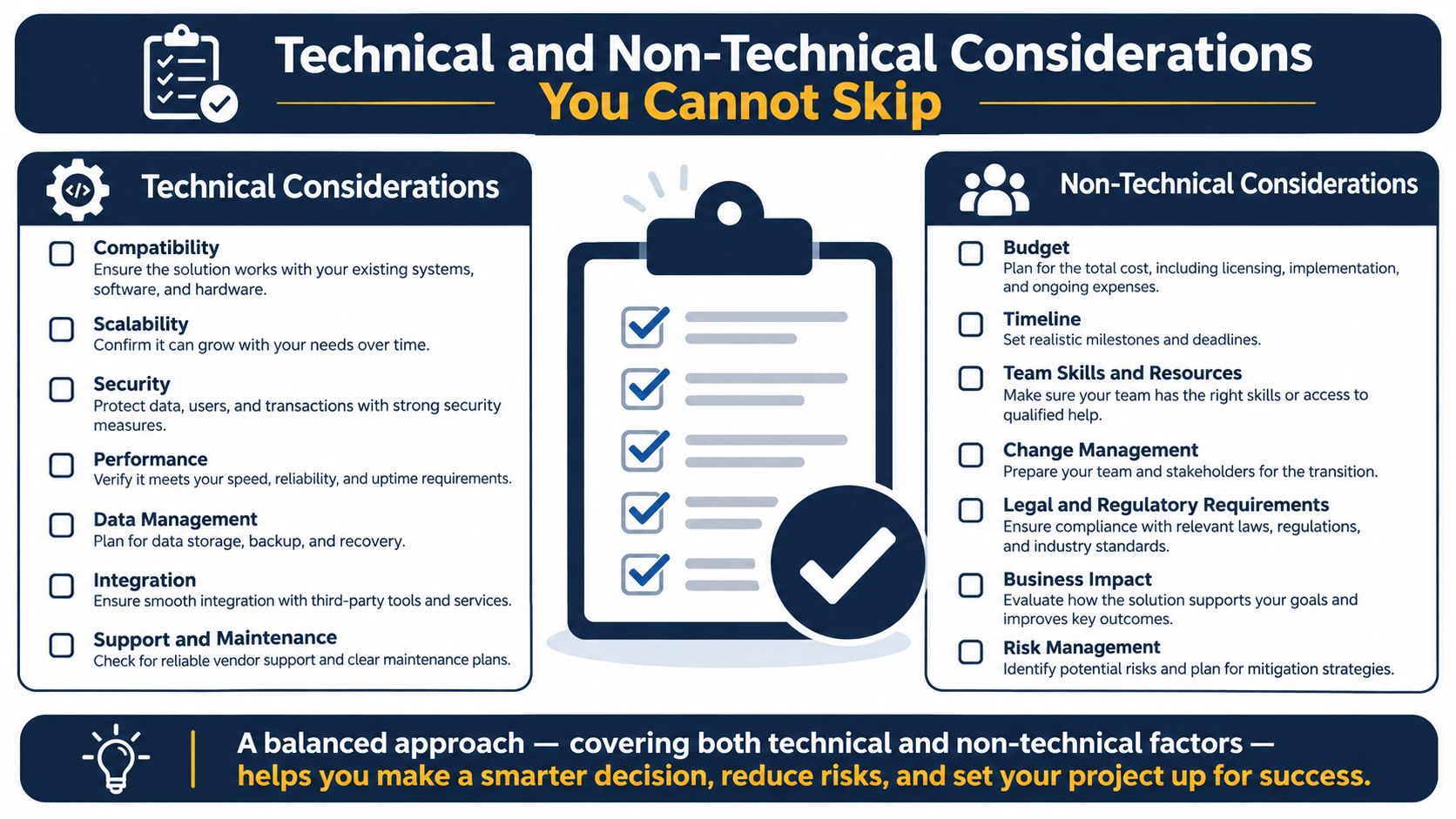
Technical and Non-Technical Considerations You Cannot Skip
Give vendors a checklist that names acceptance evidence, not just activities. “Security review completed” is weaker than an approved access-control model, tested denial paths, and documented remediation decisions.
Use the following considerations as delivery gates.
Architecture and data decisions
Architecture must define boundaries before implementation. Require target-state responsibilities, integration patterns, transaction boundaries, and failure-handling decisions. Don't accept a service diagram that omits who owns shared data or what happens when a dependency becomes unavailable.
Data needs its own transition plan. Specify source-to-target mappings, master-data ownership, archival rules, reconciliation criteria, and the authoritative system during coexistence.
-
Architecture evidence: Approved decision records and interface contracts, including degraded-operation behavior.
-
Data evidence: Business-approved mappings, migration rehearsal results, and reconciled exceptions.
A technically successful import isn't enough. Business owners must verify that the migrated records retain their intended meaning.
Security, compliance, testing, and delivery controls
Use zero trust as the security direction. NIST SP 800-207 describes zero trust as granting no implicit trust to assets or user accounts based solely on their network location or asset ownership. Require identity and authorization decisions for users, APIs, and service-to-service calls.
For compliance, ask qualified stakeholders to establish applicability before vendors promise coverage. Healthtech assessments should consider HIPAA, GDPR, and MDR where relevant; insurance assessments should address applicable solvency and audit obligations; ecommerce assessments should address PCI-DSS scope and consumer-data requirements. These aren't interchangeable checklists, and not every requirement applies to every workload.
Testing must preserve behavior and challenge assumptions: Require functional tests for business workflows, contract tests for interfaces, performance tests against agreed operating conditions, and security tests for access boundaries. An undocumented workflow needs investigation, not an invented expected result.
CI/CD must make release decisions reproducible: Ask for versioned build definitions, controlled credentials, artifact traceability, approval rules, and tested rollback procedures. The failure mode is automating deployment while leaving evidence and recovery dependent on individual memory.
A control that exists only in a presentation isn't an operational control. Ask the vendor to demonstrate it in the delivery environment.
Engagement Models and How to Pick the Right One
Choose an engagement model based on the responsibilities your organization can carry. Extra engineers won't fix missing product ownership, and outsourced delivery won't remove your obligation to make business decisions.
The distinction between outsourcing and outstaffing is useful when deciding whether you need accountable delivery or additional capacity. For modernization, make the ownership boundary explicit.
Match responsibility to internal capacity
| Model | Suitable Situation | Cost and Governance Profile | Typical Failure |
|---|---|---|---|
| Full-cycle delivery | Limited internal capacity to coordinate assessment through operational transition | Budget for multidisciplinary delivery and formal acceptance gates | The client delegates business decisions nobody else can make |
| Team augmentation | Strong internal architecture, product, and delivery leadership | Capacity-based expenditure with client-owned prioritization | Engineers wait for decisions or work around weak internal processes |
| Co-creation | Capable internal teams need shared implementation and knowledge transfer | Joint staffing with explicit decision rights | Shared accountability becomes unclear accountability |
For a healthtech scale-up without a platform team, we’d favor full-cycle software delivery for the initial modernization wave. The staffing plan should include architecture, engineering, quality assurance, delivery coordination, and access to security and domain expertise. The client must still supply a product owner with decision-making authority.
An insurer with strong architects but a delivery backlog may benefit from augmentation. Keep architecture decisions, backlog readiness, and acceptance within the insurer's operating model. Don't expect an augmented team to repair governance it isn't authorized to change.
For a mature ecommerce business standardizing its storefront and integrations, co-creation with in-house teams can support shared implementation and deliberate knowledge transfer. Assign a decision owner for product scope, architecture, and release approval rather than relying on consensus.
Contract for the system you'll operate
AI-assisted engineering shouldn't justify an untested throughput assumption. Ask how generated code is reviewed, how confidential material is protected, and who remains accountable for defects. Establish planning assumptions from observed delivery rather than a promised productivity multiplier.
-
Ownership: Define IP rights, repository access, tooling ownership, and reusable-component licensing.
-
Oversight: Include audit rights, risk reporting, and escalation routes.
-
Exit: Specify termination assistance, documentation acceptance, knowledge transfer, and access revocation.
Evaluate software development service models against these responsibilities. The right contract leaves you able to operate and change the application after the partner exits.
Success Metrics That Prove Modernization Is Working
Migration completion is a milestone, not proof of success. You can move an application and still retain slow releases, fragile recovery, and expensive emergency fixes.
DORA defines five complementary metrics: change lead time, deployment frequency, failed-deployment recovery time, change-fail rate, and deployment rework rate, distinguishing throughput from instability in its software delivery metrics guidance. Use them together rather than rewarding deployment frequency in isolation.
Build a defensible baseline
For the legacy application, reconstruct release history from source-control records, deployment logs, change tickets, and incident records. Where evidence is missing, label the gap explicitly. Don't manufacture a baseline to make the target platform look better.
Instrument the target environment from the start:
-
Change lead time: Connect commits to successful production deployments.
-
Deployment frequency: Count production deployments over a consistent reporting period.
-
Failed-deployment recovery time: Associate failed releases with recovery events.
-
Change-fail rate: Identify deployments that require immediate remediation.
-
Deployment rework rate: Identify unplanned deployments caused by production incidents.
Ask vendors how they'll produce this evidence, not whether they use DevOps. A selection checklist helps keep that discussion tied to delivery accountability.
Segment results by operational risk
Separate metrics by service and release class. A cosmetic storefront change shouldn't obscure a difficult payment release, and a routine healthcare interface update shouldn't conceal instability in a clinical workflow change.
Set the target as faster change with stable operations. If lead time improves while failure and rework worsen, investigate the release process before increasing deployment pressure.
Track readiness improvements alongside delivery outcomes: critical vulnerabilities removed, interfaces documented, recovery objectives demonstrated, and audit evidence accepted. These make progress visible before customers see new functionality.
Decision test: Can the team explain how a measured improvement changed its engineering choices? If not, the dashboard isn't guiding delivery.
Keep financial evaluation equally disciplined. In a 2024 review of 21 Department of Defense IT programs, GAO found that 70%, or $6.4 billion, of the total reported cost was for operating and maintaining the systems. Compare modernization expenditure with the ongoing cost of retaining the system, not a zero-cost baseline.
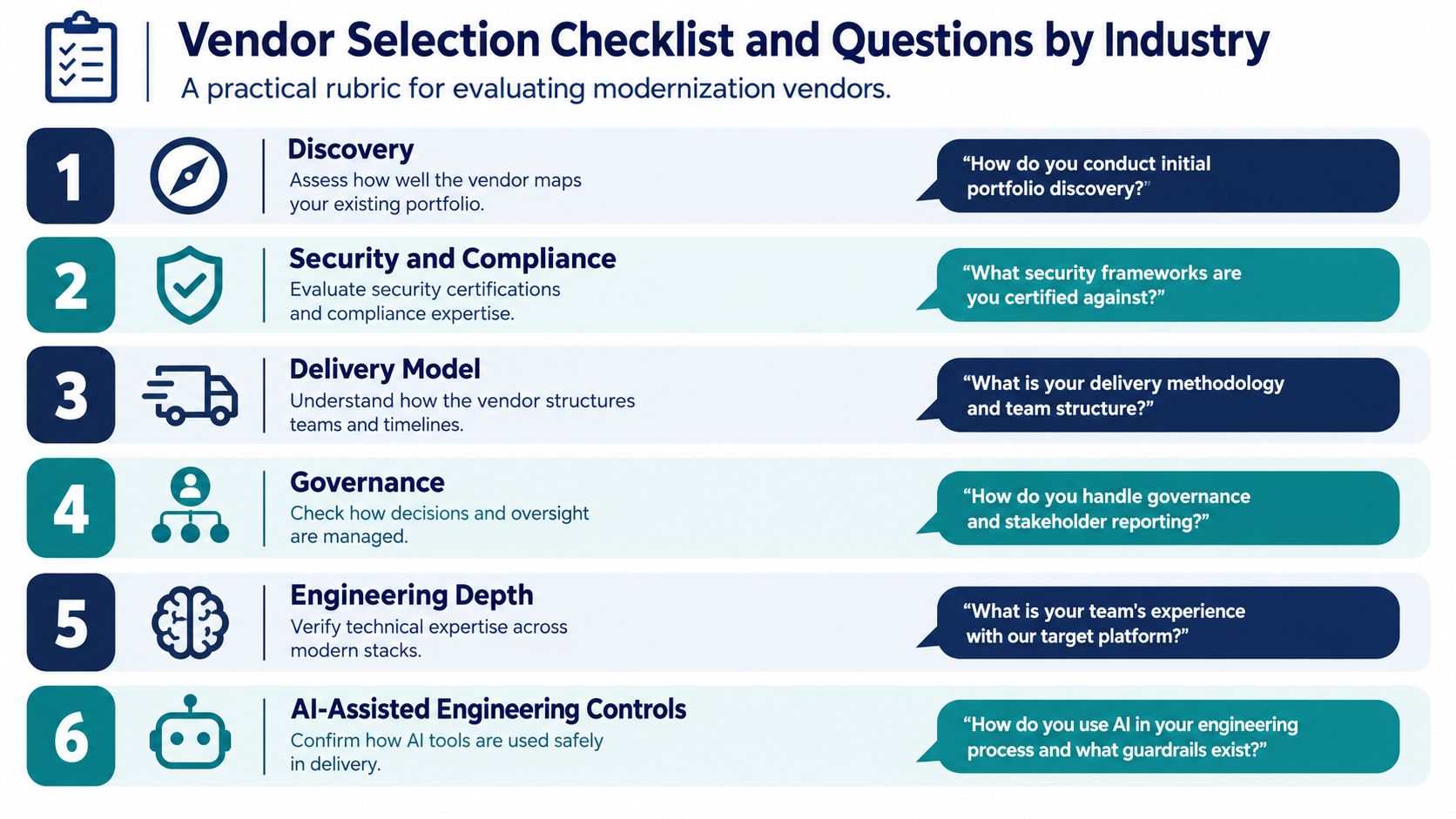
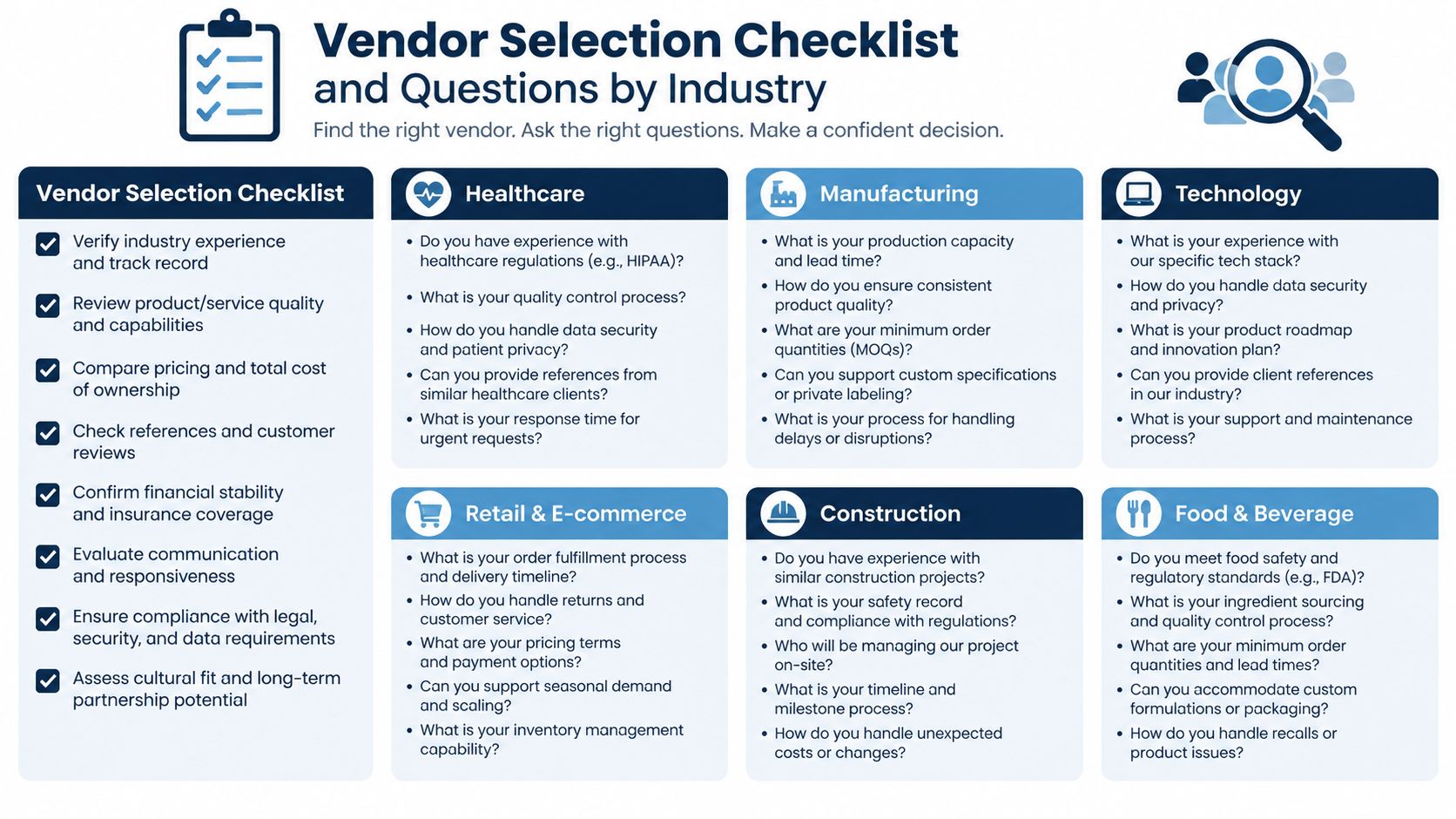
Vendor Selection Checklist and Questions by Industry
Shortlist vendors on inspectable evidence. A polished architecture presentation doesn't establish that the proposed team can discover undocumented behavior, handle a difficult cutover, or produce acceptable audit records.
Use this rubric to structure interviews and proposal reviews.
Ask for artifacts, not assurances
| Capability | Exact Question to Ask | Evidence to Request |
|---|---|---|
| Discovery | How do you find dependencies that aren't in our documentation? | An anonymized inventory, dependency map, and discovery findings |
| Security and compliance | Which controls will you implement, and which remain our responsibility? | Control mapping, audit outcomes, and verifiable certification scope |
| Delivery model | Who makes architecture, scope, and release decisions? | Named roles and decision rights |
| Governance | How do you report uncertainty and escalate blocked decisions? | Risk register, decision log, and reporting examples |
| Engineering depth | Can the proposed engineers explain a comparable migration and its hardest failure? | Named client cases and technical walkthroughs |
| AI-assisted engineering controls | What may AI tools access, and who approves their output? | Data-use rules, review controls, and accountable owners |
Certification claims need the standard, scope, issuing body, and current validity. Client references should describe the vendor’s actual role, not just confirm that a commercial relationship existed.
Adapt the interview to your industry
Healthtech buyers should ask: “Which MDR, FDA, HIPAA, and ISO requirements applied to your comparable work, and what evidence did you produce?” Probe HL7, FHIR, and DICOM handling with exception scenarios, not acronym familiarity. Ask who reviews clinical-safety implications and how workflow changes receive approval.
Insurance buyers should ask: “How did you preserve claims, underwriting, and policy behavior during transition?” Request demonstrations of rule traceability, reconciliation, and regulator-aligned audit evidence. A claims automation example alone doesn’t prove policy-platform migration experience.
Ecommerce buyers should ask: “Which of Magento, Shopify, WooCommerce, Litium, or nopCommerce have the proposed engineers worked with, and in what role?” Follow with questions about ERP synchronization, pricing exceptions, checkout continuity, and storefront performance testing.
Reject proposals that fix replacement scope before inspecting business rules, promise compliance without identifying applicability, or leave rollback ownership unresolved. Review client cases as starting evidence, then request references and artifacts relevant to your own application estate.
Your First 30 Days and Questions to Ask First
Use your first 30 days to establish decision quality, not to announce an irreversible platform commitment. Scope the portfolio, appoint business and technical owners, commission an evidence-based assessment, and evaluate partners against the same deliverables.
Select the smallest modernization slice that can demonstrate meaningful progress. A documented interface with contract tests, a supported replacement component, or a rehearsed data transition may be more valuable than a visible redesign.
Questions to resolve before committing
-
Business ownership: Who can approve recovered rules and resolve conflicting requirements?
-
Operational acceptance: Who decides that the new capability is ready to support?
-
Initial scope: What evidence will justify expanding the next delivery wave?
For a domain-specific conversation, explore custom healthcare software development, insurance software development, or ecommerce development services. Bring an initial inventory and the business constraint you need to resolve.
Bridge Global offers custom software engineering, cloud, DevOps, and quality assurance through delivery models that can support a phased modernization program. Visit Bridge Global to discuss your legacy estate, internal delivery capacity, and the evidence needed to define a safe first modernization slice.
Frequently Asked Questions
What does a modernization program cost?
There’s no defensible universal range without discovery. Request separate estimates for assessment, implementation, coexistence, operational transition, and ongoing support, with assumptions clearly identified.
How should we phase a multi-year effort?
Sequence by business criticality, dependency readiness, and risk reduction. Fund delivery waves with explicit acceptance and legacy-retirement decisions rather than one undifferentiated rewrite.
What if the legacy schema is undocumented?
Profile the data, inspect application access patterns, and validate inferred meanings with business owners. Rehearse migration and reconcile exceptions before approving cutover.
How do we retain knowledge after the original team leaves?
Combine operator interviews, incident history, code inspection, and observed behavior. Turn findings into executable tests, decision records, and runbooks.
What are application modernization services?
They cover assessing an existing application, choosing a modernization pattern such as rehost, replatform, refactor, rearchitect, or replace, and delivering the change with data migration, testing, CI/CD, and operational handover. The goal is a system you can keep changing safely.

About Upendra Jith
Upendrajith completed his Master's in English and has been a commercial content developer for the past three years. He's more inclined to develop content with a 'street-smart' delivery on topics such as technology, media, or anything he can get his hands on. He has a fixation on lyrics, dark poetry, media, technology, and flow arts.
View all posts by Upendra Jith →