



AI-Powered Care Navigation: An Enterprise Guide
The healthcare navigation platform market was valued at USD 10.83 billion in 2024 and is projected to reach USD 22.12 billion by 2030, with an 8.4% CAGR driven by AI-powered, cloud-based, and data-driven solutions, according to the market projection cited here. That number matters because it signals a shift in budget priority, not just a new software category.
Enterprise buyers aren't looking at AI-powered care navigation as a nice-to-have anymore. They're looking at it because patient journeys are still fragmented, provider networks are hard to decode, insurance rules are opaque, and operational teams keep absorbing work that software should handle earlier and more consistently.
Done well, AI-powered care navigation becomes an intelligent operating layer between the patient, the care team, and the health system's existing digital estate. It routes demand, reduces avoidable utilization, supports better clinical handoffs, and removes friction from moments that usually trigger patient drop-off. That's the practical frame CTOs and product leaders should use when evaluating the category.
The Urgent Case for AI in Care Navigation
The strongest reason to invest in AI-powered care navigation isn't novelty. It's system failure.
Patients still hit the same breakdowns across provider, payer, and digital health environments. They don't know the right care setting. They can't interpret billing or coverage language. They repeat history across channels. Staff then step in to reconcile what should've been resolved upstream by better routing, clearer communication, and earlier intervention.
Why this workload moved up the enterprise agenda
In 2025, 61% of healthcare organizations were actively developing or deploying AI solutions for care navigation, making it one of the highest-priority AI workloads in the sector, as noted in this healthcare AI adoption summary. That ranking makes sense. Care navigation sits close to both patient experience and cost control, which means it affects revenue leakage, utilization, and trust at the same time.
This is also why teams building digital products for healthcare increasingly need a stronger systems mindset than a feature mindset. A chatbot alone doesn't solve navigation. A symptom checker alone doesn't solve navigation. A scheduling tool alone doesn't solve navigation.
Practical rule: If the product can answer questions but can't move a patient into the right next action, it isn't a care navigation system yet.
What AI-powered care navigation actually does
At enterprise level, AI-powered care navigation is a coordinated service layer that can:
-
Interpret intent from patient questions, symptoms, benefits confusion, and care history
-
Recommend next steps based on available context, risk, and business rules
-
Connect systems across EHR, claims, scheduling, portals, and contact center workflows
-
Create continuity so each interaction improves the next one instead of restarting from zero
That combination matters because healthcare complexity doesn't sit in one system. It sits in the gaps between systems.
Organizations evaluating this space should think in platform terms. That means data quality, model governance, integration depth, explainability, and workflow adoption. It also means choosing the right healthtech software development partner when internal teams don't have enough AI, healthcare, and platform engineering capacity in one place.
Core Capabilities and Patient-Centric Benefits
The best AI-powered care navigation products feel simple to patients because the hard work happens underneath. They take messy, incomplete inputs and turn them into clear next steps.

A modern platform doesn't just triage symptoms. It also guides booking, explains coverage logic, nudges follow-up, and adapts recommendations when the patient's context changes. Teams building these products usually need more than off-the-shelf tooling, which is why this space often calls for custom healthcare software development.
Symptom understanding and level-of-care routing
The first moment of value is often free-text interpretation. A patient doesn't speak in ICD terms. They write things like “tight chest, short of breath, worse since morning” or “my child has a rash and fever.” The system has to translate that into a safe care recommendation without forcing the patient through a rigid form.
AI-powered care navigation systems using multimodal data fusion across EHR text, lab results, imaging metadata, and wearable data have shown 85 to 92% accuracy in predicting appropriate care levels and reduced unnecessary emergency department visits by 24 to 31% in pilot deployments, according to the CarePilot project summary.
That's the difference between a general intake bot and a navigation engine. The second one can use context, not just keywords.
Personalized next steps and continuity
Once routing is established, the system needs to keep going. Good navigation products don't stop at “visit urgent care.” They explain why, offer the nearest in-network options, surface appointment windows, and package handoff context for the next touchpoint.
Useful capabilities usually include:
-
Provider matching: Connect the patient to the right clinician or facility based on need, network, geography, and channel preference.
-
Administrative guidance: Help decode benefits, claims, referrals, and eligibility rules in plain language.
-
Follow-through support: Send reminders, education, and next-step prompts so the journey doesn't stall after first contact.
For older populations or caregiver-led experiences, conversational support has to be especially clear and low-friction. A good example of adjacent thinking is AI support for older adults, where product design has to balance usability, trust, and sustained engagement.
The best patient journeys don't ask people to understand the healthcare system. They absorb that complexity on the patient's behalf.
Patient benefits that actually matter
For patients, the practical gains are easy to define:
| Benefit | What changes in practice |
|---|---|
| Less confusion | The system recommends a next action instead of offering generic information |
| Less repetition | Prior interactions and records inform later steps |
| Faster movement | Triage, scheduling, and handoff happen in one flow |
| Better confidence | Guidance feels tailored to the person, not copied from a general article |
Teams refining these flows should also look at connected experience design, particularly around handoffs and drop-off points, as explored in this guide to digital patient journey optimization.
Technical Architecture and Data Foundations
Most failed care navigation initiatives don't fail because the front end looked bad. They fail because the architecture couldn't support trustworthy decisioning, safe escalation, and reliable integration.
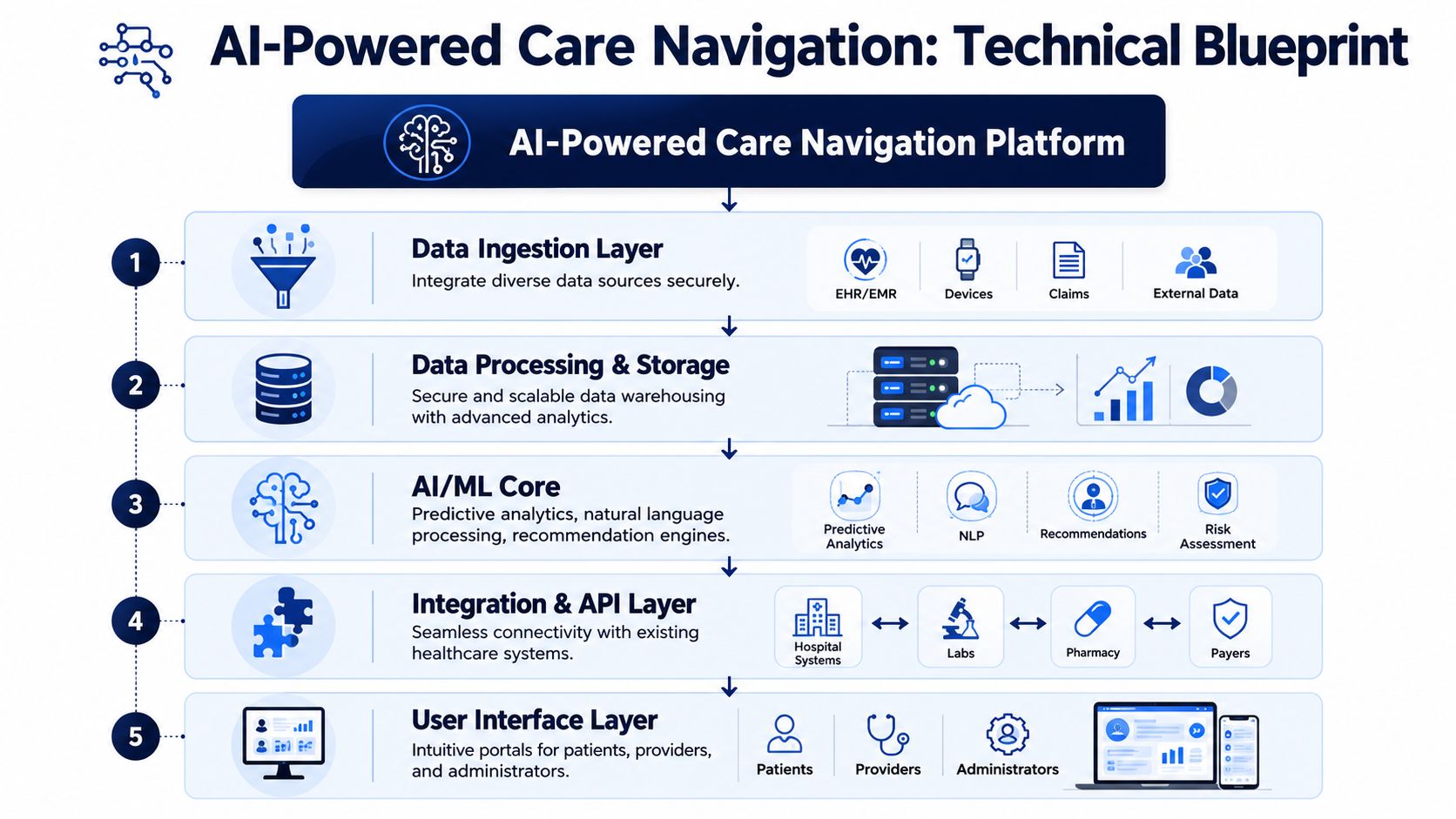
A production-grade system needs a layered design. Data enters from multiple clinical and administrative systems, gets normalized and governed, moves through AI services with policy constraints, and then gets delivered into channels patients and staff already use. If any layer is weak, the whole experience degrades quickly.
Build the ingestion layer for reality, not for demos
Real healthcare environments are messy. You'll ingest structured and unstructured data from EHRs, claims systems, scheduling platforms, contact centers, labs, imaging systems, CRM tools, and remote monitoring feeds. Some interfaces are modern APIs. Others aren't.
The data layer should support:
-
Structured feeds: Demographics, claims, authorizations, appointments, medication lists
-
Unstructured content: Clinical notes, referral text, patient messages, call transcripts
-
Operational signals: Waitlists, service availability, staffing constraints, network configuration
-
Consent and access controls: Role-based boundaries around what each agent or user can see
Architecture discipline is critical. If your source systems aren't harmonized, the model will generate plausible but unsafe guidance. Teams solving this well typically invest early in normalized event pipelines, terminology mapping, and audit-ready storage. For a deeper engineering view, the design patterns in this guide to healthcare data pipeline architecture are directly relevant.
Use domain-specific models and bounded workflows
General-purpose LLMs are useful, but they shouldn't be the primary clinical reasoning layer in a healthcare navigation product. The stack needs domain models, constrained prompts, retrieval layers, and explicit escalation logic.
Backend architectures for AI patient navigators increasingly rely on biomedical domain-specific LLMs such as BioMistral, which showed 37% higher factual accuracy on clinical queries than general-purpose LLMs, while sentiment-aware voice synthesis detected emotional distress with 88% sensitivity, according to this backend architecture review.
That doesn't mean one model does everything. In practice, strong systems separate responsibilities:
-
Intent and symptom parsing using NLU and clinical classification
-
Recommendation generation using retrieval-augmented, policy-bounded LLM flows
-
Risk detection and escalation using deterministic rules plus model outputs
-
Task orchestration for scheduling, referral routing, documentation, and follow-up
Architecture choice: Treat the LLM as one service inside a governed workflow, not as the workflow itself.
Deliver through existing channels
Care navigation wins when it shows up where users already are. That usually means embedding services into patient portals, mobile apps, payer member experiences, contact center tools, and care manager desktops.
A practical delivery stack often includes:
-
API orchestration to connect navigation logic to scheduling, eligibility, and referral systems
-
Omnichannel interfaces across web, mobile, chat, voice, and agent-assist surfaces
-
Observability for model outputs, fallbacks, escalations, and user drop-off
-
Human review queues for clinically sensitive cases and uncertain recommendations
This is also where solid healthcare integrations and mature AI development services become decisive. The platform has to be maintainable long after launch, not just technically impressive during procurement.
Navigating Clinical and Regulatory Guardrails
Compliance isn't the last workstream in AI-powered care navigation. It's part of the product architecture.
Healthcare buyers already know to ask about privacy, access control, and audit trails. The more important question is whether the system can justify how it made a recommendation, when it escalated to a human, and how it behaves across different populations. That's where many products still come up short.
Bias controls need to be designed in
A major underserved issue in AI-powered care navigation is the lack of transparent, auditable safeguards against algorithmic bias. Research has emphasized that without diverse data inputs reflecting race, ethnicity, language, and geography, AI systems can misidentify high-risk patients in underserved populations, as discussed in this equity-focused research article.
That risk isn't abstract. If the training data underrepresents a language group, if symptom phrasing varies by region, or if prior utilization patterns reflect historic access barriers, the model can optimize around a distorted picture of need.
What good guardrails look like
Product and engineering leaders should require more than policy statements. They should build reviewable controls into the delivery process.
A workable governance pattern usually includes:
-
Dataset review: Check representation across language, geography, and underserved cohorts before model training or tuning.
-
Decision traceability: Log which inputs, rules, retrieval context, and model versions shaped each recommendation.
-
Escalation thresholds: Push ambiguous, high-risk, or emotionally distressed cases to a human navigator or clinician.
-
Periodic audits: Evaluate outcome quality across patient segments, not just average performance.
If a team can't explain a routing decision after the fact, the system isn't ready for enterprise healthcare.
Compliance as a product advantage
Teams sometimes treat regulation as a drag. In this category, it's a moat.
An auditable system is easier to deploy with provider partners, easier to review with legal and clinical leadership, and easier to improve without causing silent regressions. Explainability also improves internal trust. Care managers and clinicians are more likely to use a system when they can see the recommendation logic and challenge it when needed.
This is one reason adjacent disciplines like AI-driven clinical decision support matter. The technical patterns overlap. Boundaries, review flows, and traceability all become part of the operating model.
Your Phased AI Implementation Roadmap
Most organizations shouldn't begin with enterprise-wide automation. They should begin with a narrow, high-friction journey where the operational burden is visible and the next-step logic can be governed clearly.
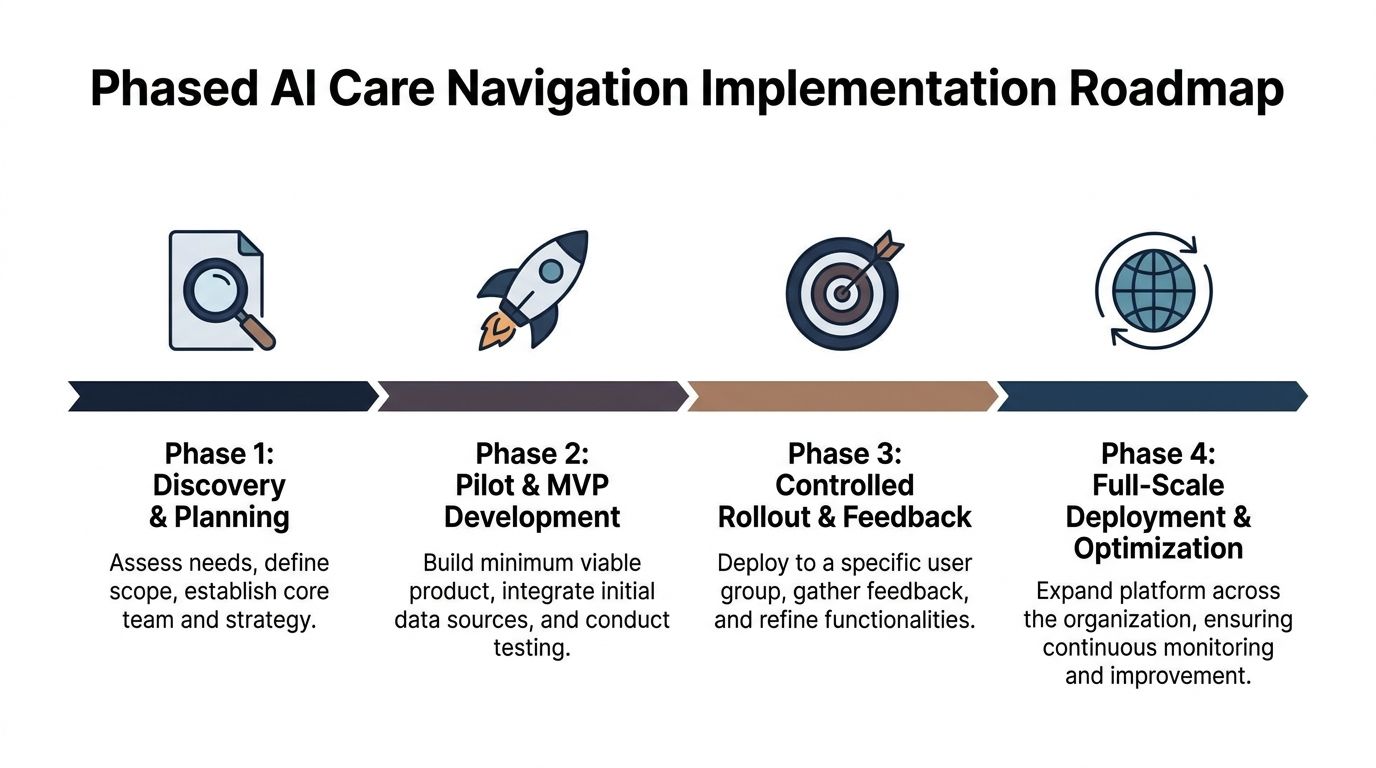
A phased rollout lowers risk, improves stakeholder confidence, and gives teams time to validate data readiness, workflow fit, and escalation behavior before broader deployment.
Phase one through phase four
Discovery and planning
Start by selecting one workflow where navigation failure is expensive and measurable. Good candidates include member guidance, symptom routing, referral leakage, or post-discharge follow-up.
Core tasks in this phase include:
-
Workflow mapping: Identify current-state handoffs, delays, manual interventions, and safety checkpoints
-
Stakeholder alignment: Bring together product, engineering, clinical, compliance, operations, and analytics leaders
-
Data assessment: Validate what sources exist, what permissions apply, and what data quality gaps need remediation
-
Success criteria: Define target outcomes, escalation rules, and essential compliance requirements
A formal AI implementation roadmap helps. It forces teams to sequence governance, architecture, and delivery rather than trying to solve all three reactively.
Pilot and MVP development
Build a bounded product, not a broad platform. The MVP should solve one navigation problem well, with explicit guardrails and limited system dependencies.
The most useful pilot features often are:
-
guided intake
-
routing recommendation
-
human escalation
-
summary generation for the next care touchpoint
-
instrumentation for drop-off and override analysis
The engineering decision that matters most here is scope discipline. If the MVP includes too many channels, too many patient cohorts, or too much autonomous action, teams lose the ability to debug what worked.
Controlled rollout and feedback
Deploy to a defined population, service line, payer segment, or geography. Give care managers and operational users a clear override path. Review recommendations in the early period with both product and clinical stakeholders.
A healthy feedback loop should capture:
| Area | What to review |
|---|---|
| Safety | Escalations, uncertain outputs, override frequency |
| Experience | User comprehension, abandonment, repeated queries |
| Operations | Staff handoff effort, scheduling completion, exception volume |
| Model quality | Misclassifications, prompt failures, retrieval gaps |
Rollout succeeds when the organization learns quickly. Not when the first release looks polished.
Full-scale deployment and optimization
After the pilot proves out, scale by adding channels, populations, and workflow depth. This is also the point to formalize operating ownership, versioning, retraining triggers, and incident management.
Organizations vary in how they resource this work. Some need embedded teams. Some need pod-based delivery. Some need platform modernization before AI can scale safely. That's where flexible software development service models become useful, especially when paired with broader custom software development support.
For product-led companies building a reusable care navigation platform, this roadmap also overlaps with disciplined SaaS product development, particularly around tenancy, compliance boundaries, and configurable workflows.
Defining Success with KPIs and Tangible ROI
AI-powered care navigation gets funded when it proves two things. It improves outcomes that leadership cares about, and it reduces waste that finance can see.
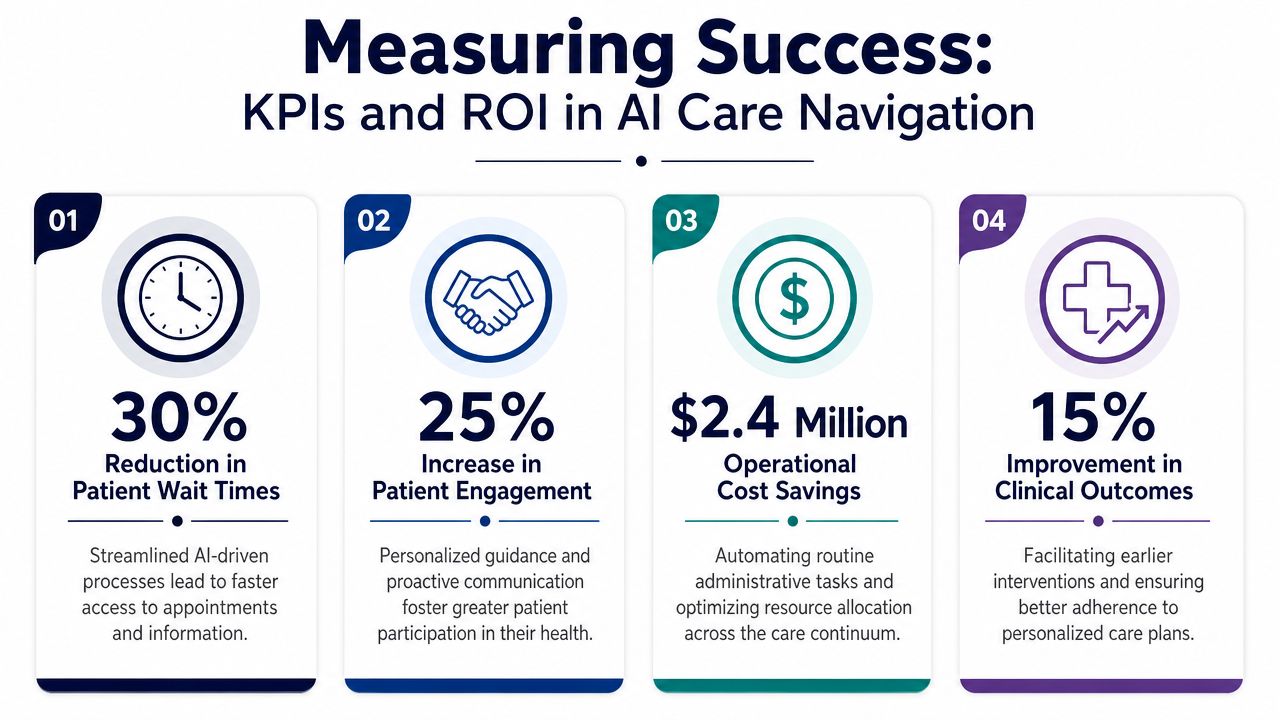
The strongest business case in the category comes from measurable utilization and adherence improvements. AI-powered care navigation has delivered 3:1 to 8:1 ROI for leading payer organizations, alongside a 25% to 40% reduction in emergency room visits, a 20% to 35% decrease in hospital readmissions, and a 30% to 50% improvement in medication adherence, according to this payer ROI analysis.
The KPI set that matters
Not every metric belongs on the executive dashboard. The useful set ties navigation activity to operational and clinical outcomes.
| KPI | Why it matters |
|---|---|
| Emergency room deflection | Shows whether triage and routing reduce avoidable high-cost utilization |
| Readmission reduction | Indicates whether follow-up and continuity workflows are working |
| Medication adherence | Captures whether reminders, education, and care-path nudges change behavior |
| Navigation completion rate | Reveals whether users actually reach a resolved next step |
| Human escalation quality | Measures whether high-risk cases are handed off appropriately |
| Administrative effort per case | Tracks whether the platform removes staff workload rather than adding review burden |
How to interpret ROI without fooling yourself
The common mistake is to count only interaction volume. A navigation assistant can be heavily used and still create no enterprise value if it doesn’t alter downstream utilization or remove work from staff.
A more grounded ROI model looks at three buckets:
-
Medical cost impact: Lower avoidable ER use, fewer readmissions, better adherence
-
Operational efficiency: Less manual triage, fewer redundant contacts, cleaner handoffs
-
Experience improvement: More confidence, less friction, better continuity
This is also why buyers increasingly group these programs under broader enterprise AI solutions rather than treating them as isolated digital front doors. The value spans departments. So should the measurement model.
AI Care Navigation in Action
The clearest way to evaluate AI-powered care navigation is by looking at how different buyers use the same architectural pattern for different business goals.
A healthtech startup building a chronic care product
A startup building for diabetes, heart failure, or oncology support usually starts with a narrow journey. Patients need reminders, symptom escalation, education, and guidance on when to seek care. The product team often wants a configurable rules engine plus conversational AI that can adapt to different partner programs.
What works is a product that combines patient messaging, care-path logic, and human escalation from day one. What doesn’t work is launching with a generic assistant and trying to retrofit clinical workflow later. Startups in this position need a platform mindset early, especially if they plan to sell into providers or payers with different integration requirements.
A payer reducing friction and unnecessary utilization
Payers have a different problem. Members don’t understand benefits, they struggle to choose the right site of care, and they often hit the contact center before they find an answer.
A strong payer implementation focuses on benefit-aware navigation. The system should interpret the member’s need, explain covered pathways, surface in-network options, and trigger outreach when a care gap appears. The upside comes from fewer costly misroutes and a better member experience. The challenge is policy complexity. Product teams have to encode coverage logic carefully and keep it current.
The most effective payer systems don’t just answer “Where should I go?” They answer “What should I do next, and will this be covered?”
A hospital system improving flow and staff efficiency
Hospitals usually feel the pain in throughput and administrative load. Navigation failures show up as repeated calls, poorly prepared visits, referral leakage, and discharge follow-up gaps.
Here, the best use case is often internal orchestration. AI can summarize context for staff, route patients to the right service line, and keep post-visit guidance moving. The weak pattern is to deploy a patient-facing assistant without aligning scheduling rules, referral teams, and service capacity underneath it.
Leaders evaluating similar programs should compare their own roadmap against relevant client cases. The important question isn’t whether another organization used AI. It’s whether they solved the same workflow bottleneck under similar clinical and integration constraints.
Frequently Asked Questions on AI Care Navigation
Can a clinic with limited IT infrastructure adopt AI care navigation?
Yes, but the rollout has to be narrower and more disciplined. This approach is critical as only 15 to 20% of safety-net health systems have successfully implemented generative AI, largely due to funding and expertise barriers, as discussed in this analysis of patient benefits and adoption gaps.
The practical path is to start with one workflow, use a limited integration footprint, and avoid building for every channel at once. In these environments, cloud-managed components, simple staff-facing workflows, and strong human fallback paths usually matter more than advanced autonomy.
How should startups design for under-resourced clinics?
Build for constrained environments from the beginning. That means lower integration assumptions, configurable workflows, multilingual support, and transparent escalation. Don’t assume every clinic can support deep EHR customization or full-time model operations.
A design that works in a large enterprise may fail in a safety-net setting if it depends on extensive implementation services or high internal technical maturity.
How do these systems integrate with legacy EHR and billing tools?
The safest pattern is incremental integration. Start with read access where possible, clear API contracts, and a bounded workflow such as intake, triage support, or follow-up guidance. Avoid making the first release dependent on every downstream system.
Legacy estates can support navigation well enough if the product team separates must-have integrations from later enhancements and keeps a manual fallback for critical actions.
What is a realistic first deployment scope?
A realistic first scope is one patient journey, one user group, and one clear operational owner. The goal is to validate recommendation quality, workflow fit, and auditability. After that, teams can expand channels, populations, and automation depth with much lower execution risk.
If you’re evaluating AI-powered care navigation and need a partner that can handle compliant product engineering, healthcare integration complexity, and audit-ready AI delivery, Bridge Global can help. Their teams support everything from discovery and architecture to scalable platform builds, whether you need a focused MVP or a broader transformation program. Before publishing, it’s also smart to review existing blog URLs, avoid duplicate slugs, and keep related content connected through relevant internal links and supporting guides.

About Preethi Saro Philip
Preethi Saro Philip is a Post Graduate Research Degree holder in Economics with more than 10 years of experience in writing, editing, research and teaching. She has an intense passion for content crafting and calls herself a ‘wordsmith’. She enjoys writing on wide-ranging topics including business, technology, health & lifestyle, education, environment etc.
View all posts by Preethi Saro Philip →