



Unlocking Growth with AI in Ecommerce Personalization
Picture this: an online store that seems to know exactly what you’re looking for, sometimes even before you do. That’s the magic of AI in ecommerce. It turns a simple digital catalog into a dynamic, personal shopping journey. It’s the difference between wandering through a massive library alone and having an expert librarian who knows your taste and points you to the perfect book.
The New Age of Smart Shopping
Artificial intelligence isn’t some far-off, futuristic idea anymore; it’s a fundamental part of a successful online retail business today. AI allows shops to move away from one-size-fits-all marketing and create truly personal experiences for every single customer. It’s the engine running under the hood of any modern, intelligent storefront.

Why AI Is Essential for Growth
The numbers speak for themselves. The global market for AI in ecommerce is set to explode, jumping from $8.65 billion in 2025 to a massive $22.6 billion by 2032. This isn’t just hype; it reflects how critical AI has become for analyzing huge amounts of data in real-time and scaling operations. You can dig deeper into these AI trends and their impact on Shopify.
By bringing in smart systems, businesses can stop just looking at past sales and start predicting what customers will do next. Instead of reacting, you can be proactive. As a long-time AI solutions partner, we’ve seen this shift deliver real, measurable results for our clients time and again.
So, what does this look like in practice? AI touches almost every corner of an ecommerce business:
- For your customers: It means getting product recommendations that feel spot-on, finding exactly what they want with intelligent search, and getting instant help from smart chatbots, day or night.
- For your business: It means more accurate inventory forecasting, catching fraud before it happens, and automating tricky supply chain logistics.
Moving from Theory to Practice
Getting started with AI doesn’t mean you have to rip everything up and start over. You can begin with small, focused improvements that solve real problems. For instance, adding a simple AI recommendation engine can give your average order value an immediate boost. As we’ve detailed in our guide on implementing AI in business, taking it one step at a time is usually the best way to go.
The real aim here is to build a shopping environment that’s smooth, intuitive, and incredibly responsive. AI gives you the tools to truly understand what your customers want and to deliver value at every step, from the moment they land on your site to long after they’ve made a purchase.
This guide will walk you through the most important uses of AI and give you a clear roadmap for bringing it into your own business. Whether you’re thinking about custom software development or integrating off-the-shelf tools, the first step is understanding what’s possible.
How AI Reshapes the Customer Journey
Let’s get practical and look at how AI actually works to create shopping experiences people remember. This isn’t just about backend code; AI actively guides customers from the moment they land on your site to the final click at checkout. The goal is to make every step feel so natural and personal that it builds real brand loyalty.
This shift happens at a few critical points, starting with the products a customer sees. By weaving smart technology into the shopping experience, you can turn a simple transaction into a helpful conversation.

Personalized Recommendation Engines
Imagine having a personal stylist for every single customer. That’s what a good AI recommendation engine does. It looks at a user’s complete history, what they’ve browsed, what they’ve purchased, and even what they’ve scrolled past, to surface products they’ll genuinely want. It’s no surprise that retailers who get this right often see a 40% bump in revenue.
These engines are much smarter than the old “customers who bought X also bought Y” logic. They use complex algorithms to spot subtle connections, creating recommendations that are surprisingly relevant and help shoppers discover new things. This doesn’t just drive more sales; it makes people feel like you truly get their style.
Intelligent Search and Visual Discovery
We’ve all been there: you type something into a search bar and get a page of useless results. AI-powered search fixes that by understanding what you mean, not just what you type. A customer can search for “durable hiking boots for rocky trails,” and the AI is smart enough to prioritize features like grip and ankle support. It understands intent.
Visual search takes this a step further. Someone can snap a picture of a jacket they love on Instagram and upload it to find similar items in your store. Suddenly, real-world inspiration becomes a direct path to a sale. It’s a game-changer for discovery, with AI-driven shopping tools like virtual try-ons and personalized picks making it easier than ever for customers to find and visualize products.
Dynamic Pricing Strategies
Pricing is always a tough balancing act. AI gives you the data to nail it. Dynamic pricing algorithms constantly analyze real-time market data—competitor prices, customer demand, current inventory levels, even the weather—to adjust prices on the fly.
This means you can stay competitive without slashing your margins. For example, an algorithm might slightly raise the price of a popular item during a weekend flash sale or apply a smart discount to move older stock.
The result is a pricing strategy that’s nimble, informed by data, and built for profitability. It takes the guesswork out of the equation and lets you react to market changes in an instant.
AI-Powered Chatbots and Support
Great customer service is essential, but a 24/7 human support team is a huge expense. AI chatbots step in to fill that role, successfully handling about 70% of conversations from start to finish. We’re not talking about the clumsy, frustrating bots from a few years ago. Today’s chatbots can answer complex queries, help users find products, and give instant updates on shipping.
As we explored in our guide on generative AI and its role in ecommerce, these tools are evolving into conversational assistants. They can even suggest products based on a user’s described needs. This immediate, helpful support builds confidence and can be the difference between a completed purchase and an abandoned cart.
Boosting Your Back-End Operational Efficiency
It’s easy to focus on the flashy, customer-facing parts of AI—the personalized storefronts and slick chatbots. But the real game-changer for your bottom line is often working quietly behind the scenes. This is where AI brings serious efficiency gains, slashes costs, and builds a rock-solid operational foundation for your entire business.
Think of these back-end operations as the engine of your retail machine. AI is the high-performance fuel that makes it run smoother, faster, and with way fewer breakdowns.
Predictive Inventory Management
Nothing kills momentum like a “sold out” sign on a trending product. On the flip side, a warehouse crammed with last season’s styles is just dead capital. AI-powered inventory management tackles this classic retail headache, turning forecasting from a gut-feel guessing game into a precise science.
Instead of just looking at last year’s sales figures, AI algorithms digest a huge menu of variables in real time. We’re talking about:
- Historical sales data and seasonal cycles.
- Current market trends and what your competitors are stocking.
- Upcoming holidays, marketing promotions, and even the weather forecast.
By spotting subtle patterns across all this data, AI can predict what customers will want with incredible accuracy. This isn’t a minor tweak; AI-driven forecasting can slash stockouts by 35% and cut overstock situations by 20%. That’s money straight back into your pocket. For a closer look at the data, you can discover more insights on AI’s future in ecommerce.
AI-Driven Fraud Detection
As online shopping grows, so does the risk of fraud. The old-school, rule-based systems just can’t keep up. They either miss clever scams or, even worse, block legitimate customers, creating a ton of frustration. AI provides a much smarter, more agile defense.
In the milliseconds it takes to process a payment, machine learning models analyze thousands of data points. They hunt for tiny red flags in user behavior, device IDs, and transaction patterns that a human could never hope to catch. If the system spots high-risk activity, it can instantly flag the order for a second look or block it outright. This protects your revenue and, crucially, builds customer trust by keeping their information safe.
The best part is that AI learns on the job. As fraudsters get more creative, the AI model adapts its own tactics, making sure your defenses are always a step ahead of the bad guys.
Optimizing the Entire Supply Chain
Your supply chain is a messy web of suppliers, warehouses, and shipping routes. AI can step in as the central command, untangling logistical knots to find the fastest, cheapest path from your warehouse to your customer’s front door.
For instance, AI can plan delivery routes that account for real-time traffic, weather, and delivery schedules, saving big on fuel and time. It can also see potential logjams in the supply chain before they happen, giving you time to reroute shipments and avoid frustrating delays. By looking at the entire network, AI ensures your products move quickly and reliably, which is exactly what today’s customers expect.
Bringing AI for your business into the fold is more than just a marketing tactic; it’s a full operational upgrade that delivers value from the warehouse to the balance sheet.
Operational Impact of AI in Ecommerce
The table below shows just how different things look when you swap out old manual processes for AI-driven systems. It’s a clear shift from reactive problem-solving to proactive optimization.
| Operational Area | Traditional Method | AI-Enhanced Method | Key Benefit |
|---|---|---|---|
| Inventory Management | Manual forecasting based on historical sales data | Predictive analysis of sales, trends, and external factors | Reduced stockouts and overstock, freeing up capital |
| Fraud Detection | Static, rule-based filters that require manual updates | Real-time behavioral analysis and pattern recognition | Lower fraud losses and fewer false positives |
| Supply Chain | Fixed routes and manual scheduling | Dynamic route optimization and predictive logistics | Faster delivery times and reduced operational costs |
Ultimately, integrating AI into your back-end isn’t just about doing the same things faster. It’s about fundamentally changing how you operate for the better, building a more resilient and profitable business in the process.
Your Blueprint for AI Implementation
So, you’re ready to bring AI into your ecommerce business? Great. But moving from a cool idea to a real-world tool that actually makes you money requires a solid game plan. This blueprint breaks down the journey into straightforward, manageable stages to ensure your AI initiatives deliver real value right from the start.
This flowchart gives you a high-level view of how AI can connect the dots between key parts of your operation, from inventory and fraud detection to logistics.
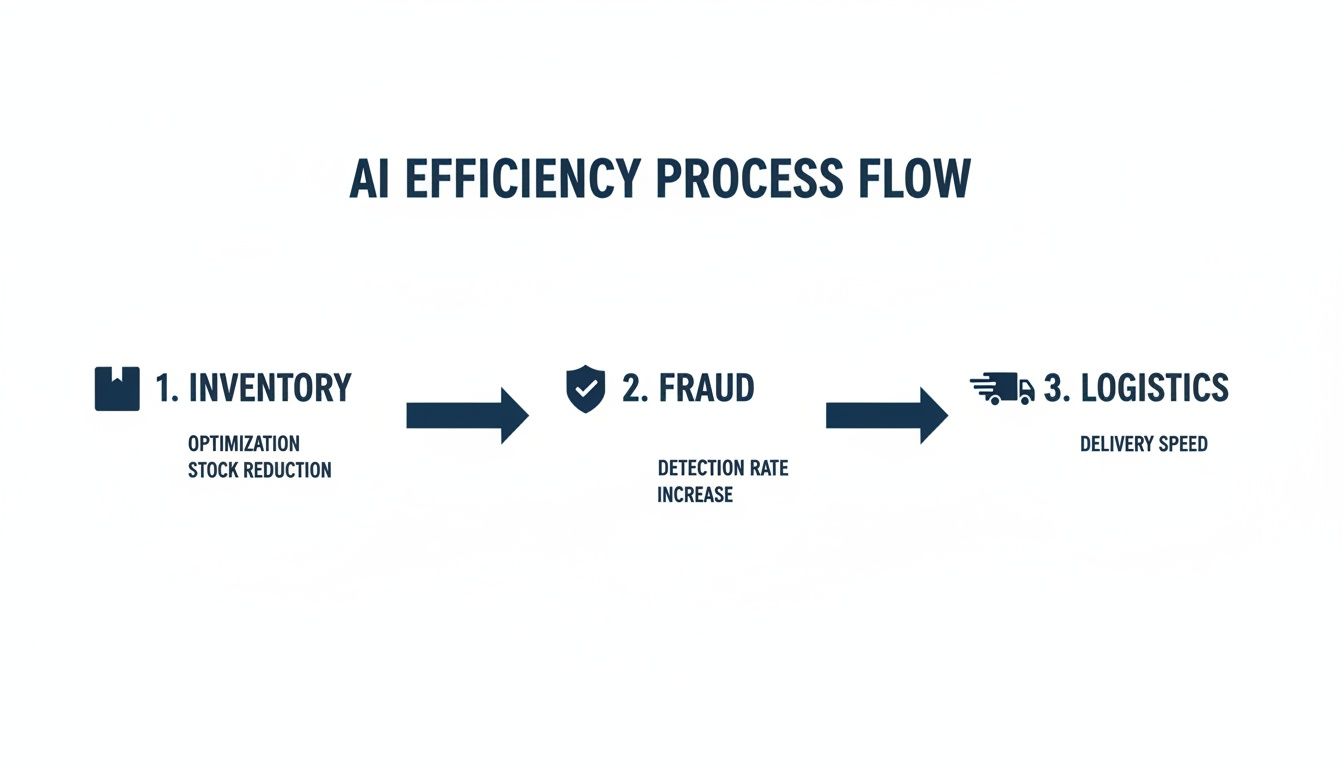
As you can see, it creates a powerful cycle. Smarter inventory management leads to faster, more efficient logistics, and the entire process is shielded by robust fraud detection.
First Things First: Define Your Business Goals
Before you even think about algorithms or platforms, you need to answer a simple question: What problem are you actually trying to solve? Forget vague goals like “using AI.” Get specific and focus on tangible outcomes.
Are you trying to:
- Bump up the average order value by 15%?
- Figure out why shoppers are abandoning their carts and reduce that number?
- Slash customer service response times in half?
Pinpointing a clear goal is everything. It becomes your North Star, guiding every decision and making sure your investment is tied directly to a business result you can measure. A well-defined objective keeps the project on track and stops you from getting distracted by shiny new tech.
Next: Evaluate Your Data Readiness
Think of data as the fuel for your AI engine. Without it, you’re going nowhere. Before you can build a single thing, you have to get honest about the state of your data. An AI model is only as smart as the information it’s trained on, making this a critical, non-negotiable step.
Ask yourself these questions:
- Is our customer and sales data clean, organized, and free of glaring errors?
- Can we pull data easily from different systems like our website, CRM, and inventory platform?
- Do we have enough historical data for an AI to actually spot meaningful patterns?
You can have the most sophisticated AI tools on the planet, but they’ll fall flat without a solid data foundation. Honestly, preparing your data is often the most time-consuming part of any AI project, but it’s absolutely essential.
Choose the Right Tools and Partners
With clear goals and your data in order, it’s time to figure out how you’ll build your solution. You could go with an off-the-shelf AI tool from your ecommerce platform or opt for a custom-built solution for a perfect fit. The right path really depends on your budget, timeline, and how complex your goals are.
This is often the point where bringing in an experienced AI partner makes a huge difference. They can help you navigate the tricky “build vs. buy” decision, pick the right technologies, and steer you clear of common mistakes that can sink a project.
Pro Tip: Don’t try to boil the ocean. A phased rollout is the smartest way to start. Kick things off with a small, high-impact pilot project. It lets you test your approach, learn quickly, and show a fast return on investment before you go all-in.
Finally: Measure, Iterate, and Scale
Launching your AI solution isn’t the finish line; it’s the starting gun. The real value comes from constant refinement. You have to track your initial KPIs like a hawk to see what’s working and what isn’t. Use A/B tests to compare the AI-powered experience against your old baseline, and use that real-world performance data to fine-tune your models.
The pace of AI adoption is picking up fast, by 2028, a third of online retailers are expected to be using autonomous agents. These systems are already handling complex jobs like store analytics and inventory optimization, freeing up human teams for more creative, strategic work.
Once your pilot project proves its worth, you can scale it across the rest of your business with confidence. This cycle of measuring, learning, and expanding is how you build a truly intelligent ecommerce operation. For a closer look at this process, check out our guide on the practical steps for implementing AI in business.
Navigating Common Challenges in AI Adoption
Bringing AI into your ecommerce business is a game-changer, but the path isn’t always a straight line. Like any major upgrade, you’re bound to hit a few bumps. But with a clear-eyed strategy, you can turn these challenges into stepping stones for a successful rollout.
Thinking about these obstacles upfront is the secret to building a resilient AI foundation. By preparing for the most common issues, you can craft a realistic plan that sidesteps costly surprises later.
Data Privacy and Security Concerns
In an age of hyper-awareness around data, protecting customer information is non-negotiable. AI systems need massive amounts of data to learn and make smart decisions, which naturally brings up serious questions about privacy and security. Your customers have to trust that you’re handling their information responsibly.
The key to earning and keeping that trust is transparency. This means:
- Creating clear data policies that explain exactly what information you collect and how your AI systems use it.
- Implementing rock-solid security protocols to protect that data from breaches.
- Ensuring compliance with regulations like GDPR and CCPA right from the start.
As we’ve covered in our guide on responsible AI implementation, an ethical approach isn’t just about following the law; it’s a powerful way to build lasting customer loyalty.
High Initial Implementation Costs
The price tag on advanced AI tools can look intimidating, especially for businesses new to the game. The costs of software, specialized talent, and the right infrastructure can add up fast, making it tempting to put the whole thing off. The problem is, the cost of doing nothing is often much higher.
The best approach is to think big but start small. Instead of a massive, company-wide overhaul, kick things off with a focused pilot project aimed at a high-impact business problem. Proving a clear and quick ROI on a smaller scale makes it much easier to get the green light for bigger investments down the road.
This method minimizes your initial risk while showing real, tangible value early on.
The Internal Skills Gap
Even the most powerful AI tools are just expensive toys without skilled people to run them. Many companies realize they just don’t have the in-house expertise needed to implement and maintain complex AI systems. This leads to a critical decision: do you train your current team or bring in outside specialists?
Often, a hybrid approach works best. Investing in training for your team builds your long-term capabilities, while partnering with an expert firm gives you immediate access to deep knowledge and experience. An AI solutions partner can speed up your timeline, help you dodge common mistakes, and ensure your project is built on a solid technical foundation from day one.
Integrating with Existing Systems
Your business already runs on a complex network of software—your ecommerce platform, CRM, inventory management system, and so on. Trying to jam a new AI tool into this ecosystem without a solid plan can cause major headaches. A poorly planned integration can create data silos, break workflows, and leave your team frustrated.
The solution is all in the planning. A thorough integration strategy, often developed with experts in custom software development, ensures your new AI tools can talk to your current systems without a hitch. As our client cases show, tackling these integration challenges head-on is fundamental to unlocking what AI can really do for you.
So, What’s the Bottom Line?
If you’ve made it this far, one thing should be crystal clear: AI in ecommerce isn’t some far-off concept anymore. It’s here, and it’s fundamentally changing how business gets done. We’re talking about creating truly personal shopping experiences and running your back-end operations with incredible efficiency. It’s the difference between a good store and a smart, responsive one.
The core idea is this: AI gives you the tools to build a business that can last and stand out. It hands your team the data-backed insights they need to stop putting out fires and start thinking strategically about what’s next. And honestly, the time to get started was yesterday. The gap between businesses using AI and those who aren’t is growing wider every day.
Ready to Build Your Smart Ecommerce Future?
Think of Bridge Global as your guide on this journey. We’re an AI solutions partner that’s all about turning the idea of AI into actual, measurable results for your bottom line. We handle everything from the initial “what if” conversations to a full-scale rollout, making sure it all works perfectly with your current setup thanks to our deep expertise in custom software development.
We’ve designed our services to meet you exactly where you are right now:
- Discovery Workshops: Let’s sit down together and pinpoint the AI projects that will give you the biggest bang for your buck.
- Expert Development: Our teams don’t just write code; they build powerful, custom ecommerce development solutions designed for your specific challenges.
- End-to-End Support: We’re with you from the first sketch on a whiteboard to launch day and all the days that follow.
Don’t just take our word for it, our client cases show what we’ve been able to accomplish for businesses just like yours.
When you bring AI into your business, you’re doing more than just adding a new tool. You’re investing in a smarter, more customer-focused, and more resilient way of operating. In a market this competitive, that kind of forward-thinking isn’t just nice to have—it’s essential.
We’re ready to help you put these ideas into action with our expert AI development services. Let’s build a smarter future for your business, together.
FAQ: Your AI in Ecommerce Questions Answered
How can a small business start with AI on a limited budget?
You don’t need a massive budget to begin. Start small and focus on high-impact areas. Many ecommerce platforms like Shopify offer built-in AI tools or app integrations for product recommendations, customer support chatbots, and marketing automation. Leveraging these existing tools is a cost-effective way to test the waters before investing in fully custom ecommerce solutions.
What is the most critical factor for successful AI implementation?
Data quality. Hands down, the success of any AI initiative hinges on the quality and accessibility of your data. An AI model is only as good as the information it’s trained on. Before you invest in any new technology, ensure your customer, product, and sales data is clean, organized, and integrated. Garbage in, garbage out is the golden rule of AI.
Will AI replace human jobs in ecommerce?
AI is more likely to augment human roles rather than replace them. It excels at handling repetitive, data-intensive tasks like analyzing sales trends, detecting fraud, and managing inventory. This frees up your human team to focus on strategic, creative, and customer-facing work that requires empathy and complex problem-solving—areas where humans still outperform machines.
How do you measure the ROI of an AI investment?
Measure the return on investment by tracking specific, tangible key performance indicators (KPIs) tied to your initial goals. For example, if you implemented an AI recommendation engine, track metrics like average order value (AOV), conversion rate, and customer lifetime value. If you deployed an AI chatbot, measure customer satisfaction scores (CSAT) and first-response times. Comparing these metrics before and after implementation will give you a clear picture of the financial impact of AI for your business.
Ready to see what intelligent automation can do for your online store? At Bridge Global, we don’t just talk about AI, we build powerful, practical solutions that drive real business results. Reach out to our experts to start your AI journey with a discovery workshop.

About Preethi Saro Philip
Preethi Saro Philip is a Post Graduate Research Degree holder in Economics with more than 10 years of experience in writing, editing, research and teaching. She has an intense passion for content crafting and calls herself a ‘wordsmith’. She enjoys writing on wide-ranging topics including business, technology, health & lifestyle, education, environment etc.
View all posts by Preethi Saro Philip →