



AI-Enabled Healthcare Workflows: A Practical Implementation
Half of surveyed U.S. healthcare leaders said their organizations had already implemented generative AI by Q4 2025, the first major survey milestone to reach that threshold. Yet implementation isn't the same as workflow value. Healthcare organizations are discovering that an AI tool can perform its assigned task accurately and still fail to improve care, administration, or clinician workload if it doesn't fit the systems and decisions surrounding that task.
AI-enabled healthcare workflows succeed when they connect patient context, human judgment, operational rules, and downstream actions. They stall when they remain isolated assistants beside the care process. The practical challenge for CTOs and product leaders is no longer proving that a model can summarize, classify, or predict. It's engineering a safe, measurable path from a narrow win, such as ambient documentation, to broader automation across clinical and administrative operations.
The State of AI-Enabled Healthcare Workflows in 2026
The adoption curve has moved quickly. In Q1 2024, more than 70% of healthcare organizations said they were pursuing or had implemented generative AI capabilities. By Q4 2025, 50% of surveyed U.S. healthcare leaders said their organizations had implemented generative AI, compared with 47% in Q4 2024 and 25% in Q4 2023. Those figures, reported in the healthcare AI adoption and clinician insights report, signal a shift from experimentation toward operational use.
Physician behavior is changing alongside enterprise adoption. A 2026 physician survey reported that over 80% of physicians currently use AI professionally, nearly doubling from 2023, while the number of use cases per physician rose to 2.3 from 1.1 in 2023. That doesn't mean every organization has an AI operating model. It means clinicians and teams are encountering AI inside more parts of their working day, often through tools purchased by departments rather than designed as a coordinated enterprise capability.

Adoption isn't the same as scale
A major 2025 survey of 43 health systems found adoption activity across healthcare workflows, but success varied substantially by use case. Ambient documentation was the only use case where 100% of respondents reported adoption activity, and 53% reported a high degree of success with AI for clinical documentation. Imaging and radiology were the most widely deployed clinical AI areas, with 90% of organizations reporting at least partial deployment. By contrast, only 38% reported high success for sepsis-risk stratification and other clinical risk tools, according to the health systems AI adoption survey.
The difference is architectural as much as statistical. Documentation assistance usually produces a draft that a clinician can review, edit, and approve within an established workflow. Risk stratification can influence prioritization, escalation, and clinical attention, so it requires stronger data quality, monitoring, explanation, and accountability.
Healthcare leaders should therefore ask a more useful question than “Where can we use AI?” Ask where the organization can provide reliable data, clear ownership, human review, and a measurable downstream action. Our guide to AI-powered care navigation develops that same workflow-first perspective.
Practical rule: Treat adoption as evidence of interest. Treat repeatable, governed completion of a real workflow as evidence of scale.
Clinical and Operational Use Cases With Proven Impact
The strongest early use cases share a practical characteristic: they reduce repetitive work without asking the model to make an unreviewed high-stakes decision. Ambient documentation is a good example. A randomized trial involving 238 physicians and 72,000 encounters found that one ambient documentation tool reduced note-writing time by about 41 seconds per note, compared with 18 seconds in the control group, with an estimated 9.5% larger reduction than usual care. The results appear in the JAMIA study of ambient documentation efficiency.
A separate EHR-based study involving 167 physicians found daily documentation time fell from 55.97 to 49.13 minutes, while note-writing time declined from 6.37 to 5.58 minutes. The engineering lesson is important. Value came from reducing after-visit charting burden, not merely making individual keystrokes faster.
Use-case sequencing matters
Imaging and radiology have reached broad partial deployment, but they still require careful integration with PACS, reporting workflows, escalation rules, and clinician interpretation. Administrative automation is another attractive area. Menlo Ventures reports that front-office revenue-cycle management administrative services represent $98 billion annually, while software represents only 3% of that spend. That gap points to a large opportunity for workflow-native automation, particularly where teams still process documents, authorizations, claims, and coding tasks manually.
Higher-risk clinical decision support deserves a slower sequence. Sepsis-risk stratification and similar clinical risk tools can produce valuable signals, but the signal must enter a documented decision pathway with clear responsibility for review and action. A dashboard that displays a score without routing, escalation, and audit logic is not a complete workflow.
Healthcare AI Use Case Maturity Matrix
| Use Case | Deployment Rate | High Success Rate | Integration Complexity |
|---|---|---|---|
| Ambient documentation | Adoption activity reported by 100% of surveyed health systems | 53% | Moderate |
| Imaging and radiology | At least partial deployment reported by 90% of organizations | Not specified in the verified survey data | High |
| Sepsis-risk stratification and other clinical risk tools | Not specified in the verified survey data | 38% | High |
| Front-office revenue-cycle management | Large service-heavy market, with software representing 3% of $98 billion annual spend | Not specified | Moderate to high |
Start with workflows where the model drafts, extracts, routes, or recommends, and where a trained user can review the result before it changes a record or triggers an external action. That sequencing creates operational learning without placing the first production release at the most difficult point of clinical risk.
Reference Architectures and Integration Patterns
A reliable healthcare AI architecture begins with integration, not the model. If the pilot uses manually exported files, a separate login, or a temporary data feed, the team hasn't tested the production workflow. It has tested a demonstration around the workflow.
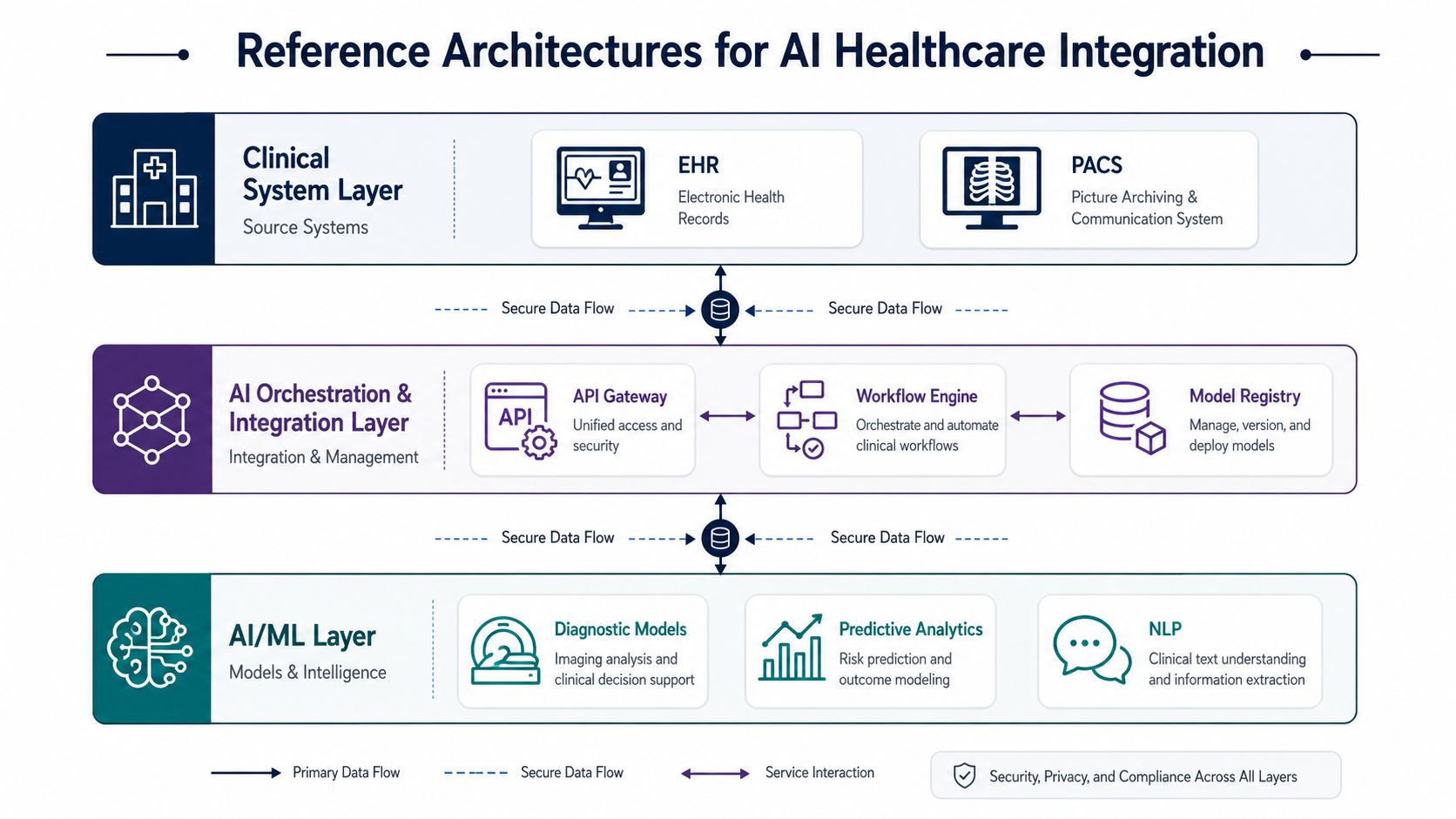
Build the data path first
A practical reference architecture has three layers:
-
Clinical system layer: Connect the EHR, PACS, laboratory systems, scheduling platform, devices, and relevant payer or administrative systems. Use FHIR R4 interfaces for priority clinical domains, as recommended in this healthcare AI adoption roadmap, while retaining HL7 interfaces where legacy systems require them.
-
AI orchestration and integration layer: Place an API gateway, workflow engine, identity controls, event handling, and model registry between clinical systems and AI services. This layer should normalize inputs, apply authorization rules, route work to the appropriate model, and return outputs to the system where users already act.
-
AI and machine learning layer: Separate diagnostic models, predictive analytics, NLP services, retrieval components, and generative models from the workflow logic. A model should be replaceable without rewriting the clinical integration layer.
A data warehouse or lakehouse can feed analytics and model development, but it shouldn't become an excuse to delay transactional integration. Real-time events may be appropriate for urgent routing or device signals. Batch processing may be safer for retrospective population analysis, reporting, and model evaluation. Make that choice from the workflow's timing and risk requirements, not from the model vendor's default architecture.
Keep context and control explicit
Use patient and encounter identifiers to bind related events, but enforce role-based access before an AI service receives protected information. Store the source record, model version, prompt or instruction set where relevant, output, reviewer, edits, approval status, and downstream action. That audit trail allows teams to investigate whether a failure came from missing data, incorrect retrieval, a model error, or an integration rule.
Point-to-point connections often work during a pilot because one team controls every dependency. They become brittle when more departments, models, or EHR instances appear. An orchestration layer with versioned APIs and workflow states gives product and engineering teams a safer place to change behavior. The healthcare integration architecture guide provides a related view of how to structure those boundaries.
Compliance, Data Governance, and Workflow Validation
Model accuracy is necessary, but it isn't the definition of a successful healthcare workflow. 55% of healthcare and life sciences leaders reported that AI outputs were accurate but failed to fit workflows. An accurate summary that arrives after the clinician has closed the encounter, or a correct recommendation that lacks an approval route, has limited operational value.
The validation target must therefore expand from output quality to action appropriateness, process safety, and resource stewardship. A 2026 benchmark for long-horizon healthcare agents evaluates automation across prior authorization, utilization management, and care management, while a PLOS Medicine framework argues that useful benchmarks should measure the full decision trajectory. The process-aware healthcare agent benchmark captures the direction of travel: enterprise teams need to evaluate whether the system completes the right process safely, not only whether a single response looks plausible.
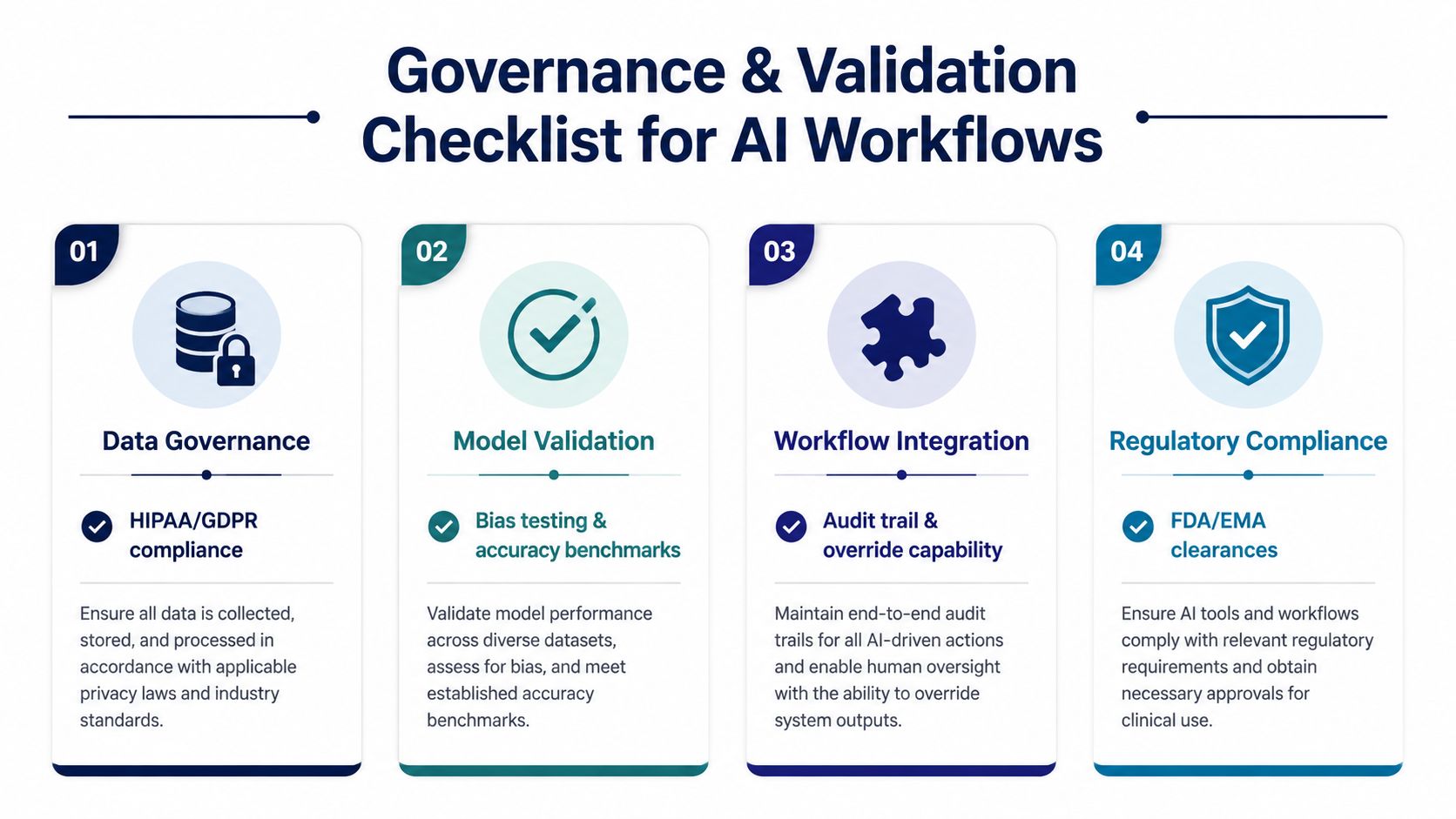
Put governance inside the delivery lifecycle
A workable governance model assigns named owners for data, clinical safety, security, compliance, product decisions, and model operations. It defines which actions require human approval, which users can access which data, and what happens when the model is unavailable or uncertain.
Regulatory uncertainty was cited as a barrier by 40% of health systems in the major adoption survey, alongside immature AI tools at 77% and financial concerns at 47%. Those barriers aren't solved by adding a policy document after launch. Teams should record intended use, excluded use, data lineage, validation evidence, known failure modes, monitoring thresholds, escalation paths, and rollback procedures before production approval. For implementation patterns around privacy and regulated delivery, see the guide to HIPAA-compliant software development.
Validate the complete decision path
Test the workflow with realistic variations, including incomplete records, conflicting observations, delayed interfaces, duplicate patients, unavailable services, and user overrides. Measure whether the right user receives the right task, whether the system preserves provenance, and whether the final action is documented.
A model can be right, and the workflow can still be wrong.
Data de-identification should support development and testing without weakening production controls. Consent management, retention rules, encryption, access reviews, and vendor contracts need to align with the actual data flow. Human review shouldn't be ceremonial. Give reviewers enough context to verify the source, make corrections, reject the output, and explain why an action was changed.
Implementation Roadmap From Discovery to Scale
Most organizations were piloting or using AI in 2025, yet few had expanded it across departments because governance gaps, ROI validation, and workflow integration remained blockers. Independent coverage also identified ambient speech as the most commonly adopted clinical AI tool at 79% of organizations, while higher-risk clinical decision support remained mostly in pilot phases, as reported in the healthcare AI workflow adoption review.
A practical roadmap treats each phase as a gate, not a calendar milestone.
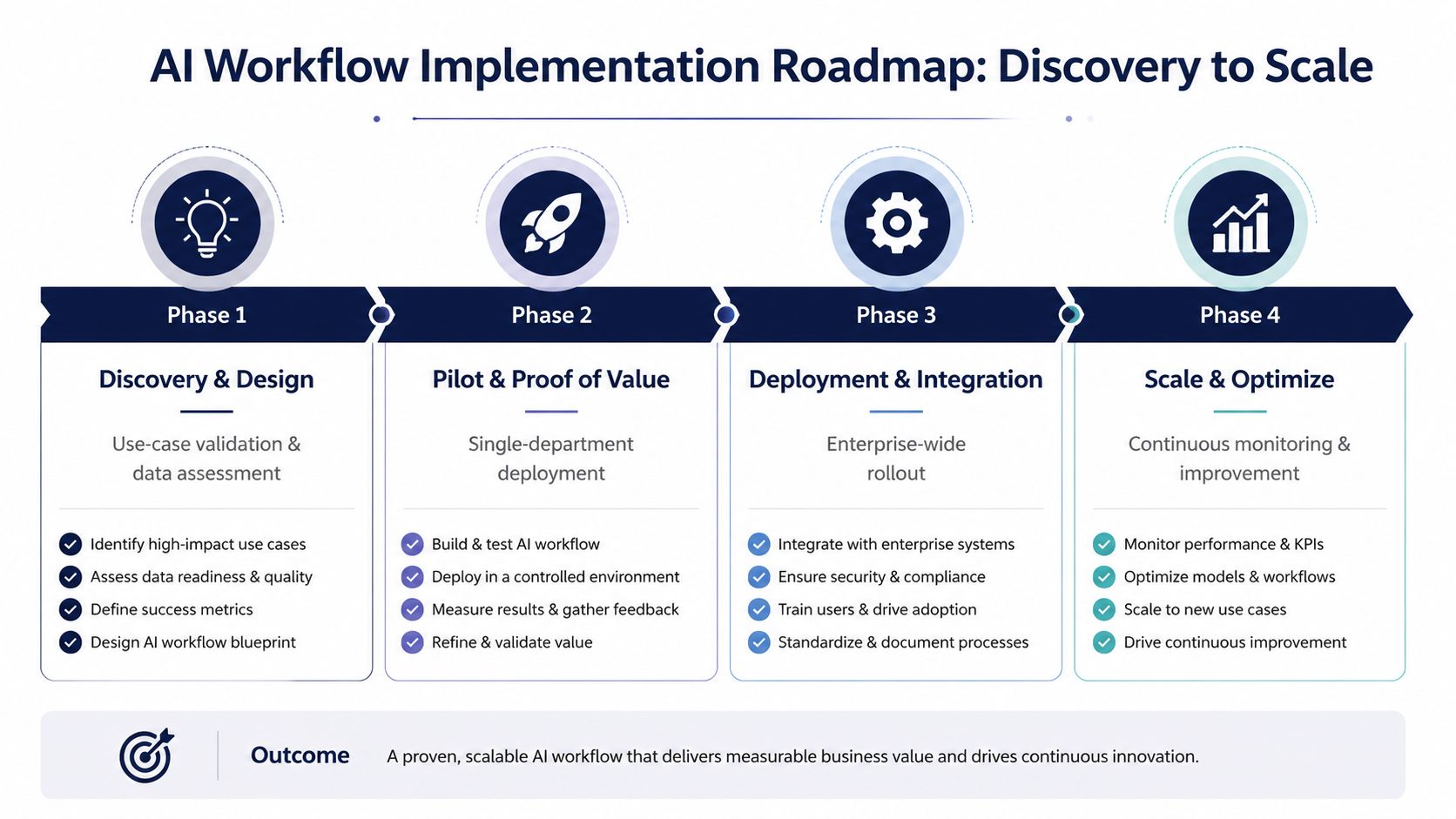
Phase one: Discovery and design
Map the current process with clinicians, administrators, compliance staff, and technical owners. Identify the handoffs, repeated data entry, exceptions, decision points, and systems involved. Select a use case where the organization can define a measurable operational outcome and a safe fallback.
The gate is evidence that the data exists, the workflow owner agrees to the proposed change, and the risk classification is understood. Don't approve a pilot because a model demo looked impressive.
Phase two: Pilot and proof of value
Deploy in a single department with production-like integration, explicit human review, and a baseline captured before launch. Track completion time, rework, override behavior, user adoption, record quality, and downstream effects. Clinical leaders should review samples regularly, while engineers monitor latency, failures, data drift, and vendor changes.
The gate is not just positive user feedback. It's repeatable performance under normal and abnormal conditions, with a documented business case and an agreed remediation plan.
Phase three: Deployment and integration
Before expanding, standardize identity, permissions, observability, support ownership, model versioning, and integration contracts. Design for multiple departments even if the initial rollout serves one. Use feature flags and staged release controls so the organization can pause a workflow without taking unrelated systems offline.
Phase four: Scale and optimize
At enterprise scale, governance becomes an operating function. Review model and workflow performance continuously, retire ineffective automations, retrain users, and revisit the process when clinical policy or payer requirements change. Keep a clear separation between model changes and workflow-rule changes so teams can identify what caused a behavior shift.
Scale gate: Expand only when the workflow remains safe, measurable, supportable, and useful under real operational variation.
Partnership Models and Build Versus Buy Decisions
There isn't one correct delivery model. The right choice depends on how unique the workflow is, how quickly the organization must learn, and whether internal teams can own integration, compliance, and long-term operations.
| Model | Works well when | Main trade-off |
|---|---|---|
| In-house build | The workflow is strategically differentiating and the organization has durable clinical, data, security, and platform ownership | Slower capability formation and greater responsibility for maintenance |
| Vendor tool | The need is standardized, the vendor already integrates with required systems, and workflow controls are acceptable | Limited flexibility when local processes or governance requirements differ |
| Engineering partner | The organization needs specialized integration, AI delivery, or product capacity while retaining business ownership | Requires disciplined knowledge transfer and clear architectural accountability |
Off-the-shelf tools are useful for testing a narrow hypothesis. They become a liability when the team treats a temporary connector as an enterprise architecture. A custom build makes more sense when the organization needs a distinct workflow, proprietary data logic, specialized user experience, or control over model and integration changes.
A healthtech software development partner can support discovery, architecture, implementation, testing, and handover without forcing the provider to replace its core systems. Bridge Global offers AI discovery workshops, cross-functional engineering teams, healthcare integrations, and product delivery support. Its AI development services can fit organizations that need to combine generative AI, machine learning, data engineering, and application development rather than purchase a single isolated feature.
Match the model to organizational maturity
Early-stage teams may need a focused custom healthcare software development engagement to establish an integrated product foundation. A mature enterprise may need enterprise AI solutions with stronger model governance, platform standards, and operating controls. Teams should also evaluate software development service models against the work’s uncertainty, required ownership, and expected duration.
For a workflow that will become a reusable product, SaaS product development may be more appropriate than a one-off implementation. Review client cases for evidence of delivery experience, but ask specific questions about integration ownership, security reviews, clinical validation, documentation, and post-launch support.
Next Steps for CTOs and Product Leaders
Start the next 90 days with an inventory of active pilots, duplicated data flows, user complaints, manual handoffs, and unresolved governance decisions. Rank opportunities by workflow value, data readiness, human-review feasibility, and integration effort. Ambient documentation may offer a practical starting point, but the broader objective is a connected process that carries trusted context from intake through follow-up, administration, and reporting.
Create a cross-functional discovery workshop with clinical users, operations, compliance, security, data engineering, and finance. Define one baseline, one accountable workflow owner, one approval path, and one scale gate before selecting a model. Then choose whether to extend internal capability, buy a bounded tool, or engage a custom software development partner.
Use an AI implementation roadmap to document decisions, and involve specialists in healthcare integrations before the pilot begins. Measure both operational efficiency and workflow safety, including overrides, rework, exceptions, and downstream completion.
Bridge Global helps healthtech teams design and build integrated AI-enabled healthcare workflows through discovery workshops, healthcare software engineering, AI development, and integration delivery. Visit Bridge Global to discuss your current pilot, architecture constraints, and a practical path from departmental proof of value to governed scale.

About Preethi Saro Philip
Preethi Saro Philip is a Post Graduate Research Degree holder in Economics with more than 10 years of experience in writing, editing, research and teaching. She has an intense passion for content crafting and calls herself a ‘wordsmith’. She enjoys writing on wide-ranging topics including business, technology, health & lifestyle, education, environment etc.
View all posts by Preethi Saro Philip →