



AI-Driven Healthcare Operations: A Roadmap
A hospital operations leader can spend the morning chasing delayed discharges, asking why imaging capacity went unused, and reviewing a denial queue that keeps growing. By lunch, the same leader may be evaluating an AI vendor promising transformation, even though the underlying problem is still fragmented data, disconnected workflows, and unclear ownership.
That gap defines AI-driven healthcare operations. The value doesn't begin with a large language model or a polished dashboard. It begins when a health system uses predictive models, generative assistants, and decision-support tools to coordinate scheduling, capacity, documentation, prior authorization, supply routing, revenue cycle work, and patient communication. The first enterprise deployment should improve a workflow people already own, measure, and understand.
The Operations Problem No One Calls AI Yet
At 7 a.m., a mid-size hospital network may face an emergency department queue, unused MRI capacity, a nurse schedule misaligned with demand, and patients waiting for appointment updates. Leaders usually classify these as staffing, scheduling, or service problems. The underlying issue is often operational data that cannot move cleanly between teams and systems.
Those signals create practical opportunities for AI-driven healthcare operations. A predictive model can estimate discharge timing, expose capacity constraints, or identify appointments at risk of becoming no-shows. A generative assistant can draft an authorization summary, organize referral details, or turn operational notes into a consistent handoff. Choose the workflow first. Select the model only after defining the decision, owner, data, and review point.

Start with the queue, not the algorithm
The bed manager may have only a partial view of expected discharges. Imaging schedulers may know which slots are open but lack a reliable way to match them with patients who can attend. Revenue cycle staff may work across structured claims data and unstructured documentation. Clinicians may spend time searching for information that already exists elsewhere in the record.
Each department can optimize its own task while the health system absorbs the combined cost: delays, rework, missed capacity, and inconsistent service. An AI deployment should therefore connect an existing queue to a measurable action, not create another analytics destination.
AI-driven healthcare operations can forecast demand, rank work by urgency, draft routine content, and show the next recommended action to the accountable employee. Keep human review for high-risk decisions. AI can organize evidence and prioritize work, but it cannot assume clinical accountability or resolve unclear policy on its own.
Practical rule: Choose a workflow with a clear owner, repeatable decisions, accessible data, and a measurable bottleneck. Build the first deployment there, then prove the result against a baseline.
Define the category correctly
This category sits beside clinical decision support, diagnostic imaging, and drug discovery, but its operating question differs. Clinical AI centers on diagnosis or treatment. Operational AI focuses on how care is scheduled, coordinated, documented, staffed, authorized, and paid for.
That definition gives the board, clinicians, and CFO a shared frame for decisions. The board can assess risk and strategic value. Clinicians can see where assistance ends, and accountability begins. Finance leaders can test whether throughput, labor utilization, or revenue integrity improved against an agreed baseline.
Adoption evidence supports treating AI as an enterprise operating concern rather than a laboratory experiment. 71% of hospitals used predictive AI integrated with the electronic health record, compared with 66% in 2023. A separate survey of 2,174 nonfederal acute care hospitals reported that 31.5% used generative AI in 2024, while 24.7% planned adoption within a year.
The recommendation is direct: stop funding isolated demonstrations. Establish the data plumbing, workflow ownership, governance checkpoints, and ROI proof that let a useful model operate safely. That is how an operations project reaches patients.
The Four Operational Pillars of AI Maturity
AI maturity isn't a feature checklist. It is a dependency map. Weakness in one layer limits the value of every layer above it.
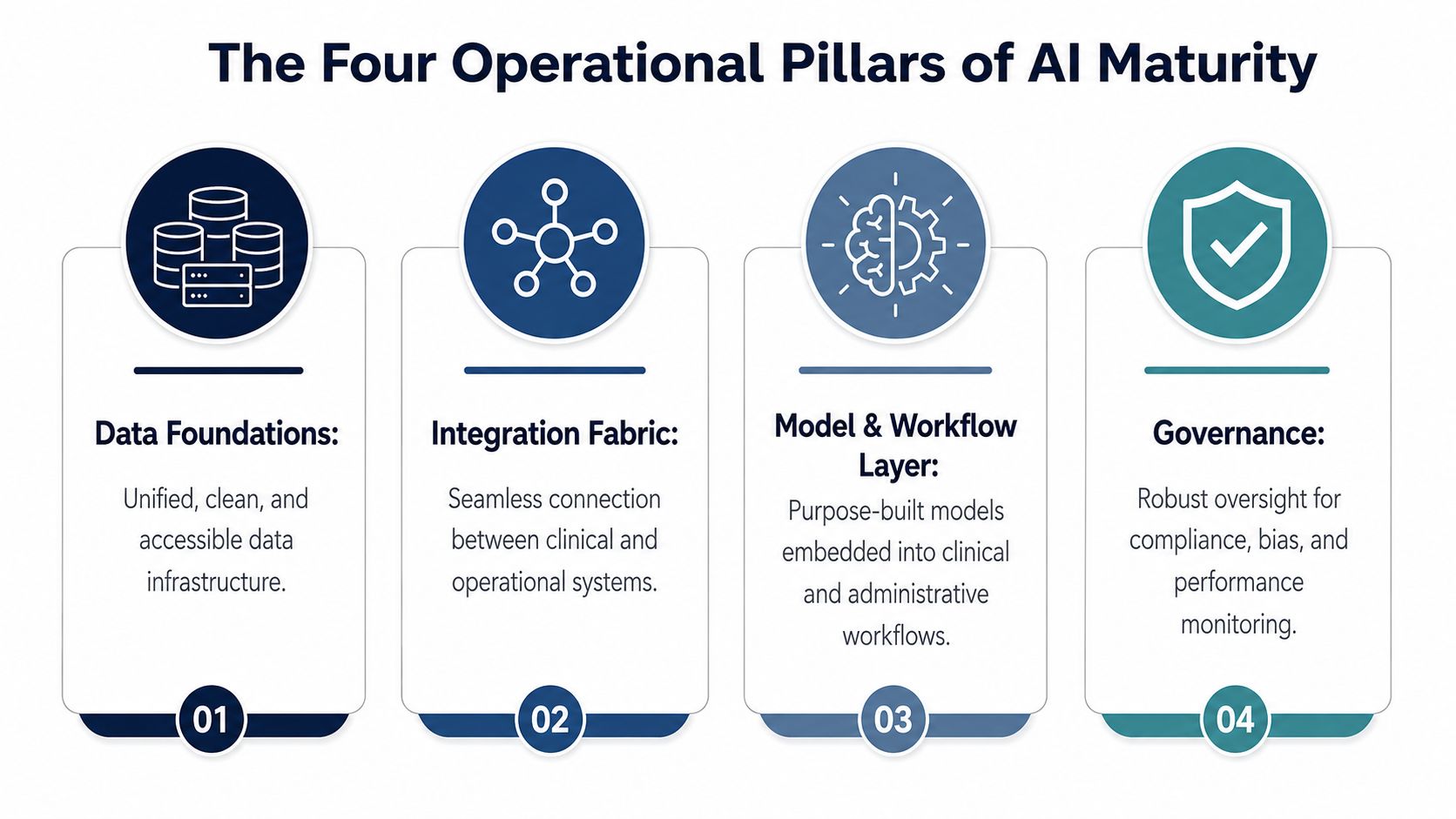
Data foundations
Operational data must be unified, clean enough for the intended decision, and available at the moment the workflow needs it. That includes encounters, orders, appointments, staffing, authorizations, claims, messages, and status changes. A model trained on stale or inconsistently defined data will produce confident recommendations that operators can't trust.
Integration fabric
The model must reach the system of record and return an actionable result. An occupancy forecast that lives in a separate analytics portal won't change bed management if the team works inside the EHR, bed board, or messaging system. Integration turns an insight into a task, alert, queue position, or documented decision.
Model and workflow layer
Use the least complex model that solves the problem. A forecasting model may be appropriate for demand planning. A generative assistant may fit documentation or communication. A rules engine may be safer for a deterministic eligibility check. The workflow should define when the model runs, who reviews the output, what happens when confidence is low, and how corrections feed evaluation.
Governance
Governance covers permissions, audit trails, data handling, model performance, bias evaluation, change control, and incident response. It also defines who can approve a use case and who can stop it. Without governance, integration accelerates compliance debt instead of operational value.
The maturity question is therefore diagnostic: Which pillar currently blocks the next one? Fixing that constraint is more valuable than adding another model to the roadmap.
Data, Integration, and the FHIR Reality
Healthcare software doesn't operate on a blank canvas. It must communicate with EHRs, scheduling systems, identity platforms, claims tools, warehouses, patient portals, and older interfaces that still carry essential events.
FHIR, or Fast Healthcare Interoperability Resources, is the current HL7 standard for exchanging healthcare information electronically. HL7's published specification is R5, version 5.0.0, as described in its FHIR overview. CMS provides implementation guidance for adopting HL7 FHIR, while ONC describes FHIR as a widely used API-focused standard for representing and exchanging health information through its interoperability guidance.
Build for today's contract without ignoring tomorrow's
Teams still need to support legacy HL7 v2 feeds, custom warehouse schemas, vendor-specific APIs, and identity reconciliation. Epic, Cerner or Oracle Health, and Meditech each bring different integration patterns, permissions, and operational assumptions. A successful deployment translates those differences into a stable internal workflow contract.
HL7 states that FHIR Release 6 is actively being worked on in 2026, and the Interoperability Standards Platform says R6 is expected to include more normative resources through its FHIR ecosystem information. That makes version planning practical, not theoretical. Build adapters and resource mappings so a future standards change doesn't force a rewrite of the scheduling, capacity, or documentation product.
The strongest integration design separates three concerns:
-
System access: Retrieve the minimum necessary data from the EHR and surrounding systems.
-
Decision logic: Apply rules, predictive models, or generative assistance in a controlled service.
-
Workflow execution: Write back a task, recommendation, message, or status update with traceability.
Integration isn't a checkbox. In healthcare operations, it is part of the product's user experience.
Identity, consent, authorization, and auditability must sit alongside the data exchange. A healthtech team choosing a custom healthcare software development partner should test whether that partner can own the long integration arc, not just connect a sandbox endpoint.
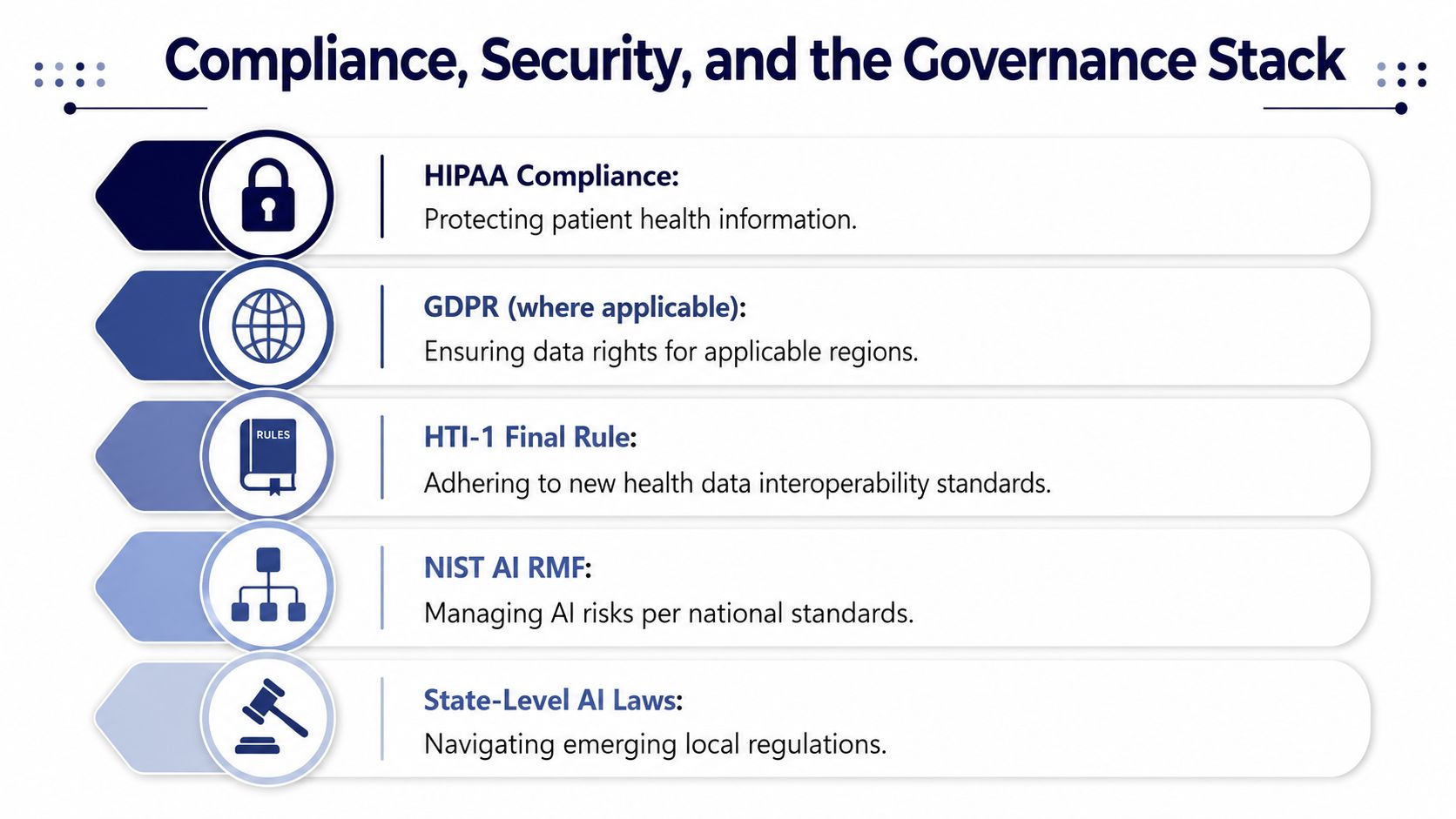
Compliance, Security, and the Governance Stack
Operational AI still handles sensitive health information and influences care delivery. Moving a use case from a spreadsheet into a model doesn't remove HIPAA, GDPR where applicable, interoperability obligations, or state-level requirements.
The U.S. HHS AI strategic plan points to the NIST AI Risk Management Framework and the HTI-1 Final Rule as governance reference points for health AI. Its published strategic plan supports a practical conclusion: governance checkpoints belong in the delivery lifecycle, not in a presentation prepared shortly before launch.
Turn policy into engineering controls
A serious deployment should define the following before production access:
-
Data minimization: Send only the fields required for the task, especially when prompts or model inputs may contain PHI.
-
Model I/O protection: Redact, tokenize, or otherwise control sensitive data entering and leaving model services.
-
Access control: Tie every action to a role, identity, purpose, and permitted system context.
-
Audit logging: Record inputs, outputs, overrides, model versions, user actions, and write-back events.
-
Evaluation: Test performance across relevant patient and operational subgroups, including missing-data scenarios.
-
Human review: Require accountable staff to approve or override outputs for decisions with material patient, financial, or access consequences.
-
Incident response: Define how the team pauses a model, investigates an error, informs stakeholders, and restores a safe workflow.
Security also includes supplier management. A hosted model provider may change versions, retention practices, or behavior. Contracts and technical controls should make those changes visible.
The healthcare cybersecurity automation guide is relevant to this operating model because automated controls need the same discipline as automated decisions. A compliant system should make safe behavior easier for staff, not add a separate manual process that people bypass under pressure.
Look for a partner that treats evaluation suites, policy enforcement, access controls, and incident playbooks as build artifacts. Compliance isn't a final gate. It is part of the system architecture.
Measuring ROI Without Fooling Yourself
AI programs fail financially when leaders measure activity instead of outcomes. A dashboard showing model calls, generated summaries, or user logins doesn't prove that the hospital improved throughput, reduced rework, or protected revenue.
Start with a baseline that operations leaders already recognize. For patient flow, measure waits, discharge delays, and bed utilization. For imaging, measure slot use and time to appointment. For documentation, measure review time and correction work. For revenue cycle, track denial rework, claim quality, and accounts receivable behavior.
The evidence supports setting credible expectations rather than promising universal transformation. A 2025 meta-analytic evaluation covering 145,872 patients across 78 healthcare facilities reported an 18% reduction in patient wait times and a 14% optimization in bed occupancy rates after AI adoption, according to the Journal of Health Management and Applied Medical Sciences. In radiology, a multi-center study reported a 71% reduction in patient wait time, from 7 days to 2 days, and a 6% increase in CT and MRI utilization over 31 weeks, with no added scheduling or operational staff workload, as described in the study on AI-based radiology slot filling.
Operational KPIs That Survive a CFO Review
| KPI | Workflow Owner | Realistic Lift Range |
|---|---|---|
| Patient wait time | Patient flow or access leader | Use the cited 18% reduction as an external reference point, not a guarantee |
| Bed occupancy optimization | Bed management leader | Use the cited 14% optimization as a benchmark for evaluation |
| Imaging slot utilization | Radiology operations leader | The cited study reported a 6% increase in CT and MRI utilization |
| Appointment wait time | Access and scheduling leader | The cited study reported a reduction from 7 days to 2 days |
| Documentation review effort | Clinical operations leader | Establish a local baseline before claiming improvement |
| Denial rework | Revenue cycle leader | Track rework minutes and overturned decisions against baseline |
The guide to predictive analytics in healthcare operations can help teams frame the measurement problem, but the discipline is local: define the metric, capture the pre-intervention state, run a controlled pilot, and compare like with like.
Don’t combine unrelated benefits into one efficiency score. A CFO can challenge a wait-time result, a utilization result, or a labor result. A vague claim that “AI saved time” is much harder to defend.
An Implementation Roadmap That Actually Ships
The right AI implementation roadmap starts with operational pain, not a platform purchase. Choose one workflow where ownership is clear, data is available, and the organization can observe the result without changing every department at once.
The sequence
-
Select one workflow: Choose a high-friction use case such as appointment slot filling, discharge coordination, or authorization preparation.
-
Instrument the baseline: Capture current cycle time, queue volume, exception rates, staff effort, and quality checks before intervention.
-
Pilot with an override: Ship a narrow model or assistant with clear review steps, fallback behavior, and feedback capture.
-
Integrate and scale: Connect the proven workflow to EHR, identity, and audit services. Expand only when the first deployment demonstrates defensible value.
Delay the broad platform purchase until the organization understands its first workflow. A platform can provide useful infrastructure, but it won’t decide whether a recommendation belongs in a scheduler’s queue, a nurse manager’s dashboard, or a revenue cycle worklist.
Use AI development services to support the engineering work only after the operational decision is clear. The first release should be narrow enough to test, safe enough to override, and integrated enough to change behavior.
Pitfalls That Quietly Kill Healthcare AI Programs
The most common failure isn’t that a model can’t produce an output. The failure is that the output never becomes part of accountable work.
Pilot purgatory
Teams run a demonstration with favorable data, collect positive reactions, and stop before production integration. The counter-move is to define the production owner, write-back location, escalation path, and success metric before building the pilot.
Integration debt
A team creates a separate data pipeline because connecting to the EHR is slower. The prototype works, but staff must switch systems and the record of action remains incomplete. Keep the integration boundary visible from the first design review, even if the initial connector is limited.
Bias blindness
A model can behave differently when data quality, documentation habits, or access patterns vary across patient groups and facilities. Evaluate subgroup performance, investigate missingness, and give operators a way to report harmful or implausible recommendations.
Vendor lock-in
A black-box API may accelerate experimentation while limiting auditability, portability, and control over model changes. Require version visibility, exportable logs, documented data handling, and a fallback path before committing a core workflow to a vendor.
The equity gap
AI adoption is uneven across health systems. The American Hospital Association’s discussion of the predictive AI gap highlights the risk that smaller, rural, independent, and critical access hospitals may lag larger system-affiliated peers. The same source cites a U.S. hospital adoption study in which 27% of hospitals adopted AI for operations-related uses, 14% had workers with AI skills, and 8% had AI-related publications.
That gap can become a care gap if better scheduling, follow-up, or risk stratification remains concentrated in well-resourced systems. Design shared services, practical training, and lower-complexity deployment options for under-resourced settings instead of assuming every hospital can support a large internal AI team.
The market’s language can also outrun reality. Recent coverage cited by Becker’s Hospital Review reported that only 17 of more than 3,000 respondents explicitly mentioned agentic AI, with one organization reporting current use. The lesson isn’t to dismiss agents. It is to distinguish enterprise capability from conference vocabulary.
What a Serious Healthtech Operations Partner Looks Like
A serious partner starts with the operating decision, not a model catalogue. It should identify which workflow needs improvement, which system owns the data, who reviews each output, and how the CFO will verify value. For a first enterprise deployment, choose a partner that can connect those four questions into one delivery plan.
Evaluate technical depth in four areas:
-
Healthcare product engineering: The team should understand PHI handling, clinical workflows, identity, auditability, and the consequences of incomplete records.
-
Integration delivery: It should work with FHIR, legacy HL7 feeds, EHR APIs, scheduling systems, data warehouses, and consent layers.
-
AI pragmatism: It should choose rules, predictive models, retrieval, or generative tools according to risk and workflow fit.
-
Operating model clarity: Its software development service models should define ownership, communication, delivery cadence, and post-launch support.
Depth in custom healthcare software development matters because operational AI rarely fits a clean off-the-shelf boundary. A health system may need a focused integration service, an internal work queue, a model evaluation layer, and a compliant user experience. Building another standalone application may add more fragmentation than value.
For a startup or scale-up, enterprise AI solutions should also arrive in increments. A team exploring SaaS product development needs tenant isolation, permissions, observability, and configurable workflows from the start. It should validate one valuable use case before building a broad set of healthcare modules.
Ask for delivery evidence, not a polished demo. Review references and client cases with specific questions: Which systems were integrated? Who owned the workflow? How were overrides logged? What changed after launch? The answers show whether the partner can operate inside a health system’s constraints. A convincing prototype does not prove production readiness.
The adoption trajectory should inform prioritization, not replace it. As noted earlier, healthcare organizations are putting predictive and generative tools into operational workflows, but adoption does not prove that a use case is governed, integrated, or producing value. Your next decision should be narrower. Within the next 30 days, select one workflow, name its owner, document its baseline, and decide whether your current team can integrate and govern it in production.
That first deployment should produce evidence about data quality, review workload, exception handling, and measurable operational outcomes. If the partner cannot define those checkpoints, it is selling experimentation rather than an operating capability.
If you need a healthtech software development partner for that first deployment, Bridge Global offers discovery, custom healthcare software development, AI engineering, integration work, and ongoing product support for operational workflows. Visit Bridge Global to discuss a focused use case, its data and governance requirements, and a delivery plan tied to measurable operational outcomes.
Frequently Asked Questions
What is AI-driven healthcare operations?
It is the use of predictive models, generative assistants, and decision-support systems to improve the non-clinical and peri-clinical work of running a health system. Typical areas include scheduling, capacity planning, documentation, prior authorization, staffing, revenue cycle, supply routing, and patient communication.
What should a hospital build first?
Start with one workflow that has a clear owner, measurable pain, accessible data, and a safe human override. Appointment slot filling, discharge coordination, capacity forecasting, and authorization preparation can be stronger starting points than high-risk autonomous clinical decisions.
Does AI replace clinical judgment in operational workflows?
It should not. Use AI to rank work, forecast demand, draft content, or surface exceptions. Accountable staff should review and approve decisions that affect patients, access, safety, or financial responsibility.
Why is FHIR important for healthcare AI?
FHIR provides an API-focused standard for representing and exchanging health information. It does not eliminate legacy interfaces or vendor-specific complexity, but it gives teams a stronger contract for connecting AI services to systems of record and preparing for interoperability changes.
How should leaders measure an AI deployment?
Measure the workflow before and after intervention. Use operational KPIs such as wait time, bed utilization, appointment availability, slot utilization, documentation effort, denial rework, and patient communication performance. Separate each outcome so the business case remains auditable.

About Preethi Saro Philip
Preethi Saro Philip is a Post Graduate Research Degree holder in Economics with more than 10 years of experience in writing, editing, research and teaching. She has an intense passion for content crafting and calls herself a ‘wordsmith’. She enjoys writing on wide-ranging topics including business, technology, health & lifestyle, education, environment etc.
View all posts by Preethi Saro Philip →