



Software Product Development Services: A CTO Buying Guide
A CTO usually starts looking for software product development services after the internal team hits a hard limit. The roadmap is growing, the legacy platform is becoming harder to change, and stakeholders still expect a secure release. Hiring takes time, while handing the work to a generalist vendor can create a different problem: the product gets built, but nobody clearly owns its architecture, risk, or future.
That's the buying decision that matters. You're not purchasing code hours. You're choosing an engineering system, an ownership model, and a partner that must keep making sound technical decisions after the first release.
What Software Product Development Services Cover
Software product development services cover the full path from an unresolved business problem to a product that can be operated, improved, and defended in production. A CTO might begin with a SaaS concept, an insurer might need to replace a policy platform, or a healthcare provider might need a clinical workflow that integrates with existing systems. In each case, coding is only one part of the work.
A capable product partner can support discovery, product definition, architecture, UI/UX design, implementation, integration, testing, deployment, modernization, and continuous improvement. Those capabilities may include custom software development, AI development, mobile applications, full stack development, cloud services, DevOps, quality assurance, UI/UX, IoT, and product engineering.
Buying principle: Treat product development as ongoing technical ownership, not a one-time delivery milestone.
The distinction matters because a software product only keeps creating value while it is maintained, released, and improved. That ongoing work is what a product development partner should be able to show it owns.
A product team also has to make decisions about integrations and boundaries. A public API, private API, event stream, or direct system connection affects security, reuse, governance, and operational ownership, so the choice should be documented before the team commits to an integration approach.
The right scope therefore includes more than feature implementation. It includes the technical decisions that determine whether the product remains adaptable when users, regulations, partner systems, and business priorities change.
Inside a Full Product Lifecycle From Discovery to Improvement
A strong engagement has visible outputs at every stage. If a vendor can only show sprint tickets and a final application, you're missing the evidence needed to manage product risk.
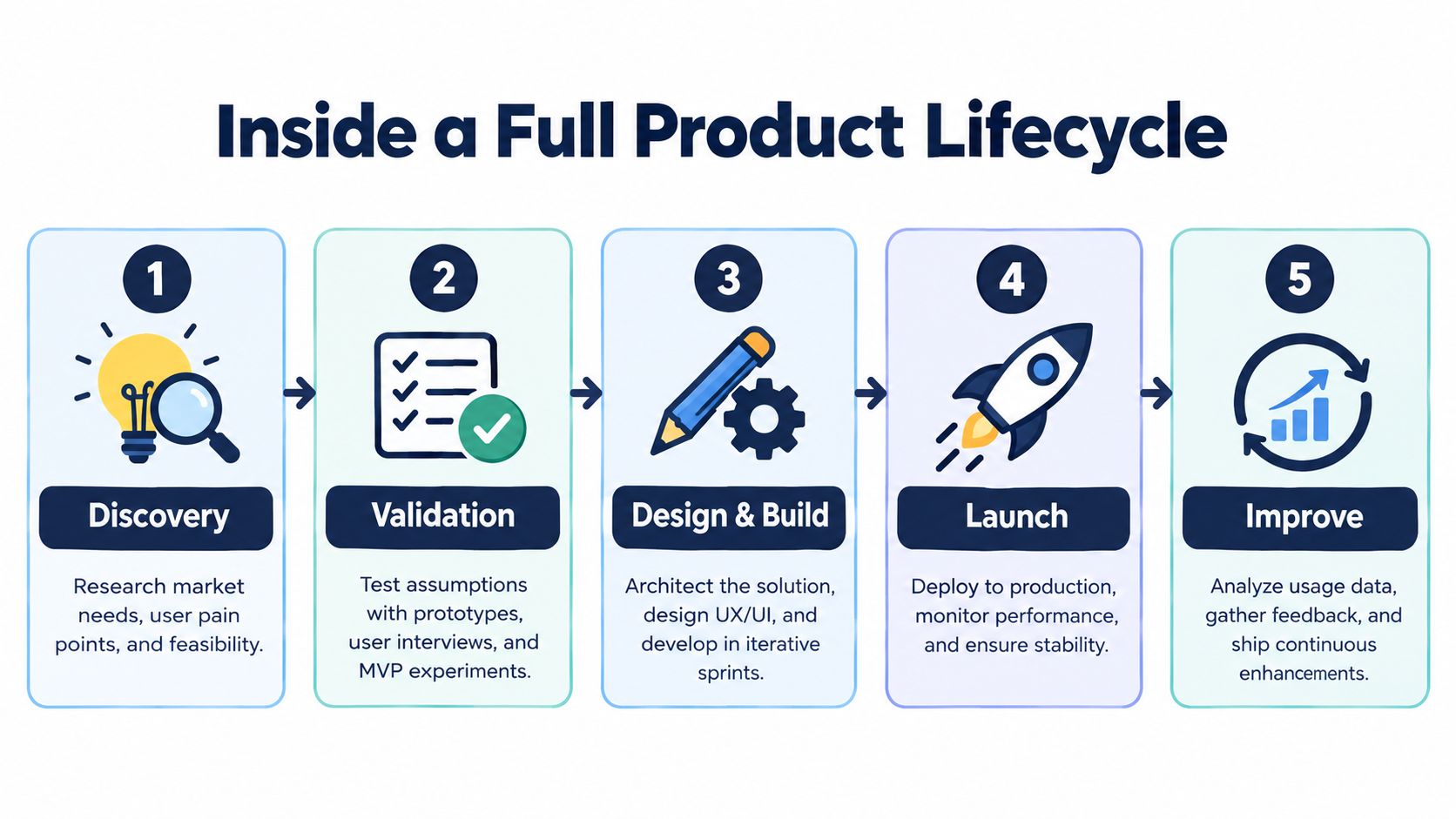
Discovery and validation
Discovery turns an idea into a decision. The team should clarify the business outcome, users, workflows, constraints, existing systems, security expectations, and commercial assumptions. For a healthcare product, that may involve clinical workflows and data exchange. For an ecommerce platform, it may involve catalog, inventory, payment, customer, and ERP dependencies.
Validation then tests the assumptions that would be expensive to get wrong. Prototypes, user interviews, workflow mapping, and a deliberately limited first release can expose gaps before architecture hardens around them. The expected output is not a large requirements document. It's a clear product scope, an initial risk register, and a reasoned sequence of capabilities.
Architecture, design, and implementation
Architecture should connect product intent to operational reality. The team needs to define system boundaries, data ownership, integration patterns, identity controls, observability, deployment constraints, and the points where future change is likely.
UI/UX design should do more than make screens attractive. It should represent real user roles, error paths, accessibility needs, permissions, and the decisions users must make under pressure. Engineers then implement the product in increments that can be reviewed by product, business, and operational stakeholders.
Forward-deployed engineering is useful here. Engineers work close to the people who understand the product and its operating environment, instead of translating decisions through several management layers.
Testing, release, and operation
Quality assurance should cover functional behavior, integration boundaries, security expectations, performance risks, data handling, and regression protection. In regulated environments, the team should preserve evidence of decisions, test results, approvals, and changes.
DevOps and cloud engineering turn a working build into an operable service. Release controls, monitoring, rollback capability, access management, and incident procedures matter because production is where technical assumptions meet real usage.
For secure engineering practices, NIST's Secure Software Development Framework (SP 800-218) is a useful reference when defining review points.
Improvement and modernization
Launch is the start of product ownership. Teams should review usage, support issues, defects, operational signals, and stakeholder feedback, then decide what to improve, retire, or redesign. Modernization may involve replacing a risky component, separating a tightly coupled service, migrating infrastructure, or improving integration reliability.
For an end-to-end ownership model, review Bridge Global's guide to full-cycle delivery. The important question isn't whether the partner can reach launch. It's whether the partner can help you operate and evolve the product afterward.
Engagement Models Compared for Product Leaders
The engagement model determines who makes decisions, who carries delivery risk, and how quickly the product can move. Don't choose a model because it sounds flexible. Choose it based on the ownership gap inside your company.
| Model | Ownership | Control and speed | Best fit |
|---|---|---|---|
| Full-Cycle Delivery | Partner owns discovery through delivery and ongoing engineering | High partner ownership, with client governance and product decisions | Product launches, platform rebuilds, and greenfield applications |
| Dedicated development team | Partner supplies a stable team aligned to your product | Client retains strong direction while the team provides sustained capacity | Long-running products and teams needing dependable engineering capacity |
| Team augmentation | Individual engineers join an existing internal structure | Highest client control, but internal management remains essential | Specialist gaps, temporary capacity, or accelerated delivery |
| Co-creation with in-house teams | Internal and external teams share delivery responsibility | Strong collaboration, with decisions distributed across both organizations | Product acceleration, legacy modernization, and agile transformation |
Full-Cycle Delivery
Use Full-Cycle Delivery when your company needs an external team to carry substantial ownership. It fits a new product, a major rebuild, or a product where internal engineering capacity is limited. You still own the business direction and investment decisions, but the partner should take responsibility for technical discovery, architecture, implementation, testing, deployment, and improvement.
This model reduces the number of handoffs. It also demands stronger governance because the partner has more influence over the product’s technical future.
Dedicated teams and augmentation
A dedicated development team makes sense when you have a continuing roadmap and want a stable group that understands the product over time. It gives you more continuity than hiring individual specialists for isolated tasks.
Team augmentation is different. You remain responsible for product direction, architecture, prioritization, and delivery coordination. It works when your internal team already has a strong operating model and needs a specific capability or additional capacity. It fails when the company expects augmented engineers to compensate for unclear ownership.
Staffing availability is not the same as product accountability. Ask who owns architecture, quality gates, technical decisions, and post-launch support.
Co-creation and AI transformation
Co-creation is the right choice when your internal team knows the product well but needs help modernizing systems, increasing delivery capacity, or introducing more effective engineering practices. Bridge Global describes this approach through corporate business solutions, where external engineers work with in-house teams rather than operating as a disconnected supplier.
AI initiatives need their own path from discovery to scaling. A prototype is not evidence that an AI capability belongs in production. Define intended use, data boundaries, evaluation criteria, human oversight, and operational ownership before scaling the solution.
Industry Requirements That Shape HealthTech Insurance and Ecommerce Builds
Industry context changes the engineering work. A partner that has built a generic workflow application may still be unprepared for clinical data, insurance rules, payment dependencies, or enterprise resource planning integration.
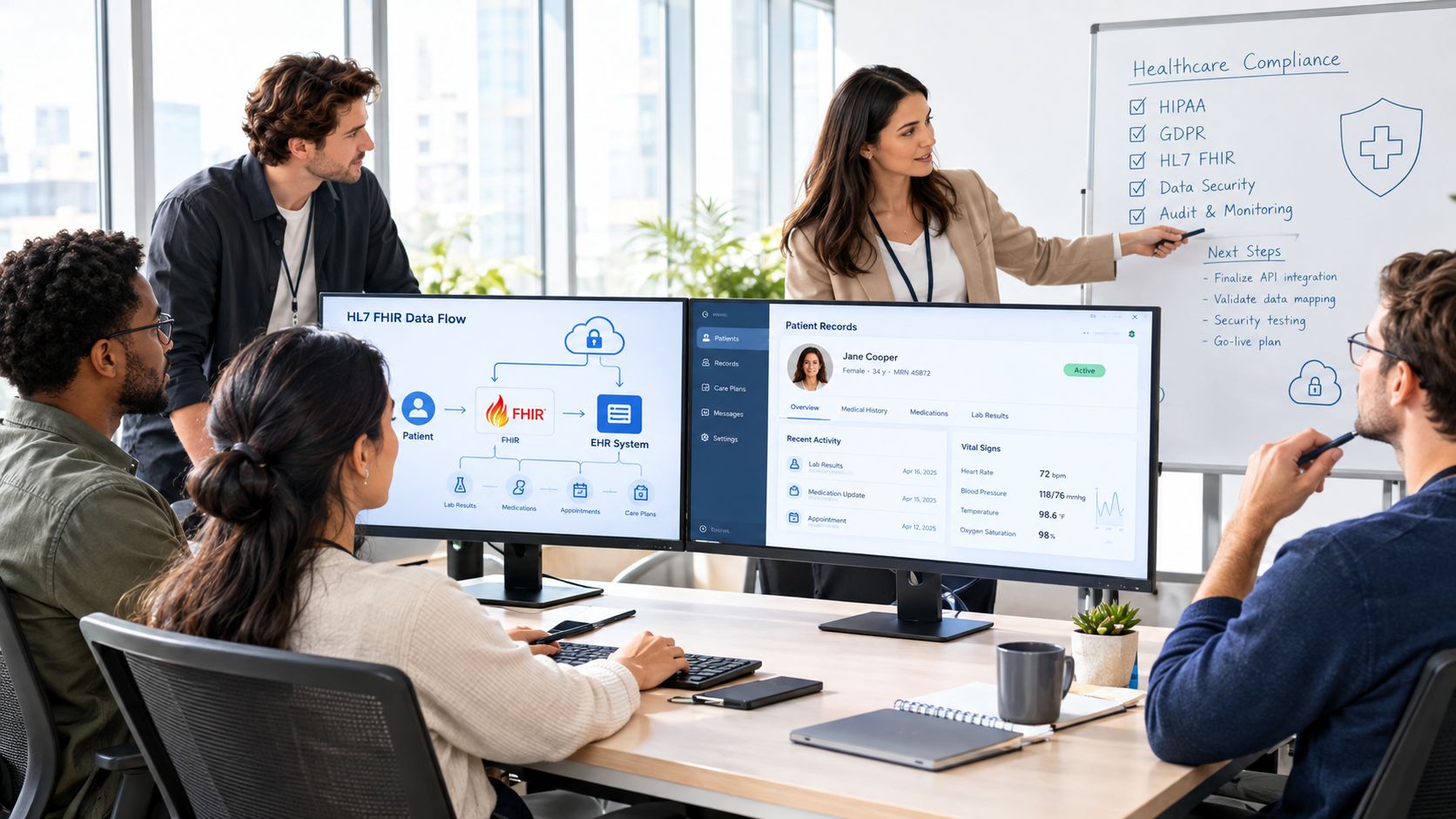
HealthTech
FHIR should be treated as an interoperability and data-governance architecture, not merely an API specification. Healthcare software needs validated FHIR resources, profiles, terminology bindings, identifiers, provenance records, and versioned implementation guides, all defined in the HL7 FHIR specification.
A serious healthcare brief should specify how the partner will validate resources, test cardinality and terminology constraints, enforce authorization scopes, preserve audit evidence, and handle incompatible counterparties. FHIR doesn’t automatically create semantic interoperability. The implementation also needs consent enforcement, identity matching, encryption, access logging, and compatibility testing with each target environment.
The same discipline applies to DICOM, legacy HL7 v2, healthcare data platforms, and AI-enabled clinical or administrative workflows. HIPAA risk analysis should cover data stores, APIs, identity systems, cloud infrastructure, mobile clients, integrations, backups, and administrative access. HHS guidance requires covered entities to conduct an accurate and thorough assessment of risks and vulnerabilities affecting electronic protected health information, including the likelihood of threats. The HHS risk-analysis guidance sets out this expectation.
Insurance
Insurance products combine policy, claims, underwriting, billing, documents, brokers, customers, and external data providers. The architecture must support rules that change without making every business adjustment a code release. AI for underwriting, claims triage, fraud analysis, or customer support also requires explainability, review paths, data controls, and evidence of how decisions are made.
Our insurance software development perspective is useful when assessing whether a partner understands these operational and integration constraints rather than just listing insurance as an industry label.
Ecommerce
Ecommerce products depend on more than storefront design. Product information, pricing, inventory, fulfillment, payments, customer accounts, promotions, search, analytics, and ERP or CRM connections must work as one operating system. A partner should explain how it will manage synchronization, failure recovery, data ownership, and changes across external platforms.
Ask for an integration map before accepting a delivery estimate. The number of screens rarely captures the full complexity. The dependencies between systems do.
How to Evaluate a Product Development Partner
Shortlist partners by evidence, not presentation quality. Ask each candidate to show how work is governed when requirements change, a release fails, or a security concern appears late in delivery.
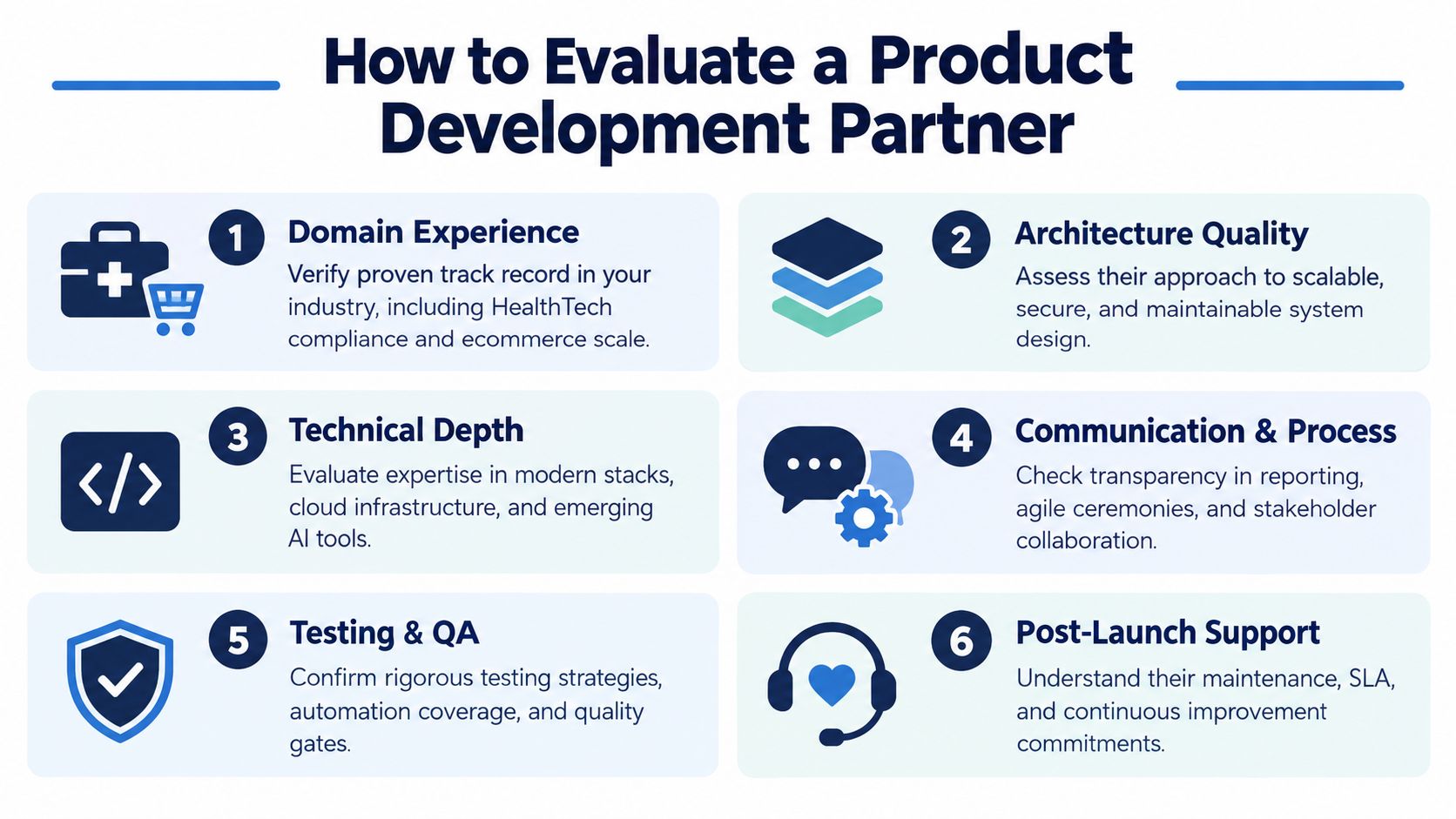
Evidence to request
-
Domain experience: Ask for relevant examples, architecture discussions, and references. A healthcare, insurance, or ecommerce logo alone proves very little.
-
Architecture quality: Request a sample decision record or an architecture workshop. Look for explicit trade-offs involving data, security, scalability, integration, and operational ownership.
-
Quality discipline: Ask how the team handles regression testing, security findings, release approval, rollback, and production incidents. Request evidence, not a list of tools.
-
Communication: Identify the actual product owner, technical lead, delivery lead, and escalation path. Confirm working hours, time-zone overlap, meeting rhythm, and documentation practices.
-
Commercial protection: Review intellectual property ownership, confidentiality, subcontracting, acceptance criteria, change control, termination, transition support, and access to repositories and environments.
-
AI governance: Ask which AI tools may process source code, customer data, clinical data, or proprietary documentation. Clarify human review, testing, security assessment, model or prompt changes, and accountability for final decisions.
DORA defines throughput through change lead time, deployment frequency, and failed-deployment recovery time. It treats change-failure rate and deployment rework rate as stability signals, supporting a sustainable flow of small changes rather than maximum release frequency. DORA’s metrics guide explains the model.
Use these signals as part of a wider conversation, not as a productivity contest. For a broader buyer-oriented checklist, read Bridge Global’s guide to choosing a software development partner.
Cost Drivers and Governing AI-Assisted Engineering
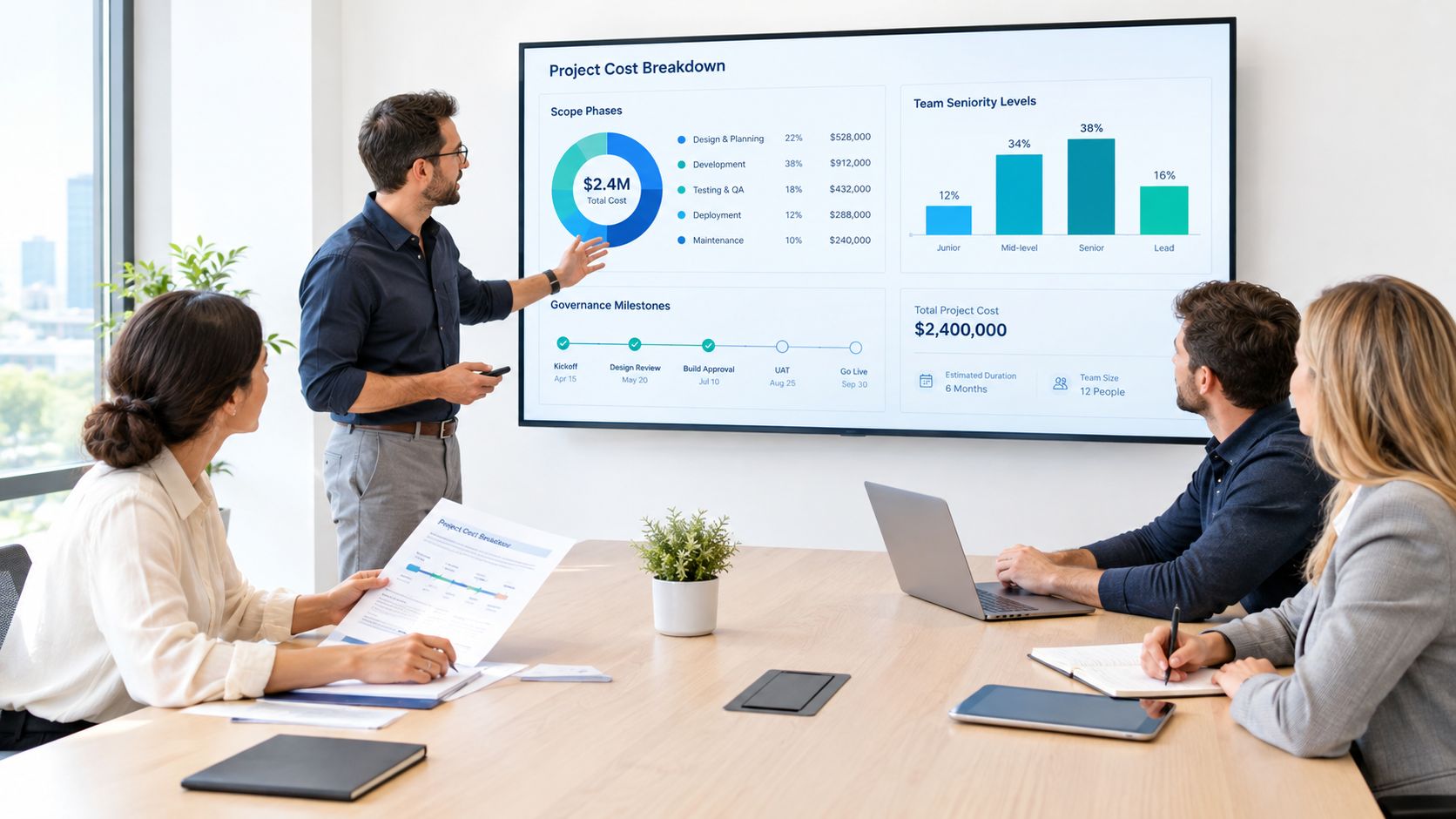
A credible proposal explains why the work costs what it does. The main drivers are scope uncertainty, team composition, seniority, engagement model, integration complexity, compliance obligations, quality evidence, infrastructure, and post-launch ownership.
A narrow internal tool has a different cost profile from a multi-tenant SaaS platform. A greenfield application differs from a modernization program constrained by legacy data and undocumented interfaces. A regulated health product also carries governance work that a simple feature list won’t reveal.
Commercial rule: Compare proposals by the risks and responsibilities they include, not only by the number of engineers or the headline rate.
AI-assisted engineering adds another commercial dimension. Google’s 2025 DORA research surveyed nearly 5,000 technology professionals globally. 90% reported using AI at work, more than 80% believed it improved productivity, yet 30% expressed little or no trust in AI-generated code. Google’s announcement provides the research context.
That combination should change the questions you ask. Faster code generation doesn’t remove the need for architecture review, testing, threat modeling, data protection, provenance, and release accountability. It can increase the amount of governance required because teams must evaluate more generated output without weakening controls.
Put AI controls into the agreement
Ask the partner to document:
-
Tool boundaries: Which tools can process source code, client data, health data, prompts, logs, or proprietary specifications?
-
Human ownership: Who approves architecture, reviews generated code, assesses security findings, and makes the final release decision?
-
Validation: Which tests, code review rules, privacy checks, and threat-modeling steps apply to AI-assisted work?
-
Traceability: How will the team record generated contributions, defects, security issues, model versions, and material prompt changes?
-
Measurement: Which delivery and quality signals will be compared before and after AI adoption?
Bridge Global governs AI-assisted engineering through TRACE, its governance framework for AI-assisted software delivery, which sets controls around technical context, dependencies, verification, change management, and execution. Experienced engineers remain responsible for architecture, code review, security, quality, and final technical decisions. That is the standard buyers should expect from any partner handling sensitive or regulated products.
Next Steps With a Partner Built for Regulated Products
Start the buying process with a one-page engineering brief. State the product outcome, target users, current architecture, required integrations, regulatory or contractual constraints, expected internal involvement, launch risks, and the ownership you want the partner to carry.
Choose Full-Cycle Delivery when you’re launching a product, rebuilding a platform, or need one team to own the path from discovery through delivery. Choose co-creation when your internal engineers understand the domain and need additional capacity for modernization, product acceleration, or agile transformation. Use team augmentation when you already have the technical leadership to direct specialists day to day.
For AI, separate discovery from production scaling. Define the use case, data permissions, evaluation method, human oversight, security controls, and operational owner before committing to a larger build.
Bridge Global is a Dutch software engineering partner with more than 20 years of agile delivery and teams in the Netherlands, USA, Canada, India, and Indonesia. Its services cover custom software, AI, mobile, full-stack development, cloud, DevOps, quality assurance, UI/UX, IoT, and product engineering, with HealthTech as a lead specialization and additional work across insurance and ecommerce.
Review the available software development services, compare the service models, and examine relevant client cases. Then take your brief to a technical conversation. The right partner should challenge unclear ownership, expose integration risk, and explain how it will preserve quality and accountability after launch.
Bridge Global provides full-cycle product engineering, dedicated development teams, and engineering team augmentation for HealthTech, insurance, ecommerce, and other complex software products. Share your product goals, constraints, integrations, and preferred ownership model through Bridge Global to discuss a practical engagement path.
Frequently Asked Questions
What do software product development services include?
They cover the path from an unresolved business problem to a product in production: discovery, product definition, architecture, UI/UX design, implementation, integration, testing, deployment, and continuous improvement. Coding is only one part of the work.
Which engagement model should we choose?
Choose full-cycle delivery when you need a partner to own the path from discovery to release, a dedicated team for a long-running roadmap, team augmentation when your own leaders direct the work, and co-creation when your internal team needs shared delivery and knowledge transfer.
What drives the cost of product development?
Scope uncertainty, team composition and seniority, integration complexity, compliance obligations, quality evidence, infrastructure and post-launch ownership. Compare proposals by the risks and responsibilities they include, not only by the headline rate.
How should AI-assisted engineering be governed?
Agree which tools may process code and data, who reviews and approves generated output, which tests and security checks apply, and how changes are traced. Accountability for architecture and release decisions should stay with experienced engineers.
What should a regulated HealthTech product require from a partner?
Evidence of interoperability work such as HL7 FHIR, a documented risk analysis for protected health information, audit trails, and traceable decisions. Ask for examples of comparable work and the evidence the partner produced.

About Stephanie Cornelissen
Stephanie Cornelissen is a Technical Solutions Consultant with strong experience helping organizations navigate complex digital change. She works closely with teams to align business goals with practical, scalable technology solutions. With expertise in system architecture, integrations, and emerging technologies, she focuses on solving real-world problems through thoughtful execution. She enjoys working where technology meets business strategy and measurable growth.
View all posts by Stephanie Cornelissen →