



Insurance Software Development: A Practical Guide
Most advice on insurance software development starts in the wrong place. It talks about features, AI demos, and customer portals before it deals with the key constraint, which is whether your policy, claims, billing, and partner data can move through the business in a controlled way. If the architecture is brittle, every new release adds more reconciliation work, more audit risk, and more frustration for the teams who have to support it.
That's why the right question isn't “What should we build next?” It's “What has to be unified, governed, and integrated first so the next release doesn't create more operational debt?” Insurance modernization is increasingly built around API-first and event-streaming architecture because real-time integration lets carriers connect core policy, claims, billing, and external partner systems without brittle batch transfers, while also improving versioning, sandbox testing, and rollback controls that reduce release risk McKinsey.
Why Insurance Software Development Is Really an Architecture Problem
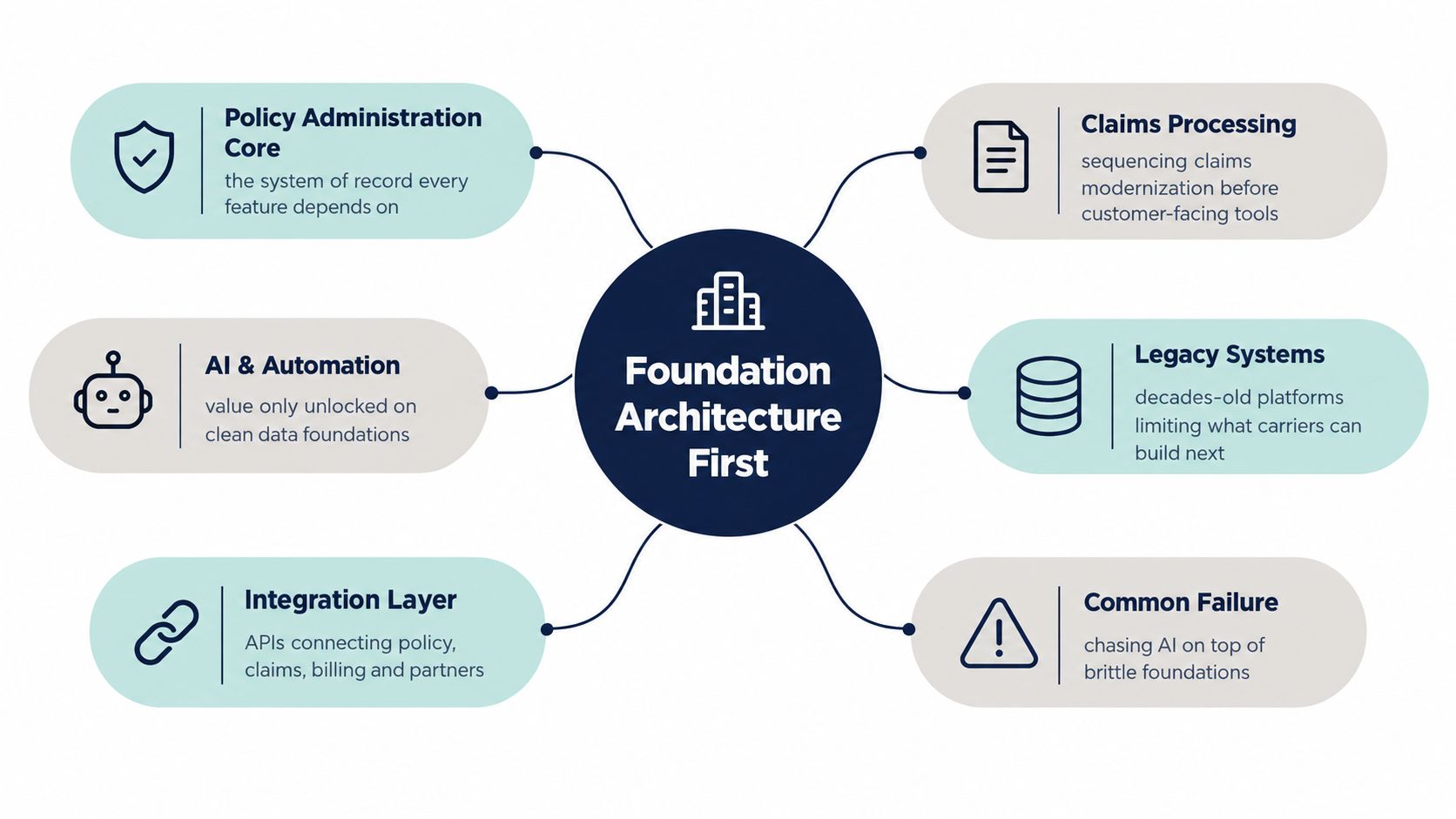
Insurance teams often chase AI first. That order is wrong. AI only works when policy, claims, billing, and partner data move through the business in a controlled way, and that starts with architecture, not a feature roadmap.
The hidden cost of treating architecture as optional
Separate systems with inconsistent identifiers force teams to maintain duplicate records and manual workarounds. That may look tolerable until a release touches claims handoff, pricing changes, or a compliance review; then the weak foundation shows up as broken workflows and delayed approvals.
Start by defining data contracts, event flow, and integration boundaries before the first major build. Insurance software teams that modernize around a centralized enterprise data platform with validated pipelines and scalable storage get better data quality and real-time analytics for underwriting, claims, and risk management, which leads to faster decisions and fewer reconciliation errors across the lifecycle.
Practical rule: if your release depends on three systems agreeing after the fact, your architecture is already costing you time.
Treating architecture as overhead is the strategic mistake. In insurance, it is the product. A brittle foundation creates audit findings, slows product launches, and forces every new capability to inherit the same bad data habits.
The same logic applies to AI at scale. Insurers can experiment with models, but real transformation stalls when policyholder data is fragmented, legacy environments are siloed, and the operating model cannot support scale. Skip the architecture work, and you get AI theatre, not AI value.
Monolithic vs microservices architecture is a useful lens here. The more practical rule is simpler: replace or refactor the parts that create friction first, then build new features on top of that foundation.
The Core Insurance Systems You Are Building or Replacing
Insurance software is not one application. It is a connected operating model where each system owns a narrow slice of business truth, and the quality of the overall platform depends on how cleanly those slices share data and events.
Policy, claims, underwriting, and the systems around them
Policy administration owns the customer's contract, coverage terms, endorsements, renewals, and status changes. It produces the canonical policy record, and it should emit events when a policy is bound, amended, cancelled, or renewed.
Claims management owns intake, triage, adjudication, payments, reserves, and subrogation touchpoints. It needs the policy record, loss details, and payment history, and it should emit events when a claim is opened, escalated, approved, paid, or reopened.
Underwriting workbenches sit between risk intake and policy issuance. They gather submissions, scoring inputs, referral logic, and decision trails, then emit underwriting decisions and exception notes that feed the policy core.
Billing and accounting own premiums, invoices, collections, commissions, and reconciliation. This layer often becomes the source of truth for financial movement, so it has to stay consistent with policy and claims changes.
Agent and customer portals don't own the business truth. They expose it. They collect service requests, quote activity, document uploads, and status checks, then pass those interactions back into the core systems.
Reinsurance systems manage treaties, cessions, recoveries, and settlement logic. They depend on clean exposure data from policy and claims, and they become painful fast when that upstream data is inconsistent.
The mistake is replacing one core system while leaving the underlying customer and policy model fragmented. That just recreates the silo somewhere else.
How the pieces connect in practice
The best operating model uses a shared customer and policy record with an event backbone around it. Each core system keeps responsibility for its own domain, but the event layer lets the rest of the business react without relying on nightly files or brittle point-to-point integrations. That is the difference between a platform and a pile of applications.
| System | Primary Function | Core Data Owned | Typical Integrations |
|---|---|---|---|
| Policy administration | Manages policy lifecycle | Policy terms, endorsements, renewals | Billing, claims, portals, underwriting |
| Claims management | Runs claim handling | Loss data, reserves, payments | Policy core, finance, fraud tools |
| Underwriting workbench | Supports risk decisions | Submission data, referrals, decisions | Data platform, pricing engines, portals |
| Billing and accounting | Handles financial flow | Premiums, invoices, commissions | Policy core, payments, ERP |
| Agent and customer portals | Serves user interactions | Requests, documents, status views | Policy, claims, identity, CRM |
| Reinsurance systems | Manages ceded risk | Treaties, exposures, recoveries | Policy core, claims, finance |
If you're evaluating whether to rebuild or replace, use that table as a forcing function. A new core without shared data rules is just a new silo with a modern UI.
The Modern Insurance Tech Stack from APIs to AI
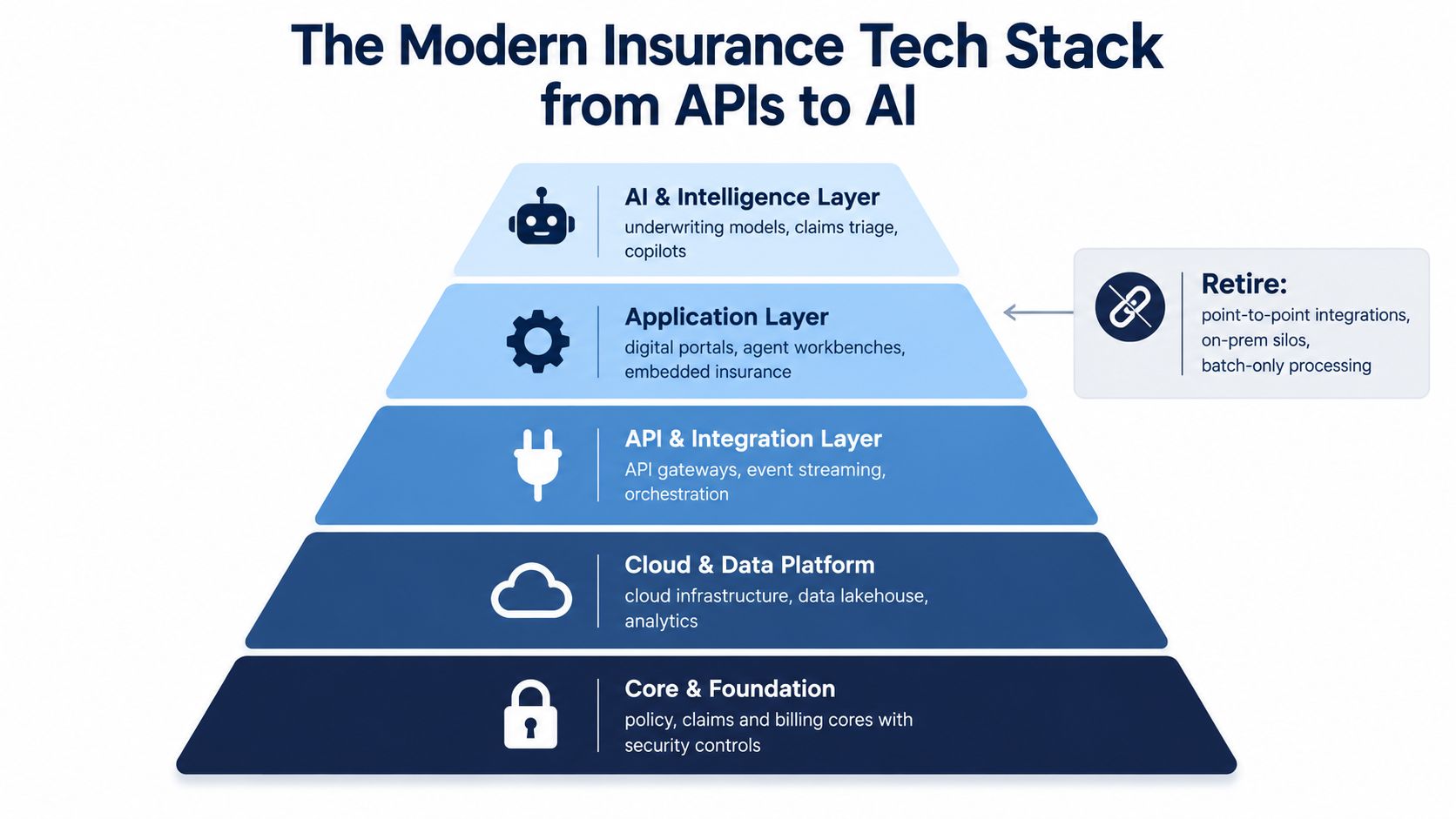
Insurance stacks fail when teams treat AI as the starting point. The real value sits lower in the stack, in data architecture and integration. Get those layers wrong, and every new feature becomes another way to hide fragmentation.
What belongs where
The core and foundation layer holds policy, claims, billing, identity, and security controls. Keep it stable, traceable, and hard to break.
Above that sits the cloud and data platform, where insurers centralize validated data, scalable storage, analytics, and governance. It reduces reconciliation errors that build up when records are split across systems.
The API and integration layer is the connective tissue. It should handle orchestration, partner connectivity, and event streaming so carriers do not fall back to batch files and manual interfaces. A good model for that approach is the data API for AI agents, because AI systems need governed access to the right data, not loose access to everything.
The application layer includes portals, agent workbenches, digital servicing, and embedded insurance touchpoints. These should change quickly without destabilizing the core.
The AI and intelligence layer belongs on top of clean data, not ahead of it. That is where underwriting support, claims triage, copilots, fraud detection, and knowledge retrieval create value. AI integration in insurance works only after the platform can support it.
Where AI earns its keep
Classical ML still fits pattern recognition, fraud signals, and scoring tasks. Generative AI is stronger at summarization, search, guidance, and servicing workflows around the transaction. Both perform badly when the underlying data is fragmented or poorly governed.
That is why sequencing matters. Data unification first. Integration second. AI third. Reverse that order, and the AI team starts building prompts around chaos.
The operating model should follow a simple rule: build the pipes before the polish. For carriers that want AI at scale, the platform has to expose trusted events, consistent entities, and controlled access across domains. Anything less turns modernization into a feature list that looks modern and behaves like legacy software under pressure.
Lifecycle, Compliance, and Security Built Into Every Release
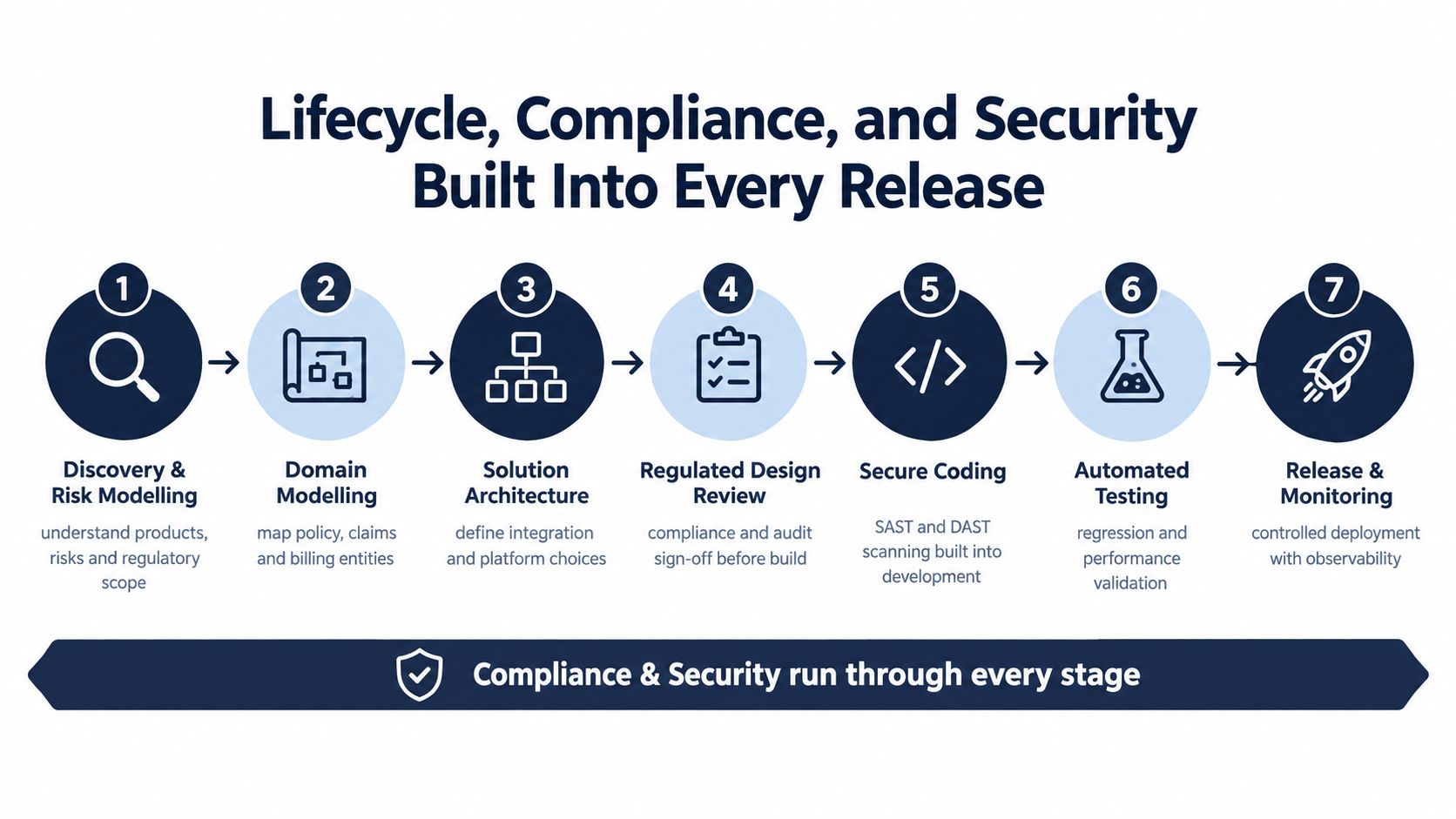
Insurance programs fail when teams treat compliance, security, and release control as end-stage checks. Those controls have to shape the build from day one, or modernization drifts into rework and audit friction.
A release process that holds up in regulated markets
Start with discovery and risk modelling. Define the product line, regulatory scope, data sensitivity, and the decision points developers cannot improvise.
Move into domain modelling so policy, claims, billing, and underwriting entities are mapped before the build starts. That keeps teams from optimizing for technical convenience instead of insurance reality.
Then define solution architecture, including integration patterns, hosting, identity, logging, and rollback behavior. At that stage, the team decides whether the system can survive a failed release.
The next gate is regulated design review. Compliance, actuarial, and risk stakeholders need a real chance to challenge pricing logic, AI support logic, and data flows before code is locked in.
Security and traceability are not separate workstreams
Secure coding has to include SAST and DAST, with builds failing when vulnerabilities are found. Automated testing then validates regression and performance before release, not after a customer report.
The final steps are controlled deployment and monitoring, with audit logs, traceability, and immutable records regulators and reinsurers can trust. Roland Berger is clear that core system transformation is also a compliance priority, not just an IT refresh, and legacy systems make regulatory obligations harder to meet.
McKinsey's guidance is equally direct. Insurers should run a structured build-versus-buy or upgrade assessment first, then sequence initiatives so migration risk is contained instead of spread across every team at once McKinsey.
If your release cannot be traced from requirement to deployment to rollback, you do not have a control system; you have a hope strategy.
In-House, Outsourced, or Nearshore Delivery Models
Delivery model debates usually get reduced to hourly rates. That's lazy. The central issue is total cost of ownership, decision speed, and how much domain knowledge survives when the program gets hard.
Which model fits which modernization problem
In-house teams give you the most control over product decisions and intellectual property. They also carry the highest fixed cost, the slowest ramp, and the hardest recruiting problem when the modernization effort stretches across years.
Offshore outsourcing can lower unit cost, but the trade-off is direct. Time-zone drag slows feedback loops, knowledge transfer becomes a recurring tax, and regulated delivery can suffer when the team is too far from the business and compliance stakeholders.
Nearshore delivery sits in the middle. It usually gives you better working-hour overlap, faster alignment, and easier collaboration with US and EU teams, which matters when the release calendar is driven by policy, claims, and compliance deadlines.
| Dimension | In-House | Offshore Outsourced | Nearshore |
|---|---|---|---|
| Cost structure | Highest fixed cost | Lower unit cost | Balanced cost profile |
| Domain control | Strongest | Depends on governance | Strong with shared oversight |
| Communication | Fastest internally | Slower due to time zones | Better overlap and responsiveness |
| Compliance alignment | Strong if staffed well | Varies by partner maturity | Easier regulatory alignment |
| Ramp speed | Can be slow | Can be uneven | Usually more predictable |
| Best fit | Strategic core ownership | Discrete work packages | Modernization with active collaboration |
The best option is usually blended. One accountable integrator, clear architectural ownership, and a delivery model matched to risk will outperform a pure in-house or pure outsourced setup. That matters most in insurance software development, where integration choices decide whether new AI features sit on clean foundations or pile onto brittle core systems.
Real-World Modernization Scenarios and What They Teach
Modernization wins or fails on sequencing. The polished parts are easy to sell. The hard part is whether data architecture, integration, and governance are ready before you start layering AI on top.
Three scenarios that show the practical trade-offs
A regional P&C carrier replaced a 1990s policy administration system with a cloud-native core. The business case looked strong until year two, when the program stalled because data contracts were never defined before the parallel run. The team had a modern platform, but migration still had to untangle years of inconsistent policy data, a familiar failure mode in insurance change programs.
A health insurer deployed straight-through claims processing with AI triage. Adjudication got faster, but the governance work had to be added late for HIPAA-adjacent controls, state review, and evidence packs the business should have planned from the start. The AI did not fail. The program failed to treat controls as part of the build.
A specialty underwriter used event-driven pricing APIs and a feature store to retrain risk models more frequently. That worked because the team had already unified the pricing inputs and isolated the high-change components from the core. The architecture supported the model, instead of forcing the model to cover for weak foundations.
Read this as a sequencing rule: legacy logic, undocumented business rules, and compliance carve-outs dominate delivery. Full rebuilds often look cleaner on paper, but they are not always the lowest-risk path when business rules are deeply embedded.
Modernization coverage keeps returning to the same point. Core systems slow AI adoption, slow product launches, and make regulatory compliance harder. The right program does not chase the most ambitious release first. It removes the integration and data risk that would break later releases.
For a practical lens on how legacy systems get retired without turning the business upside down, ROI-driven legacy modernization is a good complement to the sequencing view here.
Choosing the Right Partner and Getting Started
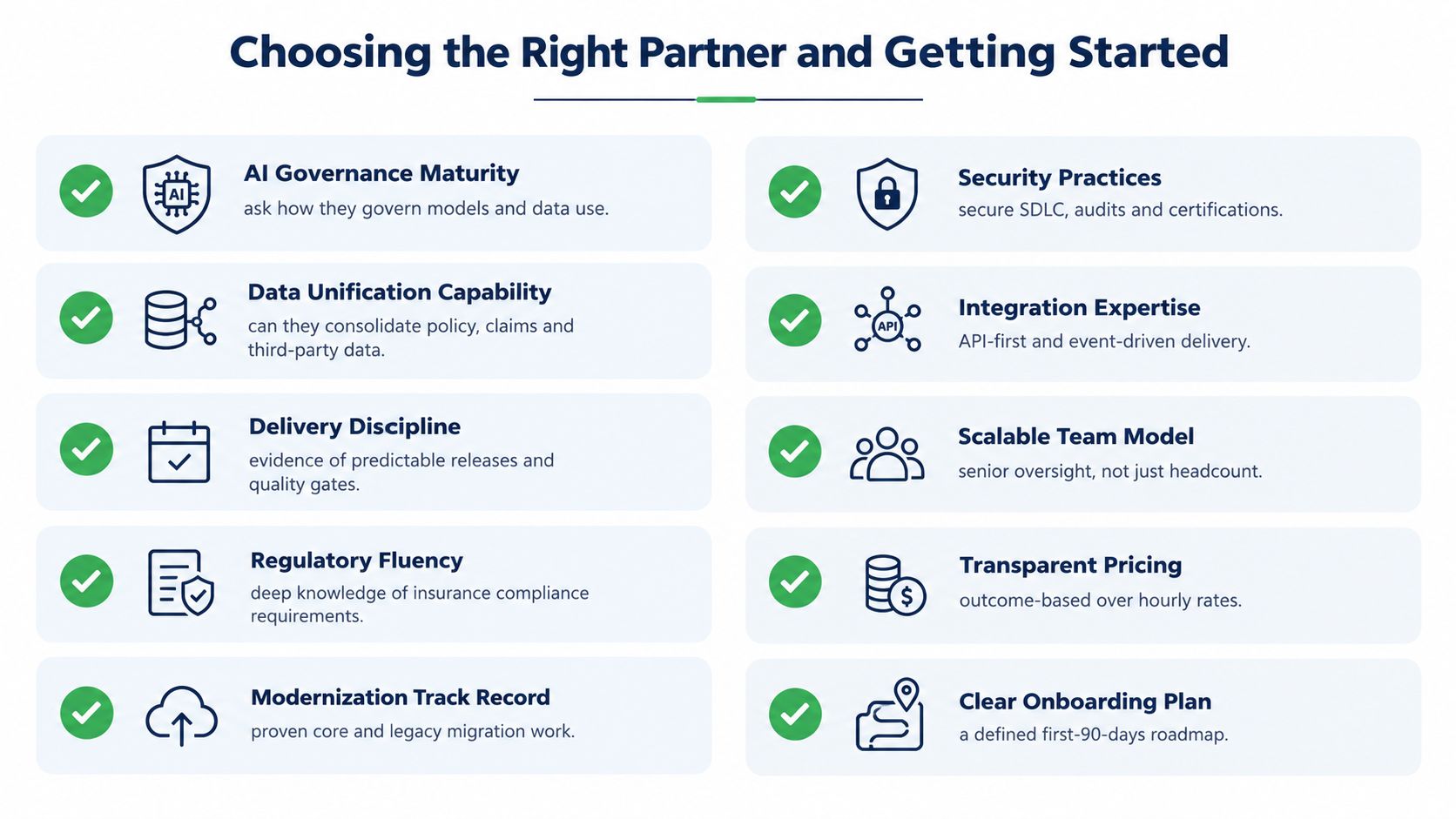
A good insurance software partner is not the one with the loudest AI pitch. It's the one that can prove it knows how to govern models, rationalize data, and deliver in a regulated environment without turning every milestone into a surprise.
Ten questions to ask before you sign anything
Regulator-ready compliance patterns: How do you design for auditability, traceability, and jurisdiction-specific controls?
Claims and policy workflow references: What insurance workflows have you handled in production, not just in demos?
Modern event-streaming experience: How do you manage events, retries, and rollback across core systems?
MLOps and model-risk controls: How do you govern AI outputs, inventories, and approval gates?
API-first architecture: How do you keep integrations from turning into point-to-point sprawl?
Legacy modernization track record: What's your approach when the core system is old, undocumented, and business-critical?
Nearshore time-zone overlap: How much collaboration time do we get with the team that will build it?
Security certifications and practices: Can you support secure SDLC expectations, including ISO 27001 and SOC 2 alignment where needed?
Transparent cost models: Can you explain scope, milestones, and change control without hiding behind rate cards?
Post-launch reliability commitments: What happens after go-live when defects, load issues, or regulatory changes appear?
Bridge Global fits this conversation as one delivery option because it brings AI-driven software development, integration work, and modernization support into the same engagement model. That matters when the program needs architecture discipline first and feature work second, not the other way around.
A sane starting point is a four-week diagnostic. Map the current systems, identify the data and integration gaps, define the target state, and turn that into a sequenced delivery plan with costed milestones. If the partner can't help you do that cleanly, they're probably not ready for your program.
If you're modernizing policy, claims, underwriting, or customer-facing insurance platforms, bring in a team that can make the sequencing explicit and the delivery safer. Bridge Global helps insurers define the target architecture, reduce integration risk, and build AI-ready systems without treating compliance and data governance as afterthoughts. Visit Bridge Global to start the diagnostic and turn the modernization plan into a real delivery roadmap.

About Stephanie Cornelissen
Stephanie Cornelissen is a Technical Solutions Consultant with strong experience helping organizations navigate complex digital change. She works closely with teams to align business goals with practical, scalable technology solutions. With expertise in system architecture, integrations, and emerging technologies, she focuses on solving real-world problems through thoughtful execution. She enjoys working where technology meets business strategy and measurable growth.
View all posts by Stephanie Cornelissen →