



Software Delivery Process: A Practical End-to-End Guide
A healthtech team can deploy code every day and still feel permanently behind. Releases create rework, support tickets consume sprint capacity, service-level commitments become difficult to defend, and auditors ask for evidence nobody can assemble quickly. The team isn't necessarily short of capable engineers. More often, the software delivery process has become fragmented.
The practical distinction matters. Software development produces code, while software delivery moves a validated change from an idea through design, testing, release, operation, and recovery. This guide treats that movement as one connected system. The aim is simple: faster decisions and safer releases, with measurable evidence that the process is improving.
Why the Software Delivery Process Matters More Than Code
I've seen teams ship quickly and still lose control of delivery. Product approved work without resolving workflow questions, engineers made reasonable assumptions, QA discovered missing acceptance criteria late, and operations inherited a release with weak observability. Each group worked hard, but the system produced rework rather than dependable throughput.
The Standish CHAOS 2020 figures put the broader problem in context. The report classifies 31% of software projects as successful, 50% as challenged, and 19% as failed, where success means delivering on time, within the original budget, and with the agreed feature set. The same source reports 16% successful projects in 1994 and approximately 32% in 2009. These figures are an industry benchmark, not a universal failure rate, because definitions, project types, and research methods vary. They do show why delivery performance can't be explained by coding ability alone.
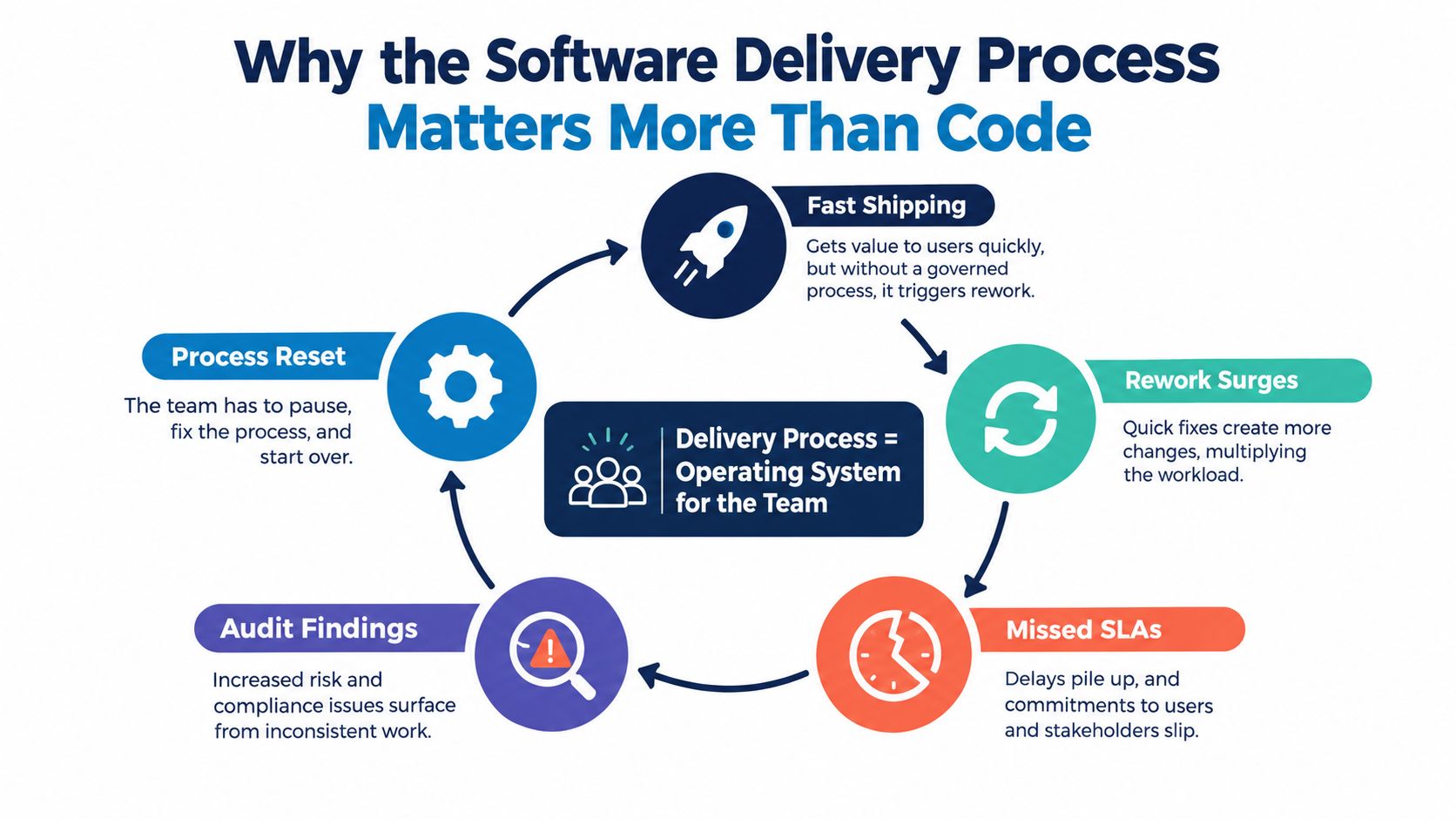
Delivery is a connected operating system
A useful delivery process connects five concerns:
-
Problem definition: Product and domain specialists agree on the user problem, constraints, and expected outcome.
-
Technical direction: Designers and engineers turn those constraints into interfaces, architecture, data flows, and operational assumptions.
-
Change production: Developers create small, testable increments and integrate them frequently.
-
Release confidence: QA, security, and platform teams provide evidence that the change is safe to promote.
-
Production learning: SRE, support, analytics, and product teams feed operational evidence back into the next decision.
A hand-off between these groups isn't automatically harmful. An undocumented hand-off is. When teams lose context at each boundary, defects become more expensive to diagnose, approvals become queues, and compliance evidence gets reconstructed after the event.
Practical rule: If a delivery stage can't explain what it received, what it changed, and what evidence it produced, it isn't a controlled stage yet.
DORA's software-delivery research measures performance through deployment frequency, lead time for changes, change failure rate, and mean time to restore service. Its benchmark language distinguishes Elite, High, Medium, and Low performers. Elite teams deploy to production multiple times per day and have lead times under one hour. High-performing teams generally deploy between once per day and once per week, with lead times from one day to one week. Low-performing teams deploy less than once per month and may need more than one month to move a code change into production.
The point isn't to force a healthcare release pattern into a benchmark category. A regulated service may need additional review for a high-risk change. The point is to see the full flow. Speed without recovery, traceability, and reliability is only a faster route to operational debt.
From Discovery to Working Software
A clinician cannot complete a patient workflow because an interruption loses entered data. A finance user cannot reconcile a transaction because permissions and audit events were considered after implementation. These failures begin in discovery, long before code reaches production. Discovery, design, and development should therefore produce a connected chain of evidence, with each stage reducing delivery risk and improving a measurable DORA-style outcome.
Product defines the user problem, business decision, and observable success signal. Designers test the workflow with users and domain experts. Engineers then assess architecture, integrations, data handling, failure modes, and security boundaries before implementation. In healthtech, that review includes protected health information and interruption-safe interaction. In finance, it includes transaction states, reconciliation, permissions, and audit events.
Use four checkpoints, but keep them connected rather than turning them into approval queues:
Frame the outcome with the user problem, non-functional constraints, and signals that will show whether the change works. Clear framing reduces rework and supports shorter lead time for changes.
Map the workflow through story mapping, including the smallest valuable slice and edge cases that could change the design. A narrow, testable slice supports higher deployment frequency without hiding important risk.
Review the system shape by tracing data flows, dependencies, failure modes, security boundaries, and integration contracts. Threat modeling and dependency review belong here because design choices influence change failure rate later.
Write testable acceptance criteria and build small increments. Criteria should describe observable behavior, not an implementation preference. Short-lived branches or trunk-based development reduce integration drift, while decisions, test results, threat-model findings, and dependency reviews remain attached to the change.
AI can assist with workflow summaries, acceptance-criteria drafts, dependency analysis, and test suggestions. Instrument that assistance. Record the tool and version, the generated output, the reviewer, the accepted changes, and any rejected recommendations. In a regulated product, this creates an auditable trail without treating generated content as approval. Human owners still decide whether a requirement, risk treatment, or release condition is acceptable.
Ownership should follow the work. Product owns the outcome and release risk. Design and architecture own workflow and system decisions. Engineering owns the integrated increment, code review, unit tests, and implementation notes. QA owns risk-based verification and traceability. Security and operations contribute before readiness, including deployment, observability, rollback, and evidence requirements.
A readiness review can then confirm one connected record: problem statement, user evidence, success measures, prototypes, data flows, architecture decisions, pull request, test results, risk acceptance, and deployment plan. That record helps explain why a change shipped and gives operators the context needed to restore service if it fails.
A suitable custom software development approach can support this progression when architecture, implementation, integration, testing, and deployment remain one delivery responsibility. The partner matters less than whether each working increment carries its contracts, tests, ownership, AI evidence, and operational controls into release.
Testing, Release, and Operations as One Continuous Flow
Working software isn't production software until the team can explain how it will be tested, released, observed, and restored. Testing and operations therefore form a stabilization spine around the development flow. The earlier stages define what should happen. This spine establishes whether the system behaves correctly and what the team will do when reality differs from expectation.
Unit tests provide fast feedback on local behavior. Integration tests validate collaboration between components. Contract tests protect service boundaries when teams release independently. Performance and resilience checks expose risks that functional tests won't catch. The right mix depends on the product, but the principle is consistent: automate repeatable evidence and reserve human attention for judgment.
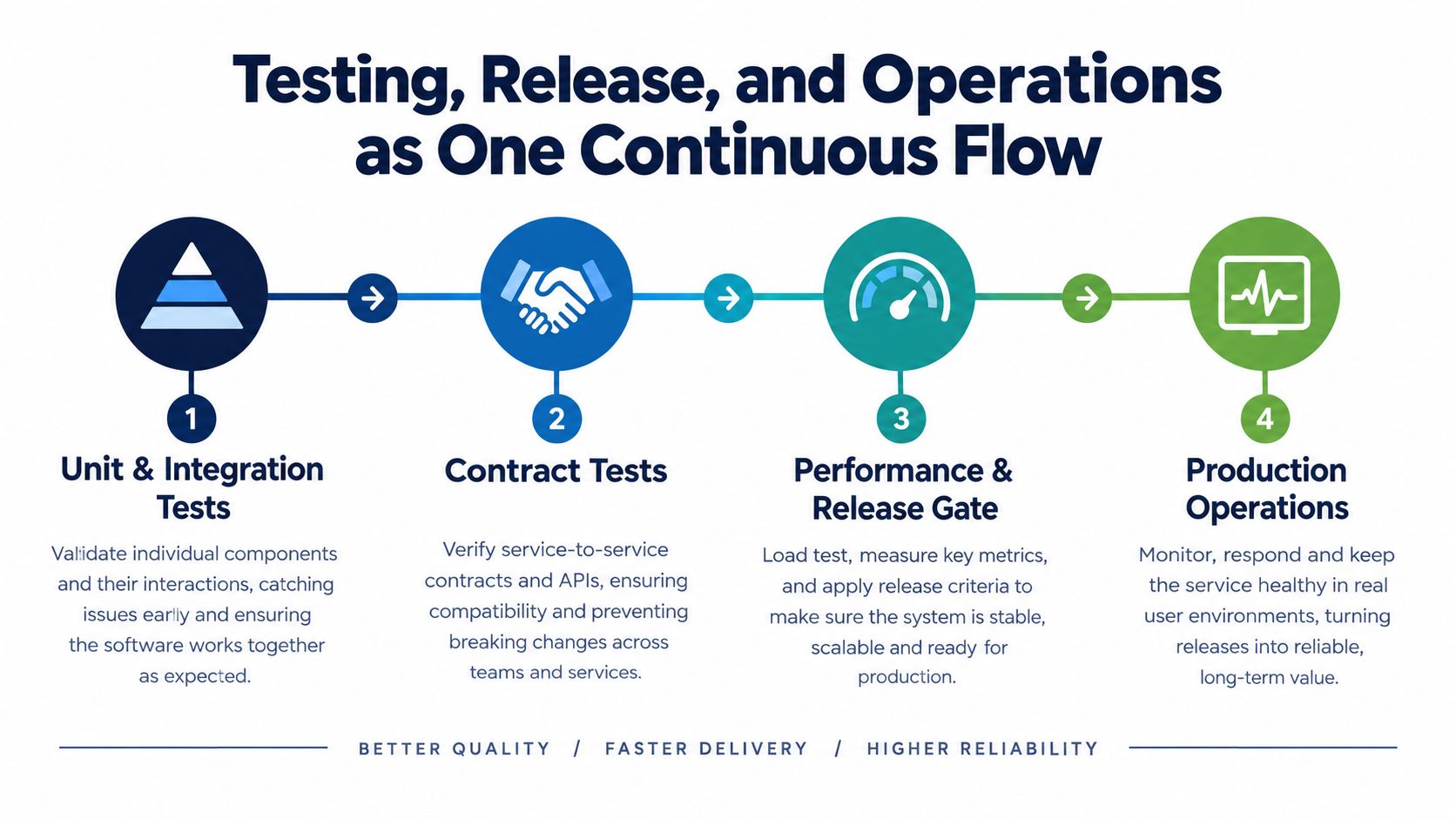
Make release ownership explicit
QA engineering owns test strategy and quality evidence. Platform engineering owns the repeatable path through build, artifact storage, environment provisioning, and deployment automation. SRE owns reliability signals, operational readiness, and the response model. Product owns the user and business risk of releasing or delaying the change. These responsibilities overlap, but they shouldn't be interchangeable.
Feature flags let product teams separate deployment from user exposure. Canary releases limit the blast radius of a change. Automated rollback uses defined signals rather than waiting for a debate during an incident. Error budgets give product and engineering a shared way to discuss whether a new feature justifies consuming available reliability capacity.
The team should document release decisions in the same systems that execute them. A pipeline can record the artifact version, test results, approval, deployment target, feature-flag state, and rollback event. Observability should connect logs, metrics, traces, and user-impact signals to that version.
A release pipeline is reliable when the team can answer three questions quickly: what changed, who approved it, and what happened after exposure.
Incident learning completes the flow. SRE and support should bring production evidence into backlog refinement, while product analytics should challenge assumptions made during discovery. A failed release may reveal a test gap, an unclear user workflow, an unsafe dependency, or a missing operational signal. Each finding should become an owned improvement, not a generic reminder to “be more careful.”
Teams improving this part of the lifecycle can use test automation methodologies for modern CI/CD pipelines to assess coverage, feedback speed, and the role of automation in their own delivery design. The objective isn't maximum automation. It's dependable evidence at the point where a decision is made.
Measuring Delivery with DORA Metrics That Actually Matter
A delivery dashboard becomes useful when it changes a decision. DORA's four widely used measures provide a practical starting point:
-
Deployment frequency shows how often the team puts changes into production.
-
Lead time for changes measures the path from committed change to production.
-
Change failure rate shows how often a deployment causes a remediation, rollback, or production incident.
-
Mean time to restore service shows how quickly the team returns the service to normal after failure.
DORA's metrics guide also describes failed-deployment recovery time and deployment-rework rate as outcome measures for understanding throughput and stability together. Smaller, independently deployable changes can improve flow, but automated testing, progressive delivery, rollback, and observability are needed to constrain failure and recovery risk. DORA reports that speed and stability generally correlate rather than represent an unavoidable trade-off.
Map the metric to the bottleneck
Don't ask a team to “improve DORA” in the abstract. Ask which decision the evidence should inform.
| Metric | Delivery Stage | Primary Data Source | Decision It Informs |
|---|---|---|---|
| Deployment frequency | Release and operations | Deployment records and production exposure events | Whether release batching or approval queues are limiting flow |
| Lead time for changes | Development through release | Version control, CI, approval, and deployment timestamps | Whether review, testing, integration, or governance is delaying delivery |
| Change failure rate | Release and production | Incident, rollback, hotfix, and deployment records | Whether release safeguards and test coverage are adequate |
| Mean time to restore service | Operations and incident response | Alert, incident, mitigation, rollback, and restoration timestamps | Whether detection, diagnosis, ownership, or recovery procedures are weak |
Instrument immutable timestamps from version control, CI, deployment, incident management, rollback, and service-restoration systems. Calculate trends per service or value stream rather than ranking teams with different architectures and risk profiles. A high-risk clinical workflow and an internal reporting service shouldn't be judged as if they have the same release constraints.
A CTO should review the four measures on one weekly board with the teams that can act on them. If lead time rises while deployment frequency falls, investigate queues and integration friction. If frequency rises while change failure rate worsens, strengthen test evidence or progressive delivery. If failure rate remains stable but restoration slows, focus on observability, runbooks, and incident decision rights.
The benchmark categories are useful for orientation, not as a target to game. A team can increase deployment frequency by splitting work into meaningless releases or by weakening its quality gate. That improves a number while degrading the product. The measure matters only when it leads to a better engineering or product decision.
Where AI Helps and Where It Hurts the Delivery Pipeline
AI assistance can reduce typing time without improving end-to-end delivery. A developer may generate implementation code quickly, while reviewers inherit more code to inspect, QA receives unfamiliar behavior, and operations sees new failure modes. The delivery system may become busier rather than faster.
Google Cloud's 2025 DORA research surveyed nearly 5,000 technology professionals. It reported 90% AI adoption, with more than 80% reporting productivity gains, while around 30% reported little or no trust in AI-generated code. Those findings make a useful distinction between perceived individual productivity and trusted production outcomes.
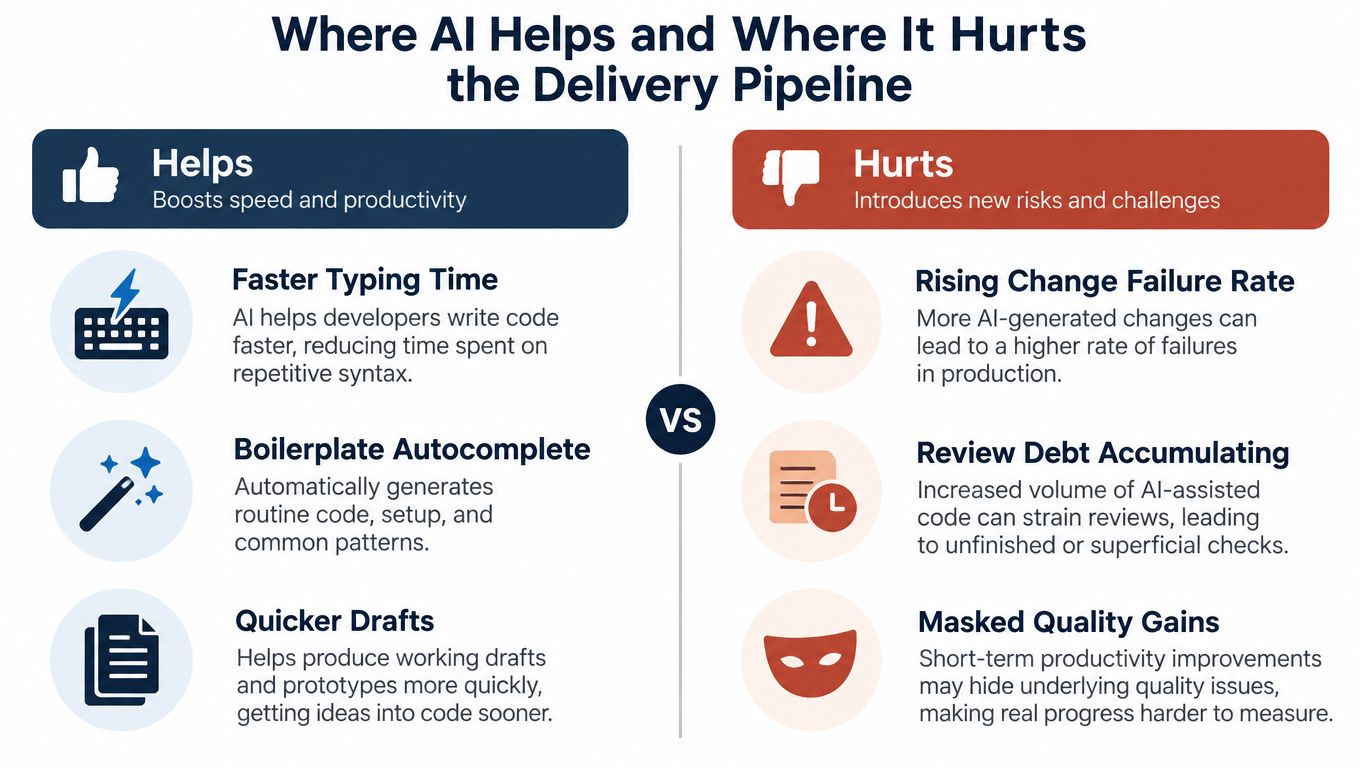
Use AI where verification is cheap
AI is useful when the team can verify the output with clear tests, schemas, or human review:
-
Test design: Generate boundary cases and draft test data, then have QA confirm that the cases reflect real risk.
-
Log summarization: Group related events during incidents so an engineer can reach the relevant evidence sooner.
-
Review assistance: Identify likely defects, missing tests, or repetitive code before a human review.
-
Migration refactoring: Draft mechanical transformations that compile and pass regression tests.
-
Post-incident drafting: Turn a timeline and notes into a first draft, while the incident owner verifies causality and actions.
Each use case needs a measure. Track reviewer time, review findings, escaped defects, change failure rate, restoration time, and security findings. A coding assistant that produces more lines but increases review debt isn't delivering value.
Put hard boundaries around high-risk work
AI can suggest a dependency that doesn't exist, overlook a security regression, recommend architecture without understanding the system's constraints, or produce code that fails a compliance requirement. A general-purpose model won't know that a particular data flow requires additional controls unless the team supplies that context and verifies the result.
For regulated work, segment AI-assisted and non-AI changes where practical. Require human review for high-risk functionality, restrict sensitive source and data exposure according to organizational policy, and preserve the review and approval evidence. Start with a low-risk module, establish a baseline, and compare quality and flow outcomes before expanding adoption.
The practical distinction between useful and harmful AI isn't whether the tool is impressive. It's whether the team can connect its use to trusted delivery outcomes. The discussion in AI in DevOps and its effect on software development and operations is relevant when evaluating AI beyond code completion, particularly across testing, observability, and incident response.
Embedding Compliance Without Slowing the Release Train
A healthcare release is ready to promote, but the team still cannot show which data flows were assessed, which vulnerabilities remain open, or who approved the exception. That delay starts well before release day. Compliance moves at delivery speed when every stage creates evidence for the next decision.
During discovery, threat modeling should identify abuse cases, trust boundaries, and sensitive data flows. Healthcare teams should map PHI and PII movement before choosing integrations or persistence patterns. Finance teams should document transaction states, authorization boundaries, retention needs, and monitoring obligations. These artifacts shape scope and architecture while changes remain affordable.
NIST's Secure Software Development Framework organizes practices around preparing the organization, protecting the software, producing well-secured software, and responding to vulnerabilities. It is designed to fit an existing SDLC, including iterative and agile delivery.
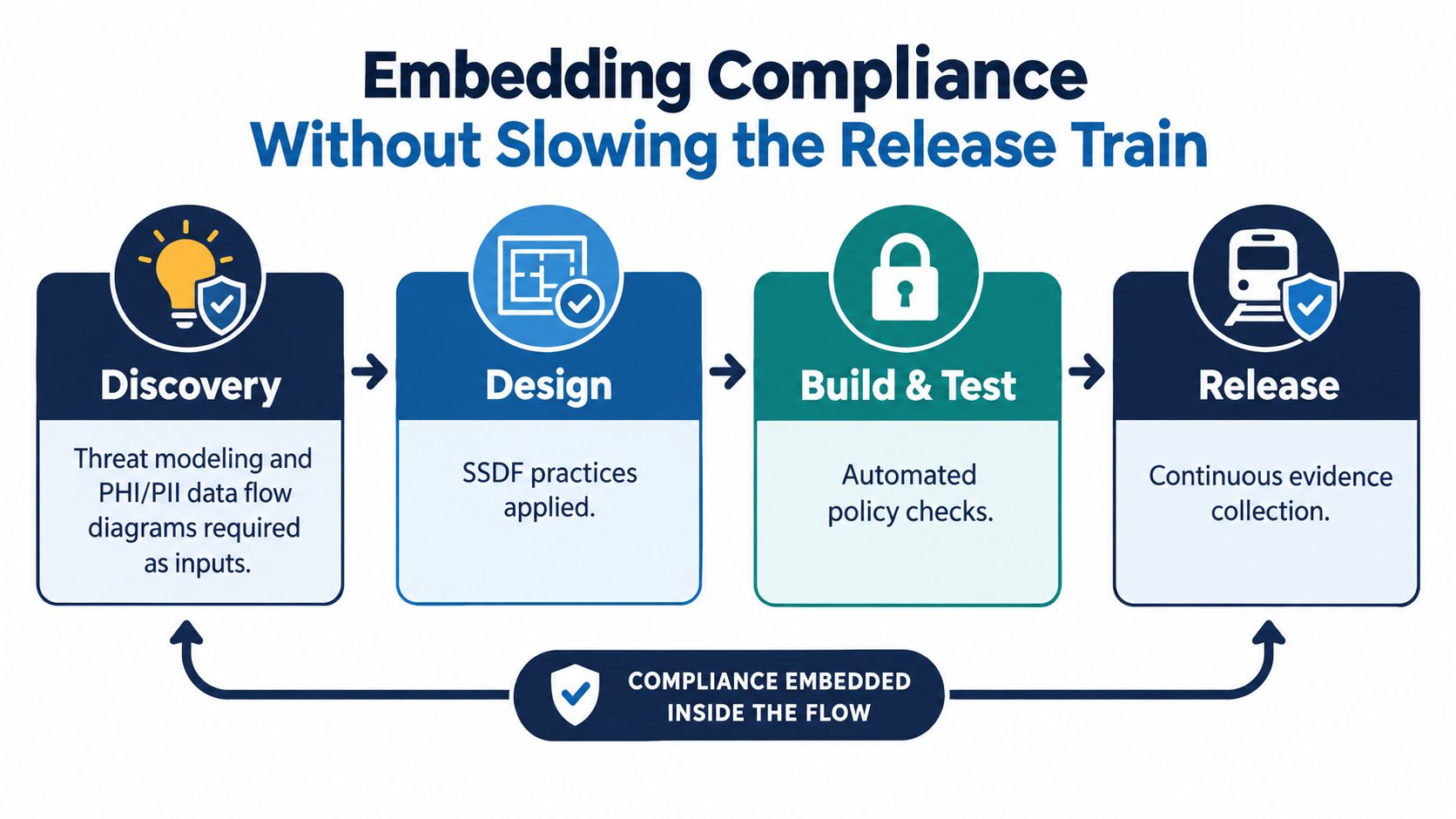
Put controls inside the work
Use the following control path, then instrument each step against delivery outcomes such as lead time, deployment frequency, change failure rate, and restoration time:
-
Discovery: Record threat assumptions, data-flow diagrams, regulatory scope, and risk ownership.
-
Design: Review security boundaries, dependency choices, failure handling, and evidence requirements. Define software bill of materials requirements within the architecture.
-
Build and test: Run code, dependency, secret, container, and infrastructure checks in development and CI. Protect source code, build systems, signing keys, and artifacts from tampering.
-
Release: Attach test results, approvals, artifact provenance, SBOM output, exceptions, and deployment history to the release record.
-
Operations: Link vulnerabilities to affected versions, remediation work, regression tests, monitoring, and release evidence. Set expiry dates for exceptions and review them before they become permanent debt.
AI-assisted work needs the same traceability. Mark AI-assisted changes in the repository or delivery record, retain the relevant review evidence, and compare findings, rework, lead time, and release outcomes with non-AI changes. That gives delivery leaders a way to assess speed without weakening audit readiness.
Healthcare teams also need a risk-based remediation policy. Clearwater's benchmark, covering August 2024 through January 2025, found that analyzed healthcare software, analytics, and business-services assets moved from an average of 13.2 vulnerabilities per asset to 8.16 by January 2025, while nearly three in five analyzed assets had a critical vulnerability. Separate healthcare penetration-testing reporting describes a median remediation time of 58 days for serious flaws and a 244-day half-life for vulnerabilities.
“Shift left” improves detection. Release policy still must define which findings block promotion, which permit compensating controls, who approves exceptions, and when those exceptions expire.
For medical-device software, the FDA's 2023 Final Guidance on Cybersecurity in Medical Devices applies to devices containing software, firmware, programmable logic, or a device software function. It recommends lifecycle practices covering documentation and resources, cybersecurity measures and metrics, and post-release vulnerability management.
Governance expressed as repeatable pipeline evidence replaces the late-stage paperwork queue without weakening control.
Governance, Offshore Collaboration, and Choosing the Right Partner
A release is ready, but the product owner wants one scope change, security has an open exception, and the offshore team is asleep. If no one can identify the approver, the delivery process stops at the point where speed and accountability matter most.
A CTO should be able to name who changes scope, approves releases, owns security exceptions, and directs incident response. Assign those decisions in writing across product, engineering, QA, security, compliance, platform, and operations. A short weekly steering review can then focus on cross-team risks, dependencies, DORA trends, and unresolved decisions rather than status reporting.
The operating model should also connect governance to measurable delivery outcomes. Track whether decision delays increase lead time, whether unclear ownership contributes to change failures, and whether incident handoffs extend restoration time. AI-assisted work deserves the same treatment. Record which tool or workflow generated a change, require human review for regulated code, and retain prompts or test evidence when they affect a release decision.
Offshore collaboration works when its controls match the product's risk and the client's delivery capacity. Staff augmentation preserves direct control, while the client remains responsible for integration, prioritization, and delivery management. A managed delivery pod supplies a coordinated cross-functional unit, but needs shared tooling and a clearly accountable product owner. Outcome-based delivery can connect payment to accepted results, but only when acceptance criteria, access rules, ownership, audit evidence, and exit provisions are precise.
| Model | Time-Zone Overlap | Audit Traceability | IP and Contractual Controls | Best Fit |
|---|---|---|---|---|
| Staff augmentation | Depends on individual allocation | Client must enforce process | Client controls core agreements and repositories | Teams with strong internal delivery leadership |
| Managed delivery pod | Designed overlap across product and engineering | Shared dashboards, records, and review cadence | Requires clear ownership, confidentiality, and exit terms | Teams needing an integrated delivery capability |
| Outcome-based delivery | Defined around milestones and acceptance | Must be specified in contract and tooling | Requires detailed IP, access, evidence, and change controls | Well-defined products with measurable deliverables |
Leaders comparing regional talent options can use hire developers in Latin America to examine collaboration structures before selecting a partner. The commercial model should follow the delivery design, not substitute for it.
Test the partner before the contract
Ask each prospective partner to demonstrate:
-
Regulated delivery: Comparable healthcare, finance, insurance, or device work, with confidential details removed.
-
Named accountability: A person responsible for security and compliance coordination.
-
Software supply-chain evidence: SBOM generation, artifact provenance, dependency controls, and vulnerability response.
-
Decision rights: Written rules for scope, release gates, risk acceptance, incident response, and access.
-
Measurement: DORA-style reporting that separates throughput from stability.
-
Exit and continuity: Repository access, documentation ownership, knowledge transfer, and transition support.
The appropriate software development service models depend on product risk, internal leadership capacity, and required control. In-house delivery fits when domain knowledge, security ownership, and continuous product investment are strategic capabilities. A hybrid model works when the client retains product, architecture, and compliance ownership while a partner adds delivery capacity. A managed model suits teams that need an accountable cross-functional unit and can maintain clear governance.
Teams assessing offshore structures should also review how to organize offshore and nearshore collaboration. The partner earns trust by leaving an audit-ready trail, improving lead time and restoration performance without forcing engineers to maintain a second manual process.
Putting the Software Delivery Process Into Action This Week
Don’t begin with a transformation program. Begin with a visible bottleneck and an instrumented experiment that a delivery lead can complete before the next sprint planning session.
-
Choose the weakest delivery signal: Review deployment frequency, lead time, change failure rate, and restoration time together. Pick the measure that points to the most actionable constraint, then put one weekly review on the calendar with the people who can remove it.
-
Remove one manual hand-off: If QA sends a release email to SRE, replace the email with a documented runbook entry and a pipeline checklist that records the same evidence. Keep a human approval where risk requires it, but eliminate duplicate transcription.
-
Pilot AI safely: Select a low-risk, non-regulated module. Measure review findings, escaped defects, reviewer effort, and relevant delivery metrics before expanding the pilot. Don’t use generated code as evidence of improvement by itself.
-
Add one compliance artifact: Export an SBOM or map one SSDF practice to an existing pipeline stage. Store the result with the build or release record instead of introducing a separate spreadsheet workflow.
-
Make the collaboration decision explicit: Schedule a short decision meeting and compare staff augmentation, a managed pod, and an outcome-based model against time-zone overlap, traceability, IP protection, and exit cost.
These moves won’t redesign the entire organization, and they shouldn’t. They create evidence about where the software delivery process is losing time or trust. Under deadline pressure, that evidence is more useful than a new methodology label. The healthtech team from the opening scenario doesn’t need to choose between shipping and audit readiness. It needs a delivery system that records the decisions, checks the risks, and learns from production as part of the same flow.
Bridge Global provides custom software, healthcare delivery, AI development, QA, cloud, and SaaS engineering support for teams building regulated and complex products. If you need to instrument delivery, strengthen release controls, or evaluate a hybrid engineering model, visit Bridge Global to discuss the next practical step.

About Upendra Jith
Upendrajith completed his Master's in English and has been a commercial content developer for the past three years. He's more inclined to develop content with a 'street-smart' delivery on topics such as technology, media, or anything he can get his hands on. He has a fixation on lyrics, dark poetry, media, technology, and flow arts.
View all posts by Upendra Jith →