



A Practical Guide to Responsible AI Principles
Responsible AI (RAI) isn’t just another buzzword; it’s a practical framework for building and using artificial intelligence in a way that’s safe, trustworthy, and genuinely helpful to people. Think of it as a set of guardrails ensuring that as we develop these powerful systems, they remain aligned with core human values like fairness, transparency, and accountability. This proactive approach helps sidestep potential problems and makes sure AI leads to positive results.
Why Responsible AI Is No Longer Optional
When you’re staring down the complexities of AI, it’s easy to get overwhelmed. But one thing you can’t afford to ignore is the ethical side of the equation. Skipping this step is a massive business risk. Responsible AI provides a clear path forward, giving you a framework to build systems that are not only powerful but also safe and dependable. This isn’t just some abstract academic concept; it’s a core business strategy.
Embracing responsible AI principles has moved from a “nice-to-have” to a “must-do.” It’s fundamental to heading off serious operational and reputational damage. It’s like the difference between building a house on a solid concrete foundation versus throwing one up on shifting sand. An AI system built without fairness in mind can quickly lead to biased outcomes, angry customers, and even legal trouble.

Connecting Trust to Business Outcomes
The real magic of responsible AI is how it builds and shores up trust—with your customers, your partners, and even the regulators. When people feel confident that your AI-powered products are fair, transparent, and secure, they’re far more likely to embrace them and stick around.
This trust isn’t just a fuzzy feeling; it pays real dividends.
- A Stronger Brand: Companies that get a reputation for ethical AI become magnets for top talent and fiercely loyal customers.
- Fewer Regulatory Headaches: When you tackle issues like bias and privacy head-on, you’re already prepared for new rules and regulations coming down the pike.
- Innovation That Lasts: Building responsibly from the start leads to AI solutions that are more robust, reliable, and valuable in the long run.
Whether you’re a fast-moving startup or an established enterprise, building a lasting competitive edge starts with trust. As a dedicated AI solutions partner, we’ve seen this play out time and again. Ethical AI doesn’t slow you down. It actually helps you build better, more resilient products that stand the test of time.
Adopting responsible AI is about future-proofing your business. It transforms a potential liability into a strategic asset, ensuring that as your AI capabilities grow, so does the confidence of your stakeholders.
Before you can dive into implementing these principles, you first need to know where you stand. A crucial starting point is conducting a thorough AI readiness assessment, which helps pinpoint any gaps in your current approach. This groundwork is essential for building an AI strategy that is both effective and responsible.
Breaking Down the Core Principles of Responsible AI
To build AI you can actually trust, you need a solid game plan. That plan is built on a handful of core responsible AI principles. Think of them as the pillars holding up every decision, algorithm, and application you create. These aren’t just fuzzy, feel-good ideas; they’re an actionable framework for making sure technology serves people safely and fairly.
It’s best to see these principles not as a restrictive rulebook, but as a compass. They help you navigate the tricky ethical landscape of AI development, guiding you toward a final product that is robust, fair, and genuinely aligned with human values. Each one helps answer a critical question about how an AI system behaves and the impact it has on the world.
To make these concepts easier to digest, let’s start with a quick overview.
Overview of Core Responsible AI Principles
This table breaks down the fundamental pillars of Responsible AI. Each principle has a clear goal and prompts a crucial question that every team should be asking throughout the development lifecycle.
| Principle | Primary Objective | Key Question to Ask |
|---|---|---|
| Fairness | To mitigate bias and ensure equitable outcomes for all user groups. | Is our AI treating different demographics equitably and without prejudice? |
| Transparency | To make AI decision-making processes understandable and explainable. | Can we clearly explain why the AI made a particular decision or recommendation? |
| Accountability | To establish clear ownership and responsibility for AI system outcomes. | Who is responsible if the AI system makes a harmful mistake? |
| Reliability | To ensure the AI performs consistently and accurately over time. | Does the AI system function as expected under a variety of conditions? |
| Security | To protect the AI system from external threats and manipulation. | Is our AI model and its data protected from adversarial attacks? |
| Privacy | To safeguard user data and ensure it is handled ethically. | Are we protecting personal information and respecting user consent? |
Now, let’s dig into what each of these principles means in the real world.
Fairness and Equity
At its very core, Fairness is all about preventing AI systems from making existing human biases even worse. An AI model is only as smart as the data it learns from. If that data is packed with societal inequalities related to race, gender, age, or anything else, the AI will learn those biases and put them on repeat.
For instance, an AI tool built to screen job applicants might start favoring people from specific backgrounds if its training data was mostly made up of successful employees from one demographic. Mitigating issues like the potential for AI lending bias is a perfect example of this principle in action, ensuring everyone gets a fair shot. The goal is simple: make sure the system’s decisions are equitable for everyone it affects.
Transparency and Explainability
Transparency is the antidote to the AI “black box” problem. If you have no idea how a model reached a conclusion, how can you possibly trust it? This principle demands that AI systems are built to be understood, with decision-making processes that are open for inspection.
This doesn’t mean everyone needs to become a data scientist and read the code. It means the system must be able to give a clear, human-friendly reason for why it did what it did. This is absolutely critical in high-stakes areas like medicine, where a doctor must understand why an AI recommended one treatment over another.
True transparency builds trust. When users and stakeholders can see the logic behind an AI’s actions, they gain the confidence to rely on its outputs and hold it accountable when things go wrong.
Accountability and Governance
When an AI messes up, who’s on the hook? The principle of Accountability makes sure there are clear lines of ownership for AI outcomes. It’s about building governance structures where humans are always in the driver’s seat and answerable for the technology’s impact.
An organization has to define who is accountable for the AI’s design, its deployment, and its performance over time. This might be an ethics committee, a dedicated AI governance officer, or a team from different departments. The bottom line is that “the computer did it” is never a valid excuse.
Reliability, Security, and Privacy
Finally, any AI worth its salt must be dependable and safe. This group of principles ensures the system actually works the way it’s supposed to, is hardened against bad actors, and respects people’s data.
- Reliability: The AI should give you accurate and consistent results, time and time again, under normal operating conditions.
- Security: It needs strong defenses to protect against hackers trying to poison its data or manipulate its outputs.
- Privacy: The system has to handle personal data with care, following all regulations and making sure user information is protected.
Putting these principles into practice isn’t just about doing the right thing—it’s smart business. A global survey by EY found that companies that get serious about responsible AI governance see much better business results. Nearly 81% reported improvements in innovation and 79% saw gains in efficiency. On top of that, more than half experienced revenue growth (54%) and higher employee satisfaction (56%). The data is clear: being an ethical AI partner leads to real-world success.
Putting Responsible AI into Practice
Knowing the principles of responsible AI is one thing, but actually weaving them into your day-to-day operations is where the real work begins. Moving from theory to action isn’t about ticking off boxes at the end of a project. It’s a deliberate, ongoing commitment that has to be baked into your AI development lifecycle from the very start.
This means you need to be asking the right questions at every single stage. When you’re gathering data, are you actively looking for hidden biases? As you’re building the model, are you choosing methods that can be easily explained? It’s about making these practices a non-negotiable part of the process before a single line of code is ever written.
Think of it as a continuous flow, where fairness, transparency, and accountability are always at the center of your AI systems.
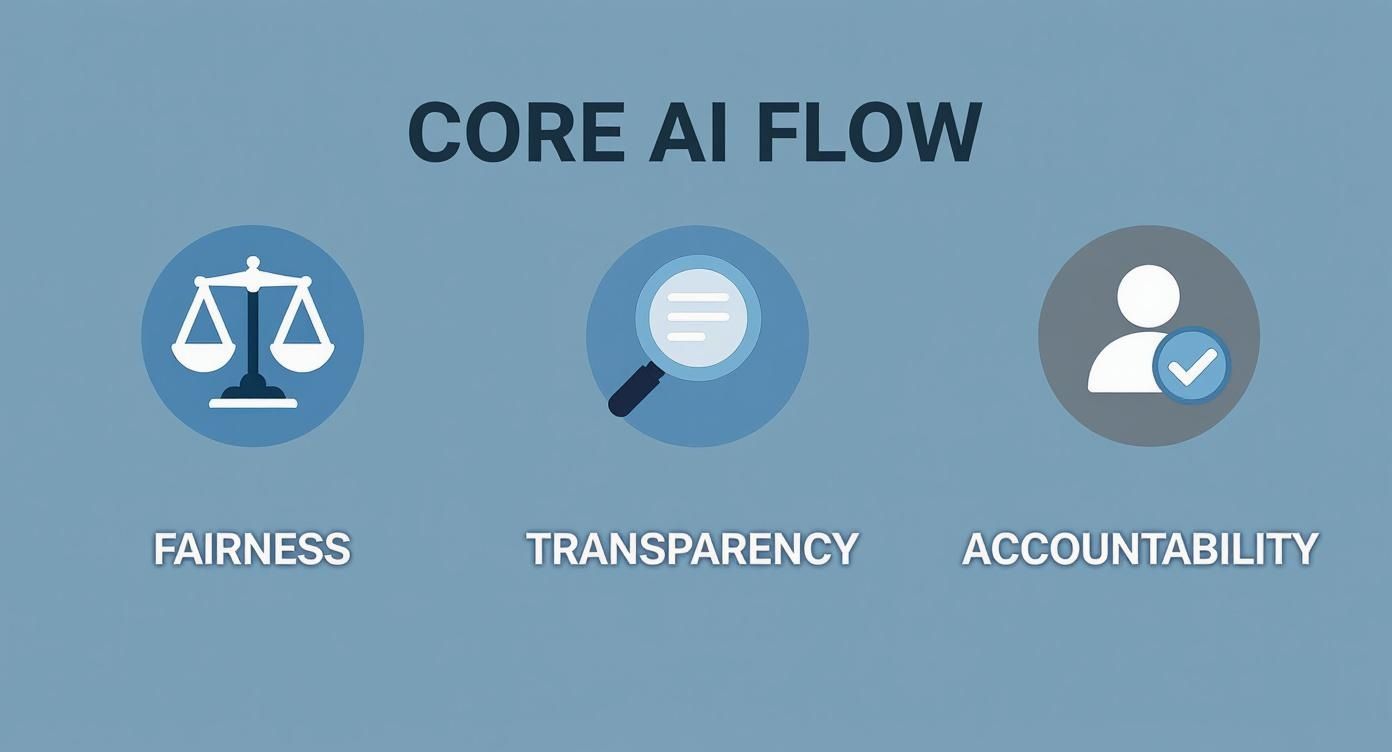
This visual really drives home how each principle supports the others, creating a feedback loop that makes the entire AI solution more trustworthy.
Integrating Responsibility Across the AI Lifecycle
A successful responsible AI strategy can’t be an afterthought. It has to be part of every phase of development, from the first brainstorming session to long-term monitoring in the real world. This ensures that ethical thinking guides your technical choices, instead of trying to patch up problems after they’re already built-in.
A practical way to manage this is to map specific responsible AI tasks to each stage of the lifecycle.
- Phase 1: Data Sourcing and Preparation: This is ground zero for bias. Your main focus here should be on fairness audits, making sure your datasets truly represent the people your AI will affect. It’s also critical to anonymize personally identifiable information (PII) to safeguard privacy right from the start.
- Phase 2: Model Development and Training: In this stage, transparency is everything. Whenever you can, opt for algorithms that are easier to interpret. If you have to use a more complex “black box” model, you need to have a plan for using explainability tools later on.
- Phase 3: Validation and Testing: Don’t just test for accuracy. You have to rigorously test for fairness across different groups of people. This is also the time for security threat modeling, where you actively hunt for and fix vulnerabilities before the system goes live.
- Phase 4: Deployment and Monitoring: Accountability is a long-term game. Once your AI is launched, you need systems in place to watch for “model drift,” which is when performance gets worse over time. You also need to give users clear ways to report problems or appeal decisions the AI makes.
This lifecycle approach turns abstract ideas into concrete steps you can actually take.
Essential Tools for Transparency and Fairness
One of the biggest challenges in AI ethics is prying open the “black box” to understand why a model made a particular decision. Thankfully, we’re not flying blind. A whole ecosystem of tools has emerged to help developers and business leaders get a look inside.
Two of the most common techniques you’ll hear about are LIME and SHAP.
- LIME (Local Interpretable Model-agnostic Explanations): Think of LIME as a detective that focuses on a single decision. For any one prediction, it builds a simple, easy-to-understand model around it to show which factors had the most influence in that specific case.
- SHAP (SHapley Additive exPlanations): SHAP gives you the bigger picture. It uses concepts from game theory to assign a value to every feature, showing how much it contributed to the model’s output overall. This gives you a global understanding of what’s driving the AI’s behavior.
Using tools like these is a huge step toward making transparency a reality. As we explored in our guide on how to properly implement AI in business, choosing the right toolkit is a key part of any successful AI strategy.
Building a Multidisciplinary Team
Let’s be clear: technology alone can’t solve these complex ethical problems. The most effective responsible AI programs are driven by people from all corners of the business working together. A team of only engineers might miss the critical social, legal, or ethical angles.
A robust responsible AI program requires a symphony of perspectives. Data scientists, ethicists, legal experts, domain specialists, and business leaders must work in concert to navigate the complex trade-offs inherent in AI development.
This mix of expertise gives you a much more complete view of potential risks and impacts. Your legal team can flag data privacy issues, while an ethicist can help you think through the gray areas where there’s no easy answer. This kind of collaboration is the human foundation you need to build technology you can actually trust.
Building a Strong AI Governance Framework
Having a solid grasp of responsible AI principles is a great start, but principles alone don’t build trustworthy systems. To truly succeed, those ideals need an organizational backbone—a structure of rules, roles, and processes that turns your ethical intentions into consistent, everyday practice. This is where AI governance comes in.
Without a strong governance framework, even the best intentions can fall apart under pressure. It provides the clarity and authority needed to ensure every AI project aligns with your organization’s values and legal obligations. This structure is the key to scaling the benefits of AI for your business responsibly and with full confidence.

Establishing an AI Ethics Committee
One of the most effective first steps you can take is creating a dedicated AI ethics committee or review board. This isn’t just about checking a box; it’s a strategic asset. By bringing together a multidisciplinary team, you get diverse perspectives at the table, helping to spot potential risks that a purely technical team might easily overlook.
This group needs to be empowered to guide, review, and, if necessary, veto AI projects that don’t meet your ethical standards. Their core responsibilities usually boil down to a few key areas:
- Defining and Upholding Ethical Standards: They translate broad principles into specific, actionable guidelines for development teams.
- Reviewing High-Risk Projects: Any AI system that could significantly impact people’s lives must pass a thorough ethical review.
- Providing Guidance: The committee acts as a go-to resource for teams wrestling with complex ethical dilemmas during development.
- Staying Informed: They keep the organization up-to-date on new regulations, research, and best practices in the responsible AI space.
Having a central body like this makes it clear who is accountable and ensures ethical thinking is woven into your company’s DNA, not just left to chance.
Defining Roles and Internal Policies
Clear roles are crucial. They prevent confusion and ensure everyone knows their part in upholding responsible AI. Governance isn’t just the committee’s job; it’s a shared responsibility across the entire organization. You need to define who is accountable for what at every stage of the AI lifecycle. For instance, data scientists are on the hook for bias testing, while product managers are accountable for the system’s overall impact on users.
These responsibilities should be spelled out in clear internal policies. Think of these policies as your company’s rulebook for AI. They should cover critical areas like:
- Data Handling: Strict rules on how data is collected, used, stored, and protected, especially when it involves personal information.
- Model Development: Clear standards for documentation, bias testing, and the level of transparency required for different types of models.
- Procurement: A checklist for vetting third-party AI tools to make sure they meet your own ethical standards before you bring them in-house.
This is a lot like the principles behind good cloud infrastructure, as we explored in our guide on governance in the cloud. AI governance provides the stable foundation needed for complex systems to operate safely and effectively.
Navigating the Regulatory Landscape
The world of AI regulation is changing fast, and staying ahead of the curve is a major competitive advantage. Landmark regulations like the EU AI Act are setting new global standards for how AI systems are classified and governed based on their level of risk. Proactive compliance isn’t just about avoiding fines; it’s about building trust with customers who are growing more and more concerned about how AI is used.
A PwC survey found that 61% of organizations are at the strategic or embedded stages of Responsible AI adoption. These advanced companies are up to twice as likely to describe their governance capabilities as effective, and nearly 60% of executives say responsible AI directly boosts ROI. Read the full PwC research on responsible AI adoption.
The data tells a clear story: mature governance leads to tangible business results. Organizations that treat compliance as a strategic priority, rather than a burden, are better positioned to innovate safely and win in the market.
A key part of this is creating a comprehensive AI model inventory—a centralized register of all AI models you have in use. This inventory should track each model’s purpose, data sources, performance metrics, and associated risks, giving you the visibility needed to manage your AI ecosystem effectively.
How to Measure and Overcome Common Challenges
Adopting responsible AI principles isn’t a “set it and forget it” task. It’s an ongoing commitment. And like any serious business initiative, if you can’t measure it, you can’t manage it. This is where we move past good intentions and into the real work of establishing clear metrics and facing the hurdles that trip up even the most dedicated teams.
Gauging your progress requires a smart mix of hard data and human feedback. Quantitative metrics give you the numbers—the cold, hard facts about your model’s performance. But qualitative measures are just as critical, as they tell you about the human impact and whether people actually trust what you’ve built. Bringing these two sides together is how you get the full picture.
Key Metrics for Responsible AI
So, how do you know if all this effort is actually working? You need to track specific, tangible indicators that connect directly back to your core principles. This is how you prove that fairness, transparency, and accountability are more than just words on a page.
- Bias Detection Scores: Are your models treating everyone fairly? Use statistical tests to check for significant differences in outcomes across demographic groups like gender, race, or age. A lopsided score is a clear red flag that your AI might be unfairly penalizing a specific group.
- Model Drift Alerts: Real-world data is always in flux, and a model that was perfect yesterday can become unreliable tomorrow. Automated monitoring is essential to catch performance degradation over time, ensuring your systems remain dependable.
- Explainability Coverage: How many of your AI models are still a “black box”? Track the percentage of models that have solid explainability documentation or tools like SHAP or LIME attached. This is a direct measure of your commitment to transparency.
- Stakeholder Trust Surveys: At the end of the day, trust is what matters. Regularly poll your customers, employees, and partners to see how they feel about your AI systems. This feedback is an invaluable gut check on whether your principles are resonating in the real world.
We treat responsible AI as a continuous improvement loop in our own client cases. The goal isn’t just to launch a successful solution, but to ensure it stays fair and reliable long after it goes live.
Addressing Common Implementation Hurdles
Knowing the principles is the easy part. Actually putting them into practice is where things get tricky. A recent study from the World Economic Forum revealed a sobering statistic: despite high awareness, less than 1% of organizations have fully operationalized responsible AI. A massive 81% are still stuck at the starting line, highlighting a serious “implementation gap.” You can discover more insights from the World Economic Forum’s AI playbook to see just how widespread this challenge is.
Here are the most common roadblocks we see—and how to navigate them.
1. The Talent and Skills Gap
Good luck finding someone who is both a world-class data scientist and a trained ethicist. They’re unicorns. This skills shortage is a major bottleneck, leaving companies without the in-house expertise to conduct proper fairness audits or implement sophisticated explainability tools.
- Solution: Don’t wait to find the perfect hire. Focus on upskilling the talented people you already have. Invest in practical training on ethical frameworks, bias detection, and AI governance. For immediate needs, consider bringing in an AI solutions partner to inject specialized expertise while your internal team gets up to speed.
2. Organizational Resistance
Let’s be honest—change is hard. Some of your teams might see responsible AI as extra red tape that slows down innovation. This pushback usually comes from a misunderstanding of the long-term value.
- Solution: This has to come from the top. When leadership makes it clear that responsible AI is a non-negotiable strategic priority, people listen. Reframe the conversation: this isn’t about adding blockers; it’s about building better, more trustworthy products that customers will love for the long haul.
3. The Challenge of Proving ROI
It’s not always easy to draw a straight line from a fairness audit to next quarter’s revenue. This ambiguity makes it tough to get the budget and resources you need to build out a proper program.
- Solution: Shift the focus to risk mitigation and brand equity. Show how investing in responsible AI helps you avoid costly legal battles, regulatory fines, and brand-damaging headlines. At the same time, highlight how transparent, reliable systems build unbreakable customer loyalty and create a powerful competitive edge.
By anticipating these challenges, you can build a strategy to overcome them. That’s how you turn responsible AI from a set of principles into your organization’s greatest strength.
Building Your Future on Trustworthy AI
Adopting responsible AI principles isn’t about pumping the brakes on innovation. It’s about building smarter, more resilient solutions that people will actually trust for the long haul.
This journey starts by weaving fairness, transparency, and accountability into the very fabric of your company culture and how you build things. Think of it less like a finish line and more like a continuous cycle of learning, adapting, and improving.
Success really comes down to treating ethical considerations as a core part of the business, not some compliance checkbox you tick off at the end. The stakes are incredibly high in sensitive fields like AI voice recognition in healthcare, where a foundation of trust isn’t just nice to have—it’s everything.
Your Path Forward
Getting started with responsible AI can feel like a huge task, but it really boils down to a few practical first steps:
- Assess Your Foundation: Take an honest look at your current development practices and see how they stack up against the core principles we’ve covered. Where are the gaps?
- Establish Governance: Someone needs to be accountable. Create clear lines of ownership and pull together a multidisciplinary ethics team to guide the process.
- Empower Your People: Don’t just hand down rules. Invest in training to create a shared language and understanding of responsible AI across every department.
Taking this proactive stance doesn’t just mitigate risk; it builds a powerful competitive advantage that sets you apart.
As your dedicated AI solutions partner, we’re here to help you navigate this path. We bring deep expertise in both responsible AI frameworks and custom software development to turn your ethical vision into a real, market-ready product. By building on a foundation of trust, you ensure your innovations don’t just launch, they last.
Frequently Asked Questions About Responsible AI
Diving into AI ethics and responsibility naturally brings up a lot of questions. As you work to weave responsible AI principles into your business, getting clear answers is the foundation of a solid strategy. Let’s tackle some of the most common questions to clarify the concepts and what they mean in practice.
Getting these fundamentals right is your first step toward building systems that aren’t just powerful, but also fair, clear, and trustworthy. Each question here touches on a crucial part of putting these ideas to work.
What Is the Difference Between Responsible AI and Ethical AI?
This is a great question. The easiest way to think about it is that Ethical AI is the “what” and “why,” while Responsible AI is the “how.”
Ethical AI is the broader philosophy—it’s about the moral principles and values that should guide AI development. It asks the big questions: What is fair? What is the right thing to do? How will this impact society?
Responsible AI is where the rubber meets the road. It’s the practical application of those ethics—the actual frameworks, governance structures, and tools you use to build systems that are fair, transparent, and accountable. As a leading AI solutions partner, our job is to help companies turn those big ethical ideas into concrete actions.
How Can a Small Business Start Implementing Responsible AI?
You don’t need a huge budget or a dedicated ethics team to get started. Honestly, the most important first step is building the right culture. Start by educating your team on the core principles we’ve covered and make a commitment to using diverse, high-quality data from the very beginning.
A simple, practical move is to adopt a “human-in-the-loop” model for critical decisions. Let the AI provide insights, but have a person make the final call. You can also start experimenting with open-source tools for things like bias detection and model explainability. When getting AI for your business, making responsibility a core value from day one is everything.
Which Responsible AI Principle Is Most Important to Start With?
All the principles are connected and feed into each other, but if you have to start somewhere, start with Fairness. Why? Because a biased AI can cause immediate and tangible harm, from wrecking your brand’s reputation to landing you in legal trouble.
Focusing on fairness forces you to get your hands dirty and really look at your data—the bedrock of any AI system. When you work to ensure your data is representative and start auditing your models for bias, you’re building a much stronger foundation. This effort often has a domino effect, making it easier to improve transparency and accountability down the line.
Is There a Universal Certification for Responsible AI?
Not yet. There isn’t a single, globally recognized certification for Responsible AI right now. What we do have is a growing consensus around a core set of principles, heavily influenced by frameworks like the NIST AI Risk Management Framework and major regulations like the EU AI Act.
The best approach is to stay on top of these evolving standards and adopt a framework that makes sense for your industry, your location, and how you’re using AI. Being proactive not only prepares you for future regulations but also builds critical trust with your customers. Many of our client cases demonstrate how aligning with these leading standards creates more durable and trusted products.
At Bridge Global, we specialize in turning responsible AI principles into practical, high-impact solutions. Whether you need expert AI development services or end-to-end custom software development, we are the technology partner you need to innovate with confidence. Get in touch with us now.

About Upendra Jith
Upendrajith completed his Master's in English and has been a commercial content developer for the past three years. He's more inclined to develop content with a 'street-smart' delivery on topics such as technology, media, or anything he can get his hands on. He has a fixation on lyrics, dark poetry, media, technology, and flow arts.
View all posts by Upendra Jith →