



Your Guide to Responsible AI Engineering
Responsible AI engineering has moved far beyond academic discussion; it’s now a fundamental part of doing business. This isn’t about lofty ideals; it’s the practical, hands-on discipline of building and operating artificial intelligence systems that are safe, fair, and worthy of our trust.
Why Responsible AI Engineering Is No Longer Optional
Think about building a skyscraper. Would you ever focus only on making it tall, while completely ignoring the foundation, safety codes, or how it fits into the city skyline? Of course not. Building powerful AI without a framework for responsibility is just as reckless. It’s like building on sand, just waiting for the whole thing to collapse when pressure is applied.
As AI becomes the new backbone for modern business, how we build our systems is every bit as important as what we build.
Ignoring core principles like fairness and transparency opens the door to massive risks. We’ve all seen the headlines: the brand damage, the costly legal fights, and the customer trust that evaporates overnight after a high-profile AI failure. In fact, a recent survey found that 85% of consumers expect companies to be transparent about their AI safety practices before launching a product. Public trust is clearly a fragile, high-stakes asset.

From Risk Mitigation to Strategic Advantage
It’s a common mistake to view responsible AI as just another set of rules or constraints. The reality is, it’s a strategic advantage that fosters sustainable growth and creates genuinely better solutions. When you build responsibility into your development process from the ground up, you’re not just dodging bullets; you’re actively building more reliable and valuable products.
This proactive approach delivers several key business benefits:
- Enhanced Customer Trust: Showing a real commitment to ethical AI builds deep loyalty and makes you stand out.
- Reduced Regulatory Risk: With new laws like the EU AI Act on the horizon, having a responsible framework keeps you ahead of compliance headaches.
- Improved Model Performance: When you actively hunt down and fix bias and vulnerabilities, your AI systems simply perform better and more accurately over time.
- Attraction of Top Talent: The best engineers and data scientists want to work for companies that are serious about building technology the right way.
An expert AI solutions partner can help weave these principles into every stage of the development lifecycle. This isn’t about adding red tape; it’s about making smart, forward-thinking decisions that protect your business and your customers.
Responsible AI practices are not speed bumps; they are accelerators. By addressing risks early, you prevent costly rollbacks and build a foundation for innovation that lasts.
The Real Cost of Neglect
The consequences of irresponsible AI aren’t just hypothetical. A biased hiring algorithm can reinforce systemic discrimination, triggering lawsuits and damaging your reputation. A flawed diagnostic tool in a hospital could put lives at risk. A vulnerable financial model could be exploited by bad actors, leading to massive monetary losses.
Each of these scenarios points to one simple truth: the cost of fixing a broken AI system, in money, reputation, and public trust, is exponentially higher than the investment required to build it responsibly from the start. It’s why our approach to custom software development and our AI development services integrates these checks and balances from day one.
By making responsible AI engineering a priority, you’re building a more resilient, future-proof organization that’s ready for the complexities of an AI-driven world.
The Five Core Principles of Building Trusted AI
To practice responsible AI engineering, you can’t just focus on code and algorithms. Your work has to be built on a solid foundation of core principles. These aren’t just abstract ideals to hang on a wall; they are the actionable pillars that should guide every single decision you make, from gathering data to deploying a live model.
Think of these principles as a constitution for your AI development. They ensure that every system you build is fair, safe, and accountable. When you embrace them, you move from simply building AI to building a reputation for integrity and excellence.
1. Fairness and Equity
An AI system is only as fair as the data it’s trained on. This is a hard truth. The principle of fairness demands that our systems treat all individuals and groups equitably, which means we have to actively work to find and eliminate existing societal biases, not just let our models amplify them.
For example, think about an AI recruiting tool trained on a company’s hiring data from the last 20 years. If that historical data reflects a bias against women in leadership roles, the AI will learn that pattern and start filtering out highly qualified female candidates. A fair system, by contrast, is one that has been carefully audited and adjusted to evaluate candidates on skill and merit alone, promoting true equity. As we explored in our guide to responsible AI principles, this is a critical first step.
2. Transparency and Explainability
If you can’t explain how your AI reached a decision, you can’t truly trust it, and neither can your customers. Transparency is all about moving away from “black box” models where the internal logic is a mystery. We need to build “glass box” systems where the decision-making process is clear enough for developers, users, and even regulators to understand.
Let’s say an AI model denies a loan application. A transparent system won’t just say “no.” It will provide the specific factors that led to that decision, like a low credit score or a high debt-to-income ratio. This explainability gives the applicant real feedback and, just as importantly, allows your team to verify that the model is working exactly as you designed it to.
3. Privacy and Security
In an era of big data, protecting user information isn’t optional; it’s a fundamental requirement. This principle means that AI systems must be secure by design and handle all personal data with the utmost respect for privacy. This is especially critical in high-stakes fields like finance or healthcare.
Consider an AI diagnostic tool in a hospital. Its job isn’t just to provide accurate medical insights. It must also strictly follow patient confidentiality laws like HIPAA. This demands robust security measures from the ground up: things like data encryption, access controls, and anonymization techniques, to prevent breaches and keep sensitive health information completely private.
The public’s demand for ethical AI is loud and clear. Recent reports show that 85% of people support national efforts to make AI safe, and an equal 85% want companies to be transparent about their AI safety practices before releasing products.
4. Robustness and Reliability
An AI system has to be dependable. It must perform consistently and safely, especially when it runs into unexpected situations or even malicious attacks. Robustness is what ensures your AI can handle the messy, unpredictable real world without failing or causing harm.
A self-driving car’s perception system is a perfect example. It needs to be robust enough to work reliably in heavy rain or dense fog – conditions that may have been rare in its training data. It also has to be resilient against adversarial attacks, where someone might try to trick the system with cleverly disguised stop signs or other altered inputs.
5. Accountability
At the end of the day, someone must be answerable for what an AI system does. The principle of accountability is about establishing clear lines of ownership and responsibility for AI outcomes. It ensures there’s always a human in the loop who is ultimately accountable for the system’s behavior.
This means creating real governance structures, like an AI ethics board, and keeping detailed logs of a model’s performance. If an automated trading algorithm makes a disastrous trade, a strong accountability framework ensures the error can be traced to its root cause, corrected, and that new safeguards are put in place to make sure it never happens again.
Weaving Responsibility into Your AI Development Lifecycle
Let’s be clear: responsible AI isn’t some final checkbox you tick off before pushing a model live. It’s a discipline, a mindset that has to be embedded in your development process from day one. Thinking about ethics and safety after the fact is a surefire way to end up with biased models, security holes, and a mountain of technical debt.
The only way to build AI that earns trust is to make these principles a natural part of your workflow. This means integrating ethical checkpoints and sound practices at every single stage of the software development lifecycle. It’s about building responsibility by design, not by accident.
Phase 1: Data Sourcing and Preparation
Every AI model is built on a foundation of data. If that foundation is flawed, the entire system is at risk. This is where responsible AI engineering truly begins – with a sharp focus on where your data comes from and how you get it ready for training.
- Hunt Down and Fix Bias: You have to actively audit your datasets for hidden biases – be they demographic, historical, or representational. Use statistical methods and data augmentation techniques to balance out skewed information. The goal is to create a dataset that actually reflects the real world your AI will operate in.
- Lock Down Privacy: From the very beginning, implement privacy-preserving methods like data anonymization or differential privacy. Complying with regulations like GDPR or CCPA isn’t optional; it protects your users and, frankly, it protects your business from serious risk.
This isn’t just about cleaning up messy data. It’s about thoughtfully curating a dataset that represents the fairness you expect your model to learn. This first step sets the standard for the rest of the project.
The diagram below shows how these principles flow together, starting with fairness and moving through transparency to create secure, trustworthy systems.
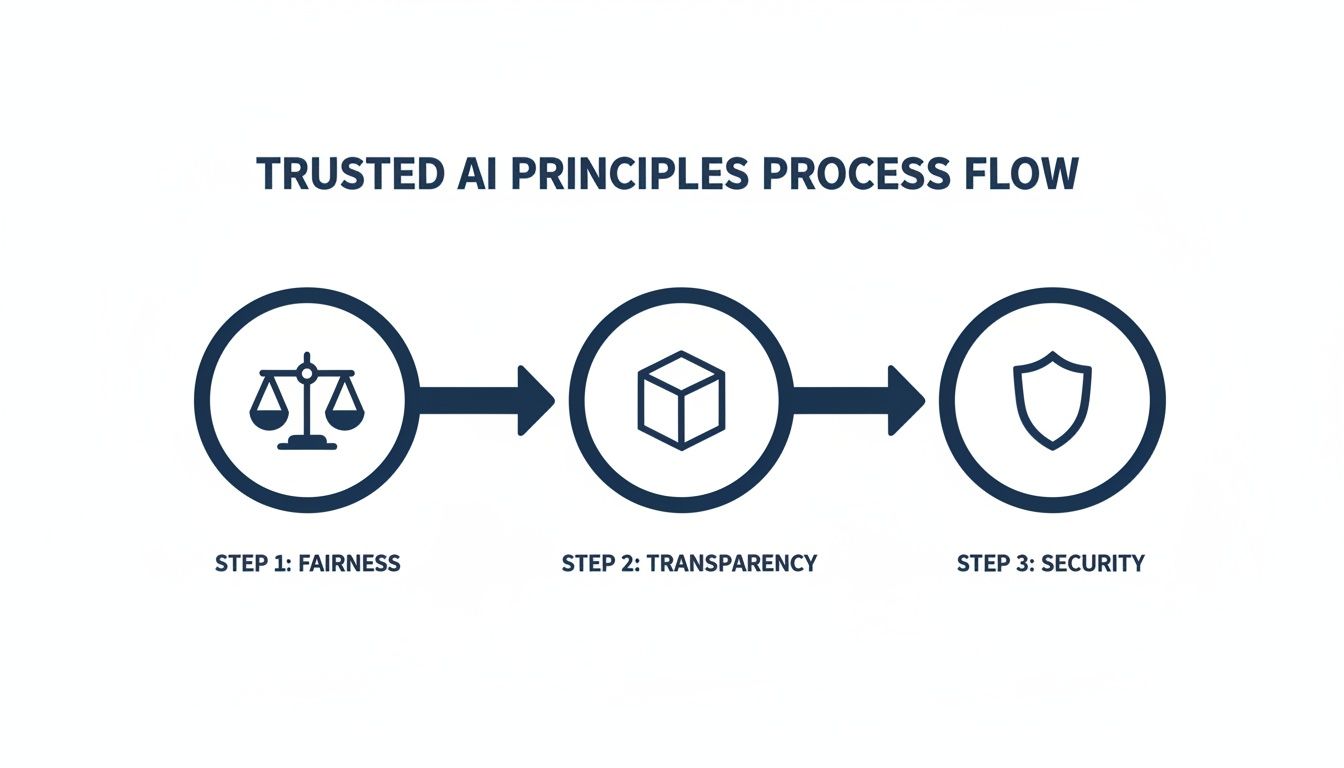
As you can see, each principle builds on the last, forming a solid framework for developing AI you can stand behind.
Phase 2: Model Design and Training
Once your data is solid, your attention turns to the model itself. The choices you make here have a direct line to your system’s transparency and fairness. Sure, a highly complex “black box” model might give you a tiny bump in performance, but if you can’t explain how it works, you’re taking on a massive business risk.
An experienced AI solutions partner can guide you in choosing algorithms that strike the right balance between performance and explainability. It’s also crucial to document everything obsessively during this stage. Every decision, every hyperparameter, and every training run needs to be recorded to create a clear audit trail for accountability down the road.
Phase 3: Validation and Testing
Before any model goes live, it needs to be put through its paces with testing that goes way beyond simple accuracy scores. This is your last chance to catch a flawed or potentially harmful model before it impacts real people. This is where comprehensive software testing services are absolutely critical.
Your validation checklist must include:
- Fairness Audits: Test the model’s predictions across different user segments to make sure it isn’t producing discriminatory outcomes.
- Robustness Stress-Testing: Deliberately hit the model with adversarial attacks and unusual data to see how it holds up under pressure.
Phase 4: Deployment and Ongoing Monitoring
Going live is just the beginning. Once an AI system is out in the wild, it needs to be monitored constantly to ensure its performance remains stable, accurate, and fair. You’ll want to have human-in-the-loop oversight for high-stakes decisions and make sure every API and endpoint is secured to prevent misuse.
Despite the obvious need, putting responsible AI into practice is still a major hurdle for most companies. A recent analysis from the World Economic Forum and Accenture found that fewer than 1% of organizations have fully mature responsible AI programs. A shocking 81% are still stuck at the very beginning stages.
This massive gap underscores just how urgently businesses need a structured way forward. A well-defined AI transformation framework gives you that roadmap, helping you move from basic awareness to a fully operational program. By systematically building these phases into your process, you can turn responsible AI from a lofty idea into a core engineering practice.
Building an Effective AI Governance Framework
Solid technical practices are the foundation of responsible AI, but they’re only half the battle. Real accountability happens when you weave those principles into your company’s culture and day-to-day operations. An effective governance framework is what turns your good intentions into concrete, repeatable actions, ensuring responsibility is baked into how you innovate, not just bolted on at the end.
Making this leap from code to culture is a team sport. It demands a coordinated effort from your technology, legal, business, and leadership teams, all working together. The goal isn’t just to check a compliance box; it’s to build a robust system of checks and balances that earns trust and supports sustainable growth. An expert partner offering digital transformation consulting can bring the outside perspective you need to build this structure right the first time.

Key Components of AI Governance
A strong governance framework rests on a few essential organizational pillars. When set up correctly, these elements create clarity, establish clear ownership, and enforce consistent standards across every AI project you undertake.
- AI Ethics Council or Board: Think of this as your mission control for AI ethics. It’s a cross-functional group of leaders from legal, tech, business, and HR who provide high-level oversight. Their mission is to set the company’s ethical guardrails for AI, review high-stakes projects, and be the final word on tough ethical calls.
- Clearly Defined Roles: Accountability crumbles without clear ownership. You need to designate specific roles, like an AI Product Owner, who is ultimately responsible for a model’s performance and real-world impact. An Ethics Lead is also crucial for championing best practices and guiding teams through tricky risk assessments.
- Internal Standards and Policies: Your principles need to be written down in a way that developers can actually use. Codify them into actionable internal policies that give your teams practical, no-nonsense guidance on everything from data handling and fairness testing to model documentation.
Getting these roles and policies right from scratch can be tough. Augmenting your team with a dedicated development team that already has this expertise can help you get up and running faster, ensuring your governance model is both practical and effective from day one.
The AI Project Review Checklist
Before any AI project gets the green light for deployment, it needs to pass a rigorous review. A standardized checklist ensures no critical ethical, legal, or reputational risks slip through the cracks. This isn’t about creating red tape; it’s a non-negotiable quality gate.
“As organizations develop a diverse ecosystem of AI agents, often created by multiple engineering teams, it becomes essential to establish a standardized evaluation process. This ensures every agent adheres to enterprise-level standards before we deploy and distribute it to end users.”
– Thomas Po, Senior Product Manager, Microsoft Digital
Your checklist should force teams to stop and answer some tough questions:
- Data Provenance: Do we know exactly where this data came from? Have we audited it for bias and confirmed we have the legal right to use it?
- Fairness Assessment: How will we test the model to ensure it doesn’t negatively affect certain demographic groups? What specific fairness metrics are we tracking?
- Transparency Plan: Can we actually explain how this model makes its decisions? How will we communicate its logic to users and stakeholders?
- Security and Privacy: Is user data protected according to all relevant regulations and best practices? Has a formal privacy impact assessment been completed?
- Human Oversight: What’s the plan for having a human in the loop, especially for high-stakes decisions? Who is accountable if something goes wrong?
Maintaining an AI Model Registry
Transparency can’t be a one-off event. A central AI model registry is one of the most powerful tools for ongoing governance. Think of it as a library catalog for every AI model running in your organization.
This internal registry gives you a complete, at-a-glance view of your entire AI landscape. Each entry should contain vital information:
- The model’s purpose and its designated owner.
- The specific data used for training.
- Key performance metrics and any known limitations.
- A complete version history, including all updates.
This registry becomes your single source of truth, making risk management easier, audits smoother, and accountability clearer. As we cover in our guide to governance in the cloud, transparent asset management is a cornerstone of any modern IT strategy. Ultimately, building a robust governance framework is how you operationalize responsible AI engineering and turn abstract principles into everyday practice.
For many companies, responsible AI engineering isn’t just a nice-to-have; it’s a hard-and-fast rule. This is especially true in highly regulated fields like finance, healthcare, and insurance, where the stakes are incredibly high. An AI failure in these sectors doesn’t just mean a bruised brand reputation; it can trigger devastating financial penalties, legal nightmares, and a total collapse of customer trust.
Getting compliance right means going beyond good intentions. It demands rigorous, provable practices. With new regulations like the EU AI Act turning ethical guidelines into enforceable laws, the pressure is on. Your business needs to act now to build a future where accountability is baked into every system. As we explore in our guide on AI for your business, getting ahead of compliance can become a powerful competitive edge.
Industry-Specific Compliance Challenges
While the core principles of responsible AI are universal, how you apply them can change dramatically from one industry to another. What passes for compliance in retail might be dangerously inadequate in a hospital.
- Finance: In the world of finance, AI models drive everything from credit scoring to fraud detection. The biggest compliance trap here is algorithmic bias. If a lending model isn’t trained correctly, it could illegally discriminate against applicants based on protected traits like race or gender, opening the door to massive regulatory fines and class-action lawsuits. Fairness and transparency aren’t just best practices; they’re legal necessities.
- Healthcare: Patient data is some of the most sensitive information on the planet. Any AI system used for diagnostics or suggesting treatments must be fully compliant with tough regulations like HIPAA. This calls for ironclad data privacy, rock-solid security, and exhaustive model validation to ensure it’s safe and reliable enough for clinical use.
- Insurance: The insurance industry lives and breathes complex models for assessing risk and setting premiums. A critical challenge here is preventing discriminatory pricing. If an AI model accidentally uses proxies for protected characteristics (like using ZIP codes as a stand-in for race) to set rates, it can violate fair-practice laws. Transparency is everything; you have to be able to prove that your pricing is based on legitimate risk factors alone.
Navigating these industry minefields requires deep, practical expertise. Our client cases show how we partner with businesses in regulated sectors to untangle these exact compliance knots.
The speed at which AI is being adopted only magnifies these challenges. A 2026 Deloitte report found that worker access to AI shot up by 50% in 2025 alone. It also projects that the number of companies with over 40% of their AI projects actually in production is set to double. This breakneck pace makes solid governance and responsible engineering more critical than ever. You can find more on these trends in the full report.
The Essential Role of Rigorous Testing
You can’t claim compliance without proof. This is where meticulous, independent validation becomes absolutely essential.
Rigorous software testing services are the only way to systematically audit your AI systems against specific regulatory rules. This goes far beyond just checking for bugs. It involves targeted fairness audits, security penetration tests, and stress tests to confirm the model performs reliably under pressure.
Ultimately, this validation process creates the paper trail you need to demonstrate due diligence to regulators. When an auditor comes knocking, being able to produce a detailed record of your testing protocols and fairness metrics can be the difference between a clean report and a costly penalty. It’s the final, crucial step in turning responsible AI principles into a defensible compliance strategy.
Turning Principles into Practice with the Right Partner
We’ve covered the what and the why behind responsible AI engineering. The real question now is, how do you actually make it happen? Moving from well-intentioned principles to a trusted, deployed solution requires more than just a blueprint; it demands hands-on expertise. This is often where a good partnership can make all the difference, bridging the gap between theory and real-world results.
Working with an experienced AI solutions partner means ethical guardrails aren’t just a final checkbox. Instead, they are built directly into the development process from day one. Our own approach to custom software development and product engineering services is grounded in this exact philosophy. We focus on building solutions that are not only powerful but also genuinely fair, transparent, and secure. That foundation allows you to innovate with confidence, knowing you have a team dedicated to getting it right.
A Consultative Path to Trusted AI
Achieving mature, responsible AI isn’t an overnight sprint; it’s a deliberate journey. It all starts with an honest look at where you are today and a clear, practical roadmap for where you want to go. We’ve found that guiding clients step-by-step, from initial strategy all the way through deployment and maintenance, is the key to success.
Our consultative process typically breaks down like this:
- Discovery and Strategy Workshops: We start by getting a deep understanding of your business objectives and assessing your current AI and data maturity. This isn’t just about tech; it’s about aligning the AI strategy with your core business goals.
- Tailored Recommendations: Armed with that understanding, we give you concrete, actionable recommendations. This covers everything from the right technology stack to governance models and a prioritized project plan.
- Structured Implementation: We use a proven AI transformation framework that methodically builds responsible AI practices into each stage of the lifecycle. A structured approach like this helps prevent costly mistakes and gets you to a mature capability much faster.
- Ongoing Support and Optimization: Our work doesn’t stop at launch. A true partnership involves continuous monitoring and fine-tuning to ensure your AI systems stay effective, compliant, and aligned with evolving standards.
Your Next Step in Responsible AI Engineering
Implementing AI for your business the right way is more than just good ethics; it’s a serious competitive advantage. It builds lasting customer trust, reduces organizational risk, and ultimately creates more sustainable, high-value solutions.
Whether you’re looking for a full-cycle dedicated development team to own a project or just need targeted expertise to guide your internal team, we’re here to help. As we’ve noted before in our guide on AI integration consulting, a strategic partner can be invaluable for navigating this complex but rewarding field.
Take a look at our comprehensive AI development services to see how we can help you build the next generation of trusted, ethical AI. Let’s work together to turn those principles into practice.
Frequently Asked Questions
When it comes to responsible AI engineering, a lot of the same questions come up. Here are some straightforward answers to help clear the air.
What Is the First Step to Implementing Responsible AI in My Organization?
The best place to start is by taking a good, hard look at your current AI projects and data practices. You can’t chart a course until you know where you stand.
Pull together a small, cross-functional team: think tech, legal, and business folks. Have them review your existing systems for potential risks around fairness, transparency, and privacy. This initial audit will shine a light on your biggest gaps and help you prioritize what to tackle first. From there, you can build a solid AI governance policy that actually fits your company’s values and risk appetite.
Can a Small Business Afford to Invest in Responsible AI?
Absolutely. In fact, you can’t afford not to. For a smaller company or startup, building these principles from the ground up is far cheaper and easier than trying to fix deep-seated problems later on. It’s simply about building a quality product from day one.
Start with the basics. Meticulously document your data sources, opt for transparent models when you can, and always put user privacy first. There are plenty of great open-source tools for things like bias detection and explainability. This approach not only lowers your long-term risk but also builds customer trust, which is pure gold for a growing business.
Does Responsible AI Engineering Slow Down Innovation?
It’s a common misconception that putting guardrails on AI will stifle creativity. The reality is that responsible AI actually fuels sustainable innovation. When you address ethical and compliance risks early, you prevent costly redesigns, legal battles, and brand-damaging disasters down the line.
It’s a mindset shift from just “moving fast” to “moving thoughtfully and building things that last.” Frameworks like our AI transformation framework are designed to weave these practices into your workflow efficiently, so you don’t have to choose between progress and principles.
What Is the Difference Between Ethical AI and Responsible AI?
Think of it this way: Ethical AI is the philosophical compass. It’s the broad set of moral principles that should guide AI development, focusing on what’s fundamentally “right” and “wrong.”
Responsible AI engineering is how you put those ethics into practice. It’s the hands-on engineering discipline and governance structure used to build systems that are provably fair, transparent, and accountable. In short, ethical AI is the “why,” and responsible AI is the “how.”
Ready to build AI solutions you can trust? As an expert AI solutions partner, Bridge Global can help you integrate these principles into your development lifecycle, ensuring your innovations are both powerful and responsible.

About Shreesha Chandrabose
Shreesha Chandrabose is a commerce graduate with a growing passion for content writing and digital media. With a curious mind and a creative approach, she enjoys transforming ideas into simple, relatable, and engaging narratives. She loves poetry, photography, and editing, and enjoys bringing ideas to life through words and visuals.
View all posts by Shreesha Chandrabose →