


Population Health Management Software for Better Outcomes
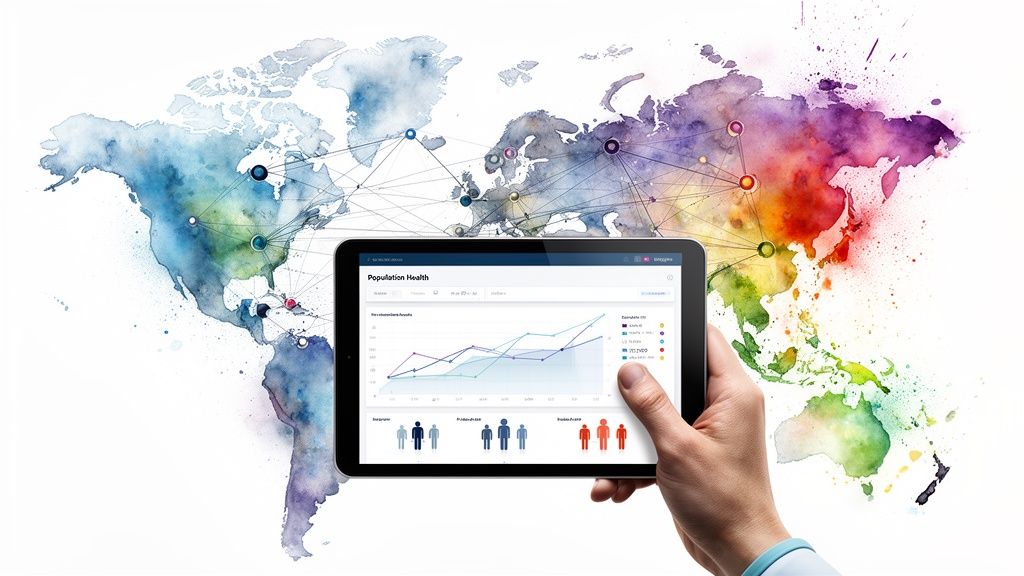
Population health management software is the technology that helps healthcare organizations see the forest for the trees. Instead of just treating one sick patient at a time, these platforms provide a high-level view of entire patient groups, making it possible to manage their health proactively. It’s the engine driving the massive industry shift from old-school, fee-for-service medicine to modern, value-based care.
The Strategic Shift to Proactive Healthcare

Think of healthcare’s traditional model like a fire department; it’s built to react to emergencies. An Electronic Health Record (EHR) is brilliant at documenting every detail of those emergencies. Population health management (PHM) software, on the other hand, is more like an advanced weather forecasting system. It sifts through massive amounts of data to predict where storms might be brewing, giving providers a chance to intervene before a full-blown crisis hits.
This proactive approach isn’t just a nice-to-have anymore; it’s a necessity. With the healthcare system moving toward value-based care, where providers are paid for good outcomes, not just for doing more procedures, the ability to manage the health of an entire population is absolutely critical.
The market is exploding in response. The global PHM software market is on track to hit a staggering USD 138.39 billion by 2032, growing at a compound annual growth rate of 15.69%. This isn’t just a trend; it’s a fundamental change in how healthcare is delivered worldwide. You can learn more about these market findings to see the full picture.
Why PHM Software Is Essential Today
So, what’s the real magic behind these platforms? It’s their ability to pull together all the disconnected pieces of a patient’s story into one clear, actionable view. They integrate data from everywhere: EHRs, insurance claims, pharmacy records, and even social determinants of health (SDOH), to paint a complete picture of a community’s well-being.
This unified view allows healthcare organizations to:
-
Identify At-Risk Groups: Pinpoint patients with chronic conditions like diabetes or heart disease who are most likely to face complications, then step in with targeted preventive care.
-
Close Care Gaps: Automatically flag patients who are overdue for a cancer screening, a vaccination, or a critical follow-up appointment. No more falling through the cracks.
-
Coordinate Care Teams: Keep primary care physicians, specialists, and care managers on the same page, preventing the kind of fragmented, redundant care that frustrates patients and inflates costs.
At its core, PHM is about turning raw data into life-saving insights. A modern PHM system rests on a few key pillars that work together to make this possible.
Core Pillars of Modern Population Health Management
This table breaks down the fundamental components that define a comprehensive PHM strategy and the software that powers it.
| Pillar | Objective | Key Software Functionality |
|---|---|---|
| Data Aggregation | Create a single source of truth for each patient and population. | Integration with EHRs, claims systems, HIEs, and patient-generated data. |
| Risk Stratification | Identify and prioritize high-risk, high-cost patients. | Predictive algorithms, risk scoring models, and cohort segmentation tools. |
| Care Management | Deliver proactive, coordinated care to at-risk individuals. | Personalized care plans, automated workflows, and team collaboration tools. |
| Patient Engagement | Empower patients to participate in their own health journey. | Secure messaging, patient portals, remote monitoring, and educational resources. |
| Analytics & Reporting | Measure performance, track outcomes, and identify improvement areas. | Quality dashboards, cost analysis tools, and population health reporting. |
These pillars aren't just features; they represent a complete operational shift. For any organization serious about improving outcomes while controlling costs, adopting a robust PHM strategy is non-negotiable.
Population health management software transforms data into actionable intelligence. It's about moving from simply recording a patient's history to actively shaping a population's future health, preventing illness, and driving down long-term costs.
Ultimately, this technology empowers providers to deliver the right care, to the right patient, at the right time. By tapping into tools built for population-level insights, healthcare organizations can finally achieve the triple aim of value-based care: better patient outcomes, improved patient experiences, and reduced costs. As we’ve explored in our guide to leveraging AI for your business, intelligent data analysis is the key to unlocking this potential.
The Core Features: What Makes Population Health Software Tick?
A modern population health management (PHM) platform isn't just a fancy database. It’s a dynamic, integrated system where different modules work in concert to make proactive care a reality. Think of these core features as the engine room of a sophisticated operation, turning a sea of raw data into coordinated, life-saving actions.
While each component has a specific job, their true power is unlocked when they connect and share insights with each other. Let's break down the essential modules that form the backbone of any effective PHM platform.
Care Management and Coordination
At the end of the day, population health is about doing something with the data. The care management module is the central hub where that action happens. It’s where care coordinators and clinical teams put strategies into motion, automating workflows, assigning tasks, and tracking interventions for at-risk patients so no one gets lost in the system.
You can think of it as a specialized project management tool, but instead of managing marketing campaigns, teams are managing complex patient care plans. This module creates a shared command center where a primary care doctor, a specialist, and a community health worker can all see the same plan, monitor progress, and communicate securely.
This level of coordination is a true game-changer. It helps eliminate redundant tests, flags medication adherence issues, and makes sure timely follow-ups happen after a hospital stay – a critical step in cutting down readmissions. The whole point is to create a seamless care journey for the patient, no matter how many different providers are involved.
Risk Stratification and Predictive Analytics
With limited resources, how do you decide who needs help the most urgently? That’s the crucial question answered by the risk stratification engine. This feature uses sophisticated algorithms to comb through enormous datasets: EHRs, claims data, lab results, and pinpoint individuals at the highest risk of a negative health event.
This is far more advanced than just looking at a diagnosis. The software hunts for complex patterns and combinations of factors that signal trouble ahead. For example, it can flag a patient with diabetes who has missed their last two appointments, shows spotty medication refills, and lives in a zip code with poor access to healthy food. That’s a much richer, more actionable insight than a simple chronic disease registry could ever provide.
A study by Slough CCG in the UK really highlights this. They found that if they had focused only on patients with severe frailty, they would have missed 46% of the population at high risk of hospitalization. True risk stratification looks beyond a single clinical marker to build a complete picture of vulnerability.
This predictive power lets care teams direct their most intensive resources to the small slice of the population that often drives the vast majority of healthcare costs. As we’ve covered in our guide on selecting AI use cases, this kind of predictive work is fundamental to running an intelligent, modern healthcare operation.
Patient Engagement and Outreach
Proactive care isn't a one-way street; it's a partnership. The patient engagement module equips organizations with the tools to bring patients into the fold, turning them from passive recipients of care into active participants in their own health. This happens through a variety of smart, digital touchpoints.
These tools typically include:
-
Secure Patient Portals: A single place for patients to see their health records, check lab results, and review their care plans.
-
Automated Communication: Personalized reminders sent via text, email, or automated calls for upcoming appointments, medication refills, and preventive screenings.
-
Educational Resources: Targeted content delivered right when it’s needed, like videos on managing diabetes or articles on heart-healthy eating, based on a patient's specific conditions.
-
Telehealth Integration: Easy access to virtual consultations and remote monitoring, breaking down barriers to receiving timely care.
By making healthcare more convenient, accessible, and easier to understand, these features dramatically improve patient adherence and overall satisfaction. Organizations aiming to create these connected experiences often partner with firms specializing in healthcare software development to build tools that are both user-friendly and secure.
Data Analytics and Reporting
Finally, you can't manage what you can't measure. The data analytics and reporting module provides the high-level oversight needed to steer the ship. It transforms mountains of complex data into intuitive dashboards and clear reports, giving healthcare leaders a 360-degree view of their performance.
This is where the leadership team can track the key metrics that matter, such as:
-
Rates of emergency department visits
-
30-day hospital readmission percentages
-
Adherence to clinical quality measures (like cancer screenings or blood pressure control)
-
The overall cost of care per patient
These insights are absolutely essential for knowing if your PHM initiatives are actually working, spotting areas that need improvement, and proving the return on investment to stakeholders. For those who need to dig even deeper, tapping into specialized AI development services can unlock more advanced predictive models and automate complex reporting workflows.
How AI and Analytics Are Reshaping Population Health
Traditional analytics in population health are great for looking in the rearview mirror. They can tell you things like last quarter's hospital readmission rates, which is useful, but it's all after the fact. What if you could see what’s coming around the bend?
That’s the real power of adding artificial intelligence to the mix. Instead of just reacting, you can predict which patients are most likely to be readmitted next month and step in before they even leave the hospital. This is where PHM stops being a reporting tool and starts becoming an intelligent, proactive system.

AI elevates standard analytics from describing the past to predicting the future and, in some cases, even prescribing the best course of action. This is the critical leap that unlocks incredible efficiency and improves patient outcomes on a massive scale.
The financial world has taken notice. The global market for this technology is projected to swell to USD 725.25 billion by 2035. We're already seeing predictive models boost disease management efficiency by 21% and cut healthcare costs by 19%. It’s happening now.
Uncovering Hidden Risks with Machine Learning
Think of machine learning (ML) models as the engines powering modern PHM platforms. These algorithms are fed vast amounts of historical data: clinical records, claims, lab results, and socioeconomic information, and trained to spot complex patterns that a human analyst would almost certainly miss.
It's one thing to flag a patient with a known diagnosis of diabetes. It's another thing entirely for an ML model to identify a "pre-diabetic" individual who shows a unique combination of subtle risk factors – a little weight gain, certain lab value trends, and a family history buried deep in clinical notes. This lets care teams intervene at a much earlier, more impactful stage.
AI doesn't just find the usual suspects. It's brilliant at uncovering non-obvious patient groups who are at risk. By analyzing thousands of variables at once, it can predict who might get sick with an accuracy that just wasn't possible before.
Finding Meaning in Messy, Unstructured Data
A massive amount of crucial patient information, maybe as much as 80%, is trapped in formats that traditional software can't read. I'm talking about physicians' notes, specialist reports, and patient messages. It’s all just a wall of text to standard analytics.
This is where Natural Language Processing (NLP), a branch of AI, comes in and completely changes the game. NLP algorithms can "read" and understand all that free-form text.
With NLP, a PHM system can:
-
Spot social determinants of health: It can pick up on mentions of food insecurity, transportation problems, or unstable housing right from a clinician's notes.
-
Pull out specific clinical details: It can find symptoms, disease severity, or patient-reported outcomes that aren't captured in neat, structured fields.
-
Gauge patient sentiment: It can analyze messages to figure out if a patient is confused, worried, or frustrated, helping care teams respond with more empathy.
Personalizing Patient Engagement at Scale
We all know that generic outreach campaigns don't work very well. AI allows for a much more personal approach by tailoring communication to what works for each individual. ML models can predict whether a patient is more likely to respond to a text, an email, or a phone call. They can even suggest the best time of day to reach out.
Just look at the real-world impact. Kaiser Permanente's AI system helped cut patient mortality rates by an incredible 16%. This shows what’s possible when you move from broad-stroke campaigns to precise, one-to-one conversations that actually drive behavior change.
As we explored in our guide, the applications of AI in healthcare are fundamentally reshaping patient care. Integrating these advanced capabilities is no longer a "nice-to-have"; it's a strategic necessity for smarter resource allocation and a huge leap forward in care quality.
Choosing Your Path: Vendor Solutions vs. Custom Development
Sooner or later, every healthcare organization serious about population health hits a fork in the road. Do you buy a ready-made PHM solution from a vendor, or do you build your own from the ground up? This isn't just a simple IT decision; it’s a strategic choice that will shape your clinical workflows, budget, and ability to adapt for years to come.
One path promises speed and a pre-built foundation, while the other offers a perfect, tailor-made fit. Let’s break down the trade-offs to help you figure out which direction makes the most sense for your organization.
The Case for Off-the-Shelf Vendor Solutions
For many hospitals and health systems, especially those needing to get a program running yesterday, an off-the-shelf platform is the most logical starting point. The biggest draw is speed. Instead of getting bogged down in a multi-year development project, you can often go live in a matter of months.
Another huge weight off your shoulders is compliance. Established vendors have already poured countless hours into making sure their software is HIPAA compliant and meets other regulatory hurdles. That baked-in security and compliance work drastically cuts down your organization's risk right out of the gate.
Here’s a quick rundown of the advantages:
-
Faster Implementation: You can launch your PHM initiatives much sooner with a platform that's already built and tested.
-
Lower Upfront Costs: The initial price tag is almost always lower than what it takes to build a comparable system from scratch.
-
Predictable Maintenance: Support, updates, and security patches are typically wrapped into a subscription fee, which makes budgeting a whole lot easier.
-
Proven Functionality: These platforms are usually designed around industry best practices and have been battle-tested by dozens, if not hundreds, of other healthcare clients.
Of course, this convenience comes at a price. The most common complaint is rigidity. You're essentially adopting the vendor's vision of how population health should work, which might not align perfectly with your unique clinical workflows. And once you're in, vendor lock-in can make it incredibly expensive and disruptive to switch systems down the line.
The Power of Custom Software Development
On the flip side, organizations with very specific patient populations, innovative care models, or a non-negotiable need for control often find that building their own platform is the only way to go. A custom-built system is designed around your processes, not the other way around. It becomes a natural extension of how your clinicians already work.
When you build it yourself, you can design a truly interoperable system that talks seamlessly to your existing EHR, billing software, and other critical tools. This helps you finally break down the data silos and eliminate the clunky manual workarounds that so often come with off-the-shelf software. As we've seen in our guide on custom enterprise software, a bespoke system is a powerful, long-term asset.
Building a custom PHM platform is like having a suit tailored specifically for you. It fits perfectly, moves with you, and is designed to meet your exact specifications, offering a level of precision and comfort that an off-the-rack option simply cannot match.
A custom platform is also built to scale and evolve right alongside your organization. While the initial investment of time and money is definitely higher, the long-term ROI can be immense. You own the intellectual property, you don’t pay ongoing licensing fees, and you have a strategic tool that truly sets you apart from the competition. To pull this off, many organizations work with a custom software development partner that has deep expertise in healthcare to ensure the final product is secure, effective, and built for the future.
PHM Software Decision Framework: Vendor vs. Custom Development
To help you weigh your options, we’ve put together a simple framework. This table breaks down the key factors you should consider when deciding between buying a solution and building your own.
| Evaluation Criteria | Off-the-Shelf Vendor Solution | Custom Software Development |
|---|---|---|
| Speed to Market | Fast. Typically deploys in months. | Slower. Development cycles can take 12-24+ months. |
| Initial Cost | Lower. Upfront investment is less, paid via licenses/subscriptions. | Higher. Requires significant capital investment in development. |
| Total Cost of Ownership | Can be higher over time due to ongoing subscription fees. | Lower over the long term. No licensing fees, but requires internal maintenance resources. |
| Flexibility & Customization | Limited. Confined to the vendor’s roadmap and configuration options. | Unlimited. Built precisely to your unique workflows and strategic needs. |
| Integration | Can be challenging. Often relies on pre-built connectors or APIs. | Seamless. Designed from the ground up to integrate with your existing tech stack. |
| Competitive Advantage | Low. You’re using the same tool as your competitors. | High. Creates a unique strategic asset that is difficult to replicate. |
| Maintenance & Support | Handled by the vendor as part of the service agreement. | Internal responsibility. Requires a dedicated IT/engineering team or a support partner. |
| Scalability | Vendor-dependent. Scalability is tied to the platform’s architecture. | Highly scalable. Designed to grow and adapt with your organization’s needs. |
Ultimately, the right choice depends entirely on your organization’s unique situation: your resources, your timeline, and your long-term vision.
Making the Right Decision for Your Organization
So, how do you decide? There isn’t one right answer, only the right answer for you. Start by having an honest conversation with your leadership team about these key questions:
-
Workflow Complexity: Are our clinical and administrative processes pretty standard? Or are they highly specialized? The more unique your workflows, the more you should lean toward a custom build.
-
Technical Resources: Do we have an experienced in-house IT and development team that can manage a project of this scale? Or would we need to find a trusted technology partner?
-
Budget and Timeline: Do we need a solution in place quickly with a lower initial outlay? Or can we make a larger, long-term strategic investment?
-
Long-Term Strategy: Do we just see PHM software as another operational tool to check a box? Or do we see it as a core asset that will drive innovation and give us a competitive edge?
By thoughtfully working through these questions, you can confidently choose the path that will best position your organization to improve patient outcomes and thrive in the new era of value-based care.
From Plan to Practice: A Roadmap for Successful PHM Implementation
Rolling out a population health management platform isn’t just an IT project. It’s a seismic shift in how your entire organization thinks and operates. To get it right, you need a clear-eyed, structured plan that balances technology, people, and processes. A good roadmap is the difference between a smooth transition and a frustrating, expensive failure.
The real work starts long before you buy a license or write a single line of code. It begins with getting everyone, from the C-suite to the clinicians on the floor, on the same page. Everyone needs to understand the why behind the change and agree on what “success” actually looks like.
Laying the Groundwork for Success
Before you get bogged down in technical details, you have to build a solid foundation. This first phase is all about alignment, planning, and getting your data house in order. So many organizations rush this part, only to hit major roadblocks later.
First things first: stakeholder alignment. Pull together a cross-functional team with people from clinical, IT, finance, and administration. This isn’t just about checking a box; this is your command center. This group will define the scope, set realistic timelines, and hammer out the Key Performance Indicators (KPIs) you’ll use to measure if this whole thing is actually working.
Next up is the unglamorous but absolutely critical task of data preparation and migration. A PHM system is only as smart as the data it’s fed. This stage involves a few key steps:
-
Data Cleansing: Hunting down and fixing all the errors, duplicates, and messy inconsistencies lurking in your current data sources.
-
Data Mapping: Drawing a clear blueprint for how information will flow from your existing systems (like EHRs and billing software) into the new PHM platform.
-
Initial Data Load: Carefully moving historical data into the new system. This gives your analytics and risk models a running start from day one.
Executing the Technical Rollout
With a solid plan in hand, you can shift focus to the nuts and bolts of the technical build and integration. This is where the platform gets configured, plugged into your existing tech stack, and tested until it’s bulletproof. The goal is seamless interoperability.
One of the biggest technical hurdles is system integration, especially with your Electronic Health Record (EHR). Your PHM software needs to pull data from the EHR in near real-time. Even better, it should be able to push insights and tasks back into the clinician’s existing workflow. This requires rock-solid APIs and a real understanding of healthcare data standards like HL7 and FHIR.
A well-managed implementation process is the key to achieving long-term adoption and value. As seen in our client cases, a strategic rollout directly correlates with the successful use of new technology to improve patient outcomes and operational efficiency.
Just as important is locking down end-to-end data security and compliance. Every single piece of this implementation has to meet strict HIPAA regulations. For a closer look at what that entails, check out our guide on the essentials for developing HIPAA-compliant software. Think encrypting data everywhere (both in transit and at rest), setting up strict role-based access, and creating detailed audit trails to log every action taken in the system.
Driving Adoption Through Change Management
Now for the final and arguably most important phase: managing the people side of the equation. The most powerful software on the planet is worthless if your team doesn’t use it. A thoughtful change management strategy is non-negotiable for getting buy-in and making sure the new system becomes a go-to tool, not a dusty shelfware.
This means you need comprehensive user training that’s tailored to different jobs. Clinicians need to see how the care management tools make their lives easier, while administrators need to become wizards with the analytics dashboards. It doesn’t stop there. Ongoing support, like a dedicated help desk and internal “super-users” in each department, is crucial for answering questions and building confidence long after launch.
By investing as much in your people as you do in the technology, you can turn a complex implementation into a true organizational win.
Measuring the ROI of Your PHM Program
So, you’ve made a major investment in population health management software. Now comes the hard part: proving it was worth it. Getting sustained support from executives and keeping your team engaged depends on showing a clear Return on Investment (ROI). This isn’t about fuzzy feelings or anecdotes; it’s about hard data.
A smart way to tackle this is to track Key Performance Indicators (KPIs) across three interconnected domains: clinical, financial, and operational. The trick is to establish a solid baseline before you flip the switch on the new system. That way, you can set realistic goals and clearly demonstrate the impact your PHM program is having over time.
Clinical and Quality Outcomes
At the end of the day, the whole point of a PHM program is to make patients healthier. Clinical KPIs are your direct proof that the strategies are actually working. These are the numbers that resonate most with clinicians and tie directly back to the goals of value-based care.
Look for improvements in metrics like:
-
Reduced Hospital Readmissions: This is a classic one. Track your 30-day readmission rates, especially for high-risk groups like patients with congestive heart failure or COPD. A drop here is a huge win.
-
Improved Chronic Disease Management: Are your interventions making a difference? Monitor things like average HbA1c levels in your diabetic population or blood pressure control rates for patients with hypertension.
-
Increased Preventive Screenings: Measure the uptake of essential screenings. Are more eligible patients getting their recommended cancer screenings, vaccinations, and annual wellness checks?
Financial and Cost Metrics
Better health is the mission, but financial stability is what keeps the lights on. Financial KPIs are crucial for showing administrators that better care can also be more efficient care. This is where your PHM software’s ability to drive efficiency really shines.
The essential financial numbers to watch are:
-
Lower Per-Member-Per-Month (PMPM) Costs: This is a core metric. Calculate the average cost to care for your patient population and track how it trends downward.
-
Decreased Emergency Department (ED) Utilization: A flood of non-urgent ED visits often points to problems with primary care access. Measuring a drop here shows you’re successfully redirecting patients to more appropriate (and less costly) care settings.
-
Increased Revenue from Value-Based Contracts: Are you hitting your quality and cost targets with payers? Quantify the bonuses and shared savings you’re earning from those agreements.
Operational Efficiency Gains
Don’t forget the impact on your own team. A good PHM platform should be a force multiplier, not another source of burnout. Operational wins are about making your staff more effective, which frees up their time for what they do best – caring for patients.
You can measure operational success by tracking:
-
Improved Care Manager Productivity: How many patients can each care manager effectively handle? Are they closing more care gaps per month than before?
-
Reduced Administrative Overhead: Quantify the hours your team gets back from automating manual work like pulling reports, patient outreach, and compiling quality data.
-
Faster Identification of At-Risk Patients: How long does it take your system to flag a high-risk patient and get a clinical intervention started? Speed matters.
Frequently Asked Questions (FAQ)
What’s the real difference between an EHR and a PHM platform?
Think of it this way: an Electronic Health Record (EHR) is like a detailed biography of a single patient. It’s incredibly deep, focused on one person’s story, treatments, and history. It’s built for one-on-one care documentation.
Population health management software, on the other hand, is like a demographic study of an entire city. It pulls together data from thousands of those individual “biographies” (EHRs), plus census data (claims, labs, etc.), to see the bigger picture. Its job is to spot trends, identify at-risk groups, and manage the health of a whole community – something an EHR just isn’t designed to do.
How does PHM software handle HIPAA and patient privacy?
This is a non-negotiable, and any solid PHM platform is built with security at its core to maintain strict HIPAA compliance. It’s not just a feature; it’s the foundation.
Here’s how they typically lock things down:
-
End-to-end data encryption is the standard, meaning data is scrambled and unreadable whether it’s sitting on a server or being sent across the network.
-
Strict role-based access controls ensure that a scheduler can’t see the same sensitive clinical data as a physician. Access is granted on a need-to-know basis.
-
Comprehensive audit trails log every single click and view. This creates a digital paper trail showing who accessed what information and when.
-
Secure data centers are a must, with physical and digital protections that meet or exceed HIPAA’s demanding security rules.
As we’ve detailed in our guide to building HIPAA-compliant software, cutting corners here simply isn’t an option.
Is PHM software only for big hospital systems?
Not anymore. While that might have been true a decade ago, the game has completely changed. The availability of cloud-based, Software-as-a-Service (SaaS) models has put powerful population health management software within reach for smaller clinics and independent practices.
These scalable platforms give smaller organizations access to the same high-level analytics and care coordination tools that large hospitals use, but without the crippling cost of an on-premise server farm. It effectively levels the playing field, allowing even a small practice to succeed in value-based care and make a real difference in the health of its community.

About Upendra Jith
Upendrajith completed his Master's in English and has been a commercial content developer for the past three years. He's more inclined to develop content with a 'street-smart' delivery on topics such as technology, media, or anything he can get his hands on. He has a fixation on lyrics, dark poetry, media, technology, and flow arts.
View all posts by Upendra Jith →