



Modern Application Development: A Practical Playbook
The Monday standup starts with four incompatible demands. The CTO is staring at a fifteen-year-old monolith, the CISO needs audit evidence by quarter-end, the CFO wants cloud spending reduced, and the product VP has promised a competitor-matching feature in six weeks. Nobody is wrong. The current delivery model can't satisfy all four.
That's the practical challenge behind modern application development. It isn't a race to adopt the newest framework or split every system into microservices. It's a shift in how an organization designs, builds, operates, secures, and improves software. The application becomes a continuously evolving product, and the delivery system becomes an operating capability.
For healthtech startups, SaaS scale-ups, insurers, financial institutions, and healthcare providers, the priority extends beyond engineering efficiency. Architecture affects release velocity, auditability, resilience, customer retention, and the organization's ability to use AI safely. This playbook connects those choices to their operational consequences.
Why Modern Application Development Is Now a Board-Level Question
The healthtech company in that standup has a familiar problem. Its monolith may contain valuable clinical workflows and years of domain knowledge, but every change carries a wide blast radius. A feature that looks small to product can require coordinated database changes, manual regression testing, deployment choreography, and a nervous post-release watch.
The result isn't merely developer frustration. Slow delivery can delay revenue, increase customer churn, and make a competitor's apparently simple feature difficult to match. A brittle release process also turns compliance into a quarterly fire drill instead of a property of daily engineering.
Board-level view: Modernization is a control over revenue velocity and operational risk, not an architectural makeover for its own sake.
The market context reinforces that conclusion. One estimate places the application development market at USD 264.96 billion in 2025 and projects it to reach USD 618.65 billion by 2031, with a 15.18% CAGR over 2026 to 2031. A separate estimate places application development software at USD 257.94 billion in 2024 and forecasts USD 862.67 billion by 2030. These estimates differ substantially, but both point to the same strategic direction: enterprises are investing in faster delivery, automation, and scalable digital products. Mordor Intelligence's application development market analysis provides the underlying market context.
The cost of postponing the decision
Legacy delivery models force leaders into false choices. They can move quickly and accept control gaps, or slow down and protect quality. They can add people to meet a deadline, or accept that the deadline will slip. They can fund an AI initiative, or spend the budget keeping fragile integrations alive.
Modern application development resolves the tension through product ownership, automation, cloud-native operations, and continuous governance. Teams own outcomes over time instead of handing over a finished project. Compliance controls run inside the development loop. Cloud services provide elasticity where demand requires it, while platform engineering standardizes the parts teams shouldn't reinvent.
That shift needs executive sponsorship because the work crosses budgets and functions. Engineering must change its architecture, product must change how it slices value, security must provide usable controls, finance must understand variable infrastructure costs, and compliance must accept continuously generated evidence.
A widely cited estimate projects the custom software development market from USD 53.02 billion in 2025 to USD 334.49 billion by 2034, at a 22.71% CAGR, with enterprise software accounting for 61% of the market.
Defining Modern Application Development and Its Core Architectures
Modern application development is product engineering organized around continuous delivery. Small, cross-functional teams own a meaningful domain end to end. They automate build, test, deployment, and infrastructure changes. They measure delivery and reliability outcomes instead of celebrating milestone completion.
That definition matters because architecture follows operating needs. A team shouldn't choose Kubernetes, microservices, or event streaming because those technologies appear in conference presentations. It should choose them when the operational benefit outweighs the complexity they introduce.
Three patterns with different jobs
Cloud-native is the deployment foundation. Containers, managed Kubernetes, serverless functions, and platform services help teams create repeatable environments and scale selected workloads without managing every server detail. Cloud-native works well when demand varies, teams need isolated environments, or the organization wants infrastructure changes expressed through automation.
But cloud-native without a platform capability can become rented complexity. Developers still lose time to permissions, networking, observability, and inconsistent environments unless a platform team provides sensible golden paths.
Microservices divide a domain into independently deployable services around bounded contexts. They earn their keep when teams need independent release cadence, selective scaling, or isolation between operationally distinct domains. They impose a real tax, including service ownership, network failure, contract management, deployment coordination, and distributed debugging.
A five-person product team with a straightforward workflow usually shouldn't begin with a dozen services. A modular monolith can preserve boundaries while keeping transactions, testing, and local development simpler. For a more detailed architectural comparison, see our guide to monolithic versus microservices architecture.
Event-driven architecture uses asynchronous messaging, streaming, and choreography to decouple producers from consumers. It's useful for workflows such as notifications, audit events, billing reactions, analytics pipelines, and integration fan-out. It's a poor fit for a simple synchronous CRUD screen where the user needs an immediate, transactional response.
Before committing to a pattern, document the proposed components, ownership boundaries, integrations, and operational dependencies. Teams that need a visual starting point can use this resource on creating a tech stack diagram to make architecture conversations concrete.
Architectural Patterns at a Glance
| Pattern | Primary Use Case | Key Trade-off |
|---|---|---|
| Cloud-native | Elastic workloads, repeatable environments, managed infrastructure | Platform and cloud-governance complexity |
| Microservices | Independent team ownership, selective scaling, separate release cadence | Distributed systems and operational overhead |
| Event-driven | Asynchronous workflows, integrations, analytics, fan-out processing | Eventual consistency and harder debugging |
The right answer is often hybrid. Keep the transactional core cohesive, separate high-change or high-scale boundaries, and introduce events where decoupling creates a clear operational advantage. Intentional architecture beats maximal architecture.
Practices and Processes That Actually Move Delivery
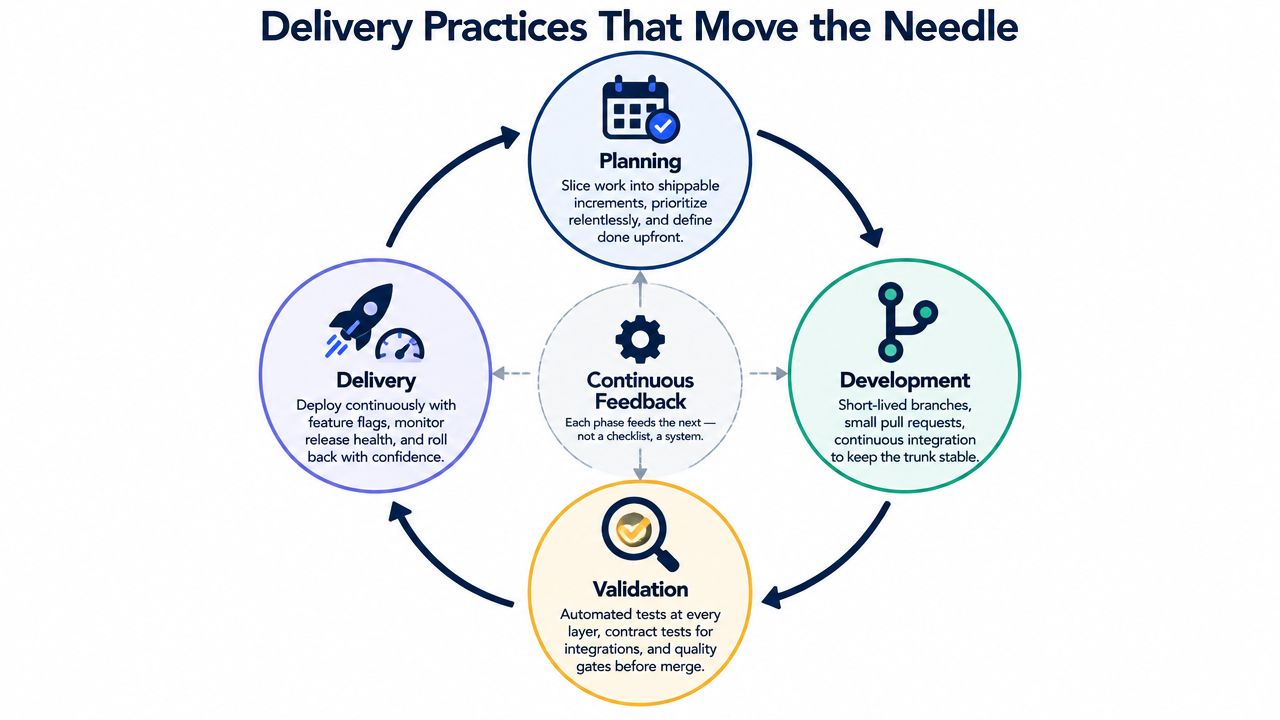
Delivery practices work as a system. Agile without engineering automation produces well-prioritized queues that still move slowly. CI/CD without product feedback ships the wrong thing faster. DevOps without ownership moves infrastructure tasks onto already overloaded developers.
Start with slices, not ceremonies
Agile is a planning discipline, not a calendar of meetings. Product managers and engineers should slice work into increments that can be built, tested, observed, and released. Each increment needs a clear definition of done, including security, telemetry, documentation, and rollback expectations where relevant.
A thin vertical slice reveals integration problems earlier than a large functional phase. It also gives customers something concrete to evaluate, which protects the team from spending a quarter perfecting an assumption.
The development loop should keep changes small. Short-lived branches, focused pull requests, and continuous integration reduce the time between a decision and its verification. Large branches hide integration conflicts and make code review a ritual rather than a quality control.
Automate evidence and reversibility
CI/CD should turn every commit into a verified artifact. The pipeline can run unit tests, integration tests, contract tests, static analysis, dependency checks, secrets scanning, and deployment validation before a release reaches production.
DevOps extends that discipline to infrastructure. Environments become code, provisioning becomes repeatable, and the old handoff between development and operations loses its purpose. GitOps tightens the model further by treating Git as the source of truth for application and infrastructure state. A reviewer can inspect who changed what, why it changed, and how to reverse it.
That audit trail is particularly valuable in regulated environments. It also improves incident recovery because the desired state remains visible instead of living in undocumented console changes.
For teams mapping the full delivery lifecycle, this practical guide to the software development workflow in 2026 offers useful context alongside the controls described here. The internal operating model should also support the principles in our guide to integrating DevOps culture.
Make reliability an explicit contract
SRE turns reliability from an aspiration into an operating agreement. Teams define service-level objectives, use error budgets to balance change against stability, and review incidents without blaming individuals. Runbooks should explain decisions and recovery paths, not merely list server names.
DORA's current delivery-performance model uses five signals: change lead time, deployment frequency, failed deployment recovery time, change fail rate, and deployment rework rate. These measures connect engineering activity to delivery performance. A team that deploys often but needs frequent rework hasn't improved its system; it has increased the speed of correction.
The layering is the point. Agile chooses valuable slices. CI/CD verifies them. DevOps makes environments repeatable. GitOps makes state auditable and reversible. SRE defines the reliability contract. Remove one layer, and the rollout often stalls after the initial enthusiasm fades.
Where AI Fits in the SDLC and Where It Should Stay Out
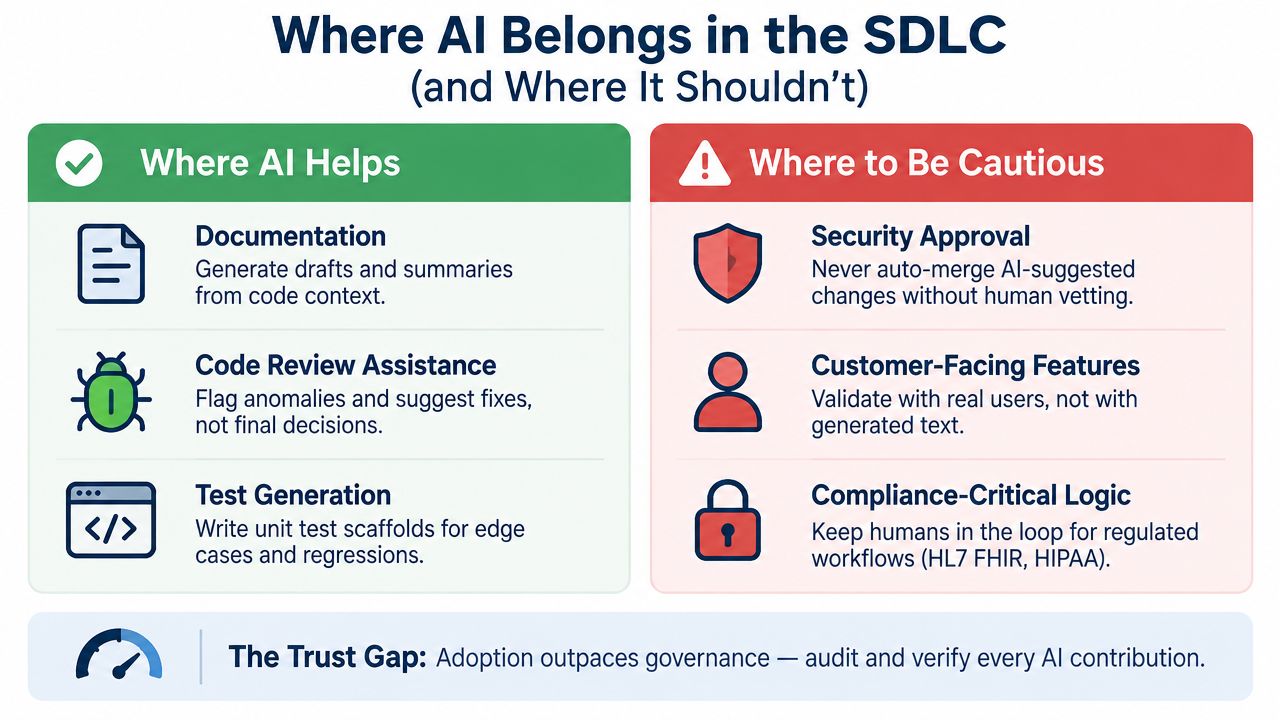
AI coding assistance has spread faster than AI governance. The adoption gap is clear: 84% of developers say they use or plan to use AI tools, while 46% don't trust the accuracy of AI output, compared with 31% the previous year. These figures come from TBlocks' application development trends analysis, which also identifies security or privacy concerns as the top deal-breaker.
That isn't an argument against AI. It's an argument against treating generated output as production-ready because it looks plausible.
Use AI where verification is cheap
AI can reduce toil in parts of the SDLC where a human can quickly inspect the result:
-
Backlog preparation: Turn rough notes into candidate stories, acceptance criteria, and questions for product review.
-
Test generation: Create unit-test scaffolds and edge-case candidates, then require the team to validate coverage and assertions.
-
Code review triage: Flag anomalies, duplicated logic, risky dependencies, and likely defects without making the final approval decision.
-
Documentation: Draft API descriptions, migration notes, release summaries, and incident timelines from approved engineering context.
-
Migration assistance: Suggest transformations across familiar patterns, while engineers validate behavior against contract and regression tests.
DORA's 2024 research shows why disciplined use matters. An estimated 25% increase in AI adoption was associated with improvements in documentation quality, code quality, code review speed, and lower code complexity, but also with a 1.5% decrease in delivery throughput and a 7.2% reduction in delivery stability overall. The research is available in the DORA-related 2024 study. AI helps when teams pair it with small batches, testing, and strong review.
Keep human ownership at the control boundary
AI shouldn't autonomously change regulated clinical logic, financial risk scoring, authentication boundaries, or decisions with a named control owner. It can propose. It can summarize. It can generate test cases. The accountable engineer or domain owner must approve the behavior.
A credible governance model includes prompt and model versioning, human checkpoints, evaluation harnesses, hallucination testing, prompt-injection red-team suites, and a policy that separates assistive suggestions from autonomous production changes. Sensitive data also needs explicit handling rules, including what developers may place into third-party tools.
Bridge Global's AI development services are one example of a delivery offering that can sit within this kind of governed engineering model. The vendor matters less than the controls, evidence, and ownership model surrounding the work.
Operating rule: Let AI accelerate repetitive engineering work. Keep humans accountable for the regulated decisions that determine whether customers can trust the product.
Choosing the Right Modernization Strategy for Your Stack
Modernization fails when leadership chooses a slogan instead of an exit condition. “Move to the cloud” says nothing about whether the workload became easier to change, cheaper to operate, safer to audit, or more resilient.
Choose among lift-and-shift, replatform, refactor, and rebuild by evaluating compliance load, time-to-value, team capability, integration risk, and the cost of carrying the legacy system. The organization shouldn't use one strategy for every workload.
Modernization Strategies Compared
| Strategy | Time-to-Value | Risk | Best Fit | Exit Criterion |
|---|---|---|---|---|
| Lift-and-shift | Fastest initial movement | Preserves many existing constraints | Low-risk workloads with limited change needs | Workload runs reliably with documented operating cost and ownership |
| Replatform | Faster than deep redesign | New platform may preserve old coupling | Integration boundaries and workloads needing managed services | Target platform supports repeatable deployment, monitoring, and rollback |
| Refactor | Slower, incremental value | Boundary decisions and partial migration risk | Regulated or high-value domain cores that need safer change | Defined domain boundary operates independently with verified controls |
| Rebuild | Slowest route to feature parity | Adoption, migration, and scope risk | Greenfield products or systems beyond salvage | Customers and operations adopt the replacement, with legacy retirement plan |
Match the strategy to the consequence
Lift-and-shift is useful when the immediate objective is to remove infrastructure constraints or free a team from aging hosting. It isn't modernization if the organization moves a monolith from a data center to virtual machines and changes the invoice.
Replatforming works when managed databases, queues, container platforms, or identity services remove operational burden. Watch for hidden recoupling. A new platform won't fix service boundaries if every component still depends on shared tables and synchronized release steps.
Refactoring is the right choice for valuable domains that need safer incremental change. In healthtech, that may mean separating patient identity, consent, clinical data exchange, audit, and notification responsibilities while preserving the workflows users already depend on. It requires a boundary map and a sequence of reversible migrations.
Rebuilding belongs where the old system can't provide a viable foundation, or where the product is new. Parallel systems fail when the replacement team builds features without securing user adoption, migration tooling, and operational ownership.
Use a portfolio view. Lift low-risk workloads, replatform integration boundaries, refactor regulated cores, and reserve rebuilds for systems beyond salvage. Every workstream needs a stop condition, because a modernization program without an exit criterion becomes permanent parallel operation.
Security, Observability, and Compliance by Design
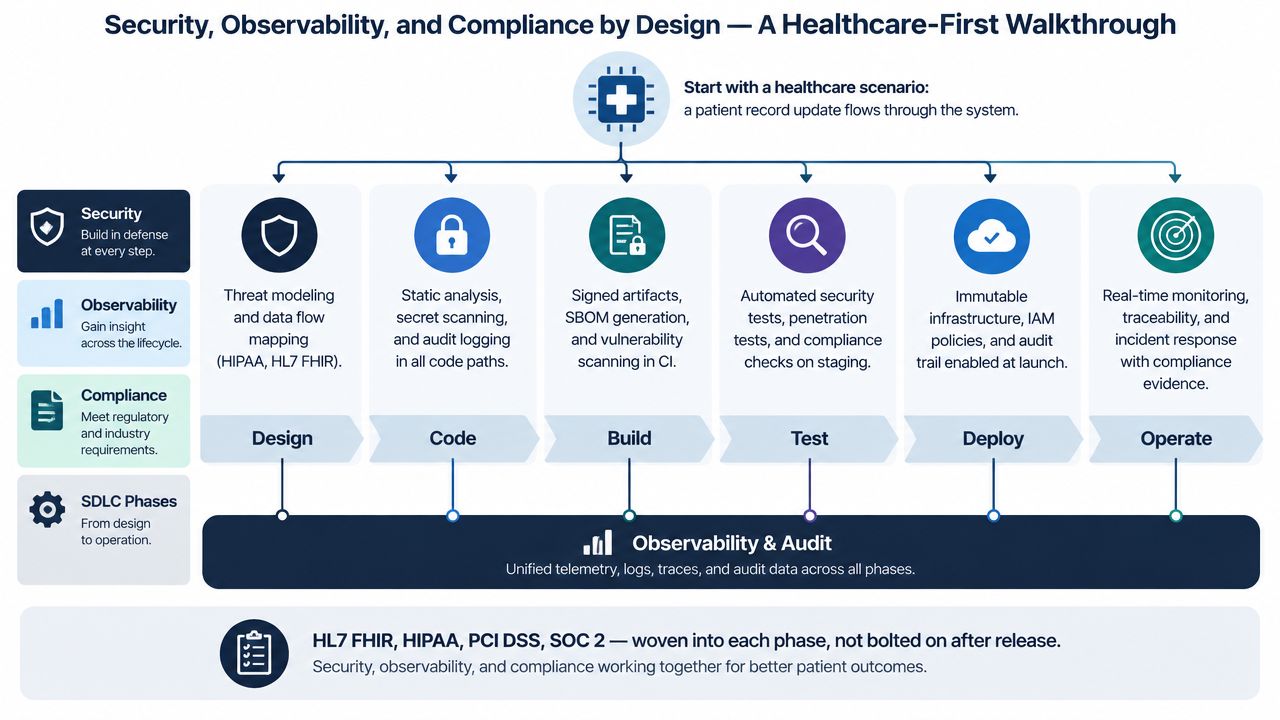
Healthcare exposes weak engineering habits quickly. A patient record update may pass through identity, consent, clinical data, audit, notification, and external integration services. The system needs to protect PHI, record access, support controlled break-glass workflows, manage BAA-covered vendors, and demonstrate reliable operation to customers and auditors.
HL7 FHIR is an API-focused standard from HL7 for representing and exchanging health information, making it a core interoperability building block for digital health products. In the United States, healthcare software is anchored to HL7 FHIR Release 4.0.1, and CMS requires certain regulated entities to implement standards-based APIs that let patients access claims, encounter, and defined clinical data through third-party applications of their choice. The healthcare interoperability context is summarized in this practical guide to CMS interoperability rules and HealthIT.gov's FHIR resource.
Put controls into the pipeline
A healthcare-first pipeline should make control placement visible:
-
Design: Map data flows, identify PHI, perform threat modeling, and define access and retention decisions before implementation.
-
Code: Run static analysis, software composition analysis, secrets scanning, and tests that verify audit logging across relevant paths.
-
Build: Sign artifacts, generate a software bill of materials, and scan dependencies and images before promotion.
-
Test: Run automated security checks, integration tests, contract tests, and compliance checks in environments that resemble production.
-
Deploy: Enforce policy as code, apply least-privilege IAM, enable audit trails, and use immutable deployment patterns where practical.
-
Operate: Monitor access anomalies, service health, data flows, and incident response evidence continuously.
Security controls should address concrete threats. Authentication boundaries need explicit ownership, privileged access needs review, and customer sessions need protection against abuse. For a focused treatment of ways teams can protect against account takeover, the threat should be considered alongside identity design, detection, and recovery rather than left to a late-stage checklist.
Observability proves what happened
Logs, metrics, and traces need correlation identifiers so an engineer can follow a request across services. Structured logging makes events searchable. Distributed tracing reveals latency and failure paths. SLO-based alerts tell the team when user impact crosses an agreed threshold, while runbooks connect alerts to recovery actions.
Telemetry introduces a small operational cost. A benchmark using OpenTelemetry reported 0.44% lower throughput and a 0.48% increase in response time from observability overhead, as described in the cloud-native observability research. That trade-off is usually justified when the telemetry lets the team find failures, prove controls fired, and restore service with confidence.
The same principle applies to SOC 2, HIPAA, and PCI DSS. Compliance evidence is useful only when the system can show which control ran, against what change or event, who reviewed the result, and what happened when it failed. Our secure software development lifecycle guide provides a practical internal reference for embedding those controls throughout delivery.
A 90-Day Roadmap and the KPIs That Prove It Is Working
A modernization program should begin with one pilot team and one meaningful product flow. Don't launch a company-wide architecture initiative before you know whether the delivery loop can produce repeatable evidence, reliable deployments, and useful operational feedback.
90-Day Modernization Milestones and DORA Signals
| Phase | Primary Actions | DORA Signal to Watch |
|---|---|---|
| Days 1 to 30 | Baseline delivery performance, map the architecture, assess compliance gaps, and select a pilot team | Change lead time and deployment frequency |
| Days 31 to 60 | Introduce CI/CD, establish GitOps repositories, and deploy minimum viable logs, metrics, and traces | Change fail rate and failed deployment recovery time |
| Days 61 to 90 | Scale the proven pattern, add AI governance, and review reliability and delivery trends | Deployment rework rate plus all five signals |
Days 1 to 30
Record the current delivery signals without manipulating the baseline. Draw the actual architecture, including shared databases, manual approvals, external integrations, and ownership gaps. Select a product flow that matters to customers but can be isolated enough for a controlled pilot.
The phase exits when the team has a current architecture map, a documented compliance gap list, agreed metric definitions, and a named owner for the pilot.
Days 31 to 60
Build the pipeline around a real change path. Add automated verification, artifact traceability, GitOps-managed deployment state, and telemetry that follows a request through its dependencies. Keep the observability stack useful rather than expansive; structured logs, service metrics, traces, dashboards, and actionable alerts are enough to begin.
This phase exits when the pilot can deploy through the pipeline, detect release health, recover through a documented path, and produce evidence for a representative control.
Days 61 to 90
Scale the pattern only after the pilot demonstrates repeatability. Add AI governance before expanding AI-assisted development, including approved tools, data-handling rules, review checkpoints, and evaluation requirements. Review DORA signals continuously, not as a one-off quarterly presentation.
The final exit is not “we adopted DevOps.” It’s a working delivery system with visible ownership, measurable change outcomes, operational evidence, and a clear backlog of the next constraints to remove.
FAQ for CTOs and Product Leaders
Where does the money go in a modern stack?
The largest cost decisions usually sit in platform engineering, observability, security controls, and AI tooling, not in language licenses. Teams should model the operating cost of environments, telemetry retention, managed services, support coverage, and engineering time spent maintaining the platform. A cheaper cloud bill can still represent a poor result if developers lose time to unreliable environments and manual release work.
Should we build, buy, or partner?
Keep differentiating domain logic and customer experience under your control. Buy commodity capabilities such as identity, messaging, payments, or managed observability when the integration and exit risks are acceptable. Use a partner when you need specialized delivery capacity, regulated workflow experience, or a faster path to a maintainable product, while retaining architectural decisions, data ownership, and operational knowledge internally.
The available software development service models have different mechanics. Fixed price suits a fully specified deliverable, time and materials bills actual hours at agreed rates, and a dedicated team supports ongoing product work through a recurring team arrangement. Choose based on uncertainty and ownership, not procurement habit.
How should we sequence an AI roadmap?
Start internally. Developer assistance, documentation, test generation, and incident summarization offer useful learning with contained customer risk. Move to customer-facing models only after the organization can evaluate correctness, protect sensitive data, assign control ownership, and monitor behavior in production. A governed AI implementation roadmap should define those gates before selecting models or features.
What must a regulated buyer do first?
In the first sprint, establish data classification, access ownership, threat modeling, secrets handling, audit requirements, dependency scanning, and a minimum release approval path. Over the following quarter, mature evidence automation, resilience testing, advanced detection, runbook coverage, and control reporting. For healthcare products, define the FHIR integration boundary and patient-data handling rules before building features that depend on them.
Bridge Global can help healthtech and SaaS teams assess architecture, modernize legacy systems, build compliant products, and introduce governed AI through cross-functional engineering teams. Start with a focused modernization assessment, review relevant client cases, and visit Bridge Global to discuss the first product flow you need to make safer and faster to change.

About Upendra Jith
Upendrajith completed his Master's in English and has been a commercial content developer for the past three years. He's more inclined to develop content with a 'street-smart' delivery on topics such as technology, media, or anything he can get his hands on. He has a fixation on lyrics, dark poetry, media, technology, and flow arts.
View all posts by Upendra Jith →