



A Guide to Medical Billing Automation Solutions
If you've ever stared at a mountain of claim denials and billing errors, you know the feeling. It’s a frustrating reality for far too many healthcare providers. This is where medical billing automation solutions come in. Think of them not just as software, but as a specialized digital workforce designed to tackle those tedious, error-prone tasks and start reclaiming lost revenue.
For any practice looking to not just survive but thrive, getting a handle on these tools is the first step toward a much healthier bottom line. As a leading healthtech software development partner, we've seen firsthand how the right automation strategy can transform a healthcare organization's financial outlook.
Why Your Practice Can No Longer Ignore Automation
Let's be honest: the traditional medical billing process is broken. It's a complex, manual marathon that practically invites costly human errors at every turn, from the moment a patient registers to the final payment posting.
The numbers don't lie, and they paint a grim picture. Recent studies show that approximately 80% of all medical bills contain errors. To make matters worse, a staggering 42% of insurance claims are denied due to coding inaccuracies alone. These aren't just minor clerical slip-ups; they represent a massive drain on your resources, delaying payments and forcing your most skilled staff to spend countless hours on rework and appeals.

Shifting from Manual Labor to Smart Systems
Medical billing automation acts as a powerful digital assistant, using technologies like Artificial Intelligence (AI) and Robotic Process Automation (RPA) to bring order to the chaos of the revenue cycle. Instead of relying on tired eyes and manual data entry, these systems work tirelessly behind the scenes to ensure accuracy from the very beginning.
This shift doesn't make your billing team obsolete; it makes them more powerful. By offloading the most repetitive and mundane tasks, it frees your staff to focus on higher-value work, like analyzing denial patterns and improving the patient's financial experience. As we explored in our guide to enterprise AI solutions, this synergy between human expertise and machine efficiency is where true transformation happens.
For a clearer picture of how this works, let’s compare the old way with the new.
Manual vs. Automated Billing: A Quick Comparison
The table below breaks down the key differences at each stage of the billing cycle. It’s easy to see where automation creates a huge advantage in speed, accuracy, and ultimately, cost-efficiency.
| Process Stage | Manual Billing Approach | Automated Billing Approach |
|---|---|---|
| Patient Registration | Staff manually enters patient data from forms, risking typos and errors. | Software auto-populates fields, often using an ID scanner, and verifies insurance in real-time. |
| Charge Capture | Relies on providers to select codes from memory or paper "cheat sheets." | AI suggests CPT/ICD-10 codes based on clinical documentation, reducing errors. |
| Claim Creation | Billers manually compile data from different sources into the claim form. | The system automatically pulls verified patient, provider, and coding data into the claim. |
| Claim Scrubbing | A staff member visually reviews claims for obvious errors, often missing complex issues. | Software instantly scrubs every claim against thousands of payer rules, flagging errors before submission. |
| Denial Management | Staff manually investigates each denial, researches the cause, and submits an appeal. | The system automatically identifies denial reasons, suggests corrections, and can even auto-appeal common denials. |
As you can see, automation injects efficiency and intelligence into processes that were once slow and prone to failure. The result is a faster, more predictable revenue cycle.
This guide to efficient medical billing for clinics provides even more excellent context on the compelling reasons to make this switch. For today’s healthcare organizations, the question is no longer if they should automate, but how to start.
The Technologies Powering Smart Billing Systems
When we talk about “medical billing automation,” we’re not talking about a single piece of software. It’s more like a team of specialists, each with a different role, all working together to make the revenue cycle run smoothly and accurately. Understanding the key technologies involved is the first step to seeing how they can completely reshape a practice’s billing operations.
These aren’t just fancy upgrades to old data entry programs. This is a new class of tools with built-in intelligence designed to get ahead of problems and speed up cash flow. To really get a handle on the technology, it’s helpful to understand how you can optimize healthcare revenue with RCM.
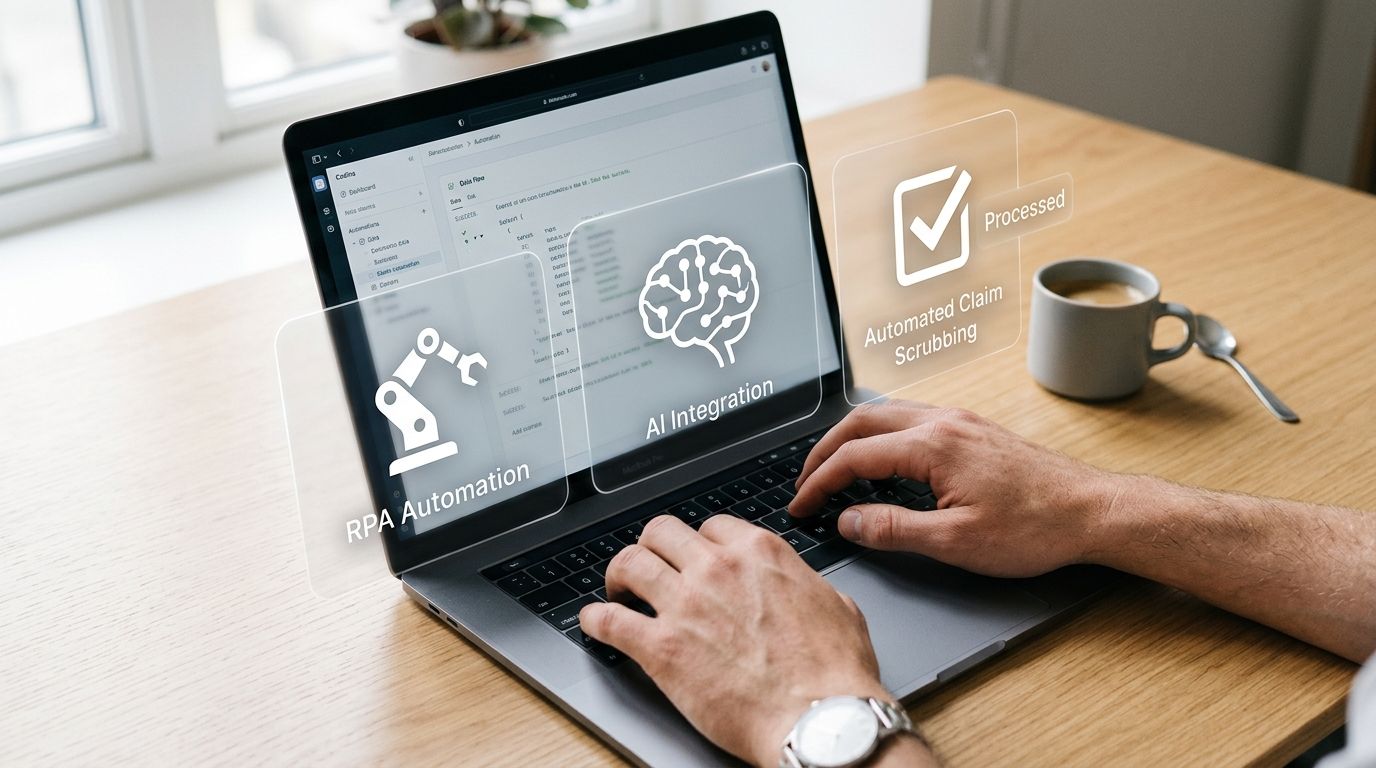
Robotic Process Automation (RPA): The Digital Workforce
The first piece of the puzzle is Robotic Process Automation (RPA). Think of RPA as a digital assistant that you can train to handle all the repetitive, manual clicking and typing that bogs down your billing staff. It’s a workhorse that never gets tired, doesn’t need breaks, and follows instructions to the letter, every single time.
In the world of medical billing, RPA bots are perfect for straightforward, rules-based jobs. For example, they can:
-
Handle data migration: Moving a patient’s demographic details from your registration system directly into a claim form without any copy-paste errors.
-
Run status checks: Logging into dozens of different payer portals throughout the day to check on the status of outstanding claims.
-
Post payments: Automatically taking payment data from electronic remittance advice (ERA) files and posting it to the correct patient accounts.
By putting these high-volume, low-skill tasks on autopilot, RPA lets your experienced team members focus their brainpower on complex issues that actually require human expertise.
AI and Machine Learning: The Brains of the Operation
If RPA bots are the hands doing the repetitive work, then Artificial Intelligence (AI) and Machine Learning (ML) are the brains making intelligent decisions. This is where billing automation goes from just being fast to being truly “smart.” Unlike RPA, which just follows a script, AI actually learns from the data it processes. Our AI development services focus on creating these intelligent systems that adapt and improve over time.
AI and ML algorithms sift through thousands of your historical claims; both the ones that got paid and the ones that were denied. They find subtle patterns in that data that no human could ever hope to spot, allowing the system to predict problems before they happen.
This intelligence unlocks some incredibly powerful capabilities:
-
Predictive denial analysis: The system can flag a claim that has a high chance of being rejected based on the specific payer, CPT code, or diagnosis, giving you a chance to fix it upfront.
-
Automated coding: Using a technology called Natural Language Processing (NLP), AI can read a doctor’s clinical notes and suggest the most accurate medical codes, reducing errors and saving time.
-
Intelligent appeals: For common denial reasons, the system can even draft an appeal letter automatically, pulling in the necessary documentation to support the case.
The power of these systems lies in their ability to learn continuously, a core concept of machine learning. The more data they process, the smarter and more accurate their predictions become over time.
Measuring the Real-World Impact and ROI
When you’re considering new technology, it’s never just about the bells and whistles. What really matters are the tangible results it can deliver. For medical billing automation, the return on investment (ROI) isn’t just significant; it’s felt across your entire revenue cycle, boosting both your finances and your team’s effectiveness.
The first place you’ll see a financial win is in your clean claim rate. Automation is designed to catch costly errors before a claim ever leaves your system, which means far more claims get approved and paid on the first try. This simple shift has a powerful ripple effect, accelerating your revenue cycle, improving cash flow, and slashing the time your team spends chasing down and fixing denials.
Quantifying the Financial Gains
The numbers speak for themselves. We’ve seen healthcare providers achieve an ROI of 300% to 600% within the first year of implementing an AI-powered billing solution. Think about what that really means. In one case, a large U.S. hospital network cut its claim submission time from a painstaking 45 minutes down to just 12 minutes per claim. The result? They were able to process 40% more claims every single day.
This isn’t just about moving faster; it’s about being more accurate. When fewer claims are denied, you’re writing off less money as bad debt, creating a more stable and predictable revenue stream for your practice. These are the kinds of concrete improvements we see time and again in our client cases, where organizations document real financial gains.
By transforming the billing process from a reactive, error-prone system to a proactive, data-driven operation, automation turns a cost center into a strategic asset for financial health.
Beyond the Bottom Line: Empowering Your Staff
But the ROI of automation goes well beyond dollars and cents. One of the most valuable, yet often overlooked, benefits is what it does for your people.
Imagine your expert billers freed from the monotonous grind of data entry and endless status checks. With automation handling the repetitive work, they can finally focus on the high-value tasks that truly require their expertise. Suddenly, they have the bandwidth for things like:
-
Analyzing denial trends to uncover and fix the root cause of recurring issues.
-
Negotiating complex appeals that require a human touch and a deep understanding of payer policies.
-
Improving patient financial counseling by having more time for clear, compassionate communication.
This pivot doesn’t just make your team more productive; it makes their jobs more satisfying and helps prevent burnout. When your staff can use their skills for meaningful challenges, they’re more engaged and effective. Investing in custom healthcare software development is ultimately an investment in your people, helping you build a more resilient and capable revenue cycle team.
How to Keep Your Automated Billing System Secure and Compliant
In healthcare, data security isn’t just a good idea; it’s a legal and ethical obligation. When you bring in a medical billing automation solution, you’re handing over the keys to a vast amount of Protected Health Information (PHI). This means security and compliance can’t be an afterthought; they have to be your top priority from day one.
A properly designed automated system should be a vault for your sensitive data. At its very heart, it must be built for HIPAA compliance. This isn’t just about checking a box on a form. It’s a core design principle that governs how every piece of patient data is managed, stored, and sent.
The Cornerstones of a Secure System
To truly protect PHI, any worthwhile automation platform needs several layers of security built right in. These aren’t optional features; they are the non-negotiables that protect you from breaches and devastating penalties.
-
End-to-End Encryption: Think of this as a digital sealed envelope. All data, whether it’s sitting “at rest” in a database or moving “in transit” to a payer’s system, must be encrypted. This makes the information completely unreadable and useless to anyone who might intercept it without authorization.
-
Strict Access Controls: Not everyone in your practice needs access to everything. Role-based access controls are essential, ensuring that team members can only see and modify the specific information they need to do their jobs. For instance, a scheduler might see patient demographics, but only a certified biller can access detailed coding and claims data.
-
Detailed Audit Logs: A compliant system needs to track every single click and change. These audit trails provide a complete history of who accessed what data and when. This is absolutely critical for investigating any potential security issues and proving your due diligence.
These security principles are the foundation of any responsible custom software development, especially when dealing with complex healthcare integrations.
How to Verify a Vendor’s Security Commitment
Don’t just take a vendor’s word for it. You need to look for external proof that they take security seriously. Certifications like SOC 2 and HITRUST are powerful signals that a company has passed rigorous, independent audits of its security infrastructure and processes.
Choosing a vendor without a proven, audited commitment to security is a gamble you can’t afford to take. These certifications show that a provider has truly invested the time and money to build the infrastructure needed to protect your practice and your patients. As we detail in our whitepaper on AI regulatory compliance and security in MedTech, this level of diligence is no longer optional.
Your Step-by-Step Implementation Roadmap
Bringing medical billing automation into your practice isn’t an overnight switch. It’s a journey. To get it right, you need a clear, practical roadmap that moves you from your current, often manual, processes to a fully optimized workflow. Think of it less like flipping a switch and more like a carefully planned construction project.
It all starts with a candid look in the mirror. During this initial assessment and goal-setting phase, you need to get brutally honest about what’s not working. Map out your current billing cycle and pinpoint the exact spots where things get stuck. Where are the bottlenecks? What’s the number one source of errors? Where does your team burn the most time on tedious tasks?
Once you have that intel, you can set concrete goals. Don’t just aim to “be more efficient.” Get specific. For example, you might aim to reduce claim denials by 15% or cut the average time to payment by ten days. These are the numbers that will prove the project’s worth down the line. Our various software development service models are designed to help organizations plan and execute projects with these kinds of clear, measurable outcomes.
The urgency for this kind of change is reflected across the entire healthcare industry. The global market for these solutions exploded from around $1.2 billion in 2016 to an estimated $4.8 billion in 2026 – a 300% leap. This massive growth is a direct response to ballooning administrative costs and ever-shifting insurance rules, a trend you can explore in more detail within this research.
Vendor Selection and System Customization
With your goals clearly defined, it’s time to find the right partner. When you start your vendor selection, look for a healthtech software development partner who has a proven track record, ideally within your medical specialty.
Drill down on the important questions. Ask about their security certifications, how seamlessly their platform integrates with your specific EHR, and what their training and ongoing support look like. Always ask for live demos, not just a canned presentation, and speak with references from practices that are similar in size and scope to yours.
After choosing a vendor, the customization and integration work begins. No two practices are identical, so no off-the-shelf software will be a perfect fit from day one. This is the stage where the platform is configured to your unique payer rules, billing workflows, and reporting requirements. This is where custom software development expertise becomes invaluable, ensuring the tool truly works for you, not the other way around.
Throughout this process, security and compliance are non-negotiable.
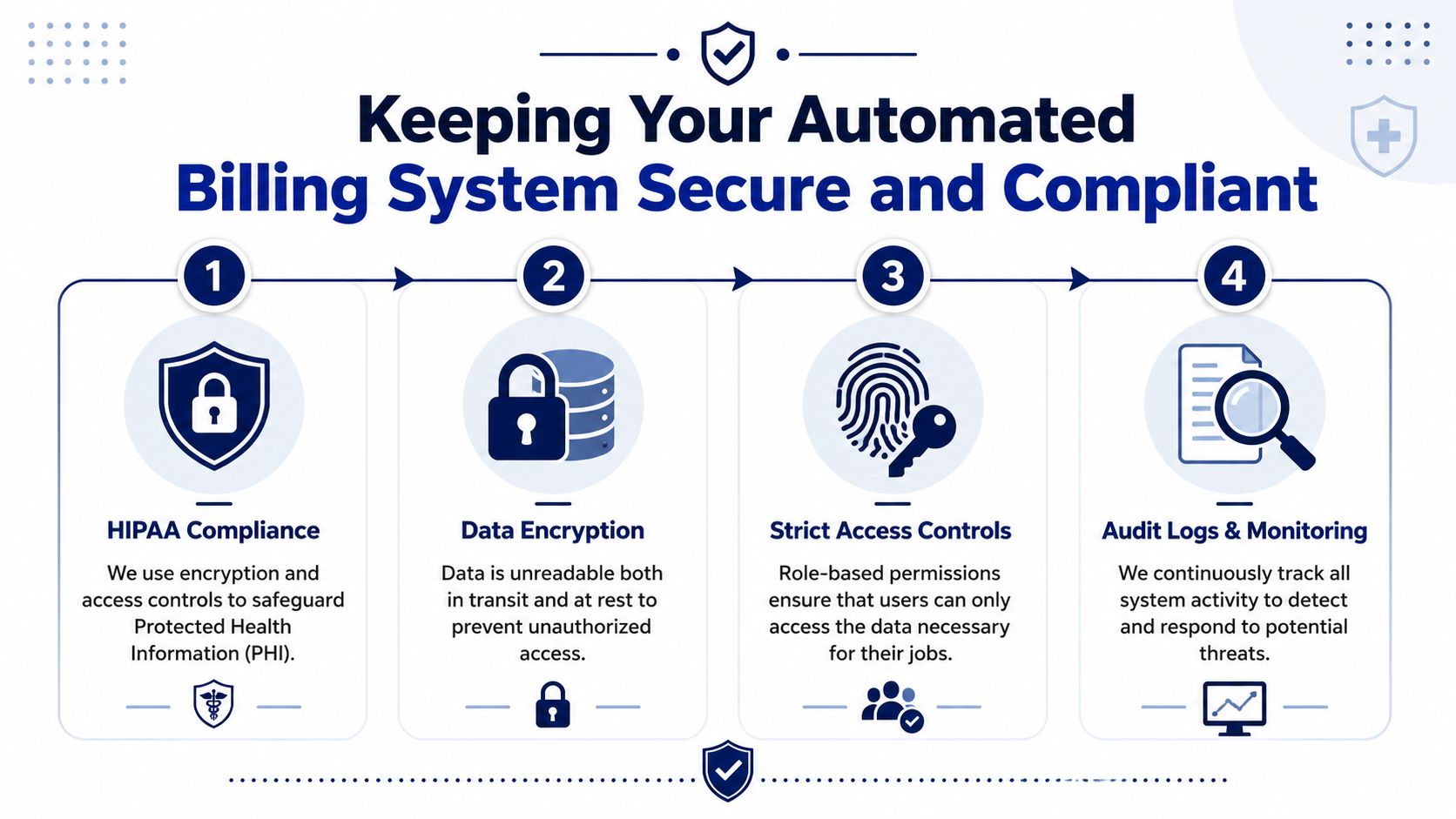
As you can see, keeping patient data safe is an ongoing commitment. HIPAA compliance depends on strong encryption, strict user access controls, and constant monitoring; it’s not a “set it and forget it” task.
Training, Go-Live, and Optimization
Now for the most important part of the equation: your people. A powerful new system is useless if your team doesn’t know how to use it or, worse, doesn’t want to. This is where staff training and change management come in.
Training needs to be hands-on, role-specific, and patient. Just as importantly, you have to sell the “why” behind the change. Show your staff how this new system will free them from repetitive data entry and allow them to focus on more valuable, strategic work.
Plan your go-live carefully. A phased rollout: starting with a single provider, department, or even a specific insurance payer, is almost always the smartest approach. This lets you identify and fix any issues in a controlled environment before you go all-in.
Once you’re live, the work continues. You have to continuously monitor performance against those initial goals you set. Keep a close eye on your key performance indicators (KPIs) like your clean claim rate, denial rate, and days in A/R. This data is your guide to measuring ROI and finding new ways to refine your automated workflows.
How to Choose the Right Automation Partner
Choosing a medical billing automation solution is one thing; picking the right partner to build and support it is another game entirely. The technology is only half the equation. The other half is the team behind it: their expertise, their support, and their understanding of the healthcare world.
Get this decision wrong, and you’re not just looking at a bad investment. You’re facing operational gridlock, frustrated staff, and a direct hit to your bottom line. It’s crucial to look past the flashy sales demos and dig into what makes a partnership truly work.
Putting Potential Partners to the Test
A thorough vetting process is your best defense against a bad fit. A solid partner will have no problem answering tough questions and backing up their claims with proof.
Here’s what you need to focus on:
-
Healthcare Industry Chops: This is non-negotiable. Does the vendor live and breathe healthcare, or is it just one of many industries they serve? They must be fluent in HIPAA, PHI security, and the unique headaches of revenue cycle management. Don’t be afraid to ask for specific examples of how they’ve handled complex compliance scenarios.
-
Seamless Integration Power: Your billing automation tool can’t live on an island. Ask them point-blank: “How will your system connect with our specific EHR and practice management software?” You’re looking for deep healthcare integrations, not clunky workarounds that create more manual tasks.
-
A Verifiable Track Record: Don’t just settle for a list of logos on their website. Ask to see detailed client cases and, more importantly, ask to speak with current clients. A conversation with a practice similar to yours in size and specialty will give you the unvarnished truth about their day-to-day performance.
-
Real-World Training and Support: A great partnership doesn’t end at go-live. What does the onboarding look like? Who do you call when a claim gets stuck or a new payer rule breaks a workflow? You need a partner who invests in training your team and provides responsive, expert support long after the initial sale.
Custom Build vs. Off-the-Shelf
Early in the process, you’ll hit a fork in the road: do you adapt your practice to a pre-built, off-the-shelf system, or do you build a solution tailored to your unique needs?
Off-the-shelf products can get you up and running faster, which is certainly tempting. The trade-off, however, is that you might have to bend your established, effective workflows to fit the software’s rigid structure.
On the other hand, custom healthcare software development allows you to create a system that molds perfectly to your practice. This approach builds the technology around your specific processes, payer contracts, and specialty-specific billing rules. While it’s a bigger initial undertaking, a custom solution often delivers a far greater long-term advantage by maximizing efficiency and flexibility.
Frequently Asked Questions About Medical Billing Automation
Getting started with medical billing automation brings up a lot of practical questions for any practice or health system. Let’s tackle some of the most common ones head-on.
How Long Does It Take to Implement an Automation System?
There’s no single answer, as it really depends on the size of your practice and the system you choose. That said, a realistic window for most cloud-based SaaS platforms is somewhere between six and eight weeks. A more involved, custom software development project will naturally take longer.
A successful rollout always follows a clear, logical path:
-
Initial Assessment and Data Prep: It all starts with understanding your current workflows and cleaning up your data for a smooth migration.
-
System Configuration: The software is then set up to handle your specific payer rules and medical specialties.
-
Integration and Testing: This is the critical step of connecting the new platform to your existing EHR and running it through its paces to ensure everything works perfectly.
-
Training and Go-Live: Finally, your team gets trained, and the system is launched, often in phases to make the transition easier for everyone.
Having a partner with a clear AI implementation roadmap is the key to making this whole process predictable and stress-free.
Will Automation Replace Our Billing Staff?
This is a big one, and the short answer is no. The goal of automation is to augment your team, not replace them. It’s built to handle all the repetitive, manual tasks that drain your staff’s time: things like data entry, eligibility checks, and endlessly following up on claim statuses.
Freeing them from that administrative grind allows your billing specialists to focus on the high-value work that actually requires a human touch and critical thinking. They can finally spend their time on things like:
-
Digging into complex denial trends to fix the root cause.
-
Managing nuanced appeals and negotiations with payers.
-
Providing better financial support and communication to patients.
Think of it this way: automation transforms your team from data entry clerks into true revenue cycle analysts. It’s a shift that not only makes your practice more money but also dramatically improves job satisfaction.
What Are the Typical Costs and Pricing Models?
Pricing for medical billing automation solutions can vary quite a bit. Many vendors in the SaaS product development space have moved to subscription models that are incredibly straightforward. You might see a small per-claim fee or a fee based on a percentage of collections, which is great because it means the vendor only succeeds when you do.
Other models include a flat monthly fee per provider or, for custom-built systems, a one-time licensing cost. When you’re looking at the numbers, it’s so important to think beyond the sticker price and focus on the total ROI. The money you save from reduced labor, fewer claim denials, and getting paid faster almost always outweighs the subscription fee, delivering a very healthy return on your investment.

About Preethi Saro Philip
Preethi Saro Philip is a Post Graduate Research Degree holder in Economics with more than 10 years of experience in writing, editing, research and teaching. She has an intense passion for content crafting and calls herself a ‘wordsmith’. She enjoys writing on wide-ranging topics including business, technology, health & lifestyle, education, environment etc.
View all posts by Preethi Saro Philip →
Pingback: Electronic Claims Submission: A Practice Manager’s Guide - One For All Medical Billing