



Intelligent Healthcare Scheduling for Boosting Efficiency
A front desk coordinator is on the phone with a patient who needs an urgent follow-up. A physician is running late. Two patients have canceled, one didn't show, and a specialty slot is sitting empty because the referral note hasn't been reviewed. Staff members are switching between calendars, spreadsheets, voicemail, and the EHR, trying to patch the day together by hand. Patients feel the chaos as delays, rushed calls, and appointment offers that don't fit their needs.
That's the point where ordinary scheduling tools start to break down. Static calendars can store appointments, but they can't reason about risk, urgency, staff constraints, or sudden change. Healthcare delivery is dynamic. Scheduling has to be dynamic too.
Introduction and scope
Intelligent healthcare scheduling is the shift from basic booking to adaptive coordination. Instead of asking staff to manually juggle every cancellation, referral, reminder, and provider rule, these systems use patient data, operational signals, and AI models to help clinics and healthtech teams make better scheduling decisions in real time.
For startups building scheduling products, providers modernizing access workflows, and product leaders designing regulated SaaS platforms, the challenge isn't only automation. It's doing automation in a way that stays clinically sensible, operationally useful, and audit-ready. That last part gets overlooked far too often.
A reliable platform has to answer practical questions:
-
Who should be scheduled first: The patient with the highest clinical need, the lowest no-show risk, or the earliest request?
-
What should happen after a cancellation: Hold the slot, overbook strategically, or offer it to a waitlisted patient?
-
How do teams prove decisions were compliant: Especially when schedules change repeatedly during the day?
Practical rule: If a scheduling engine can change appointments, it also needs to explain those changes later.
Teams evaluating a healthtech software development partner usually discover that scheduling sits at the intersection of workflow design, AI, privacy, integration, and accountability. That's why the strongest implementations aren't just clever algorithms. They're engineered systems with clear governance, measurable outcomes, and careful fit with clinical operations.
Understanding intelligent healthcare scheduling
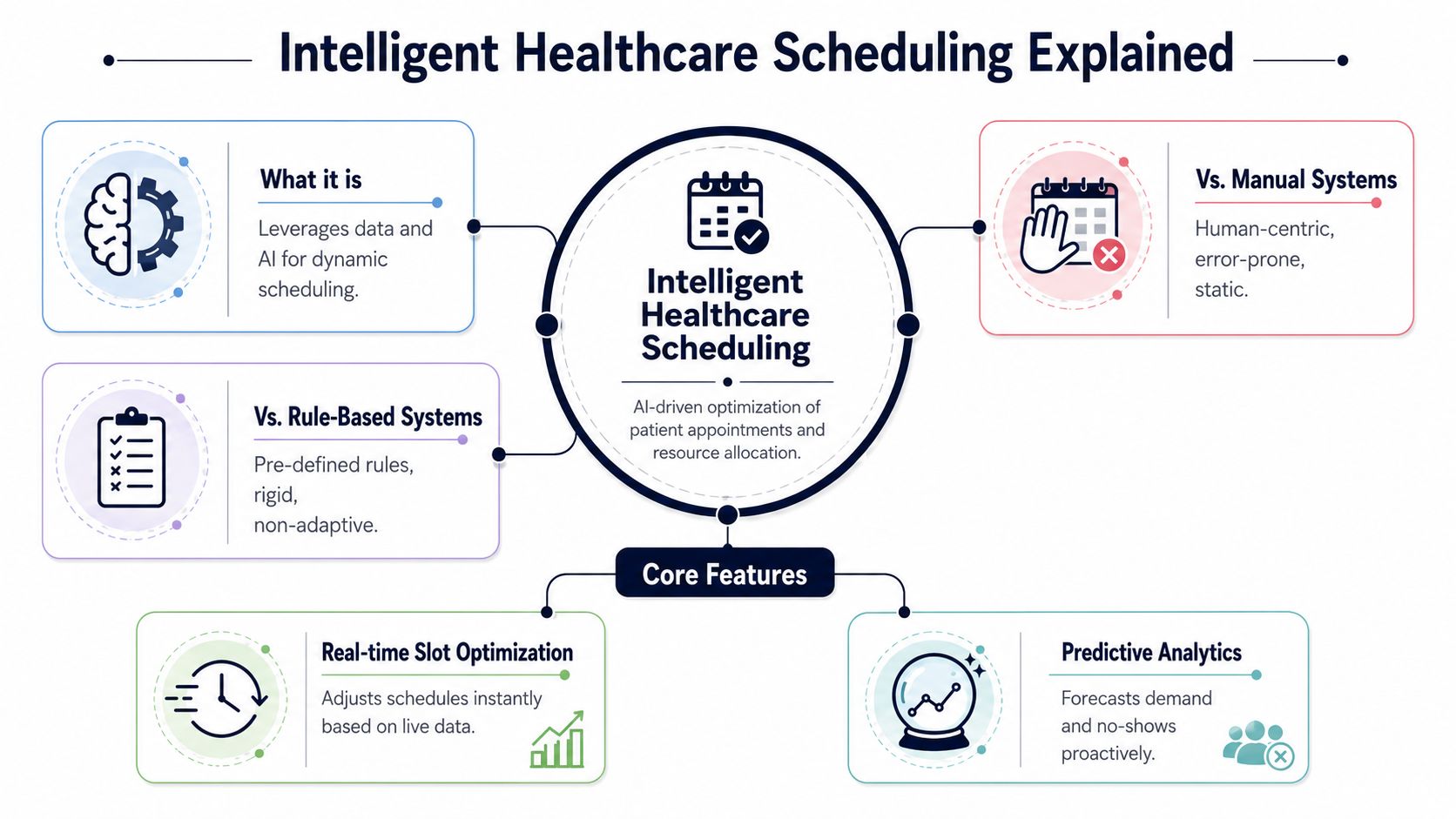
The simplest way to understand intelligent healthcare scheduling is to compare it with older approaches.
A manual system depends on staff judgment, memory, and repeated phone calls. It can work in a small practice, but it becomes fragile when demand spikes or multiple constraints collide.
A rule-based system is more structured, but it still follows fixed logic such as “book follow-ups only on Tuesdays” or “assign patients by provider specialty.” It's better than a paper calendar, but it doesn't learn.
Intelligent healthcare scheduling adds a layer of prediction and adaptation. It looks at patterns such as booking lead time, appointment type, patient behavior, provider availability, and operational bottlenecks. Then it helps decide which slot should be offered, which patient needs a reminder, and how the schedule should react when the day changes.
What makes it different
Think of a traditional scheduler as a hotel booking sheet. It shows which rooms are full. Think of an intelligent scheduler as an air traffic controller. It's not just tracking occupancy. It's continuously deciding sequence, priority, timing, and safe reallocation.
Common capabilities include:
-
Real-time slot optimization: It can react when a patient cancels, a clinician runs behind, or a higher-priority case arrives.
-
Predictive no-show modeling: It estimates which appointments are at risk of being missed and supports earlier interventions.
-
Dynamic acuity scoring: It helps route limited clinical capacity toward patients who need attention sooner.
The urgency is real. The Grand View Research analysis of the AI medical scheduling software market states that the global AI in medical scheduling software market was valued at USD 159.79 million in 2024 and is projected to surge to USD 1,451.41 million by 2033, reflecting a CAGR of 28.1% from 2025 to 2033.
Why the definition matters
A lot of teams say they're building AI scheduling when they're really building a nicer booking interface. That's useful, but it's not the same thing. Intelligence starts when the system helps make better operational decisions, not just faster clicks.
If you want a broader product-side view, this guide for healthcare leaders on scheduling gives helpful context on the operational side of appointment software choices. For a related perspective on AI-enabled operational design, see our guide on healthcare workflow intelligence and, as we explored in our guide on enterprise AI solutions, value comes from embedding AI into the actual workflow where decisions happen.
Business and clinical benefits
Healthcare teams usually feel the value of scheduling improvements in two places first. The front office gets relief from repetitive coordination work. Clinicians get a more stable day with fewer avoidable disruptions.
That matters because scheduling isn't an isolated admin task. It shapes access, throughput, continuity, and patient experience.
Operational gains teams notice quickly
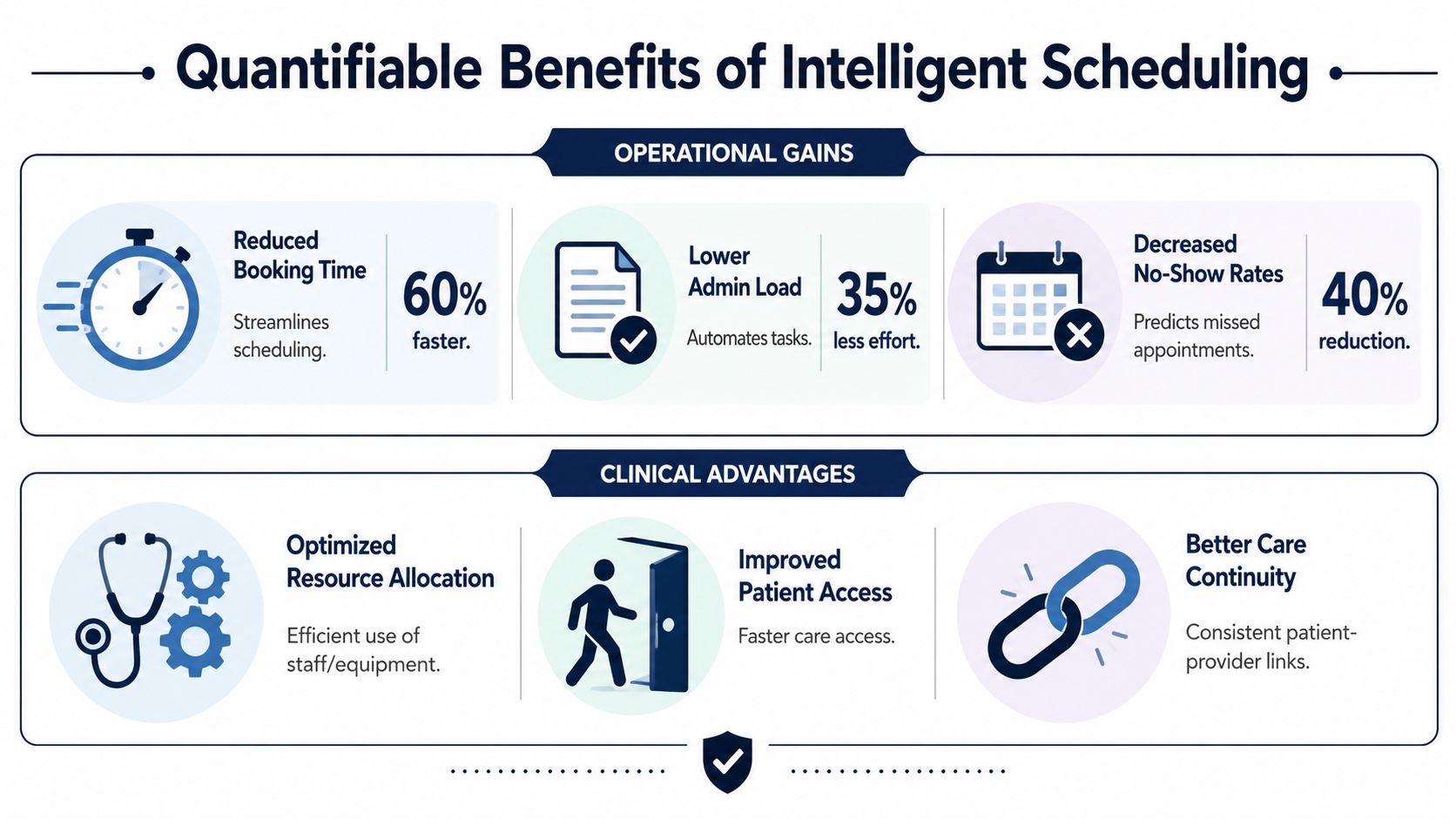
The strongest reported gains are administrative. The PMC study on intelligent healthcare scheduling systems reports that these systems reduce booking times by 96.3%, compressing average duration from 155 minutes down to 5.73 minutes, and cut human intervention in administrative tasks by 70%.
Those numbers become more meaningful when translated into daily work:
-
Less manual triage: Staff members spend less time deciding where each patient should go.
-
Faster backfilling: Open slots can be offered promptly instead of being discovered too late.
-
Lower call volume pressure: Automated reminders and self-service tools reduce repetitive status checks.
The same verified research also notes that missed appointments create a major financial burden and that AI-driven scheduling can support better throughput. In that source, practices using these approaches are described as being able to see 30% more patients in the same time slots while cutting administrative hours by over 25 per week.
Better scheduling doesn't only save time. It protects scarce clinical capacity from being wasted.
Clinical benefits beyond efficiency
Clinicians care about something slightly different. They want the right patient in the right slot with the right prep done beforehand. Intelligent scheduling supports that by aligning appointments with urgency, specialty fit, and resource availability.
A simple example helps. A patient with a routine follow-up may be fine in the next available general slot. A patient with escalating symptoms may need faster routing to the correct specialty. A static scheduler may treat both requests as equal calendar events. An intelligent one tries to distinguish them.
That distinction supports:
-
Improved access: Patients get matched to more appropriate appointment options.
-
Better continuity: Follow-ups are less likely to drift because of preventable scheduling friction.
-
Smarter resource use: Rooms, clinicians, and equipment are coordinated more effectively.
For organizations building these workflows into products, custom healthcare software development often has to account for local provider rules, specialty pathways, and patient communication preferences. Delivery also depends on the right software development service models, especially when the rollout needs phased implementation across teams or locations.
AI ML techniques and architecture patterns
An intelligent scheduler looks simple from the user side. A patient requests an appointment. The system recommends a slot. Staff gets fewer calls. Underneath, though, several technical layers have to work together.
Data ingestion and triage
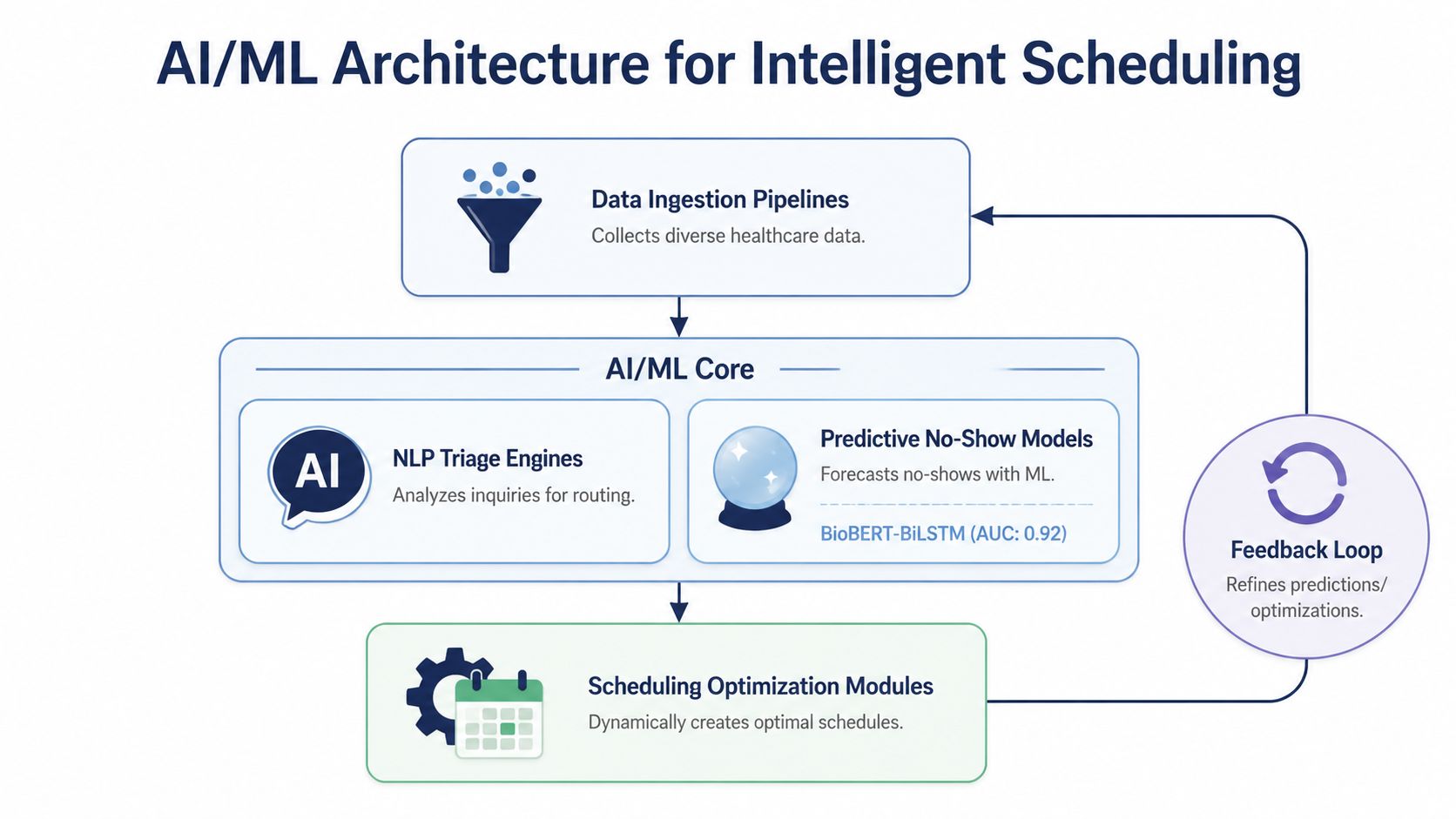
Everything starts with data ingestion. The scheduler needs a steady flow of appointment history, provider templates, referral data, cancellation signals, and operational constraints from systems such as the EHR, patient portal, and call center software.
Then comes triage. Some requests arrive as structured forms. Others come in free text or through conversations. Natural language processing helps classify what the patient is asking for and where it should go. The verified literature notes the use of BioBERT-BiLSTM with an AUC of 0.92 for symptom analysis and specialist matching in intelligent healthcare scheduling systems through the same PMC article.
That sounds technical, but the idea is familiar. It's like an experienced nurse reading a messy referral note and quickly seeing the likely intent. The model tries to perform a similar pattern-recognition task at scale.
Predictive models and optimization logic
No-show prediction is often the first machine learning component teams deploy because the business case is easy to see. A model looks at patterns in prior appointments and estimates the chance that a future visit will be missed.
The verified data says AI-powered scheduling engines can forecast no-show rates with over 85% accuracy by analyzing historical appointment data, patient demographics, and seasonal disease patterns. Another verified source adds useful operational detail. In this analysis of smart scheduling inputs, appointments made more than 21 days out cancel at twice the rate of same-week bookings, and risk scoring can draw on factors such as time slot, day of week, referral type, and transport distance while cutting administrative waste by 20–50%.
Once the risk is estimated, the optimization layer decides what to do. It may trigger a reminder, prioritize a waitlist candidate, or recommend strategic overbooking for certain slots.
Architecture tip: Prediction alone doesn't create value. Value appears when predictions change scheduling decisions in a controlled way.
Common architecture patterns
Teams usually choose among three broad patterns.
Monolith with embedded AI
This is common in early products. The booking workflow, business rules, and model inference live in one application. It's faster to ship and easier for a small team to manage, but harder to scale and update safely.
Microservices with event-driven workflows
In a more modular design, services handle separate jobs such as intake, scoring, optimization, reminders, and audit logging. Events like “appointment canceled” or “patient confirmed” trigger downstream actions. This pattern is more flexible for growing platforms and works well when multiple channels feed the scheduling engine.
Hybrid integration architecture
Many healthcare environments can't go fully cloud-native because critical data or workflow logic still lives inside the EHR or on-prem systems. In that setup, the intelligence layer often sits beside existing infrastructure and exchanges data through secure interfaces. That's where dependable healthcare integrations matter most.
For a deeper technical view of integration-led automation in regulated care, see our guide on healthcare automation architecture. Teams building these systems also tend to combine focused AI development services with broader enterprise AI solutions, because scheduling touches both model behavior and platform engineering.
Compliance and data privacy considerations
A common misconception is that compliance is mostly about encryption and access control. Those are necessary, but they aren't enough for intelligent healthcare scheduling.
The hard part starts when the system acts. If an AI engine reschedules a patient, prioritizes one referral over another, or fills an opening from a waitlist, someone may later need to explain why that happened. In regulated healthcare, “the model decided” isn't an acceptable answer.
Audit trails for moving schedules
Many implementations become fragile because, as the Simbo analysis of AI scheduling in regulated markets notes, few resources explain how to maintain an immutable audit trail of dynamic, AI-driven rescheduling decisions for HIPAA or GDPR compliance, creating a significant implementation gap for regulated health markets.
An audit-ready trail should record more than the final appointment state. It should preserve the sequence of decisions:
-
What changed: Cancellation, overbooking, reassignment, waitlist fill, or escalation
-
Why it changed: Approved business rule, clinician input, patient preference, or model score
-
Who or what initiated it: Staff member, patient self-service action, or automated workflow
-
Which data influenced the change: Without exposing more personal data than necessary
A scheduling engine should behave like a careful clinician writing notes. Every meaningful decision needs context, timing, and accountability.
Privacy, fairness, and access
There's another layer that deserves more attention. A scheduler optimized only for efficiency can inadvertently create unfair outcomes. If it consistently favors patients who are easiest to reach, quickest to confirm, or least likely to miss visits, underserved populations can lose access.
That's why governance should include:
-
Role-based access controls: Limit who can view, override, or export scheduling decisions
-
Encryption in transit and at rest: Protect data during exchange and storage
-
Fairness reviews: Check whether scheduling logic disadvantages specific patient groups
-
Multilingual support: Reduce access friction during intake, reminders, and self-scheduling
For engineering teams building compliant platforms, our guide on HIPAA-compliant software development is a useful companion. Practical delivery also depends on effective healthcare integrations, because weak data handoffs can undermine both privacy controls and audit quality.
KPIs, ROI, and AI implementation roadmap
A scheduling initiative gets traction when teams can measure whether it's working. “Smarter scheduling” is too vague for a product roadmap and too vague for a budget conversation. You need a small set of KPIs that connect model quality to operational outcomes.
KPIs that matter
The first KPI is usually prediction quality. The verified data shows that AI-powered scheduling engines forecast no-show rates with over 85% accuracy by analyzing historical appointment data, patient demographics, and seasonal disease patterns. That tells you the model can detect risk patterns. It doesn't tell you whether the intervention strategy is useful.
So teams should pair model metrics with workflow metrics such as:
-
Lead-time waste reduction: Are long-gap bookings being managed better?
-
Schedule density: Are valuable slots staying filled more consistently?
-
Fill speed after cancellation: How quickly can the system offer the slot to someone else?
-
Patient satisfaction signals: Are scheduling interactions becoming easier, not just more automated?
The verified operational detail on lead time is especially useful. This smart scheduling analysis notes that appointments booked more than 21 days out cancel at twice the rate of same-week bookings, and that using those records for risk scoring can cut administrative waste by 20–50%. That makes lead-time distribution a practical KPI, not just a reporting detail.
Sample KPI baselines and targets
Below is a simple way to structure measurement before rollout. The figures in the baseline and target columns are directional labels, not invented numeric claims.
| Metric | Baseline | Target |
|---|---|---|
| No-show prediction quality | Manual intuition or basic reminder logic | Model-driven forecasting informed by historical data and seasonality |
| Lead-time waste | High variability in far-out bookings | Lower waste through risk-aware scheduling and reminder workflows |
| Schedule density | Frequent gaps after cancellations | Faster refill of open slots through waitlist and prioritization logic |
| Administrative effort | Staff-heavy coordination | Reduced manual intervention through automation |
| Patient satisfaction | Inconsistent scheduling experience | Clearer, faster, more flexible booking journeys |
| Audit readiness | Partial change records | Immutable, reviewable decision history for scheduling changes |
A practical roadmap
The best implementation roadmaps are short enough to execute and detailed enough to govern.
1. Discovery workshop
Start with workflow mapping, not model selection. Identify where delays, no-shows, and rescheduling pain happen. Many teams find that several issues blamed on “scheduling” are really intake or integration problems.
This stage usually answers questions like:
-
Which appointment types create the most disruption?
-
Where do staff override the system most often?
-
Which decisions must always remain human-led?
2. Define decision boundaries
Before building anything, specify what the AI may recommend and what it may do automatically. Recommending a reminder is different from automatically overbooking a specialty slot. Those lines matter clinically and legally.
A structured AI implementation roadmap helps teams document these boundaries before code gets written.
3. Select models and rules together
Healthcare scheduling rarely works with a pure ML approach. You usually need a hybrid of fixed business rules and learned predictions. For example, a no-show model may estimate risk, but provider credentialing rules and specialty pathways still constrain slot assignment.
4. Integrate with EHR and adjacent systems
This is often the longest phase. The scheduler must exchange information with calendars, referral systems, patient messaging tools, and EHR workflows without creating duplicate truths. Product teams building multi-tenant platforms often approach this like SaaS product development, with integration layers and tenant-specific configuration separated carefully.
Implementation note: If your pilot depends on manual exports and imports, you aren’t testing the real operating model yet.
5. Test with shadow mode
A strong method is to run the intelligence layer in parallel before letting it act. Let it score risk, recommend slots, or propose fills while staff continues using the current process. Compare recommendations with actual outcomes and note where humans disagree.
6. Pilot in a narrow workflow
Don’t begin with the most complex service line. Start where data quality is acceptable and operational pain is visible. Follow-up visits, imaging appointments, or selected specialty clinics often make better pilots than highly variable acute workflows.
7. Roll out with monitoring
After pilot validation, expand gradually. Monitor override rates, fairness indicators, patient complaints, and audit-log completeness alongside performance KPIs.
How ROI should be framed
ROI in intelligent healthcare scheduling isn’t just recovered revenue. It also includes reduced admin burden, more reliable patient access, and better use of clinician time. For product teams, there’s another layer: fewer fragile manual workflows means a more defensible platform.
The long-term trajectory suggests this is becoming core infrastructure, not an optional feature. According to Market Research Future, by 2029, at least 35% of scheduling decisions in large health systems are expected to be made autonomously by AI engines, up from under 5% in 2025. Because that’s a projection, it should be treated as directional, but it captures the shift clearly. Scheduling is moving from static administration to algorithm-driven orchestration.
Industry use cases and case study examples
Use cases make the concepts more concrete. The examples below are illustrative scenarios built from the verified patterns and outcomes in the research, not named company case studies.
Mid-size clinic tackling no-shows
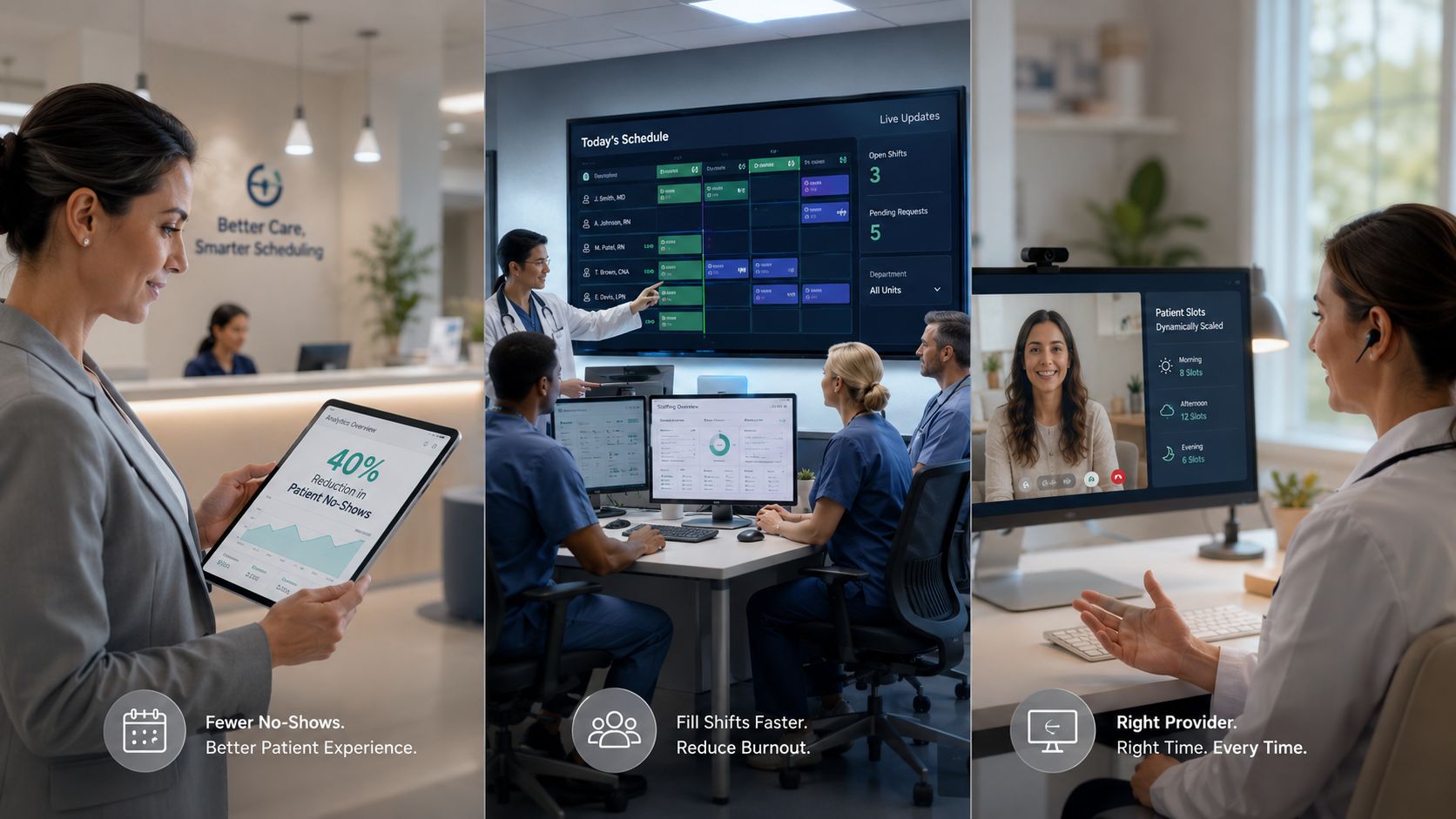
A multispecialty clinic has a familiar problem. New-patient appointments booked far in advance are frequently missed, and staff spend hours trying to confirm visits manually. The clinic adds predictive scoring based on booking lead time, appointment type, and patient history, then ties high-risk appointments to targeted reminders and faster waitlist backfill.
In the verified literature, practices deploying AI-powered scheduling are reported to see a 40% drop in missed appointments through the PMC study on intelligent scheduling. In a clinic scenario like this, that kind of result changes both revenue protection and patient access.
Hospital network filling last-minute gaps
A hospital network has the opposite issue. It isn’t struggling to find demand. It’s struggling to react to constant change. Cancellations, delayed discharges, provider shifts, and referral approvals all move faster than the scheduling team can coordinate manually.
The intelligent scheduler watches for open capacity and triggers offers to the next suitable patient based on specialty fit, urgency, and operational rules. Staff members still oversee exceptions, but they stop chasing every gap by hand.
This use case becomes more important as autonomy expands. Market Research Future projects that by 2029, at least 35% of scheduling decisions in large health systems are expected to be made autonomously by AI engines, up from under 5% in 2025.
In large systems, the real breakthrough isn’t one perfect schedule. It’s a system that keeps repairing the schedule all day.
Telehealth provider scaling dynamic slots
A telehealth provider faces a different scheduling pattern. Demand shifts rapidly by time of day, symptom type, and clinician availability. The platform can’t rely on fixed templates alone because virtual care demand is uneven and short-notice.
Here, the scheduling engine combines intake classification with dynamic slot allocation. Lower-complexity cases can be routed quickly, while higher-risk cases get escalated for review. The architecture usually needs configurable workflows, messaging, and tenant-aware controls, which is why these products often require adaptable custom software development rather than generic calendar tooling.
For readers comparing product delivery approaches, the best benchmark is usually a portfolio of client cases showing how teams have handled complex workflow products, integration-heavy environments, and regulated software builds.
Conclusion and next steps
Intelligent healthcare scheduling works best when teams treat it as a decision system, not a nicer booking screen. The value shows up in faster operations, stronger capacity use, and smoother patient access. The harder work sits behind the scenes. Audit trails, fairness checks, integration quality, and KPI discipline determine whether the system holds up in real care settings.
The hidden implementation challenge is accountability. A scheduling engine that can adapt in real time also needs to preserve a trustworthy record of how and why it acted. That’s what turns automation into a defensible healthcare capability.
If you’re planning the next step, start with a focused discovery effort. Map the workflow, define which decisions can be automated, choose the right KPIs, and design for compliance from the first architecture draft. For delivery paths, review custom healthcare software development, compare software development service models, and assess specialist AI development services.
Bridge Global helps teams move from AI ambition to working software. If you need a healthtech software development partner for an AI Discovery Workshop, product planning, or compliant platform delivery, Bridge Global brings together healthcare engineering, AI development services, and a practical AI implementation roadmap to turn intelligent scheduling ideas into audit-ready systems.

About Upendra Jith
Upendrajith completed his Master's in English and has been a commercial content developer for the past three years. He's more inclined to develop content with a 'street-smart' delivery on topics such as technology, media, or anything he can get his hands on. He has a fixation on lyrics, dark poetry, media, technology, and flow arts.
View all posts by Upendra Jith →