



Mastering Healthtech Product Scaling Engineering Support
When we talk about healthtech product scaling engineering support, we’re really talking about the backbone of your product’s growth. It’s the strategic work that takes you from a promising Minimum Viable Product (MVP) to a platform that can genuinely handle market-leading demand. This isn’t just about throwing more servers at a problem; it’s about proactively building a resilient, compliant, and high-performing system from the ground up.
Building a Foundation for Healthtech Growth
I’ve seen it happen countless times: a great healthtech idea gets an MVP off the ground, built for speed and quick validation. But that very architecture, designed to get you to market fast, often becomes a minefield of technical debt and architectural dead ends.
As soon as user numbers start to climb, those early shortcuts turn into serious performance bottlenecks, security holes, and compliance nightmares. Suddenly, the very thing that was supposed to fuel your growth is now what’s holding it back.
This is where a proactive engineering strategy makes all the difference. You have to look beyond the next feature request and focus on the core structure. By working with a seasoned healthtech software development partner, you can develop a roadmap that anticipates future demands, ensuring your system stays stable and secure as it expands.
The Critical Discovery Phase
Before you even think about scaling, you must start with a deep-dive discovery phase. I can’t stress this enough. This is where you get brutally honest about your current architecture’s weak spots, potential performance chokepoints, and any regulatory gaps.
Think of it as a technical risk assessment. It gives you the clarity to build a scaling plan that actually works. If you skip this, you’ll likely waste time and money fixing symptoms instead of the root cause.
This process lays the groundwork for sustainable growth, moving you from a fragile MVP to a robust, scalable product.
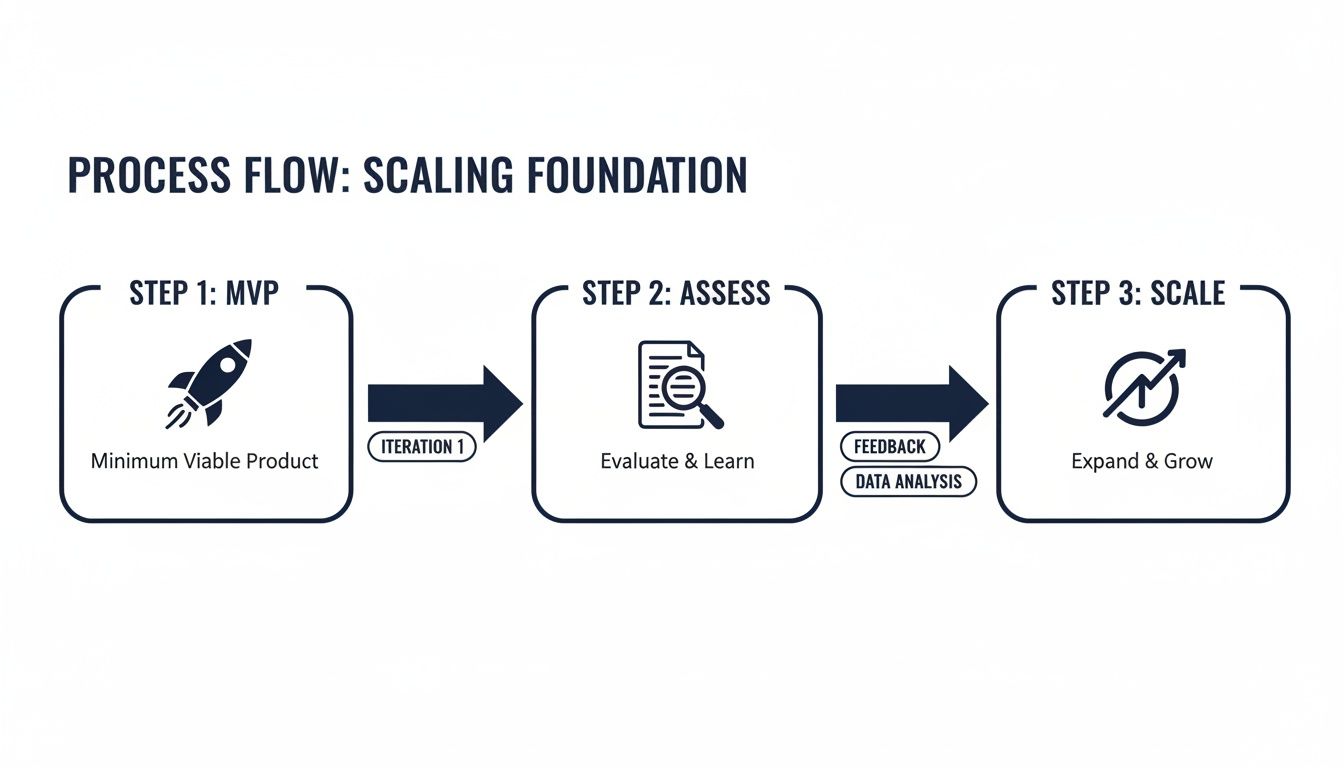
As you can see, scaling isn’t a one-and-done event. It’s a cycle: assess your system, implement scalable improvements, and then use feedback to guide the next iteration.
This kind of strategic thinking is becoming non-negotiable. The global market for product engineering services is expected to climb from USD 1,297.71 billion in 2025 to USD 1,800.45 billion by 2030, and healthcare is a huge driver of that growth. The data shows that top digital health products acquire users over 10 times faster than their peers – a gap often credited to an engineering foundation that can handle traffic spikes while seamlessly integrating new features. You can learn more about these product engineering market trends and see why this is so critical.
Scalable vs. Non-Scalable Engineering Stacks
For any CTO or engineering lead, the difference between a scalable architecture and a non-scalable one is the difference between success and failure. Many teams fall into the “non-scalable trap” without even realizing it until it’s too late.
Here’s a breakdown of what to aim for and what to avoid.
Scalable vs. Non-Scalable Healthtech Engineering Stacks
| Characteristic | Non-Scalable Stack (The Trap) | Scalable Stack (The Goal) |
|---|---|---|
| Architecture | Monolithic, tightly coupled components that create single points of failure. | Microservices or serverless; loosely coupled, independent services. |
| Data Management | Single, overburdened database struggling with concurrent requests. | Distributed databases, read replicas, and caching strategies. |
| Deployment | “Big bang” releases that are risky, slow, and require downtime. | Automated CI/CD pipelines with feature flags and canary releases. |
| Infrastructure | Manually provisioned, fixed-capacity servers leading to over- or under-utilization. | Infrastructure as Code (IaC) with auto-scaling cloud resources. |
| Compliance | Security and compliance are treated as afterthoughts, addressed manually. | “Compliance-as-code,” with security checks integrated into the pipeline. |
| Team Impact | Engineers spend most of their time firefighting and fixing production issues. | Teams focus on delivering new features and improving system performance. |
A non-scalable stack forces you to choose between growth and stability. A scalable stack, however, allows you to achieve both simultaneously, turning your engineering from a cost center into a powerful engine for business growth. By investing in a solid foundation, you build the capacity to innovate faster and more safely than your competitors.
Designing a Resilient Cloud and System Architecture
Think of your healthtech product’s architecture as its foundation. If you built your MVP on a foundation meant for a small house, it’s going to crack when you try to build a skyscraper on top of it. Scaling successfully means deliberately moving away from that initial MVP structure to something designed for growth.
I’ve seen it happen too many times: a team keeps trying to patch a monolithic system built for 1,000 users when they suddenly have 100,000 knocking at the door. This reactive approach is a recipe for disaster. It leads to terrible performance, constant outages, and an engineering team that’s too busy firefighting to innovate. You have to build for the future you want.

Choosing the Right Architectural Pattern
The first big decision you’ll face is picking the right architectural pattern. This isn’t a one-size-fits-all problem. The best choice hinges entirely on your product’s complexity, how data moves through your system, and even how your team is structured.
-
Microservices Architecture: This is about breaking your application into a collection of small, independent services. Each one handles a specific job: patient authentication, appointment scheduling, billing, you name it. This approach is perfect for complex platforms. For instance, the service handling your telehealth video streams will have vastly different scaling needs than the one managing patient records. Microservices let you scale them independently.
-
Serverless Architecture: With serverless, your team can forget about managing the underlying servers and just focus on writing code for specific functions. The cloud provider handles all the provisioning and scaling automatically. This is a game-changer for event-driven tasks like processing incoming lab results or firing off automated patient reminders. It’s also incredibly cost-effective because you only pay for the compute time you actually use.
Making this call requires you to have a clear vision for your product’s future. Sometimes, bringing in experts in custom healthcare software development can give you the foresight to build a system that can handle a 10x increase in users without needing a painful and risky overhaul down the road.
Implementing Smart Cloud Strategies
A great architecture won’t get you far without an equally smart cloud strategy. The old way of manually setting up servers with fixed capacity just doesn’t work anymore. Modern healthtech platforms have to be more dynamic.
A huge piece of this puzzle is mastering non-functional testing. It’s how you confirm your system isn’t just working, but that it’s also scalable, secure, and reliable enough for the high-stakes world of healthcare.
A resilient architecture isn’t just about handling more traffic; it’s about maintaining high availability and performance even when parts of the system fail. In healthtech, where downtime can directly impact patient care, this is non-negotiable.
To build that kind of resilience, you need to use these strategies:
-
Auto-Scaling: Set up your infrastructure to automatically add or remove resources as traffic changes. When a big public health campaign kicks off, your system scales up to handle the load. When it’s over, it scales back down to save you money.
-
Multi-Region Deployments: Don’t put all your eggs in one basket. By distributing your application across different geographic regions, you can automatically reroute traffic if one data center has an outage. For your users, the service never skips a beat.
-
Infrastructure as Code (IaC): Using tools like Terraform or Pulumi to define your infrastructure in code is essential. It makes your environments repeatable, auditable, and consistent – all critical for scaling and staying compliant. As we explore in our guide on healthcare cloud migration services, planning your migration with IaC from the start is a cornerstone of long-term success.
When you pair a modular architecture with these dynamic cloud strategies, you create a system that doesn’t just survive growth; it thrives on it. This proactive approach to healthtech product scaling engineering support is what truly separates the market leaders from the ones who crumble under pressure.
Turning Data and AI into Your Strategic Advantage
In healthtech, data isn’t just a byproduct of user clicks; it’s the core asset that can define your competitive edge. The real test for healthtech product scaling engineering support isn’t just about collecting data; it’s about turning huge amounts of sensitive health information (PHI) from a liability into a value driver. To do this, you need an infrastructure that makes data accessible, compliant, and intelligent.
I’ve seen it happen time and again: a healthtech company’s initial data setup simply can’t keep up with growth. Queries crawl, analytics become unreliable, and the engineering team is constantly putting out fires. The answer is a scalable data pipeline. Think of it as your product’s circulatory system, ensuring information flows smoothly and reliably where it’s needed most.
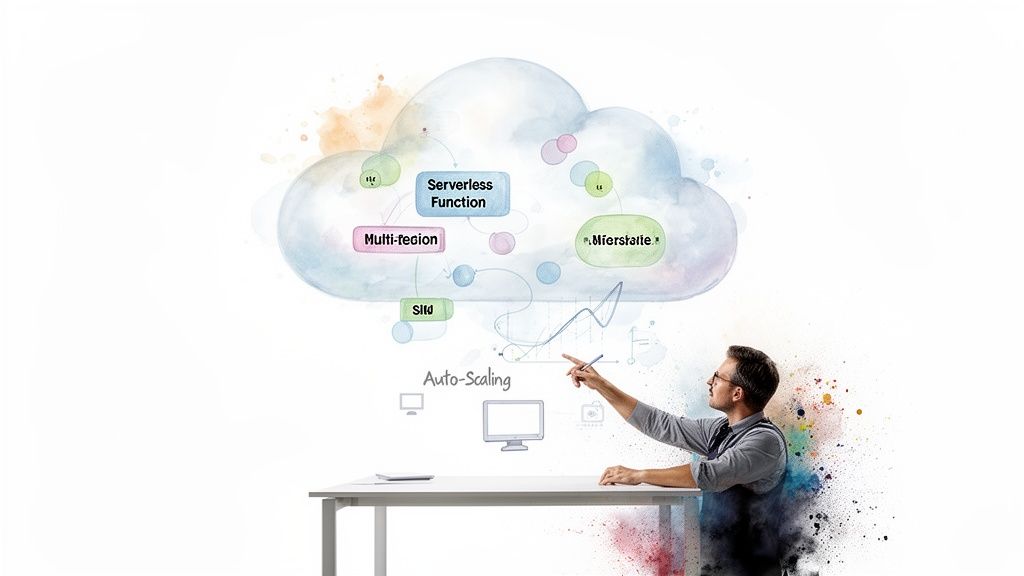
Building a Data Pipeline That Scales
A solid pipeline isn’t built overnight. It’s a combination of several key components working together perfectly.
-
Data Ingestion: This is your front door. It’s how you securely pull in data from everywhere: patient wearables, EMR integrations, and in-app user activity. This process absolutely must be fault-tolerant to prevent any data from getting lost.
-
ETL (Extract, Transform, Load) Processes: Here’s where the real work gets done. Raw data is extracted, cleaned up, and structured (like anonymizing PHI to protect privacy), and then loaded into its final destination.
-
Data Warehousing: This is your single source of truth. A central warehouse, like Snowflake or Google BigQuery, is specifically designed to handle complex analytical queries without slowing down your main application database.
Getting this architecture right is a serious engineering challenge. It demands deep data expertise to create a system that’s not only powerful but also strictly compliant with regulations like HIPAA.
Putting AI to Work in Practical Ways
Once your data is clean and organized, the fun begins. You can start integrating artificial intelligence to create real, tangible value for your users and your business. The goal here is to get beyond basic reports and into predictive and even generative capabilities. This is where professional AI development services can make a huge difference in building and deploying effective models.
Think about these real-world applications:
-
Predictive Diagnostics: You can train machine learning models on historical patient data to spot early signs of disease or predict risk scores. For example, an algorithm could analyze EKG readings to flag potential arrhythmia risks for a clinician to review.
-
Operational Efficiency: AI is fantastic for automating tedious administrative work like medical coding, claims processing, and appointment scheduling. This frees up your staff to focus on what matters most – patient care.
-
Generative AI for Patient Support: Imagine a secure, HIPAA-compliant chatbot that can answer common patient questions, send medication reminders, or offer personalized health tips. It’s a game-changer for engagement and provides support that can scale infinitely.
Building with AI is more than just plugging in an algorithm. It demands a holistic AI transformation framework that connects your tech, your data, and your business strategy. From what I’ve seen, the companies that win are the ones who view AI for your business as a core part of their product, not just a feature.
Closing the Gap Between AI Hype and Reality
Everyone in healthcare is excited about AI, but the foundational infrastructure often gets overlooked. Research shows that while 83% of US healthcare executives are exploring generative AI, fewer than 10% are actually making the necessary enterprise-wide investments to support it at scale.
This is where great engineering becomes critical. Medtech firms that effectively scale generative AI are already seeing massive returns. One study estimated a potential value capture of $14-55 billion annually just from productivity gains. You can discover more insights on how healthcare providers can scale productivity with GenAI.
Without that robust engineering support, though, these impressive benefits will remain out of reach for most companies. You simply can’t build a skyscraper on a weak foundation.
Making Security and Compliance Part of Your DNA
When you’re scaling a healthtech product, your user base isn’t the only thing that grows. Your regulatory responsibilities and your appeal to attackers grow right alongside it. Security and compliance can’t be a line item on a checklist or something you bolt on later. They have to be woven into the very fabric of your engineering culture.
It’s a shift from a siloed approach to a shared one – a move toward what we call DevSecOps. This means every single engineer, from your junior developer to your lead architect, is empowered and expected to build securely from the very first line of code.

From Manual Audits to Automated Guardrails
In the early startup days, you can probably get by with manual security reviews. But that approach simply doesn’t scale. As your team grows and you start deploying code multiple times a day, manual checks become a massive bottleneck – and a huge liability. The only way forward is to automate security and compliance right inside your CI/CD pipeline.
-
Automated Vulnerability Scanning: Tools like Snyk or SonarQube should be your new best friends. Integrate them to automatically scan every single pull request for known vulnerabilities. This catches problems before they ever have a chance to hit production.
-
Secrets Management: Never, ever hard-code credentials. Use a dedicated secrets manager like HashiCorp Vault or Doppler to inject sensitive keys at runtime. This also makes rotating secrets, a critical security practice, infinitely easier.
-
Infrastructure as Code (IaC) Security: If you’re using Terraform or Pulumi to manage your cloud environment, you need to scan those configurations, too. Misconfigurations are a leading cause of data breaches, and scanning your IaC helps you enforce security policies before a single resource is deployed.
This “shift-left” philosophy turns security from a painful, reactive fire drill into a proactive, continuous part of your development flow.
How to Engineer for HIPAA and GDPR
Regulations like HIPAA and GDPR aren’t just legal headaches; they are technical specifications. You have to build a compliant-by-design architecture, which requires very specific engineering choices. As we’ve covered in our deep dive on HIPAA-compliant software development, it’s about knowing the rules and knowing how to write the code that enforces them.
Your engineering team absolutely must get these core areas right:
-
Rock-Solid Data Encryption: All Protected Health Information (PHI) must be encrypted, period. That means in transit (using TLS) and at rest (using AES-256). This isn’t optional; it’s the bare minimum.
-
Granular Access Controls: Implement Role-Based Access Control (RBAC) to live by the principle of least privilege. An ER nurse shouldn’t see the same data as a hospital administrator, and your code must be the gatekeeper that enforces those boundaries.
-
Comprehensive Audit Trails: Your system has to log every single action involving PHI. Who accessed what data? What did they do with it? When? These logs must be immutable and are non-negotiable for security investigations and regulatory audits.
In healthtech, a security breach isn’t just a technical problem; it’s a catastrophic breach of trust. Integrating security into your engineering process with dedicated cyber compliance solutions is the only way to protect your users, your reputation, and your business as you grow.
Get Ahead of Threats with Threat Modeling
Beyond the automated tools, the most mature engineering teams I’ve worked with are all masters of proactive threat modeling. This isn’t a complex, formal process. It’s a structured brainstorming session where your team thinks like an attacker before building a new feature.
Imagine you’re adding a new patient-to-doctor messaging function. The team would gather and ask questions like:
-
How could a bad actor intercept these messages in transit?
-
What’s stopping one patient from seeing another patient’s conversation history?
-
How are we really verifying the identity of the person on both ends?
By asking these tough questions upfront, you can design defenses directly into the feature’s architecture. It’s a far more effective and less expensive way to build secure software than trying to patch holes after a release. This proactive mindset is the true sign of a team that gets what’s at stake in healthtech.
Your tech is only as scalable as the team behind it. What got you from zero to one: that scrappy, all-hands-on-deck startup vibe, will absolutely break as you try to get from one to one hundred. The informal chats and overlapping roles that felt agile at first quickly become major roadblocks to growth.
Getting your team structure right is one of the most critical parts of scaling a healthtech product. This isn’t just about hiring more people; it’s about designing an organization that can support complexity, speed, and the unforgiving demands of healthcare.
The first big question you’ll face is whether to build out your entire engineering team in-house or to bring in an external partner. I’ve seen companies succeed and fail with both, and the right answer for you comes down to your budget, timeline, and how quickly you can find the right talent.
The In-House vs. External Partner Dilemma
Keeping everything in-house gives you total control. Your engineers live and breathe the product, soaking up the company culture and building deep institutional knowledge. That’s the dream. The reality, however, is that it’s often a slow and expensive path, especially when you suddenly need a specialist in machine learning or someone who deeply understands a niche area of compliance.
This is where a dedicated development team can be a game-changer. It gives you instant access to a bench of vetted experts, letting you ramp your engineering firepower up or down as your roadmap dictates. It’s a strategic move to hit your goals faster, without the drag of recruiting cycles and overhead costs. We’ve seen this firsthand in our client cases, where companies leverage specialized external talent to pour fuel on their growth.
How to Choose the Right Engineering Partner
Picking a partner isn’t like shopping for developers based on the lowest hourly rate. You’re looking for a strategic ally who gets what’s at stake in healthtech. Your evaluation has to be about long-term value and proven capability.
Focus on partners with a track record in custom healthcare software development. They should be able to talk confidently about HIPAA, GDPR, and the specific technical safeguards needed to protect patient data. If they can’t, walk away.
Here’s what you should be digging into:
-
Real Domain Expertise: Have they actually built successful healthtech products? Ask for case studies and a clear explanation of how they’ve navigated clinical workflows and regulatory hurdles before.
-
Clear Communication Cadence: How will you stay in sync across time zones? What project management tools do they live in? A great partner will feel like they’re in the next room, not a world away.
-
Rock-Solid Service Level Agreements (SLAs): The SLA is your shared definition of success. It must clearly spell out uptime guarantees, response times for critical bugs, and key performance metrics. This is non-negotiable.
-
A Truly Cross-Functional Team: Can they provide more than just coders? As you scale, you’ll need QA, DevOps, and UI/UX specialists. Your partner needs to be able to grow with you.
A partnership with the right product engineering services provider acts as a force multiplier. They don’t just bring more hands; they bring battle-tested processes and an outside perspective that can help you sidestep common scaling mistakes.
The Hybrid Model: Getting the Best of Both Worlds
For most of the scaling healthtech companies I’ve worked with, a pure in-house or fully outsourced model isn’t the best fit. The sweet spot is often a hybrid approach.
This means you keep a core in-house team of architects and product leaders who own the long-term vision and culture. You then augment this core group with a flexible external team to handle specific feature development, take on the QA workload, or execute specialized projects like a new AI integration. To make this work, you need to know how to build a high-performing DevOps team structure that seamlessly blends your internal and external talent.
This approach gives you the strategic control of an in-house team with the agility and specialized skills of a partner. It’s how you tackle new opportunities without derailing your core roadmap. As we’ve explored in our guide on how to choose a healthtech software engineering partner, success hinges on finding a partner that truly operates as an extension of your own team.
Getting this right has a massive impact. The healthtech engineering services market is on track to hit $3.14 billion by 2034, fueled by the relentless pressure to cut costs and get to market faster. The data shows that the best healthtech products achieve an incredible 7.3% monthly new user growth – ten times the median. A huge reason for this is an engineering structure that can iterate and scale without friction. You can learn more about these healthcare product benchmarks and their drivers.
Ultimately, putting the right people in the right structure isn’t just an operational detail; it’s your most powerful scaling strategy.
FAQs on Healthtech Product Scaling
Here are answers to the most common questions I get from founders, CTOs, and product leaders about navigating the challenges of healthtech growth.
What are the first signs that my architecture can’t handle scale?
The early warnings are often subtle but consistent. Performance starts to drag during peak usage hours, shipping even minor features becomes a slow and painful process, and you see a sudden spike in production bugs. If your engineers spend more time firefighting than building, that’s a huge red flag. Another is when minor code changes require risky, all-or-nothing deployments. These are symptoms of deep architectural debt that will only get more expensive to fix as you grow.
How do we balance speed with building a scalable foundation?
Stop thinking of it as “speed versus quality.” Instead, adopt an agile mindset that builds “architectural runways” – intentionally creating foundational pieces that support future features. Focus on solid APIs, a real testing pyramid, and containerizing services for portability. Working with a custom software development partner can embed this modular thinking, letting you add features quickly without accumulating technical debt.
What is the role of AI in scaling engineering support?
AI is a powerful tool for your engineering team. Internally, you can apply AI for your business to automate code reviews, predict bugs before they reach production, and optimize cloud spending. For example, generative AI can write boilerplate code, generate realistic test data, and automatically document APIs. This frees up senior engineers for high-impact architectural work, an approach often guided by strategic digital transformation consulting.
When should we move from a monolith to microservices?
Wait as long as possible. A well-organized monolith is simpler for early-stage products. Only consider migrating when you hit specific walls:
-
Conflicting Scaling Needs: One part of your app (like video streaming) needs massive scaling, while another (like patient records) doesn’t.
-
Team Bottlenecks: Your dev teams are constantly blocking each other’s progress.
-
Tech Diversity: You want to use a different language or database for a specific job.
When you do migrate, use a gradual approach like the Strangler Fig pattern to carve off one service at a time, minimizing risk.
Ready to build a scalable and compliant healthtech platform? Bridge Global is your trusted healthtech software development partner. We combine deep industry expertise with AI-driven engineering to help you innovate faster, scale securely, and achieve your growth targets.

About Shreesha Chandrabose
Shreesha Chandrabose is a commerce graduate with a growing passion for content writing and digital media. With a curious mind and a creative approach, she enjoys transforming ideas into simple, relatable, and engaging narratives. She loves poetry, photography, and editing, and enjoys bringing ideas to life through words and visuals.
View all posts by Shreesha Chandrabose →