



Healthcare Workflow Orchestration: A Practical Guide
Your product worked in pilot because everyone could still improvise. Then the second customer arrived, the payer rules changed, the EHR team updated a field, and the AI summary lived outside the audit trail. That's the point where healthcare workflow orchestration stops being an architecture buzzword and starts being the control layer your team has to get right.
The hard part isn't making one workflow faster. It's building a decoupled layer that can survive rip-and-replace pressure, AI model drift, and HIPAA-grade audit scrutiny without turning every new integration into a rewrite. In practice, that means a product lead needs four things at once: a clear definition, a mental model of the architecture, a compliance posture, and a phased build path that doesn't bet the company on a big-bang rollout.
The Day Two Problem in Healthcare Software
Day one feels manageable. Scheduling sends a message to the EHR, billing waits for coding, prior auth sits in a Slack thread, and a support analyst copies a note from one screen into another because nobody has wired the systems together yet. The workflow works because people are filling the gaps.
Day two exposes the cost of that approach. Every new hospital brings a different EHR configuration, every imaging site has its own worklist habits, and every payer process adds another exception path. If AI is summarizing encounters but not part of the audit trail, the product looks modern and behaves fragile.
Practical rule: if a workflow depends on someone remembering where to look next, it isn't orchestrated yet.
A better pattern is to treat orchestration as the control plane above the systems, not as another task queue inside them. That control plane is what lets a healthtech team keep moving when the underlying stack changes, and it's why operational resilience in healthcare software matters as soon as a product leaves pilot.
What Healthcare Workflow Orchestration Actually Means
Think of healthcare workflow orchestration as air traffic control for clinical and administrative work. The planes are your EHR, RIS, billing system, AI service, and payer API. Orchestration doesn't replace them; it decides what moves next, in what order, with what context, and what happens when a step fails.
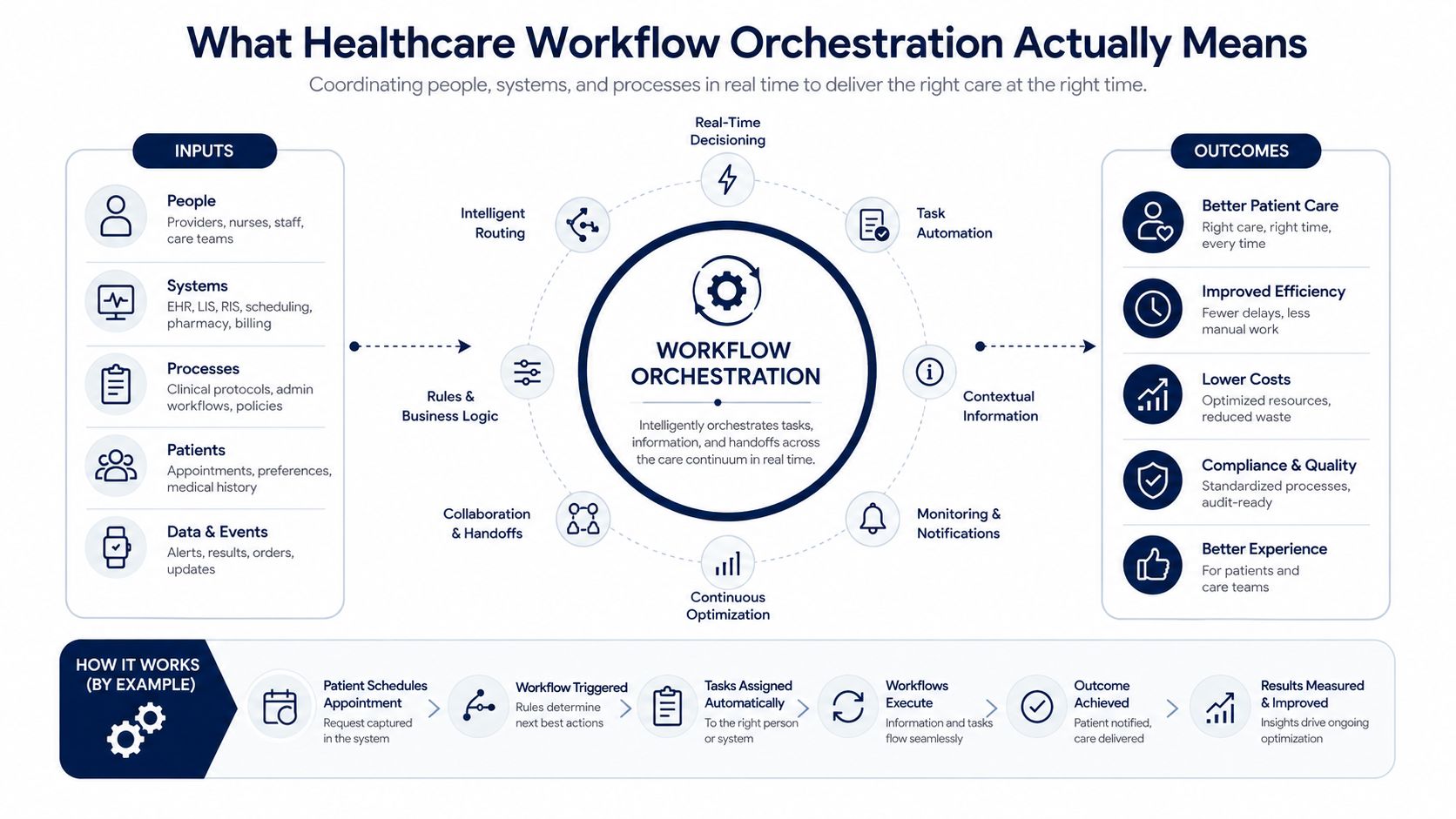
That distinction matters because orchestration is not the same as point-to-point integration, RPA, or a classic BPM suite. Point-to-point links move data between two systems, but they don't coordinate the broader sequence. RPA mimics clicks, but it's brittle when screens change. BPM can model processes, but healthcare teams still need a runtime layer that can react to live events, retries, and exceptions.
The market is starting to reflect that shift. By 2025, the global clinical workflow solutions market was valued at USD 15.99 billion and is projected to reach USD 40.20 billion by 2034, implying a 10.92% CAGR, with North America accounting for 44.0% of the market in 2025, according to Fortune Business Insights. That growth says orchestration has moved beyond a feature request and into a category of its own.
For teams handling revenue cycle handoffs, payer correspondence, and exception queues, the same mental model applies. If you're also trying to untangle denial workflows, the context in understanding EOBs and denials helps frame why the handoff logic matters so much.
The Architecture Behind a Decoupled Control Plane
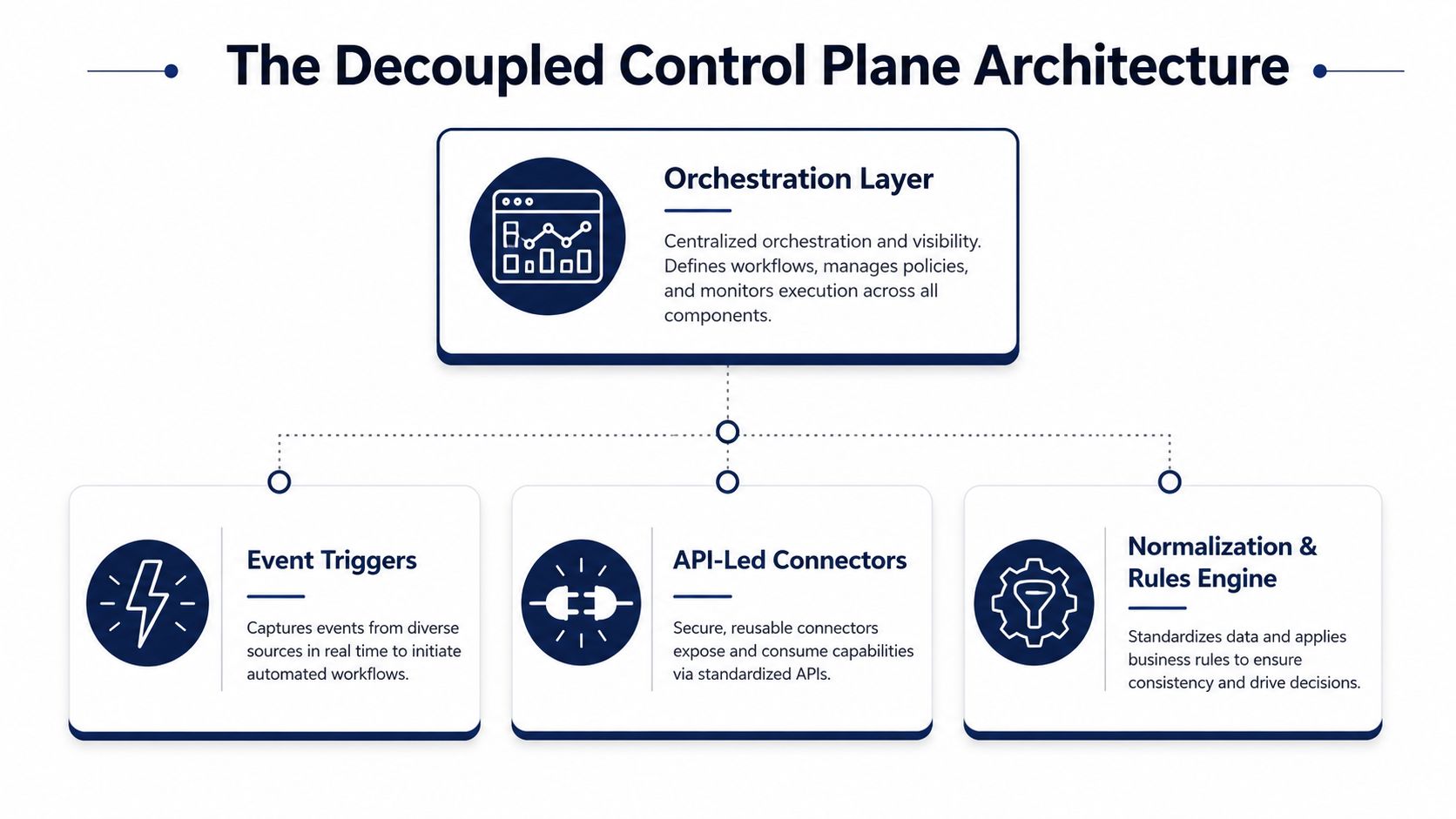
A useful orchestration layer starts with an event. A new order is placed, a study is signed, a claim is denied, or a lab result arrives. That event triggers a workflow decision, not a manual hunt across systems.
The next layer is API-led connectors and middleware. These services pull data from EHR, PACS, billing, scheduling, or analytics systems, then normalize identifiers, timestamps, statuses, and document shapes before routing work onward. That normalization step is what keeps one department's “complete” from becoming another department's “pending.”
What the control plane needs to do
A decoupled control plane usually needs four things working together.
-
Event triggers: These listen for status changes, new orders, file arrivals, or queue updates.
-
Routing logic: This decides which team, queue, or model should receive the work next.
-
Exception handling: This catches mismatched identifiers, missing consent, failed APIs, or incomplete records.
-
Audit and monitoring: This records what happened, when it happened, and why the system chose that path.
In medical imaging, the payoff is easy to see. A single intelligent workspace can consolidate multiple PACS, RIS, and EHR worklists, then surface study type, source, severity, status, and expected completion while preserving standards-based connectivity to existing systems, as described by Merative. That's vendor-neutral orchestration in practice, one interface over multiple systems, not a rip-and-replace migration.
The architecture gets simpler when the workflow logic sits above local systems, not inside each one.
That's the design move. The orchestration layer doesn't ask every source system to become smarter; it makes the coordination logic portable enough to survive future platform changes, added AI services, and new partner APIs.
Compliance and Data Governance as Design Inputs
A workflow can look efficient on paper and still fail in production if compliance was treated like a later review. In healthcare, HIPAA, consent handling, auditability, and access control have to shape the orchestration design before the first route is written. If your product also reaches regulated research or laboratory settings, the discipline around contemporaneous records for labs shows why the system has to preserve process evidence as it goes, not after the fact.
Build the guardrails into the workflow
An orchestration layer in a regulated setting needs to normalize identity, check access, and confirm consent at every handoff. It also needs immutable audit trails, not just log files that say a request occurred. If a case moves to a human reviewer, the system should retain the reason, the timestamp, and the decision path so an auditor can follow the sequence without guessing.
That requirement grows once AI enters the routing layer. Model behavior can shift over time, so governance has to cover routing rules, exception thresholds, and human review checkpoints, not only system connectivity. If an output can affect patient access, reporting, or billing, the orchestration layer has to make the decision path visible and reviewable.
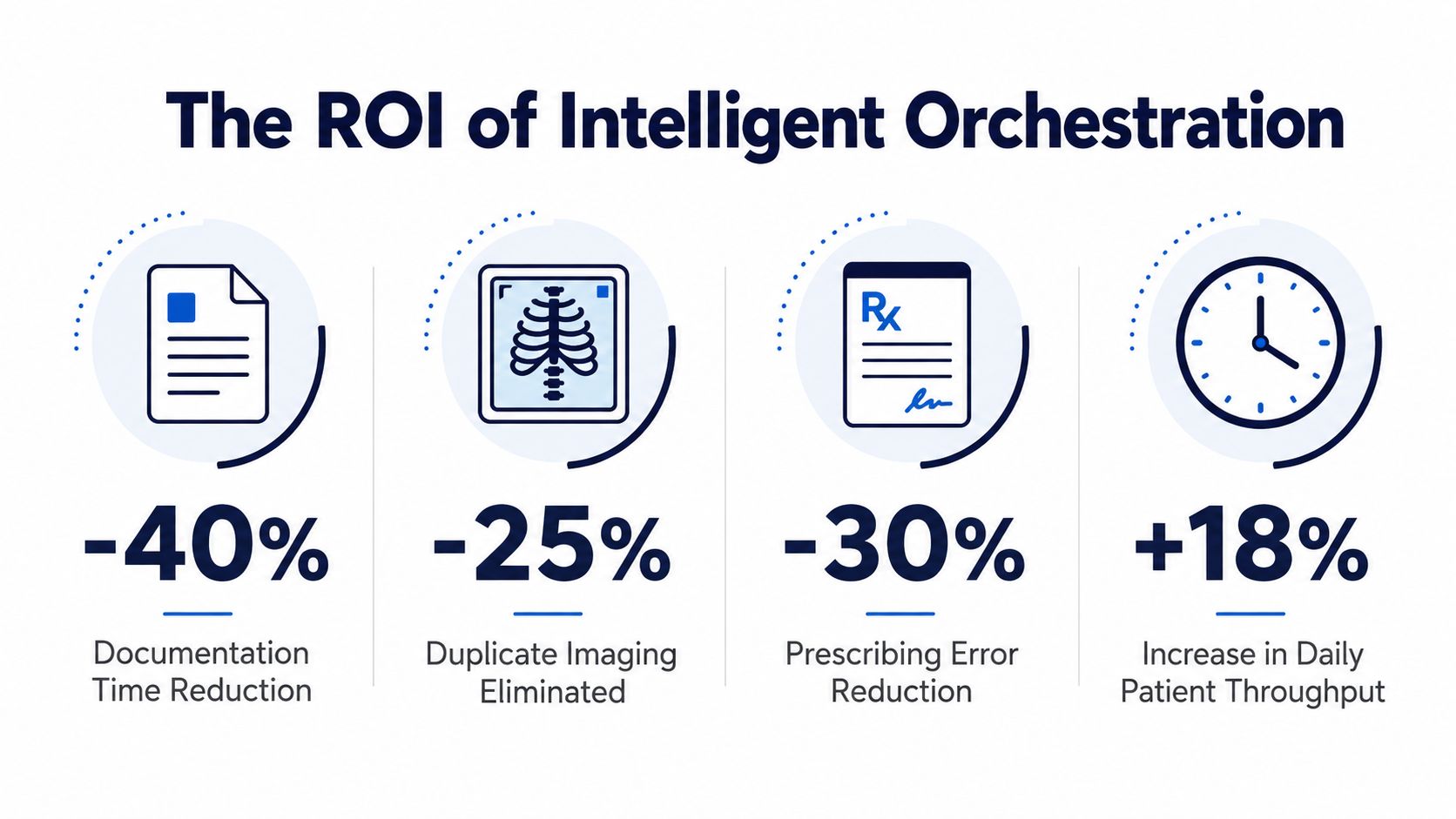
One healthcare workflow study reported broad efficiency gains across clinical pathways, including documentation-time reductions, duplicate imaging elimination, reductions in medication prescribing errors, and throughput improvements, and one documented implementation prevented duplicate orders and generated savings in an annual cycle. The exact mix of gains matters less than the pattern. Audit-grade coordination pays off when the system can prove what it did, why it did it, and which rule or reviewer allowed the next step.
Bridge Global's healthcare data governance guide fits here because orchestration and governance cannot live in separate silos with separate assumptions. The control plane has to carry the compliance posture with it, the same way a flight controller keeps the clearance record attached to every handoff.
Where Orchestration Changes Day-to-Day Operations
The fastest way to understand orchestration is to watch it move across departments. In imaging, an order comes in, the study is prioritized, the right reader sees it, and the worklist updates without anyone chasing status in three systems. The work doesn't vanish, but the handoffs become visible.
In prior authorization, the pattern is different. An EHR event can trigger a payer-facing task, the payload can move through middleware, and the exception queue can catch cases that need human review before the process stalls. That's where orchestration connects patient access with administrative operations instead of leaving them in separate tools.
Revenue cycle uses the same logic in another direction. A coding event can route to claim edits, denial handling can land in one exception queue, and operational analytics can watch backlog age without someone exporting a spreadsheet at the end of the week. Bridge Global's clinical workflow optimization perspective is relevant here because the point isn't just automation; it's keeping the workflow legible across teams.
Three operational patterns that show up often
-
Imaging to reporting: Consolidate worklists, route studies by urgency, and preserve the reading context.
-
Prior auth to payer follow-up: Use event triggers and routing rules to move cases through the next required step.
-
Billing to denial management: Push exceptions into a shared queue so the team can work from one source of truth.
A healthcare workflow orchestration layer coordinates cross-functional workflows across patient access, clinical-adjacent administration, billing, ERP processes, and operational analytics, combining workflow rules, API integrations, middleware services, event triggers, exception routing, and monitoring into one execution layer, according to SysgenPro. That reach is what separates orchestration from a narrow automation script.
A Phased Implementation Roadmap With AI Built In
The cleanest build path starts before code. The first move is cross-functional pathway design, where product, clinical ops, compliance, and engineering agree on the sequence and the failure points. After that comes clinical-pathway refinement, then data source mapping, then prototype validation, then pilot, and finally production.
The sequencing matters because AI and automation only work when the workflow already has clear boundaries. A model can classify exceptions, but someone still has to define which exceptions it may handle and which ones go straight to a human. Routing rules also need change governance, because a safe workflow today can become a broken one after a policy update.
| Phase | What Gets Built | AI Integration Checkpoint | Gate to Next Phase |
|---|---|---|---|
| Cross-functional pathway design | Scope, actors, handoffs, failure states | Identify where AI could assist, not decide | Agreement on workflow boundaries |
| Clinical-pathway refinement | Detailed step order and exceptions | Define human review thresholds | Clinicians sign off on the flow |
| Data source mapping | Source systems and event triggers | Confirm usable model inputs | Integration inventory is complete |
| Prototype validation | One end-to-end workflow in a test setting | Test exception classification and fallback paths | Prototype matches expected behavior |
| Pilot | Limited live deployment | Monitor model output and routing changes | Operational stability in real use |
| Production | Full rollout and monitoring | Formal change governance for model and rules | Support model for ongoing operations |
Independent guidance on orchestration also recommends moving from cross-functional pathway design to clinical-pathway refinement, then defining additional data sources, building and validating a prototype, transitioning to pilot operations, and finally moving to full production implementation, which aligns well with a phased delivery model from custom healthcare software development, custom software development, software development service models, AI development services, enterprise AI solutions, AI implementation roadmap, healthcare integrations, SaaS product development, and client cases when a team needs outside delivery support.
Start with one workflow that crosses two systems and one exception path. If that doesn’t survive a pilot, a broader rollout will only multiply the failure.
Metrics, ROI, and the Case for Investment
Finance teams do not buy orchestration because it sounds current. They buy it when overtime, rework, and avoidable escalations start showing up in the operating numbers. The business case gets easier to defend when you can tie those failures to work that could have been coordinated earlier.
A useful headline is the 49.0% mean weighted efficiency improvement, but a steering committee will want to know where that improvement lands in daily operations. 78.9% documentation-time reductions suggest more clinician and staff time can shift back to productive work. 50% duplicate imaging elimination points to less waste. 48% reductions in medication prescribing errors speak to safety and the rework that follows from preventable mistakes. 19.0% throughput improvements in integrated clinical pathways show how capacity can rise without adding the same level of manual coordination.
What to track early
-
Cycle time: Measure how long a case takes from trigger to completion.
-
Denial rate: Watch whether upstream coordination reduces avoidable rework.
-
Backlog age: Track how long exceptions sit before someone owns them.
-
Exception queue size: Use this as a signal that a workflow is drifting or a rule is too brittle.
The strongest ROI story connects operational cleanup to safety and staffing relief, not to one isolated number. That gives product leaders one evidence set they can use with clinical owners and finance reviewers, even when those audiences care about different parts of the workflow.
Choosing a Partner and Bringing It All Together
The best partner is the one that can design for healthcare constraints without forcing your stack into a brittle template. Look for healthcare-specific compliance posture, decoupled architecture, observability and audit depth, AI governance maturity, and integration breadth. If those five are weak, the orchestration layer will look good in a demo and struggle in production.
You should also ask how the team handles change:
-
Can they keep workflow logic separate from local system quirks?
-
Can they prove what happened after an exception?
-
Can they support AI-assisted routing without losing human control?
Those questions matter more than a long feature list.
A common mistake is buying another point tool when the need is a control plane. The opening-day mess only gets worse if scheduling, billing, imaging, and AI each live in their own logic island. Orchestration gives your product a stable coordination layer, so the next payer rule, EHR change, or model update doesn’t force a rebuild.
If you’re mapping that first build, Bridge Global can help with discovery, healthcare integrations, AI-enabled workflow design, and custom delivery for product teams that need a structured path from pilot to production. Visit Bridge Global if you want a partner that can translate this architecture into an implementable roadmap for your team.

About Stephanie Cornelissen
Stephanie Cornelissen is a Technical Solutions Consultant with strong experience helping organizations navigate complex digital change. She works closely with teams to align business goals with practical, scalable technology solutions. With expertise in system architecture, integrations, and emerging technologies, she focuses on solving real-world problems through thoughtful execution. She enjoys working where technology meets business strategy and measurable growth.
View all posts by Stephanie Cornelissen →