



Healthcare Software Modernization: The Complete Guide
About 90% of enterprise applications in healthcare and life sciences are still legacy, and that’s the number that should stop any executive from treating modernization like a cosmetic upgrade. In this environment, healthcare software modernization is about keeping clinical operations safe, auditable, and interoperable while the organization keeps running, not about swapping a few screens or moving servers to a cloud badge.
The wrong mental model is “we need a new stack.” The right one is “we need a controlled transition that protects patient data, preserves uptime, and makes room for API-driven workflows and AI governance.” That’s why modernization belongs in the boardroom, because the costs of delay show up in resilience, compliance, and security, not just in IT tickets.
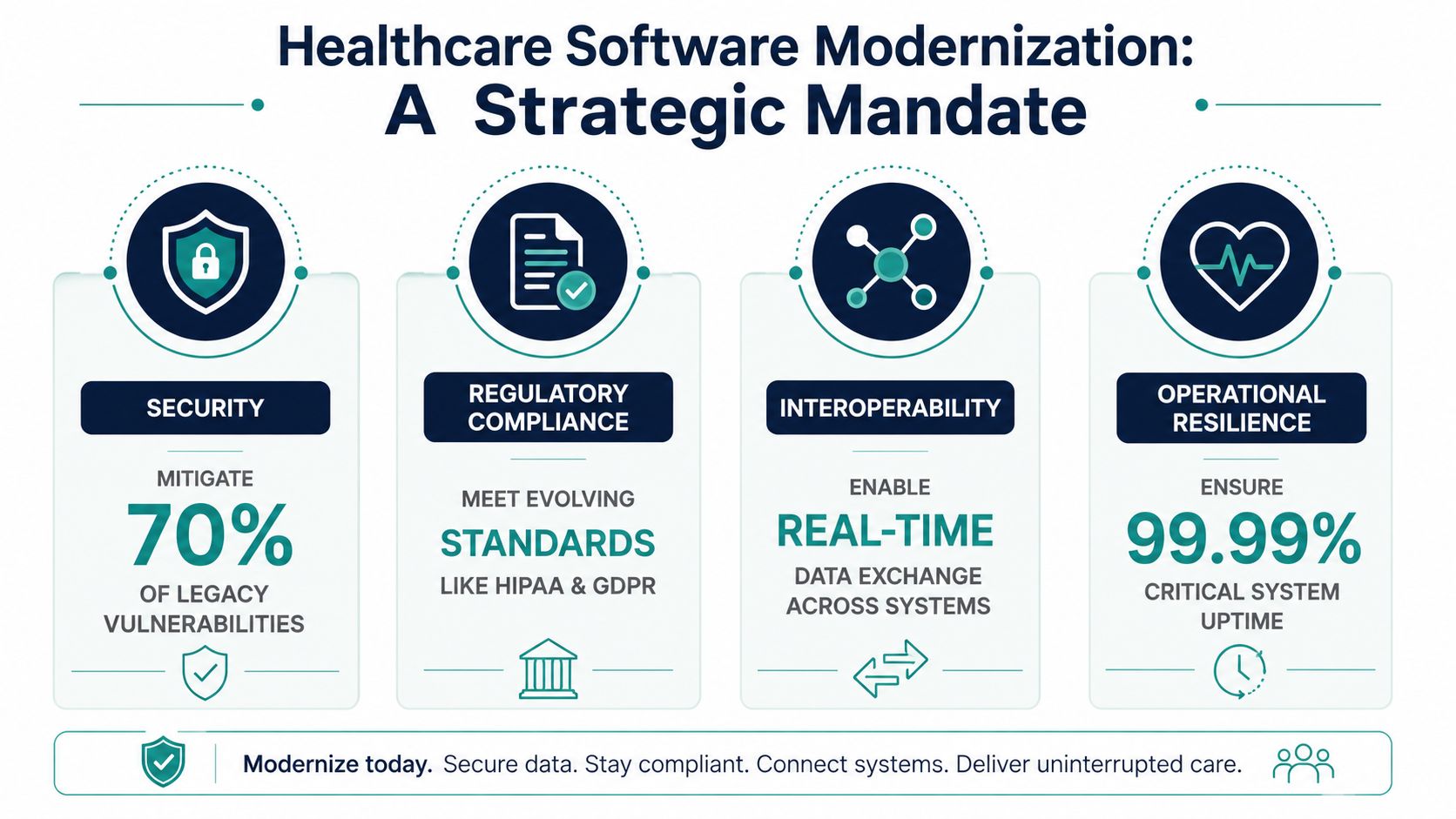
Why Healthcare Software Modernization Is Now a Strategic Mandate
Legacy systems still dominate healthcare software. Infosys reported that about 90% of current enterprise applications in healthcare and life sciences are still legacy, with roughly 46% of those legacy systems being mainframes, and it expected about 50% of legacy applications to be modernized within two years and 70%–90% within five years. That is not a distant planning signal. It is a near-term operating constraint for hospitals, payers, and life sciences teams that still depend on older platforms for patient administration, billing, and data exchange.
The underlying issue is clinical safety under coexistence. Healthcare modernization has to reduce fragility while systems still run side by side, because patient data, orders, claims, and workflow state cannot tolerate a careless cutover. Older stacks make it harder to sustain uptime, keep compliance evidence intact, and connect new clinical workflows without creating gaps between systems.
The mandate is broader than IT cleanup
A board that treats modernization as routine IT maintenance is making the wrong call. NIST’s clinical safety guidance points to risk assessment, standard user-interface design, safety in network-enabled environments, and unambiguous patient identification as core problems in modern health IT. Those are operational controls, not backend extras. They determine whether a new platform can be trusted in live care settings.
Practical rule: if a modernization plan does not reduce clinical risk, improve data exchange, and make auditability easier, it is not a modernization plan; it is a technical detour.
The equity problem is just as real. A redesigned system that assumes perfect connectivity, strong digital literacy, and always-on devices can still fail underserved patients and low-resource settings even if the code ships cleanly. Independent health IT research defines underserved populations as people with inhibited access to medical or information services, which is why offline workflows, multilingual access, accessibility, and low-bandwidth design need to be built into the architecture from the start.
Modernization is a resilience program with clinical, regulatory, and access consequences. Treat it that way, or you will end up with a faster system that is still unsafe to run in parallel with the old one.
The Four Real Drivers Behind Modernization
Modernization fails when teams treat every driver as equal. Security and compliance force the schedule. Interoperability and AI readiness shape the target architecture. Separate those forces early, or you will spend money in the wrong order and still miss the clinical risk.
Security changes the economics fast
Legacy infrastructure usually falls behind on encryption, multifactor authentication, continuous monitoring, and timely patching. That gap raises exposure and makes incident response slower, especially in healthcare environments where downtime and data loss hit patient care as well as operations. If a critical workflow still runs on an aging system with weak control coverage, modernization is a risk-reduction program before it is anything else.
Compliance is not paperwork after the fact
HIPAA and GDPR shape data retention, access control, audit logging, and the boundaries of what a modern interface can expose. Teams get this wrong when they build the platform first and try to bolt governance on later. That approach creates rework, weak audit trails, and avoidable friction with legal and security review.
Interoperability is now a procurement expectation
The 2026 Black Book Global Healthcare IT Survey found that 92% of respondents viewed FHIR/API interoperability as a top-three procurement requirement, and 65% of hospitals in the fastest-adopting countries reported active EHR replacement or expansion in 2026, compared with 13% in slower-adopting markets. That changes the design brief.
AI readiness depends on the data foundation
The same Black Book survey found 18% of organizations had clinical AI in production in at least one workflow in 2026, up from 11% in 2025. That growth does not justify rushing models into production. It means modernization now has to include lineage, validation, and governance boundaries that keep AI deployment inside clear safety limits, with no ambiguity about what can be automated and what must stay under human control.
Prioritize security and compliance when the system is already exposed. Build interoperability and AI readiness into the target state from the start. That ordering keeps modernization tied to patient safety, not just infrastructure refresh work.
Modernization Patterns and Target Architectures
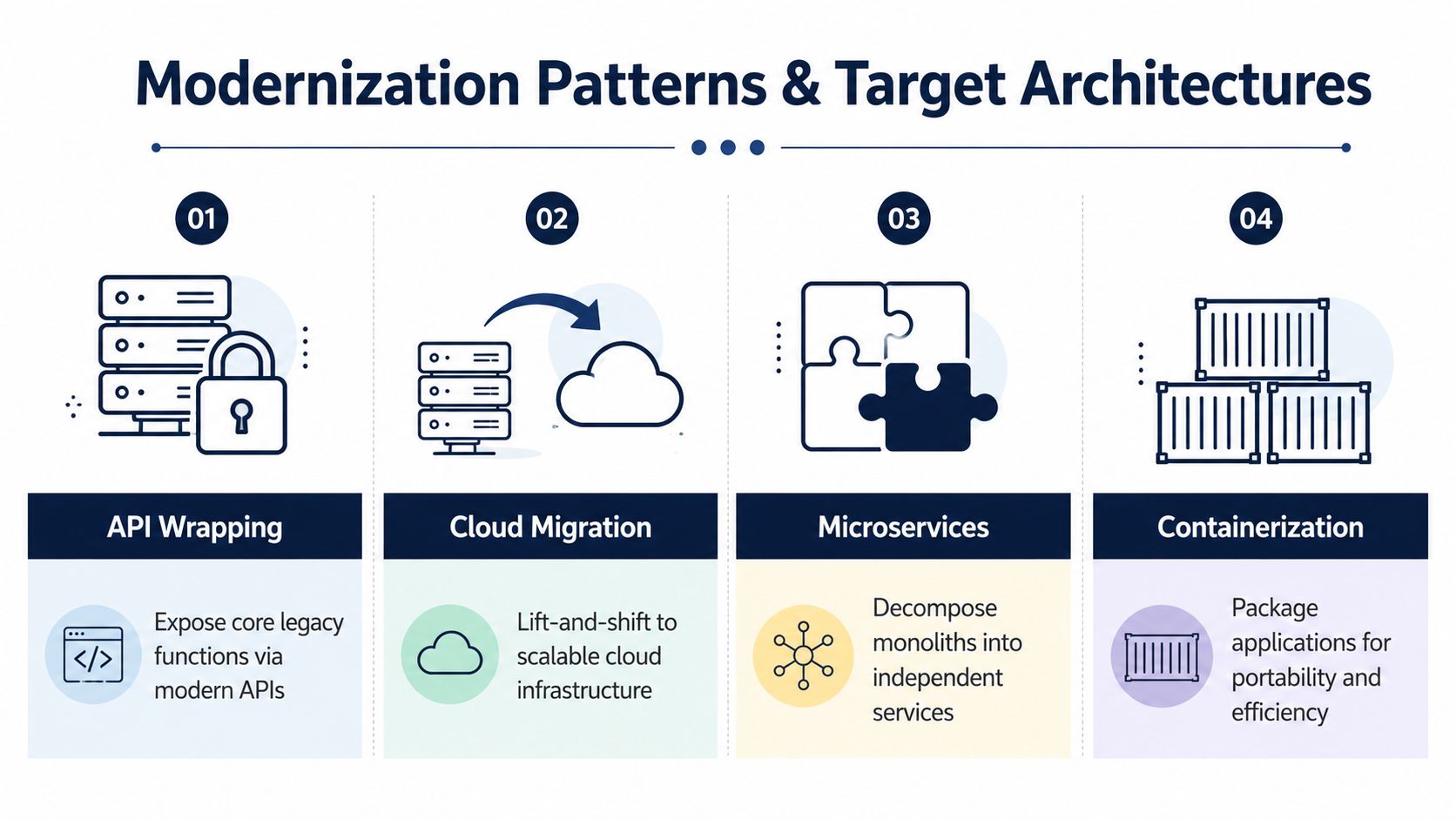
Healthcare modernization isn’t one move. It’s a choice among patterns, and the right one depends on how dangerous the legacy core is, how much clinical disruption you can tolerate, and how fast you need value. One industry source groups the practical options as reusing legacy components and APIs, moving to cloud infrastructure, rearchitecting into microservices or service-oriented architecture, or rewriting when the codebase is too fragile to trust.
Encapsulate first when the core still works
API wrapping is the lowest-risk path when the legacy system is stable but inaccessible. You expose core functions through modern APIs, then move new experiences and integrations outside the old boundary. That works well for hospital EHRs and billing systems where the core logic is still valuable, but the surrounding access model is the problem.
Cloud migration buys elasticity, not design quality
Moving infrastructure to the cloud can improve scalability and operational management, but it doesn’t fix bad domain boundaries or brittle data models by itself. Use it when infrastructure friction is slowing the business, not as a substitute for architecture work. If the code is coupled to old assumptions, a lift-and-shift can just relocate the mess.
Microservices fit productized platforms, not rushed clinical rewrites
Microservices make sense when a platform needs independent deployment, clearer ownership, and stronger modularity. That’s often true for greenfield healthtech SaaS and for subsystems that already have clean seams. It’s a poor fit for teams that don’t have mature DevOps discipline, because you’ll trade one monolith for a distributed failure surface.
Rewrite only when the legacy is beyond salvage
A rewrite is the most expensive and time-consuming option, and it should be rare in clinical environments. Use it when the existing code is too fragile to maintain, too undocumented to trust, or too entangled to modernize safely. If the platform is still carrying live care workflows, a full rewrite without a coexistence plan is how teams create downtime they can’t afford.
A hospital team can modernize the front door with APIs and still leave the engine intact. That’s often the right move because patient safety cares more about continuity than architectural purity.
A Phased Migration Roadmap With Coexistence Built In
The safest modernization programs I’ve seen in regulated care environments all start the same way, with assessment and dependency mapping, not coding. You need to know which workflows are fragile, which interfaces are mission-critical, and which data elements will break if you move them too early. A phased plan is slower on paper, but it’s faster than cleaning up a failed cutover.
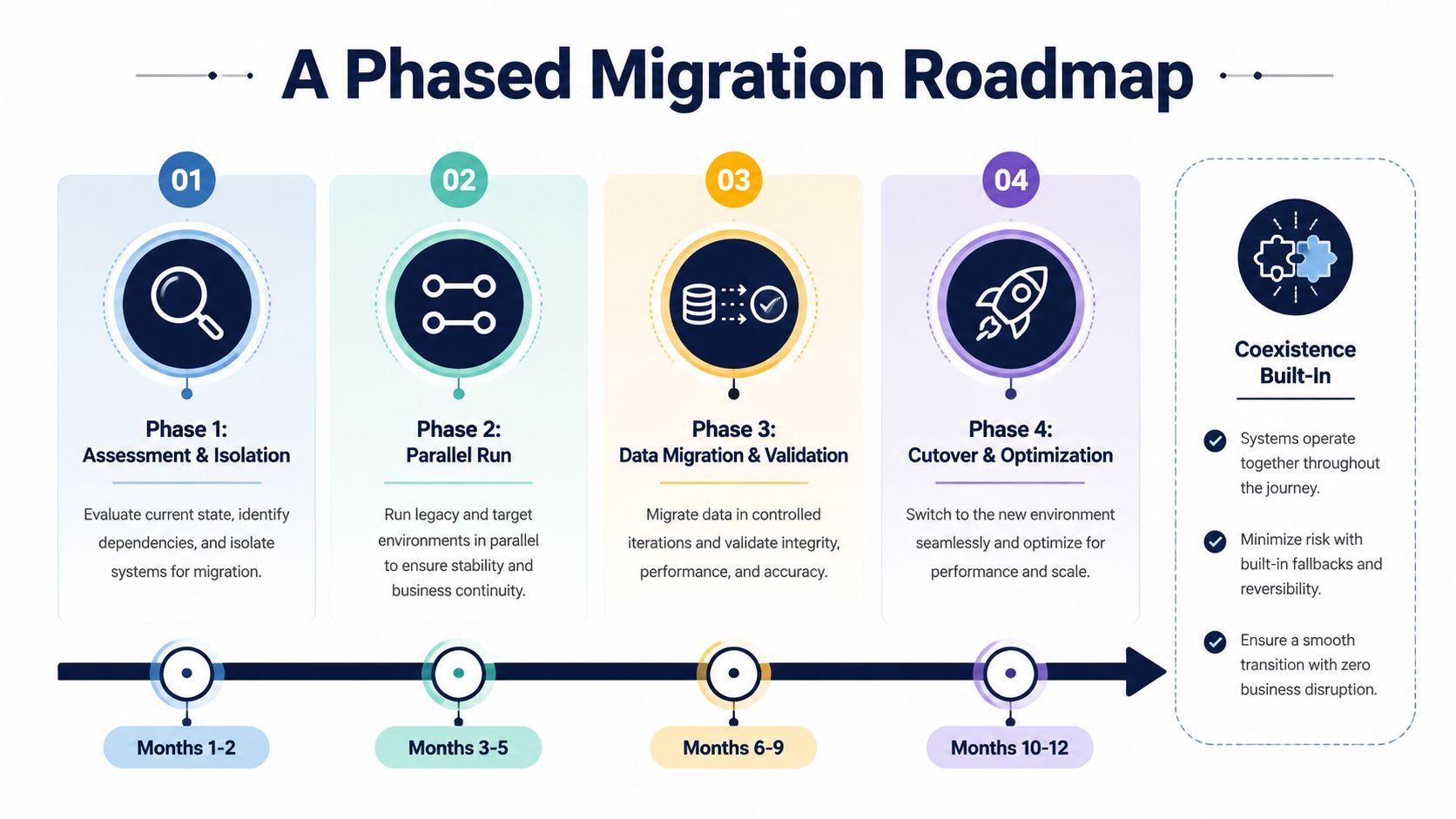
Start by isolating the real risks
Assessment isn’t a document review exercise. Map dependencies, identify duplicate records, find manual workarounds, and locate every place where clinical staff compensates for system weakness. The goal is to understand where a migration can cause a workflow break, a data integrity issue, or an identity mismatch.
Run legacy and modern components in parallel
Dual-running is not a compromise; it’s the control mechanism. Recent guidance on healthcare modernization emphasizes phased rollouts, modular wrappers and APIs, and parallel operation because clinical systems often need a long transition period rather than a clean cutover. Use coexistence to validate interface behavior, compare outputs, and define rollback boundaries before you retire anything.
Treat migration as a data quality program
Data movement has to include cleaning, normalization, validation, staging, logging, and rollback. That’s the difference between “we moved the records” and “we preserved the truth.”
A practical sequence looks like this.
- Assessment and isolation: Identify high-risk workflows, brittle interfaces, and data ownership gaps.
- Parallel run: Keep legacy and modern paths active while comparing outputs and flagging discrepancies.
- Migration and validation: Move cleaned data in controlled batches, then verify records against test and staging cases.
- Cutover and retirement: Remove old components only after the new path has proven stable under real use.
The main mistake is treating coexistence like wasted time. In healthcare, coexistence is the safety net that lets you modernize without making uptime the casualty.
For a more tactical view of transition planning, see Bridge Global’s legacy healthcare system migration to cloud guide, especially if your current environment mixes older application tiers with newer infrastructure targets.
Governance, Compliance, and Auditability Across HIPAA and GDPR
If modernization does not improve evidence, it is incomplete. HIPAA and GDPR both require clear control over access, retention, and sensitive data handling, and governance has to live in the architecture, not in a separate policy binder. For teams building regulated systems, see our guide on HIPAA-compliant software development.
Design the audit trail before the feature ships
A modern system needs logs that are useful, tamper-resistant where needed, and tied to user identity, workflow state, and data movement. If you cannot reconstruct who changed what, when, and under which role, auditability is still weak. Access control should be explicit at the service boundary, not assumed because the UI looks restricted.
Audit trails also need to help with investigations, not just compliance reviews. That means recording enough context to explain why a change happened, which record version was active, and which service handled the transaction. If the log only says something changed, it is too thin for clinical operations or regulatory review.
Bake safety into the interface and identity model
Standard UI design and patient identification are not cosmetic concerns. Clinical software can look modern and still be unsafe if two patients are conflated, a workflow hides state, or the interface invites the wrong selection. Safety validation belongs in release criteria, and it should be tested against real clinical workflows, not just happy-path demos.
Identity design deserves the same discipline. Role-based access, step-up verification, and clear patient matching rules should be consistent across legacy and modern components during coexistence. That reduces the chance that one side of the system behaves safely while the other side creates confusion for staff.
Set AI boundaries before implementation
Define where AI is allowed to act before you deploy it. The common mistake is letting the model decide too much, then trying to bolt on controls after clinicians already rely on its output. In regulated environments, AI should be bounded by role, workflow, escalation paths, and human review rules from the start.
AI governance also needs a hard line on what the model may never do on its own. It should not change patient-facing guidance, override clinical prioritization, or act as the final authority on a sensitive decision without review. Keep the boundary clear, document it, and make sure it is enforced in the workflow, not just in policy text.
Governance rule: if the platform cannot explain itself to auditors and clinicians, do not promote it to production.
I say that plainly because I have seen teams treat governance as overhead, then spend months rebuilding trust after one bad deployment. The right architecture makes compliance easier to prove, easier to maintain, and safer to operate while legacy and modern systems run side by side.
Integrating AI and Data Pipelines Safely
A safe AI rollout starts with the data pipeline, not the model. If ingestion is messy, normalization is inconsistent, or lineage is unclear, then the model is built on unstable ground. For healthcare teams, that usually means the first design task is deciding which records are authoritative, which fields are clinically sensitive, and where human review stays mandatory.
A practical example is AI-assisted triage documentation. The clinician enters notes, the platform normalizes the structured and unstructured fields, and the model proposes a draft summary or routing suggestion. The system should never skip validation, never hide the source data, and never route a case automatically if the confidence or context is unclear.
Build the pipeline for traceability
Use ingestion controls, normalization rules, and lineage tracking so every downstream output can be traced back to its source. That matters because AI errors in healthcare aren’t just model issues; they’re data provenance issues. If a review team can’t see what the model saw, it can’t judge whether the output was safe.
Keep humans in the loop where it matters
Human review isn’t a slowdown; it’s the boundary that keeps automation from drifting into unsafe autonomy. Put clinicians or trained reviewers in the approval path for anything that changes patient-facing guidance, billing decisions, or clinical prioritization. The model can assist, but it shouldn’t own the decision.
Design for underserved users from the beginning
Modernized AI workflows also have to work for low-bandwidth, multilingual, offline-first, and accessibility-constrained users. That’s the equity problem embedded in architecture: if the feature collapses outside ideal connectivity, the people most likely to be excluded are the ones who needed help first. I’d rather ship a simpler workflow that reaches more people than a fancy one that widens access gaps.
For a deeper implementation view, Bridge Global’s healthcare data pipeline architecture guide is relevant because data pipelines are where AI, governance, and modernization either hold together or fall apart.
Choosing a Modernization Partner and a 12-Month Sample Timeline
The right partner should know healthcare operations, not just software delivery. If a team can’t talk clearly about dependency mapping, HIPAA controls, staged releases, and coexistence periods, they’re not ready to modernize a clinical platform. You want a partner that can handle custom healthcare software development, broader custom software development, AI development services, enterprise AI solutions, AI implementation roadmap, healthcare integrations, SaaS product development, and the operating model behind software development service models without treating healthcare as a generic vertical.
What to ask before you sign
Use this checklist in vendor conversations.
- Healthcare domain experience: Ask for regulated provider or healthtech platform work, not just general enterprise delivery.
- Security posture: Request evidence of secure delivery practices, access control discipline, and audit-ready processes.
- Migration experience: Ask how they handle coexistence, rollback, and data validation in legacy transitions.
- Delivery model fit: Clarify whether offshore, hybrid, or dedicated teams match your governance and speed requirements.
- References and proof: Review client cases that show relevant modernization or integration work.
Bridge Global can fit into that shortlist when a team needs a delivery partner that combines engineering, AI, and healthcare-aware implementation, but the true test is whether the team can explain the migration trade-offs in your environment, not theirs.
A realistic 12-month sequence
Months 1 to 2 should be assessment, system isolation, and planning. Months 3 to 4 should establish the integration foundation and coexistence model. Months 5 to 8 should focus on the first production pilot with parallel testing. Months 9 to 11 should expand phased migration and validation. Month 12 should close the first wave with full deployment support and a retirement plan for the oldest components.
If you’re choosing a partner now, don’t ask who can move fastest. Ask who can keep the system safe while it changes.
If you’re planning a healthcare platform overhaul, Bridge Global can help you map the migration, build the coexistence architecture, and define the AI and integration boundaries before the first release goes live. Visit Bridge Global to review the team’s healthcare and AI delivery capabilities, then take that conversation into your modernization roadmap with a clearer view of what safe change looks like.

About Stephanie Cornelissen
Stephanie Cornelissen is a Technical Solutions Consultant with strong experience helping organizations navigate complex digital change. She works closely with teams to align business goals with practical, scalable technology solutions. With expertise in system architecture, integrations, and emerging technologies, she focuses on solving real-world problems through thoughtful execution. She enjoys working where technology meets business strategy and measurable growth.
View all posts by Stephanie Cornelissen →