



Healthcare Knowledge Management Explained
You can feel the problem before anyone names it. A clinician is trying to confirm the latest sepsis guidance, but the policy lives in one portal, the workflow note sits in another, and the bedside team is leaning on memory because the patient can't wait. That gap is where healthcare knowledge management earns its place, not as document storage, but as the system that decides whether evidence reaches the point of care in time to matter.
The discipline has grown up alongside digital health rather than appearing out of nowhere. A 2025 bibliometric analysis found 419 articles on knowledge management and digital innovation in healthcare, with the first studies dating to 1985 and publication volume rising steadily from 2004 onward. The same analysis showed the United States led the literature with 90 publications, followed by the United Kingdom with 51, Germany with 41, and Australia with 36, which is a strong signal that this is an established international field, not a niche topic. The bibliometric analysis makes the point clearly: healthcare KM matured as health systems, informatics, and digital operations matured.
The urgency is even easier to grasp when you look at the pace of medical knowledge itself. A 2026 market analysis reported that medical knowledge reportedly doubled about every 73 days by 2020, compared with roughly every seven years in 1980, and valued the global healthcare knowledge management market at USD 5.8 billion in 2026, projecting growth to USD 22.4 billion by 2036 with a 14.4% CAGR. That market analysis quantifies the pressure clinicians and operators are under, and it explains why static manuals, scattered docs, and tribal memory break down so quickly.
Practical rule: if a care team can't find the right version of guidance inside the workflow, the organization doesn't really have knowledge management; it has content sprawl.
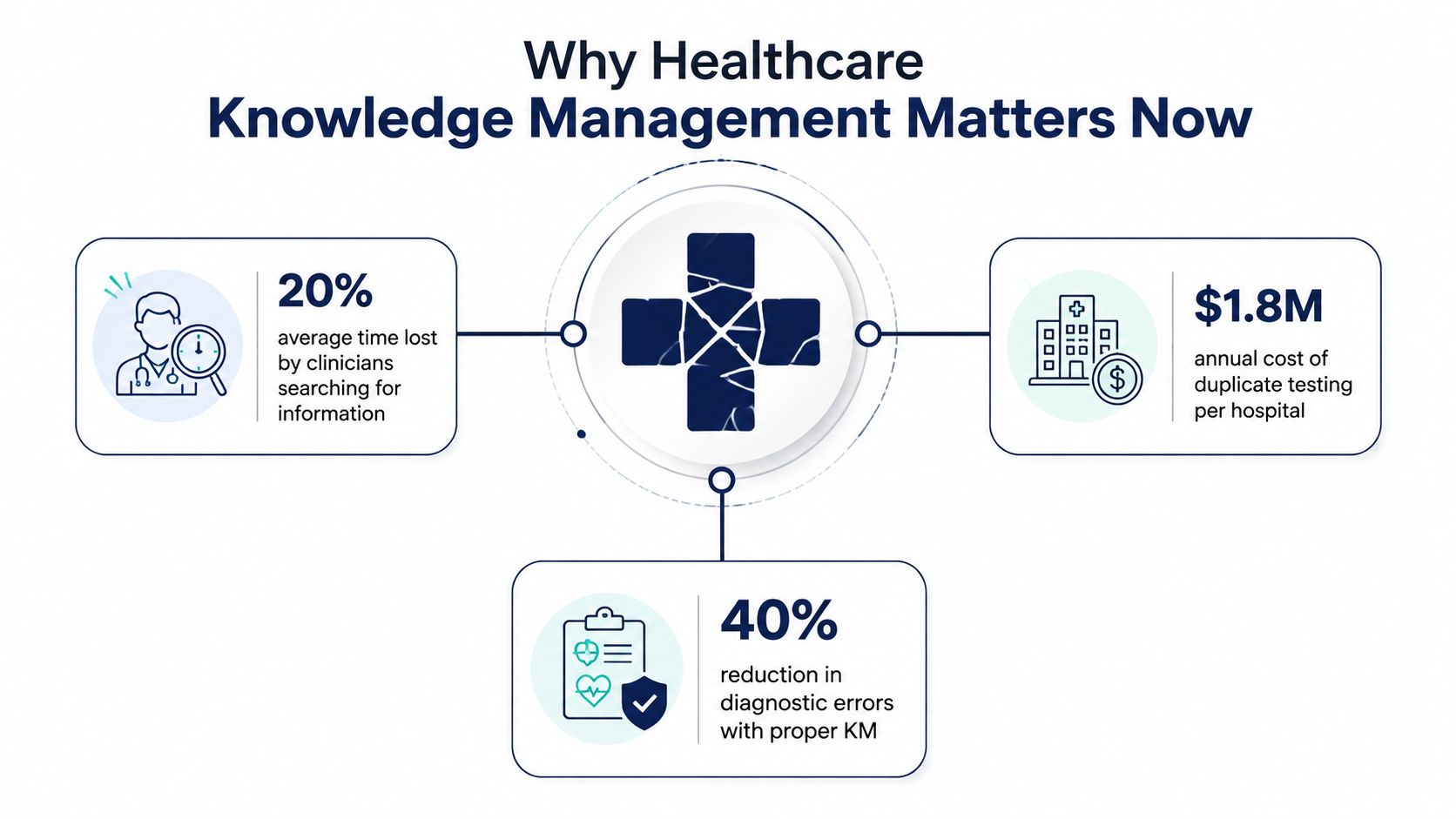
Why Healthcare Knowledge Management Matters Now
The most common failure isn't that hospitals lack guidance. It's that someone has to locate the right guidance while a patient is waiting, and the search cuts across portals, shared drives, and people's inboxes. A hospital can have excellent policies and still lose time, because the right knowledge is buried in the wrong place, under the wrong label, or behind the wrong approval path.
That's why healthcare knowledge management is an infrastructure issue. It connects the facts clinicians need, the policies administrators enforce, and the practical experience that frontline teams accumulate every day. When those three things stay disconnected, the organization pays in rework, inconsistent decisions, and staff frustration.
A more useful mental model is simple. If your organization treats knowledge as a static library, every update becomes a new search problem. If it treats knowledge as a living service layer, the latest guidance can surface inside the clinical moment where it's needed.
The international research base reinforces that this isn't a side project. It's part of how healthcare organizations standardize decision-making, manage digital complexity, and keep pace with evidence that changes faster than memory can. For a product leader, that means the central question isn't whether to invest in KM; it's whether the current environment can deliver the right answer quickly enough to influence care.
What Healthcare Knowledge Management Actually Is
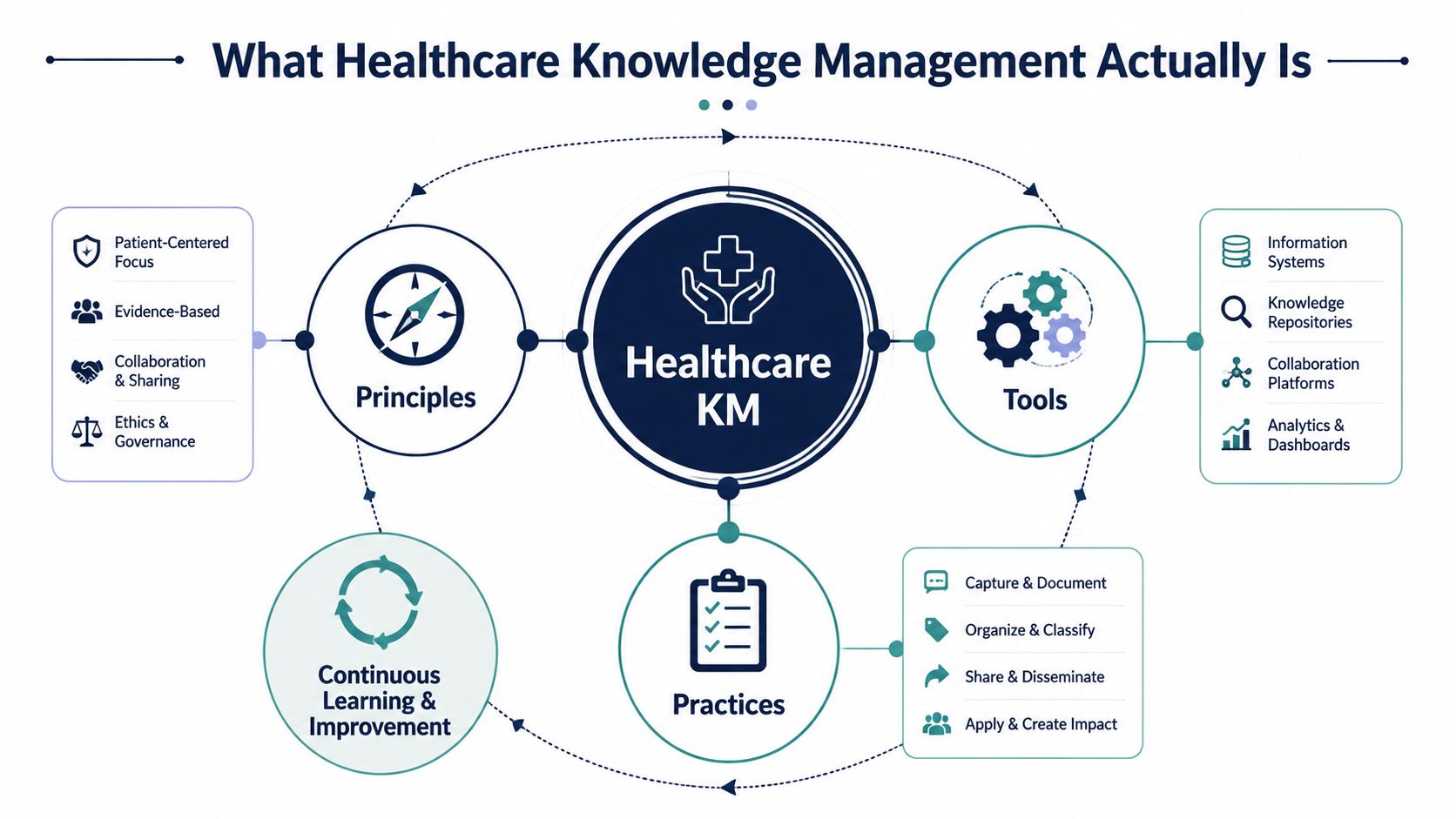
The cleanest definition comes from two complementary ideas. The WHO framing describes knowledge management as principles, tools, and practices that help people create knowledge, and share, translate, and apply it to improve effectiveness. The Canadian Health Services Research Foundation adds a concrete structure: three knowledge sources, policy, evidence, and experience, plus three core processes, knowledge production, knowledge use, and knowledge refinement. The Canadian framework is useful because it shows where knowledge comes from and what happens to it in practice, while the WHO definition makes translation and application part of the job, not an afterthought.
A diabetes care pathway makes the difference obvious. Policy tells the nurse what the approved insulin titration rules are. Evidence tells the team which follow-up interval or medication pattern fits the current clinical standard. Experience tells the care coordinator how patients respond when they leave with a confusing discharge plan.
A working model a product team can use
Treat healthcare KM as a flow, not a shelf.
-
Production: Clinical policies, research findings, and local practice notes are captured, reviewed, and organized.
-
Use: The right people can search, share, and apply the knowledge during care or operations.
-
Refinement: Teams evaluate what worked, update what didn't, and keep the system current.
The useful question isn't “Do we store this information?” It's “Can the right person use it in time, in the right context, with the right version?”
That distinction matters in software planning. A portal that stores documents isn't the same thing as a KM layer that supports bedside decisions. The latter has to respect role, context, and timing, because those are the variables that determine whether a clinician can act on the information at all.
Core Components That Make Healthcare KM Work
The operational layer becomes clearer when you stop thinking in terms of “content” and start thinking in terms of tools that move knowledge through a care system. A systematic review in Health Policy and Planning identified shared repositories, communities of practice, decision-support tools, and formalized processes as common KM mechanisms, and linked them with better organizational performance, quality of care, and efficiency across healthcare settings. That review is valuable because it focuses on the mechanisms, not just the aspiration.
A shared repository gives the organization one place to keep approved guidance. A nurse shouldn't need to guess whether the handoff checklist on a shared drive is still current. A repository only helps, though, if someone can trust what's inside it and find it quickly.
A community of practice carries the tacit knowledge that doesn't fit neatly into a policy file. For example, one unit may have a better way to standardize shift handoffs, but that practice won't scale unless the team can compare notes and agree on a common version. That's where peer learning becomes a real operational asset.
A decision-support tool brings knowledge into the moment of care. A renal dosing prompt in the EHR is more useful than a PDF in a folder because it appears when the clinician is ordering, not after the mistake is already possible. The point is not automation for its own sake; it's reducing the gap between evidence and action.
A formalized process keeps all three from drifting apart. Without intake rules, review cycles, and ownership, every repository becomes stale. Without process, the system gradually fills with old guidance and unresolved duplicates.
The ACS bulletin frames the service model in a way product teams can use. It breaks KM into enabling services, care services, and transformational services, which helps leaders distinguish between infrastructure, point-of-care support, and broader operating change. The ACS overview is a good reference point when you're deciding what belongs in the platform versus what belongs in the care model.
For a closer look at workflow logic in clinical systems, see our guide to healthcare workflow intelligence.
Taxonomy, Governance, and Workflows Working Together
A good taxonomy is not a filing habit; it's a shared language. If one team writes “heart failure,” another writes “HF,” and a third uses “congestive cardiac failure,” the search experience falls apart unless the system maps those terms to the same evidence bundle. The practical consequence shows up fast, because clinicians don't have time to interpret naming differences during a shift.
Governance is what prevents the library from becoming unreliable. Someone has to own each knowledge object, define the review cadence, and decide who can publish or retire a document. Without that accountability, version drift begins, then becomes the kind of problem people only notice after a stale instruction reaches the bedside.
Where workflow design makes or breaks adoption
Workflows decide when the knowledge appears. A guideline that lives only in a back office portal won't help a triage nurse who needs it inside the chat channel, or a physician who needs it inside the EHR. The knowledge doesn't need more storage; it needs better timing.
That's why taxonomy, governance, and workflow design have to be treated as one layer. Taxonomy makes the knowledge findable. Governance makes it trustworthy. Workflow design makes it usable at the moment the clinician needs to decide.
Operational test: if your team can't answer who owns a document, when it expires, and where it surfaces, the KM program isn't ready for clinical use.
The service-category lens helps here too. Enabling services create the structure, care services deliver the knowledge into clinical work, and transformational services change the way the organization learns. The boundaries matter because a governance choice in one layer changes the behavior of all the others.
If your team is planning EHR connectivity, start with healthcare integrations, because the knowledge only matters if it can move into the system where clinicians already work. For a governance perspective on implementation, our healthcare data governance guide is a useful companion.
Implementation Roadmap With AI-Enabled Features
A KM rollout works best when it's sequenced like a product program, not launched like a one-time content project. The first phase is discovery and content audit. Teams inventory policies, clinical guidance, training docs, and local workarounds, then sort what's current, duplicate, or risky. At this stage, semantic search becomes the first AI feature worth enabling, because it helps people find the same concept even when they don't know the exact label.
The second phase is taxonomy and governance design. Naming rules, owner assignments, review cadences, and publication workflows get defined during this phase. It's also the right moment for retrieval-augmented drafting of protocols, because reviewers can use AI to propose structured starting points while clinical owners stay responsible for approval.
Four phases that keep the project controllable
-
Discovery and audit: Deliverable, a map of current knowledge assets and obvious gaps. Owner, clinical informatics plus operations.
-
Taxonomy and governance: Deliverable, approved terminology, ownership, and review rules. Owner, clinical leadership with compliance input.
-
AI-enabled retrieval and EHR integration: Deliverable, searchable and workflow-aware access inside daily tools. Owner, product and engineering.
-
Continuous learning and measurement: Deliverable, feedback loops, usage review, and update cycles. Owner, operations and quality.
The third phase is where KM starts to feel real to frontline users. EHR-aware proactive surfacing can push the right guidance into the right context, instead of forcing a second search. The fourth phase turns the system into a learning loop, where feedback, usage patterns, and content updates improve the next round of decisions.
Bridge this work to broader AI planning with the AI transformation framework, because KM is often the cleanest place to start enterprise AI when the organization needs governed, high-value retrieval instead of novelty. If you're staffing the build, AI development services and custom software development are usually part of the delivery mix, especially when the KM layer has to sit on top of live clinical systems.
Compliance, Security, and Common Failure Modes in Healthcare KM
A clinic can have strong policies and still fail at knowledge management if the system makes safe behavior hard. In healthcare, security and access control sit inside the design of the platform, because the system has to show who viewed a guideline, who edited it, and which version was active when a decision was made. Audit trails, role-based access, and version history are not just controls; they shape whether staff trusts the system enough to use it during care.
The most common failure modes are easy to recognize once you look at day-to-day work. Knowledge stays split across portals, drives, and local files, so no one is sure where the current source of truth lives. Legacy tools sit outside clinical workflow, so staff skip them when time is tight. Documentation weakens because maintenance is treated like extra work instead of part of the job. Turnover then removes the context that lives in people's heads, and the organization ends up relearning the same lesson in a new shift or a new unit.
Failure modes and structural fixes in healthcare KM
| Failure mode | Why it happens | Structural fix |
|---|---|---|
| Siloed systems | Knowledge is spread across portals, drives, and local files | Federated access with one searchable layer |
| Version drift | No clear owner or expiry process | Immutable version history and named clinical owners |
| Weak documentation habits | Staff don't see maintenance as part of the job | Embedded documentation rituals in daily work |
| Tacit-knowledge loss | Experienced staff leave and take context with them | Exit-capture workflows and structured handoffs |
| Low trust in content | People can't verify what's current | Review cadence, audit trails, and visible approvals |
Security decisions need to stay close to the operating model. If your engineering lead already thinks in terms of cybersecurity for engineering leaders, the KM conversation becomes easier, because the same habits apply here: clear access boundaries, traceable change control, and controlled sharing. Security is what lets knowledge move across teams without turning every lookup into a risk.
For healthcare-specific build choices, HIPAA-compliant software development is the right starting point when the KM platform has to work with protected clinical data and existing health workflows. The goal is straightforward: protect the data while keeping the system usable enough that clinicians do not work around it.
Choosing Vendors and Partners for Healthtech KM
The vendor market looks crowded until you compare products on the things that matter. Point KM platforms are often fast to deploy, but they can be weak on deep clinical workflow fit. EHR-vendor modules may integrate well, but they can be constrained by the host platform’s own logic. AI-native startups can be strong on search and content intelligence, yet still need time to mature their governance and compliance story. A custom development partner is usually the right fit when the KM layer has to reflect your own clinical model, integration environment, and approval rules.
How to evaluate the four archetypes
-
Point KM platforms: Good for faster content centralization, weaker when the clinical workflow is highly specific.
-
EHR-vendor modules: Useful when the organization wants tight native placement, but flexibility can be limited.
-
AI-native startups: Attractive for semantic search and retrieval, but often need stronger integration and governance design.
-
Custom software development partners: Better when you need configurability, interoperability, and controlled rollout tied to your own processes.
The evaluation criteria should stay concrete. Look at clinical workflow fit, semantic search quality, integration depth with EHR and CDS tooling, governance configurability, and total cost of ownership. If the vendor can’t show how content moves from authoring to review to in-workflow delivery, the platform will probably become another disconnected system.
That’s where a healthtech software development partner can help, especially if you need custom healthcare software development tied to specific clinical and operational needs. Bridge Global is one example in that category, and it also fits into software development service models when teams need a mix of discovery, implementation, and ongoing support. In product-heavy programs, SaaS product development often becomes relevant too, because the KM layer may need to live as part of a broader platform strategy.
A final filter matters more than most buyers admit: measurement. The literature links KM with management, finance, patient care, quality and safety, IT, continuous improvement, culture, learning, job satisfaction, knowledge distribution, and productivity, but it also notes that the field still lacks consistent measurement approaches. That review is a good reminder not to overclaim ROI before you’ve defined the operational metrics that your team can track.
FAQ on Healthcare Knowledge Management
How is healthcare knowledge management different from a content management system?
A CMS stores and publishes content. Healthcare KM adds ownership, clinical context, workflow delivery, and feedback loops so the right knowledge reaches the right user at the right time.
What should a startup measure first?
Track search success, time to find approved guidance, content freshness, and how often the KM layer is used inside workflows. Those are safer early signals than broad outcome claims.
Can KM work in low-resource settings?
Yes, but the design has to account for weak internet access, limited repositories, and uneven documentation habits. The implementation has to be simpler, lighter, and more local.
What does a realistic first year look like for a small clinical ops team?
Start with one source of truth, a controlled taxonomy, a named owner for each knowledge area, and a review cadence the team can keep. Then connect the highest-value guidance to the tools people already use.
If you’re building a governed knowledge layer for healthcare, Bridge Global can help with the software, integrations, and AI workflows that make it usable in real clinical environments. The team’s healthtech delivery approach fits product leaders who need compliant systems, strong workflow alignment, and practical implementation support. Visit Bridge Global to discuss a KM roadmap that matches your clinical model and platform goals.

About Upendra Jith
Upendrajith completed his Master's in English and has been a commercial content developer for the past three years. He's more inclined to develop content with a 'street-smart' delivery on topics such as technology, media, or anything he can get his hands on. He has a fixation on lyrics, dark poetry, media, technology, and flow arts.
View all posts by Upendra Jith →