


Healthcare Interoperability Solutions Guide for Startups
A clinician opens a chart, sees half the story in one system, then jumps to another screen for the rest. A product leader watches the same problem from a different angle: missed workflow, slow onboarding, support tickets, and a platform that technically connects but still frustrates users at the point of care. Healthcare interoperability solutions exist to fix that gap, but the test is not whether data can move; it's whether people can use it safely, quickly, and in context.
Teams that build in this space usually start with the wrong question. They ask how to connect systems, when they should first ask how data will be read, trusted, and acted on inside clinical work. That's where a healthtech software development partner becomes useful, because interoperability sits at the intersection of product design, data standards, workflow, and governance, not just APIs.
Modern healthcare has moved a long way toward standards-based exchange. In U.S. hospital markets, API-enabled patient access has expanded from 84% of hospitals in 2019 to 93% in 2024, and 81% of hospitals now enable patient access through apps meeting API specifications, with 70% doing so through apps meeting FHIR specifications. Those numbers matter because they show interoperability is no longer a side project; it's infrastructure.

Introduction to Healthcare Interoperability Solutions
A referral arrives, but the medication list is outdated. Lab results sit in one system, imaging in another, and the intake team has to piece together PDFs, portals, and faxed summaries. That is the everyday cost of disconnected care, and it is why healthcare interoperability solutions matter to patients, clinicians, and software teams alike.
Beyond missing data: the continuity gap
In mature healthcare settings, the issue is rarely absent data. The issue is scattered information in tools that do not share the same operational language, so the care team spends time reconstructing the patient story instead of using it. For a startup, that often means slower adoption and more integration work. For an enterprise, it usually means fragmented workflows and a harder path to scale.
Practical rule: if a clinician has to leave the workflow to understand the data, interoperability has not been achieved in a usable way.
That is why the best systems do more than move records. They connect EHRs, payers, devices, portals, and third-party apps while keeping meaning intact and fitting clinical work. The question has shifted from “Can we send the record?” to “Can the record support a decision at the point of care?”
Startups usually win by solving one narrow workflow, such as referrals, prior auth, or patient access. Enterprises need wider coordination across legacy systems, governance rules, and multiple business units. Both groups still need the same foundation: usable interoperability, not just technical connectivity.
A package can be delivered and still be useless if it reaches the wrong desk with the wrong label. Healthcare works the same way. Data exchange only matters when the right information arrives in the right form, at the right time, with clear rules for use. That is the challenge for custom healthcare software development, and it is where healthtech software development partner relationships earn their keep.
What Healthcare Interoperability Really Means
A chart can move from one system to another and still fail the clinic. Interoperability becomes useful only when the receiving team can trust the meaning, understand the context, and act on the information within a normal workflow. A translation chain is a helpful model here. The data first has to move. Then it has to keep its structure. Then both sides have to interpret it the same way. Finally, the organizations involved need shared rules for use.
Four levels that build on each other
Foundational interoperability is the delivery truck. It allows information to be sent and received at all.
Structural interoperability is the box and label. It defines how the data is formatted so the receiver can open it correctly.
Semantic interoperability is the dictionary. It keeps both systems aligned on the meaning of a term.
Organizational interoperability is the policy layer. It sets who can share what, when, and under which rules.
The United States framework ties those layers together through USCDI, HL7 FHIR, and TEFCA. That stack matters because a platform can look interoperable in a slide deck while still failing at the point of care.
Why usable interoperability is the practical standard
A system can exchange records and still leave clinicians stuck. That happens when the payload is incomplete, the terminology is inconsistent, or the data arrives in a form that slows down a visit. The test is whether exchange leads to action.
The difference shows up quickly in product design. A patient app that displays a raw feed of claims data may satisfy transport requirements, but a care navigation tool needs context, prioritization, and a clear presentation. A provider dashboard needs the same information arranged around decisions, not data fields.
Data that cannot be interpreted in workflow is still fragmentation.
For founders and product leaders, interoperability design starts with user behavior. Which person needs which data, at what moment, in what format, and within which trust boundary? Answering those questions early reduces rework later, especially for teams building across custom software development and software development service models.
Core Standards and Architectures Behind Modern Interoperability
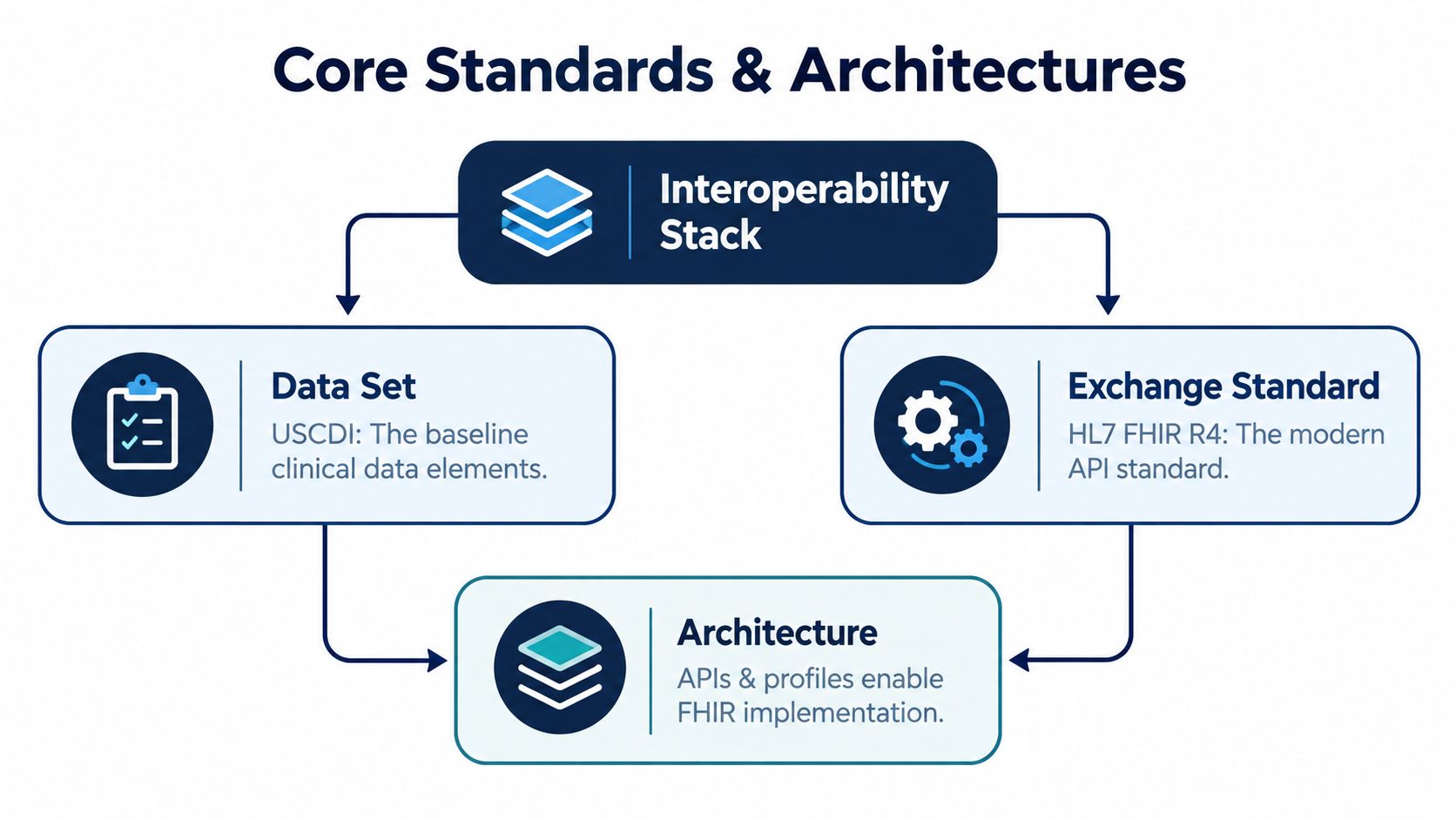
A hospital can send data and still leave the receiving team guessing. The core standards address different layers of that problem. USCDI defines the data that should be exchanged, HL7 FHIR defines how it moves, and TEFCA sets the trust rules for exchange at scale.
USCDI, FHIR, and TEFCA serve different jobs
USCDI is the baseline data set. It defines the health data classes and elements that should be available for interoperable exchange.
HL7 FHIR is the exchange standard. It uses discrete resources and RESTful interfaces, and CMS notes that FHIR Release 4.0.1 includes the first normative resources, which makes the core structure backward-compatible and suitable for production-grade interoperability programs (HL7 product brief).
TEFCA is the trust framework. It creates a universal policy and technical floor for broader exchange across entities. The ONC interoperability overview explains how these layers fit into national exchange efforts.
A standards-compliant payload is only the start. Product teams still need the right exchange pattern, the right trust model, and the right implementation details before the data becomes useful in care delivery.
Implementation guides turn standards into working systems
Teams often get stuck at the same point. FHIR is the language, but implementation guides tell systems how to use it in a specific setting. CMS and Health IT guidance treat IGs as the concrete rules for profiling resources, terminology, and conformance, while CDC guidance recommends mapping source datasets to target FHIR resources, setting up FHIR infrastructure, and validating data quality and security to avoid broken exchanges.
That is why mapping should be treated as part of product design, not cleanup. If terminology is sloppy or resource profiles are underspecified, the integration may still run while analytics and clinical workflows become harder to trust.
Bridge Global's FHIR integration services fit into this layer when teams need implementation support around standards-based exchange rather than a one-off data pipe.
Integration Patterns That Connect Health Systems at Scale
The right integration pattern depends on how often data moves, how many endpoints must stay in sync, and how much legacy tooling still sits between systems. A direct FHIR API, middleware orchestration, and a health information exchange each solve a different problem, and each creates a different burden for product teams and clinical users.
Direct APIs, orchestration layers, and exchange networks
FHIR APIs work well when a system needs direct access to defined resources. They fit patient-facing apps, focused workflows, and products that only need a narrow slice of the clinical record. Middleware and integration engines handle translation, routing, and orchestration when source systems speak different formats. Health Information Exchanges extend sharing across organizations, which matters when community-level record access has to span many providers.
The trade-off is not only technical. Direct APIs can stay simple at the edges, but every new partner can turn into a custom relationship that has to be maintained. Middleware reduces one-off work by adding a control layer, yet that layer also has to be governed. HIEs widen reach, but they depend on network participation and local policy, so the exchange may exist without being usable in the moment a clinician needs it.
A useful test is clinical usability. If the data arrives but does not fit the workflow, the integration has still failed. Product leaders should ask whether the pattern reduces clicks, clarifies the patient story, and fits the decisions clinicians make. That is why healthcare integration architecture matters early in product design, not after implementation is already underway.
For startups, the path often starts with a narrow API boundary and a clear use case. For enterprise teams, the harder problem is coordination across many systems with different rules, so middleware or an exchange network often becomes the practical choice.
Choosing your healthcare integration pattern
| Pattern | Best For | Complexity | Scalability |
|---|---|---|---|
| FHIR APIs | Patient apps, focused workflows, modern product surfaces | Lower at the edge, higher with many partners | Strong for standard use cases |
| Middleware and integration engines | Multi-system translation, orchestration, legacy estates | Higher upfront | Strong across heterogeneous systems |
| Health Information Exchanges | Regional record access, community-wide sharing, continuity of care | Moderate to high depending on governance | Strong when network coverage is broad |
A simple example makes the trade-offs clearer. A patient app that shows appointment data may only need a direct API. A platform that has to combine labs, imaging, payer data, and provider records usually needs orchestration, mapping, and exception handling before the information becomes useful at the point of care.
Bridge Global’s healthcare integrations work in this layer when teams need implementation support for standards-based exchange, translation, and coordination across multiple systems.
Data Governance, Security, and Compliance Essentials
A health record can travel from one system to another and still fail at the bedside. If the receiving app cannot show the right context, the exchange has not helped clinical work. Governance closes that gap by controlling who can see the data, how it is matched, how it is checked, and how the organization proves those controls later.
Build trust into the workflow, not around it
Start with access control. Role-based permissions, audit trails, and narrow sharing scopes should be part of the product design, not added after launch. For teams that need a practical framework, controlling data access at your firm offers a useful parallel, because the same ideas of least privilege, logging, and enforcement apply when the data is clinical. If a product supports third-party access, consent should be explicit and revocable, and the user flow should not invite unsafe workarounds.
Identity and data quality come next. Patient matching errors create confusion downstream, so teams need deterministic rules and exception handling that fit the clinical setting. Terminology validation matters too, because a field can look fine to a developer and still be clinically unclear if the code set is inconsistent.
CMS requires impacted payers to expose a Patient Access API that uses HL7 FHIR Release 4.0.1 and gives patients access to claims, encounters, cost, and a defined subset of clinical information through third-party apps of their choice. The same policy also requires payer APIs to meet technical standards, including USCDI Version 1 and other adopted content and vocabulary standards.
Validation is part of compliance
A compliant integration still needs conformance checks. Implementation guides define how the system should behave, but real data rarely arrives in a perfect shape. Validation, logging, and exception handling carry the same weight as the API contract itself.
For regulated teams, the practical question is straightforward. Can you show what came in, what changed, what failed, and who approved the exception? If that trail is unclear, the system may be hard to defend in an audit, even if it works in production.
Governance rule: if you cannot trace a data element from source to use, you do not really control it.
Teams that use healthcare cybersecurity automation often pair these controls with continuous monitoring, so security keeps pace with the integration surface.
From Vendor Selection to AI-Powered Interoperability in Practice
A referral app can look polished in a demo and still fail in a clinic if the data arrives in a form staff cannot use. Vendor selection should begin with that workflow question. Which task is being removed, what legacy systems sit behind it, and can the vendor support standards, governance, and implementation without turning the project into a fragile custom build?
What to compare before you commit
Start with one concrete exchange. For a startup launching a referral product, ask whether the vendor can validate a single FHIR profile, such as ServiceRequest, in one EHR sandbox before anything else. That narrow test shows whether the product can move real clinical work, not just messages.
Enterprise buyers need a different bar. They usually already have multiple systems, multiple owners, and multiple approval paths. In that setting, the vendor should prove terminology mapping for USCDI v1 and audit logging for role-based access before the integration is expanded to a second business unit. That is the difference between a tool that connects and a platform that can be governed.
The 2025 interoperability survey points to the same tension. Respondents said the hardest problems were integrating data from multiple EHRs, fitting new solutions into existing workflows, and handling unstructured content, while fewer than half of unstructured documents and medical images were available at the point of care. Exchange alone is not enough if the receiving team still has to hunt for the meaning.
Where AI actually helps
AI fits above the transport layer. It can map source data to FHIR resources, extract fields from documents and images, and flag patterns that are easy to miss in large, messy datasets. Standards still do the heavy lifting. AI just reduces the manual work around them.
For product teams, the sequence matters. First, prove the integration path. Then add extraction and routing. After that, use analytics to improve clinical operations or prioritization. If you are planning that sequence, AI development services can help shape the technical approach, while enterprise AI solutions become more relevant once governance and scale enter the picture. A practical AI implementation roadmap helps teams choose the next step without overcommitting too early.
Bridge Global also works on SaaS product development for teams that need interoperability features in the product from day one, and its client cases show how product decisions change once integration becomes part of the core offer. If your team uses custom software development across multiple service layers, interoperability should be treated as a product capability, not a backend afterthought.
Frequently Asked Questions About Healthcare Interoperability
How do you make exchanged data clinically usable at the point of care?
Start with the decision the clinician needs to make. Then map the data to that moment; for example, surface active medications with standard codes and the last fill date in a referral view, while keeping raw claims history behind a secondary tab. That keeps the screen focused on action instead of volume.
A simple review process helps. Test the view with 3 to 5 chart reviews and ask whether the user can answer the clinical question faster, with less searching and fewer clicks. If the answer is no, the data is being exchanged, but it is still not usable.
How do you handle information blocking and network governance outside EHR vendors?
Treat governance as a shared operating model. The technical path, partner rules, consent terms, and escalation steps all need to be defined before data starts moving. That matters because a clean API can still fail if one party refuses a field, a workflow, or a use case.
For product teams, the practical move is to document who can send, who can receive, and who approves exceptions. That lowers confusion during onboarding and gives legal, security, and operations teams a clear playbook when a partner changes policy or raises a dispute.
How do you measure interoperability success beyond uptime?
Measure whether the receiving team can act on the data without extra cleanup. Look for fewer manual lookups, fewer reconciliation exceptions, cleaner handoffs, and faster decisions in the workflows your product supports.
A useful test is simple. If nurses, care coordinators, or analysts still export the data into spreadsheets before using it, the integration is only partial. Strong interoperability reduces that handoff work and fits into the team’s normal process.

About Stephanie Cornelissen
Stephanie Cornelissen is a Technical Solutions Consultant with strong experience helping organizations navigate complex digital change. She works closely with teams to align business goals with practical, scalable technology solutions. With expertise in system architecture, integrations, and emerging technologies, she focuses on solving real-world problems through thoughtful execution. She enjoys working where technology meets business strategy and measurable growth.
View all posts by Stephanie Cornelissen →