



Healthcare Innovation Platforms: A CTO’s Guide
Your team probably has the same problem most healthtech CTOs hit at the same moment. The MVP works, customers are asking for more, and the stack underneath is turning into a patchwork of point tools, custom integrations, and exception handling that only one engineer fully understands.
That's where healthcare innovation platforms stop being a buzzword and start becoming architecture. In practice, they're the difference between a product that can absorb clinical, payer, and partner workflows, and a product that keeps collapsing under every new requirement. If you're weighing whether to rebuild, refactor, or keep stitching together SaaS, the core question is no longer whether you need a platform. It's whether you want a defensible core or a fragile bundle of features.
Why Healthtech Leaders Are Rebuilding Around Platforms
A Series B healthtech team usually feels the break before it can explain it. The product team wants new care pathways, the compliance team wants tighter controls, the sales team wants enterprise integrations, and engineering is still babysitting a stack of tools that were never designed to work together cleanly. At that stage, “platform” stops meaning a future ambition and becomes the only sane way to protect the roadmap.
The market has moved in that direction for a reason. IQVIA reported 337,000 digital health apps in 2024, along with more than 360 software-based digital therapies, including 140 prescription digital therapeutics approved for at-home use and over 220 therapies used in clinics or digital care settings, plus more than 103 digital diagnostics for disease assessment, risk evaluation, faster diagnosis, and patient monitoring. Those numbers show why healthtech can't stay limited to narrow telehealth wrappers anymore, because the category now spans apps, therapies, diagnostics, and AI-enabled workflows in the same commercial space. IQVIA's Digital Health Trends 2024 report makes the point clearly.
What changed in buying behavior
Provider and payer buyers now expect software to fit into existing operations instead of creating another island. That expectation is visible in the push toward interoperable data exchange, automation, and administrative simplification in public health IT conversations, including the current focus on affordability and data exchange in HITAC's health IT agenda. Consumer expectations have shifted too, because patients increasingly encounter care through mobile, wearable, and home-based devices rather than a single clinic visit. Nature's overview of portable and residential digital devices captures that shift.
That's why I'd push a CTO to think beyond stitched-together SaaS and toward a defensible shared core. If you're looking for adjacent thinking on operating model and roadmap design, the piece on healthcare technology modernization is a useful companion.
Practical rule: if every new workflow requires a new one-off integration, you don't have a platform strategy; you have an integration tax.
For teams considering an outside delivery partner, a solid AI healthcare consulting perspective can help separate feature hype from actual operational value. The strategic shift is simple, even if the implementation isn't. Product-as-feature gets you to market. Platform-as-ecosystem is what lets you stay there.
What a Healthcare Innovation Platform Is
A hospital that keeps adding point solutions often ends up with a crowded app layer and no shared foundation. A healthcare innovation platform is the shared core underneath those tools, a composable service architecture that lets multiple workflows, applications, and partners use the same trusted data and controls without rebuilding the base each time. That is the line that gets blurred in vendor messaging, where a module suite is often sold as a platform even when the underlying services are still siloed.
Three layers define the real thing
The first layer is an extensible codebase. In platform ecosystem research, the platform owner exposes core services and allows outside builders to attach complementary capabilities through APIs and SDKs. In healthcare, that matters because regulated software has to stay stable at the core while still allowing controlled extension for new care programs, payer workflows, or partner services. If you want a practical implementation reference, the healthcare platform API engineering guide is a useful companion.
The second layer is interoperable data flow. Deloitte describes interoperable health platforms as systems that can move data on individuals, populations, institutions, and the environment securely, in ways that support real-time decisions. Deloitte's digital health overview is useful because it treats interoperability as operational infrastructure, not a checkbox. In practice, that means a platform has to ingest EHR, claims, remote-monitoring, and population-health data without creating a fresh silo for each source.
The third layer is AI-enabled analytics. Recent reviews describe AI and machine learning as components used for diagnosis, treatment planning, imaging, drug development, and patient data management, rather than decorative extras. AI in healthcare literature supports that view, but the architectural point is what matters here. If the platform cannot turn data into triage, prediction, or workflow automation, then the intelligence layer is too thin to justify the rest of the stack.
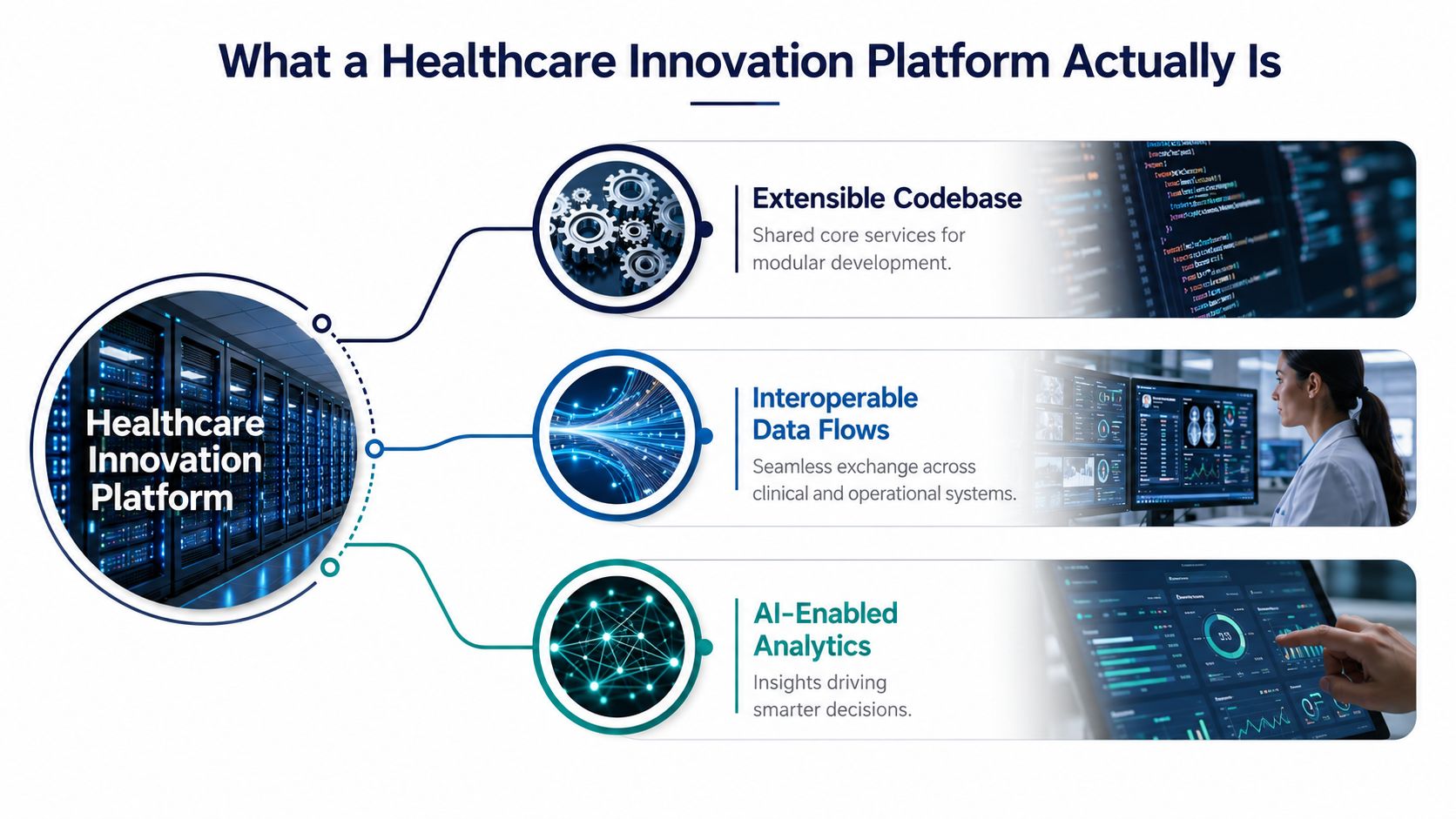
A product solves one job. A suite covers several related jobs. A platform lets new jobs be added safely without redesigning the foundation. For product teams, AI for product managers is a useful reminder that AI creates value when it sits inside a decision loop, not when it is dropped into the UI as a feature badge. Once you design for shared services, governed data, and controlled extensibility, you are in platform territory.
Core Capabilities Every Platform Must Get Right
A healthcare innovation platform lives or dies on a small set of capabilities that sound obvious until you try to ship them under HIPAA, GDPR, and enterprise procurement scrutiny. The failure mode is usually the same. Teams overbuild the front end, underbuild the data plane, and then discover the workflow layer can't move because the identity model, audit trail, and permissions model don't line up.
Data and identity first
Data integration is the first critical requirement. A serious platform has to unify inputs from EHRs, claims, connected devices, and social determinants of health sources, then preserve enough structure that the data can still be used operationally. That is why the category is increasingly built around composable services, not a single monolith. If you need a deeper implementation reference, the healthcare platform API engineering guide is the right companion piece.
Identity and access management come next. In healthcare, “one patient” can mean multiple records across systems, multiple roles across care settings, and multiple consent states across jurisdictions. Secure matching, role-based access, and auditability matter as much as data movement itself.
Intelligence, workflow, and compliance
AI and prediction should sit on top of that foundation, not replace it. Recent healthcare innovation literature points to AI as a driver of personalization, earlier detection, predictive analytics, and more efficient care delivery, while also emphasizing cost-effective, data-driven disease management. The review here is a good grounding point for that claim. In a platform, AI needs to support triage, risk stratification, and automation inside a governed workflow.
Clinical workflow orchestration is where many teams underestimate effort. A platform has to line up with care pathways, utilization review, outreach, and escalation logic, or else the software becomes an inbox with a dashboard. That's also where a lot of custom healthcare software development work gets real, because the workflow edge cases are rarely generic.
Implementation note: if the platform can't explain who changed what, when, and under which consent or policy rule, it isn't ready for regulated production.
Security and compliance are not a separate postscript. They're embedded into every layer, including encryption, logging, access review, vendor boundaries, and data retention. That's why custom software development for healthcare is different from general SaaS work, and why good teams design for compliance posture before they optimize for feature velocity.
The practical checklist is straightforward, even if the work isn't. If a vendor or internal build can't show interoperable ingestion, governed identity, AI-enabled decision support, workflow orchestration, and audit-ready controls, it isn't a platform. It's a pile of tools with a common login.
Comparing the Three Architecture Patterns That Dominate
The biggest architecture mistake I see is treating platform design as a moral choice instead of a trade-off. In reality, the right pattern depends on stage, buyer type, regulatory burden, and how fast the product needs to change. Some teams need composition. Others need the simplicity of a tighter suite. A few can start with a data-platform-first model, but only if they're disciplined about what gets built above it.
| Pattern | Best For | Main Strength | Main Risk |
|---|---|---|---|
| Best-of-breed modular platform | Growth-stage healthtech, payer-provider workflows, partner ecosystems | Strong composability and easier vendor swapping | Integration cost can creep if ownership is weak |
| Monolith-with-modules | Early enterprise products, regulated workflows with one primary buyer | Faster initial delivery and fewer moving parts | Harder to extend without internal coupling |
| Data-platform-first | Analytics-heavy, population-health, or AI-led teams | Strong data foundation and flexible downstream use cases | Thin apps can feel disconnected from frontline operations |
A modular platform wins when the team needs to swap services, especially around AI, communications, or engagement. It lines up well with software development service models that support staged delivery and shared governance, because each service can evolve independently. The risk is that too much freedom turns into integration sprawl if no one owns the reference architecture.
A monolith-with-modules is often the safest starting point when compliance and speed matter more than ecosystem breadth. It reduces coordination overhead and can be easier for operations teams to reason about, especially in payer and provider settings where one workflow owns most of the value. The downside is exit risk. Once the platform becomes too coupled, replacing any major subsystem becomes expensive and politically painful.
A data-platform-first approach fits teams that already know their differentiation sits in analytics, population health, or AI-driven decisioning. It can work well when the warehouse or lakehouse is the system of truth and thin apps sit on top. The problem is that clinical users don’t buy “thin apps.” They buy workflow fit, and if the operational layer is weak, adoption stalls.
For a deeper read on the connective layer, healthcare integration architecture is worth a look. The heuristic I use is simple. If your business depends on partner extensibility, go modular. If your buyer wants controlled simplicity, start tighter. If your edge is analytics and prediction, anchor the architecture in data, but don’t forget the workflow users who have to live in it.
A Phased Roadmap From Discovery to Scale
The fastest way to derail a platform program is to treat it like a single build. Regulated software moves better when the roadmap is staged around decisions, not just features. The trick is to separate the irreversible work, like identity and data model design, from the parts you can safely iterate later, like UI and secondary services.
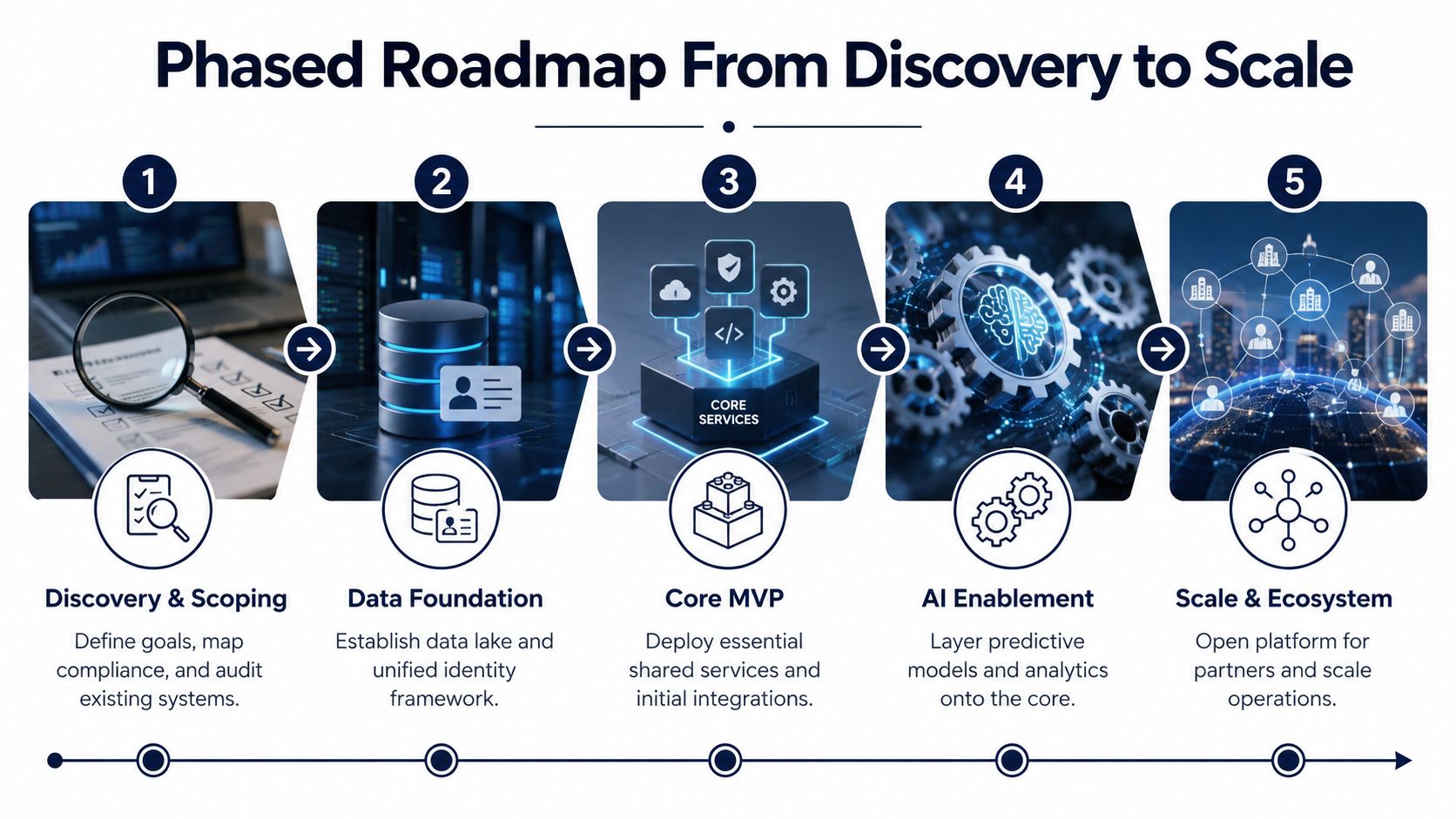
Phase by phase
Discovery and compliance scoping should start with a system map, not a feature list. The deliverables are an integration inventory, a data classification map, and a compliance boundary diagram. The usual failure mode is promising AI before the team knows which data it can lawfully use.
Data foundation and identity is where the platform earns its future. Build the patient, provider, and organization identity strategy here, along with the canonical data model and core access controls. If this phase is weak, every later workflow inherits ambiguity.
Core service MVP should focus on the few shared services that enable everything else, such as ingestion, matching, permissions, event logging, and one or two critical integrations. This is also where a team usually underestimates testing effort, because regulated flows need much deeper validation than a standard SaaS MVP.
AI enablement belongs after the data plane is stable. That keeps model work from blocking the platform launch. I’d look for one governed use case, such as risk scoring or intelligent routing, before broadening into multiple prediction paths. If your team is planning the AI workstream, the AI development services page is relevant to the delivery model, while an AI implementation roadmap helps organize the sequence.
Scale and ecosystem are where partner onboarding, extensibility, and operational automation come in. At that point, the platform can expose controlled extension points and support external services. That’s also where SaaS product development capability matters, because you’re no longer shipping isolated features; you’re maintaining a product environment.
Practical rule: don’t let AI become the gating item for the platform MVP. Lock the foundation first, then layer intelligence onto stable workflows.
If you need a delivery structure that ties this together, the software development service models page is a useful way to think about engagement shape. The phased roadmap works because each stage produces something durable, and each compliance gate gets handled before the next layer depends on it.
Real-World Use Cases and Case Study Signals
The best way to judge a platform is to trace how it handled a real operational bottleneck. The patterns below are representative of the kinds of work healthtech teams ship, and they all depend on composable architecture rather than a single big-bang build.
A remote-monitoring platform can improve clinical response when device data is routed into a triage workflow instead of sitting in a dashboard. The capability that matters is not the device feed itself; it’s the orchestration layer that turns readings into action. In practice, that means thresholds, escalation rules, and role-based routing have to sit on top of the device integration, or the team just creates more data exhaust.
A population-health module becomes useful when EHR data and SDoH signals are unified enough to reveal care gaps that outreach teams can close. The challenge is usually identity matching and data normalization, not the reporting layer. Teams that get this right can target outreach more precisely, while teams that skip it end up with a prettier version of the same blind spots.
A prescription digital therapeutic path depends on platform readiness too. IQVIA’s market data shows how large the DTx category has become, with more than 360 software-based digital therapies in commercial availability, including 140 prescription digital therapeutics and over 220 therapies used in clinics or digital care settings. IQVIA’s report is useful here because it makes clear that the platform must support distribution, prescribing, and patient use, not just therapy content.
A payer-side automation workflow can use AI to streamline prior authorization, but only if the documents, policy rules, and decision trail are all wired into the same platform. That’s where the value shows up, because automation cuts manual friction only when the system can explain and record the decision path.
Bridge Global has published client cases that line up with this kind of delivery, including healthcare software work and secure document workflows in regulated environments. The signal I look for is simple. If the case study shows integration depth, workflow control, and compliance boundaries, it’s probably relevant. If it only shows a pretty interface, it isn’t enough.
Misconceptions That Derail Healthcare Platform Programs
The fastest way to waste months is to accept a nice-sounding definition that doesn’t survive contact with operations. Healthcare platform work fails when leaders confuse labels with architecture, then discover too late that the underlying system can’t support regulated delivery.
Myth one, an EHR with APIs is a platform: Not really. An EHR is a record of truth and a core clinical system, but it doesn’t automatically orchestrate external services, partner modules, or product extensibility.
Myth two, one AI feature makes it a platform: AI without data plumbing and workflow control is theater, not architecture.
Myth three, interoperability is solved by adopting FHIR: FHIR helps, but it doesn’t solve identity matching, semantic consistency, permissioning, or the organizational work of making data usable.
Myth four, platforms can be bought plug-and-play: In regulated care, the most valuable parts usually require tailoring, because the workflow and compliance model are specific to the operating context.
The expensive failures happen when a team treats “platform” as a marketing label instead of an engineering commitment. That’s why the evaluation has to look at composability, governance, and the ability to support regulated workflows over time. If you’re comparing integrations in the market, the platform integrations ecosystem is a useful reminder that connection points matter, but only when they’re built around a stable core.
Evaluation Criteria, KPIs, and Choosing the Right Partner
A CTO-grade platform decision needs a scorecard, not a slogan. I’d weight interoperability depth, AI integration model, compliance posture, time-to-value, total cost of ownership, and ecosystem extensibility. The right ranking shifts by buyer and stage, but those six criteria keep the discussion on architecture instead of brochure language.
KPIs that tell the truth
Start with a small operating set, then expand it only after the first metrics are stable.
-
Integration latency: Measure how quickly data moves from source systems into the platform without manual intervention.
-
Clinician adoption: Track whether frontline users use the workflow rather than bypassing it.
-
AI prediction accuracy: Validate models against real operational outcomes, not demo datasets.
-
Audit findings: Count access, logging, and policy exceptions that show up during review.
-
Time to first deployment: Watch how long it takes to move from signed scope to a production-grade release.
The partner question matters just as much as the architecture. A true healthtech software development partner should understand regulated delivery, not just generic engineering. That usually shows up in how a team designs permissions, traceability, and the edge cases that appear after deployment. A serious vendor should be able to explain how its healthcare delivery work, broader software engineering practice, and AI delivery model fit regulated environments without turning the platform into a custom one-off. The same applies to how they structure AI development services around operational use cases instead of isolated models.
Practical rule: if a partner can’t explain how they handle auditability, data boundaries, and phased delivery, they’re not ready for healthcare platform work.
When you build a shortlist, ask for architecture samples, delivery governance, and the exact integration plan for one real workflow. Ask how they adapt their SaaS product development approach for regulated environments, and how they use an AI implementation roadmap to keep model work aligned with platform milestones. Also ask for direct proof of healthcare delivery, not generic claims. One useful test is whether the vendor can show how it handles HIPAA-oriented work, identity boundaries, workflow exceptions, and release controls in plain language.
A good 90-day evaluation ends with a shortlist, a reference architecture, and a clear “go, no-go” decision on the first production slice. That is the difference between a platform program and a slide deck.
If you’re comparing platform integrations across candidates, use the same scorecard. Connection points only matter when the core platform can support them under real governance, with clear ownership and a release path that does not slow every future change.

About Upendra Jith
Upendrajith completed his Master's in English and has been a commercial content developer for the past three years. He's more inclined to develop content with a 'street-smart' delivery on topics such as technology, media, or anything he can get his hands on. He has a fixation on lyrics, dark poetry, media, technology, and flow arts.
View all posts by Upendra Jith →