



Healthcare Compliance Automation: An Essential Guide
A compliance review starts on Monday morning. An auditor asks for evidence that a policy was current when a clinician accessed protected health information, that a contractor's training was complete, and that a billing control operated consistently across departments. Your team opens spreadsheets, searches email threads, checks shared drives, and discovers that several systems record different versions of the same event. By Friday, people have assembled a defensible package, but nobody can confidently say whether the underlying control worked continuously or only looked healthy after the fact.
That pattern is becoming harder to sustain. Healthcare organizations manage overlapping obligations across privacy, security, quality, billing, documentation, and vendor oversight. In the United States, the Office for Civil Rights reported 30,256 new HIPAA complaints in calendar year 2024, resolved 28,228 cases, and closed 22 investigations with resolution agreements or civil money penalties. The figures don't describe every organization's risk, but they show why complaint handling, evidence collection, and corrective-action tracking can't remain dependent on manual searches.
This guide treats healthcare compliance automation as more than faster audit preparation. It is a technical operating model for continuous control monitoring, shadow AI governance, explainable risk detection, and production-ready evidence. The path moves from the basic concept to regulatory design, architecture, implementation, measurement, and the role of an engineering partner.
Introduction: Why Manual Compliance Cannot Scale Anymore
A compliance review can begin with a simple question: can your team prove that a control operated correctly yesterday, not merely that someone documented it last quarter? The answer often requires a compliance analyst to update a policy register, a security administrator to export access logs, a clinical operations manager to check training records, and a revenue integrity specialist to review billing exceptions. The work becomes difficult when those activities must be connected to the correct requirement, timing, response, and accountable owner.
A spreadsheet can list controls, but it cannot maintain a live relationship between a control and the operational event supporting it. One system may show an approved policy while an older copy remains available elsewhere. A staff member may complete training after a workflow has already started. A vendor may change how it processes data without appearing in the next manual review. These are documentation drift problems. They become harder to detect as organizations add sites, products, integrations, and regulatory obligations.

The cost of a reactive operating model
Reactive compliance uses skilled people to locate evidence when they should be interpreting risk. Teams reconstruct decisions instead of improving controls, prepare one-off reports instead of watching exceptions as they emerge, and often discover deployment readiness gaps only after a product or workflow is already in use.
That problem extends to unsanctioned AI. A team may connect a public model to sensitive work without recording the data flow, approval status, model owner, or review obligations. Manual checks rarely provide continuous visibility into these shadow AI paths. Automation can monitor the relevant events, flag unapproved behavior, and preserve evidence, while accountable professionals decide whether a use case should be approved, restricted, or stopped.
The market trajectory reflects growing demand for this operating model. One estimate places the global healthcare compliance software market at USD 2,778.2 million in 2022, projecting USD 6,503.3 million by 2030 at an 11.6% CAGR. Scope can vary across market estimates, but the direction is clear: compliance automation now supports continuous control monitoring, AI governance, and deployment readiness, not only audit preparation.
Architectural principle: If a control matters enough to audit, it deserves a machine-readable owner, source event, rule, response, and evidence trail.
The business case is measurable beyond fewer spreadsheets. Continuous monitoring helps teams identify missing documentation, policy exceptions, access anomalies, shadow AI activity, and overdue remediation while action remains possible. It also gives CTOs and product leaders a clearer boundary between automated control execution, escalation, and decisions that must remain with accountable professionals.
What Healthcare Compliance Automation Really Means
A clinical AI tool can pass review on launch day and drift out of bounds weeks later. A new integration may expose PHI, a vendor may change its processing terms, or an employee may begin using an unsanctioned model. Periodic audits can find these gaps after the fact. Healthcare compliance automation treats compliance as continuous control monitoring, similar to an aircraft autopilot that reads operating signals, compares them with defined limits, and alerts or corrects when conditions change.
A compliance platform collects events from systems of record, maps them to requirements, evaluates rules, assigns exceptions, and preserves evidence. It does not make an organization compliant by itself. It makes controls observable and repeatable, gives leaders a way to govern shadow AI, and shows whether a product is ready for deployment.
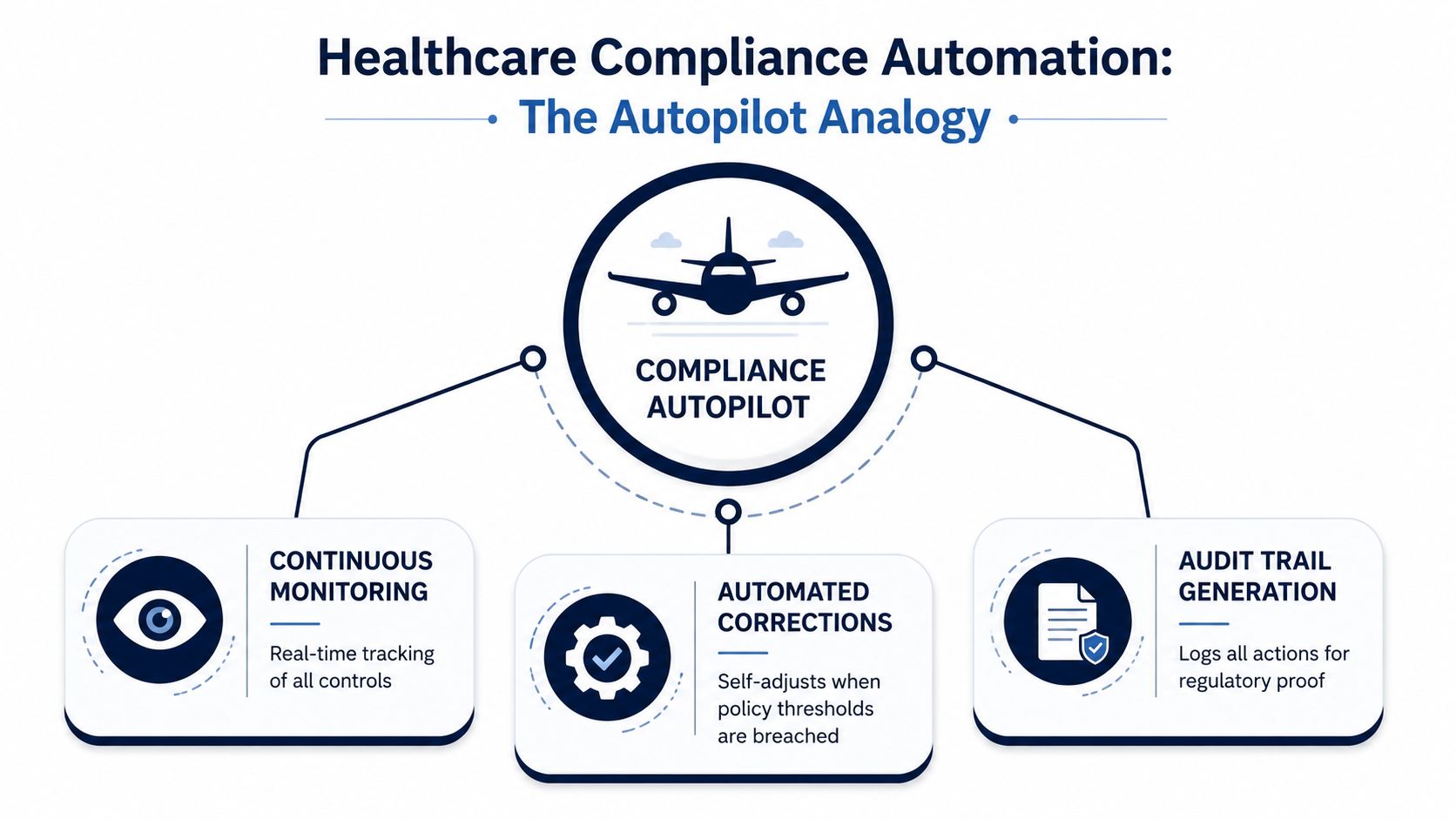
Three layers of automation
The first layer is workflow automation. It routes policy approvals, assigns training, reminds owners, records attestations, and escalates overdue tasks. This removes repetitive coordination, but it may not interpret what an operational event means.
The second layer is continuous control monitoring. A requirement is connected to evidence, such as a privileged-access change, incomplete clinical note, missing maintenance record, vendor review, or model-use event. The platform can flag a deviation while remediation remains possible, rather than waiting for a periodic audit sample.
The third layer is AI-assisted decision support. A model can identify unusual patterns, summarize regulatory changes, or prioritize investigations. Human owners must validate the result, understand limitations, and approve consequential action. A prediction is not evidence of a violation, and a generated summary does not replace the underlying record.
A practical platform often includes:
-
Policy management: Versioned policies, approval history, distribution records, and staff attestations.
-
Regulatory monitoring: A controlled process for identifying relevant changes and assigning impact assessments.
-
Risk alerts: Notifications based on defined thresholds, exceptions, or patterns across connected systems.
-
Evidence collection: Records showing which control ran, what it evaluated, who reviewed the result, and what happened next.
-
Audit trails: Tamper-resistant records for investigations, audits, and corrective-action reviews.
Automation also needs to cover the patient-facing service layer, not only the EHR. An answering workflow can expose sensitive information through staff access, transcription, or escalation paths. Vendor-risk reviews can use this resource on avoiding answering service pitfalls to examine those paths.
The dividing line is accountability. Automation can detect, route, preserve, and recommend. Leaders still define acceptable use, approve policies, investigate meaningful exceptions, and decide whether a control fits the clinical or business context. That division lets teams measure operational gains without treating automation as permission for unsupervised AI decisions.
Regulatory Privacy and AI Governance You Must Design For
A clinician pastes a patient message into an unapproved assistant, a meeting tool stores its transcript, and a vendor retains prompts for model improvement. No one intended to create a compliance incident, yet the data path now crosses several systems. Healthcare automation must govern that path continuously, not just prepare an audit file.
In the United States, there is no AI-specific HIPAA rule. AI systems handling PHI remain subject to the existing HIPAA Privacy and Security Rules. A vendor handling PHI will usually be a business associate and require a BAA.
That distinction belongs in the product architecture. Teams need an inventory of where PHI enters a model, where outputs go, who can access them, how long records remain available, and whether a vendor may use the data for training. Least-privilege access, immutable audit logs, explicit retention rules, and contract controls should be deployment requirements, not documents added after launch.
Privacy and security are different control problems
Privacy controls determine whether information is used, disclosed, or retained for an appropriate purpose. Security controls protect confidentiality, integrity, and availability through identity management, encryption, monitoring, incident response, and resilient operations. A system may restrict access while using data for an unauthorized purpose. The reverse also occurs: a valid purpose can still be exposed through weak access controls.
Section 1557 introduces algorithmic discrimination risk. HHS OCR's rule addresses patient-care decision-support tools that use protected attributes such as race, color, national origin, sex, age, or disability, and requires covered providers to identify those tools and mitigate discrimination risk, with compliance due by May 1, 2025. Product leaders should maintain a decision-support inventory, document intended use, test relevant performance differences, and provide an escalation path when users challenge an output. The healthcare data governance guide provides broader context for stewardship when products and data owners share patient information.
Shadow AI turns governance into discovery
Shadow AI is difficult to find because employees can introduce it through email, chat, meeting notes, browser tools, and productivity software. Healthcare organizations report suspected staff use of generative AI for work, unapproved AI use in email, inconsistent BAA coverage, and assumptions that tools such as Copilot are automatically HIPAA compliant. These signals describe a deployment-readiness gap: the organization may have a policy, but lack visibility into actual use.
A prohibition that nobody can enforce will not close that gap. Continuous control monitoring should connect discovery, ownership, data-path restrictions, evidence, and review:
-
Find unsanctioned tools: Use procurement records, identity data, browser telemetry where lawful, and staff disclosure channels.
-
Assign ownership: Record the business purpose, data classification, vendor, BAA status, and approved user group.
-
Constrain data paths: Prevent PHI from entering tools without an approved purpose and contractual boundary.
-
Preserve evidence: Log prompts, outputs, approvals, and overrides when the use case requires it.
-
Review behavior: Treat new tools and changed vendor terms as governance events.
For sensitive conversations across borders, evaluating a secure meeting transcription Europe option applies the same test. Privacy claims must become concrete controls for storage, access, processing, and deletion. Those controls also give product leaders evidence of which risks were reduced and whether a proposed AI deployment is ready for production.
Architecture and Integration Patterns That Make Automation Work
A compliance engine is credible only when its operational inputs are complete and traceable. Policy approvals alone cannot show whether the correct employees acknowledged a policy. EHR documentation alone cannot explain which rule version applies or why a missing field represents a control failure. The architecture must connect evidence to the business context that gives it meaning.
A workable design links EHR, CMMS, HRIS, and policy-management feeds to a central compliance engine. The engine normalizes events, maps requirements to workflows, stores evidence, and delivers results to dashboards, alerts, remediation queues, and regulatory reports. It should also expose deployment-readiness gaps, such as a control that depends on a data source with no reliable connector or an AI workflow whose approval state is missing.
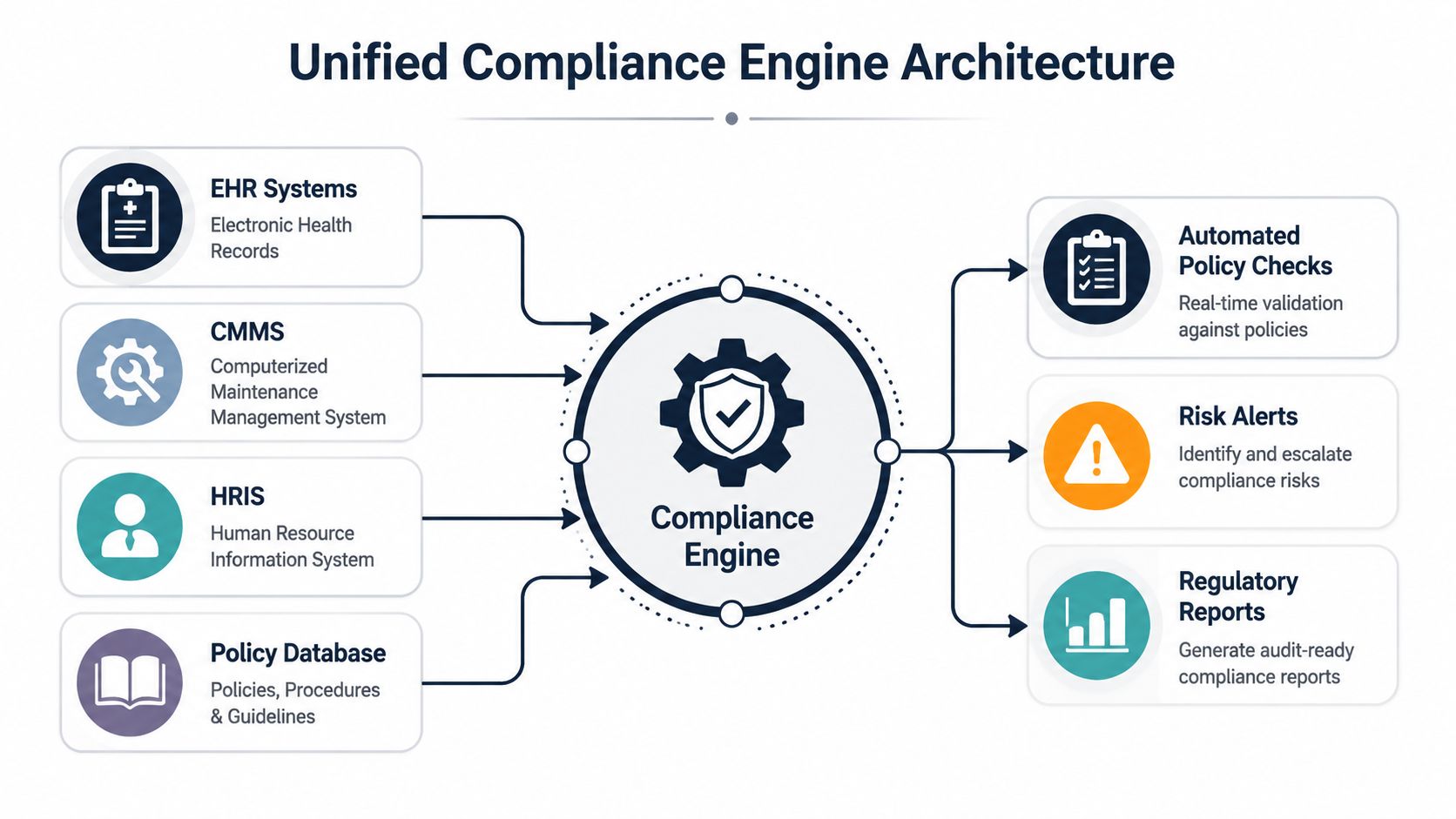
Start with the control graph
The most useful design artifact is a control graph, not an integration checklist. For each requirement, define the process it governs, the system that produces evidence, the event that indicates compliance, the threshold that signals deviation, and the person responsible for response.
A policy control could connect:
-
A policy record and approved version.
-
An HRIS population of affected workers.
-
An assignment event in a learning or attestation system.
-
A completion or exception event.
-
An escalation workflow for overdue or failed attestations.
-
An immutable evidence record for review.
This creates a cause-and-effect chain. A reviewer can trace a requirement to a system event, then to an owner and response. A green dashboard status without that chain is only a claim.
The same graph can govern AI deployments. It can link a use case to its approved model, data classification, access group, human reviewer, monitoring signal, and production gate. An unsanctioned tool then appears as a missing node or an unapproved path, rather than as a policy violation discovered months later.
Integration design needs operational discipline
Choose APIs, event streams, or scheduled transfers according to each source system's capabilities and risk profile. Normalize identity, timestamps, facility identifiers, policy versions, and data classifications before evaluating rules. Record source provenance so investigators can distinguish an original event from a transformed or aggregated one.
A phased integration pattern can follow this sequence:
-
Inventory standards and gaps: List requirements, owners, evidence types, and blind spots.
-
Connect systems of record: Start with sources that produce high-value evidence.
-
Map rules to workflows: Specify responses to missing documentation, unexpected access changes, or outdated policies.
-
Expose review context: Show the source event, rule, history, and recommended action together.
-
Monitor the monitor: Treat failed connectors, stale data, duplicate events, and rule changes as compliance risks.
Cloud choices shape the control model through identity, tenancy, encryption, backup, observability, and regional data handling. Teams assessing those dependencies can review this guide to healthcare cloud architecture.
The target is a dependable control loop. It detects deviations early, routes them to accountable owners, and preserves enough context to support a defensible decision and demonstrate whether an AI deployment is ready for production.
Implementation Roadmap and Best Practices for Lasting Adoption
Implementation fails when teams treat compliance automation as a software installation rather than a change to operating practice. A dashboard won't improve control performance if owners don't trust the data, alerts lack context, or executives can't see which exceptions require action.
Phase one starts with scope, not technology
Create an inventory of standards, policies, systems, data flows, vendors, and control owners. Mark documentation gaps and distinguish controls that can be evaluated from system events from controls that still require professional review.
Choose a bounded pilot with a clear evidence path. A policy-attestation workflow, privileged-access review, or vendor-risk renewal can work well because each has identifiable owners, source systems, exceptions, and closure evidence. Avoid selecting a use case only because it sounds advanced.
Phase two validates behavior in production-like conditions
The 2026 Frontiers review examined 519 evaluation studies and found that only 5% used real patient-care data, while 95% optimized accuracy alone. It also found that 16% examined fairness, 5% examined deployment readiness, and 1% examined calibration; the review states that no LLM-based quality management system has yet received regulatory clearance.
Those findings should change the acceptance criteria. Test whether users understand alerts, whether thresholds produce manageable queues, whether outputs remain stable across relevant populations, and whether the system behaves correctly when source data is late or incomplete. Accuracy matters, but explainability, calibration, fairness, workflow fit, and recovery behavior determine whether a model can operate safely.
Phase three encodes evidence and retention
HIPAA's Security Rule requires covered entities and business associates to retain required documentation for 6 years from creation or the date it was last in effect, whichever is later. Encode that requirement in retention policies for audit trails, approvals, review records, and control evidence, while also applying lawful deletion and minimization rules where other regimes require them.
Logging must capture more than login success. HIPAA-compliant logging includes audit controls, log-in attempt monitoring, and regular review of system activity. A practical model groups events into authentication, PHI access, security incidents, and administrative changes, recording user ID, timestamp, source IP, action, affected system or data, and incident-response details where relevant.
Phase four scales through governance
Create a review group with compliance, security, clinical or operational leadership, product, engineering, and data owners. Define who can change rules, approve new AI use cases, override alerts, release models, and retire integrations.
Train users on what automation can and can't prove. Keep a human approval step for high-impact decisions, document overrides, and review false positives and false negatives. Scale only after the pilot demonstrates reliable data lineage, accountable ownership, acceptable operational load, and evidence that an auditor can follow without a private explanation from the implementation team.
Measuring Success With KPIs, ROI, and Real-World Scenarios
ROI becomes credible when leaders connect operational improvements to risk exposure and staff capacity. The right question isn't “How many alerts did the platform generate?” It is “Which control became more reliable, how quickly did people respond, and what evidence can we show?”
Start with a baseline before automation. Measure how long teams spend preparing an audit, locating evidence, responding to complaints, closing findings, reviewing access activity, and reconciling policy versions. Then compare the same workflows after implementation, while tracking alert quality and user effort so a faster process does not transfer work to another team.
Healthcare Compliance Automation KPI and ROI Matrix
| KPI Category | Manual Baseline | Automated Target | Business Impact |
|---|---|---|---|
| Evidence readiness | Evidence is gathered from spreadsheets, email, and shared drives | Evidence is collected continuously with source and owner context | Less audit preparation effort and stronger traceability |
| Documentation completeness | Reviewers discover missing records during periodic checks | Rules flag missing or stale records near the originating event | Earlier remediation and fewer avoidable exceptions |
| Complaint response | Teams reconstruct timelines manually | A case view presents relevant events, actions, and approvals | Faster investigation and more consistent responses |
| Finding closure | Corrective actions rely on reminders and separate trackers | Owners receive routed tasks with escalation and closure evidence | Better accountability and clearer remediation status |
| AI governance | Unsanctioned tools are discovered informally | Tools, users, data paths, BAAs, and approvals are inventoried | Smaller shadow AI attack surface and stronger oversight |
| Control reliability | Sampling provides intermittent visibility | Connected systems support ongoing evaluation | Better understanding of control performance between audits |
Two scenarios for interpreting ROI
A provider may begin with policy attestations. The measurable benefit isn’t that reminders are automated. The provider can compare completion evidence, overdue exceptions, escalation time, and audit reconstruction effort before and after the workflow changes. If completion improves but alert volume overwhelms managers, the implementation needs better segmentation or thresholds.
A healthtech SaaS company may focus on vendor and AI governance. Its value case could combine fewer manual reviews, faster BAA verification, clearer model data boundaries, and reduced time spent answering enterprise security questionnaires. The strongest evidence comes from a traceable workflow, not a broad claim that AI “improved compliance.”
Market expansion reinforces why these measures matter. The estimates cited earlier show a sector moving toward enterprise-scale adoption, but investment should follow control risk and operational fit rather than market pressure. A small, well-instrumented workflow can produce more useful ROI evidence than a large platform with weak ownership and unreliable source data.
How an AI-Driven Engineering Partner Accelerates Compliant Automation
A healthtech team usually reaches a decision point after the discovery work. It can extend an existing GRC platform, build a focused control-monitoring service, or combine both through a staged delivery model. The right choice depends on data access, workflow complexity, regulatory scope, internal engineering capacity, and the evidence required by customers or auditors.
A healthtech software development partner can help turn that decision into an architecture and delivery plan. Bridge Global, for example, combines discovery, AI engineering, cloud development, integration work, testing, and ongoing support. Its custom healthcare software development capability is relevant when standard workflows don’t match clinical operations, while custom software development can support a focused compliance product or internal control service.
The engagement should produce concrete artifacts: a control inventory, data-flow map, risk register, integration plan, evaluation protocol, and release gates. Teams can compare software development service models before deciding which responsibilities belong in-house and which require an external delivery team. For AI-heavy work, AI development services, enterprise AI solutions, and an AI implementation roadmap can be assessed against the governance requirements rather than treated as separate technology purchases.
The same logic applies to data movement and productization. Secure healthcare integrations connect systems of record to control evidence, while SaaS product development helps teams package monitoring, tenancy, permissions, and auditability for multiple customers. Product leaders comparing delivery outcomes can review client cases, then ask specific questions about data lineage, testing, model oversight, and post-launch support.
Legal and operational teams may also compare specialized tools, such as an AI legal assistant for business owners, but every tool entering a healthcare workflow still needs an appropriate data, access, contract, and evidence review. That is the practical lesson behind healthcare innovation consulting: innovation must fit the operating model that will govern it.
Bridge Global helps healthcare organizations design and build audit-ready automation across compliance workflows, clinical systems, AI governance, and healthcare integrations. Visit Bridge Global to discuss your control-monitoring priorities, evaluate build-versus-partner options, and create a delivery roadmap for a secure, production-ready platform.

About Stephanie Cornelissen
Stephanie Cornelissen is a Technical Solutions Consultant with strong experience helping organizations navigate complex digital change. She works closely with teams to align business goals with practical, scalable technology solutions. With expertise in system architecture, integrations, and emerging technologies, she focuses on solving real-world problems through thoughtful execution. She enjoys working where technology meets business strategy and measurable growth.
View all posts by Stephanie Cornelissen →