


The Modern Guide to Global Engineering Partnership Success
Not so long ago, bringing in an outside engineering team was seen almost entirely as a way to cut costs. That’s not the case anymore. A global engineering partnership has evolved into a powerful strategy for driving real innovation and achieving long-term growth.
Think of it less like hiring a contractor and more like building an integrated extension of your own team. You’re tapping into world-class talent to accelerate your product roadmap and sharpen your operations, all without the heavy overhead of traditional hiring.
Why Global Partnerships Are the New Growth Engine
We all know the struggle. Scaling an in-house engineering team is tough. You’re constantly battling budget limitations, a shallow local talent pool, and hiring cycles that seem to drag on forever. A global engineering partnership completely flips that script.
This isn’t old-school outsourcing, where you just hand off tasks and hope for the best. It’s a true strategic alliance. Your partner becomes deeply invested in your success, sharing the same mission to build better products, faster. The right partner, especially a dedicated AI solutions partner, doesn’t just add headcount – they inject new energy and expertise into your organization. They help you break down those stubborn internal knowledge silos and introduce smarter, more efficient ways of working.

The Strategic Shift from Cost to Value
The entire conversation around global partnerships has changed. The focus has moved from a simple “How much can we save?” to “How much value can we create?” While cost-efficiency is still a fantastic perk, it’s no longer the main event.
Today, the real drivers are getting access to specialized skills, dramatically increasing your development speed, and improving the quality of your final product. For example, if you’re struggling to find AI specialists in your city, a global partner can give you immediate access to a top-tier team for your AI development services.
This approach gives businesses the power to:
-
Accelerate Time-to-Market: Augment your team with ready-to-go squads to launch products and features in a fraction of the time.
-
Access a Global Talent Pool: Find highly specialized experts for complex projects, like custom software development, that are either unavailable or prohibitively expensive in your local market.
-
Increase Operational Agility: Easily scale your engineering team up or down based on project needs, making sure your resources are always perfectly aligned with your business goals.
The numbers don’t lie. The global engineering services market is expected to hit $2.0 trillion in 2026, growing at a 3.2% compound annual growth rate (CAGR) from 2021. This massive growth, spread across roughly 1 million businesses worldwide, shows just how many companies now rely on external engineering talent as a core part of their strategy. You can read more about the global engineering market’s growth on IBISWorld.
When it works, a global engineering partnership is a beautiful thing. It frees you up to concentrate on your core business while your tech partner handles the engineering, ensuring you stay competitive and ahead of the curve.
So, you’ve decided a global engineering partnership is the right move. That’s a big step. The next, and arguably more critical, decision is choosing the right operating model. This isn’t just a logistical detail; it’s the very foundation of your collaboration, and it will shape everything from your budget to your daily stand-ups.
We’re talking about three main flavors here: offshore, nearshore, and hybrid. Each has its own distinct personality, and understanding them is about more than just looking at a map.
Think of it like hiring a team to build your dream house. You could hire a world-famous architect from across the globe (offshore), a top-rated builder from the next state over (nearshore), or a flexible crew that brings in local and distant specialists as needed (hybrid). Each one can build you a fantastic house, but how you communicate, the costs involved, and the project’s rhythm will be completely different.
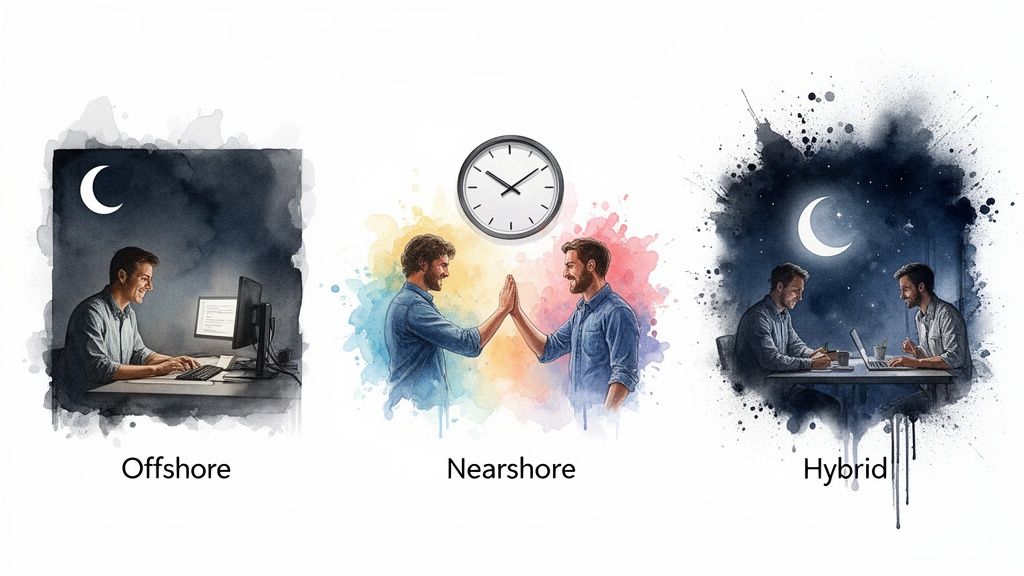
The Offshore Model: Accessing Global Talent Pools
The offshore model is the classic approach; partnering with a team in a distant country, often many time zones away. There’s a reason this model became so popular: it provides unmatched access to enormous, skilled talent pools at a very competitive price point.
One of the biggest draws is the potential for a 24/7 development cycle. Your in-house team can sign off for the day, hand over the work, and wake up to find significant progress has been made. This “follow-the-sun” workflow can seriously accelerate timelines, especially for a massive undertaking like a full custom software development project.
The numbers don’t lie. The Asia-Pacific region is on track to command 37.30% of the global engineering services market in 2025. On top of that, the outsourcing segment is expected to explode from $164.71 billion in 2026 to $312.65 billion by 2031, which tells you just how deep these talent pools are. You can Discover more insights about these engineering market trends on Fortune Business Insights.
The Nearshore Model: Balancing Cost and Collaboration
For those who feel a world away is a bit too far, there’s the nearshore model. This involves working with teams in neighboring countries, where time zones are similar and cultural overlap is greater. It strikes a fantastic balance, giving you the cost benefits of a global team with the collaborative ease of a local one.
A nearshore model minimizes the friction of communication. With teams working within a 1-3 hour time difference, you can schedule meetings, resolve issues, and make decisions in real-time without anyone having to work late nights or early mornings.
That time zone alignment is everything, especially if you’re using agile methods that rely on daily stand-ups and rapid feedback. It helps foster a genuine sense of one team, making your partners feel more like an extension of your own office than a distant vendor. As we explored in our guide to distributed product engineering, this is a core principle of effective collaboration.
The Hybrid Model: The Best of Both Worlds
Then there’s the hybrid model, which is all about flexibility. It’s not an “either/or” choice; it’s a “best of both” strategy that lets you mix and match offshore and nearshore elements to create a team that’s perfectly suited to your needs.
Here’s a practical example:
-
You could have your core development and project management team nearshore for seamless daily collaboration.
-
Meanwhile, you could tap into an offshore team for specialized, non-time-sensitive tasks like round-the-clock QA testing or heavy data processing.
An AI solutions partner might place data scientists in a time-zone-aligned nearshore location for high-touch strategy sessions, while using a global offshore team for the massive computational work of training models. This model gives you the agility to optimize for cost, speed, and collaboration all at once.
To make the differences even clearer, let’s break them down side-by-side.
Comparison of Global Engineering Partnership Models
This table lays out the key distinctions between the offshore, nearshore, and hybrid models across the factors that matter most to your business and operations.
| Factor | Offshore Model | Nearshore Model | Hybrid Model |
|---|---|---|---|
| Cost Savings | Highest. Access to lower-cost labor markets. | Moderate. Competitively priced with lower travel costs. | Optimized. Balances cost by blending models. |
| Time Zone Overlap | Low. Often 8-12+ hours difference, enabling “follow-the-sun” workflows. | High. Typically 0-3 hours difference, facilitating real-time collaboration. | Variable. Strategically designed for both real-time and asynchronous work. |
| Collaboration | Asynchronous communication is key (email, project management tools). | Real-time, synchronous communication is easy (calls, video meetings). | Blends both synchronous and asynchronous communication based on the task. |
| Cultural Affinity | Can be low, requiring more deliberate cultural alignment efforts. | High, often sharing similar business etiquette and language skills. | A mix of cultures that requires a strong, inclusive company culture. |
| Access to Talent | Vast. Access to a global talent pool for a wide range of skills. | Focused. Access to strong regional talent hubs. | Strategic. The best of both worlds; access to global specialists and regional teams. |
| Project Control | Requires very strong project management and clear documentation. | Easier to manage with more direct, real-time oversight. | Flexible management style, tailored to different parts of the team. |
Ultimately, the hybrid model isn’t just a compromise; it’s a strategic choice. It’s about building a truly global, interconnected team without being locked into a single way of working. It gives you the power to create a partnership that perfectly fits your project, your budget, and your goals.
When you establish a genuine global engineering partnership, you’re doing more than just outsourcing tasks. You’re giving your entire organization a serious upgrade in its capabilities. The rewards ripple out far beyond a single project, creating the kind of momentum that can truly sharpen your competitive edge.
It’s all about moving faster, building smarter, and tapping into a level of expertise that would be incredibly difficult, if not impossible, to build on your own.
The most powerful benefit you’ll feel right away is a dramatic boost in accelerated time-to-market. Think about it: instead of losing months to recruiting, hiring, and onboarding, you get instant access to a ready-made, high-performing team. They can plug into your workflow and start producing real value in a matter of weeks, not quarters.
Strategic Business Gains
That kind of speed gives you the agility to jump on market opportunities or react to a competitor’s new release while your ideas are still fresh and relevant.
This speed is also directly connected to another huge win: significant cost optimization. A global partnership lets you work with top-tier talent without paying the premium prices of major tech hubs. This isn’t about finding the cheapest option; it’s about making smarter financial decisions.
The money saved on recruitment fees, inflated salaries, and benefits can be channeled right back into your product. That means more features, a bigger marketing push, or the freedom to explore new innovations. It becomes a powerful financial lever for growth.
On top of that, a global engineering partnership gives you incredible scalability and flexibility. Your engineering team is no longer a fixed cost but a dynamic resource you can dial up or down as needed.
-
Need to double your team for a big launch? Your partner can make it happen.
-
Is the project shifting into a maintenance phase? You can scale back without going through painful internal layoffs or restructuring.
This kind of elasticity frees you from the rigid headcount model and empowers you to take on ambitious projects that once seemed out of reach.
A Surge in Technical Skill
Beyond the bottom line, the technical advantages are just as game-changing. Suddenly, your company’s collective skillset expands overnight. You gain on-demand access to a worldwide talent pool filled with deep, specialized knowledge.
By bringing in a global engineering firm, you’re injecting your projects with new perspectives and different technical approaches. This outside view is crucial for challenging your team’s assumptions and breaking free from the “we’ve always done it this way” trap.
This fresh talent can be a lifesaver, especially in fast-moving industries. If you need to pivot to a new technology or integrate complex new features, you aren’t starting from square one. Whether it’s specialized AI development services or a deep understanding of a niche framework, your partner is your direct line to those skills. This is a key way an AI solutions partner can help you integrate sophisticated tech without a massive internal learning curve.
This diversity of thought almost always leads to higher product quality and enhanced innovation. As our client cases show, when engineers from different backgrounds put their heads together, they spot blind spots, propose more durable solutions, and push the limits of what’s possible. The end result is a tougher, more secure, and more creative product that genuinely stands out.
Integrating AI To Future-Proof Your Partnership
Let’s be blunt: launching a global engineering partnership today without a solid AI strategy is a recipe for obsolescence. AI has shot past being a futuristic “nice-to-have” and is now a core part of modern engineering. Picking a partner who only does traditional development is like building a skyscraper with last century’s blueprints; it might look fine for a little while, but it won’t be competitive or ready for what’s next.
The best partners don’t just tack on AI as a final feature. Instead, they integrate it directly into the software development lifecycle from the very beginning. Think about using AI to scan project data and predict budget overruns before they happen. Or using generative AI to handle routine code creation and testing. This isn’t science fiction anymore; it’s the new standard of work.
Beyond Code: The AI-First Mindset
An AI-forward partner doesn’t just build things differently; they think differently. It’s a complete shift from simply reacting to problems to proactively creating intelligent solutions. This mindset is absolutely critical if you want to build systems that are genuinely smart, not just functional.
For instance, imagine you’re building a new platform. A traditional team builds according to the spec sheet. An AI-driven team asks different questions:
-
How can we use machine learning to anticipate what users will do and change the interface on the fly?
-
Could we build in a large language model to create a truly helpful self-service support system?
-
What data should we be gathering now to train a model that spots security threats before they become a problem?
This way of thinking leads to products that are more intuitive, efficient, and valuable right out of the gate. It’s the difference between building a simple tool and building an intelligent assistant. This is especially true for complex projects, like intelligent custom ecommerce solutions that need deep personalization or health tech that relies on predictive data to improve patient care.
The market is already there. The global engineering services industry is re-centering around AI, with a huge focus on AI-augmented engineering and digital twin technologies. As Deloitte’s industry outlook highlights, major partnerships are now defined by their digital transformation goals, with AI integration at the heart of that strategy.
Starting Smart With An AI Discovery Workshop
Knowing you need AI is the easy part. Knowing exactly where to apply it for the biggest impact is much harder. That’s where an AI Discovery Workshop becomes so valuable. It’s a structured, collaborative session led by your partner to pinpoint high-value, realistic AI use cases for your specific business.
A Discovery Workshop stops you from chasing shiny objects and wasting money on “AI for AI’s sake.” It connects what’s technically possible with what actually solves a business problem, ensuring every AI project has a clear, measurable return.
A skilled AI solutions partner guides you through this process, helping you figure out how you can best use AI for your business. The end result is a strategic roadmap that prioritizes the opportunities that will give you the biggest competitive edge. As we explored in our guide, this kind of strategic alignment is a cornerstone of any successful engineering-led digital transformation.
When you choose a partner with proven AI development services, you aren’t just hiring coders. You’re bringing on strategists who can guide you through the complexities of AI implementation. This ensures your global engineering partnership is built not just for today, but is ready to adapt and thrive in an AI-powered future.
A Practical Roadmap For Implementation and Governance
Moving from a signed contract to a high-performing innovation engine is where the real work of a global engineering partnership begins. A clear roadmap is non-negotiable. Without one, even the most promising alliance can get bogged down by mismatched expectations and poor oversight. This framework is designed to cut through the complexity, reduce risk, and turn that paper agreement into a genuine strategic advantage.
Everything starts with meticulous vendor selection. This phase is much more than just a price comparison. You’re not hiring a contractor; you’re choosing a long-term partner. The evaluation has to be deep, looking for a team that has the right technical chops and fits with your company’s culture and communication style.
Mastering Governance And Contracting
Once you’ve found the right partner, your focus has to shift to building a solid governance framework. This is the foundation of any successful partnership, providing the clarity, accountability, and legal guardrails everyone needs to work effectively. The goal isn’t to create bureaucracy, but to build a system that encourages collaboration while making sure everyone knows the rules of the road.
The contract itself is the heart of this framework. It needs to be more than just boilerplate legal text. Make sure it includes these critical components:
-
Service Level Agreements (SLAs): These are your non-negotiables. SLAs need to spell out exact metrics for performance, availability, and response times. For instance, an SLA might mandate 99.9% uptime for a production system or guarantee a four-hour response for critical bugs.
-
Intellectual Property (IP) Protection: The contract must state, without a shadow of a doubt, that all code, designs, and work product belong exclusively to your company. This clause needs to be ironclad, backed by strong non-disclosure agreements (NDAs) signed by every single person on the partner’s team.
-
Well-Defined Communication Channels: Your agreement should specify the who, what, when, and how of communication. This means defining the tools (like Slack, Jira, or Microsoft Teams), the cadence of meetings, and who the primary contacts are for different types of issues.
The flowchart below gives a high-level look at how a new initiative, like an AI project, might move through the pipeline within a well-governed partnership.
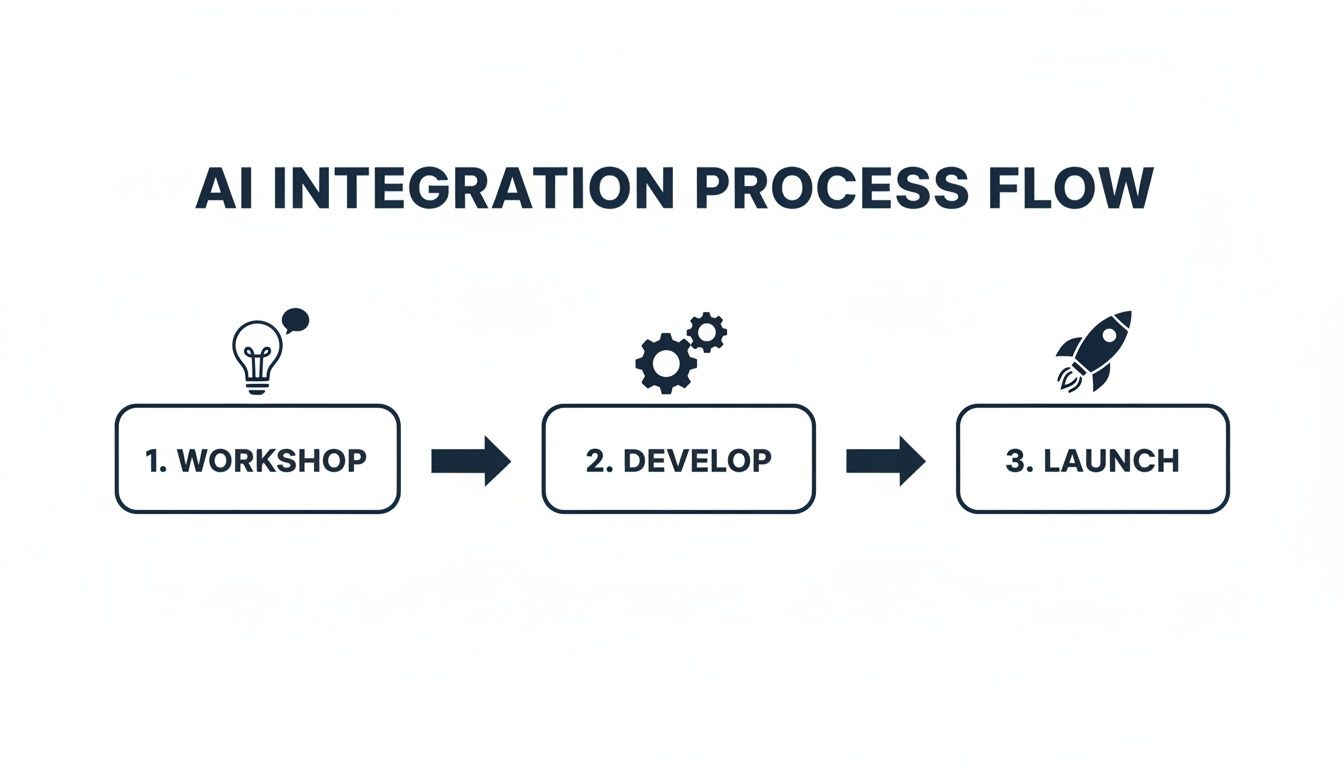
This process, from initial workshop to final launch, is exactly the kind of journey that strong governance keeps running smoothly.
Setting Up KPIs and Reporting
You can’t manage what you don’t measure. Setting up the right Key Performance Indicators (KPIs) with a consistent reporting rhythm is the only way to track progress and hold everyone accountable. But here’s the thing: effective KPIs aren’t just about checking off tasks. They measure the real business impact the partnership is having. As we’ve covered in our blog on governance in the cloud, clear accountability is central to effective project management.
A successful global engineering partnership is managed by outcomes, not just activity. Your KPIs should reflect the strategic goals of the project, whether that’s reducing time-to-market, improving user engagement, or lowering operational costs.
Here are a few powerful KPIs that I’ve seen work wonders:
-
Velocity and Cycle Time: This measures how fast the team turns backlog items into finished work. It’s a fantastic, no-fluff indicator of raw efficiency.
-
Code Quality Metrics: Don’t let speed come at the cost of quality. Track metrics like defect density (bugs per 1,000 lines of code) and code review coverage to keep standards high.
-
Budget Adherence: A simple comparison of actual spend versus the forecast. This regular check-in prevents nasty financial surprises down the line.
-
Stakeholder Satisfaction: Use quick surveys or informal feedback sessions to see how your internal teams feel about the collaboration and the results they’re seeing.
When you combine a strong legal framework with metrics that focus on outcomes, you create a partnership that isn’t just productive; it’s transparent, resilient, and built to deliver real, consistent value.
Building A Lasting and Successful Alliance
Think of a global engineering partnership not as a one-off project, but as a long-term investment in your company’s future. The goal isn’t simply to get a task done. It’s about building a real, collaborative relationship that fuels constant improvement and gives you a genuine edge over the competition.
When you see your technology partner as a core part of your innovation team, you start to see what’s truly possible. They’re more than just hired help; they bring fresh ideas, deep expertise, and an outside perspective that can challenge your own team’s thinking and push everyone to do better work.
From Vendor to Strategic Partner
A truly great alliance moves far beyond the typical client-vendor relationship. It grows into something more, where both sides are equally invested in getting to the same business goal. This kind of shift doesn’t happen overnight; it’s built on trust, transparency, and honest communication from the very beginning.
To really solidify this kind of bond, it’s worth considering a formal partner program. This gives the relationship structure, makes everyone’s roles clear, and sets the stage for genuine strategic alignment, making your partner a natural extension of your own operations.
The most successful partnerships are those where the external team is indistinguishable from the internal one. They share the same goals, celebrate the same wins, and work together to solve the same challenges.
This is the kind of integration that turns a service provider into a true strategic ally. It’s a powerful setup for creating smarter products and running a more efficient business. Many of our most successful projects, which you can read about in our client cases, are founded on this very idea of deep, lasting collaboration.
Your Catalyst for Future Growth
The right global engineering partner doesn’t just execute your vision – they help you sharpen and expand it. By bringing top-tier talent and hard-to-find skills into the fold, they make it possible to chase ambitious goals that might have otherwise felt out of reach.
For example, a skilled AI solutions partner can walk you through the often-confusing world of modern tech, helping you get ahead of the curve instead of just trying to keep up. From mapping out your initial strategy in an AI Discovery Workshop to rolling out sophisticated AI development services, your partner is there to spark innovation. They can help you spot opportunities to use AI for your business and build a tech foundation that’s ready for whatever comes next.
Ultimately, deciding to form a global engineering partnership is a statement. It says you’re ready to scale, innovate, and compete on a bigger stage. The journey starts with finding a partner who gets your ambition and has the chops to help you make it a reality.
Ready to see how a tailored partnership can transform your business objectives? Let’s discuss how Bridge Global can help you scale with world-class engineering talent.
Frequently Asked Questions (FAQ)
Stepping into a global engineering partnership naturally brings up a lot of questions. We’ve been there. Here are some honest answers to the most common things people ask, drawn from years of experience helping companies build successful remote teams.
What Is the Biggest Risk in a Global Engineering Partnership and How Can I Mitigate It?
Hands down, the biggest risk is a disconnect. When expectations don’t align and communication breaks down, you get project delays and work that misses the mark. It’s a classic case of “garbage in, garbage out.”
The only way to head this off is through obsessive, upfront planning. Before a single line of code is written, you need to establish rock-solid communication protocols. Define your goals and what “done” looks like with absolute clarity in your contract. Then, set up a rhythm of regular, structured meetings to keep everyone on the same page. Your partner has to get your business, not just the technical spec. This is why choosing a partner who lives and breathes agile methodologies is so important – it forces transparency.
How Do I Ensure the Quality of Work From a Remote Engineering Team?
You can’t just hope for quality; you have to build a process for it. This starts way before you sign a contract.
First, do your homework on the partner. Really dig into their technical skills and their quality assurance (QA) processes during the vetting stage. Ask to see their client cases and, more importantly, talk to their current or former clients. A good track record speaks for itself.
Second, map out a robust QA strategy for your own project. This should include a mix of automated tests, manual checks, and consistent code reviews. Define your acceptance criteria clearly and objectively for every feature. A truly experienced partner won’t treat QA as a final step. They’ll weave it into every single stage of the development cycle, making high-quality output a continuous effort, not an afterthought.
How Are Intellectual Property Rights Handled in These Partnerships?
Your Intellectual Property (IP) is your most valuable asset, and protecting it is non-negotiable. This has to be spelled out in your Master Service Agreement (MSA) and every Statement of Work (SOW) you sign.
Your contract must state, without any ambiguity, that all work product: every piece of code, design, and documentation created for you, is the exclusive intellectual property of your company. Full stop.
To back this up, make sure the agreement has ironclad confidentiality and non-disclosure clauses (NDAs). We strongly recommend having a legal expert who specializes in this area review all contracts. You need to be 100% certain your IP is fully protected under the laws of the agreed-upon jurisdiction. For more general guidance on legal frameworks, this Frequently Asked Questions (FAQ) is a solid starting point.
What Is the Difference Between Outsourcing and a Global Engineering Partnership?
While people sometimes use the terms interchangeably, they represent two completely different philosophies. Outsourcing is typically tactical. It’s about delegating a specific, often non-essential, task to a vendor, usually to cut costs. It’s a transaction.
A global engineering partnership is strategic. It’s a long-term commitment to building an integrated team that acts as a genuine extension of your own. Your partner doesn’t just take orders; they contribute to strategy, help solve your biggest challenges, and drive innovation. An AI solutions partner like Bridge Global is the perfect example of this model in action, focusing on delivering real business outcomes and value that grows over time.
Ready to build a partnership that drives real growth? Bridge Global is an AI-driven technology partner that helps businesses like yours innovate faster and scale with world-class engineering talent. Explore our custom software development services to see how we can build your future, together.

About Stephanie Cornelissen
Stephanie Cornelissen is a Technical Solutions Consultant with strong experience helping organizations navigate complex digital change. She works closely with teams to align business goals with practical, scalable technology solutions. With expertise in system architecture, integrations, and emerging technologies, she focuses on solving real-world problems through thoughtful execution. She enjoys working where technology meets business strategy and measurable growth.
View all posts by Stephanie Cornelissen →