



Future of Software Development: A Practical Roadmap
AI accounts for 42% of committed code today and is projected to reach 65% by 2027, yet 96% of developers still don't fully trust AI-generated code. The future of software development will therefore be decided less by who generates code fastest and more by who can review, test, secure, and govern it without slowing delivery.
That tension is already visible in production workflows. A 2026 benchmark found that 88.3% of surveyed organizations use AI-assisted tools daily or weekly, up from 71.6% in early 2024, while AI-agent pull requests wait 17.6 hours for review compared with 3.4 hours for unassisted work. Adoption has crossed the experimentation threshold. Governance hasn't.
For CTOs, the strategic question is no longer whether teams should use AI. They already are. The question is how to capture AI's useful throughput while preventing oversized changes, weak verification, technical debt, and compliance exposure from becoming the new delivery bottleneck.
Why the Next Decade of Software Starts With a Hard Question
Generative AI compresses the time required to produce code, but it doesn't compress every activity required to operate software safely. Pull requests still need reviewers. Tests still need meaningful assertions. Security teams still need evidence. Product leaders still need confidence that a feature solves the intended problem.
That mismatch creates systemic review latency. The benchmark cited above found that AI pull requests merge within 30 days only 32.7% of the time, compared with 84.4% for unassisted work. The surprising conclusion is that AI can increase the amount of code entering the queue while reducing the proportion that reaches production reliably.
The competitive advantage isn't raw generation speed. It's the ability to govern generated output without creating a slower queue downstream.
This changes how engineering leaders should evaluate the future of software development. Vendor demos typically showcase the first keystroke, the generated endpoint, or the working prototype. CTOs need to evaluate the complete delivery loop, including specification, implementation, review, testing, deployment, monitoring, incident response, and audit evidence.
Three decisions deserve priority:
-
Measure productivity across the full delivery system: Track review latency, merge reliability, defect escape, change failure, and recovery effort, not just lines produced or coding time saved.
-
Sequence adoption by risk: Give AI room in repetitive, bounded work before allowing agents to modify architecture, production configuration, or regulated logic.
-
Translate governance by sector: A consumer ecommerce feature and a clinical workflow may use similar models, but their evidence requirements, data controls, and approval paths are different.
Sonar's 2026 survey reinforces the point. AI already accounts for 42% of committed code, and the survey projects 65% by 2027, yet only 48% of developers always verify AI-generated code before committing. Engineering organizations have adopted AI faster than they have redesigned accountability.
The rest of this roadmap treats governance as an operating capability, not a final checklist. Teams that treat it as paperwork will throttle useful automation. Teams that ignore it will accumulate changes they can't confidently explain, test, or defend.
Eight Forces Reshaping How Software Gets Built
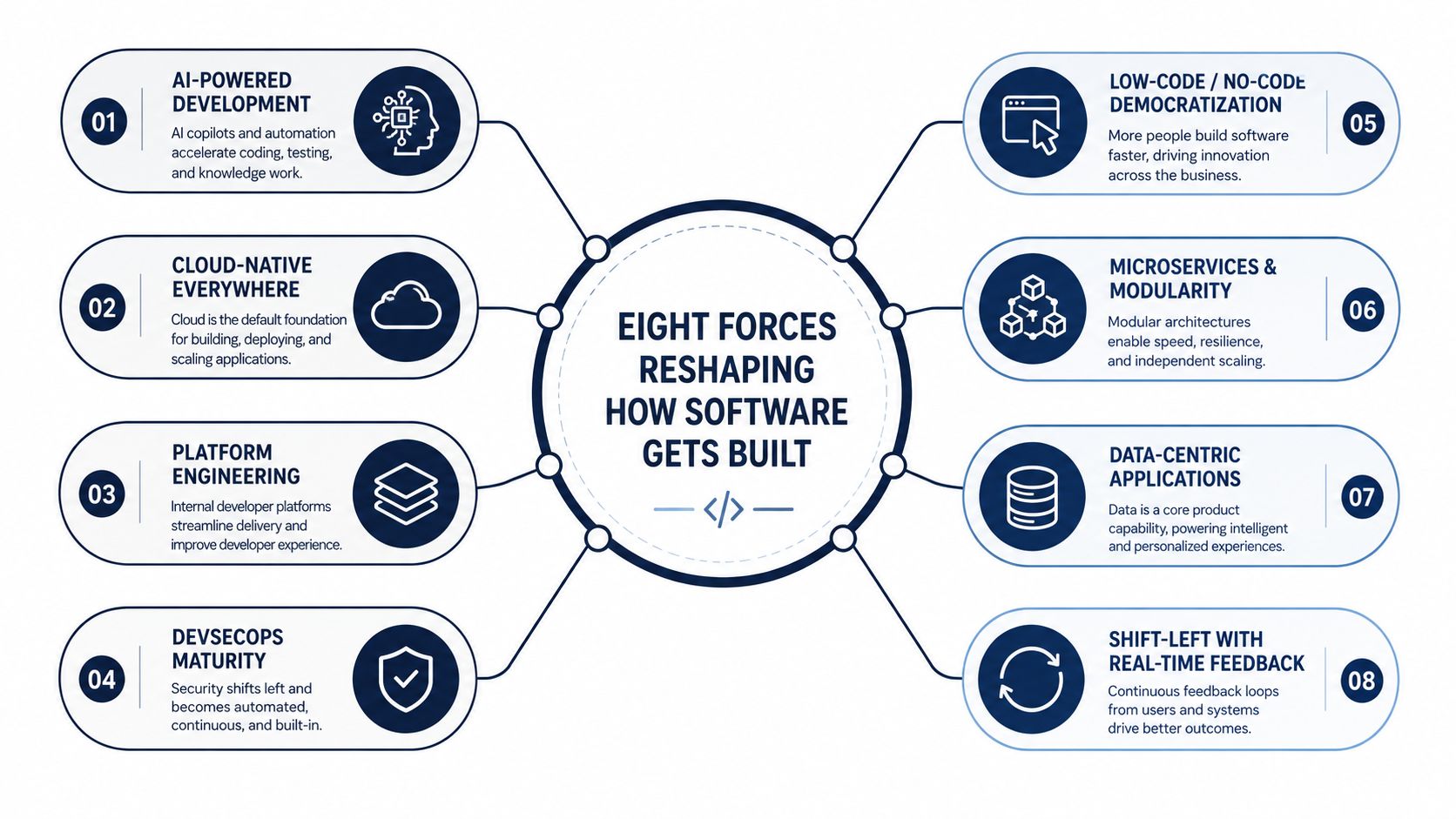
1. Generative AI coding assistants are moving from autocomplete toward agents that inspect repositories, create changes, run tests, and open pull requests. The team implication is immediate: engineers spend less time typing and more time defining constraints, validating behavior, and reviewing intent. Even analysts and nontraditional builders are entering the workflow through resources such as AI code generation for analysts, which makes access broader but raises the importance of repository permissions and review boundaries.
2. ML-augmented testing can generate test cases, identify likely edge conditions, and prioritize regression coverage. It won't replace test design. Teams still need humans to decide whether a test validates a business rule or merely confirms that an implementation behaves as written.
3. Low-code and no-code tools will keep expanding the number of people who can assemble workflows and interfaces. Product teams should welcome that speed for prototypes and internal operations, but require ownership, data classification, version control, and exit plans before low-code applications become business-critical.
4. Cloud-native architecture and platform engineering shift operational complexity into reusable internal platforms. Platform teams should absorb Kubernetes, deployment templates, secrets handling, and environment provisioning so product squads can focus on customer outcomes instead of rebuilding infrastructure patterns.
5. GitOps-driven delivery makes desired infrastructure state reviewable and reproducible. The practical consequence is that configuration changes need the same discipline as application code, especially when an AI agent can alter manifests or deployment definitions quickly.
6. End-to-end automation connects planning, coding, testing, deployment, and release operations. Automation only improves flow when teams define clear approval gates. Otherwise, it turns an unclear process into a faster unclear process.
7. Observability becomes a first-class concern as logs, traces, metrics, and business signals must expose whether a generated change behaves safely after release. Engineers can't govern systems they can't see.
8. Security-by-design moves threat modeling, dependency analysis, secrets detection, software bills of materials, and provenance evidence into the pipeline. Outputs such as SBOM and SLSA evidence should become routine pipeline artefacts rather than emergency additions for a customer review.
These forces don't operate independently. Forces three through eight either amplify or constrain generative AI. A platform can make agents safer by limiting permissions. Observability can reveal whether generated code creates operational harm. Automated testing can increase confidence, while weak security controls can turn higher throughput into a larger attack surface.
The practical perspective is covered further in software engineering trends for the future. The conclusion is straightforward: AI productivity doesn't automatically translate into delivery speed. Teams must redesign the surrounding system.
Where AI Actually Pays Off in the SDLC
AI delivers its clearest value where work is repetitive, syntactically structured, and easy to verify. A recent meta-analysis found a moderate positive productivity effect, Hedges' g=0.33, with a 95% confidence interval of 0.09 to 0.58 and p=0.008, with the strongest gains concentrated in boilerplate generation, implementation support, and documentation.
That doesn't justify giving an agent unrestricted authority. It supports a sharper division of labor. Let AI handle high-volume, bounded work. Keep humans responsible for architecture, integration boundaries, security decisions, and exceptions.
| SDLC Stage | AI Suitability | Risk Level | Human-in-the-Loop Required |
|---|---|---|---|
| Requirements clarification | Moderate | Medium | Yes, product and domain review |
| Code scaffolding and boilerplate | High | Low to medium | Yes, automated checks plus review |
| Test generation | High | Medium | Yes, validate coverage and intent |
| Documentation | High | Low | Editorial review |
| Migration scripts | Moderate to high | Medium to high | Yes, staging validation and rollback plan |
| API contract design | Low to moderate | High | Mandatory architecture review |
| Distributed-system boundaries | Low | High | Mandatory design and failure analysis |
| Security-critical paths | Low | High | Security and senior engineering review |
| Regulatory logic | Low | High | Domain, compliance, and engineering approval |
Consider a payments team. AI can generate CRUD endpoints, request validation, test fixtures, and documentation. The team should hand-design the idempotency contract, failure semantics, reconciliation behavior, and authorization model. Those decisions define financial correctness. A generated implementation can follow them, but it shouldn't invent them.
Controlled experiments and field estimates point in the same direction. One GitHub Copilot experiment reported an HTTP server implementation completed 55.8% faster, while a combined analysis across 4,867 developers found a 26.08% increase in completed tasks for users of a generative AI coding tool. These are task-level results, not a universal promise for a whole product organization.
Teams designing multi-agent workflows can use a practical introduction to coordination in the Yalc AI orchestration guide. The important operating rule is simple:
If failure is cheap, visible, and reversible, let AI take the first pass. If failure is expensive, distributed, or difficult to detect, require human design before generation.
For a broader implementation perspective, see AI for software development. The best AI-assisted teams don't remove engineering judgment. They move it toward decisions that machines can't safely infer from syntax alone.
The Productivity Whiplash Nobody Wants to Talk About
AI coding can reduce typing time while increasing delivery time. Faros reported that AI-assisted work increased pull request size by 51% and bugs per pull request by 28%. Larger changes take longer to understand, review, test, and revert. More bugs increase the cost of every downstream activity.
| Metric | Pre-AI Baseline | With Ungoverned AI | Interpretation |
|---|---|---|---|
| Pull request size | Existing team baseline | 51% larger | Reviewers face more context and higher cognitive load |
| Bugs per pull request | Existing team baseline | 28% higher | Faster generation can create downstream reliability work |
| AI-agent review wait | 3.4 hours for unassisted work | 17.6 hours for AI-agent pull requests | Review capacity becomes a delivery constraint |
| Merge within 30 days | 84.4% for unassisted work | 32.7% for AI pull requests | More generated changes don't guarantee reliable integration |
The last two comparisons come from the same 2026 benchmark on AI in software development. Together, they show why a dashboard focused only on completed coding tasks can mislead leadership. The organization may be producing more code while moving less validated software into production.
Junior-heavy teams feel this effect sharply because generated code can hide missing system understanding. A less experienced engineer may accept a plausible implementation without recognizing an unsafe retry policy, an incomplete authorization check, or a migration that can't be rolled back. AI amplifies the reviewer's judgment, so weak review systems become more expensive as output rises.
The evidence isn't uniformly optimistic. Deloitte expects software teams to be reshaped around agentic AI across the SDLC in 2026, but METR reported an early-2025 study in which experienced developers were 19% slower with AI tools, with later follow-up data showing no clear universal speedup. Task type, codebase complexity, tool familiarity, and review burden all matter.
The corrective is not to ban AI. It is to stop measuring only the first keystroke. Instrument queue time, review rounds, defect escape, rollback frequency, and maintenance effort. Then set repository-level controls that keep generated changes small enough for humans to understand.
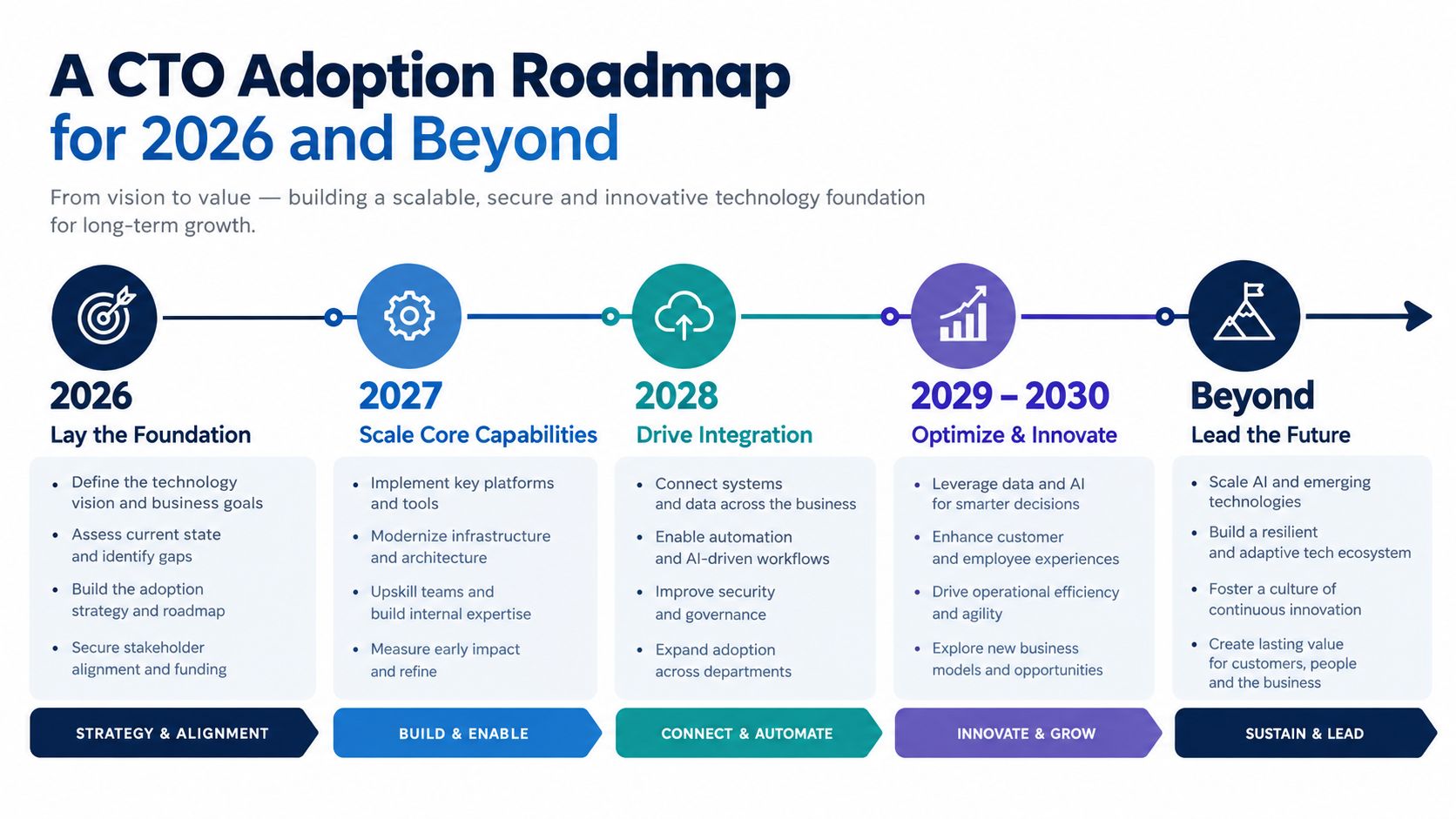
A CTO Adoption Roadmap for 2026 and Beyond
A useful adoption plan sequences autonomy instead of announcing a blanket AI mandate. The first year should establish evidence, controls, and repeatable patterns before teams expand agent permissions.
Months one through three
Start with repositories containing low-risk internal tools, documentation, test generation, and repetitive maintenance tasks. Prohibit autonomous changes to production infrastructure, authentication, payment logic, clinical decision support, and regulated data flows until the team has baseline controls.
Create an inventory of approved tools, data restrictions, repository permissions, and required review roles. Record which changes used AI assistance. That metadata gives leaders a way to compare review load and defect outcomes without pretending every generated line has equal value.
Track:
-
Review wait time and total pull request cycle time.
-
Merge reliability and reopened work.
-
Defects found before and after release.
-
Test coverage quality, not just coverage quantity.
-
Evidence available for security and compliance review.
Use this practical AI readiness guide to frame the initial capability assessment, but keep the first phase operational. A policy nobody can follow won't protect the team.
Months four through eight
Introduce policy-as-code for repository permissions, prohibited data handling, required checks, dependency scanning, and approval gates. Add AI-assisted review as a first pass for obvious defects, missing tests, and consistency issues. Human reviewers should focus on architecture, business intent, security, and operational risk.
Bring in a fractional principal architect when teams begin connecting agents to production systems, shared platforms, or legacy modernization work. That role should define service boundaries, migration guardrails, rollback patterns, and the evidence required for high-risk changes. Hiring more tool users won't solve an architecture problem.
Months nine through twelve
Expand agent permissions only where the metrics support it. A repository is ready for broader autonomy when review queues remain controlled, defect escape is stable, rollback is rehearsed, and the team can explain how generated changes were validated.
For organizations with fewer than 200 employees, upskilling existing engineers on AI-assisted workflows is generally more practical than building a separate greenfield AI organization. The priority is not a new title. It is stronger engineers who can specify, supervise, and reject machine-generated work.
In regulated environments, add an audit-ready record of model use, data access, approvals, test evidence, and release decisions. The objective is bounded autonomy, not maximum autonomy.
What This Looks Like in Healthtech, Finance, Ecommerce, and SaaS
The same AI capability creates different obligations in different industries. A CTO should approve patterns by risk context, not by tool popularity.
| Industry | Primary Trend Impact | Dominant Compliance Constraint | Credible Engagement Pattern |
|---|---|---|---|
| Healthtech | AI-assisted workflows and healthcare integrations | HIPAA, clinical validation, interoperability, algorithm transparency | Domain engineers, security review, traceable data flows, validation evidence |
| Finance | Core-system modernization and automated engineering | Model risk management, PCI expectations, SOX controls, auditability | Segregated environments, approval gates, immutable evidence, rollback plans |
| Ecommerce | Faster experimentation and conversion-critical delivery | Privacy, payment security, resilience, performance budgets | Small releases, feature flags, observability, automated regression checks |
| SaaS | Higher ship velocity with platform pressure | Customer security commitments, access control, change traceability | Platform engineering, tenant isolation, policy-as-code, service ownership |
Healthtech needs the strictest data and decision boundaries. The U.S. ONC’s HTI-1 rule established nationwide transparency requirements for AI and algorithms used in certified health IT, and it advanced USCDI Version 3 as the certification baseline beginning January 1, 2026. In the European Union, the AI Act entered phased application in 2026, with transparency obligations for general-purpose models and stricter high-risk requirements due during that year. The EU Health Data Space also became law in March 2026, establishing a transition framework for primary and secondary health-data use.
Healthcare teams should treat integrations as core product architecture. Electronic health information from electronic health records is needed to develop AI tools for health, while data flow depends on standards and interoperability. Identity, authorization, and delegation also remain evolving areas, with community extensions such as MCP-I being discussed alongside HIPAA and FDA software-as-a-medical-device guidance.
A healthtech engagement should therefore produce more than a model. It should produce data-flow documentation, authorization rules, validation evidence, release approvals, and an incident process. A finance team needs comparable evidence around model inputs, controls, and segregation of duties. Ecommerce can move faster, but only if observability catches customer-impacting regressions. SaaS leaders must balance release velocity against platform debt and tenant risk.
For teams evaluating a healthtech software development partner, the key question is whether the partner can connect product engineering with governance artefacts. The same principle applies when selecting custom healthcare software development, custom software development, or SaaS product development. Delivery capability matters, but defensible operation matters just as much.
The Executive Takeaway and Frequently Asked Questions
The future of software development belongs to organizations that make three deliberate bets:
-
An AI-augmented SDLC with bounded autonomy: The risk is allowing agents to cross architectural or regulatory boundaries without human design.
-
Observable delivery metrics: The risk is celebrating generated output while review queues, defects, and rework grow.
-
Compliance-by-default pipelines: The risk is treating evidence, access control, and auditability as late-stage paperwork.
CTOs should also select delivery partners by operating model. Compare software development service models, evaluate AI development services, and review enterprise AI solutions against the controls described above. A credible AI implementation roadmap should connect tool adoption to measurable delivery and governance outcomes.
How should we measure AI ROI?
Use end-to-end indicators, including review latency, merge reliability, defect escape, rework, and release confidence. Section three’s task-level productivity evidence matters, but it doesn’t replace system-level measurement.
When should we retire legacy tooling?
Retire it when a supported replacement improves maintainability, security evidence, and operational ownership. Don’t remove a tool solely because a newer AI workflow looks faster in a demonstration.
What belongs in an MVP AI governance policy?
Define approved tools, prohibited data, repository permissions, human approval requirements, testing expectations, logging, incident handling, and exceptions. Start with controls teams can enforce automatically.
Can low-code reach regulated production scale?
Yes, for bounded use cases with clear ownership, access controls, versioning, testing, and audit evidence. The technology isn’t the governance model.
How should an AI policy satisfy HIPAA, PCI, and SOC 2 auditors?
Map each AI workflow to data access, authorization, encryption, change approval, monitoring, retention, and evidence requirements. Use the healthtech and finance patterns above rather than one generic policy.
For practical examples of delivery patterns and outcomes, review Bridge Global’s client cases before selecting an implementation approach.
Bridge Global helps CTOs design AI-assisted software workflows, build compliant healthcare platforms, modernize enterprise systems, and develop SaaS products with governance built into delivery. Visit Bridge Global to discuss an adoption roadmap that connects AI throughput with review capacity, reliability, and audit readiness.

About Stephanie Cornelissen
Stephanie Cornelissen is a Technical Solutions Consultant with strong experience helping organizations navigate complex digital change. She works closely with teams to align business goals with practical, scalable technology solutions. With expertise in system architecture, integrations, and emerging technologies, she focuses on solving real-world problems through thoughtful execution. She enjoys working where technology meets business strategy and measurable growth.
View all posts by Stephanie Cornelissen →