


Custom Marketplace Development: A Practical Guide
When you decide to build a custom marketplace, you’re not just creating a website. You’re building a unique digital ecosystem from scratch, designed to fit your business like a glove. This isn’t about using a template; it’s about gaining total control over every feature, the user experience, and how you make money. Think of it as laying the foundation for a platform that can grow with you and stand out in a crowded market.
Why Go Custom When Off-the-Shelf Exists?
Every marketplace founder hits this crossroads: build from the ground up or use an off-the-shelf solution like Sharetribe or Mirakl? The pre-made options are tempting because they promise a quick launch. The problem is, that shortcut often leads to a dead end.
Those “one-size-fits-all” platforms force your unique business idea into a generic box. You’ll quickly hit a wall when you try to implement a clever monetization strategy or design a user flow that truly speaks to your niche. They’re built for the average business, not for your business.
The Strategic Value of a Tailored Platform
Choosing a custom build isn’t just about the tech; it’s a strategic investment in a long-term business asset. It’s about creating a platform that’s a perfect reflection of your brand and how you operate.
Here’s where a custom approach really shines:
- A Truly Unique User Experience (UX): You get to map out every single click and interaction. From a seamless onboarding process to a frictionless checkout, you can design an experience that keeps your specific users coming back.
- Monetization That Fits Your Model: Want to implement a hybrid model with tiered subscriptions, dynamic commissions, and listing fees? No problem. Off-the-shelf solutions simply can’t handle that kind of complexity.
- Scalability on Your Own Terms: Your platform’s architecture is built for your growth projections. You won’t have to worry about performance crashing right as your user base starts to take off.
- Proprietary, Defensible Features: You can develop tools that solve a very specific problem for your audience. This creates a powerful competitive moat that copycats can’t easily cross.
A custom platform is more than just software; it’s the digital embodiment of your business model. It allows you to own your intellectual property and control your destiny without being subject to a third-party provider’s roadmap or fee changes.
To make this choice clearer, let’s break down the core differences.
Custom vs Off-the-Shelf Marketplace Platforms
| Feature | Custom Marketplace Development | Off-the-Shelf Solution (e.g., Sharetribe, Mirakl) |
|---|---|---|
| Flexibility & Customization | Virtually limitless. Every feature and workflow is built to your exact specifications. | Limited. You’re confined to the features and templates the provider offers. |
| Scalability | High. Architected from the start to handle your specific growth and traffic needs. | Moderate. Can face performance issues or require expensive plan upgrades. |
| Monetization Models | Fully flexible. Can support complex, hybrid, or unique revenue streams. | Restricted to standard models like commissions, subscriptions, or listing fees. |
| Upfront Cost & Time | Higher initial investment and longer development timeline. | Lower upfront cost and faster time to launch for a basic version. |
| Long-Term Cost & Ownership | You own the IP. No recurring license fees, but there are maintenance costs. | Ongoing subscription fees that can increase with scale. You don’t own the code. |
| Competitive Advantage | Strong. Enables you to build proprietary features that set you apart. | Weak. Your platform will look and feel similar to others using the same solution. |
While an off-the-shelf platform can get you to market faster, a custom build is what gives you the power to win the market.
Future-Proofing Your Marketplace
The world of digital commerce is incredibly competitive. With the global e-commerce market expected to hit USD 7.4 trillion by 2025, platforms that offer a distinct, superior experience are the ones that will thrive. In fact, custom-built marketplaces often see 30% higher customer retention rates compared to their template-based competitors; proof that a tailored experience pays off.
As an experienced AI solutions partner, we’ve seen how a bespoke foundation makes it possible to integrate advanced tech like AI-powered recommendations or dynamic pricing. Trying to bolt these features onto a rigid, pre-built system is often a nightmare, if not impossible. Understanding different models, like a managed software marketplace for SaaS, can also help you see where the industry is headed.
Ultimately, a custom approach ensures your platform can evolve with the market, not just react to it.
The Strategic Blueprint: Your First Critical Phase
Before you even think about writing a single line of code, you need a rock-solid strategic plan. This discovery phase isn’t just a preliminary step; it’s the most critical part of the entire custom marketplace development journey. This is where your great idea transforms into a viable business model.
Skipping or rushing this stage is a classic mistake that leads to costly scope creep down the road. A proper blueprint ensures your development budget is spent on features that actually matter and gets your entire team pulling in the same direction. It’s where you validate your core assumptions and build a roadmap that works.
Nail Down Your Unique Value Proposition
First things first: what makes you different? Your value proposition needs to be razor-sharp and solve a genuine problem for both your buyers and sellers. It’s not enough to just be a middleman; you have to offer a compelling reason for them to ditch their current habits and use your platform instead.
For instance, a marketplace for handmade furniture isn’t just selling tables. For buyers, the value might be “finding unique, artisan-quality pieces you can’t get anywhere else.” For the sellers, it’s “a dedicated audience that appreciates craftsmanship, without getting lost among mass-produced junk.” This clarity will guide every single feature you decide to build.
A custom approach, guided by this kind of strategic blueprint, is how you break free from the pack.
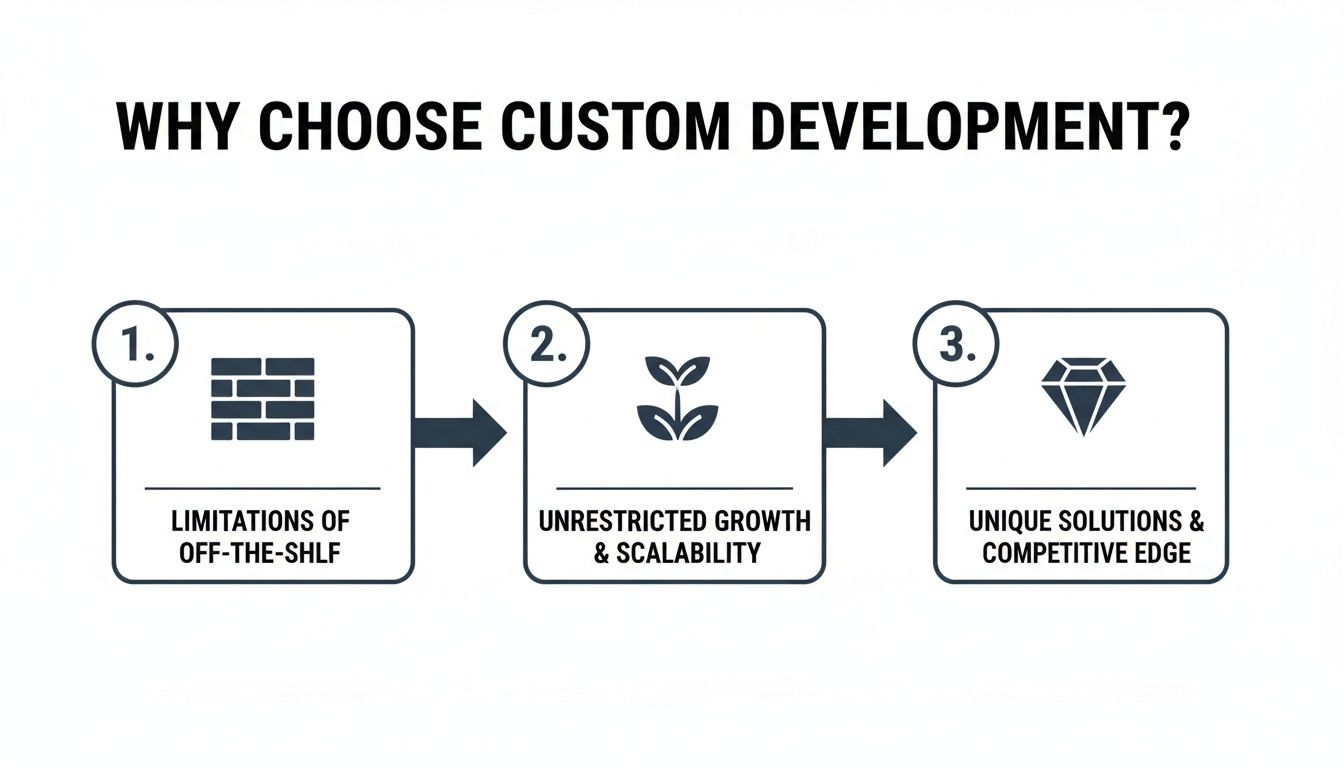
As you can see, a bespoke platform lets you build exactly what your users need, setting the stage for real growth and a serious competitive edge.
Find Your Niche and Scope Out the Competition
Trying to be everything to everyone is a fast track to failure. The most iconic marketplaces started by owning a specific, often overlooked, niche. Remember Airbnb? They didn’t launch with a plan for global travel domination. They started by offering air mattresses on the floor for people attending a design conference in San Francisco.
To zero in on your niche, ask yourself a few tough questions:
- Who is being underserved by the current options?
- Is this market big enough to be profitable but small enough for me to dominate early on?
- Do I have some kind of “insider” knowledge or unique advantage here?
Once you have a niche in mind, it’s time to put your competitors under the microscope. Don’t just make a list of their features. The real gold is in uncovering their weaknesses. Dig into their user reviews—what are customers constantly complaining about? That’s your opening. Study their pricing models, their user experience, and their marketing to find the gaps you can drive a truck through.
Map the User Journey and Define Core Features
With your value proposition and niche locked in, you can start mapping out the ideal experience for your users. Think of it like storyboarding a movie. You need to visualize the entire process from their perspective, from the moment they land on your site to a successful transaction and what happens after.
Crucially, you need to map out separate journeys for buyers and sellers. Their motivations and goals are completely different.
This exercise is what tells you which features are truly essential. Instead of a random brainstorm session, you’ll derive your feature list directly from the critical steps in each user’s journey.
A huge mistake I see all the time is founders trying to cram too many features into their MVP. Your blueprint should force you to be ruthless. Focus only on what’s absolutely necessary to facilitate that core transaction and prove your value. Everything else is just noise for now.
This foundational work is non-negotiable. As we’ve discussed when exploring the world of custom enterprise software development, this kind of structured planning ensures your marketplace is built on solid ground, ready to solve real problems from day one.
Laying the Technical Foundation for Long-Term Success
Once you’ve got your strategy nailed down, it’s time to get into the technical nitty-gritty. This is where you make the foundational decisions that will either support or constrain your marketplace for years to come. Designing the right architecture for your custom marketplace development isn’t about chasing the latest tech fads; it’s about building a stable, scalable, and secure platform that grows with you.
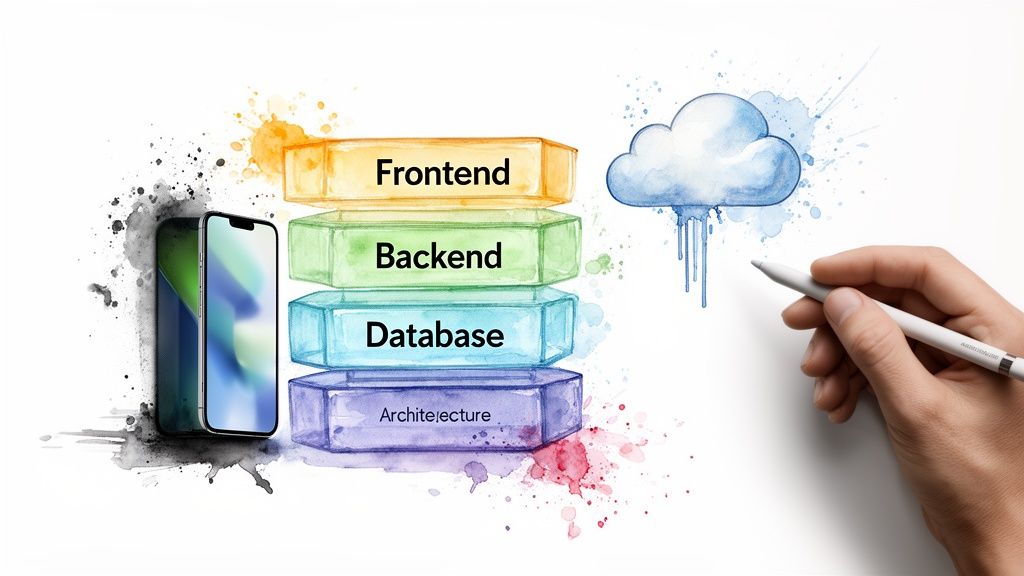
You have to think ahead. The demand for truly custom software solutions is exploding—the market is projected to jump from USD 43.16 billion in 2024 to USD 52.84 billion by 2025. This tells you one thing loud and clear: businesses need platforms that can adapt and scale. Your architecture has to be built for tomorrow’s challenges, not just today’s launch.
Monolithic vs. Microservices: Your First Big Choice
One of the first forks in the road is choosing between a monolithic or microservices architecture. They both have their place, and the right answer depends on where you are in your journey.
- Monolithic: This is your classic “all-in-one” approach. Every piece of your platform – user profiles, listings, payments, notifications, lives in a single, unified codebase. It’s often much faster to get an MVP off the ground this way. The downside? As you grow, it can become a beast to manage. A small bug in one area can crash the whole system, and updates become slow and risky.
- Microservices: Here, you break the platform into a collection of small, independent services. You might have a dedicated “payment service,” a “user service,” and so on. Each one can be developed, deployed, and scaled on its own. It’s more complex to set up initially, but the long-term flexibility and resilience are incredible.
A monolithic build is like constructing a single large building. It’s straightforward at first, but adding a new wing later is a major project. Microservices are like building a campus of smaller, interconnected buildings—more complex to plan, but you can add or renovate one building without disturbing the others.
Picking the Right Tech Stack
Your “tech stack” is simply the set of technologies you use to build everything. There’s no single “best” stack—the right choice depends entirely on your marketplace’s specific needs for performance, scalability, and the talent you can find to build and maintain it.
A popular and powerful combination for modern web apps is the MERN stack:
- MongoDB: A flexible, NoSQL database that’s great for the kind of varied data a marketplace generates.
- Express.js: A lean and mean backend framework that runs on Node.js.
- React: A powerhouse JavaScript library for building fast, interactive user interfaces.
- Node.js: This lets you run JavaScript on the server, meaning your team can use a single language across the entire application.
If you’re building for mobile, frameworks like React Native or Flutter are game-changers. They allow you to build for both iOS and Android from a single codebase, which can cut your development time and costs nearly in half.
And, of course, no marketplace works without payments. Getting this right is critical, and a great starting point is understanding payment gateway API integration, which is an essential piece of the puzzle.
Weaving in AI for a Smarter Platform
In today’s market, AI isn’t some futuristic add-on; it’s a core component for building a competitive platform. Marketplaces run on data, and integrating AI for your business from the very beginning gives you a massive advantage.
Here are a few ways AI can immediately elevate your marketplace:
- Personalized Recommendations: This is table stakes now. AI algorithms can analyze a user’s browsing history and past purchases to suggest products or services they’ll actually want, which directly boosts engagement and sales. This is a must-have for any modern ecommerce development.
- Dynamic Pricing: Imagine prices that adjust in real time based on supply, demand, and even competitor activity. Machine learning models can do this automatically, helping your sellers maximize their revenue while still offering fair prices to buyers.
- Proactive Fraud Detection: AI can spot suspicious activity—like fraudulent listings or shady transactions—with much greater accuracy than simple rule-based systems. This builds trust and protects everyone on your platform.
Thinking about AI from day one means you’re not just building a platform; you’re building an intelligent system that gets smarter and more efficient over time.
Turning Your Blueprint into a Real, Working Product
Alright, the planning is done. Now for the exciting part: actually building the thing. This is where the rubber meets the road, and your strategic documents start morphing into a tangible platform.
Let’s be clear: the old way of building software—the rigid, waterfall method where you spec everything out for a year and then build—is a death sentence for a marketplace startup. You need to be nimble. You need to be agile.
Agile development means we’re not trying to build the entire universe in one go. Instead, we break the project down into small, bite-sized pieces called sprints. Each sprint, usually lasting a couple of weeks, delivers a functional piece of the platform. This cycle of building, testing, and getting feedback is what keeps the project grounded in reality and ensures you’re building something people actually want to use.
The Power of the Minimum Viable Product (MVP)
The heart of this agile approach, especially for a new marketplace, is the Minimum Viable Product, or MVP.
Don’t mistake an MVP for a buggy, incomplete prototype. It’s not. An MVP is the leanest, most stripped-down version of your platform that solves the core problem for your very first users. Its entire purpose is to launch quickly, prove that people will pay for what you’re offering, and start collecting real-world feedback to shape what comes next.
I’ve seen so many founders get bogged down here. They want to cram every cool feature they’ve ever imagined into the first release. That’s a classic, cash-burning mistake that pushes your launch date into the distant future. You have to be ruthless about prioritizing.
The question isn’t, “What other features can we add?” It’s, “What is the absolute bare minimum we need to create value and facilitate a transaction?” For now, everything else is just a distraction.
How to Actually Define Your MVP Scope
Okay, so how do you decide what makes the cut? I find it helps to bucket features into three simple categories. It forces you to be honest about what’s truly necessary.
- The Must-Haves (Core Functionality): These are the absolute non-negotiables. Think user sign-ups, seller profiles, a way to create a listing, basic search, and a secure way to take payments. If any of these are missing, you don’t have a marketplace.
- The Key Differentiators: What’s the one simple thing that backs up your unique selling point? If you’re building a platform for handmade goods, maybe it’s a better photo upload and gallery tool. For a service platform, maybe it’s a simple, reliable messaging system to connect buyers and sellers. Keep it lean.
- The “Later” List (Post-Launch Features): This is your parking lot for everything else. Fancy admin dashboards, AI-powered recommendation engines, multi-tiered subscription plans—all great ideas, but they can wait. You build these after you’ve proven the core concept works.
Focusing your initial custom software development horsepower on that first bucket gets you to market faster and saves your precious cash for the features that will actually move the needle later on.
Who’s Going to Build This Thing?
With a tight MVP scope, you need a team. Broadly, you have two choices: hire everyone in-house or partner with a development agency.
Building an in-house team gives you total control, but it’s a massive undertaking. The time and money spent on recruiting, salaries, benefits, and management can bleed a startup dry before you’ve even written a line of code.
Partnering with an agency, especially one with a global team, lets you plug into a ready-made group of specialists. For most marketplaces just starting out, this model just makes more sense.
Here’s why:
- Hit the Ground Running: You can have a full team of developers, designers, and project managers ready to go in weeks, not the months it takes to hire.
- Been There, Done That: A good agency has built other marketplaces. They know the common traps and can guide you away from them, which is invaluable.
- Stretch Your Budget: An offshore or nearshore team can dramatically lower your development costs, letting you do more with your funding.
- Flexibility is Key: Need to add another developer for a tough sprint? Easy. Need to scale back after launch? Also easy. You’re not locked into long-term hires.
The right path depends on your funding and long-term goals, but to get a quality MVP out the door without breaking the bank, a smart partnership is often the most strategic move you can make.
Launching and Scaling for Sustainable Growth
Getting your marketplace live is a huge milestone, but let’s be real—it’s the starting line, not the finish. The real work starts now. Your focus has to shift from building the platform to actually growing it, which means having a smart go-to-market plan, knowing your numbers cold, and being ready to scale intelligently.

A launch isn’t just flipping a switch and hoping for the best. It’s a carefully orchestrated event designed to create pre-launch buzz and, most importantly, successfully onboard that critical first wave of users. Their early momentum is the fuel that will carry you through the tough first few months.
Your Playbook for Going to Market and Onboarding Users
Every marketplace founder eventually comes face-to-face with the classic “chicken-and-egg” problem. You need buyers to get sellers, but you need sellers to attract buyers. So, where do you start? The trick is to stop trying to get both at once and focus on acquiring one side of the market first, almost always the supply side (your sellers or service providers).
Here are a few tactics that flat-out work:
- Go Hyper-Niche: Don’t try to conquer the world on day one. Start in a single city or with a very specific product category. This concentrates your marketing firepower and makes it much easier to build that initial critical mass of users.
- Do Things That Don’t Scale: This is famous advice for a reason. In the beginning, you should be personally reaching out to your first 100 sellers. Walk them through the platform, help them create their listings, and, most importantly, listen to their feedback. This builds incredible loyalty and gives you priceless insights you can’t get any other way.
- Create Early Incentives: Roll out the red carpet for your first cohort of sellers. Offer them reduced commission fees, free premium listings, or other perks. You’re rewarding them for taking a chance on a new platform, and it gets the flywheel spinning.
This hands-on, high-touch approach is absolutely vital for building a strong foundation and a community that feels genuinely valued.
Using Data and KPIs to Make Smart Decisions
Once you have users, data becomes your North Star. Forget about vanity metrics like total sign-ups; you need to be obsessed with the Key Performance Indicators (KPIs) that reveal the actual health of your marketplace.
To scale effectively, you must move from gut feelings to data-driven decisions. The right KPIs will tell you exactly where your platform is succeeding and where it’s falling short, allowing you to invest your resources with surgical precision.
Make these four KPIs your dashboard’s main event:
- Gross Merchandise Volume (GMV): This is the total value of all transactions flowing through your platform in a given period. Think of it as your top-line indicator of marketplace activity.
- Customer Acquisition Cost (CAC): Simply put, how much does it cost you to get a new buyer or a new seller? Keeping this number low is non-negotiable for long-term profitability.
- Customer Lifetime Value (LTV): This is the total revenue you can reasonably expect from a single customer over their entire time with you. A healthy business model demands an LTV that’s way higher than your CAC—aim for a ratio of at least 3:1.
- Liquidity: This is the magic metric. It measures how likely a seller is to make a sale or a buyer is to find what they’re looking for. High liquidity means your marketplace is efficient and working for everyone.
Scaling Up: Technically and Operationally
As your user base and GMV climb, you’ll inevitably face scaling challenges on both the technical and operational fronts. These are good problems to have, but they will sink you without a forward-thinking plan. Proactive scaling is what separates thriving platforms from those that crumble under their own weight. If you’re looking for guidance, finding a strategic software delivery partner who has navigated these growth stages before can make all the difference.
This is also where leveraging comprehensive AI development services stops being a buzzword and becomes a critical tool. It can power automated support chatbots to handle common questions, predictive analytics to forecast demand, and sophisticated fraud detection to keep your platform safe as you grow.
The broader software development market is projected to skyrocket from around USD 290 billion in 2025 to over USD 700 billion by 2033, and AI integration is at the heart of that shift. This explosive growth just highlights how important it is to build a scalable, intelligent foundation from the get-go if you want to compete.
What’s the Real Cost to Build a Custom Marketplace?
This is almost always the first question, and the most honest answer is: it really depends on what you’re building. There’s no one-size-fits-all price tag because every marketplace has its own unique DNA. You can explore some of our client cases to see the range of custom solutions we’ve delivered.
For a lean Minimum Viable Product (MVP) focused on core functionality, you’re likely looking at a range of $50,000 to $100,000. This gets you the essentials—user profiles, listing management, a decent search, and a secure way to handle payments. It’s the perfect approach to prove your concept without betting the farm.
But if you’re aiming for a more sophisticated platform with features that give you a serious competitive edge, the investment can climb to $150,000 to $500,000 or more.
What drives that cost up? A few key things:
- Feature Complexity: Things like real-time chat, complex booking calendars, or AI-driven recommendation engines all add significant development hours.
- Third-Party Integrations: Need to plug into specific shipping carriers, analytics tools, or specialized payment gateways? Each API integration adds to the project scope.
- Polished Custom Design: A completely bespoke, pixel-perfect user interface takes more design and front-end work than a simpler, more straightforward layout.
- Security & Compliance: If you’re in a regulated space like fintech or healthcare, building to meet strict compliance standards (like HIPAA or PCI DSS) requires specialized, and often costly, work.
Working with a global custom software development partner can be a smart move here, often giving you access to top-tier talent more cost-effectively.
How Long Until My Marketplace Is Live?
Just like cost, the timeline is a direct reflection of your project’s scope. An MVP with a tight, well-defined feature set can realistically go from concept to launch in about 4 to 6 months. This speed is a massive advantage—it gets your product in front of actual users fast, so you can start learning and iterating.
On the other hand, a full-featured, complex marketplace is a much bigger journey. If you’re building a platform with multiple user roles, advanced admin controls, and native mobile apps for both iOS and Android, you should plan for a timeline of 9 to 18 months, and sometimes longer.
The secret to managing a longer timeline is embracing agile development. It lets you launch the most critical features first and then build on that foundation in cycles. This prevents you from building in a silo for a year, only to discover the market has already moved on.
This iterative process keeps your development perfectly aligned with real user feedback and your evolving business goals.
What Features Absolutely Must Be in My MVP?
An MVP isn’t about cramming in every cool idea you have. It’s about solving one core problem beautifully for your first wave of users. The entire experience has to make the main transaction between your buyers and sellers feel seamless and trustworthy.
Based on my experience, these are the non-negotiables for a marketplace MVP:
- User Profiles & Registration: A simple and secure way for both sellers and buyers to sign up and manage their accounts.
- Listing Management: Sellers need a dead-simple dashboard to create, update, and manage their products or services.
- Solid Search & Filtering: Buyers won’t stick around if they can’t find what they’re looking for. Good search, sorting, and filtering are crucial.
- Secure Payment Gateway: Don’t reinvent the wheel. Integrating a trusted processor like Stripe or Braintree is essential for building trust and handling money safely.
- Basic Order Management: Both buyers and sellers need a simple way to see and track the status of an order.
- Reviews & Ratings: This is the bedrock of trust in any marketplace. It encourages good behavior and helps users make informed decisions.
Why Not Just Use an Off-the-Shelf Platform Like Shopify or Sharetribe?
SaaS platforms are tempting. They promise a fast and easy launch, and for a very basic idea, they can be a decent starting point. The problem is, they come with some serious long-term handcuffs.
You’re essentially renting, not owning. You’re stuck with their rules, their feature roadmap, and their design limitations. As your business grows, you’ll inevitably hit a ceiling where you can’t build the unique user experience or implement the specific monetization model you need to truly stand out.
Building a custom platform is about taking full ownership. It’s a business asset you control completely. You can develop proprietary features your competitors can’t touch and integrate specialized custom eCommerce solutions that create a real, defensible advantage in the market. For anyone serious about building a scalable, lasting business, it’s the only way to go.
Frequently Asked Questions
What is the “chicken-and-egg problem” in a marketplace?
It’s the classic dilemma: you can’t attract buyers without sellers, and you can’t attract sellers without buyers. The proven solution is to stop trying to acquire both at once. Focus your initial efforts on building up one side of the market, usually the supply side (sellers) to create an attractive, well-stocked environment that will naturally draw in the other side (buyers).
How do I measure marketplace liquidity?
Liquidity metrics depend on your model. For a product marketplace, you might track the percentage of listings that sell within 30 days. For a service marketplace, it could be the percentage of booking requests that get successfully filled. Whatever the specific metric, a higher percentage means a healthier, more efficient marketplace.
When should I start thinking about scaling?
From day one, but with a caveat. Your initial architecture should be built with scale in mind, but don’t prematurely optimize for a million users. Focus on building a solid MVP and validating your market first. Once your core KPIs show consistent, positive growth, that’s your cue to start seriously planning for technical and operational scaling. This approach prevents you from over-investing in heavy-duty infrastructure you don’t need yet.
Ready to build a marketplace that truly stands out? At Bridge Global, we specialize in turning ambitious ideas into scalable, intelligent platforms. As your dedicated AI solutions partner, we blend deep technical expertise with strategic insight to build custom marketplaces that win. Let’s discuss your vision today.

About Preethi Saro Philip
Preethi Saro Philip is a Post Graduate Research Degree holder in Economics with more than 10 years of experience in writing, editing, research and teaching. She has an intense passion for content crafting and calls herself a ‘wordsmith’. She enjoys writing on wide-ranging topics including business, technology, health & lifestyle, education, environment etc.
View all posts by Preethi Saro Philip →