



A Guide to Custom Healthtech Software Development
In the complex world of healthcare, custom healthtech software development has moved from being a nice-to-have luxury to an absolute necessity. At its core, it’s about creating digital tools: think electronic health records (EHRs), telehealth platforms, or patient management systems, that are built from the ground up to match the specific needs of a hospital, clinic, or medical innovator.
It’s not just about building an app; it’s about engineering a solution that fits your unique workflows, compliance demands, and patient care philosophies like a glove.
Why Custom Healthtech Is No Longer an Option
Trying to run a modern healthcare practice on generic, off-the-shelf software is like attempting a marathon in a pair of ill-fitting shoes you bought at a department store. You might eventually cross the finish line, but the process will be painful, inefficient, and you'll be left far behind competitors who invested in the right gear.
One-size-fits-all software forces your team into clunky workarounds, fails to meaningfully engage patients, and rarely solves the deep operational bottlenecks that hold you back. This is why we're seeing such a massive shift in the industry.
The global healthcare IT market is on track to hit an incredible USD 2,864.39 billion by 2033, according to Grand View Research. This explosive growth isn't just about technology for technology's sake; it's a direct reaction to soaring healthcare costs and the industry-wide move toward value-based care – a model that generic products simply weren't built to support.
To give you a clearer picture, let's break down the fundamental differences between buying a pre-made solution and building your own.
Off-the-Shelf vs Custom Healthtech Software
| Feature | Off-the-Shelf Software | Custom Healthtech Software |
|---|---|---|
| Functionality | Generic, fixed features designed for a broad audience. | Built for purpose, designed around your specific workflows and goals. |
| Integration | Limited or difficult integration with your existing systems. | Seamless integration with EHRs, billing, and other legacy tools. |
| Scalability | Often rigid; scaling can be expensive or impossible. | Highly scalable, designed to grow and adapt with your organization. |
| Compliance | General compliance (e.g., HIPAA), but may not cover specific state or international laws. | Precision compliance built in for HIPAA, GDPR, and other specific regulations. |
| User Experience | A standardized interface that your team must learn to adapt to. | An intuitive interface designed for your users, reducing training time. |
| Competitive Edge | You use the same tools as everyone else. | Creates a unique strategic asset that sets your services apart. |
| Long-Term Cost | Lower initial cost, but high costs for customization, licenses, and workarounds. | Higher upfront investment, but lower total cost of ownership over time. |
While off-the-shelf software might seem like a quick fix, it often creates more problems than it solves in the long run. The real value comes from a solution that’s truly yours.
Moving Beyond Generic Frustrations
A custom-built application, much like a perfectly tailored suit, is designed to fit your organization without compromise. It molds to your clinical processes, connects smoothly with the systems you already rely on, and is built with your specific patient population in mind.
The benefits become obvious almost immediately:
-
Optimized Workflows: It automates the tedious, repetitive tasks and kills redundant data entry, giving your clinical staff more time to focus on what matters – caring for patients.
-
Meaningful Patient Engagement: You can design portals and apps that address the actual needs and preferences of your patients, which directly improve treatment adherence and open up clear lines of communication.
-
Built-in Regulatory Guardrails: The software is constructed from day one to handle specific compliance requirements, like HIPAA or GDPR, which is a cornerstone of our cyber compliance solutions.
-
Actionable, Data-Driven Insights: It unlocks the valuable data hidden within your own operations, paving the way for smarter decisions and even predictive care models.
The real power of custom healthcare software development is its ability to solve the actual problems your organization struggles with every day, instead of just checking a feature box on a vendor’s sales sheet. You’re building a strategic asset, not just buying another tool.
To get this right, you need more than a team of coders. You need a strategic healthtech software development partner who truly understands the delicate balance between technology, clinical demands, and your business goals. Digging into dedicated IT services healthcare solutions can shed more light on how specialized partners are fundamentally changing patient care. This kind of partnership ensures your investment translates into measurable gains in efficiency, better patient outcomes, and a sustainable future.
Your Blueprint for Building Custom Healthcare Software
Taking on a custom healthtech software development project can seem daunting. It’s a space where clinical precision has to meet exacting technical work. But if you have a solid blueprint, the path from a great idea to a live, working application becomes much clearer. Think of it less like a frantic sprint and more like a carefully planned expedition with clear, unskippable stages.
A disciplined process, like the one we follow for our custom software development, is non-negotiable. It ensures each step builds logically on the one before it, which helps you avoid costly mistakes and guarantees the final product actually solves the problem it was meant to fix.
Let’s walk through the typical lifecycle, stage by stage.
Phase 1: Discovery and Strategy
This is ground zero. It’s where we nail down the “why” behind your project with absolute clarity. We aren’t writing code yet; we’re digging into the context. This means mapping out existing clinical workflows, sitting down with everyone from doctors to administrative staff, and creating detailed patient journey maps. The entire goal is to get a deep, firsthand understanding of the real-world operational headaches and what users truly need.
Key activities in this phase include:
-
Stakeholder Workshops: Getting everyone in a room to agree on business goals, user needs, and what success will look like.
-
Workflow Analysis: Documenting how things are done now to pinpoint inefficiencies and chances for improvement.
-
Technical Feasibility Study: Figuring out what it will take to integrate with existing systems like EHRs and deciding on the core technology.
The concrete output from all this work is a comprehensive Product Requirements Document (PRD) and a strategic roadmap. This initial deep dive is what saves you from scope creep and makes sure the solution is actually viable – clinically, technically, and financially.
Phase 2: Design and Prototyping
With a clear strategy in hand, the focus shifts to how the software will look and feel – the user experience (UX) and user interface (UI). In healthcare, bad design isn’t just an inconvenience; it can be a genuine risk. Our job here is to create something that’s intuitive and clean for both time-crunched clinicians and patients who might not be tech-savvy.
A well-designed healthtech application feels like a natural extension of a clinician’s workflow, not another frustrating task. It presents the right information at the right time, reducing cognitive load and the potential for error.
This stage is all about creating wireframes and interactive prototypes. These aren’t just rough sketches; they are working models of the app that we can put in front of real users for early feedback. This cycle of testing and refining ensures the design is user-approved before a single line of code is written, which saves a huge amount of time and money down the road. You can see more on this meticulous process, as we explored in our guide on software engineering in healthcare.
Phase 3: Engineering and Development
This is where the vision starts to become a real, tangible product. Following the roadmap and the approved designs, our development team gets to work. Using agile methods, we break the project down into two- to four-week “sprints,” where each sprint delivers a small, functional piece of the application.
This iterative rhythm allows for constant feedback and keeps the project flexible. Our philosophy on product engineering services is to build a robust and scalable architecture from day one—one that can handle sensitive health data securely and grow with you. To better understand how to manage this process and its costs, a good guide on outsourcing custom software development can be incredibly helpful.
This is a perfect illustration of why off-the-shelf software often falls short, creating problems that only a purpose-built application can solve.
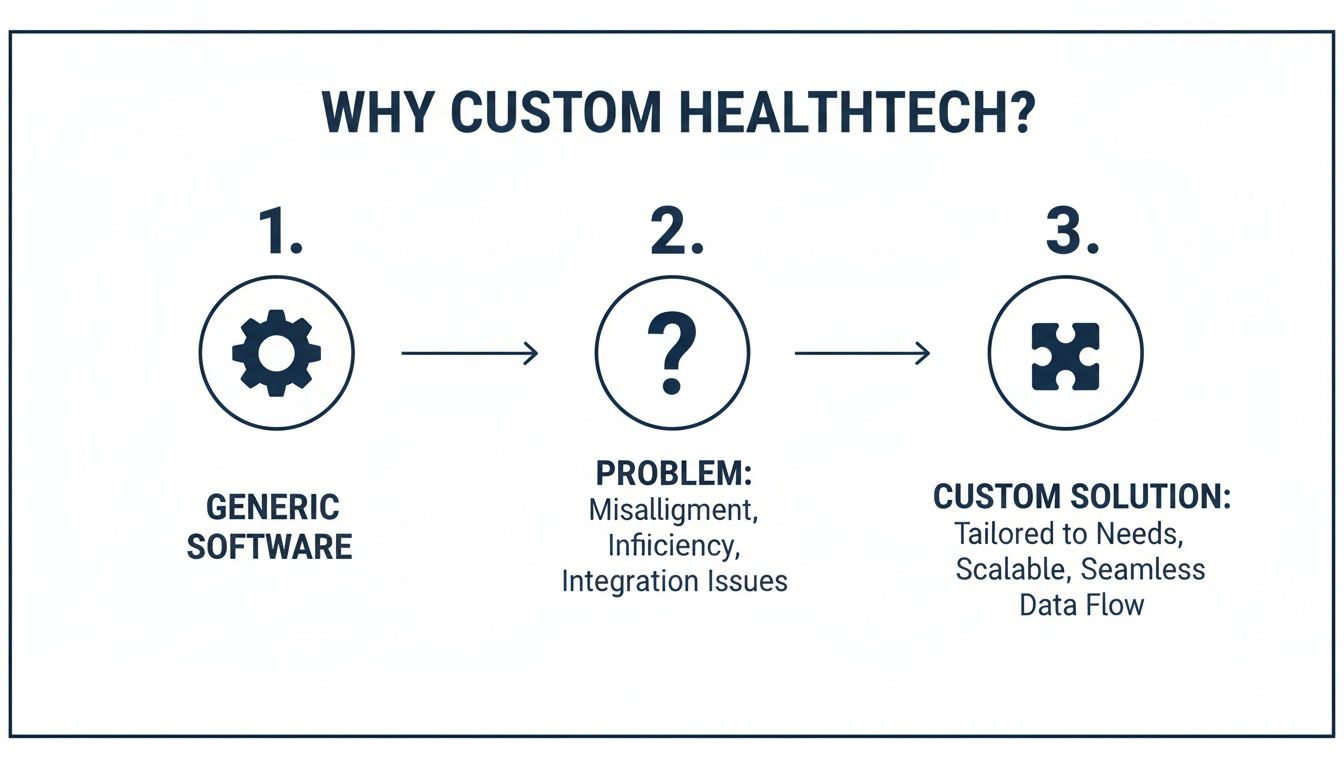
It really drives home the point that custom solutions aren’t just an alternative; they are often a necessary evolution for tackling specific healthcare challenges.
Navigating the Maze of Healthtech Regulations
When you’re building custom healthtech software, compliance isn’t a box to check at the end. It’s the foundation you build everything on. Think of regulations as the guardrails on a winding mountain road; they aren’t there to slow you down, but to keep you from going over a cliff. Ignoring them can lead to devastating data breaches and legal troubles that can completely derail your project.

Violating these rules doesn’t just come with steep fines; it shatters the trust of patients and providers, which is a death sentence for any healthcare app. It’s a sobering fact that a staggering 80% of major healthcare data breaches involve the very electronic protected health information (ePHI) your software will handle. This is why security can’t be an afterthought.
The Key Regulations You Need to Know
The world of healthtech regulation can feel like a tangled mess of acronyms. But at their core, these rules all serve a few simple purposes: protect patient data, ensure that data can be shared securely, and uphold individual privacy.
Here are the big ones you’ll encounter:
-
HIPAA (Health Insurance Portability and Accountability Act): In the United States, this is the law of the land for patient privacy. It lays out the national standards for keeping sensitive health information safe and secure, preventing it from being shared without a patient’s explicit consent.
-
GDPR (General Data Protection Regulation): If you have any users in the European Union, you must follow GDPR. It’s a sweeping regulation that gives people significant control over their personal data and comes with heavy penalties for getting it wrong.
-
FHIR (Fast Healthcare Interoperability Resources): This isn’t a law, but it’s just as important. FHIR is a standard that dictates how health information should be exchanged between different systems. It’s what makes it possible for an emergency room’s system to talk to a primary care doctor’s system, enabling truly connected care.
The point of these regulations isn’t to make development a headache. It’s to make healthcare safer for everyone. By adopting a “compliance-by-design” approach, you ensure your software is not just legally sound but also ethical and trustworthy from the ground up.
This isn’t something you can figure out from a quick Google search. It requires working with a team that has lived and breathed these rules and knows how to translate them into secure, functional code.
From Legal Text to Practical Code
This is where the rubber meets the road. Turning dense legal documents into actual software features is where many projects get stuck. A genuinely compliant app doesn’t just have a privacy policy; it has these rules baked into its very architecture.
Here’s what that looks like in practice:
-
Data Encryption: Both HIPAA and GDPR require that you encrypt patient data everywhere; when it’s sitting in a database (“at rest”) and when it’s being sent over the internet (“in transit”).
-
Access Controls: Your platform must have strict, role-based access. A nurse should only be able to see the clinical data needed for their job, while a billing administrator sees something entirely different. No one should have access to information they don’t need.
-
Audit Trails: Every single interaction with patient data must be logged. Who viewed it? Who edited it? Who shared it, and when? This creates an immutable record that is absolutely essential for security audits and investigations.
-
Patient Consent: The software must provide clear, simple ways for patients to grant or withdraw their consent for how their data is used and shared.
Getting these features right is a serious technical challenge. As we cover in our deep dive on HIPAA-compliant software development, it takes specialized expertise. By choosing the right partner, you can be confident that these critical safeguards are part of your application’s DNA from day one, resulting in a secure and reliable solution that earns everyone’s trust.
Weaving AI and ML into Your Healthtech Software
Artificial intelligence (AI) and machine learning (ML) have moved far beyond industry hype. Today, they are practical, hard-working tools that can fundamentally change how healthcare is delivered. When you build these technologies into your custom healthtech software development, you’re not just adding features; you’re creating a system that can predict health outcomes, accelerate diagnoses, and lift the heavy administrative weight off your clinical teams.

The numbers tell a compelling story. The AI in healthcare market is on track to skyrocket from USD 39 billion in 2025 to a staggering USD 504 billion by 2032. This isn’t happening in a vacuum; it’s directly connected to the massive global investment in healthcare IT, which is projected to hit USD 279.5 billion in 2025. Clearly, the demand is for smarter, AI-driven solutions that improve both patient care and operational workflows. For a deeper dive into these trends, HG Insights offers some excellent data.
What AI Looks Like in a Clinical Setting
The real magic of AI is its ability to sift through mountains of data and find subtle patterns that the human eye might overlook. This capability unlocks some incredibly powerful applications that can make a tangible difference in daily clinical practice.
Here are a few grounded examples:
-
Predictive Analytics for Early Intervention: Think of AI algorithms that comb through a patient’s entire history: genetics, lab results, lifestyle habits, to flag a high risk for a specific disease. This shifts the focus from treating sickness to proactively maintaining health.
-
An Expert Assistant for Diagnostic Imaging: Machine learning models can be trained on millions of X-rays, MRIs, and CT scans. The result? They can spot anomalies like tiny fractures or early-stage tumors with incredible precision, acting as a reliable second set of eyes for radiologists. This helps catch issues sooner and reduces the chance of human error.
-
Generative AI to End Tedious Paperwork: Ask any clinician what their biggest time sink is, and they’ll likely say documentation. Generative AI can listen to a patient consultation and automatically draft clinical notes, patient summaries, or referral letters. This gives doctors back their most valuable resource: time with patients.
Strategy First, Technology Second
Just deciding to “add some AI” is a surefire way to waste time and money. A successful AI project always begins with a clear strategy rooted in a real-world problem, not with the technology itself. You have to pinpoint the exact, high-value challenge that AI is uniquely positioned to solve.
The most effective AI integrations are born from a deep understanding of a real-world problem. Instead of asking, “How can we use AI?”, the right question is, “What is our biggest bottleneck, and could AI be the solution?”
This is where having a structured plan, like our AI transformation framework, makes all the difference. It forces you to identify and prioritize the use cases that will give you the biggest bang for your buck. This ensures you’re building something that creates real value, not just a flashy tech demo.
Finding the Right Partner for AI Integration
Building these kinds of sophisticated AI capabilities is a heavy lift. It requires a unique blend of data science, model training, and a deep understanding of how to weave the final product into existing clinical systems securely and compliantly. This is why partnering with a team that specializes in AI development services is so critical.
A good partner will guide you through both the technical and strategic minefields, making sure your investment pays off. It’s not just about building an algorithm; it’s about knowing how to make AI for your business work in the real world to meet your goals. As you map out your next steps, our guide on the key considerations for artificial intelligence integration services is a great resource for a more detailed look at the journey ahead.
Assembling Your Team and Calculating ROI
Great technology is only half the battle. Your custom healthtech software development project will sink or swim based on two things: the team you build and the business case you make for it. It’s not just about code; it’s about having the right experts in the room and a clear financial path forward.
First things first, you need to decide how you’re going to source your technical talent. There’s no one-size-fits-all answer here. The right choice really hinges on your project’s complexity, what your in-house team already looks like, and where you see this product going in the long run.
Choosing Your Engagement Model
When you’re sourcing people for a specialized build like this, you have a few well-trodden paths to consider. Each one offers a different balance of cost, control, and speed.
-
Project-Based Engagement: Think of this as the “black box” approach. You define a project with a clear beginning and end, hand over the specs, and the vendor builds it for a fixed price. It’s predictable, which is great for budgeting, but can get rigid if you need to pivot mid-project.
-
Staff Augmentation: Do you have a solid team but are missing a few key players, like a HIPAA compliance guru or a machine learning specialist? Staff augmentation lets you hand-pick experts to plug those specific skill gaps. You get direct control over these new team members, integrating them right into your existing workflows.
-
Dedicated Development Team: For a complex, long-haul project, this is often the gold standard. When you hire a dedicated development team, you’re getting a full, cross-functional crew that lives and breathes your project. They essentially become an extension of your own company.
For any serious healthtech application, a dedicated team is usually the smart money. You get the deep expertise and flexibility you need, and all the institutional knowledge built during development stays with the team as you move into maintenance and future updates.
Once you’ve landed on a model, it’s time to define the roles. A healthtech team isn’t your standard software crew. You’ll need specialists who get the nuances of healthcare, including a Product Manager, UI/UX Designer, Compliance Specialist (HIPAA/GDPR), Full-Stack Developers, QA Engineer, and a DevOps Engineer.
Sample Healthtech Project Timeline
To give you a clearer picture of how these pieces come together, here is an estimated timeline for building a mid-sized custom healthtech application. Remember, this is a sample – your actual timeline will depend on your project’s specific complexity and scope.
| Phase | Duration (Weeks) | Key Activities |
|---|---|---|
| Discovery & Planning | 2 – 4 | Defining project scope, technical requirements, user stories, compliance audit, risk assessment. |
| Design (UI/UX) | 3 – 5 | Creating wireframes, mockups, interactive prototypes, and user journey maps. |
| Development (Sprints) | 8 – 16 | Agile development cycles, building core features, API integrations, and security implementation. |
| QA & Testing | 3 – 6 | Functional testing, security penetration testing, performance testing, UAT (User Acceptance Testing). |
| Deployment & Launch | 1 – 2 | Server setup, data migration, final deployment to production, go-live support. |
| Post-Launch Support | Ongoing | Monitoring, bug fixes, regular maintenance, planning for future feature releases. |
This timeline helps you visualize the commitment from start to finish. Proper planning in the early phases is crucial for keeping the later, more intensive stages on track and within budget.
Building the Business Case with ROI
Getting the green light for custom healthcare software development takes more than a cool feature list. You need to present a rock-solid business case showing a clear Return on Investment (ROI). The upfront cost is just one line item; a compelling proposal focuses on the long-term value and savings the software will deliver.
To do this effectively, you have to connect the software directly to tangible, measurable results. Let’s break down how you can calculate this.
A Framework for Calculating Healthtech ROI:
-
Operational Efficiency Gains:
-
How much time will you save by automating tedious work like charting, scheduling, or billing? Put a number on it. Multiply the hours saved per employee each week by their average hourly rate.
-
Think about the cost of manual data entry errors. Estimate how much you spend fixing them and how the new software will virtually eliminate that cost.
-
-
Clinical Outcome Improvements:
-
Better post-discharge monitoring can dramatically reduce costly hospital readmissions. Project that reduction and attach the corresponding savings.
-
When patients stick to their treatment plans, they have better long-term health and need fewer expensive emergency interventions. Quantify the financial impact of that improved adherence.
-
-
Increased Revenue and Patient Retention:
-
Will you be offering new digital services like telehealth visits? Project the new patient volume and revenue that will be generated.
-
A great digital experience builds loyalty. Estimate the lifetime value of a patient and how much retention could improve with a modern, user-friendly platform.
-
When you walk into a budget meeting with a data-backed analysis of these gains, you shift the entire conversation. It’s no longer about spending money; it’s about making a strategic investment that will pay dividends for years to come.
Real-World Success Stories in Healthtech
Theory and process maps are great, but nothing speaks louder than results. The true test of custom healthtech software development is the impact it makes in the real world: for patients, clinicians, and healthcare systems alike. Seeing how a well-built solution solves a genuine problem is what really shows the value of building something for a specific purpose.
A fantastic public example of this is the UK’s National Health Service (NHS) app. Instead of trying to be everything to everyone at once, they focused on a single, high-impact user need: ordering repeat prescriptions. This simple but powerful feature unlocked a massive surge in digital adoption.
The Power of Patient-Centric Design
The demand for digital health is undeniable. The market is projected to skyrocket from USD 323.87 billion in 2022 to USD 1,258.64 billion by 2033, growing at a staggering CAGR of 21.4%. A huge slice of that pie, 61.5%, in fact, is telehealth, which tells you that patients want convenient, remote access to care. You can get a closer look at these numbers in this insightful digital healthcare report.
The NHS app is a perfect case study in meeting this demand. By focusing on that one patient pain point, repeat prescription orders jumped from 13 million to 25 million in just one year. That’s a 92% increase. This wasn’t just a technical achievement; it was a masterclass in understanding the user journey and removing a major point of friction.
The outcome was a clear win for everyone. Patients got a ridiculously convenient way to manage their medications, and the NHS significantly cut down on its administrative workload.
From Concept to Clinical Impact
Success stories like this don’t just happen by accident. They are the direct result of putting all the principles we’ve talked about into practice, from deep discovery and compliance-first thinking to smart technology integration. When a solution is truly built for the job, it turns lofty goals into real, measurable outcomes like fewer hospital readmissions, faster diagnoses, or better patient follow-through on treatment plans.
The most compelling success stories in healthtech start by solving a single, pressing problem for a specific user group. By delivering undeniable value, these applications build trust and create a foundation for broader digital transformation.
While big public examples are inspiring, seeing how these strategies work for specific business challenges provides even more clarity. Digging into detailed client cases can show you exactly how a strategic partner helps organizations achieve their own impactful results. Each story reinforces the same core idea: with the right approach and a skilled team, custom software becomes a powerful engine for improving healthcare.
Frequently Asked Questions
When you’re diving into custom healthtech software development, it’s natural to have a lot of questions. We get it. Here are some straightforward answers to the questions we hear most often, drawn from our experience building these solutions from the ground up.
How Long Does It Take to Develop Custom Healthtech Software?
This is the classic “it depends” question, but I can give you some real-world benchmarks. For a Minimum Viable Product (MVP) with just the essential features, you’re typically looking at a 4–6 month timeframe to get a working product into the hands of early users.
On the other hand, a comprehensive, enterprise-level platform with multiple complex integrations and rigorous compliance demands will realistically take 12–18 months, and sometimes even longer.
The biggest things that stretch out a timeline are:
-
The sheer scope and number of features you need.
-
The complexity of the clinical workflows you’re trying to digitize.
-
How many third-party systems, like EHRs, need to talk to your software.
-
The specific regulatory hurdles you need to clear for your market.
A solid discovery phase upfront is non-negotiable. It’s what allows us to build a reliable roadmap and sidestep those frustrating delays later on.
What Are the Biggest Risks in Healthtech Development?
The risks in healthtech are serious. At the top of the list is failing to meet regulatory standards, which can lead to crippling fines. Another major pitfall is poor user adoption: if doctors, nurses, or patients find your software confusing, they simply won’t use it. And, of course, a data security breach that exposes protected health information (PHI) is a nightmare scenario.
Beyond those, scope creep and budget overruns can quickly derail a project if it lacks a clear, well-managed strategy from the start. This is exactly why getting expert guidance through digital transformation consulting is so critical for mitigating these issues before they become problems.
How Much Does Custom Healthtech Software Cost?
The budget can swing pretty dramatically. A straightforward MVP might start around $50,000, while a feature-rich, complex system for a large organization could easily exceed $500,000.
What drives that cost? It comes down to the development team’s location and depth of experience, the technology stack we build on, the complexity of each feature, and the ongoing costs for maintenance and support.
It’s best to view this as an investment, focusing on the long-term ROI from improved efficiency, better patient outcomes, and a stronger competitive position rather than just the upfront cost.
Can I Integrate AI into My Existing Healthcare Software?
Absolutely, and it’s one of the smartest ways to upgrade your capabilities without having to build a whole new system from scratch. This usually involves creating custom AI modules that plug into your current software through APIs. For instance, we could build a predictive analytics model that sits on top of your EHR to flag high-risk patients.
A great first move is to schedule an AI Discovery Workshop. It’s a hands-on session where we can pinpoint the best opportunities for AI integration. From there, we map out a phased plan that delivers maximum value from using AI for your business with minimal disruption to your daily operations.
Ready to turn your healthtech vision into a reality? At Bridge Global, we specialize in building secure, compliant, and impactful custom software solutions.

About Shreesha Chandrabose
Shreesha Chandrabose is a commerce graduate with a growing passion for content writing and digital media. With a curious mind and a creative approach, she enjoys transforming ideas into simple, relatable, and engaging narratives. She loves poetry, photography, and editing, and enjoys bringing ideas to life through words and visuals.
View all posts by Shreesha Chandrabose →