

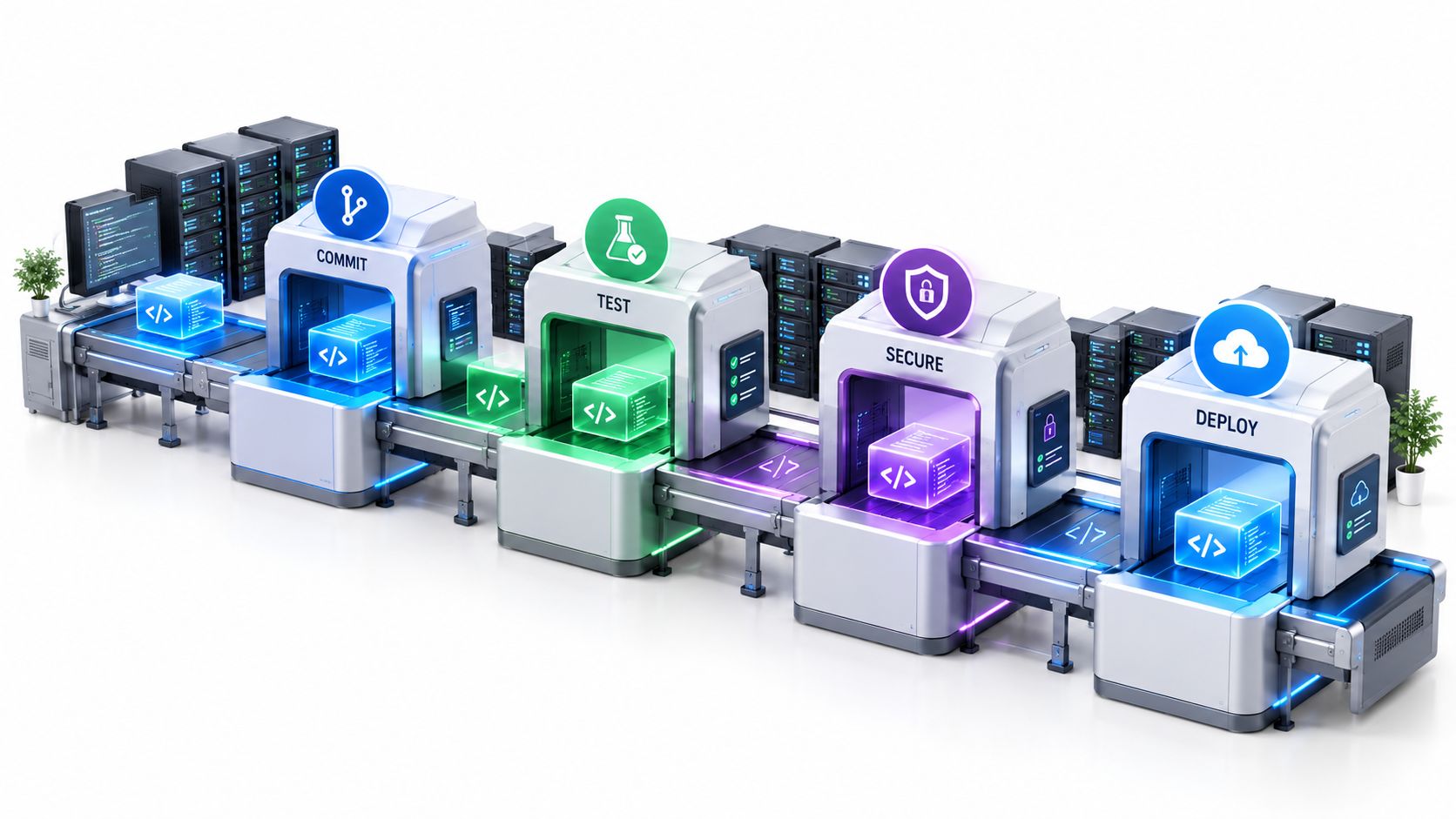

Continuous Software Delivery: The Enterprise Playbook
A healthtech SaaS team starts Monday with two regulatory hotfixes, a clinician-requested workflow change, and a release branch that has stalled because nobody can confirm which manual checks are complete. The engineers aren't short of effort. They're short of a delivery system that can move small changes forward while preserving evidence, control, and a safe way back.
Continuous software delivery solves that problem when teams treat it as an always-ready, audit-traceable flow from committed code to production-ready artifacts. It doesn't mean every successful build must go live. That latter model is continuous deployment, where a green build proceeds automatically to production. Continuous delivery keeps the release decision available without making release frequency the primary objective.
DORA's original framework made delivery performance measurable through deployment frequency, lead time for changes, mean time to recover, and change-failure rate. Its later evolution added reliability and failed-deployment recovery time, and in 2024 introduced deployment rework rate to capture unplanned work caused by production defects. DORA's research history shows why regulated teams should measure throughput and stability together.
The practical standard is simple: a team should be able to release on demand, explain exactly what changed, prove which controls ran, and recover when a release fails. That requires disciplined pipeline mechanics, deployment patterns suited to regulated workloads, safe database migrations, explicit AI-era gates, useful metrics, and a staged implementation plan.
What Continuous Software Delivery Really Means
The stalled release branch is usually a symptom, not the root problem. When a team must assemble test evidence manually, wait for an environment, confirm database scripts in a separate channel, and reconstruct approvals from chat messages, the delivery process has become a queue of human dependencies. Automating deployment alone won't remove that queue. It may only make an incomplete process run faster.
A working definition is more demanding. Continuous software delivery is the practice of keeping every acceptable change in a production-ready, versioned, and traceable state, with the decision to release separated from the act of building and validating the artifact. A commit should produce a known artifact, automated evidence, an environment result, and a clear promotion path. A release manager or authorized product owner can then decide when that artifact should reach users.
Delivery is not deployment
Continuous integration validates changes as they enter a shared codebase. Continuous delivery extends that flow through packaging, testing, security checks, environment promotion, and release approval. Continuous deployment removes the final approval step and sends every change that passes its gates to production.
That distinction matters in healthcare, insurance, and finance. A security patch may need immediate promotion, while a clinical workflow change may require a documented business decision, a support briefing, or a controlled feature activation. The code can be ready even when the business isn't ready to expose it.
Practical rule: Build and validate continuously. Release according to risk, operational readiness, and authorized business intent.
A production-ready artifact also needs more than a passing unit test. It should be tied to a commit, built reproducibly, scanned, tested against relevant contracts, associated with its deployment manifest, and accompanied by approval and rollback evidence. For a healthtech platform, the record should also show how sensitive data was protected across environments and who authorized the change.
What separates delivery from theatre
A pipeline is theatre when it reports green status while engineers still perform essential work outside the system. Common examples include manually editing production configuration, running a migration from a laptop, approving a change in an unrecorded call, or testing a different artifact from the one eventually deployed.
The useful question isn't, “How many releases did we make?” It is, “Can an independent reviewer reconstruct the path from commit to production and identify the decision points?” Teams evaluating a healthtech software development partner should ask that question early. The answer reveals whether the partner can operate an auditable delivery system or only configure CI tools.
Anatomy of a Modern CI/CD Pipeline
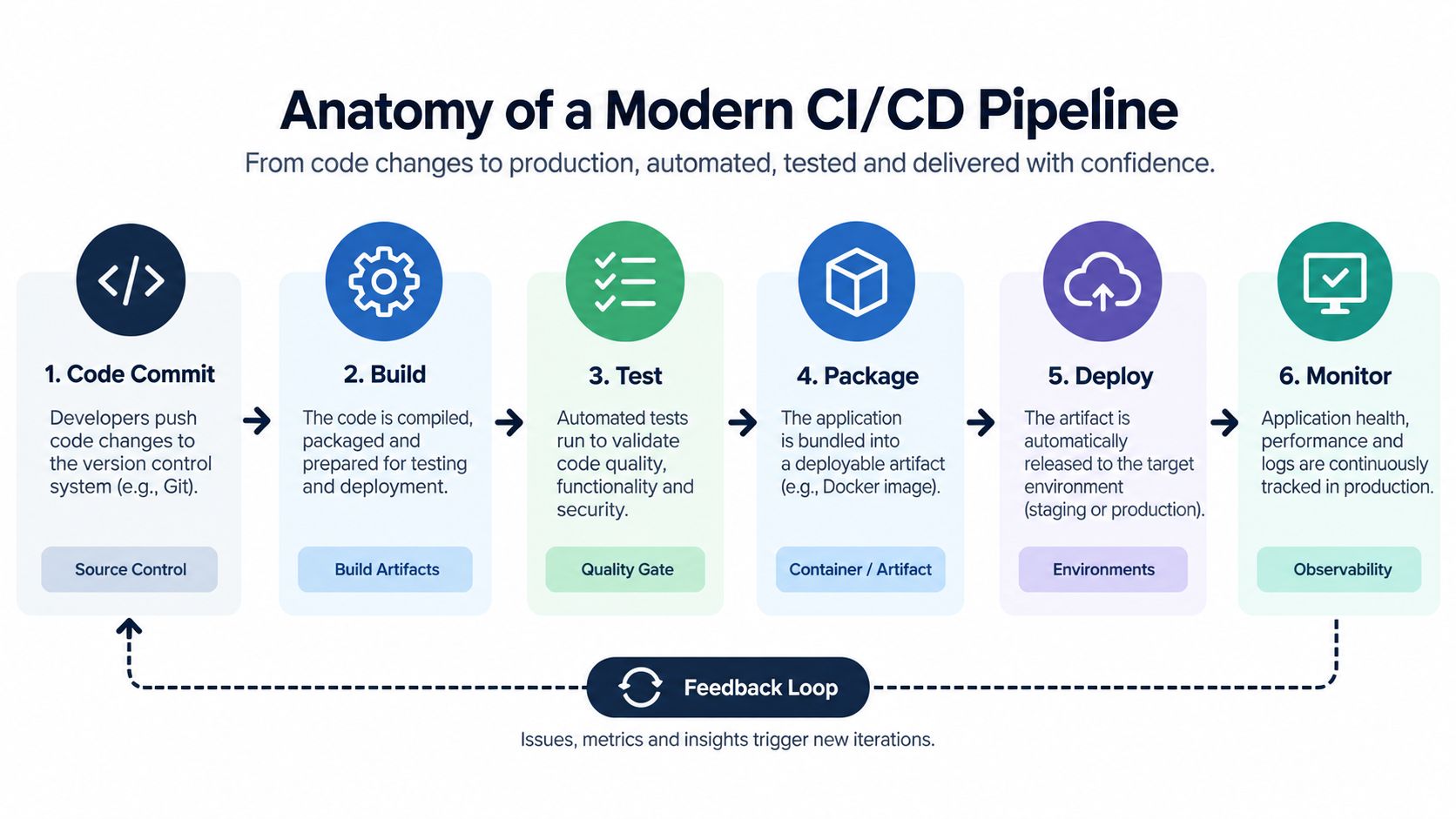
A reliable pipeline is a connected chain of evidence, not a checklist of fashionable tools. Each stage consumes a known input, performs a bounded action, and emits an artifact that the next stage can verify.
Start with an immutable change
Source control should define the change boundary. Pull requests, protected branches, required reviewers, signed commits where appropriate, and a clear merge policy prevent undocumented work from entering the delivery path. The trigger should identify the commit, dependency lockfile, build configuration, and relevant infrastructure changes.
The build stage should run in a controlled environment rather than on an engineer's workstation. A hermetic build limits variation in tools and dependencies, while artifact signing establishes that the image or package promoted later is the same one that passed validation. Generate an SBOM as part of the build and retain it with the artifact. The output is not merely “build passed.” It is a signed image, version metadata, dependency inventory, and reproducible build record.
Increase confidence in layers
Fast checks belong early. Unit tests, linting, type checks, and static analysis should stop obvious defects before expensive environment tests begin. Contract tests then verify that services agree on interfaces, which is essential when independent teams deploy APIs and consumers on different schedules.
Security and compliance scans should operate on the code and the built artifact. Integration tests, browser tests, dependency checks, and infrastructure validation can run in an ephemeral pull-request environment or a controlled integration environment. A staging environment should represent production configuration and data contracts closely enough to expose deployment problems, without copying sensitive production data into an uncontrolled space.
Promotion to production should reference the already-tested artifact. It shouldn't rebuild source code at the final step. Keep the deployment manifest, test reports, scan results, SBOM, approval record, and post-deployment checks together so an auditor can follow the release without relying on screenshots.
Teams building this operating model can also use DevOps roles as we are distributed, as a useful reference point when defining ownership across platform engineering, release management, and service teams. For a deeper treatment of automated validation, see test automation methodologies for modern CI/CD pipelines.
Evidence standard: A green pipeline is credible only when another person can inspect what ran, against which input, with what result, and under whose authority.
Deployment Patterns and Environment Strategy
Deployment patterns are risk controls, not interchangeable vocabulary. The right choice depends on blast radius, rollback mechanics, session behavior, data compatibility, and how quickly telemetry can reveal harm.
Blue-green deployment keeps a current environment and a separately deployed candidate. The team validates the candidate, drains or redirects sessions according to the application design, and switches traffic through a controlled routing layer. It fits regulated workloads when a clean cutover and fast return to the previous environment matter more than minimizing infrastructure duplication.
Canary deployment sends a limited portion of traffic or a selected tenant group to the new version. It suits user-facing changes where error rates, latency, business transactions, and clinical workflow signals can be observed before wider promotion. A canary is weak if the monitoring cannot distinguish the candidate from the stable version or if rollback criteria are subjective.
Feature flags decouple deployment from release. The code can be present in production while a workflow remains disabled for specific users, organizations, or roles. In healthcare, a flag can provide a kill switch for a clinician-facing feature, but flags create operational debt. Each one needs an owner, an expiry decision, audit logging, and tests for both states.
Match the pattern to the control
| Pattern | Best fit | Required controls | Rollback time |
|---|---|---|---|
| Blue-green | High-impact services needing controlled cutover | Session draining, environment parity, traffic switch audit, PHI segregation, documented rollback criteria | Fast traffic reversal when the previous environment remains healthy |
| Canary | User-facing changes that benefit from live telemetry | Cohort selection, error and latency thresholds, tenant isolation, automated halt, progressive promotion | Gradual or immediate traffic reduction, depending on the routing layer |
| Feature flags | Clinical or business workflows requiring release separation | Role-based access, flag audit trail, kill switch, owner, expiry review, dual-state testing | Immediate feature disablement when flag infrastructure is available |
Build an environment ladder
Use ephemeral pull-request environments for isolated validation, a shared development environment for team integration, and a dedicated integration environment for service contracts and external dependencies. Staging should mirror production configuration and data contracts while maintaining strict segregation of protected health information. Production can then use blue-green or progressive tiers based on service risk.
Every environment should be created and changed through versioned configuration. Secrets belong in controlled secret management, not repository files or manually edited dashboards. Production promotion should also account for session draining, audit events, background jobs, queues, and downstream integrations. A deployment that looks healthy at the HTTP layer can still corrupt a clinical workflow if asynchronous processing is ignored.
Teams planning custom healthcare software development should make rollback criteria explicit before implementation begins. The criteria should name the signal, owner, decision authority, and action. “Monitor closely” isn't a rollback plan.
Handling Database Changes Without Stopping the Train
Application code can often be replaced quickly. A schema change may alter persistent data, lock a heavily used table, or remove information that no previous binary can reconstruct. That makes database work a first-class delivery concern, not an implementation detail hidden inside an application pull request.
DORA's guidance finds that integrating database changes into the software delivery process contributes positively to continuous delivery and availability. Database change management guidance from DORA supports the expand-and-contract pattern because it separates compatibility, migration, and cleanup.
Use expand and contract by default
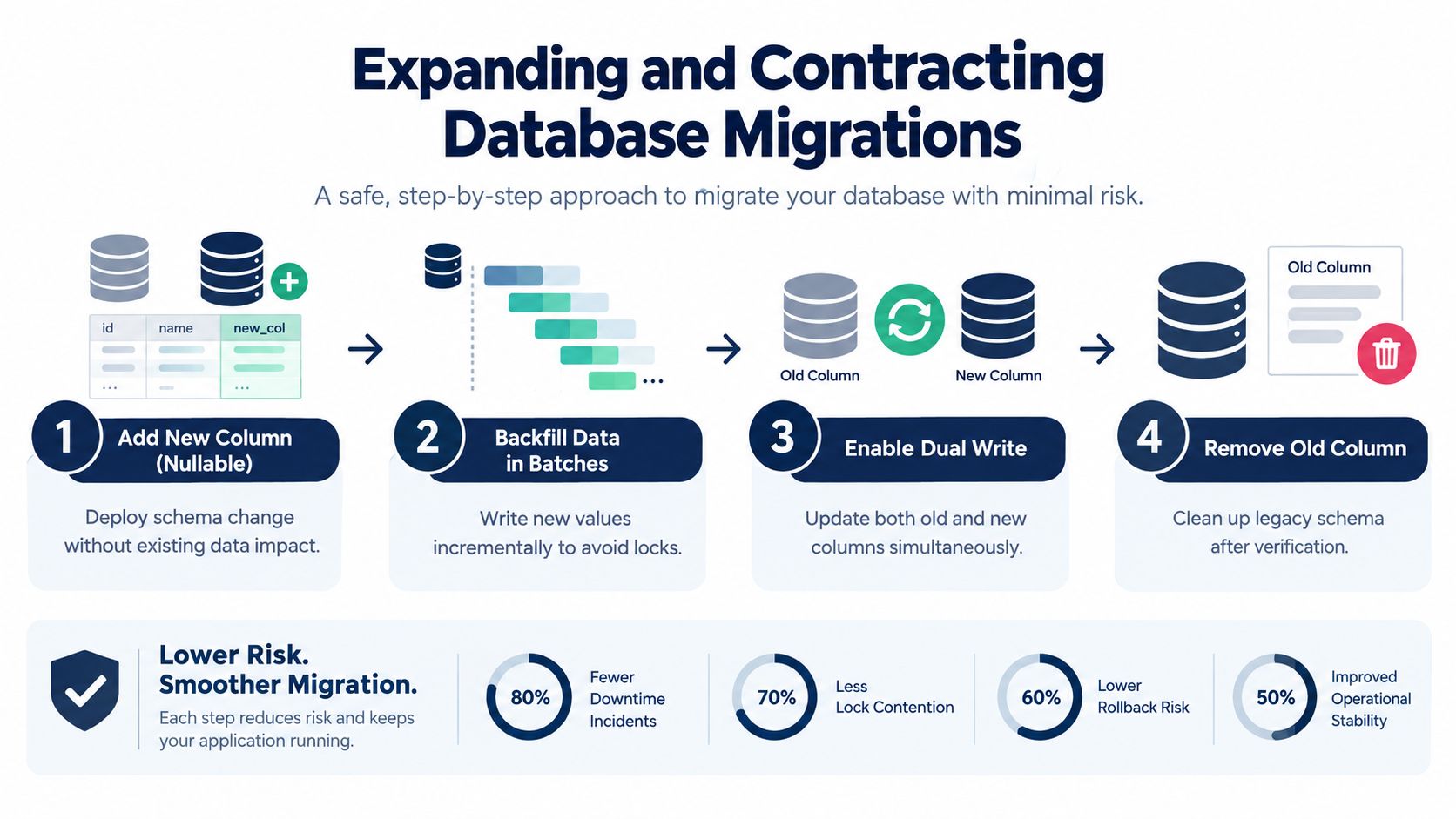
Suppose a patient profile needs a new nullable column. First, add the column without requiring existing rows to contain a value. Deploy application code that can read the old shape and the new shape. Then introduce a controlled, idempotent backfill job, throttled so it doesn't overwhelm the database or create unacceptable lock contention.
After verification, enable dual writes or switch reads to the new representation. Observe consistency, query performance, and downstream consumers. Only in a later release should the team remove the legacy column, and that destructive operation should require a separate manual approval.
The same discipline applies when splitting a table or introducing an enum. Create the new structure without breaking the current application, write compatibility code, migrate data in batches, switch reads, validate consumers, and remove obsolete structures only after dependency checks pass.
Make migration safety visible
Pipeline gates should include:
-
Schema diff review: Identify additions, type changes, index operations, destructive statements, and compatibility risks before execution.
-
Production-like dry run: Test the migration against a representative snapshot or equivalent data volume, with lock behavior and runtime recorded.
-
Rollback feasibility: Generate rollback DDL before execution and confirm whether it restores structure without losing transformed data.
-
Operational limits: Set lock timeouts, batch sizes, throttling, and cancellation behavior for long-running jobs.
-
Change window attestation: Record the authorized window, operator identity, approver, and post-deployment verification.
Retain the signed DDL, migration package digest, execution logs, timestamps, approval record, backup or recovery evidence, and verification output as release artifacts. A failed application deployment shouldn't leave a successful but undocumented schema mutation behind.
The data migration problems and how to fix them guidance is relevant here because migration failure usually comes from sequencing, incomplete validation, or hidden dependencies rather than from the syntax of a single statement.
Database rule: Never make an automated application release responsible for an irreversible data decision without a separately owned approval and recovery path.
AI in the Pipeline and the New Release Gates
AI changes the trust boundary in a delivery pipeline. A developer using an assistant to draft a test is one risk profile. An agent modifying infrastructure, changing access policy, or promoting a production artifact is another. Treating both actions as “AI-assisted development” hides the control difference.
Google's 2025 DORA research, based on nearly 5,000 technology professionals globally, found that 90% use AI at work and more than 80% report productivity gains, while AI adoption remains associated with greater delivery instability. The implication for engineering leaders is not to reject AI. It is to demand evidence proportionate to the change.
Use risk tiers rather than blanket approval
| Risk Tier | Example Use Case | Required Gates | Approval |
|---|---|---|---|
| Tier 1 | AI-generated unit tests, documentation, or low-risk refactoring | Linting, deterministic build, test execution, secret scan, provenance record | Automated merge when repository policy permits |
| Tier 2 | AI-assisted application code or integration changes | Human review, test evidence, dependency and security scans, prompt or context traceability, signed commit | Named reviewer signs off on evidence |
| Tier 3 | Autonomous production deployment or infrastructure change | Second engineer, policy evaluation, deterministic artifact verification, monitored rollout, automated rollback thresholds | Explicit production approval with recorded ownership |
The traceability record should connect generated code to the relevant prompt context or task, reviewer comments, merged commit, test results, and deployed artifact. Scoped API tokens should limit what an agent can access. Deny-listed actions should block destructive database operations, permission escalation, secret retrieval, and unapproved production changes.
Rollback triggers should use observable system behavior, such as error rate, latency, and SLO burn. A model's confidence score isn't an operational control. If the system cannot explain why a deployment proceeded or stopped, it isn't ready for autonomous promotion.
For leaders assessing AI development services, the important question is how generated changes enter the existing control system. The same principle applies to enterprise AI solutions, where model behavior, data access, infrastructure changes, and customer impact may span several teams. A practical discussion of the wider operating model appears in AI in DevOps and transforming software development and operations.
Teams also need to govern the tools surrounding AI agents. A technical overview such as NotFair's guide to MCP Ad tools illustrates why tool permissions and action boundaries deserve explicit review when an agent can call external systems.
Metrics and KPIs That Actually Predict Performance
Deployment frequency is easy to display and easy to misuse. A team can increase release activity by splitting changes, bypassing difficult checks, or pushing operational work outside the pipeline. That number says little about health unless it is interpreted with delivery speed, failure, recovery, and rework.
DORA's four core measures form a balanced scorecard: deployment frequency, change lead time, change-failure rate, and failed-deployment recovery time. DORA defines lead time as the elapsed period from version-control commit to production, while failure and recovery measures reveal whether a faster path remains stable. The DORA 2015 report describes why high-performing teams can improve speed and stability together rather than accepting failure as the cost of faster delivery.
The scale can be substantial. DORA's 2015 findings reported that high-performing organizations deployed 30 times more frequently, had lead times 200 times shorter, experienced 60 times fewer failures, and recovered 168 times faster than low performers. These ratios are historical findings, not targets to copy blindly. They show why speed should be evaluated alongside resilience.
DORA's 2021 benchmarks provide another historical comparison. Elite organizations often deployed on demand, with an illustrative normalization of approximately 1,460 deployments per year for four deployments daily, compared with about 1.5 deployments per year for low performers. That produces a roughly 973-times frequency difference, but the benchmark still requires stability measures to determine whether the flow is safe. The 2022 DORA report also connects stronger continuous-delivery capabilities with higher frequency, shorter lead times, and faster restoration.
Add rework to expose hidden cost
In 2024, DORA added deployment rework rate to capture unplanned work caused by production defects. Rework matters because a team may appear fast while spending its capacity repairing earlier releases. Instrument the scorecard from commit, build, deployment, incident, and recovery events instead of asking teams to self-report.
| Metric | What It Measures | Reliable Data Source |
|---|---|---|
| Deployment frequency | How often production deployments occur | Deployment controller and release records |
| Change lead time | Time from commit to production | Version control and deployment timestamps |
| Change-failure rate | Deployments requiring immediate intervention | Incident linkage and rollback records |
| Failed-deployment recovery time | Time needed to restore service after a failed release | Incident, rollback, and recovery events |
| Deployment rework rate | Unplanned delivery work caused by production defects | Defect, incident, and follow-up change records |
Slice results by service, team, and regulatory domain. Publish three metrics weekly, assign an owner to each, and act on the result within 30 days. Otherwise, the dashboard is theatre.
Your 90-Day Continuous Delivery Roadmap and Starter Checklist
A delivery transformation works better when it begins with evidence rather than a platform purchase. The first phase should expose queues, manual approvals, unreliable environments, and database risks. The second should standardize the safe path. The third should add intelligence only after the basic control loop works.
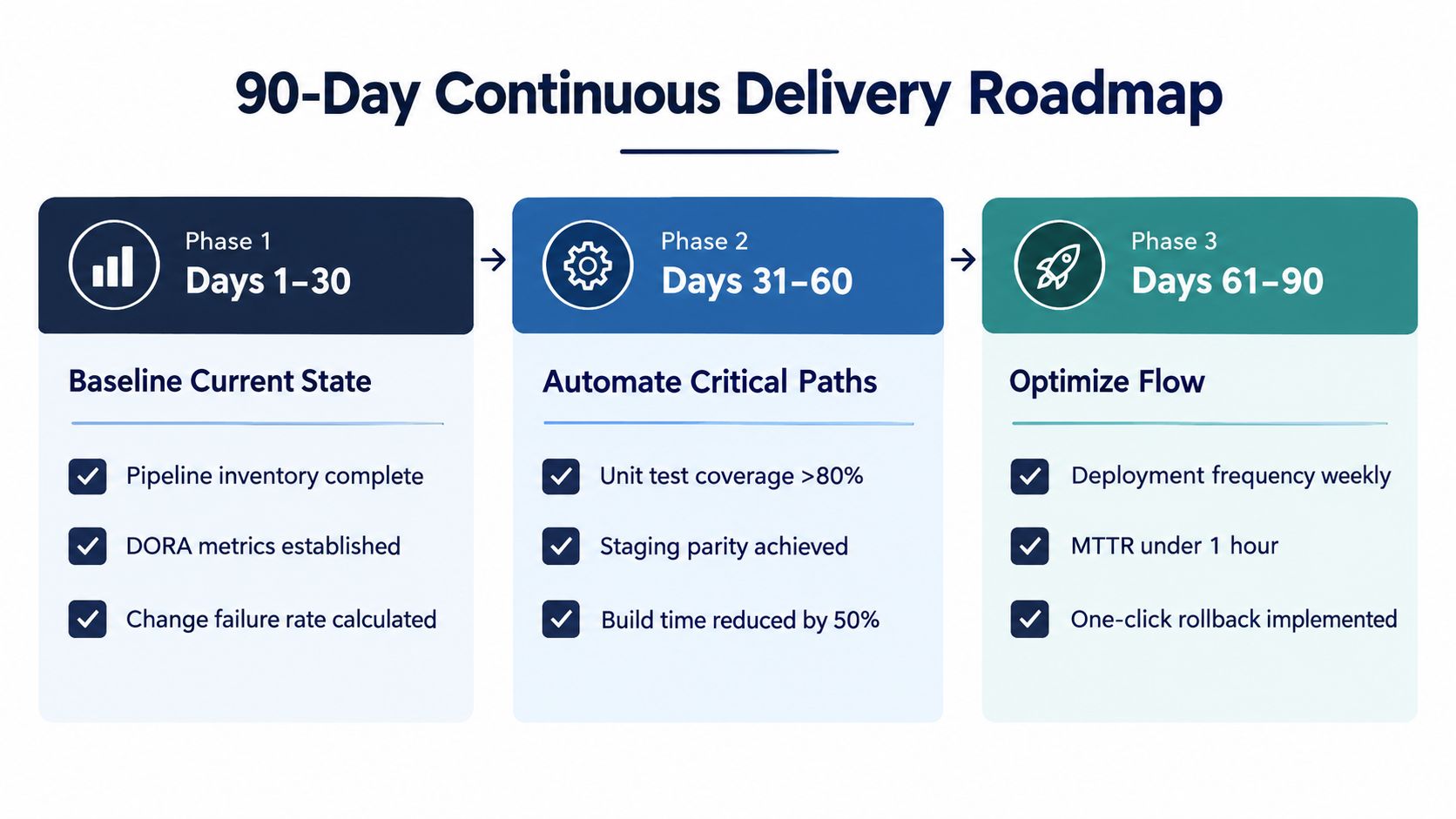
Days 1 to 30: Establish the baseline
Inventory every pipeline and release path, including manual scripts and approvals outside the delivery platform. Establish the DORA measures, calculate change-failure rate, and document the compliance steps that block or delay production changes. Assign ownership for each service, environment, rollback action, and evidence record.
Do not optimize a metric before confirming its source. A deployment event should represent an actual production change, and an incident should link to the release that caused or exposed it.
Days 31 to 60: Standardize the core path
Move teams toward trunk-based development or an equivalent short-lived branch policy. Implement gated CI with signed artifacts, layered tests, security scans, deployment manifests, and retained reports. Introduce blue-green production where the service can support it, and make expand-and-contract the default for stateful changes.
At this point, the team should be able to promote one known artifact through environments without rebuilding it. The release process can still retain a human approval gate, particularly where clinical, financial, or insurance risk requires accountable authorization.
Days 61 to 90: Add controlled optimization
Add risk-tiered AI release gates, automated rollback triggers, and a DORA-plus-rework dashboard. Use an AI implementation roadmap to connect adoption to governance, access controls, evidence, and operating ownership rather than treating AI as an isolated developer tool.
A starter checklist should include:
-
Version control policy: Protected branches, review rules, commit identity, and merge ownership.
-
Required pipeline stages: Build, signed artifact creation, tests, scans, deployment validation, approval, and promotion.
-
Environment parity rules: Versioned configuration, production-like contracts, and protected data segregation.
-
Database conventions: Expand-and-contract sequencing, dry runs, rollback DDL, and destructive-change approval.
-
AI evidence: Generated-code provenance, reviewer sign-off, scoped tokens, and denied actions.
-
Rollback ownership: Named responder, trigger thresholds, routing control, and recovery evidence.
-
KPI cadence: Weekly publication of selected metrics, service-level slices, and an action deadline.
The implementation should also account for the systems around the product. Teams delivering healthcare integrations, SaaS product development, or broader custom software development may need different environment contracts and release authorities. Choosing appropriate software development service models helps clarify where an internal platform team ends, and an external delivery partner begins. Review relevant client cases for evidence of delivery context, but ask for the underlying operating practices, not only the outcome story.
Continuous software delivery is working when every release is small enough to understand, controlled enough to audit, and observable enough to reverse. It isn’t working when the organization celebrates automation while engineers still depend on undocumented intervention.
Bridge Global provides custom software, healthcare technology, AI development, and DevOps delivery support for teams building auditable release pipelines and scalable digital products. Visit Bridge Global to discuss your current delivery constraints and define a practical path from manual releases to controlled continuous software delivery.

About Preethi Saro Philip
Preethi Saro Philip is a Post Graduate Research Degree holder in Economics with more than 10 years of experience in writing, editing, research and teaching. She has an intense passion for content crafting and calls herself a ‘wordsmith’. She enjoys writing on wide-ranging topics including business, technology, health & lifestyle, education, environment etc.
View all posts by Preethi Saro Philip →