



API Development Services: What Teams Get and What It Costs
API development services cover design, build, documentation, security, testing, management and integration across the full API lifecycle. The scope includes the contracts consumers depend on and the controls needed to keep those contracts reliable after release.
Who owns the consequences when an endpoint changes and a partner's order import stops working? That question matters more than how quickly a team can write the controller. My view is that integration work and ongoing governance often outweigh endpoint code in total effort, so buyers should evaluate lifecycle ownership alongside implementation skills.
What API Development Services Cover
An API behaves like a supplier contract. Every consumer depends on its exact terms, including field meanings, error responses and supported operations. Changing those terms without coordination can break a partner even when your application still passes its own tests.
ERP, CRM and ecommerce platforms also have different owners and release schedules. A complete engagement must account for those boundaries.
| Component | What the provider delivers | Artifact the buyer receives |
|---|---|---|
| Design | Resource model, API style choice and interface contracts | Reviewed OpenAPI or AsyncAPI file in version control |
| Build | Service implementation, data mapping and connectors | Running code with unit and integration tests |
| Documentation | Reference docs, examples and changelog | Published reference generated from the contract |
| Security | Authentication, authorization, input validation and secrets handling | Threat model and security test report |
| Testing | Contract, functional, load and security tests | Test suites in CI with pass and fail history |
| Management | Gateway policies, API keys, quotas and versioning rules | Configuration as code and an operations runbook |
| Integration | Connectors to ERP, CRM, ecommerce and partner systems | Mapping specification and sandbox test results |
Documentation deserves explicit acceptance criteria. In Postman's 2024 State of the API survey, based on responses from more than 5,600 developers and API professionals worldwide, 39% identified inconsistent documentation as the biggest obstacle.
Within a broader custom software development engagement, your team might retain architecture and operations while a provider builds connectors. Write those boundaries component by component, including who approves changes and who responds to production failures.
Buying rule: A deliverable should be something your engineers can inspect, run or operate after handover.
Before requesting proposals, mark which components your team already handles well and which lack an owner. That inventory produces a more useful scope than a request to build an API.
Choosing an API Style for Each Integration
Choose the style around the consumer and its change pattern. A mobile application assembling a screen has different needs from an ERP accepting an invoice.
| API style | Best fit | Main trade-off | Typical consumers |
|---|---|---|---|
| REST | Resource-oriented business operations, with cacheable GET responses | Multiple round trips for composite views | ERP, CRM, ecommerce and partner systems |
| GraphQL | Client-driven queries across related entities | Harder caching and required query-cost controls | Web and mobile front ends |
| gRPC | Internal calls with strict schemas and low protocol overhead | Limited native browser support, often requiring a proxy | Internal microservices |
| Webhooks | Notifications when business records change | Requires retries, signature verification and a reachable receiver | ERP, CRM and ecommerce event consumers |
| Async APIs described with AsyncAPI | Decoupled or long-running processing through message brokers | Eventual consistency and harder ordering diagnostics | Order processing, inventory synchronisation and reconciliation |
Let the consumer justify the choice
Ask who calls the interface, how frequently its data changes, whether callers need push notifications, and what happens when a dependency is unavailable.
An ecommerce catalogue can use REST with HTTP caching. A mobile order screen combining customer, shipping and payment information may benefit from GraphQL. Internal pricing and inventory services may justify gRPC when their teams can manage generated clients and compatible schema changes.
A webhook can tell an ERP that an order was paid. A message queue better suits reconciliation work that can finish later without blocking a user. AsyncAPI documents that messaging contract; it isn’t the transport itself.
For a booking-system example, Samba’s resource on how to connect booking data via API provides a useful starting point for evaluating the consumer’s integration requirements.
Avoid GraphQL for a simple partner feed that maps cleanly to REST resources. If you expose GraphQL externally, enforce query-depth, complexity and rate limits.
I would start business integrations with REST and webhooks, adding another style only when a named consumer has a concrete requirement.
Designing Contracts for ERP, CRM and Ecommerce Integrations
API-first practice is mainstream. 82% of organizations surveyed worldwide had adopted some level of an API-first approach in 2025, according to Postman’s State of the API Report, based on more than 5,700 developers, architects and executives.
Design-first work puts an OpenAPI description ahead of REST implementation and an AsyncAPI description ahead of event-channel implementation. For an ecommerce-to-ERP order sync, the procedure should make business semantics explicit.
- Map business objects and identifiers. Record how each system identifies orders, customers, products and invoices, because their keys rarely align automatically.
- Write the OpenAPI contract with error responses and retry behaviour. Require idempotency keys for writes that could create duplicate effects, with server-side storage and replay rules so retrying an invoice request doesn’t create another invoice.
- Agree on representation rules. Define pagination, timestamps, currency precision and partial-update semantics to prevent ambiguous mappings.
- Generate a mock server so the ERP team can test its client before the backend is complete.
- Approve the contract in version control. Name the system owner who can approve changes so implementation has an accountable baseline.
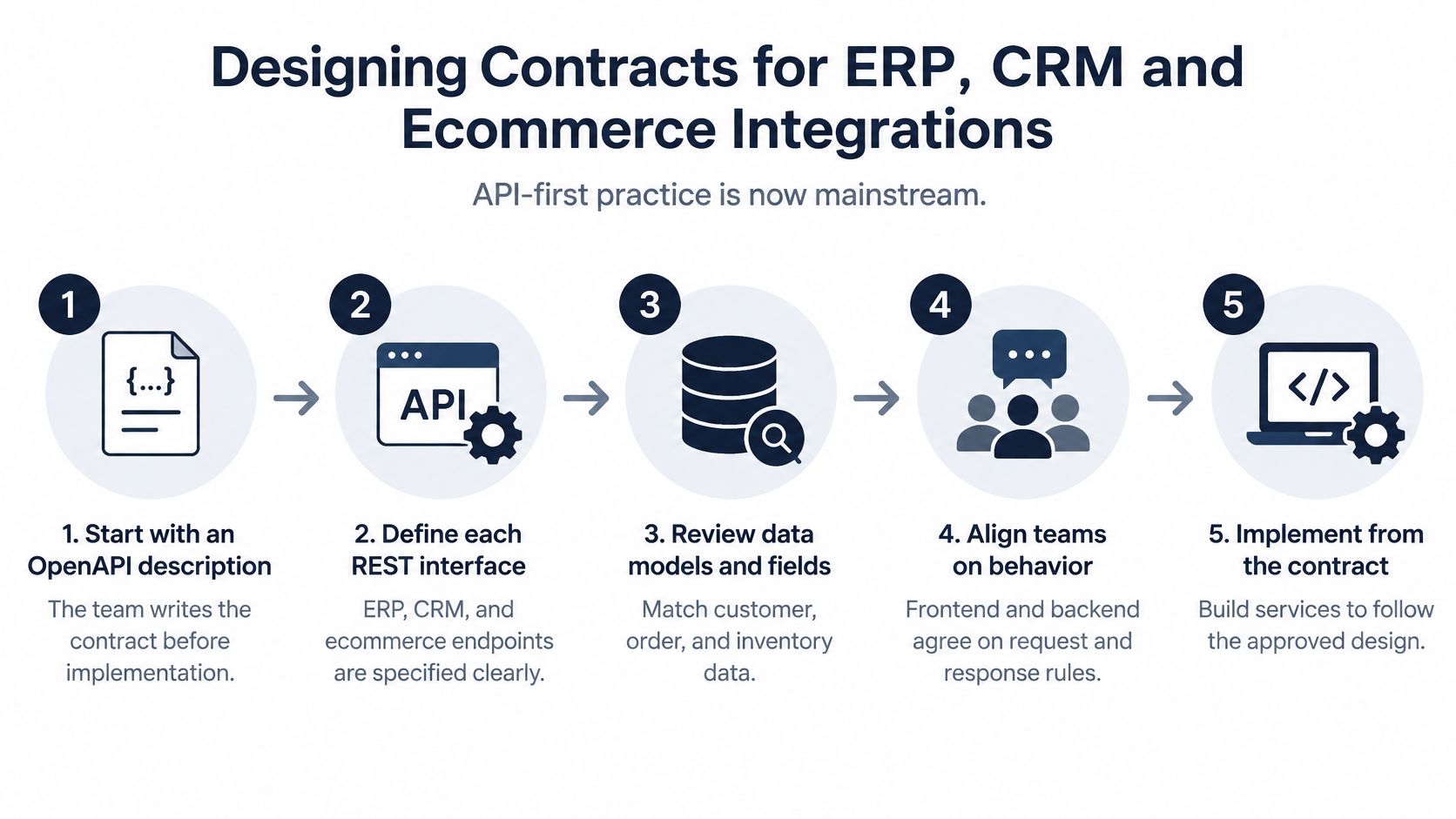
PlatformDTC’s discussion of idempotent ecommerce API retries is a useful companion when defining duplicate-request behaviour. Include payload-conflict handling and the retention period for idempotency records in your own contract.
We develop custom ERP and CRM platforms that connect teams, workflows and business data, refining modules iteratively with continuous customer collaboration. The same contract discipline applies to web application development and the workflows discussed in our B2B ecommerce development guide.
Healthcare interfaces add domain-specific standards, as explored in our healthcare API management guide, healthcare API development guide and healthcare integrations resources.
Acceptance test: Can an ERP developer build a working client from the contract alone?
Securing Business APIs with OAuth 2.0 and Access Controls
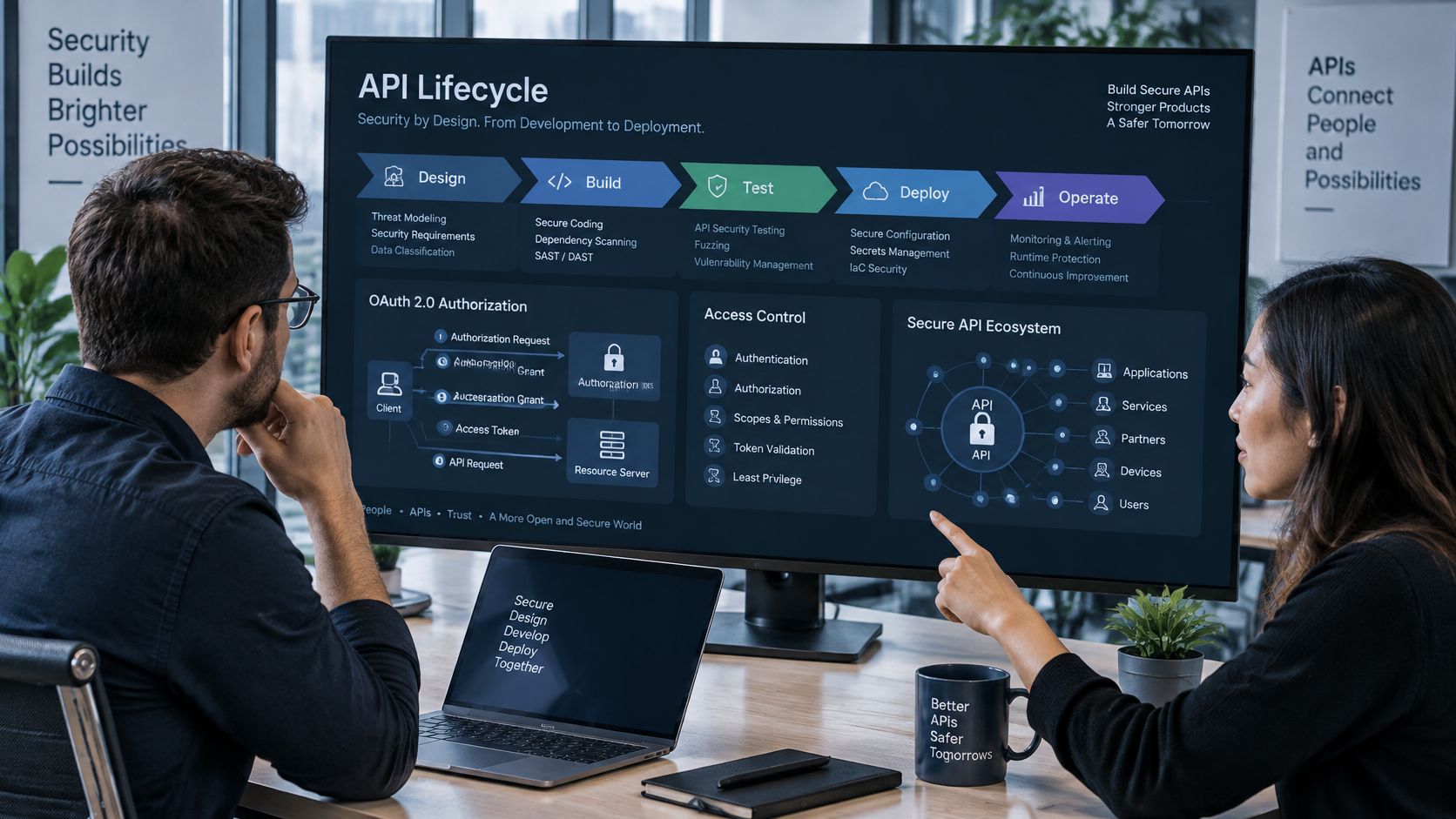
Authorization boundaries and connector privileges need attention before deployment. NIST’s API protection guidance separates specification and schema validation before runtime from controls protecting live communications, including encrypted transport and service-level and identity-level authorization.
A gateway can enforce shared policies. Each API still needs enough business context to decide whether the caller may access the requested record.
Protect the request and the resource
Use OAuth 2.0 for delegated authorization. For user-facing applications, prefer authorization code flow with PKCE; for suitable service-to-service integrations, use client credentials with narrowly scoped, short-lived access tokens.
Don’t confuse token validation with user authentication. Validate issuer, audience, signature and expiry, then evaluate whether that identity can perform this operation on this order. Use an appropriate authentication layer when the application needs to establish the user’s identity.
| Control | Request it protects | Risk if missing |
|---|---|---|
| Scoped, short-lived access token | Every business endpoint call | Over-broad tokens remain useful after a leak |
| Object-level authorization | Record reads and writes by ID | Changing an order ID exposes another customer's record |
| OpenAPI schema validation | Request bodies and parameters | Malformed or oversized input reaches business logic |
| Vaulted, rotated secrets | ERP and CRM connector credentials | Old keys survive staff or system changes |
| Least-privilege service account | Connector calls into business systems | A connector can modify unrelated data |
Test altered record identifiers explicitly. When an order belongs to another customer, return an appropriate forbidden or non-disclosing not-found response.
Apply per-client quotas and burst limits, returning a too-many-requests response and retry guidance when appropriate. Rate limits protect capacity; authorization protects access. Neither substitutes for the other.
For personal data, design audit events to record the acting identity, accessed resource, operation and outcome without copying sensitive payloads into logs. Determine retention and access restrictions through the applicable privacy and risk review.
Our application security work includes code reviews, penetration testing and AI-driven threat detection supporting cybersecurity compliance work. For agent-based consumers, Mallary.ai’s explanation of securing AI agents with OAuth provides additional authorization context.
Start the security review with an endpoint inventory containing each endpoint’s data class, required scope and resource-level access rule.
Versioning, Performance and Gateway Options
A published API contract outlives its first release. Consumers need time to adopt changes, and some won’t upgrade on your preferred schedule.
Path versioning makes routing and manual testing straightforward. Header or media-type versioning keeps resource URLs stable but makes browser testing less convenient. Additive evolution can avoid another version, provided consumers tolerate unfamiliar fields and values.
| Change | Working decision |
|---|---|
| Add an optional response field | Usually compatible; verify client deserialization |
| Rename or remove a field | Treat as breaking |
| Change a field's meaning | Treat as breaking even if its type stays unchanged |
| Introduce another required request field | Provide a migration path or new contract version |
Deprecation needs an announcement, a migration guide and an agreed retirement date. Where supported, return a Sunset header so consumers can capture the retirement signal in their own telemetry.
Measure the user’s wait
Agree an endpoint latency target with the business owner and evaluate tail latency, including the p95, alongside error rates. Treat targets as planning decisions tied to user journeys, rather than universal benchmarks.
Use cursor pagination for large, changing collections, with stable ordering and tie-breakers. Offset pagination can suit smaller, relatively static lists. Apply ETag and Cache-Control policies where data sensitivity and freshness requirements permit caching.
Managed cloud gateways reduce some operational work. Self-hosted open-source gateways offer deployment control while leaving upgrades and availability with your team. Service-mesh ingress components can cover overlapping routing and policy needs, although developer portals and subscription management may require additional tooling.
Choose based on deployment location, policy ownership and operator skills. A gateway won’t repair a weak data model; cloud services decisions should account for the backend and its dependencies.
Testing and Monitoring After Launch
Tests establish release readiness, while monitoring shows how the system behaves under real consumers. A successful launch demonstration offers little evidence about expired credentials or duplicate deliveries.
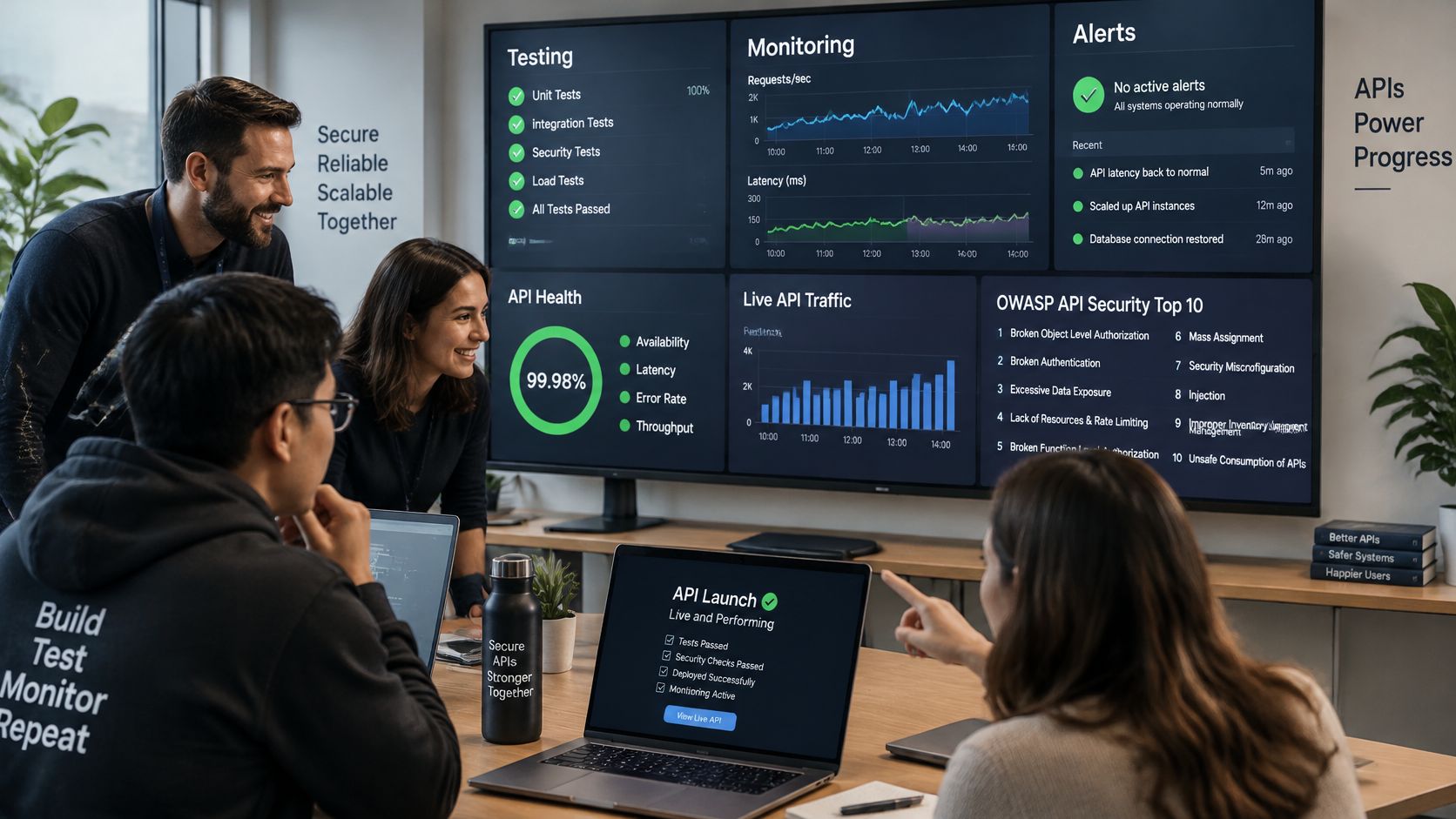
The OWASP API Security Top 10 provides a named framework for API-specific reviews, including broken object-level authorization, unrestricted resource consumption and improper inventory management.
Run evidence-producing checks through the delivery pipeline.
- Contract checks validate responses against OpenAPI during builds.
- Exercise integration workflows against ERP or CRM sandboxes with realistic mappings and failure cases.
- Negative and authorization tests cover malformed input, expired tokens, incorrect scopes and another customer’s records.
- Run load tests against production-like staging using an agreed peak-load assumption and headroom.
- Security review combines automated scans with penetration testing appropriate to the release risk.
Make every alert actionable
Track endpoint error rates, tail latency, throttling responses, schema-validation failures and webhook delivery outcomes. Alert on sustained deviations with enough request context to investigate, while keeping sensitive data out of telemetry.
An authentication-error surge after credential rotation should reach the integration owner promptly. Waiting for a periodic partner report leaves the business workflow broken.
Coordinate software quality assurance with DevOps services; our DevOps work covers builds, deployment automation, monitoring and infrastructure. We track QA, DevOps and deployment changes throughout development in the client’s chosen project management platform.
Our guide to AI-assisted API testing workflows discusses supporting automation. Keep production and nonproduction endpoints in the inventory, write monitoring requirements before go-live, and assign an owner to every alert.
Cost Drivers and a Provider Checklist
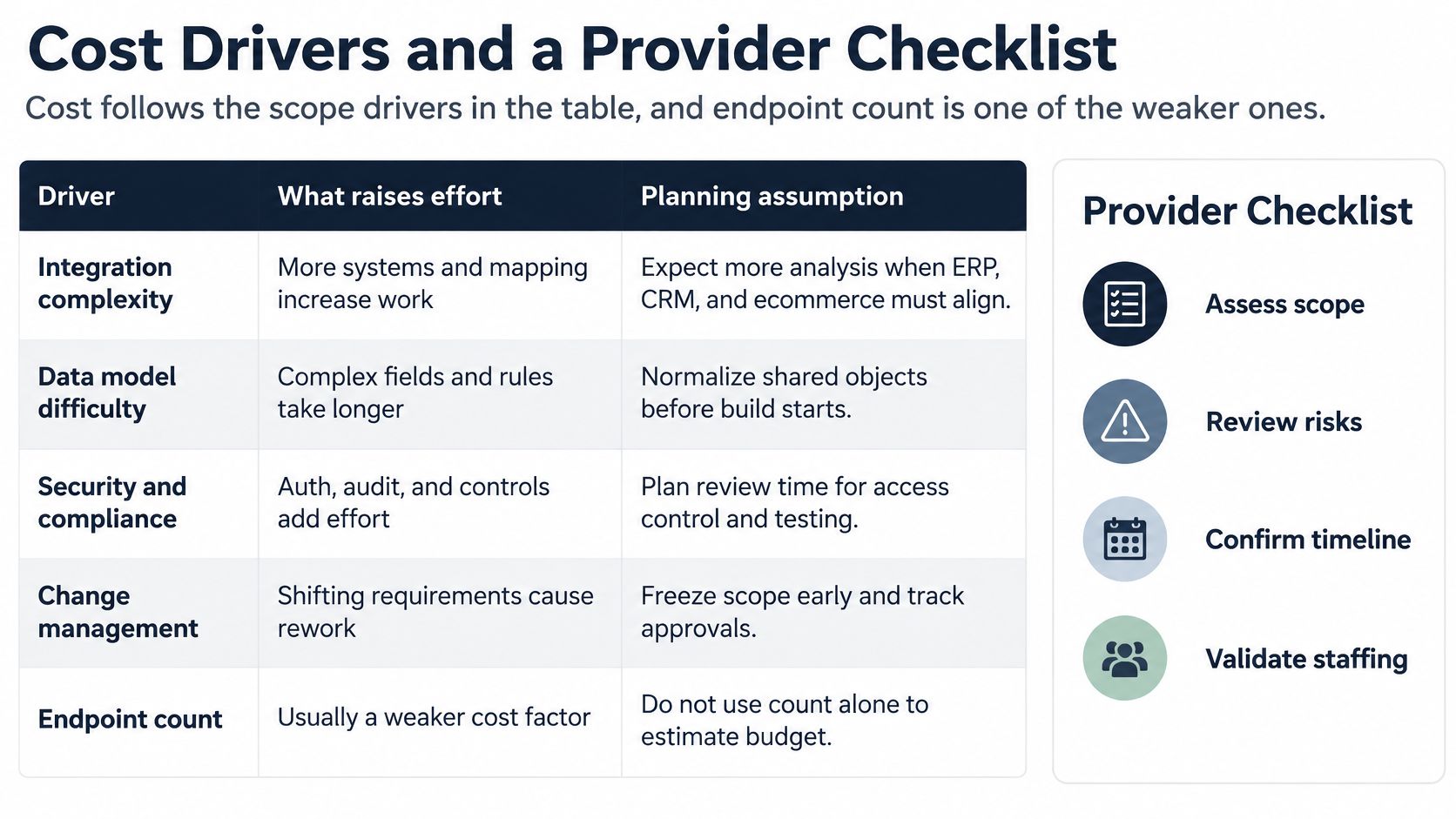
Cost follows integration scope and operating obligations. I consider endpoint count a weak standalone estimator, because a simple lookup and a regulated transaction workflow can require very different work.
| Cost driver | What raises the effort | Planning assumption |
|---|---|---|
| Number of integrations | Each connector has its own data model | Separate mapping and test cycle per system |
| Data model complexity | Custom objects, many-to-many relations and legacy codes | Discovery before accepting an estimate |
| Security and compliance | Audit logging, regulated data and penetration testing | Review and retest material changes |
| Legacy systems without APIs | File, database or middleware adapters | Budget ongoing adapter maintenance |
| Versioning and consumer count | Partners and apps using live versions | Support windows create recurring work |
| Documentation and sandbox | Developer portal, examples and sandbox data | Budget these explicitly |
| Engagement model | Fixed-scope project versus dedicated team | Match the model to requirement stability |
No price figures are given here. A useful indicative estimate needs documented assumptions and a scoped proposal, consistent with the considerations in our custom software development pricing guide.
Put ownership into the proposal
Use these questions as an acceptance checklist.
- Scope Can you document ownership across every service component?
- Contracts Will OpenAPI or AsyncAPI files remain in our repository?
- Evidence Which test reports and OWASP mappings accompany releases?
- Operations Who controls credentials, audit logs and gateway configuration after handover?
- Staffing Which named engineers cover architecture, QA, DevOps and implementation?
- Ownership Who owns code and documentation, and how will our engineers participate?
- Handover Does the sample include a runbook and deprecation policy?
We can assemble dedicated teams with developers, QA engineers, architects and DevOps specialists, working alongside the client’s internal team and development workflow. Compare full-cycle software delivery with co-creation with in-house teams according to retained responsibilities.
Bridge Global is a Dutch software engineering partner offering software development services that can support scoping a component-level engagement for your systems.
Conclusion
The strongest API engagement makes ownership visible. Decide which components the provider owns, which interface style each consumer needs, and which evidence must accompany a release.
Start straightforward business integrations with REST and webhooks unless a consumer justifies another approach. Treat published contracts as continuing obligations, and enforce business authorization within the API even when a gateway handles shared controls.
A useful handover leaves your engineers able to change the system safely and operate it without undocumented dependencies.
This week, write the component scope for your most important integrations and name each contract owner. Include consumer contacts, acceptance artifacts and operational responsibilities before discussing implementation dates.
Frequently asked questions
How much do API development services cost?
Cost depends on integration scope, data-model complexity and security requirements. Request an indicative estimate tied to written assumptions and a scoped proposal.
What is the difference between an API and an integration?
An API defines an interface and its behaviour. An integration connects systems using that interface, with data mapping, failure handling and monitoring.
How long does an API project take?
Duration follows the component scope, connected systems and approval dependencies. A design-first contract and mock server let consumer teams begin before backend implementation finishes.
Should we build APIs in-house or use a provider?
Choose according to available skills, ownership requirements and timing. Co-creation can retain knowledge internally while adding engineering capacity.
Do we need an API gateway from the first release?
A single internal consumer may work without a separate gateway if the service implements necessary controls. Central management becomes more useful when consumers need different quotas, access policies or version-routing rules.
Bridge Global offers custom software development and engineering teams that work alongside your internal developers. Bring your integration inventory and ownership gaps to Bridge Global to discuss a component-level scope for API contracts, implementation and ongoing operations.

About Preethi Saro Philip
Preethi Saro Philip is a Post Graduate Research Degree holder in Economics with more than 10 years of experience in writing, editing, research and teaching. She has an intense passion for content crafting and calls herself a ‘wordsmith’. She enjoys writing on wide-ranging topics including business, technology, health & lifestyle, education, environment etc.
View all posts by Preethi Saro Philip →