



Your Guide to AI Software Development in This Era
Think about your software development team, but with a powerful new collaborator working alongside every engineer. This isn't science fiction anymore; it’s the practical reality of AI software development. AI is quickly becoming a core part of how we build modern applications, influencing everything from the first brainstorming session all the way to long-term maintenance.
For CTOs and product leaders, this isn't just another trend to watch. It's a fundamental change in how great software gets made, and ignoring it means falling behind.
The New Reality of AI Software Development
The very process of building software is being rewritten. AI tools are now sophisticated 'pair programmers,' working side-by-side with engineers to boost their productivity, catch errors early, and get products to market faster than ever. The goal isn't to replace developers; it's to give them superpowers so they can solve bigger, more interesting problems.
This guide will show you how working with a leading AI software development company can give you a real, measurable advantage.
The shift is undeniable, and the numbers tell a compelling story about where the industry is headed. AI isn't just a feature anymore; it's becoming the factory floor.
Gartner predicts that by 2030, 80% of organizations will have moved from massive software engineering teams to smaller, highly effective AI-augmented units. The application software market is also set to grow to $780 billion at a 13% CAGR, fueled directly by the productivity gains AI brings to development.
The Market's Embrace of AI
This isn't happening in a vacuum. The growth in the custom software development market is staggering, projected to jump from $53.02 billion in 2025 to $334.49 billion by 2034. Enterprise software is leading the charge, making up 61% of that market, which shows a clear demand for smarter and more efficient ways to build business-critical tools.
Developers themselves are on board. A 2025 Stack Overflow survey found that 84% of developers are already using or planning to use AI tools, a significant jump from 76% just a year prior. They're not just experimenting; they're integrating AI into their daily work for tasks like:
-
Code Generation: Writing boilerplate and functional code automatically.
-
Code Reviews: Spotting potential bugs and suggesting better coding patterns.
-
Predictive Maintenance: Identifying issues that could impact users down the line.
As we explored in our guide on achieving AI readiness, these trends show we've reached a tipping point where AI-driven methods are becoming the new standard.
From Manual to Automated Workflows
So, what does this change actually look like on the ground? It's about moving from a reactive, manual workflow to one that’s predictive and highly automated.
Here's a quick comparison to illustrate the difference:
Traditional vs AI-Driven Software Development
| Development Stage | Traditional Approach (Manual & Reactive) | AI-Driven Approach (Automated & Predictive) |
|---|---|---|
| Requirements | Manual analysis of documents; prone to ambiguity. | AI analyzes user stories, identifies gaps, and suggests features. |
| Design/Architecture | Relies on past experience and manual pattern selection. | AI recommends optimal architectures based on project constraints. |
| Coding | Developers write all code from scratch. | AI generates boilerplate, suggests code snippets, and auto-completes. |
| Testing | Manual test case creation and execution. | AI generates test cases, predicts failure points, and automates testing. |
| Deployment | Manual, often complex, release processes. | AI automates CI/CD pipelines and predicts deployment risks. |
| Maintenance | Reactive bug fixing after users report issues. | AI monitors systems, predicts potential failures, and suggests fixes. |
A traditional team might spend weeks on tasks that an AI-augmented team can now knock out in a matter of days. For business leaders, the benefits are clear: you deliver features faster, your product quality goes up, and you gain a powerful competitive edge. As we’ll explore, this new reality requires a new way of thinking about how you build and manage your development teams.
How AI Is Changing the Software Development Lifecycle
The classic software development lifecycle (SDLC) is undergoing a fundamental shift. AI is being woven into every stage, acting less like a replacement for developers and more like an incredibly sharp partner for the entire team. It’s about augmenting human skill; making the whole process smarter, faster, and more insightful from beginning to end.
Imagine giving your development team a seasoned navigator. This partner doesn’t just point to the destination; they anticipate roadblocks (bugs), suggest shortcuts, and even help assemble parts of the vehicle. From fleshing out the initial concept to keeping the application running perfectly, AI is completely changing the game.
This simple flow captures how AI fits into the core phases of development, from brainstorming and coding all the way through to long-term maintenance.
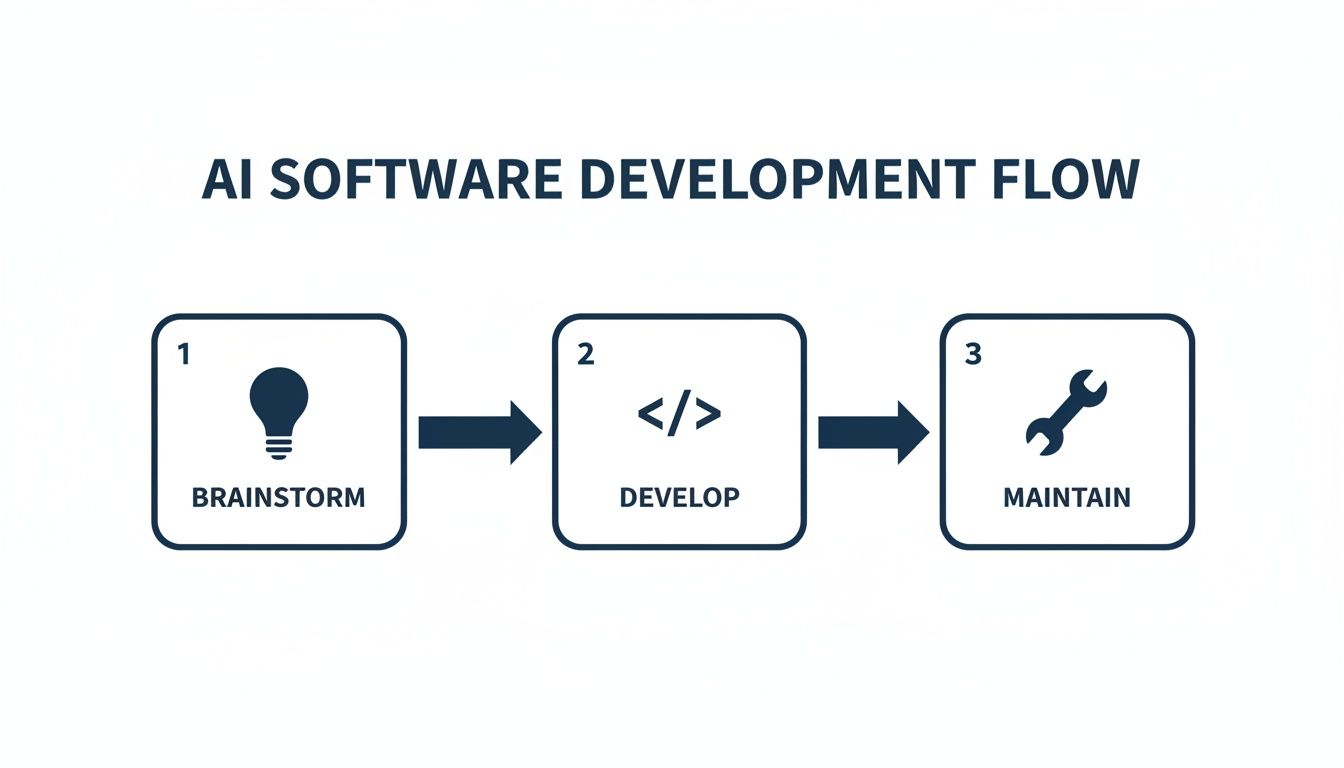
Ultimately, AI creates a feedback loop where each stage makes the next one better. This results in a development workflow that is both more efficient and more intelligent.
From Requirements to Writing Code
This evolution starts right at the beginning, with requirements gathering. Instead of just manually sifting through client notes and user feedback, AI tools can analyze all that unstructured input. They can pull out clear user stories, flag potential contradictions, and even propose features that directly support business objectives. This helps build a much stronger foundation before anyone writes a single line of code.
Once the plan is solid, AI helps speed up the actual coding. AI-powered assistants can handle the grunt work, like generating boilerplate code, drafting function outlines, and suggesting optimized algorithms.
This frees up your best developers from tedious, repetitive tasks. It allows them to apply their real brainpower to complex business logic and architectural decisions – the places where human creativity and problem-solving truly matter.
This focus on high-value work is a central tenet of modern custom software development, where delivering quality at speed is everything.
Smarter Testing and Deployment
The testing phase, which so often becomes a project bottleneck, is seeing some of the biggest gains. AI can automatically generate a huge range of test cases, including tricky edge cases that a human tester might overlook. It can also analyze code changes to pinpoint which parts of the application are most likely to break, helping QA teams focus their efforts where they’re needed most.
This intelligence carries right through to deployment. AI-driven Continuous Integration/Continuous Deployment (CI/CD) pipelines can now:
-
Predict deployment risks by analyzing the complexity of new code.
-
Trigger automatic rollbacks the moment a new release shows signs of instability.
-
Optimize cloud resource allocation for smoother, more dependable releases.
The impact here is enormous. The market for Generative AI in the SDLC is set to explode, growing from $184 million in the US in 2025 to an estimated $513 million by 2030. With over 80% of developers globally already using AI coding tools, these hyper-efficient workflows are quickly becoming the new standard, something an experienced AI software development company can help you adopt. You can discover more about how Generative AI is reshaping the SDLC in this detailed market analysis.
Predictive Maintenance and Constant Improvement
AI’s job isn’t done when the software goes live. During the maintenance phase, it acts as a proactive defense system. Instead of waiting for users to report errors, AI monitoring tools analyze performance logs and user behavior patterns to predict failures before they even happen.
This predictive maintenance lets your team fix underlying problems before they affect users, which dramatically improves stability and customer satisfaction. It changes maintenance from a reactive, fire-fighting scramble into a strategic, ongoing improvement cycle. This forward-thinking mindset is a core part of our AI development services, designed to ensure our solutions deliver lasting value.
Understanding Core AI Technologies and Integration Patterns
To really get a handle on AI software development, you first have to understand the engines running the show. It’s not about high-level theory; it’s about two practical ways to use AI with software. You can either use AI to build your software better and faster, or you can build AI into your software to give it brand-new capabilities.
Think of it like this: a carpenter can use a new power tool (an AI tool) to build a standard table more quickly. Or, they can build a “smart” table that adjusts its height based on who’s using it. Both are useful, but they solve completely different problems. This distinction is at the heart of most modern AI projects.
The technologies making this happen are Machine Learning (ML), Generative AI (GenAI), and the data science that supports them both. Each has a specific job, and knowing how they fit together is the key to getting real value from your investment.
Machine Learning Integration
Machine Learning is all about giving your software the power to predict what’s next. It works by training a model on your historical data to spot patterns, which it then uses to make educated guesses about the future. When you integrate ML into your software, you’re adding a layer of intelligence that simply wasn’t possible before.
Instead of just showing a dashboard with past sales figures, an ML-powered application could forecast next quarter’s revenue. This shifts your business from simply reacting to what has happened to strategically planning for what will happen. Common ways we see this applied include:
-
Predictive Analytics: Building features that forecast customer churn, predict inventory needs, or flag equipment for maintenance before it breaks.
-
Personalization Engines: Driving the recommendation systems you see in e-commerce or content platforms that make the user experience feel incredibly relevant. We’ve used this approach to create powerful custom ecommerce solutions for our clients.
-
Anomaly Detection: Automatically identifying suspicious transactions in a financial app or spotting unusual sensor readings from an IoT device.
The real aim of ML integration is to create applications that don’t just show you data but give you actionable intelligence. The software learns from what’s happening and helps people make smarter decisions without spending hours on manual analysis.
The Rise of Generative AI
Generative AI is a newer and profoundly different kind of technology. Where ML is great at predicting and sorting information, GenAI is all about creating new things. It can generate original text, images, music, and even computer code based on the vast patterns it learned from its training data.
This has unlocked an entirely new world of software features. Rather than relying on static, pre-written responses, your applications can generate dynamic, context-aware content instantly. As we detailed in our guide on GenAI in software testing, its creative ability is valuable across the entire development process.
Here are a few common GenAI integration patterns:
-
Intelligent Chatbots: Building conversational assistants that do more than follow a script. They can understand complex questions and provide nuanced, human-like answers.
-
Content Creation: Automatically writing product descriptions for an e-commerce site, drafting marketing emails, or summarizing long reports right inside an application.
-
Code Generation: Using AI assistants that not only suggest small code snippets but can write entire functions or test cases, as we touched on earlier.
Bringing these AI capabilities to life often means using a combination of different platforms and services. As AI becomes more integral to the software lifecycle, it’s essential to stay on top of the rapidly growing ecosystem of specialized developer tools.
The Role of Data Science and Pipelines
Here’s the simple truth: neither ML nor GenAI works without good data. That’s where data science enters the picture. It’s the essential work of preparing, cleaning, and structuring all your raw information so that AI models can actually learn from it. This is a core part of our own AI development services.
A key part of this is the data pipeline – an automated system that gathers data from all your different sources, cleans and transforms it into a consistent format, and then feeds it to your AI models. This ensures your AI-powered features are always working with fresh, accurate information. For any serious AI software development initiative, building solid data pipelines is non-negotiable.
AI Software Development in Action
It’s easy to get lost in the technical jargon of AI models and data pipelines. Let’s ground this conversation in what really matters: how AI software development solves tangible business problems. Seeing the “before and after” in different industries makes the value proposition crystal clear. These aren’t futuristic ideas; they are practical applications delivering results right now.
Think of a healthcare app that can predict patient risks, an e-commerce platform with a recommendation engine that actually gets you, or a fintech app that nips fraud in the bud. We build these kinds of solutions to boost efficiency, create better user experiences, and open up new revenue streams. You can see these principles at work in our custom ecommerce solutions and across our portfolio of client cases.

Predictive Analytics in Healthcare
In healthcare, timing and accuracy can be a matter of life and death. A traditional patient management system is little more than a digital filing cabinet; it stores records and tracks appointments, but it’s a passive tool. An AI-infused version, on the other hand, becomes an active participant in patient care.
Take a system designed to monitor patients with chronic conditions. Before AI, nurses would have to manually sift through charts, a time-consuming process where it’s easy to miss subtle warning signs. Care was reactive, happening only after a patient’s health declined.
Now, imagine that same system powered by a machine learning model. By constantly analyzing patient history, lab results, and even data from wearable devices, the software can identify individuals at high risk of a serious health event before it happens. It proactively flags these patients, giving medical staff the chance to intervene early.
This shift from reactive to predictive care is a complete game-changer, improving patient outcomes while easing the burden on hospital resources. A skilled AI software development company can engineer these systems to deliver life-saving insights while maintaining strict compliance with standards like HIPAA.
Hyper-Personalized eCommerce Experiences
The e-commerce landscape is brutally competitive. The old recommendation engines, the ones based on simplistic “people who bought this also bought that” logic, just don’t cut it anymore. Generative AI is changing the game by enabling true hyper-personalization.
Picture an online fashion retailer. Instead of just showing you a grid of vaguely related products, a GenAI-powered styling assistant can start a conversation. It can ask about your personal style, what occasion you’re shopping for, and then generate entire, curated outfits just for you.
This changes shopping from a simple transaction into a personalized styling session. The impact is immediate: higher customer engagement, bigger cart sizes, and a much stronger sense of brand loyalty. It’s a perfect illustration of how our AI development services deliver concrete business value.
This creative use of AI isn’t just for a better shopping cart, either. As we’ve detailed in our guide on how Generative AI can be used in software testing, its ability to produce new content is valuable across the entire software lifecycle.
Next-Generation Security in Fintech
For any financial technology company, security is paramount. For years, fraud detection has relied on rigid, rule-based systems. The problem? Sophisticated criminals learn the rules and quickly find ways to break them. AI provides a far more dynamic and intelligent defense.
An AI-powered fraud detection system learns the unique, normal transaction patterns for every single user. It analyzes dozens of variables in real time: transaction amount, location, time of day, and the device used, to build a behavioral fingerprint.
When a new transaction deviates from a user’s established pattern, the system can instantly flag it for review or even block it completely. This proactive security is essential for building trust and protecting both the business and its customers. It’s a great example of adding a critical layer of intelligence to a custom software development project. For any organization exploring this, the first step is often discovering how to apply AI for your business in a way that tackles your most urgent challenges.
How to Choose the Right AI Development Partner
So, you’re ready to get serious about AI. That’s a great first step. But the single most important decision you’ll make isn’t about which algorithm to use or what tech stack to build on; it’s about who you choose to build it with.
Getting this choice right is the difference between an AI project that generates real business value and one that becomes a costly science experiment. You aren’t just looking for a team of coders; you’re looking for a strategic partner who can guide you through the complexities of AI, from initial idea to enterprise-wide adoption. This is your playbook for finding that team.
Technical Expertise and Proven Methodologies
Let’s start with the basics. Any potential partner needs to have serious technical chops. We’re talking about deep, proven experience in data science, machine learning engineering, and now, Generative AI. But that’s just the ticket to the game. What truly separates the best from the rest is their process.
I can’t stress this enough: look for a firm that insists on starting with a collaborative AI Discovery Workshop. This should be non-negotiable. It’s where you and their team roll up your sleeves to:
-
Identify High-Impact Use Cases: They should help you zero in on the exact business problems where AI will make the biggest dent.
-
Assess Data Readiness: This means taking a hard look at your data, the fuel for any AI system, to see if it’s clean, accessible, and ready for action.
-
Define a Strategic Roadmap: You should walk away with a clear, step-by-step plan that takes you from a small-scale pilot to a fully integrated solution.
This initial consultative work shows they’re focused on your business outcomes, not just on selling you a block of development hours. It’s a core part of how our own consultative approach to bringing AI for your business has worked so well for our clients.
Industry Experience and Client Success
Technical theory is one thing, but delivering results in the real world is something else entirely. A top-tier AI software development company will have a portfolio filled with projects that prove they can turn complex challenges into successful outcomes.
When you’re looking at their past work, don’t just skim the project titles.
Ask for specific client cases and testimonials that show how they solved problems that look a lot like yours. You’re looking for hard evidence of measurable results: things like a concrete lift in efficiency, a jump in customer engagement, or the creation of new revenue streams.
This is doubly important if you’re in a regulated field like healthcare or finance, where data security and compliance aren’t just best practices; they’re the law. A partner who already knows your industry’s landscape will save you from common pitfalls and get you to market much faster.
The demand for this kind of specialized expertise is reshaping the entire industry. The global software development services market, valued at $570 billion in 2025, is on track to blow past $1.04 trillion by 2030. A major driver is that 72% of organizations are outsourcing to find elite talent, which results in 33% better quality. With 84% of developers already using AI tools, you can’t afford to work with generalists.
Key Questions to Ask a Potential Partner
To cut through the sales pitches and find a team you can trust, here are a few critical questions you should ask every potential partner:
-
Can you show me a case study where you delivered measurable ROI with a project similar to mine? This pushes them to talk about real business impact, not just their technical capabilities.
-
How do you handle data privacy, security, and model governance? This is essential for building trustworthy AI and making sure you stay on the right side of regulations.
-
What does your process look like after the initial model is deployed? An AI solution is never truly “finished.” You need a partner who is committed to ongoing monitoring, refinement, and support.
-
How do you balance innovation with practical, reliable solutions? The ideal partner offers a smart mix of modern custom software development and advanced AI development services.
Measuring AI Success and Ensuring Governance
Getting your AI-powered software out the door is a huge milestone, but it’s really just the starting line. The true test comes next: figuring out if your AI initiative is actually delivering value and operating responsibly over the long haul. Success isn’t just about a model’s accuracy; it’s about seeing a real impact on your business and earning your users’ trust.
This is where many teams get sidetracked. It’s easy to get caught up in technical metrics, but you need to shift the conversation from “How accurate is our model?” to “How is this model improving our business?” That change in perspective is what turns an interesting tech project into a genuine strategic asset.

Beyond Technical Metrics
While things like precision and recall are essential for your development team, they mean very little to your stakeholders. The real proof of success lies in how the AI affects your core business operations. This is where you connect the dots between the technology and your bottom line.
Think in terms of tangible business outcomes:
-
Operational Efficiency: Did the AI feature cut down on manual work? A great example is seeing a 25% drop in customer service response times after rolling out an AI-powered chatbot. That’s a number everyone can understand.
-
Customer Satisfaction (CSAT): Are your customers happier? A measurable jump in CSAT scores or a flood of positive reviews mentioning the new AI feature is undeniable proof of its value.
-
Revenue Impact: Can you directly link the AI to an increase in revenue? Maybe your new recommendation engine boosted conversion rates, or a predictive model helped you reduce customer churn.
The goal is to build a clear, data-driven story that shows the return on your AI investment. This doesn’t just validate the project; it builds crucial momentum for what comes next.
The Critical Role of AI Governance
On the other side of the coin is responsibility. Great power without great control is a recipe for disaster, which is why strong AI governance is non-negotiable. This framework is your rulebook for navigating the ethical and regulatory minefield that comes with using AI.
Effective governance really boils down to three key pillars:
-
Data Privacy and Security: Protecting user data has to be your top priority. This means implementing tight security protocols and making sure your data practices are fully compliant with regulations like GDPR and HIPAA.
-
Model Fairness and Bias: AI models learn from the data they’re given, and if that data contains hidden biases, the model will not only learn them but often amplify them. Good governance demands that you actively audit your models to ensure they don’t lead to unfair or discriminatory outcomes.
-
Transparency and Explainability: More and more, users and regulators want to understand how an AI arrives at its decisions. Using “explainable AI” (XAI) techniques helps you peek inside that “black box,” which is essential for building trust and makes troubleshooting much easier.
Navigating these complexities is no small task. As we detail in our guide, a responsible AI implementation is the bedrock of any sustainable AI strategy.
Ultimately, a successful AI initiative is one that is not only powerful but also fair, transparent, and secure. Building this governance from day one ensures your innovation is built on a solid ethical foundation. This is how you create technology that people can truly depend on.
Frequently Asked Questions About AI Development
As you start exploring what AI software development can do for your business, you’re bound to have questions. We get it. Here are clear, straightforward answers to a few we hear all the time, drawing on the core ideas we’ve covered.
What Is the First Step to Start with AI Software Development?
The best place to begin is almost never with code. Instead, start with an AI Discovery Workshop. Think of this as a strategic huddle with an expert partner, like an AI software development company, to pinpoint high-value opportunities that align with your actual business goals.
During this session, you’ll map out your available data, get crystal clear on your objectives, and build a practical roadmap. This ensures your first AI project is focused on solving a real problem with a measurable return, not just chasing a trend.
How Is AI Software Development Different from Traditional Development?
The core difference is in how the logic is created. With traditional custom software development, a developer writes explicit, rule-based instructions that the software follows perfectly. If you want it to do something new, you have to write new rules.
AI development is different. You aren’t writing the rules; you’re training a model to learn the rules from data. It’s like the difference between giving someone a fish (traditional) and teaching them how to fish (AI). The AI system can adapt and make smart predictions on its own, even with new data it’s never seen before.
Can I Integrate AI into My Existing Applications?
Absolutely. In fact, this is one of the most powerful and common ways to get started with AI. You don’t have to tear everything down and start over.
The most popular approach is connecting your current application to a specialized AI model through an API. This allows you to inject intelligent features, like a personalized recommendation engine or a predictive analytics dashboard, directly into the software your teams and customers already use. A good AI development services partner can assess your architecture and find the smartest, least disruptive way to add that intelligence.
How Do You Ensure AI Models Are Accurate and Unbiased?
This is a critical part of any responsible AI initiative, and it’s a multi-step process. It starts with feeding the model clean, high-quality, and diverse training data to avoid embedding biases from the start.
From there, it involves relentless testing against specific business metrics and using “explainable AI” (XAI) techniques to make sure you can understand why the model is making the decisions it is. As we touched on in our guide to responsible AI implementation, ongoing monitoring after the model goes live is just as important. This rigorous governance is the key to building trust and getting reliable results.
Ready to see how AI can give your products and processes a real-world advantage? At Bridge Global, we help businesses navigate every phase of their AI journey, from that first discovery session to full-scale deployment. Find out more about how you can get ahead with AI for your business.

About Preethi Saro Philip
Preethi Saro Philip is a Post Graduate Research Degree holder in Economics with more than 10 years of experience in writing, editing, research and teaching. She has an intense passion for content crafting and calls herself a ‘wordsmith’. She enjoys writing on wide-ranging topics including business, technology, health & lifestyle, education, environment etc.
View all posts by Preethi Saro Philip →