



AI-Powered Clinical Documentation: An Essential Guide
Physicians spend 34% to 55% of their workday on clinical documentation, and that burden carries an annual U.S. opportunity cost of $90 billion to $140 billion that could otherwise support patient care, as reported in a 2024 PMC review. This is a key reason AI-powered clinical documentation moved from a nice-to-have to a board-level priority; it isn’t just about speed, it’s about reclaiming clinical capacity, reducing after-hours work, and making documentation fit the operational reality of modern care. For teams evaluating AI trends in healthcare, this is one of the clearest examples of a workflow problem large enough to justify product, engineering, and governance investment.
At a practical level, the technology listens, structures, and drafts notes so clinicians aren’t forced to do every keystroke themselves. The promise is real, but so are the trade-offs. In production, the difference between a tool that helps and a tool that frustrates usually comes down to specialty fit, integration quality, and how tightly the organization controls review, audit, and escalation.
Why AI-Powered Clinical Documentation Matters Now
Documentation has always been part of care, but EHR-era documentation turned it into a second job. A 2024 review in PMC reported that physicians spend 34% to 55% of their workday creating and reviewing clinical documentation in electronic health records, with an annual U.S. opportunity cost of $90 billion to $140 billion. That number matters because it explains why documentation automation stopped being a niche productivity idea and became a structural response to clinician overload, reimbursement complexity, and compliance pressure.
The business case is bigger than note writing
Clinical documentation supports DRG coding, reimbursement, and Joint Commission compliance. That means every improvement in note quality or turnaround time affects more than physician convenience; it touches billing accuracy, audit readiness, and operational throughput. If a note lands late, incomplete, or inconsistent, the downstream cost shows up in denied claims, rework, and clinician frustration.
Practical rule: treat documentation automation as an operating model change, not a transcription add-on.
That mindset matters for product leaders. A clinic team won’t judge the tool by its architecture diagram; they’ll judge it by whether it reduces charting drag without creating new cleanup work. In my experience, the strongest adoption happens when teams define success in clinical terms – less pajama time, cleaner notes, fewer corrections, easier coding – then design the system around those outcomes.
For a healthtech platform, that usually means the documentation feature can’t sit alone. It has to sit inside a broader product strategy that includes custom healthcare software development, custom software development, and the right software development service models for regulated delivery. The organizations that ignore the operational context tend to ship a demo, not a durable workflow.
How AI Clinical Documentation Systems Work
AI clinical documentation systems usually operate in three stages: capture, structure, and drafting. They first record the encounter, then identify the clinically relevant details, then produce a note that a clinician can review before it reaches the EHR.
The three-stage pipeline that matters in production
In production, these systems usually combine automatic speech recognition (ASR), natural language processing (NLP), and large language model (LLM) note generation. ASR handles the raw encounter, NLP organizes the transcript into clinically meaningful entities, and the LLM turns that structure into an editable note. Each layer removes a different bottleneck, and each layer fails in a different way.
That is why implementation teams need to evaluate the whole pipeline, not only the final note. ASR accuracy affects the transcript itself. NLP quality determines whether symptoms, medications, allergies, or exam findings are captured correctly. LLM drafting affects tone, section structure, and whether the output fits SOAP or a specialty-specific template.
What to look for in workflow fit
The workflow has to match the specialty, the speaker, and the note type. A psychiatry follow-up, a dermatology visit, and an orthopedic consult place very different demands on the system, and accent variation can change performance even when the model looks strong in a demo.
Modern systems can also pre-populate discrete EHR fields and support coding workflows when they are implemented with appropriate human review. That is the part many vendor demos skip, yet it often decides whether the product shortens work or just shifts work from typing to editing.
A useful procurement question is straightforward. What happens when the tool misses a symptom, misplaces an assessment, or inserts an unsupported phrase? If the answer is that the clinician catches it during review, then the review step needs to be designed, measured, and trained like a real safety control. If you are connecting documentation to broader clinical systems, a strong healthcare integrations strategy and an integration architecture plan are not optional.
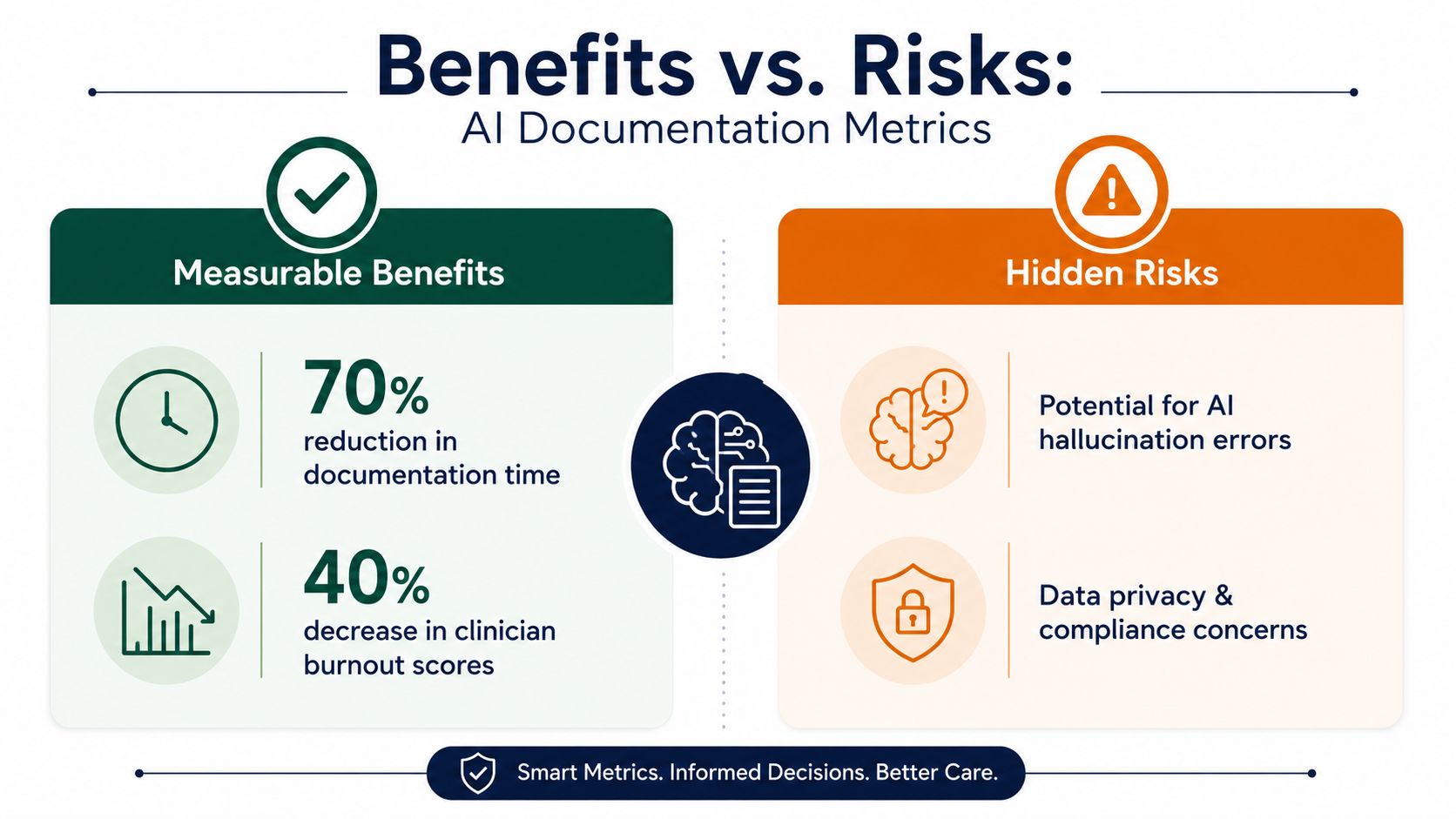
Measurable Benefits and Hidden Risks of AI Documentation
The best evidence on AI documentation doesn’t tell a story of universal success. It shows real workflow gains, but also variation by user, specialty, and behavior. In a 2024 JAMA Network Open study, 47.1% of clinicians using AI documentation reported decreased EHR time at home, compared with 14.5% in the control group, and the difference was statistically significant with P < .001. That’s meaningful, but it’s not the same as saying every clinician benefits equally.
Why the results are uneven
A recent review found average documentation workload reductions and burnout improvements when clinicians reviewed and edited AI drafts, yet another study found that only about half of clinicians using a tool on the basis of interest reported a positive outcome. The lesson is not that the technology is inconsistent; it’s that implementation quality, note type, and specialty shape the result. A primary care note, a dermatology note, and a psychiatry note are not interchangeable workloads.
The vendor may sell one platform, but your clinicians experience many different documentation jobs.
That’s why I’d measure ROI by specialty and note type, not by a single organization-wide average. If your orthopedic team gets a clear gain while your behavioral health team sees little change, the product still might be valuable. But you won’t know that unless your evaluation model is granular from day one.
Time savings are real, but they’re not identical everywhere
A 2025 review found a 20.4% decrease in documentation time per visit in one quality-improvement study, from 10.3 minutes to 8.2 minutes per note. Other ambient AI documentation reviews report outpatient AI consultations were 26.3% shorter overall and average documentation time per primary care encounter fell by 28.8%. A systematic review also found many tools reduce documentation time by about 1 to 2.1 minutes per note, and a dermatology pilot with 12 clinicians using DAX reduced total daily documentation time from 54.6 minutes to 42.2 minutes.
Those gains are useful, but they don’t erase the operational risk. Accuracy, fallback workflow design, and specialty validation still matter, especially if you’re rolling out a tool across diverse care settings. For teams doing product due diligence, our guide on generative AI risk management is a good companion read because clinical documentation inherits the same class of failure modes, only with higher stakes.
Building an AI Documentation Implementation Roadmap
Clinical documentation projects fail more often on rollout than on model quality. The teams that get value fastest start by deciding who reviews output, what gets blocked, and where the system is allowed to write back before anyone talks about broad adoption. Without that governance layer, a pilot can look impressive and still collapse when it meets real clinic workflows, specialty variation, and the messiness of live charting.
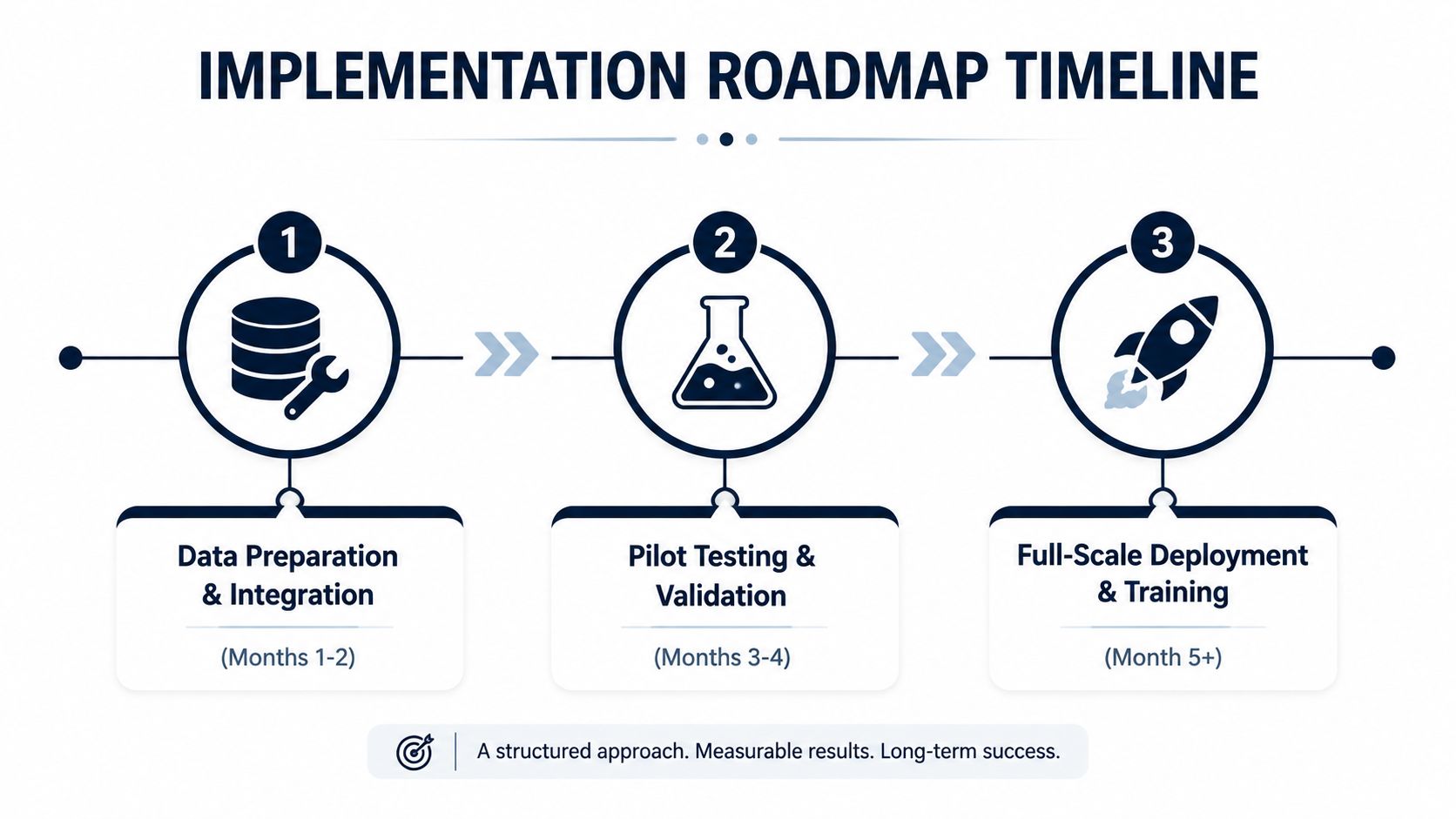
Start with data, integration, and boundaries
Begin with data readiness. Confirm which encounter types are in scope, how notes will be reviewed, which parts of the note stay clinician-authored, and where the system writes back into the EHR. The strongest implementations keep the first release narrow on purpose, with a short list of note types, a few well-understood specialties, and explicit exclusions for settings where the transcript quality or documentation pattern is too variable.
Integration choices matter just as much. If the draft note lands in the wrong place, or forces clinicians into extra clicks, adoption stalls even when the underlying transcript quality is good. Product teams should map the note lifecycle end to end, from encounter capture to review to final sign-off, and identify every handoff where error can enter.
Pilot validation should use real clinicians and real encounters, not polished demo audio. Track whether the draft note is usable as written, how much editing is required, and whether the tool creates confusion around coding, follow-up plans, or the structure of specialty-specific notes. A pilot that looks clean in primary care can break down in behavioral health, dermatology, or any service line where accents, pacing, or clinical phrasing vary more than the model expects.
Add monitoring before broad rollout
Operational monitoring should be in place before expansion. Set audit trails, review thresholds, and escalation paths for low-confidence transcripts, unusual phrasing, and recurring correction patterns. That gives the team a way to catch deterioration before it reaches billing, quality reporting, or the patient chart.
A direct checklist keeps the rollout grounded:
- Define specialty gates: Validate separate workflows for note types with different structure, terminology, or conversational style before expanding scope.
- Set review thresholds: Route low-confidence outputs to mandatory human review.
- Track correction themes: Group recurring edits by transcript quality, note structure, and clinical meaning.
- Monitor drift: Compare note quality across time, specialties, accents, and clinician groups.
- Train for failure modes: Show users how the system behaves when it misses context or mishears terms.
For product leaders who want this work tied to a larger delivery program, AI development services, enterprise AI solutions, and an explicit AI implementation roadmap help align product, compliance, and engineering around the same release decisions. Teams that already ship software should also account for SaaS product development early, because documentation features often become part of a broader platform rather than a standalone tool.
Addressing Equity and Safety Gaps in AI Scribes
The hardest implementation question isn’t whether the system saves time. It’s whether it saves time for the clinicians and patients who don’t sound like the training data. A 2025 analysis warns that patients with non-standard accents, limited English proficiency, or other marginalized speech patterns may receive incomplete documentation from AI scribes, and that can omit critical clinical information. That’s not a theoretical fairness issue; it’s a documentation quality issue with clinical consequences.
The speech problem is a safety problem
If the system underperforms on diverse voices, the damage isn’t always obvious. A missed medication, a partial symptom description, or an incomplete history can look like a minor omission in the draft, then become a bigger issue after the note is signed and the record is treated as complete. Medication name inaccuracies are especially concerning because they can survive review if the clinician is moving too fast.
Governance needs to be operational, not symbolic. Teams should validate against accent diversity, multilingual encounters, and noisy real-world rooms, not just polished demo audio. If performance drops for a subgroup, the system needs a fallback path, usually mandatory human review or a restricted use case.
Don’t call it equitable until you’ve tested it on the voices that are hardest to recognize.
What good validation looks like
A strong validation plan uses mixed encounter samples, including background noise, rapid speech, and language-switching. It also defines audit thresholds, meaning the point at which error frequency or error severity forces a workflow change. That threshold should be documented before launch, not discovered after a bad outcome.
For product teams, clinical documentation AI diverges from generic productivity software. The output becomes part of the legal and clinical record. If the tool cannot reliably handle variation in speech, it can’t be deployed as if every encounter were the same.
Build vs Buy Decisions for AI Documentation Platforms
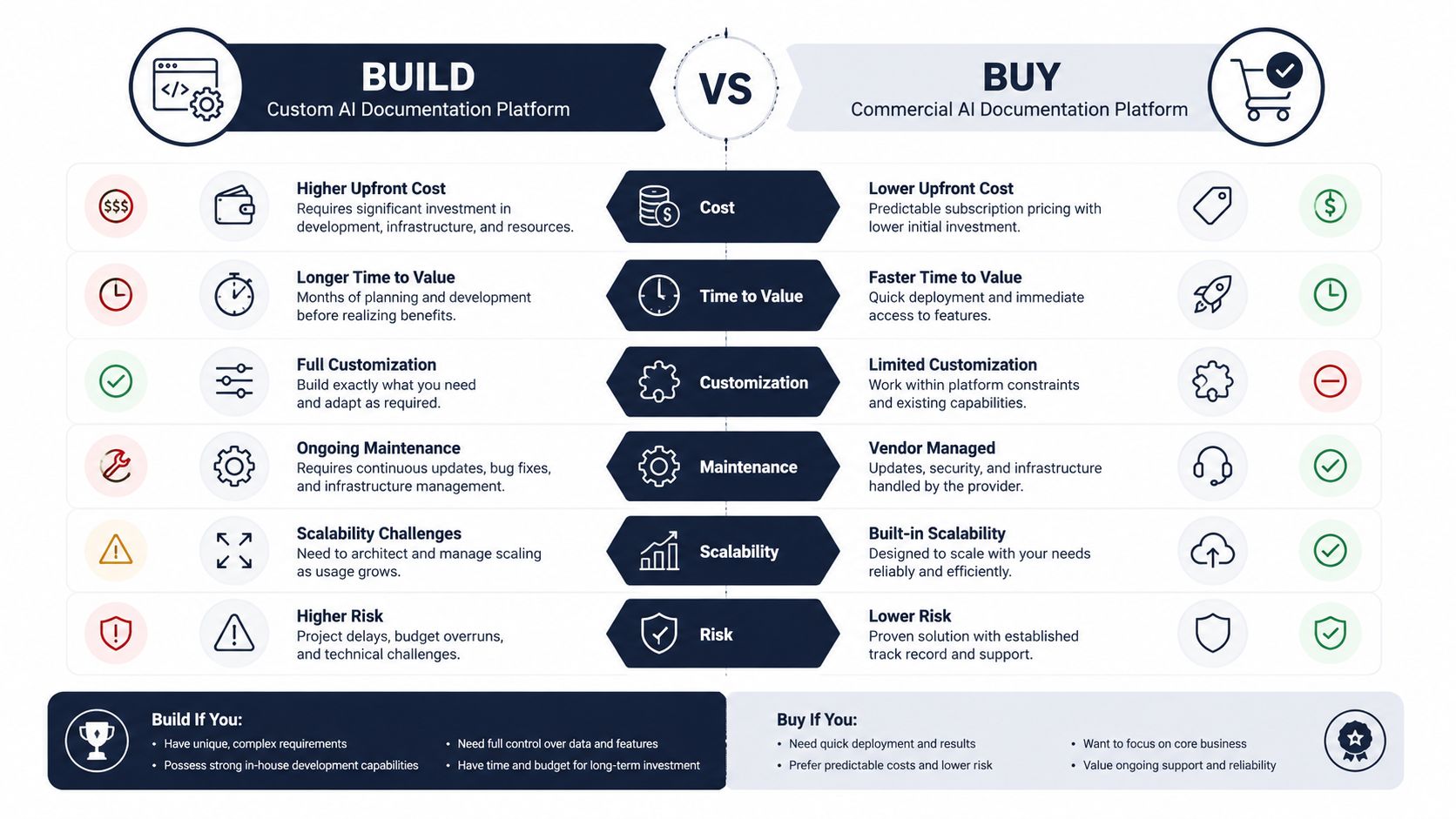
The build-versus-buy decision is usually framed as speed versus control, but that’s too shallow for healthcare. The key question is whether documentation is part of your differentiating workflow or a capability you need to operationalize quickly with minimal risk. If the note experience is core to your product identity, build may make sense. If your goal is to modernize quickly, buy can be the cleaner path.
Where building earns its keep
Build when you have proprietary workflows, specialty-specific logic that vendors can’t model well, or an existing platform where documentation is tightly coupled to your broader product experience. Build also makes sense when long-term control over data flow, model behavior, and user experience is strategically important. That said, building doesn’t just mean engineering the note generator; it means owning the integration, QA, monitoring, and compliance burden too.
Where buying is the smarter move
Buy when time to market matters more than differentiation, or when the operational cost of maintaining speech, NLP, and note-generation layers would distract from your core roadmap. Buying can also reduce implementation risk if the vendor already has mature EHR integration patterns and a clear human review workflow. For healthcare startups that need help balancing prototype speed with durable architecture, a resource like the Australian R&D Tax Incentive for ML can be useful when planning machine learning investment and R&D treatment.
A sensible decision rubric looks like this:
- Build if: Documentation is a strategic moat, your workflows are unusual, or you need full control over the note lifecycle.
- Buy if: You need faster deployment, your workflows are standard, or the team can’t absorb long-term model maintenance.
- Hybrid if: You want a vendor foundation but need custom orchestration, specialty logic, or integration depth.
If you’re a startup founder or CTO making that call, the answer often depends on whether your team is prepared to own model evaluation, release management, and clinician feedback loops. If not, the hidden cost of building arrives quickly.
Real-World Implementation Highlights and Next Steps
The strongest implementations share a pattern. They start narrow, measure carefully, and let clinician feedback shape the next release rather than treating go-live as the finish line. In practice, the best teams do not judge AI documentation by headline time savings alone. They watch where it helps, where it struggles, and how performance changes across specialties, visit types, and speaker accents.
Ambient AI documentation platforms have shown measurable time savings, but the more useful signal is consistency. In some settings, analysts have found shorter consultations and less note-writing burden, yet that improvement is not uniform across every clinic or clinician group. A system that performs well in routine primary care may still miss nuance in a specialty note, or struggle when speech patterns, audio quality, or local documentation style vary. Those differences matter because they shape clinician trust and determine whether the tool becomes part of daily work or a pilot that never scales.
What strong teams do after launch
They keep pilots small until note quality holds up under real use. They compare specialties instead of averaging everything together, because a clean result in one workflow can hide weaker performance elsewhere. They also keep a human-in-the-loop path for cases that fall outside the model’s comfort zone, including complex encounters, unusual accents, and visits with noisy audio.
The next step is usually not a bigger model. It is a clearer implementation plan, tighter integration discipline, and a governance model that names who reviews errors, who approves changes, and how clinician feedback turns into product decisions. That governance has to cover specialty-specific templates, escalation rules for uncertain output, and audit routines that catch drift before clinicians lose confidence. If your roadmap already includes custom workflows, integrations, and regulated delivery, bringing in a seasoned healthtech software development partner can shorten the path from proof-of-concept to a production-grade system.
For teams that need a broader platform view, it helps to revisit enterprise AI solutions and real delivery patterns in client cases. Those examples make the implementation trade-offs easier to see, especially the gap between a vendor demo and a system that survives day-to-day clinical use.
As noted earlier, integration depth is where many programs gain or lose momentum. If the note generator cannot fit into existing workflows, the quality gains are hard to sustain, no matter how polished the model looks in isolation.

About Preethi Saro Philip
Preethi Saro Philip is a Post Graduate Research Degree holder in Economics with more than 10 years of experience in writing, editing, research and teaching. She has an intense passion for content crafting and calls herself a ‘wordsmith’. She enjoys writing on wide-ranging topics including business, technology, health & lifestyle, education, environment etc.
View all posts by Preethi Saro Philip →