



Unlocking Your AI Healthcare Chatbot System
At its core, an AI healthcare chatbot system is a smart software tool that mimics human conversation. It’s designed to give patients instant, round-the-clock support for common tasks like booking appointments, finding answers to quick questions, and even running through a basic symptom check. Think of it as the digital front door to your practice, handling the routine work so your team doesn’t have to.
Why Your Practice Needs an AI Healthcare Chatbot

Let’s be honest: today’s healthcare world is a tough balancing act. Patients want immediate, easy access to care and information. Meanwhile, your administrative staff is likely drowning in phone calls, scheduling conflicts, and the same repetitive questions, day in and day out. This constant administrative pressure doesn’t just lead to burnout; it pulls skilled people away from the work that truly matters: caring for patients.
The old ways of doing things, like relying solely on phone calls and manual emails, just can’t keep up anymore. They create frustrating bottlenecks for patients and clunky, inefficient workflows for your team. An AI healthcare chatbot system or an AI Agent isn’t just a fancy tech upgrade; it’s a practical, modern answer to these problems, acting as a tireless digital assistant for your practice.
Bridging the Communication Gap
What if your front desk never closed? That’s the real value of a well-implemented chatbot. It gives patients the power to manage their own needs whenever it’s convenient for them, day or night. This kind of immediate access can completely transform the patient experience.
For your practice, the advantages are clear and immediate:
- Reduced Administrative Load: The chatbot takes over routine tasks like appointment booking, refill requests, and answering FAQs. This frees up your team to handle more complex patient issues.
- Enhanced Patient Access: No more waiting on hold. Patients get instant answers and can manage their care on their own time, which dramatically improves their satisfaction.
- Improved Staff Efficiency: With fewer interruptions from routine calls, your staff can work more smoothly, cutting down on stress and boosting productivity.
This isn’t just about adopting new technology. It’s about strategically reassigning your most valuable asset—your team’s time—back to delivering outstanding patient care.
A strategic approach is key to success. The goal is to implement a system that seamlessly integrates with your existing workflows, turning operational headaches into opportunities for growth and superior patient care.
A Growing Market and a Clear Need
This shift toward AI-powered assistance is far from a fleeting trend; it’s a major movement within the healthcare industry. The global healthcare chatbot market is expected to grow at a compound annual growth rate (CAGR) of 23.5%, ballooning to a value of $17.74 billion by 2035. This explosive growth is fueled by the undeniable need for 24/7 virtual help and a growing comfort with digital health tools. You can explore the full healthcare chatbot market analysis to see the data for yourself.
Making this digital transition successful requires a clear plan. Partnering with an experienced AI solutions partner can help you build and launch a chatbot that truly fits the unique needs of your practice and your patients, paving the way for a more efficient, patient-focused future.
How AI Healthcare Chatbots Actually Work

To really get a handle on an AI healthcare chatbot system, you have to look past the simple chat window and see the engine humming away in the background. It’s less like a pre-written script and more like a tireless digital assistant, always ready to understand, reason, and act on patient needs, 24/7.
Think of it as a digital triage nurse. It can ask targeted questions about symptoms, analyze the answers, and then point the patient toward the right next step—all based on established clinical guidelines and massive medical datasets. The whole point is to give people immediate, reliable guidance when they need it most.
The Brains Behind the Bot: Natural Language Processing
So, what’s the secret sauce? It all starts with Natural Language Processing (NLP). This is the technology that gives the chatbot the power to read and truly understand human language, whether it’s typed out or spoken. When a patient says, “I have a headache and I feel dizzy,” NLP is what deconstructs that sentence to figure out the key symptoms and what the person is trying to do.
This is a world away from simple keyword matching. A smart system learns the context, the sentiment, and all the little quirks of medical language to make sure its responses are both accurate and genuinely helpful. It’s the difference between a bot that only gets “book an appointment” and one that can easily handle a request like, “I need to see Dr. Smith next Tuesday afternoon.” This ability is fundamental to creating an interactive and supportive patient experience, a concept we’ve explored in-depth in our guide on AI in healthcare.
From Simple Rules to Smart Decisions
Of course, not all chatbots are built the same. The early versions were mostly rule-based, meaning they followed a very rigid, flowchart-like script. If you went off-script, they broke. Today’s AI systems, however, are built on Machine Learning (ML), which allows them to learn and get smarter from every single conversation.
This constant learning cycle helps the chatbot fine-tune its ability to deliver accurate information and personalized support. As these systems become more sophisticated, verifying their safety and performance is critical, which is why solid testing methodologies for chatbots are so important during development.
To give you a clearer picture, let’s break down how these systems have evolved.
AI Healthcare Chatbot Capabilities Comparison
The capabilities of a healthcare chatbot depend entirely on the technology powering it. A simple, rule-based system is good for basic Q&A, while an advanced AI can handle far more complex and personalized interactions. The table below shows the key differences.
| Capability | Basic System (Rule-Based) | Intermediate System (ML-Powered) | Advanced System (Generative AI) |
|---|---|---|---|
| Conversation Flow | Follows a strict, predefined script. Deviations can cause errors. | Understands context and intent, allowing for more flexible conversations. | Can generate new, human-like responses and handle complex, multi-turn dialogues. |
| Personalization | Offers generic, one-size-fits-all responses. | Can tailor responses based on user history and previous interactions. | Delivers highly personalized advice and proactive health insights based on deep data analysis. |
| Learning Ability | Does not learn or adapt. Requires manual updates to its rules. | Learns from each conversation to improve accuracy and relevance over time. | Continuously self-improves its knowledge base and conversational skills. |
| Core Technology | Simple if-then logic and keyword matching. | Natural Language Processing (NLP) and Machine Learning (ML) algorithms. | Large Language Models (LLMs) and deep learning networks. |
As you can see, the jump from a basic system to an AI-powered one is huge.
The leap from rule-based systems to AI-powered platforms represents a significant shift. It moves the chatbot from a simple FAQ tool to a dynamic partner in patient engagement, capable of handling complex administrative and clinical support tasks.
This evolution from a static tool to a dynamic assistant is what makes modern healthcare chatbots so powerful.
Building Trust with Secure and Compliant AI

In healthcare, nothing is more valuable than a patient’s trust. When you introduce an AI healthcare chatbot system, you’re essentially asking patients to confide in a machine with their most sensitive health information. That’s a big ask.
This is why building a system with security and compliance at its core isn’t just a technical checkbox—it’s the very foundation of the patient relationship. Patients must feel completely certain that their data is protected. It’s not about burying the details in legal jargon; it’s about putting tangible, practical security measures in place to safeguard every single interaction.
Navigating Healthcare Compliance
Regulations like the Health Insurance Portability and Accountability Act (HIPAA) in the U.S. and the General Data Protection Regulation (GDPR) across Europe are the gold standard for protecting patient data. Think of them less as legal hurdles and more as blueprints for building systems that people can actually trust.
A compliant AI chatbot has to be designed with these standards in mind from the very beginning. It’s an architectural commitment, not just a privacy policy. For truly robust data security, it’s also smart to implement global standards like ISO 27001 for AI-powered risk detection.
Following these regulations isn’t optional. Any chatbot that handles Protected Health Information (PHI) must be built for compliance. A single data breach can lead to massive fines and completely shatter a provider’s reputation.
Core Pillars of a Secure AI Chatbot System
So, what does it actually take to achieve compliance? It comes down to implementing a few critical security layers. These are the pillars holding up the entire structure of patient trust.
Here are the absolute must-have security features for any AI healthcare chatbot:
- End-to-End Encryption: From the moment a patient types a message to the second it’s stored, all data must be encrypted. This makes the information unreadable and useless to anyone who might intercept it.
- Secure Data Storage: Patient information needs to live in a fortress—whether that’s a compliant cloud environment or on-premise servers with incredibly strict access controls.
- Robust User Authentication: Simple passwords aren’t enough. Secure login methods, especially multi-factor authentication (MFA), are essential to confirm a user’s identity and block unauthorized access.
- Regular Security Audits: The threat landscape is always changing. Continuous monitoring and frequent security audits are necessary to find and fix vulnerabilities before they can be exploited.
Putting these safeguards in place is a serious undertaking, which is why working with experts in healthcare software development is so important. As detailed in our guide, mastering the specifics of HIPAA-compliant software development is the only way to build a platform that both patients and providers can fully depend on.
At the end of the day, a secure chatbot is a trustworthy chatbot—and that creates a safe space for patients to engage with their care.
Real-World Impact on Patients and Providers
Let’s move past the technical specs and talk about what really matters: the tangible results. The true measure of an AI healthcare chatbot system isn’t its code, but its real-world impact on clinics, hospitals, and specialty practices. These aren’t just fancy automation tools; they’re genuinely changing the day-to-day experience for both patients and the people who care for them.
The stories from the front lines really bring this to life. Take a large urban hospital that was wrestling with a high no-show rate for appointments. It was a constant source of disruption, throwing schedules into chaos and wasting clinicians’ valuable time. They rolled out an AI chatbot for automated, interactive reminders, and within six months, they cut their no-show rate by a staggering 35%. That one simple change created a more predictable patient flow and let them manage their resources so much more effectively.
Giving Patients 24/7 Access and Control
One of the biggest wins for patients is simply being able to get help whenever they need it. AI chatbots create a secure, on-demand channel for support that doesn’t close at 5 PM. Having that constant access empowers patients to be more involved in their own health journey.
A great example is a mental health provider that launched a chatbot to offer emotional support resources and coping exercises around the clock. It’s not a replacement for a therapist, of course, but it acts as an essential first line of support, helping users manage moments of anxiety whenever they strike. They saw a 50% jump in patient engagement with self-help materials and found that their users felt more connected and supported.
These real-world applications demonstrate a clear return on investment. The technology directly addresses common operational bottlenecks, turning patient frustration into satisfaction and administrative burdens into streamlined, efficient processes.
Easing the Burden on Providers and Staff
The effect on healthcare providers and administrative staff is just as significant. By taking over the flood of repetitive questions, an AI chatbot frees up the human team to concentrate on the complex, high-value work that truly requires their expertise and empathy.
Picture a busy primary care clinic where the front desk staff was buried under hundreds of calls a day for simple prescription refills and appointment changes. After deploying an AI healthcare chatbot system, they saw a 40% drop in routine administrative calls. This gave the staff breathing room to focus on patients who were physically in the office, sort out complex billing issues, and provide a much higher level of personal service. These examples, much like our own documented client cases, make the benefits concrete and show the real ROI of investing in this technology.
Expanding What’s Possible with Digital Care
Today’s healthcare chatbots do so much more than answer simple questions. They handle everything from scheduling and prescription renewals to initial symptom evaluation and connecting patients directly with medical professionals. This versatility helps everyone by making the whole operation run smoother while also improving how patients are monitored. It’s no surprise the services segment of this market is growing so fast, with a projected CAGR of 24.5%. You can discover more insights about the healthcare chatbots market to see the full picture.
The applications for these systems are constantly evolving. Here are a few key areas where they are already making a huge difference:
- Chronic Disease Management: Chatbots are perfect for sending medication reminders, tracking patient-reported vital signs, and providing educational content to improve how people manage conditions like diabetes and hypertension.
- Post-Operative Follow-Up: After surgery, a chatbot can check in with a patient, ask about their recovery, and flag any concerning symptoms for immediate review by a nurse.
- Navigating Complex Systems: For large hospital networks, chatbots act like a digital concierge, helping patients find the right department, understand their insurance coverage, or prepare for an upcoming visit.
At the end of the day, successfully implementing an AI healthcare chatbot system is about more than just the tech. It’s about building a healthcare ecosystem that is more responsive, efficient, and centered around the patient. By partnering with an expert in AI development services, healthcare organizations can create solutions that deliver these kinds of measurable, positive outcomes for everyone.
Your Implementation Blueprint for Success
Bringing an AI healthcare chatbot system into your practice isn’t just a matter of picking the right technology; it’s about having a clear, strategic blueprint. This roadmap will guide you through the big decisions and technical details, taking you from a great idea to a fully functioning tool that’s woven into your daily workflow.
Think of your chatbot’s architecture like a well-run hospital. Every department has a specific role, and they all need to communicate flawlessly. The chatbot’s front desk is its Natural Language Processing (NLP) engine, which has to understand what patients are asking, no matter how they phrase it. From there, secure pathways connect it directly to your Electronic Health Record (EHR) system, making sure patient information flows exactly where it needs to go—safely and instantly.
The diagram below shows how all these pieces fit together, creating a seamless journey from patient question to provider action, ultimately leading to better outcomes for everyone.
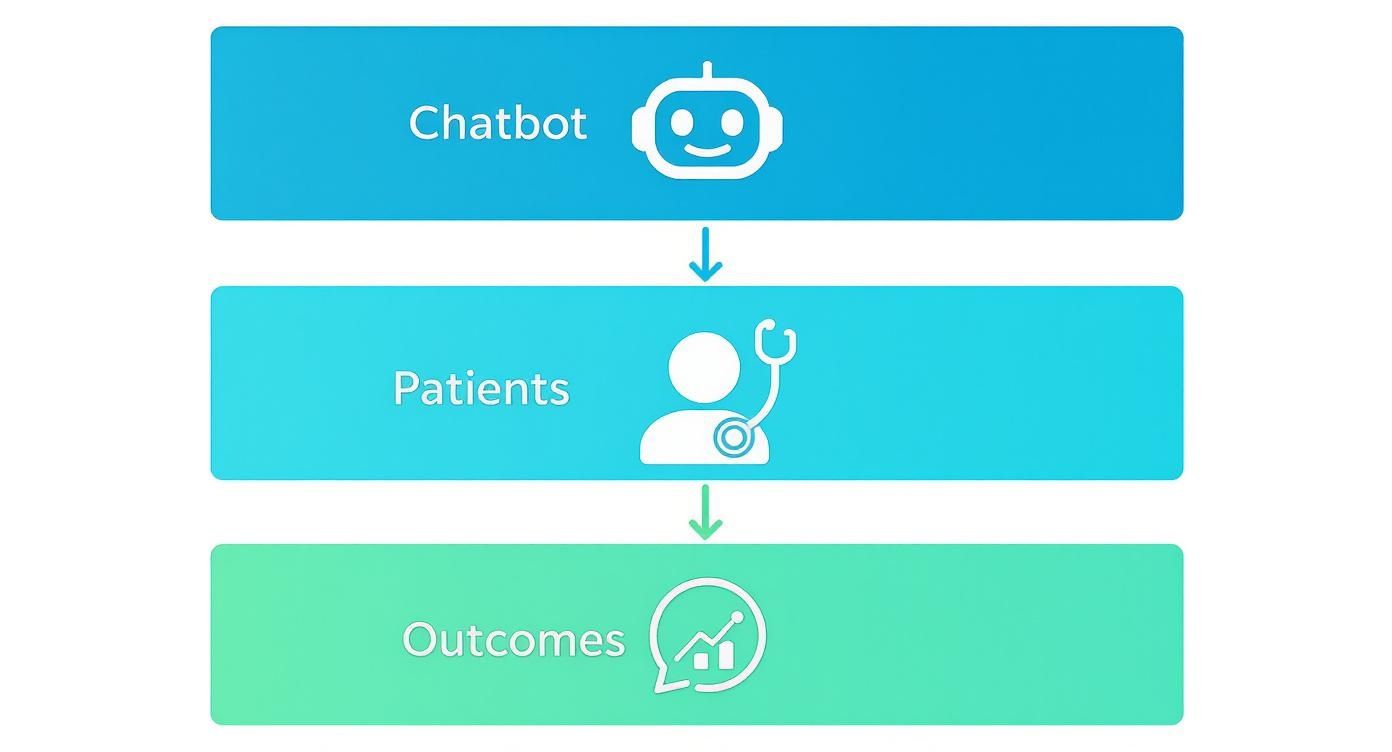
As you can see, a well-designed chatbot acts as a smart go-between, making things more efficient for both patients and your staff.
To Build or To Buy Your AI Chatbot
One of the very first hurdles is deciding whether to build a custom chatbot from the ground up or buy a ready-made platform. There’s no single right answer to the “build vs. buy” question. It really boils down to your organization’s unique needs, your budget, and what you want to achieve down the road.
- Buying an Off-the-Shelf Solution: This is the faster, more direct route. It gets you up and running quickly with lower upfront costs, making it a great option for practices that need standard features like appointment booking or answering common questions. The trade-off? You often sacrifice flexibility and might have less control over how it integrates with your other systems.
- Building a Custom Solution: Going custom gives you complete control. You can tailor every single feature to match your specific clinical workflows and patient engagement strategies. This is usually the best path for larger organizations with complex requirements, but it demands a serious investment in time, money, and specialized development talent.
The decision really comes down to balancing short-term needs with your long-term vision. A pre-built solution gets you quick wins, while a custom build becomes a powerful, proprietary asset that’s perfectly tuned to how you operate.
Key Architectural and Technology Choices
Whether you build or buy, some technical components are simply non-negotiable. Your system needs to be built on a foundation that’s secure, scalable, and can talk to the other software you already use. As we explored in our guide, integrating artificial intelligence services is a great resource for a deeper dive into what that involves.
Essential Technology Stack Components:
- Cloud Hosting: Using a platform like AWS or Azure is standard practice. They provide the secure, scalable, and HIPAA-compliant environment needed to handle sensitive patient data.
- NLP/NLU Engine: This is the brain of the operation. You could use a proven service like Google Dialogflow or Amazon Lex, or you might need a custom-trained model that understands your specific medical terminology.
- Integration Layer (APIs): A solid set of APIs is what connects your chatbot to everything else—your EHR, scheduling software, and billing systems. This is what makes real-time data sharing possible.
- Security Framework: Think end-to-end encryption, multi-factor authentication, and constant monitoring. These are the locks and alarms that ensure compliance and protect you from cyber threats.
Pulling all these pieces together is no small feat; it requires serious technical expertise. This is where partnering with an experienced AI solutions provider can make all the difference. They can help you navigate the tricky technology choices and ensure every component works together perfectly, resulting in a reliable and effective AI healthcare chatbot system.
Measuring What Matters for Long-Term Growth
Getting your AI healthcare chatbot system up and running is just the beginning. The real magic happens when you start to measure, learn, and improve based on real-world data. To see lasting success, you have to look past simple usage stats and focus on the key performance indicators (KPIs) that show you’re actually making a difference for your patients and your practice.
Think of it as a continuous feedback loop. You’re listening to what the data tells you about the chatbot’s performance and using those insights to make it smarter, more helpful, and more efficient. This is how you ensure your investment pays off for years to come.
Core KPIs for Your Healthcare Chatbot
To truly understand how your chatbot is performing, you need a balanced scorecard. I recommend tracking a mix of metrics that cover patient engagement, operational efficiency, and even clinical support. This gives you a complete picture and helps you make decisions with confidence.
Here’s where to start:
- Patient Engagement Metrics: Are patients actually finding the chatbot useful? These numbers will tell you.
- Task Completion Rate: This is your most direct measure of usefulness. What percentage of people who start a task—like booking an appointment or asking a question—actually finish it? If this number is low, something’s not clicking.
- User Satisfaction (CSAT) Scores: Nothing beats direct feedback. A simple “How did we do?” survey after a chat gives you a clear signal on what’s working and what’s frustrating your patients.
- Containment Rate: How many conversations does the chatbot handle from start to finish without a human needing to step in? A high containment rate means your chatbot is doing its job and freeing up your staff.
- Operational Efficiency Metrics: How is the chatbot impacting your team’s workload and your bottom line?
- Reduction in Call Volume: Keep an eye on the number of routine calls your front desk receives. If the chatbot is handling appointment scheduling and FAQs, you should see a noticeable drop here.
- Time to Resolution: How long does it take the chatbot to solve a patient’s problem compared to a phone call or email chain? Speed and convenience are huge wins for patients.
- Cost Per Interaction: This is where you prove the financial value. Calculate the cost of a chatbot conversation versus one handled by a staff member. The difference shows a clear return on investment.
Driving Growth with Data
Once you start tracking these KPIs, you’ll quickly see where the opportunities are. For example, if you notice a low task completion rate for prescription refills, it might mean the workflow is too clunky or the chatbot isn’t properly connected to your pharmacy system. Acting on insights like that is how you unlock the full potential of AI for your business.
The demand for these systems is exploding, particularly in regions with mature digital health ecosystems. North America, for instance, is the dominant player, holding a 34-45% market share. The market there is already valued at around $1.5 billion and is expected to shoot past $2.85 billion by 2034.
This isn’t just a fleeting trend; it’s a fundamental shift driven by heavy investment in AI health tech. You can learn more about these healthcare market findings to get a better sense of the competitive landscape. It all comes back to data—using it not just to fine-tune your chatbot, but to stay ahead of the curve.
Frequently Asked Questions
Stepping into the world of AI in healthcare often brings up a few questions. We’ve put together some straightforward answers to the things we hear most often about building and using an AI chatbot in a clinical setting.
How does an AI chatbot keep patient data secure?
This is, without a doubt, the most critical question. Patient data security isn’t just a feature; it’s the foundation of the entire system. A properly built healthcare chatbot relies on several layers of protection. First, all communication is locked down with end-to-end data encryption. The system must also be built from the ground up to comply with regulations like HIPAA and GDPR. This includes using secure cloud infrastructure, implementing strict user authentication, and anonymizing data whenever possible. Think of it as a digital fortress with multiple walls, where access is tightly controlled and monitored. Working with a partner who lives and breathes healthcare software development is non-negotiable to get this right.
Can a chatbot integrate with our existing EHR system?
Absolutely. In fact, it’s essential for the chatbot to be useful. A chatbot that can’t talk to your Electronic Health Record (EHR) system is like a receptionist who can’t access the appointment book. The connection is made through secure APIs (Application Programming Interfaces) that act as a protected bridge between the two systems. This allows the chatbot to do its job—like book appointments, retrieve patient history for context, or log interaction details back into the patient’s record. A tight integration creates one seamless workflow, which is exactly what you want. Handling these delicate connections is a core skill of any good custom software development team.
How long does it take to implement a healthcare chatbot?
The timeline really depends on what you need the chatbot to do. A more straightforward bot designed for common tasks like answering FAQs or scheduling appointments can often be up and running in 2-4 months. However, a more sophisticated system that requires deep EHR integration and complex, custom-built clinical triage logic will naturally take longer—usually somewhere in the 6-12 month range. As our client cases show, a well-planned project moves through discovery, development, thorough testing, and a careful, phased rollout to make sure everything works perfectly from day one.
How do chatbots handle medical emergencies?
This is a crucial point: chatbots are programmed to be safety-first. They are specifically trained to recognize words, phrases, and symptom combinations that might signal a medical emergency or a question that’s simply too complex for an AI to handle. The moment the bot detects a potential emergency, its primary protocol kicks in: escalate immediately. The automated conversation stops, and the system either transfers the user directly to a live person (like a triage nurse or on-call doctor) or provides clear, unmissable instructions to call 911 or visit the nearest emergency room. An AI chatbot is a support tool, not a replacement for a medical professional. Its most important safety feature is its ability to recognize its own limitations and quickly get the patient to the right human expert when needed. This “human-in-the-loop” model is fundamental. It ensures you can improve patient access with technology without ever risking patient safety. A knowledgeable AI solutions partner will tell you that building these safety nets isn’t an add-on; it’s part of the core design.
Ready to see how an AI healthcare chatbot system can help your organization? At Bridge Global, we specialize in building secure, compliant, and intelligent solutions that improve patient outcomes and make operations more efficient. Contact us to talk about putting AI to work for your business.

About Preethi Saro Philip
Preethi Saro Philip is a Post Graduate Research Degree holder in Economics with more than 10 years of experience in writing, editing, research and teaching. She has an intense passion for content crafting and calls herself a ‘wordsmith’. She enjoys writing on wide-ranging topics including business, technology, health & lifestyle, education, environment etc.
View all posts by Preethi Saro Philip →