



Your Guide to AI Enablement for Enterprises
AI enablement is far more than just plugging in a new piece of software. It’s a complete strategic overhaul, weaving artificial intelligence into the very fabric of your business: your people, your daily operations, and your technology stack. The goal is to generate real, bottom-line results and carve out a competitive edge that lasts.
What Is AI Enablement for Enterprises
Think of it this way: instead of running a few scattered AI projects that offer isolated wins, AI enablement builds a central nervous system for your entire company. This allows intelligence to flow freely across all departments, moving you from a business that merely uses AI to one that is truly AI-enabled.
And if you think this is still a concept for the future, the data tells a different story. Enterprise AI adoption is no longer a niche play. A staggering 87% of enterprises are already actively using artificial intelligence in their operations. This isn't just experimentation anymore; it’s a reflection of AI becoming essential business infrastructure. Underlining this shift, 88% of executives are planning to increase their AI spending, with much of that investment aimed at new agentic AI work. You can find more details on these enterprise AI adoption trends at TrixlyAI.com.
The Four Pillars of AI Enablement
Getting AI enablement right means building a strong foundation. It really comes down to four critical areas that need to work in concert. A seasoned AI solutions partner can be invaluable in helping you balance these elements.
-
Strategy: This is your "why." It's about defining exactly what you want AI to achieve, whether that's boosting efficiency, creating entirely new products, or something in between.
-
Technology: You need a robust and scalable data architecture. This is the technical backbone that allows AI models to integrate with your existing systems and actually do their job.
-
Culture: Technology is only half the battle. Your team needs to see AI as a helpful tool that augments their skills, not a threat. This requires a cultural shift driven from the top down.
-
Governance: You have to set the rules of the road. This means clear policies for data privacy, ensuring model fairness, and managing risk to use AI responsibly and safely.
A huge part of this is rethinking your business processes automation to be smarter and more adaptive. Once you have a solid footing across these four pillars, you're truly ready for a deep and sustainable integration of AI. Of course, before you jump in, it's critical to know your starting point, a topic we cover in our guide to AI readiness.
The transformation from a traditional business to an AI-enabled one is dramatic. The following table highlights just how different key functions look after this shift.
From Traditional Operations to an AI-Enabled Enterprise
This table contrasts the conventional approach to business functions with the transformative impact of AI enablement, showcasing the tangible shifts in key operational areas.
| Business Function | Traditional Approach | AI-Enabled Approach |
|---|---|---|
| Customer Experience | Reactive support, generalized marketing, and manual segmentation. | Proactive, personalized support; predictive customer engagement; and dynamic micro-segmentation. |
| Operational Efficiency | Manual, repetitive tasks; siloed data; and rule-based decision-making. | Automated workflows, unified data analytics, and data-driven predictive insights. |
| Product Development | Long development cycles, manual testing, and intuition-based feature prioritization. | Accelerated development with AI assistance, automated quality assurance, and data-backed feature roadmaps. |
| Decision Making | Based on historical reports, gut feelings, and limited data sets. | Powered by real-time dashboards, predictive modeling, and comprehensive data analysis. |
As you can see, the change isn’t just about doing things faster. It’s about fundamentally changing how work gets done, making your entire organization more predictive, proactive, and intelligent.
Your Enterprise AI Enablement Maturity Model
Getting real value from AI isn’t about finishing a single project; it’s a long-term commitment to evolving how your business operates. Think of it like building a house. You can’t install a sophisticated smart home system on day one. You have to start by pouring a solid foundation, framing the structure, and then methodically adding more advanced capabilities.
An AI maturity model is the blueprint for that construction process. It helps you honestly assess where you are right now and shows you the most direct path to where you want to go.
This framework maps the journey across four distinct stages. Each level comes with its own set of goals, common hurdles, and specific actions you’ll need to take across your technology, people, and processes. It’s a structured way to level up your AI for your business, ensuring every step forward is deliberate and builds on the last.
The diagram below highlights the three core pillars that have to grow together for any of this to work: Strategy, People, and Technology.
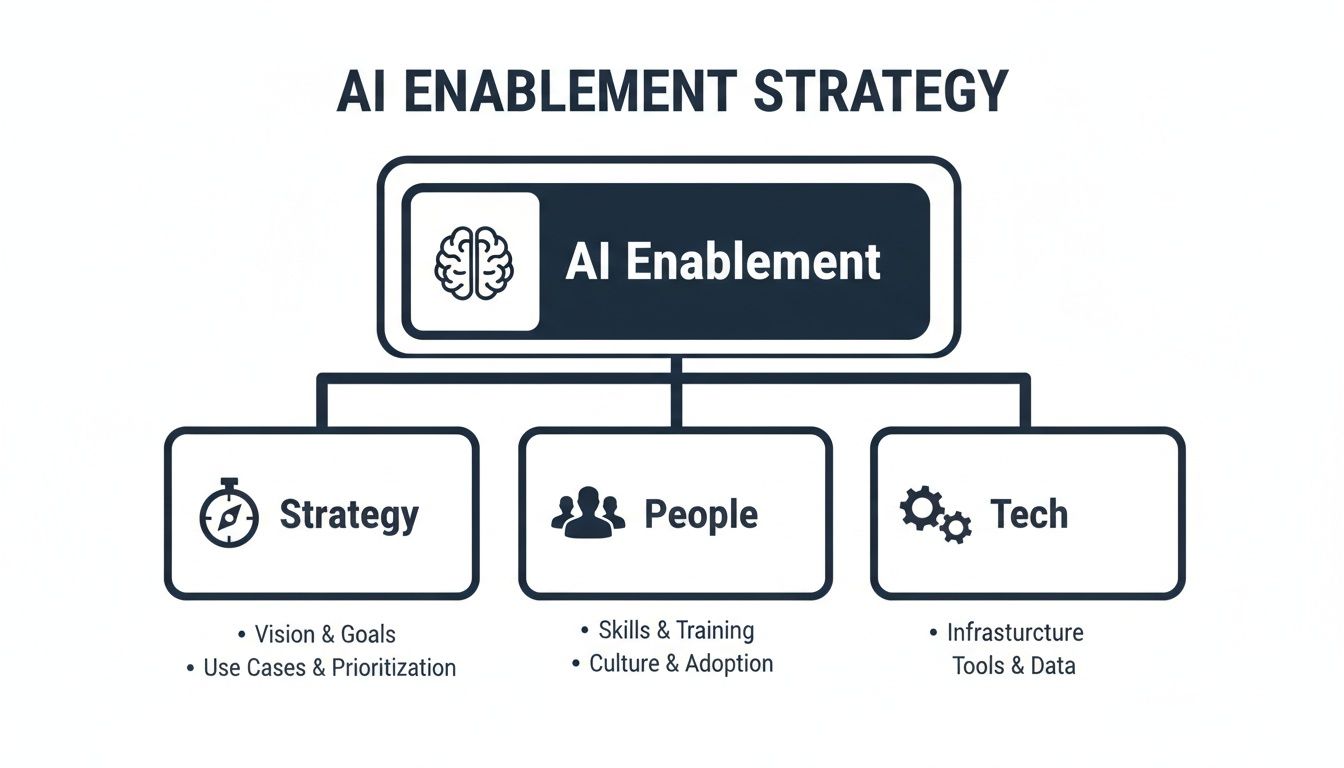
This really drives home the point that AI enablement isn’t just a tech problem to be solved. It’s a delicate balance. Your strategic vision, your team’s skills, and your tech stack must all advance in sync.
Stage 1: Foundational
This is the starting line, where most organizations find themselves today. At the Foundational stage, AI is still in the “let’s try it out” phase. Think isolated pilot projects and a few proofs-of-concept (PoCs) scattered across different departments.
-
Technology: Efforts are often disconnected. You might be using some off-the-shelf AI tools or trying some small-scale custom software development for one specific problem. The infrastructure isn’t built to scale or connect these efforts.
-
People: A handful of passionate “AI champions” are typically pushing these early projects forward. But there’s no widespread understanding of AI, and many employees are either unaware of it or a bit nervous about what it means for them.
-
Governance: Rules? What rules? Policies are usually informal or non-existent. There are no standard procedures for handling data, checking models, or assessing risk, which can create some serious blind spots.
The main goal here is simply to explore and learn. The biggest challenge is figuring out how to move beyond these one-off successes and build something more strategic.
Stage 2: Developing
After seeing some initial promise, your organization realizes it’s time to bring some order to the creative chaos. The Developing stage is all about creating standards and repeatable processes. This is often the point where companies look for AI development services to help formalize their approach.
-
Technology: You start to standardize on a core set of AI platforms and tools. The beginnings of an MLOps (Machine Learning Operations) foundation appear, helping you manage the entire AI lifecycle more efficiently.
-
People: Formal training programs are rolled out to build a baseline of AI literacy across different teams. The roles of data scientists and AI specialists become more formally defined.
-
Governance: The first draft of a governance framework is created. You establish basic guidelines for data privacy, model fairness, and ethical use, usually because the first scaled projects made you realize you needed them.
At this stage, the key objective is to build a repeatable and reliable “AI factory.” You’re moving from one-off craft production to a more systematic assembly line for AI solutions.
Stage 3: Mature
In the Mature stage, AI stops being a special project and becomes woven into the fabric of your business. It’s a key part of how you make decisions and automate daily work.
-
Technology: AI is now deeply embedded within core enterprise systems like your ERP and CRM. You have a robust, scalable data infrastructure that feeds clean, reliable data to your models. Your tech stack is flexible enough to support fast development and deployment.
-
People: A culture of data-driven decision-making has taken hold. You see cross-functional teams of business experts, data scientists, and engineers working together seamlessly. Employees no longer see AI as a threat, but as a tool that helps them do their jobs better.
-
Governance: AI governance is a well-oiled machine. It includes automated monitoring for model performance and bias, clear lines of accountability, and regular audits. Rigorous software testing services are a non-negotiable part of the process to ensure AI systems behave as expected.
Stage 4: Advanced
This is the peak of AI enablement. At the Advanced stage, your organization isn’t just reacting; it’s predicting. AI doesn’t just automate tasks; it anticipates future trends and actively shapes business strategy.
An organization at this level has mastered all the technical and cultural elements from the previous stages. As we’ve seen in our client cases, reaching this point is what allows companies to invent entirely new business models and create untouchable market advantages.
The enterprise essentially operates as an intelligent, adaptive system that is always learning and optimizing itself. By understanding these stages, you can pinpoint where you are and what you need to do next, and then find the right AI solutions partner to help accelerate your journey.
Building Your AI Technology Backbone
A solid AI strategy is about more than just slick algorithms. You need a powerful and flexible technology backbone to make it all work. This isn’t a shopping spree for the latest AI gadgets; it’s about deliberately architecting a system that lets AI weave itself into the fabric of your business.
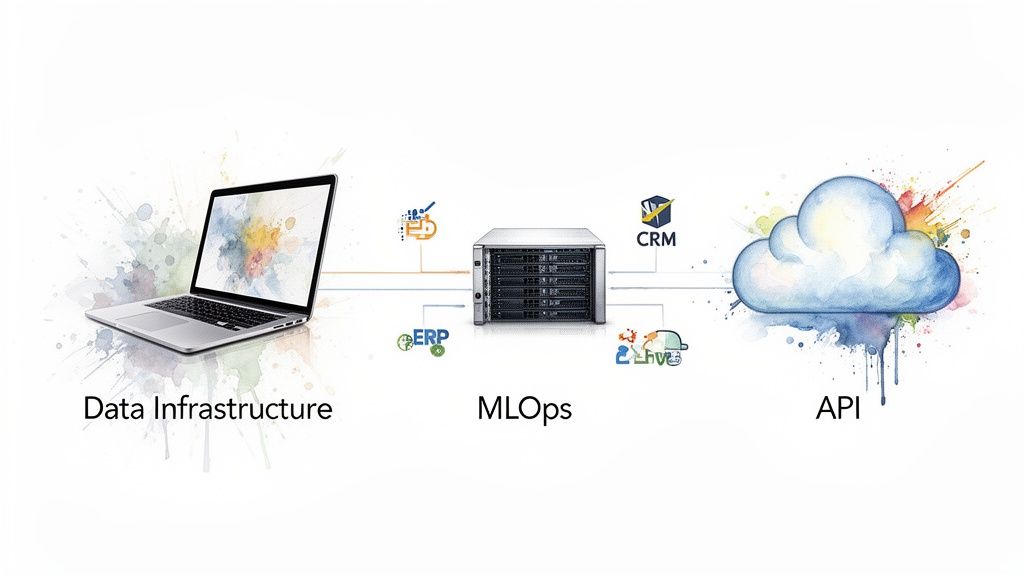
Think of it like the plumbing and wiring in a smart home. Without that essential infrastructure, your fancy smart devices are just expensive paperweights. In an enterprise, this tech backbone is what allows AI to genuinely enhance your ERPs and CRMs, not just create more IT headaches.
The Three Pillars of a Modern AI Stack
To build a foundation that lasts, IT leaders really need to zero in on three key areas. Get these right, and you’ll have a system that doesn’t just create AI models but gets them into the hands of your users and keeps them running effectively.
-
Modern Data Infrastructure: Let’s be blunt: AI is useless without good data. This means you need a modern data platform, like a data lakehouse, that can handle a constant flood of both structured and unstructured information. Having clean, accessible, and well-governed data is the non-negotiable first step. It’s the fuel for your entire AI engine.
-
Machine Learning Operations (MLOps): MLOps is what separates the AI dabblers from the professionals. It applies the same rigor we see in DevOps to the machine learning lifecycle, creating a repeatable, automated process for everything from training models to deploying and monitoring them. A strong MLOps practice is your guarantee that you can get models into production reliably and keep them performing over time.
-
A Robust API Strategy: Your AI models can’t live on an island. They need to talk to your other enterprise systems, and that’s where APIs (Application Programming Interfaces) come in. Think of your API strategy as the universal translator that lets different software exchange data and trigger tasks. It’s how you embed AI-powered predictions and automation right where people work.
The big shift we’re seeing is AI moving from a standalone gadget to becoming part of the core enterprise infrastructure. Instead of just bolting on a new AI tool, smart companies are weaving these capabilities directly into their business systems. It’s no wonder that over 75% of organizations now use AI in at least one business function. Adoption of generative AI alone has more than doubled every year since 2023.
Making AI Play Nice with Your Existing Systems
Let’s be honest, getting shiny new AI tools to work with your trusty, and often old, legacy systems is one of the biggest challenges out there. An off-the-shelf solution rarely fits your unique processes perfectly, leaving you with frustrating gaps.
This is where a thoughtful approach to integration is critical. As we’ve explored in our guide on artificial intelligence integration services, understanding the details is the key to making sure data flows seamlessly and insights get to the right person at the right time. The kind of innovation needed to build this leading-edge backbone is even attracting serious investment, with dedicated funds like the deep tech fund for Quantum AI and advanced computing startups emerging.
By concentrating on these architectural pillars, you can build a cohesive, powerful technology backbone that turns isolated AI experiments into sustained business value. Getting this foundation right is what makes your AI initiatives built to last.
How to Build AI Governance and Manage Risk
Rolling out AI across your company without a solid governance plan is like giving the keys to a racecar to someone who’s never driven before. It’s not about putting the brakes on innovation. Far from it. Think of governance as building the roll cage, the fire suppression system, and the five-point harness – the critical safety features that let you push the limits with confidence.
In practical terms, AI governance is your company’s playbook. It sets the rules of the road, defines who’s accountable, and creates the processes to ensure your AI efforts are responsible, compliant, and true to your corporate values. This is especially true in tightly regulated fields like finance or healthcare, where a single misstep can have massive legal and financial fallout.
Assembling Your AI Governance Committee
Your first move should be to create a cross-functional AI governance committee. Don’t make the mistake of burying this in the IT department. To be effective, this group needs representation from every corner of the business: legal, compliance, HR, key business units, and, of course, technology.
This committee acts as the strategic command center for all things AI. Their core responsibilities include:
-
Setting AI Policies: They’ll write the clear, enforceable rules for data privacy, model fairness, and transparency that everyone must follow.
-
Greenlighting High-Risk Projects: Any AI project with significant ethical or compliance implications must get its approval before a single line of code is written.
-
Championing AI Ethics: They ensure every AI system reflects the organization’s ethical compass.
Without a central body like this, you risk departments going rogue, creating a chaotic mess of conflicting standards and hidden risks. As we explored in our guide on the topic, getting this right is a cornerstone of any successful strategy for software project risk management.
Essential Controls for Responsible AI
With the committee in place, it’s time to get tactical. You need to implement specific controls, both technical and procedural, that bring your governance policies to life. These are the daily checks and balances for your AI systems.
A proactive approach to governance is what separates the leaders from the laggards. By putting structured oversight in place early, you can head off major problems like vendor lock-in, regulatory fines, and skill gaps before they derail your entire AI strategy.
Here are a few controls that should be on your list:
-
Human-in-the-Loop (HITL) Systems: For any high-stakes decision, a human expert must have the final say. Whether it’s a medical diagnosis or a large financial trade, the AI can recommend, but a person must approve. This is non-negotiable.
-
Regular Bias Audits: Models are only as unbiased as the data they’re trained on, which means they can easily perpetuate existing prejudices. You need to conduct routine audits to find and fix unfair outcomes, ensuring the AI works equitably for everyone.
-
Explainable AI (XAI) Techniques: People need to trust the AI, and that starts with understanding it. XAI tools help demystify a model’s decisions, showing you why it reached a particular conclusion. This is crucial for debugging, building stakeholder confidence, and satisfying regulators.
The Uncompromising Role of Testing
At the end of the day, rigorous testing is your ultimate safety net. You can’t just build a model in a lab and hope for the best when it hits the real world. Comprehensive software testing services are absolutely vital to confirm your AI systems perform as expected, are secure, and don’t violate any rules.
This isn’t your standard QA process. AI testing must include model validation to check for accuracy, data integrity checks to ensure quality inputs, and adversarial testing to see how the system reacts to bizarre, unexpected scenarios. When you make this level of testing a mandatory gateway in your AI lifecycle, you give leadership the proof they need to deploy AI with conviction.
Cultivating an AI-Ready Company Culture
Let’s be honest: the fanciest AI tech stack in the world is useless if your people don’t or won’t use it. I’ve seen massive AI projects stall and fail not because the technology was flawed, but because the human element was ignored. True AI enablement for enterprises is as much about people and culture as it is about algorithms and data.
Getting this right means moving beyond a top-down mandate. You have to actively cultivate an environment where your teams see AI as a new, powerful tool in their belt, not as a threat to their job. This starts by demystifying the tech, tackling the inevitable fears head-on, and showing people how AI can make their work better, not just different.
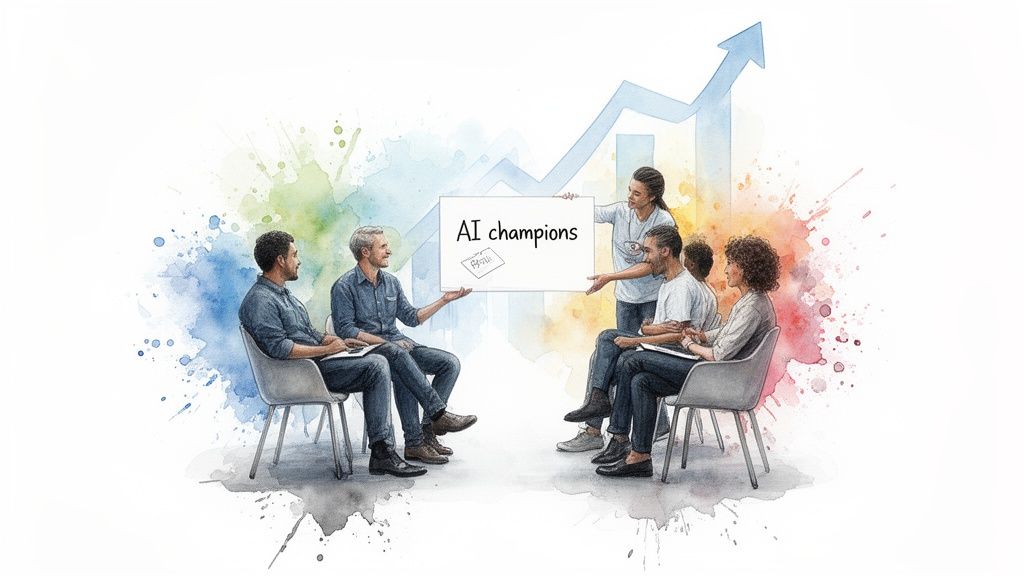
When you get your communication right, you start framing AI as a partner for your employees – something that handles the tedious, repetitive work so they can focus on strategy, creativity, and the kind of high-impact tasks that drive real value. This isn’t just about feel-good messaging; it’s how you turn a technology expense into a measurable leap in productivity.
Fostering AI Champions and Executive Sponsorship
Real change doesn’t happen in a vacuum. It needs catalysts. The first and most critical one is executive sponsorship. When your leadership team visibly puts their weight and budget behind AI initiatives, it sends a powerful signal across the entire organization: this is a core part of our future, not just another short-lived experiment.
But leadership can’t do it alone. You need to empower “AI champions” on the ground, within your business units. These are the curious, enthusiastic people who are naturally drawn to new tools. Give them early access, support them, and let them become your internal advocates. They’ll translate AI’s benefits into the day-to-day language of their peers, troubleshoot problems, and share success stories in a way that feels organic and trustworthy. This grassroots network is your secret weapon for driving adoption from the inside out.
This is where the conversation shifts from simple “upskilling” to what I call “new-skilling.” It’s about giving every single employee a baseline AI literacy while simultaneously creating deep, specialized expertise in your technical and data teams. This two-track approach ensures everyone feels confident enough to engage with AI in their daily roles.
Closing the Productivity Gap with Targeted Training
Recent data paints a very clear picture. While 66% of companies using AI see productivity gains, there’s a huge catch. We’re seeing a staggering 6x productivity gap between the “power users” who are truly proficient and the average employee who is just dabbling. Simply giving people access to a tool doesn’t create impact; it just creates activity. The fact that nearly two-thirds of companies haven’t even begun to scale their AI efforts shows just how critical this skill gap is. You can dig into more of these AI adoption findings from Accelirate.com.
To turn your AI investment into a true competitive advantage, you must close this proficiency gap. The goal isn’t just to give everyone access to AI tools but to equip them with the skills to use those tools effectively.
This is where generic, one-size-fits-all training completely falls apart. You need a far more targeted and practical approach.
Here’s what works:
-
Role-Specific Training: Stop the generic webinars. A marketing professional needs to master AI for campaign personalization and customer segmentation. A finance analyst needs to learn how to build better predictive models. Make the training relevant to their actual jobs.
-
Hands-On Workshops: People learn by doing. Get your teams into interactive sessions where they can use the new AI tools to solve real-world business problems they face every day. This builds practical skills and confidence far better than any presentation.
-
Continuous Learning Paths: Proficiency isn’t a one-time event. Offer clear development pathways that take employees from beginner to intermediate and, eventually, to expert. This is how you cultivate your next generation of AI power users internally.
By putting your people at the center of your strategy, you do more than just implement a new technology. You weave AI into the very fabric of your company’s DNA. If you’re struggling with where to begin, a good AI solutions partner can be invaluable in helping you design and roll out the cultural and training programs needed to ensure your team is ready to lead the charge.
Measuring the ROI of Your AI Initiatives
So, how do you actually prove your investment in AI enablement for enterprises is worth it? Your stakeholders aren’t just looking for flashy demos; they want to see the numbers. They need concrete proof that links what you’re spending on AI to real, tangible business results. To get there, you need to move past vanity metrics and adopt a structured way of measuring your return on investment (ROI).
The first, and most critical, step is to establish clear baselines before you begin. You can’t show how far you’ve come if you don’t know where you started. A solid measurement framework will track key performance indicators (KPIs) across the four main ways AI creates business impact. This gives you a complete view of the value you’re generating.
Key Areas for Measuring AI Value
To build a business case that gets everyone on board, you should focus your measurement efforts on these core domains. Each one represents a distinct way AI delivers value, whether it’s by cutting costs or opening up entirely new revenue streams.
-
Operational Efficiency: This is usually the low-hanging fruit and the easiest to measure. You’re looking for things like cost reductions from automation, faster production cycles, or fewer errors in your daily workflows. For instance, if an AI model automates invoice processing, you can directly measure the decrease in manual data entry hours and the reduction in payment errors.
-
Customer Experience: AI can completely change how customers see and interact with your company. Here, you’ll want to monitor KPIs like customer satisfaction (CSAT) scores, Net Promoter Score (NPS), and any drop in customer support tickets. An AI-powered chatbot, for example, can be judged by how well it resolves issues on the spot, which might lead to a 25% decrease in average handling time for your human agents.
-
Employee Productivity: One of the biggest wins with AI is giving your team their time back. Track how much time is saved on repetitive, manual tasks, which frees up your people to focus on more strategic work. A generative AI assistant that helps your team draft reports and emails can be measured by tracking the average hours saved per employee per week.
-
Revenue Growth: This is where you connect AI directly to the top line. The right KPIs here could be improved lead conversion rates, a bigger average deal size, or a higher customer lifetime value. Think of an AI-driven recommendation engine on an e-commerce site; its success can be measured by the increase in cross-sell and upsell revenue it generates.
Calculating ROI Beyond Hard Costs
Calculating the ROI for AI isn’t always a simple math problem. While the hard cost savings and revenue boosts are fairly straightforward, the more strategic benefits, like creating a culture of innovation or getting a leg up on the competition, are just as valuable but much trickier to put a number on.
A truly balanced ROI model needs to account for both. Start with the tangible savings and revenue gains, as they provide the solid financial footing for your business case. From there, you can layer on the softer, strategic benefits to paint the full picture for your stakeholders.
Your ROI calculation needs to tell a story. It should show how AI is more than just another IT project; it’s a fundamental driver of business strategy that delivers compounding returns through better efficiency, smarter decisions, and a more capable workforce.
We see this direct connection between AI projects and measurable business outcomes time and again in our client cases. When you establish a clear measurement plan from day one, you can effectively prove the value of your AI strategy and get the buy-in you need to scale your efforts across the entire organization.
FAQs on AI Enablement for Enterprises
Let’s tackle some of the real-world questions that pop up when leaders start thinking seriously about bringing AI into their operations.
What’s the right first step for an AI enablement program?
The best first step isn’t about technology; it’s about business strategy. Identify a specific, high-impact business problem that AI can solve. Instead of getting distracted by new tools, focus on an area where automation could eliminate a repetitive task or where predictive insights could dramatically improve decision-making. Starting with a clear business goal makes it easier to measure success and get organizational buy-in.
How do we build an AI-ready culture without causing fear about job losses?
This is all about communication and reframing the narrative. The message, delivered consistently from leadership, must be about augmentation, not replacement. Show your teams how AI is a tool to make their jobs more strategic and less tedious. As we explored in our guide to AI readiness, pilot programs with enthusiastic “AI champions” are a great way to build trust. When colleagues share their positive experiences, it’s far more powerful than any top-down directive.
Do we need to hire a team of data scientists to get started with AI?
No, not at all. Many companies can start by leveraging the AI-powered features already built into their existing software platforms (like CRMs or ERPs). This is a low-cost, low-risk way to get quick wins and start building AI literacy. For more ambitious projects, partnering with an external AI solutions partner is often a smarter move than hiring immediately. It gives you instant access to specialized expertise so you can prove the ROI before committing to building a large in-house team.

About Upendra Jith
Upendrajith completed his Master's in English and has been a commercial content developer for the past three years. He's more inclined to develop content with a 'street-smart' delivery on topics such as technology, media, or anything he can get his hands on. He has a fixation on lyrics, dark poetry, media, technology, and flow arts.
View all posts by Upendra Jith →