



Population Health Analytics Platforms: A CTO’s Guide
Population health analytics platforms are moving from side project to core infrastructure. One market estimate puts the category at USD 3.09 billion in 2024, rising to USD 3.60 billion in 2025 and projected to reach USD 16.46 billion by 2032. Another forecast is even more aggressive, projecting USD 4.25 billion in 2026 to USD 30.04 billion by 2034 with a 27.70% CAGR (GII Research). That’s not a niche trend; it’s a warning that every CTO in healthcare needs to treat population analytics as a platform decision, not a reporting add-on.
The strategic shift is simple. Providers, payers, and public-health teams are moving away from retrospective reporting and toward systems that continuously stratify risk, identify care gaps, and prioritize intervention. In value-based care, that means the platform is no longer a dashboard on the side of the stack; it’s the operating layer that decides where attention goes first.
A competent healthtech software development partner matters here because the hard part isn’t buying charts; it’s building the data, workflow, and governance spine underneath them. If your architecture can’t unify data, support auditability, and fit clinical operations, the platform will still look modern while failing in production.
The Rise of Population Health Analytics Platforms
The market numbers tell you one thing, but the operating reality tells you more. Population health analytics platforms are growing because healthcare organizations can’t manage value-based care with static reports and disconnected spreadsheets anymore. The category’s expansion from USD 3.09 billion in 2024 to a projected USD 16.46 billion by 2032 signals a broad technology shift toward AI, big data, and cloud-based workflows (GII Research).
Why the timing changed
Population health analytics only becomes strategically important when the organization needs to act before outcomes deteriorate. That’s the core change from traditional reporting, which answered what happened, to modern analytics, which tries to determine who is at risk now and what should happen next. In parallel, the broader healthcare analytics market is projected to grow from USD 57.16 billion in 2025 to USD 192.78 billion by 2031 at a 22.46% CAGR, which shows this isn’t a side market; it’s the data layer healthcare is reorganizing around (Innovaccer).
For a CTO, the implication is blunt. If your organization still depends on retrospective reporting, you’re paying for historical visibility when competitors are building operational decision support. That gap shows up in missed care opportunities, weak risk stratification, and slow intervention timing.
Practical rule: if the platform doesn’t change who gets called, flagged, or prioritized, it’s just expensive reporting.
What the category really solves
The platform’s job is to unify fragmented clinical, claims, and social data into a longitudinal view, then turn that view into repeatable operational workflows. That matters because the market isn’t buying another dashboard. It’s buying a way to make care coordination, quality tracking, and intervention targeting more reliable across large patient cohorts.
A custom healthcare software development decision starts to make sense for certain use cases. If your operation requires unique data models, specialty workflows, or payer-provider coordination logic, off-the-shelf software often stops short. When the platform has to fit your contracts and your clinical reality, customization isn’t an indulgence; it’s architectural discipline.
The Core Architecture of a Modern Platform
A population health platform should be built like city infrastructure, not a brochure site. Roads, utilities, transit, and emergency services each do a different job, and they only work when they are connected. The same applies here, because ingestion, storage, analytics, and workflow delivery solve separate problems and have to fit together cleanly.
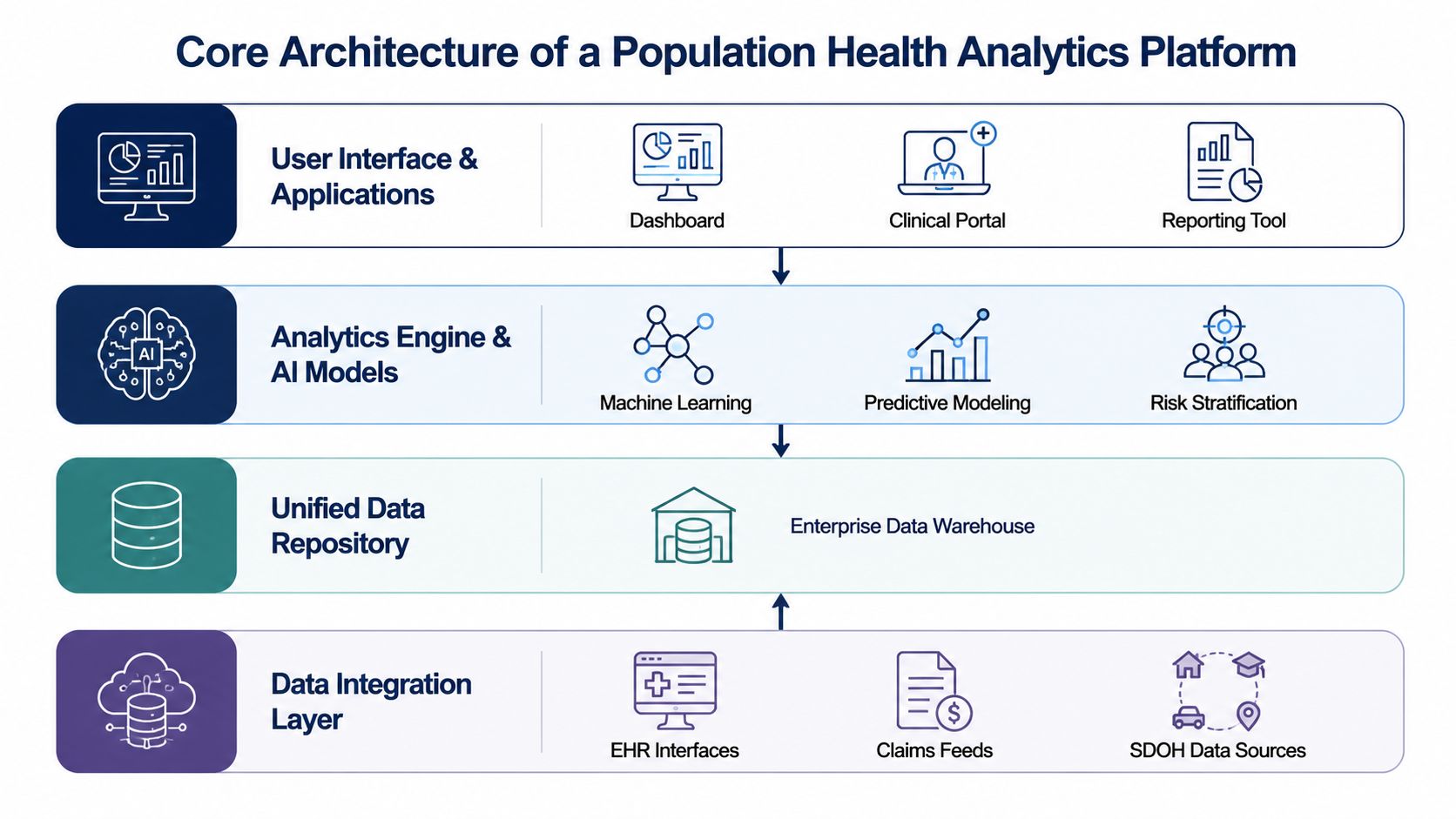
Build the layers in the right order
Start with the data integration layer. One documented enterprise deployment supports FHIR, HL7, C-CDA, and USCDI, plus auditable logic for regulatory reporting and the ability to rerun measures throughout the year (Infor). That matters because healthcare data is useless until it moves safely and consistently across systems.
Then build the unified data repository. EHR, claims, operational, social, and environmental data should land there in a form the analytics engine can trust. A healthcare infrastructure guide recommends a central repository with secure, compliant integration, audit trails, and role-based access controls, which is the baseline for handling sensitive population data (OpenMetal). The same integration discipline is covered in this healthcare integration architecture guide, which is useful if your current stack still depends on brittle point-to-point feeds.
The analytics engine and AI models sit on top of that repository. This layer has to support risk stratification, cohort monitoring, quality-measure tracking, and continuous re-evaluation of measures. If your platform cannot rerun logic during the year, you end up stuck with batch-era assumptions in a live-care environment.
Don’t ignore latency and workflow fit
The presentation layer is where many platforms fail. A deployment description from Infor specifies near real-time feeds of up to 15 minutes, segregated data marts for identifiable and de-identified data, and secure Azure-based scaling. That points to where the market is heading, toward operational analytics that support intervention timing, not quarter-end review (Infor).
Design standard: if clinicians cannot trust the freshness, provenance, and audit trail of the data, they will not act on the output.
For CTOs evaluating vendors or planning a build, custom software development becomes a strategic choice. The right architecture matches your data volume, regulatory burden, and care workflow, not the one that looks polished in a demo. If your organization needs different ingestion rules, tighter governance, or specialty-specific workflow logic, forcing those needs into a generic product usually creates more operational debt than it removes.
A platform built this way stays boring at the infrastructure layer and specific at the workflow layer. That is the point.
Unifying the Data Pipeline From EHRs to SDOH
Population health analytics platforms live or die on data integration. The visible dashboards matter, but the core product is the pipeline that turns fragmented clinical, claims, social, and environmental inputs into a longitudinal record the organization can use.

The hardest problem is not collection; it’s reconciliation
A practical platform has to pull from EHRs, insurance claims, social determinants datasets, and patient-generated data, then normalize them into one operating layer. A clean diagram hides the complex work, which is reconciling mismatched patient identifiers, lagging claims, inconsistent coding, and sparse SDOH records across systems.
That is why the pipeline architecture matters before the analytics layer does. If you want a clear reference model for the moving parts, start with healthcare data pipeline architecture. Without disciplined integration, risk stratification becomes noisy, cohort management loses reliability, and quality reporting gets harder to defend during audit reviews. One vendor analysis makes the same point plainly; the platform only creates value when it converts multi-source data into repeatable workflows, not when it stores a larger pile of records (Innovaccer).
Standards matter more than slogans
Interoperability is a business decision. Support for FHIR, HL7, C-CDA, and USCDI is required if you want the platform to survive long-term integration work in healthcare. If a vendor cannot support those standards cleanly, your engineering team will spend its time patching weak interfaces instead of improving analytics.
Vertical integration matters more than layering datasets side by side. Integrating area-level public health survey and census data with clinical and individual-level data creates more value than merely displaying them together, because linkage quality determines whether the model can drive action or just generate noise (Roche).
Strong recommendation: treat linkage quality as a first-class metric. If your pipeline cannot prove record quality, your AI layer will inherit every upstream mistake.
The right pattern is a layered ETL or ELT pipeline with strong identity resolution, source-level lineage, and explicit rules for missing or conflicting records. A healthcare integrations program should start with the feeds that affect care decisions first, then expand outward. Do not try to integrate everything at once just to claim completeness.
A platform built this way stays boring at the infrastructure layer and specific at the workflow layer. That is the point.
Powering Insights with Advanced Analytics and AI
Once the data is unified, the platform stops being a reporting layer and starts making decisions usable for care teams. The maturity path is clear. Start with historical reporting, move to root-cause analysis, then prediction, then intervention guidance.
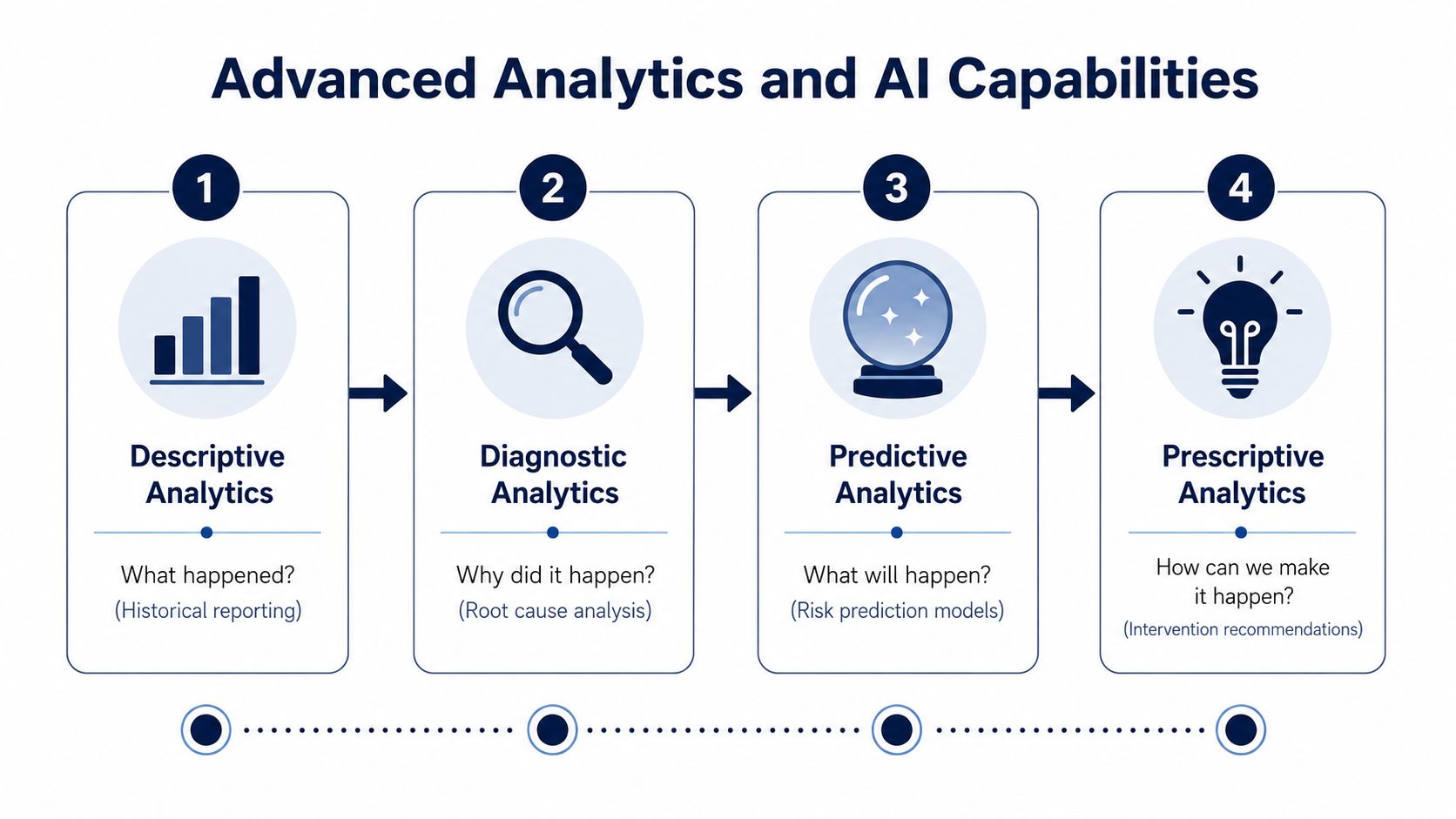
Descriptive and diagnostic are table stakes
Descriptive analytics answers what happened. Diagnostic analytics explains why it happened. Both matter because clinical and operational teams need a trusted baseline before they accept any predictive output.
The key test is whether the platform can show what is happening now and what should happen next. Population health analytics is built to identify risk, surface care gaps, and support intervention sequencing, which is why predictive modeling sits at the center of the category (Innovaccer). If the system cannot prioritize outreach or connect the analysis to action, it is too weak for value-based care. For teams that need live operational views, a real-time healthcare analytics dashboard approach is the right complement to batch reporting, because it keeps care managers working from current signals instead of stale extracts.
Predictive and prescriptive need governance
MLOps is required. Predictive models drift, scoring logic changes, and the population itself changes over time. If your team does not watch inputs, outputs, and performance continuously, the model will drift away from reality while still sounding confident.
Healthcare buyers are also demanding measurable operational criteria, not just feature lists. A Becker’s Hospital Review summary of a survey of 2,230 healthcare professionals says buyers evaluated 18 KPIs, including effectiveness of data integration, interoperability, and timeliness of data availability, then ranked vendors across population health reporting and analytics categories (Becker’s Hospital Review). That tells you what the market values: useful analytics has to be fast, integrated, and usable inside workflow.
Here’s the decision rule I’d use:
- Descriptive layer: Keep it clean, auditable, and easy to trust.
- Diagnostic layer: Make it searchable enough for care teams to investigate causes.
- Predictive layer: Deploy models only where the intervention path is clear.
- Prescriptive layer: Recommend actions only when the organization can execute them inside workflow.
A platform built this way can support AI development services without turning the analytics team into a science project. It also makes enterprise AI solutions easier to govern because every model is tied to a use case, a workflow owner, and a measurable outcome.
If you are planning a broader product strategy, SaaS product development decisions get real here. The platform has to behave like software, with release discipline, monitoring, and user feedback loops, not like a static reporting package.
Measuring Success with the Right KPIs and ROI
A platform that doesn’t change care delivery is a sunk cost. CTOs need to stop evaluating population health investments by feature depth alone and start measuring whether the platform changes clinical behavior, operational speed, and financial performance.
Track outcomes, not dashboard activity
The right KPI set should combine care quality, utilization, and economics. In practical terms, that means monitoring readmissions, quality-measure performance, care-gap closure, and cost of care trends, because those are the metrics the C-suite understands. If the platform doesn’t move one of those levers, the organization is buying visibility without strategic advantage.
The market evidence already points in that direction. Value-based care depends on proactive risk identification, care-gap tracking, and quality measure monitoring, because those functions let teams intervene earlier and avoid avoidable deterioration (Innovaccer). In ACO and payer contexts, that also ties directly to contract performance and financial sustainability.
Build ROI around operational leverage
ROI is usually won or lost in workflow efficiency. If care managers receive cleaner risk lists, if analysts spend less time reconciling reports, and if quality teams can rerun measures without waiting on manual refresh cycles, the platform pays for itself through time saved and mistakes avoided.
A useful operating model is to separate metrics into three buckets:
- Clinical KPIs: Readmissions, preventative care completion, and care-gap closure.
- Operational KPIs: Data timeliness, interoperability quality, and measure rerun frequency.
- Financial KPIs: Cost of care, contract performance, and resource utilization.
Hard truth: if your analytics team can’t explain how a model output changes a care action, the model isn’t ready for production.
The reason buyers score vendors on integration, interoperability, and timeliness is simple: those are the levers that affect whether a platform produces action or noise (Becker’s Hospital Review). That’s why business cases should be tied to specific interventions, not generic “efficiency” claims.
For leadership teams comparing build and buy, a custom healthcare software development approach makes sense when the ROI depends on embedded workflows, unique contracts, or a proprietary population strategy. If the system’s value comes from differentiation, not just compliance, build economics often improve over time.
Vendor Selection and Implementation Roadmap
Choose vendors like you’re choosing infrastructure, not a prettier user interface. The wrong partner will bury your team in integration debt, weak governance, and model trust issues. The right one will give you a platform that your clinicians and analysts can use.
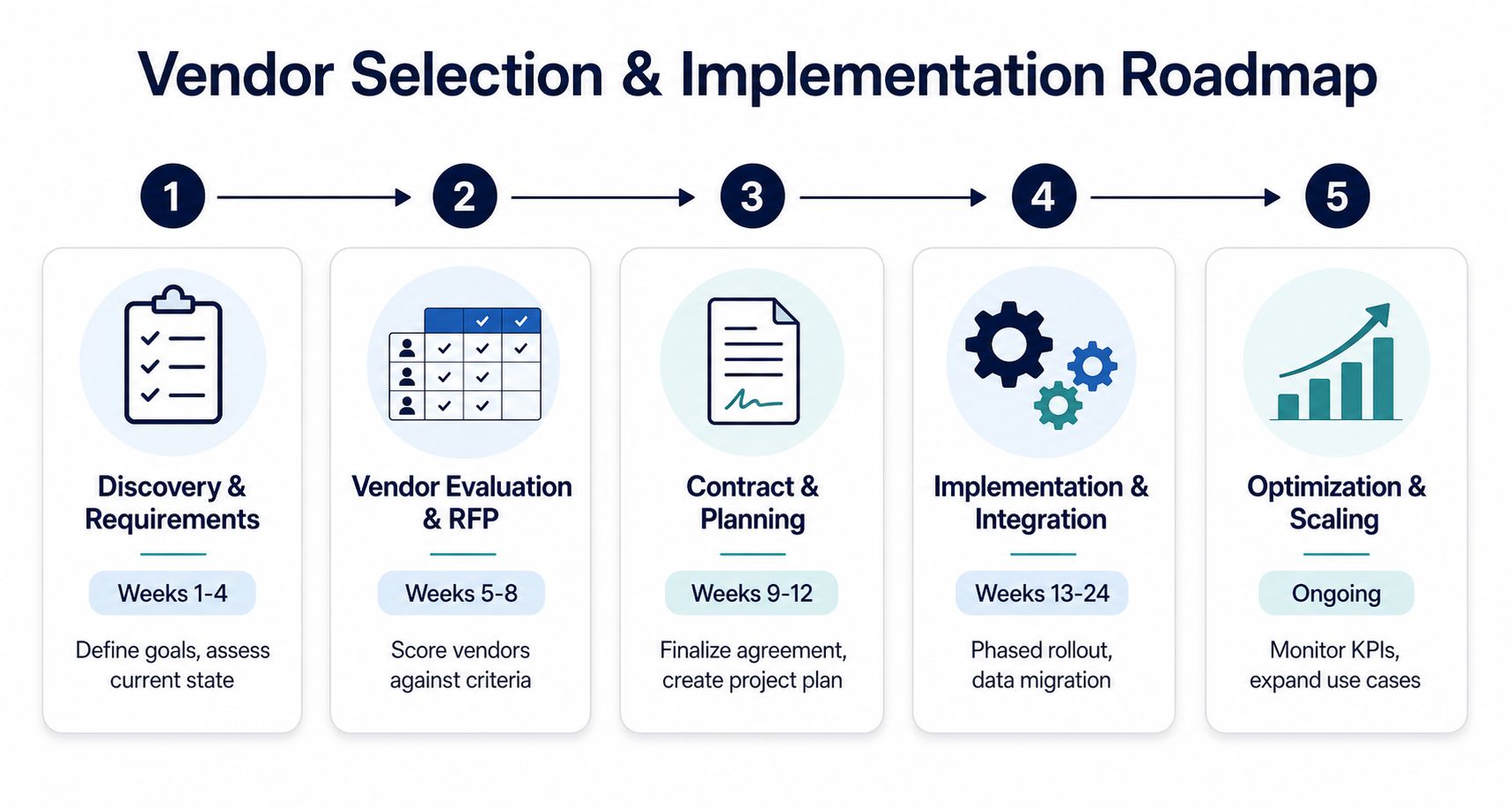
Score vendors on engineering reality
Start with interoperability, auditability, and scale. If the platform doesn’t support the standards your current stack needs, your internal engineering team will become the integration layer by accident. Also check whether the system can handle multiple data representations, because identifiable and de-identified use cases usually require separate controls.
The market is already telling buyers what matters. A Becker’s Hospital Review summary of a survey of 2,230 healthcare professionals found that buyers reviewed 18 KPIs, including data integration effectiveness, interoperability, and timeliness of data availability (Becker’s Hospital Review). Use that as your vendor scorecard baseline, then add your own regulatory and workflow criteria on top.
You should also ask the AI questions that many procurement teams skip:
- Can the model be audited?
If not, don’t deploy it.
- Can it be retrained without breaking clinical trust?
If not, expect drift problems.
- Can you explain why a patient was flagged?
If not, care teams won’t use it.
- Can the platform prove fairness across sparse or undercoded populations?
If not, you’re likely to amplify blind spots.
Use a phased roadmap, not a big-bang rollout
A phased launch is the only sane option. Start with discovery and current-state assessment, then move into source connection, then pilot the highest-value use case, then expand. One enterprise deployment description shows why this works: near-real-time feeds, secure marts, and auditable measures all require controlled rollout, not all-at-once deployment (Infor).
If you need a partner that can connect platform planning with delivery, Bridge Global is one option for teams evaluating software development service models and broader build-versus-buy execution. Its consulting and engineering capabilities can be relevant when a healthcare organization needs to align data work, AI work, and product delivery in one program.
Use the following sequence as your implementation discipline:
- Discovery & Requirements: Define the population, the care workflows, and the reporting obligations.
- Vendor Evaluation & RFP: Score architecture, interoperability, governance, and AI transparency.
- Contract & Planning: Lock scope, data ownership, and escalation paths.
- Implementation & Integration: Connect systems in phases and validate data lineage early.
- Optimization & Scaling: Expand use cases only after the first one is stable.
If you’re building the platform instead of buying it, this is also where an AI implementation roadmap should sit inside the broader delivery plan. Otherwise, AI becomes a feature request instead of an operational capability.
Conclusion: Your New Strategic Imperative
Population health analytics platforms are not just software purchases. They’re decisions about how your organization will identify risk, coordinate care, and prove value over time. Once you accept that, the architecture conversation gets sharper, because the platform has to earn trust across data integration, analytics, workflow fit, and governance.
The CTO’s job is to resist cosmetic solutions. A strong platform needs interoperable ingestion, a longitudinal data model, auditable analytics, and a rollout plan that fits real clinical operations. Anything less turns into a dashboard that looks useful and behaves like a liability.
The organizations that win here won’t be the ones with the fanciest demos. They’ll be the ones that treat population analytics as a strategic asset, then build or buy accordingly. Real-world client cases are worth reviewing before you commit, because implementation quality matters more than feature lists.
Frequently Asked Questions
Should we build or buy a population health analytics platform?
Buy if your use case is conventional and your differentiator isn’t the analytics layer itself. Build if your workflows, data models, or care coordination logic are distinctive enough that a packaged product would force too many compromises. The most expensive mistake is buying a platform that still needs heavy engineering to fit your operation.
What data sources matter most?
Start with EHR and claims because they usually anchor the operational view. Then add social determinants, operational data, and patient-generated inputs when the organization is ready to use them in a repeatable workflow. More sources are only better if the platform can reconcile them cleanly and turn them into actions.
How do we know the AI models are fair enough?
You don’t rely on a vendor claim. You require audit trails, model explanation, monitoring across subpopulations, and a process for checking undercoded or sparsely represented groups. If the platform can’t show how it performs across heterogeneous populations, it’s not ready for serious healthcare use.
What should a CTO ask in the first vendor meeting?
Ask how the platform handles interoperability, lineage, auditability, latency, and retraining. Then ask who owns the data model, how measures are rerun, and how clinicians will see the output inside workflow. If the answers stay at the demo layer, keep looking.
Where does implementation usually fail?
It usually fails at integration, governance, and adoption. Teams connect too many systems too early, skip data quality checks, and assume clinicians will trust outputs just because the dashboard looks polished. A phased rollout with clear ownership avoids most of that pain.
If you’re evaluating a build-or-buy decision for population health analytics platforms, Bridge Global can help you connect architecture planning, AI delivery, and healthcare-grade implementation into one execution path. Review its healthcare engineering approach at Bridge Global and use that starting point to scope a platform that fits your data, workflow, and governance reality.

About Upendra Jith
Upendrajith completed his Master's in English and has been a commercial content developer for the past three years. He's more inclined to develop content with a 'street-smart' delivery on topics such as technology, media, or anything he can get his hands on. He has a fixation on lyrics, dark poetry, media, technology, and flow arts.
View all posts by Upendra Jith →