



Healthcare Application Modernization: A Step-by-Step Roadmap
The popular advice is to move healthcare applications to the cloud, replace the interface, and call it work modernization. That approach misses the operational problem. Healthcare application modernization succeeds when clinicians, administrators, patients, and connected systems can complete their work with less friction and stronger control, not when an old server runs in a new environment.
The stakes are substantial. The U.S. shift to electronic health records after 2009 produced a major infrastructure and workflow transition. Hospital EHR use increased by 87 percentage points between 2008 and 2021, while physician use increased by 61 percentage points, according to the Infosys healthcare modernization analysis. The next modernization cycle has to address what those systems made visible: disconnected applications, difficult workflows, fragile interfaces, security exposure, and adoption barriers.
A practical roadmap starts with diagnosis, not deployment. It maps the estate, tests the workflows, selects a strategy system by system, validates interoperability and security, and measures whether people can use the result.
Why Healthcare Modernization Fails Before It Starts
Healthcare application modernization succeeds when clinicians, administrators, patients, and connected systems can complete their work with less friction and stronger control. A technically sound migration can still produce a poor outcome if the new software interrupts documentation, results review, claims correction, portal access, or telehealth care.
The failure point is usually the workflow. One healthcare IT survey found that 77% of respondents reported EHR friction caused by clunky workflows, limited customization, or difficult navigation. The same survey found that 81% said telehealth tools failed to integrate with existing EHRs, while 48% ranked poor user experience as the top reason systems fail to deliver value. These findings are documented in Becker's coverage of healthcare IT inefficiencies.

The symptom is often mistaken for the cause
A clinical team may report that its EHR is slow. The underlying constraint could be a poorly designed screen sequence, repeated data entry, a timing-out interface, or a lab feed that arrives in an inconsistent format. Changing the hosting environment will leave those workflow defects in place.
Revenue cycle operations show the same risk. 79% of organizations in the survey said outdated revenue-cycle systems contributed to longer claims processing times and higher denial rates. The finding does not assign every denial to legacy software. It does show why modernization teams need operational measures alongside infrastructure targets.
Practical rule: If the business cannot describe which workflow becomes safer, faster, or easier, the proposal remains a technology inventory.
Start with observed work
Observe real work before selecting a cloud platform or architecture. Follow a patient from registration through scheduling, consultation, diagnostics, billing, and follow-up. Record each handoff, manual lookup, duplicate entry, exception path, and workaround. Ask clinicians what they do when the application fails to support the process. Those adaptations often expose requirements that an application inventory misses.
A credible assessment also tests interface behavior and user adoption. Check whether data arrives at the right time, whether users can find it without unnecessary navigation, and whether the workflow fits staffing patterns and clinical responsibilities. Healthcare modernization is a workflow redesign and adoption program supported by software, with code conversion serving only one part of the work.
Assessing Your Legacy Healthcare Systems
A modernization program can fail before anyone changes code. The usual cause is an incomplete view of how applications, interfaces, data, and staff work together. Healthcare estates often include clinical applications, billing platforms, laboratory systems, medical devices, reporting tools, identity services, interfaces, and data stores assembled through acquisitions and departmental projects. Assessing each application in isolation hides the operational risks between them.
Infosys found that roughly 90% of current enterprise applications in healthcare and life sciences remained legacy systems, while about 46% of those legacy systems ran on mainframes, according to its Modernization Radar healthcare and life sciences report. Organizations in that study expected to modernize 50% of legacy applications within two years and 70% to 90% within five years. Those targets describe a portfolio program, not a single migration ticket. The assessment must therefore rank business workflows, dependencies, and adoption risk alongside technical age.
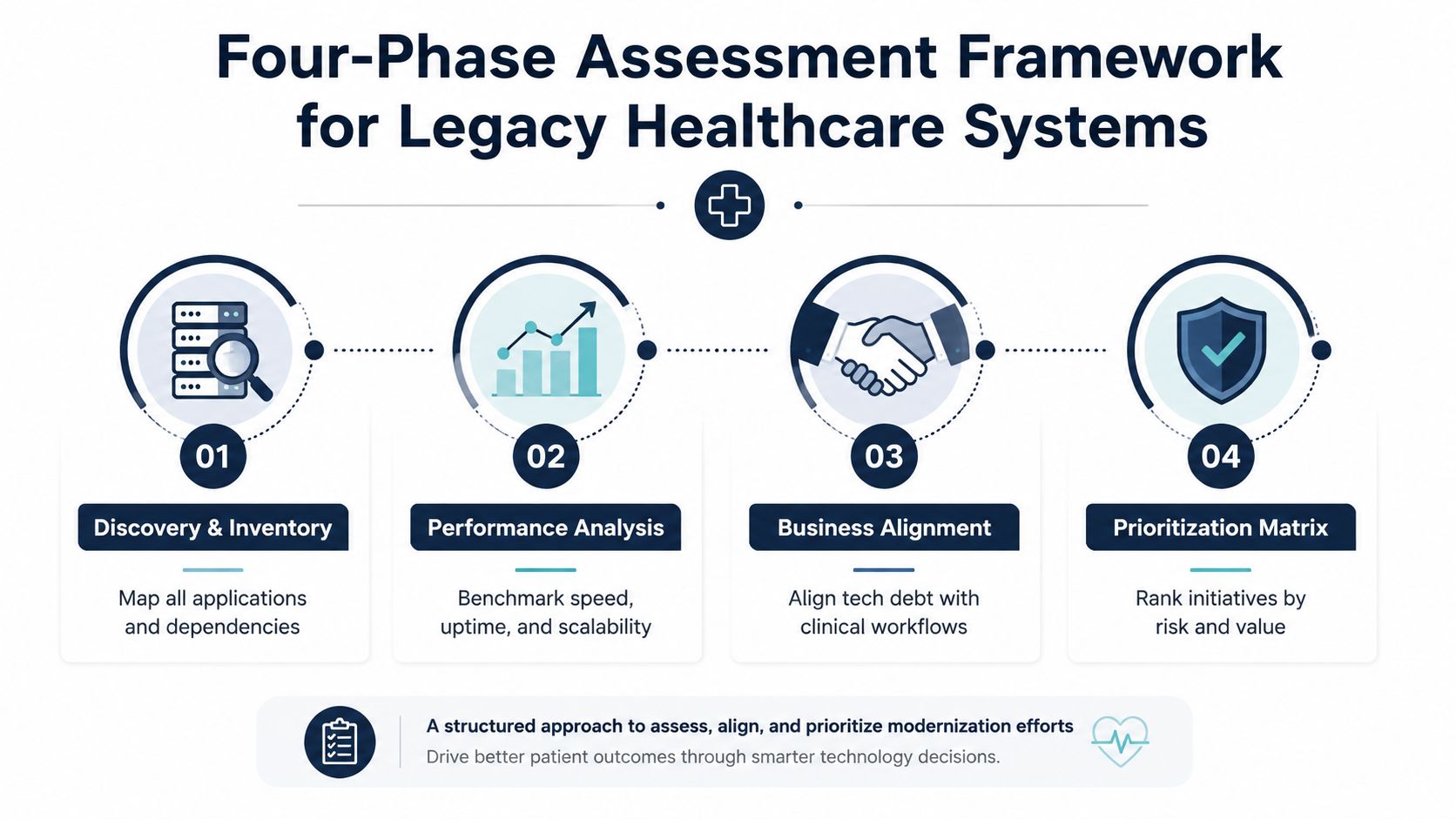
Phase one maps the system
Create an application and dependency register covering:
-
Applications: Record business purpose, owner, users, runtime, release process, and support model.
-
Interfaces: Trace inbound and outbound connections, message formats, frequency, failure handling, and manual reconciliation.
-
Data stores: Identify clinical, financial, operational, and reporting data, including copies created for downstream use.
-
Infrastructure: Document hosting locations, operating systems, databases, batch jobs, network dependencies, and recovery arrangements.
Architecture diagrams provide a starting point, not evidence. Interview system owners, inspect logs, review deployment scripts, and compare documented integrations with traffic moving through the environment. A dormant interface on paper may still support a high-risk workflow, while an undocumented spreadsheet exchange may carry more operational importance than a formal API.
Phase two tests compliance exposure
Classify where protected health information is created, stored, transformed, displayed, and transmitted. Map access controls, authentication, encryption, retention, consent handling, backup protection, audit logging, and vendor responsibilities against applicable obligations, including HIPAA and GDPR where relevant.
Produce a gap register with an accountable owner and remediation path. A system that handles sensitive data without dependable audit evidence may require a different migration sequence from a low-risk administrative tool, even when the administrative tool is easier to move.
Phase three follows dependencies
A telehealth application may rely on an aging scheduling service, identity provider, laboratory-result pipeline, and billing interface. Changing one component can alter timing, error behavior, data semantics, and support responsibilities throughout the transaction.
Map dependencies around business events, not only servers and technical connections. Trace appointment creation, order placement, result publication, medication updates, claim submission, and patient notification. This exposes coupling that an infrastructure inventory will miss, including manual steps that staff perform between systems.
Phase four measures readiness
Readiness includes clinical sponsorship and operational capacity. Identify clinical champions, process owners, training needs, local variations, resistance points, and current workarounds. Then rank candidates by clinical criticality, compliance exposure, dependency complexity, user pain, data quality, and business value.
A useful output is a prioritization matrix:
| Decision | Typical signal |
|---|---|
| Retire | The capability is duplicated, unused, or safely absorbed elsewhere |
| Migrate first | The system is bounded, valuable, and relatively well understood |
| Refactor | The function remains important, but architecture and maintainability limit delivery |
| Rebuild or replace | The workflow, security model, or integration constraints prevent sustainable change |
Choosing the Right Modernization Strategy
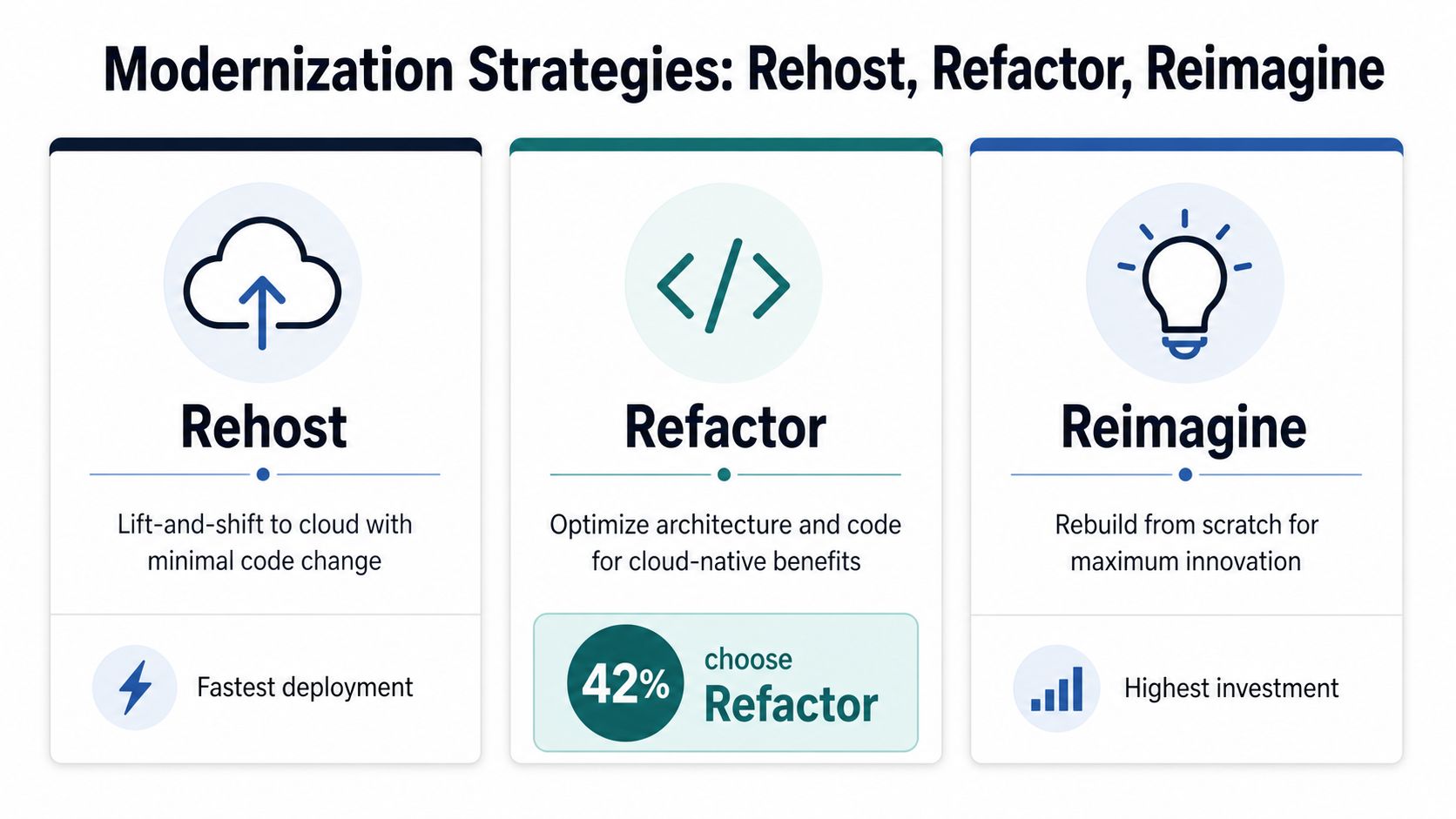
No single modernization pattern fits every healthcare application. Rehosting, refactoring, and reimagining solve different problems, and the wrong choice can increase risk while producing little operational improvement.
Rehost preserves speed and limitations
Rehosting, or lift and shift, moves an existing application to new infrastructure with minimal code change. It can make sense when the immediate problem is aging hardware, data-center dependency, or an urgent hosting constraint, while the application still performs its core function.
The trade-off is straightforward. Rehost changes the environment more than the application, so tightly coupled code, inefficient batch processing, weak interfaces, and difficult user journeys usually remain. Use it as a containment or sequencing move, not as proof that the product has become cloud-native.
Refactor balances continuity and improvement
Refactoring changes internal architecture while preserving the application's essential behavior. Teams may separate modules, introduce automated tests, improve database access, expose stable APIs, or replace fragile integration logic without changing the complete business process at once.
This path often suits large providers with embedded scheduling, claims, laboratory, or revenue-cycle functions. It supports incremental releases and gives operations teams time to validate behavior. The cost is sustained engineering effort, careful regression testing, and disciplined architecture governance. Refactoring fails when teams modernize code without removing the workflow constraints that users experience.
Reimagine changes the operating model
Reimagining means designing a new product around modern workflows, modular services, cloud deployment, automation, and interoperability. It can be the right starting point for a healthtech startup building a SaaS platform because there may be no entrenched production process to preserve.
For an established provider, reimagining a core clinical or financial platform demands stronger controls. Data migration, parallel operation, user training, integration certification, and cutover planning become central workstreams. A full rebuild can produce the cleanest long-term result, but it also creates the largest continuity challenge.
| Strategy | Speed to value | Main strength | Main exposure |
|---|---|---|---|
| Rehost | Faster | Reduces infrastructure dependency | Preserves technical and workflow debt |
| Refactor | Moderate | Improves maintainability while retaining behavior | Requires sustained testing and sequencing |
| Reimagine | Slower | Enables new workflows and architecture | Creates the greatest migration and adoption burden |
Choose per capability, not per organization. A provider may rehost a stable reporting service, refactor a claims engine, and reimagine a patient engagement product. A startup may reimagine its core platform while encapsulating a partner’s legacy service through APIs. The practical decision should reflect clinical criticality, compliance complexity, integration depth, data quality, and tolerance for disruption.
Cloud Enablement and Interoperability Architecture
Cloud adoption doesn’t remove the need for architecture discipline. It changes where applications run, how teams provision capacity, how access is controlled, and how services communicate. Healthcare organizations also need to account for hybrid and colocated environments when regulatory, latency, device, or operational requirements make a single hosting pattern impractical.
Match the hosting model to the workload
Infrastructure as a Service offers more control over operating systems, networking, and runtime configuration, but it also leaves the organization responsible for more platform administration. Platform as a Service can reduce that burden and accelerate delivery, though teams must accept provider constraints around supported runtimes, data services, and deployment patterns.
A hybrid design may keep tightly controlled workloads in a private or colocated environment while placing patient-facing services, integration layers, or analytics workloads on managed cloud services. That arrangement only works when identity, network boundaries, observability, backup, incident response, and data movement are designed as one operating model.
Make interoperability an acceptance criterion
CMS says networks must provide or facilitate data access through FHIR APIs that follow the US Core FHIR implementation guide. Requirements include a full FHIR capabilities statement and support for USCDI v3 or later, with terminology standards such as LOINC for laboratory data, RxNorm for medications, and SNOMED for conditions.
That means an API isn’t complete because it returns JSON. Teams need to validate resource profiles, terminology mappings, authorization, provenance, versioning, error handling, pagination, and audit behavior. They also need a plan for older HL7 interfaces, device feeds, DICOM workflows, and partner systems that cannot move at the same pace.
As we explored in our guide to building a healthcare data interoperability strategy, interoperability should be treated as a product capability with ownership, testing, and lifecycle management.
Sequence migration around frontline risk
Move the parts that create visible value and operational learning first, often patient-facing interfaces, clinician workflow services, and integration APIs. Keep backend batch-processing systems stable until the new layers have demonstrated reliable data exchange, monitoring, and support procedures.
This isn’t a universal order. A backend dependency may need remediation before any interface can move. The principle is to isolate change, protect critical care, and give users a stable path during transition. Containerization, automated deployment, contract testing, synthetic data validation, and centralized observability can support that sequencing when teams implement them before cutover rather than during an incident.
Security, Compliance, and Data Migration
Security work should begin with the workflow and data, not with a cloud checklist. Replacing unsupported infrastructure can remove known weaknesses, while cloud, hybrid, or colocated environments introduce others. Misconfigured identity, excessive permissions, insecure interfaces, exposed storage, weak secrets handling, and incomplete logging can all undermine a sound modernization design. The transition therefore needs explicit threat modeling, ownership, and verification.
Build compliance into the migration path
Start with data classification and a control map. For each data flow, record who may access it, why access is permitted, how identity is verified, where encryption applies, how long data remains available, and what evidence the organization must produce during an audit.
A practical control set includes:
-
HIPAA safeguards: Apply administrative, physical, and technical safeguards to protected health information, with clear responsibility across internal teams and vendors.
-
GDPR obligations: Address lawful processing, access, correction, portability, retention, and deletion requirements where European personal data is involved.
-
Encryption controls: Protect data in transit and at rest, manage keys separately from application secrets, and test certificate and key rotation procedures.
-
Audit trails: Capture access, changes, exports, administrative actions, interface events, and migration exceptions in a tamper-resistant, reviewable form.
The HIPAA-compliant software development guidance reinforces a practical point: compliance belongs in requirements, architecture, testing, and operations, rather than in a final review.
Treat migration as a clinical safety process
A 2026 academic review found that evidence on complete migration pathways remains sparse, particularly for data mapping, interoperability validation, cutover planning, and post-migration assurance. Much of the available research relies on simulations rather than real deployments, as summarized in the review coverage of healthcare cloud migration security. Do not treat a successful data copy as a successful migration.
Use staged extraction, deterministic mapping rules, record-level reconciliation, and clinical validation by people who understand how the data is used. Run old and new paths in parallel where patient safety and operational continuity require it. Define rollback conditions before launch, rehearse them, and retain a post-cutover review process that can identify discrepancies before they affect clinical decisions. Teams should also document ownership for exceptions, because unresolved mapping questions often become workflow failures after go-live.
AI Integration and Continuous Deployment
AI projects in healthcare usually fail at workflow adoption before they fail at model accuracy. A clinical decision-support feature, claims classifier, documentation assistant, or operational prediction service needs governed data, secure interfaces, traceable changes, and users who understand when to accept, question, or override its output.
Start with an AI discovery workshop. Rank use cases by workflow value, data readiness, explainability, human oversight, and regulatory exposure. A low-risk administrative assistant may be a better first release than a model influencing clinical decisions, even if the latter appears more advanced. Confirm who owns the workflow, exception handling, and safety review before development begins.
Teams following an AI readiness practical guide should bring product, clinical, security, data, and compliance owners into the same planning cycle. Adoption criteria belong in the release plan, not in a later training exercise.
Make the delivery pipeline evidence-producing
A regulated CI/CD pipeline should automate unit, integration, API contract, security, data-quality, and regression testing, alongside deployment approvals. Each release needs traceable evidence of the code change, data or model version, test results, and approving owner.
Observability must extend beyond uptime. Monitor API latency, interface success, data completeness, schema changes, access anomalies, workflow errors, and model drift. Alerts can expose deterioration before staff creates workarounds, but safety-sensitive behavior still requires human review.
The strongest teams run AI engineering, clinical safety review, security validation, and quality assurance in parallel. That arrangement reduces late surprises while keeping clinical accountability with named people. In production, a rollback plan and an explicit path for reporting harmful or confusing outputs matter as much as deployment speed.
Measuring Modernization Success and Managing Change
Modernization creates value only when the new system changes daily behavior. A cleaner architecture matters, but executives, clinicians, patients, and regulators need evidence that the platform supports safer operations and dependable service.
Nearly 90% of healthcare organizations consider modernization essential, according to a survey summarized by Becker’s Hospital Review. Adoption remains uneven by region. A 2026 Black Book Global Healthcare IT Survey summary reported that 65% of surveyed hospitals in the fastest-adopting countries were replacing or expanding EHRs in 2026, compared with 13% in slower-adopting markets, as described by Access Newswire.
Use operational KPIs
Choose measures that connect technology behavior to work. Establish a baseline before deployment and review the same measures after each release.
-
Interface success rate: Track whether messages, events, and API calls complete without manual repair.
-
Workflow effort: Measure clicks, screen transitions, duplicate entry, and time spent on representative clinical tasks.
-
Revenue-cycle performance: Monitor claims processing time and denial-rate change after a billing or claims migration.
-
Data quality: Review completeness, terminology consistency, duplicate records, reconciliation exceptions, and late-arriving results.
-
Adoption behavior: Measure active use of the new workflow, completion of training, support requests, and continued reliance on legacy workarounds.
-
Reliability and security: Track availability, recovery performance, access anomalies, unresolved vulnerabilities, and audit evidence quality.
Make change management part of delivery
Clinicians don’t resist change because they dislike technology. They resist tools that add work, interrupt care, obscure clinical context, or fail under real conditions. Invite frontline users into workflow design, usability testing, pilot review, training, and release decisions. Give each department a named champion who can distinguish a training issue from a design defect.
A change checklist should include:
-
Name the behavior: Define what users will do differently and why it matters.
-
Test real scenarios: Use representative patient journeys, exception cases, and handoffs.
-
Train by role: Teach the tasks each user performs, not every feature the platform contains.
-
Watch production: Review workflow metrics and support signals immediately after release.
-
Remove the old path deliberately: Retire duplicate tools only when the replacement is stable, supported, and trusted.
Engage a healthtech software development partner when the modernization crosses clinical workflows, legacy interfaces, cloud architecture, compliance validation, and change management. Bridge Global offers assessment, healthcare software engineering, interoperability work, migration support, AI-enabled development, and ongoing product delivery for teams that need those capabilities coordinated rather than purchased as disconnected tasks.
The central test is simple: can people complete important work more reliably than before, with evidence that the system protects data and supports care? If the answer is unclear, the program needs another round of observation and measurement, not another infrastructure purchase.
Frequently Asked Questions
What is healthcare application modernization?
Healthcare application modernization is the structured improvement, migration, refactoring, replacement, or retirement of software used in clinical, administrative, financial, diagnostic, and patient-facing workflows. It includes architecture, infrastructure, data flows, interoperability, security, user experience, and operational adoption.
Should a healthcare organization rehost, refactor, or reimagine an application?
Choose based on the application’s criticality, compliance exposure, integration depth, data condition, and tolerance for disruption. Rehosting can address an infrastructure constraint quickly, refactoring can improve maintainability while preserving behavior, and reimagining can support a redesigned product or workflow when the existing system no longer provides a sustainable foundation.
Why do healthcare modernization projects struggle with adoption?
Teams often optimize code and infrastructure while leaving workflow friction intact. Poor navigation, limited customization, disconnected telehealth tools, inadequate training, and missing frontline feedback can cause users to return to legacy workarounds even when the new platform is technically functional.
What role does FHIR play in modernization?
FHIR provides a structured way to expose and exchange healthcare data through APIs. CMS requirements refer to FHIR APIs aligned with the US Core FHIR implementation guide, a full capabilities statement, USCDI v3 or later, and terminology standards including LOINC, RxNorm, and SNOMED. Teams still need to address legacy HL7 interfaces, device connectivity, authorization, provenance, and data quality.
How can teams reduce migration risk?
Map dependencies before changing code, classify sensitive data, validate mappings, reconcile records, test interfaces, run parallel processes where appropriate, define rollback conditions, and monitor post-cutover behavior. Migration should be governed as a resilience and patient-safety program, not only as a technical deployment.
When should a team consider custom software?
Custom software is appropriate when existing products cannot support critical workflows, interoperability requirements, compliance controls, or the organization’s product strategy. Teams should first confirm that the requirement is genuinely differentiated and that they can support the resulting product over its operational life.
Bridge Global can help healthcare organizations assess legacy portfolios, design interoperable cloud architectures, modernize clinical and administrative workflows, and deliver compliant software through phased releases. Visit Bridge Global to discuss an evidence-led modernization roadmap built around your systems, users, and operational risks.

About Upendra Jith
Upendrajith completed his Master's in English and has been a commercial content developer for the past three years. He's more inclined to develop content with a 'street-smart' delivery on topics such as technology, media, or anything he can get his hands on. He has a fixation on lyrics, dark poetry, media, technology, and flow arts.
View all posts by Upendra Jith →