



A Guide to Ecommerce Web Development That Drives Growth
Successful ecommerce web development isn’t just about putting products online. It’s the craft of building a digital storefront that’s fast, secure, and masterfully designed to turn casual browsers into repeat customers. Think of it less like a digital catalog and more like a high-performance engine for your business, built from the code up to the final click.
Building Your Ecommerce Blueprint
Before you even think about code, a great online store starts with a solid plan. This is like creating the architectural blueprint for a house. Every decision you make down the line – from your business model to the specific features on your site – will depend on this foundation.
Getting this stage right from the start is crucial. It ensures that the money you invest in technology directly supports real business goals. This initial planning phase is all about translating your vision into a practical, technical roadmap, preventing expensive changes later and setting you up for a scalable and profitable business.
Defining Your Audience and Business Model
First things first: who are you selling to? Pinpointing your ideal customer is the most important step. What do they care about? What problems are you solving for them? The answers will shape everything from your website’s visual design to the tone of your marketing emails.
Once you know your audience, you need to be crystal clear on your business model. This determines how you’ll operate and interact with your customers.
- Business-to-Consumer (B2C): The classic model of selling directly to individual shoppers.
- Business-to-Business (B2B): Selling to other companies, which often requires features like custom pricing, bulk order forms, or quote management.
- Direct-to-Consumer (D2C): A model where brands manufacture their own products and sell them straight to the end consumer, bypassing traditional retailers.
Your model has a huge impact on the features you’ll need. A B2B site, for example, is very different from a D2C site that needs to excel at brand storytelling and building a community. As an experienced AI solutions partner, we specialize in helping businesses connect these strategic dots, turning a simple idea into a powerful digital storefront.
Setting Clear Goals and Identifying Core Features
With your audience and model figured out, it’s time to set goals you can actually measure. Vague ambitions like “increase sales” won’t cut it. You need to get specific with Key Performance Indicators (KPIs).
For example:
- Boost conversion rates by 15% in the next quarter.
- Increase the average order value (AOV) to $75.
- Reduce cart abandonment by 20%.
These hard numbers will be your guide when deciding which features to build. You can’t afford to build everything at once, so these goals help you prioritize. Your blueprint should clearly list the must-have features for launch, ensuring every dollar you spend directly supports your most critical objectives. As part of this, think about how a dedicated mobile solution like ecommerce app development could help you tap into the massive and growing market of mobile shoppers.
Choosing Your Ecommerce Architecture
Before you write a single line of code, you have to decide on your ecommerce architecture. Think of it as the foundation and frame of a house, get it wrong, and you’ll be dealing with cracks and instability for years. The right architecture sets you up for speed, flexibility, and growth, while the wrong one can lead to slow load times, painful updates, and crashing during a Black Friday rush.
This decision isn’t just a technical one; it shapes your day-to-day operations and your ability to innovate down the road. Nailing this choice early in your ecommerce web development journey means you’re building a business that’s designed to last.
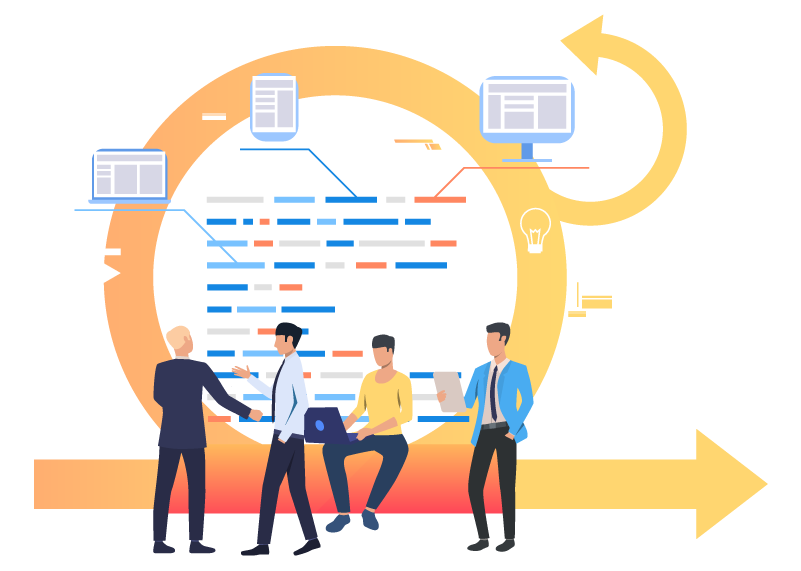
As this blueprint shows, everything starts with a clear plan. You need to know your customer, your goals, and your business model inside and out before you can even think about the technology.

The diagram drives home a critical point: strategy comes first. A deep understanding of your audience and business objectives is the non-negotiable starting line.
Understanding Monolithic Architecture
The monolithic approach is the classic, all-in-one setup. Picture an old-school home entertainment system where the DVD player, speakers, and amplifier are all housed in one big box. It’s straightforward to get up and running, which is why it’s often the go-to for startups and smaller businesses.
In this model, the front-end (what your customers see and click on) and the back-end (all the business logic, databases, and servers) are fused into a single, massive application. Every feature, from the product catalog to the shopping cart, lives in the same codebase.
Here’s the breakdown:
- Unified Codebase: All functions are developed, deployed, and managed as a single unit.
- Simpler Development Start: It’s initially easier to build because everything is in one place.
- Straightforward Deployment: You push the entire application live in one go.
But that initial simplicity has a catch. Need to update just the search feature? You often have to redeploy the entire system, which makes updates slow and risky. As your business grows, this monolithic structure can become a tangled, bulky mess that stifles your ability to adapt quickly.
Exploring Microservices Architecture
Microservices, on the other hand, are like a modern, high-end component stereo system. Your receiver, turntable, and speakers are all separate, independent units. You can swap out your speakers for a better pair without having to touch the receiver. It’s all about modularity, which gives you incredible flexibility and scale.
With this architecture, each business function—like user authentication, inventory management, or payments—is its own tiny, independent service. These “microservices” talk to each other through APIs but can be developed, deployed, and scaled individually. If your payment service gets slammed with traffic, you can give just that one service more resources without disrupting the rest of your site.
A microservices approach allows different teams to work on separate parts of the application at the same time without tripping over each other. This dramatically speeds up development and makes it much easier to introduce new technologies for specific functions.
This is the preferred route for large, complex businesses that need to move fast and handle serious traffic. While the initial setup is more involved than a monolith, the long-term payoff in scalability and easier maintenance is huge. It’s a cornerstone of modern custom software development for any serious enterprise platform.
Embracing Headless Commerce
Headless commerce pushes this separation even further by completely chopping off the front-end “head” (the user interface) from the back-end “body” (the ecommerce engine). Imagine your back-end is a central warehouse that manages all your products, orders, and customer data. A headless setup lets you build any number of unique storefronts—a website, a mobile app, a smart mirror, even a voice assistant—that all pull from that same warehouse.
This gives you total freedom to design one-of-a-kind customer experiences on any device imaginable, all powered by the same back-end logic. Your marketing team can go wild creating stunning, content-rich front-ends with their favorite tools, completely free from the limitations of a traditional back-end platform.
As we explored in our guide on ecommerce and AI, this flexibility is essential for weaving in advanced personalization. For any business serious about delivering unique shopping journeys, building powerful custom ecommerce solutions with a headless approach is the clear winner.
Comparison of Ecommerce Architectures
Choosing the right architecture depends entirely on your business’s current needs and future ambitions. What works for a small boutique won’t work for a global enterprise. To help you decide, here’s a quick comparison of the three main approaches.
| Architecture Type | Best For | Key Advantages | Potential Challenges |
|---|---|---|---|
| Monolithic | Startups, small businesses, and projects with simple requirements. | Faster initial setup, simplified development and testing, straightforward deployment. | Becomes complex to manage as it grows, updates are risky, technology stack is inflexible. |
| Microservices | Large enterprises, complex platforms, and businesses anticipating high growth. | Independent scaling, technology flexibility per service, improved resilience, faster development cycles. | Complex initial setup, challenges in managing distributed systems, requires DevOps expertise. |
| Headless | Brands focused on omnichannel experiences and creative content-led commerce. | Unmatched front-end flexibility, faster performance, seamless integration across multiple channels. | Requires separate development for front-end and back-end, can increase overall complexity. |
Ultimately, this table should guide you toward the foundation that best supports your vision. A monolith gets you to market quickly, microservices prepare you for massive scale, and headless gives you ultimate creative control. Choose wisely.
Choosing Your Technology Stack
Think of your technology stack as the foundation and framework of your digital store. It’s the collection of programming languages, tools, and software that brings your ecommerce vision to life. Picking the right components is one of the most critical decisions you’ll make, setting the stage for everything from site speed to future growth. This choice fundamentally shapes your ability to build powerful custom ecommerce solutions that can scale with your ambitions.
The tech you choose has a direct, tangible impact on your business. It affects how fast your pages load, how easily you can roll out new features, and what your long-term maintenance costs will look like. A well-thought-out stack delivers a snappy, reliable shopping experience that customers love. The wrong one can lead to sluggish performance and glitches that send potential buyers running to your competitors. The aim is to strike the perfect balance between performance, scalability, and cost.
Front-End Frameworks: Crafting the Customer Experience
The front-end is everything your customer sees, touches, and interacts with—the product galleries, the checkout buttons, the overall design. A great user experience here is non-negotiable. It has to be intuitive, visually engaging, and, above all, fast. Two of the most trusted frameworks for building world-class front-ends are React and Vue.js.
- React: Backed by Meta, React is famous for its component-based structure. Essentially, developers build reusable UI “blocks”, like a search bar or a product rating widget, which dramatically speeds up development and keeps the design consistent across the entire site. Its massive community and library ecosystem make it a go-to for complex, high-traffic stores.
- Vue.js: People love Vue for its simplicity and gentle learning curve. It’s incredibly flexible and can be introduced piece by piece, which is perfect if you’re looking to upgrade an older site without starting from scratch. It hits a sweet spot between high performance and developer-friendly features.
Both of these frameworks excel at creating single-page applications (SPAs) that feel incredibly fluid and responsive, much like a native mobile app.
Back-End Technologies: The Engine Room
If the front-end is the showroom, the back-end is the engine, warehouse, and office all rolled into one. It’s the behind-the-scenes powerhouse that manages your inventory, processes orders, handles customer accounts, and makes sure all the data gets where it needs to go. A robust back-end is the key to a scalable and secure store.
Node.js has become a dominant force in ecommerce for good reason. It runs on JavaScript, meaning your developers can use the same language on both the front and back ends. This simplifies the whole process. Its architecture is built to handle tons of simultaneous connections without breaking a sweat, making it ideal for the unpredictable traffic spikes of online retail.
Of course, a crucial part of the engine is payment processing. A seamless, secure checkout is absolutely essential. This is where specialized integrations, like Integrating Stripe with React Native, become critical. You need to ensure the payment experience is smooth and inspires trust.
Finding the Right Ecommerce Platform
Beyond the code, you need a platform to pull it all together. This choice will define your store’s capabilities, flexibility, and day-to-day management.
Here’s a quick rundown of the heavy hitters:
- Shopify: Perfect for businesses that want to get up and running quickly. It’s an all-in-one solution that takes care of hosting, security, and payments, making it incredibly user-friendly. The trade-off is that customization can feel a bit restrictive.
- Magento (Adobe Commerce): This is the powerhouse for large, enterprise-level operations with massive product catalogs and international ambitions. Magento offers unparalleled flexibility but comes with a steep learning curve and requires serious development resources. Check out our customized Magento extensions store here.
- Headless CMS (like Contentful): As we touched on earlier, this approach separates your content “brain” from your customer-facing “face.” It gives you complete creative freedom to design unique experiences across any channel you can imagine, from your website to a mobile app or even a smart kiosk. This is where brands focused on a truly unique identity are headed.
Ultimately, your choice has to line up with your business goals, your team’s technical skills, and your budget. Whether you need the speed of Shopify or the total control of a headless architecture, this decision is the cornerstone of your entire ecommerce operation.
Weaving AI into Your Store for Smarter Shopping

Artificial intelligence isn’t some far-off idea in ecommerce web development anymore. It’s the engine running under the hood of the most engaging and profitable online stores today. When you bring AI into the mix, you’re no longer just showing a static catalog of products; you’re creating a dynamic, intelligent shop that actually understands and anticipates what your customers want.
This is about much more than adding a few flashy features. It’s about using data to build a fundamentally smarter business. A thoughtful AI implementation can elevate every single part of the customer’s journey, from the moment they land on your site to the follow-up support they receive after a purchase. Understanding how to leverage AI for your business is what turns a good store into a great one.
AI-Powered Personalization and Smart Search
Let’s face it, generic shopping experiences are dead. Shoppers now expect a store to get them. This is where AI-driven personalization comes in, analyzing everything from browsing history and past purchases to subtle mouse movements to serve up product recommendations that feel genuinely helpful. Think of it as giving every single visitor their own personal shopper.
This technology is what makes features like these possible:
- “You Might Also Like” Sections: These aren’t random guesses. They’re smart suggestions for complementary items that directly boost your average order value.
- Personalized Homepages: Imagine a homepage that looks different for every user, showcasing the exact banners and products they’re most likely to be interested in.
- Dynamic Email Marketing: No more email blasts. Instead, you can send promotions tailored to what each person has shown they care about.
At the same time, AI completely changes how your search bar works. Instead of just matching exact keywords, a smart search uses Natural Language Processing (NLP) to understand what the user really means. Someone can type “blue running shoes for men under $100” and get exactly what they asked for. It makes finding products incredibly fast and intuitive.
Intelligent Chatbots and Customer Support
Great customer service can make or break a business, but it’s notoriously hard to scale. AI-powered chatbots are the answer. They offer instant, 24/7 support without needing a massive team of people. And these aren’t the clunky, frustrating bots of yesterday; modern chatbots can handle a surprisingly wide range of questions.
By plugging directly into your backend systems, an AI chatbot can look up an order status, start a return, or even walk a confused customer through the checkout steps. This frees up your human agents to handle the really tricky, high-value conversations, which makes everyone happier and your support more efficient.
This kind of automation doesn’t just cut down on operational costs; it ensures your customers get the help they need, right when they need it. Building that kind of trust and reliability is huge for customer loyalty. As we’ve detailed in our guide on ecommerce and AI, this combination creates a far more responsive and customer-first operation.
Behind-the-Scenes Optimization
The real magic of AI isn’t just what the customer sees. It’s also working behind the scenes to make your entire business run smoother, which has a direct impact on your bottom line. Two of the biggest wins here are in inventory management and fraud detection.
AI for Inventory Management:
Predictive analytics can chew through historical sales data, seasonal trends, and even market forecasts to predict future demand with uncanny accuracy. This helps you avoid running out of a hot-selling item or, just as bad, getting stuck with a warehouse full of products nobody wants.
AI for Fraud Detection:
In the split second it takes to process a transaction, machine learning models can analyze thousands of data points to spot suspicious activity. By recognizing patterns linked to fraud, these systems can flag or block high-risk orders before they go through, saving you from the headache and financial hit of chargebacks.
Pulling all this off requires real expertise. It’s about building a store that’s not only smarter for your customers but also far more efficient and secure for your business. Our expert AI development services are designed to achieve just that.
Mapping the Development Journey from Start to Finish
Bringing a great idea for an online store to life isn’t magic—it’s a structured, predictable journey. An ecommerce web development project isn’t a chaotic sprint to the finish line; it’s a carefully orchestrated process that takes you from a concept on a whiteboard to a fully functional, revenue-generating storefront. Let’s pull back the curtain on this lifecycle.
This step-by-step approach, which is at the heart of any successful custom software development project, creates a clear roadmap with realistic timelines. We break the entire build into manageable phases, each with its own specific goals, so nothing gets missed.
Stage 1: The Discovery and Planning Phase
Before a single line of code is written or a design is mocked up, we start with discovery. Honestly, this is the most important part of the entire project because it sets the foundation for everything that follows. Think of it as a series of deep-dive strategy sessions where we get business goals and technical reality on the same page.
The whole point here is to nail down the project’s scope, requirements, and what “success” actually looks like. We’ll work together to answer the big questions: Who are we building this for? What problems are we solving for them? What features are absolutely essential for day one, and what can wait? This phase wraps up with critical documents, like a detailed spec sheet and a project roadmap.
Stage 2: UI/UX Design and Prototyping
Once the plan is locked in, we shift gears to crafting the user experience (UX) and user interface (UI). This is where the store starts to feel real, but it’s about so much more than just looking good. A great design makes shopping intuitive, seamless, and even enjoyable.
- User Experience (UX) Design: This is all about the flow. We map out how a customer moves through the site—from landing on the homepage to finding a product and checking out. We use wireframes and user journey maps to make that path as logical and friction-free as possible.
- User Interface (UI) Design: Now we add the visual layer. This is where we define the colors, fonts, buttons, and imagery that bring your brand to life. We build interactive prototypes so you can click around and get a genuine feel for the site long before development begins.
Stage 3: Agile Development and the MVP
With the design approved, the development team gets to work. We build using an agile methodology, breaking the project into short, focused cycles called “sprints.” Instead of trying to build the perfect, all-encompassing site in one go, we focus on the most critical features first to launch a Minimum Viable Product (MVP).
The MVP isn’t a “half-baked” site; it’s a lean, fully functional version of your store with just the core features needed to launch. This gets you to market faster, reduces upfront risk, and lets you start collecting real customer feedback to guide what you build next.
This iterative approach keeps the process flexible and collaborative, with constant check-ins to make sure we’re staying on track. Many companies find that partnering with dedicated external talent can supercharge this phase, which is why, as we explored in our guide, there are real benefits to hiring offshore software development teams to drive the build.
Stage 4: Rigorous Quality Assurance and Launch
The last hurdle before going live is Quality Assurance (QA). Our QA engineers become your store’s toughest critics, meticulously testing every single feature to find and squash bugs. They check for browser compatibility, make sure the site works perfectly on mobile, stress-test the checkout, and confirm all integrations are running smoothly.
Only when the site has passed this gauntlet of tests is it ready for the world. This structured journey, from a simple idea to a fully vetted digital storefront, is a proven formula for success, which you can see in action in our client cases.
Optimizing Your Store for Long-Term Success
Getting your store live is a huge achievement, but it’s really just the starting line. The real work in ecommerce web development begins after launch. It’s all about making sure your platform stays fast, trustworthy, and ready to grow for years to come. Skipping this part is like building a brand-new race car and then never bothering to change the oil. It’s only a matter of time before it breaks down.
To build a business that lasts, you need to nail three critical areas: lightning-fast performance, rock-solid security, and a clear path to scale. Get these right, and your digital storefront will be ready for anything, from a massive traffic spike on Black Friday to the ever-changing expectations of your customers.

Ensuring Peak Performance and Speed
In the world of online shopping, speed is money. Period. Every extra millisecond it takes for a page to load is another chance for a potential customer to click away. A slow, clunky website doesn’t just frustrate visitors; it also gets pushed down in search engine rankings.
To keep your store humming along, you need to focus on a few key things:
- Image Optimization: Those beautiful, high-resolution product shots can be performance killers. You have to compress them without turning them into a pixelated mess. Using modern image formats like WebP is a great way to slash file sizes.
- Leverage Caching: Caching is like your website’s short-term memory. It saves parts of your site so return visitors don’t have to load everything from scratch, which massively cuts down on server strain and makes browsing feel instantaneous.
- Content Delivery Network (CDN): Think of a CDN as a global network of mini-servers. It stores copies of your site’s assets (like images and code) in locations all over the world, so when a customer in London visits, the content is delivered from a nearby server, not one all the way in California.
Fortifying Security and Building Trust
Security isn’t just a technical detail; it’s the bedrock of your relationship with your customers. A single data breach can torpedo your reputation and land you in serious financial hot water. When people give you their credit card details, they’re placing immense trust in you. Don’t break it.
Here are the non-negotiables for security:
- SSL Encryption: An SSL certificate is what puts the “s” in “https” and the little padlock icon in the browser bar. It encrypts the connection between your customer’s computer and your server, making it nearly impossible for hackers to snoop on sensitive information.
- PCI DSS Compliance: If you take credit card payments, you have to follow the rules. The Payment Card Industry Data Security Standard (PCI DSS) is a set of strict security requirements for any business that handles card information. As we explored in our guide, following a PCI DSS compliance checklist isn’t just a good idea—it’s mandatory.
Scaling for Growth and Demand
Your ecommerce platform needs to be able to stretch as your business grows. A site that runs perfectly with a few hundred visitors a day needs to be able to handle thousands during a holiday sale without melting down. Scalability is all about having the right architecture in place to manage more traffic, more products, and more orders without skipping a beat.
A scalable architecture is built for growth, preventing performance bottlenecks as your business expands. Whether it’s a seasonal spike or sustained growth, your site must remain stable and responsive to capture every sales opportunity. The global online retail market is projected to reach between $6.4 trillion and $7.4 trillion by 2025, with mobile commerce accounting for up to 60% of sales, highlighting the need for scalable, mobile-first platforms. Discover more insights about these ecommerce statistics on elementor.com.
Frequently Asked Questions
What is the difference between a front-end framework and an ecommerce platform?
Think of it this way: a front-end framework like React is the set of tools you use to build the “storefront”—what customers see and click on. An ecommerce platform like Shopify is the entire building, complete with the stockroom (database), the cash registers (payment processing), and a pre-built storefront. One is a specialized toolset; the other is a full-service solution.
How Long Does Ecommerce Web Development Take?
There’s no single answer, but a good rule of thumb is anywhere from 3 to 9 months. If you’re looking for a relatively straightforward store using a pre-built template, you might be up and running in as little as 3-4 months. But if you’re dreaming bigger—think a headless architecture, several custom integrations, and smart AI features—you should plan for a timeline closer to, or even beyond, 9 months. It all comes down to the complexity of what you want to build.
What Is the Difference Between Shopify and Custom Development?
Think of it like buying a house versus building one. Shopify is the pre-built house. It’s a fantastic SaaS (Software as a Service) platform that gives you templates and a full suite of tools right out of the box. It’s perfect if your main goal is to get to market quickly and start selling. Custom ecommerce web development, on the other hand, is like hiring an architect to design and build your dream home from the ground up. You get total control over every single detail—the design, the features, and how it can grow with you. This is the path for businesses that have very specific needs or a unique vision that just won’t fit into a template.
How Much Does Building an Ecommerce Website Cost?
The price tag can swing wildly. A simple site built on a template might only run you a few thousand dollars to get set up. However, a fully custom build is a different beast. When you start adding unique designs, advanced features like AI-powered personalization, and integrations with your existing business systems, the cost can range from $25,000 to well over $250,000. The final number really depends on how complex your project is and the tech you choose to build it with. The best way to get a real number is to talk through your vision with an experienced AI solutions partner.
How does a headless CMS fit into an ecommerce tech stack?
In a headless setup, you have a few specialized systems working together. A headless CMS like Contentful manages all your content—product descriptions, blog posts, banners. Your ecommerce platform handles the commerce functions—inventory, pricing, checkout. Both feed their data through APIs to a custom-built front-end, giving you complete control to design the exact user experience you want on any device.
Ready to build an intelligent, high-performing ecommerce platform that drives real growth? At Bridge Global, we specialize in AI-driven custom ecommerce solutions designed for scalability and success. Talk to our experts now.