

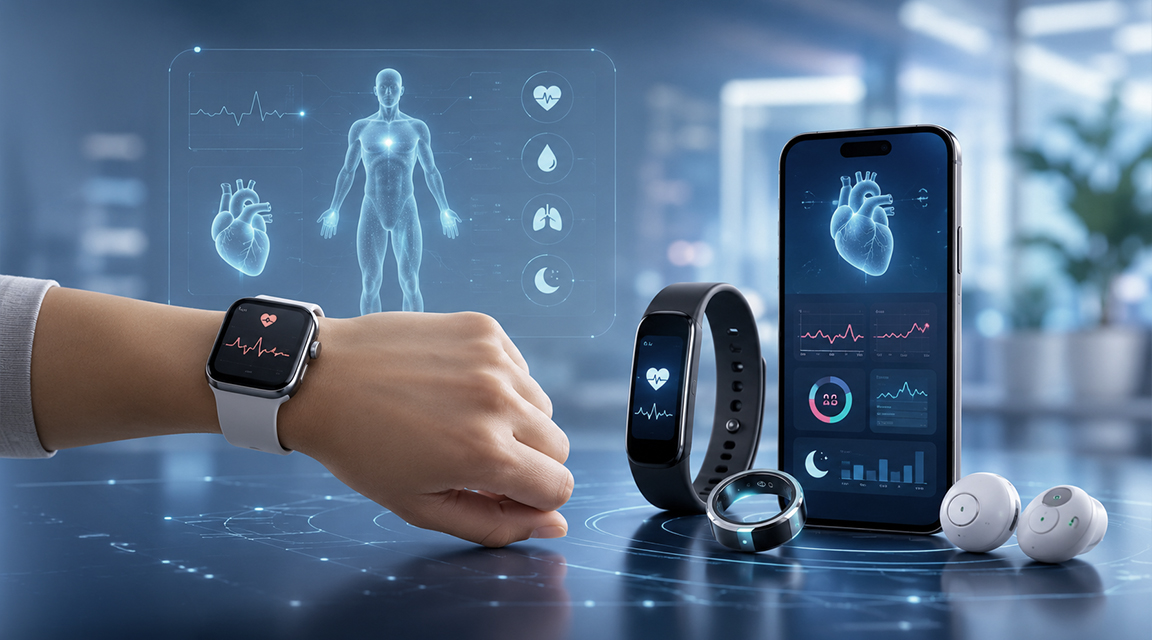

A Comprehensive Guide to Wearable App Development for 2026
There was a time when building a wearable app was mostly a vanity project. Maybe it was a simple fitness tracker that pushed step counts or heart rate alerts to a user’s wrist. That era is over.
Today, wearables have evolved from novelty gadgets into core digital infrastructure, and the apps powering them have also evolved. We’re no longer designing apps that only handle basic tracking functions. We’re building continuous data and decision-making systems that users live with every day.
And the market behind this revolution is changing, too. According to MarketsandMarkets Research, the global market for wearable tech may likely hit $176 billion by 2030.
For companies in digital health, Wearable Health App Development creates a massive opportunity. As the adoption of wearables grows, so does the demand for the apps that support preventive healthcare, remote patient monitoring, adaptive care systems, and AI-driven personalization.
If you want to capture a share of this market, this guide is for you. In the sections ahead, we’ll break down how the modern wearable ecosystem works as well as strategies for building successful wearable software in 2026 and beyond.
The 2026 Wearable Tech Landscape
As already noted, the wearable tech market is expected to reach $176 billion by 2030. But more aggressive forecasts from firms like Business Research Insights suggest it could exceed $930 billion by 2035.
This difference in figures simply reflects the speed at which the industry is moving, and how much wearables are becoming a major layer of digital health infrastructure.
But raw market size isn’t the interesting part. What’s interesting is where the growth is concentrated.
Healthtech industry experts are looking beyond smartwatches. Now, don’t take this the wrong way. Smartwatches still dominate shelf space and health-conscious consumer attention, but they’re no longer where the interesting development is happening.
Smart rings are the clearest signal of where things are heading. Oura, for example, which holds roughly 80% of the global smart ring market, is projecting billions in annual sales for the coming months and years.
AR/VR headsets are another growth vector, though they’re still early for health applications.
We’re also seeing a massive surge in continuous glucose monitors (CGMs), cuffless blood pressure rings like the Circul Ring 2 MAX, and wearable biosensors designed for remote patient monitoring and chronic disease management.
Let’s not forget audio-only wearables and lightweight AR glasses. These devices, which used to be associated with the gaming niche, have now moved into clinical workflows and even individual healthcare.
What does this mean for healthtech companies and developers? It means the old one-size-fits-all strategy for wearable apps development may no longer work.
Different device categories now require completely different interaction models. Smartwatches are built for quick micro-interactions. Smart rings focus on passive sensing. AR wearables are designed around spatial workflows and hands-free computing.
If you want to build wearable apps for the future, you have to design specifically for each device class.
The Difference Between Wearable Apps and Mobile Apps
Wearable apps and mobile apps may seem like the same thing, but they’re not. True, they’re both apps; however, they’re built with completely different user behaviors in mind.
Here’s a simple table to show how they differ:
| Wearable Apps | Mobile Apps | |
| Device | Smartwatches, smart rings, fitness bands, AR glasses | Smartphones and tablets |
| User Interaction | Quick taps, voice commands, gestures, glance-based actions | Typing, swiping, scrolling, multi-touch interaction |
| Purpose | Fast access to alerts, health data, and micro-actions | Full-feature experiences for communication, productivity, entertainment, and more |
| Screen Size | Small screens with limited space | Larger displays with more interface flexibility |
| Battery and Performance | Built around strict battery and processing limits | More computing power and battery capacity |
| Best Use Cases | Fitness tracking, remote monitoring, quick updates, hands-free actions | Streaming, gaming, editing, messaging, shopping, and complex workflows |
The key difference? Mobile apps demand attention, while wearable apps are designed to fit quietly into a user’s daily routine. Because of that, more features are usually fine on mobile apps. But adding complexity to a wearable app is almost always a mistake.
How to Decide What Kind of Wearable Health App To Build
The most important decision in wearable app development is determining what kind of product you’re actually making. You need to consider how it relates to the broader digital ecosystem.
Generally, wearable apps fall into three categories:
- Companion Wearable Apps: These are the apps that extend an existing mobile experience onto the wrist or ring. Think of an mHealth app that surfaces medication reminders or vitals summaries on a smartwatch. The watch isn’t the product. It’s just an extension of it.
- Standalone Wearable Apps: These apps run independently, with their own logic and UI. Although they typically have an “Open On Phone” feature, standalone apps are designed so users can use them without a phone nearby.
- Hybrid Wearable Apps: These systems share logic across devices and phones. The hybrid app can run standalone. This means that it can handle core tasks without a phone. However, it can also pair with a companion phone app to unlock deeper features and offload saved data to the phone app. The data can then be synced to the cloud and displayed in rich, detailed charts.
So, how do you choose right?
By asking yourself or your team one question: Are we creating a new behavior or improving on an old one? Incidentally, the best wearable applications for healthcare create new behaviors.
Take the CUDIS ring, for example. It isn’t the first ring wearable to show health data. But it’s different because the developers decided to create a new behavior. CUDIS comes built in with an AI “agent coach” that spots when your health metrics are looking funny.
Then it does something useful. It suggests lifestyle changes. Or connects you to a professional. It escalates, as their CEO put it.
“The AI spots when you’re trending in the wrong direction, such as chronic poor sleep, declining HRV, elevated resting heart rate, and either suggests lifestyle changes or connects you to a professional. The control is in the escalation pathway to the right care access.” — Edison Chen, CUDIS CEO and co-founder speaking to TechCrunch.
See the difference? CUDIS was able to capture its own share of the market because it gives users something different.
Tech Stack, Sensors & AI Integration
Once you’ve decided on the type of health wearable app to build, the next step is the tech behind it.
The tech stack powering most modern wearable apps includes Kotlin and Jetpack Compose Wear for the Android ecosystem, and SwiftUI and HealthKit integration for the Apple ecosystem.
But coding is just one aspect. Modern wearable healthcare apps work with sensor systems. These systems monitor:
- Heart rate
- Blood oxygen
- GPS data
- Motion patterns
- Temperature
- Sleep behavior
- Heart rate variability
- ECG-related signals
The challenge? The raw data from these sensors is noisy. Wrist placement shifts. Motion interference happens. Skin tone variations. Environmental conditions. All of that. This noise is, in fact, one of the most important realities in health tech app development.
To build wearable health apps that do what it’s meant to do effectively, your team will have to do a lot of work with sensor fusion, filtering, contextual interpretation, and artificial intelligence.
AI is actually one of the biggest things to happen to wearable app development in recent times. And not just any AI, but edge AI. Instead of sending the user’s heart data to the cloud to figure out if they’re stressed, the edge AI does it directly on the device. This fixes three huge problems: latency, battery drain, and privacy.
Of course, none of this is as simple as it sounds. The truth is that the more intelligent wearable systems become, the harder the apps are to design. And that’s exactly where many developers struggle.
The real challenge isn’t just building the app. It’s building something users can trust, regulators can approve, and users can rely on every day.
Key Development Challenges & Best Practices for Health Wearable Apps
Building a health wearable app isn’t like building a mobile app or system software. And the challenges are a lot different. Here are just a few of them to watch out for:
Battery Optimization
Your app could be clinically brilliant, but if it drains the battery by lunch, users will stop using the device. That’s the end of your product.
According to research from Intel Market Research, a massive 58% of users report battery life as their primary concern with wearable devices. It’s clearly an ongoing challenge and something you should have at the back of your mind when building your app.
Data Privacy, HIPAA, and GDPR Readiness
This is where a lot of health tech teams get into trouble. Because your software captures medical and biological signatures, protecting data isn’t just good design; it is a legal requirement.
Unfortunately, many wearable app developers don’t care. A study actually found that fitness apps share users’ data, often without explicit user consent. That’s the kind of practice that draws enforcement attention.
To avoid that kind of attention, be sure that your product meets HIPAA compliance in the United States and GDPR in Europe.
User Interface Design
On a smartwatch, you have between 1.5 and 2 inches of screen real estate. On a smart ring, you have none. Everything is communicated through haptics and a companion app. This means that your information hierarchy has to be ruthless. If you’re building a smartwatch app that requires users to read, scroll, or make a decision, you’ve missed.
Bottom line? Design for the single most important piece of information first. Everything else is secondary.
Limited Functionality
A wearable app is not a miniature smartphone app. Many developers forget this and try to build a mobile dashboard onto a watch or smart ring. Of course, this creates bloated software that degrades processing speeds and confuses the end user.
Be aware of this and be brutal with your feature filtering. A smart ring app should focus entirely on zero-UI background harvesting. A smartwatch interface should only handle immediate actions. Don’t fall into the trap of featuritis.
The good news is that the challenges above are very solvable.
How? Easy.
If your internal product team doesn’t have the expertise and engineering experience to deliver, hand the project over to a proven, dedicated wearable app development company.
Not someone with a flashy portfolio on Fiverr or Upwork.
You need an established product partner who deeply understands low-level hardware communication, edge AI deployment, and the strict realities of healthcare software compliance.
The Non-Technical Challenge That Wrecks App Development Projects
Most app development projects don’t fail because the code was bad. They fail because the people involved couldn’t agree on what problem to solve. This is why many companies end up shipping a half-finished product that doesn’t really satisfy anyone.
This is a C-suite challenge, and online Doctor of Education degree programs, particularly those focused on organizational leadership, are designed for exactly this kind of challenge.
According to Marymount University, programs like this focus heavily on leading an organization, transformative leadership, policy making, and more. An EdD in organizational leadership won’t teach you to write code, but it will teach you to get different stakeholders to move in the same direction.
Trends in Wearable Application Development
As you get set to launch your first or your next wearable health app, it is important to stay abreast of the trends impacting this industry. Here are a few of them.
- AI Personalization: AI personalization is moving from reactive to predictive. The next generation of wearable apps won’t just tell you what your heart rate is. They’ll tell you what it means in the context of your sleep, stress, and activity patterns, and what you should do about it.
- Smart Clothing: Smart clothing, already popular in professional sports uniforms for tracking performance and preventing injury, is entering mainstream consideration. Several brands already ship products with clinical-grade ECG cardiac monitoring, breathing rate, and sleep tracking.
- Data Ownership: Users are becoming more aware of what their biometric data is worth. As a result, wearable apps where users can control their own data and explicitly opt into sharing will soon become standard.
- IOT: Wearables are increasingly becoming part of the broader connected health ecosystem. Device apps now share data with smart home devices and clinical platforms. This is a big deal, with the global IOT wearable device market projected to hit $37 billion by 2030.
Staying on top of trends makes it easy to quickly fine-tune your development strategy. You don’t want to launch an app into the market that doesn’t meet user expectations.
FAQs
What’s the difference between a standalone and a companion wearable app?
A companion app is a wearable app that needs a mobile phone to function fully. A standalone app, on the other hand, runs independently on the wearable. Standalone apps for wearable devices work well in environments that require hands-free operation.
How do you make a wearable app?
Making a wearable app starts with defining your goals. Then, you’ll have to do market research to see if these goals match current healthtech market needs. If they do, the next step is to put together a professional team to handle the actual app development. This aspect will also cover testing, launch, and post-launch support.
How much does it cost for a wearable app development
The cost of wearable app development varies. It can range from a few thousand to several hundred thousand dollars. The cost depends on how complex the app is, the healthtech features to be included, the category of app, and where the dev team is located.
Healthtech Wearable Apps in Numbers
| Details | Numbers |
| Wearable market size | $176B by 2030 |
| Our smart ring market share | 80% |
| IoT wearable market | $37B by 2030 |
| Number of users with wearable device battery life concerns | 58% |
| Number of wearable apps that share users’ data | 73% |
Final Thoughts
Wearable app development promises to revolutionize how we engage with technology. It also provides big opportunities for the mHealth industry. But going into this field requires more than just enthusiasm. You also need to understand the technical nitty-gritty, and hopefully, this guide has proved helpful in that area.
Whether your goal is daily fitness goals, personal healthcare, or advanced clinical insights, the wearable apps that win are the ones that can quietly fit into people’s lives and improve decisions in real time.
Every wearable product comes with its own technical, integration, security, and compliance considerations. If you’re planning a wearable health application, remote patient monitoring solution, or connected health platform, working with an experienced healthcare software engineering team can help turn the concept into a reliable and scalable product. Contact Bridge Global to discuss your wearable health technology initiative.

About Agwalogu Bob
Agwalogu Bob believes great content doesn't just inform, it resonates, and then sticks. For over eight years, he's been helping agencies across four continents craft just that kind of content: sharp, engaging cut-through-the-noise copy across SaaS, finance, tech, health, and lifestyle. When he's not putting pen to paper, you'll likely find him scouring the internet for funny memes. Connect with him on LinkedIn or Medium.
View all posts by Agwalogu Bob →