



Software Delivery Automation: A Practical Enterprise Guide
Most software delivery automation advice starts with a promise: release faster, remove manual steps, and let the pipeline carry the work. That advice is incomplete. A pipeline that ships unstable changes faster can increase incident response, rollback work, and compliance exposure. In healthtech, finance, insurance, and medical-device software, the better objective is evidence-automated delivery, where routine changes move efficiently while every important decision remains traceable.
The distinction matters even more as AI-assisted coding becomes common. Google's 2025 DORA research reports that 90% of surveyed technology professionals use AI at work, while more than 80% believe it improves productivity. The same research found a negative association between AI adoption and delivery stability, and 30% of respondents reported little or no trust in AI-generated code. Google's 2025 DORA research makes the operational question clear: what controls allow teams to gain speed without weakening reliability?
Why Faster Pipelines Can Make Delivery Worse
Release frequency is an attractive executive metric because it's easy to understand. It's also easy to optimize badly. A team can increase deployment volume while creating more failed releases, more emergency fixes, and more work for engineers who must investigate production behavior instead of building product capability.
The 2022 State of DevOps Report treats continuous integration and continuous delivery as foundational capabilities, not as isolated productivity tools. It found that 63% of respondents considered their CI/CD systems for production releases “very” or “completely” established, and organizations with higher-than-average use of version control, continuous integration, continuous delivery, and loosely coupled architecture achieved 3.8 times higher organizational performance than organizations that didn't use those capabilities. The 2022 State of DevOps Report connects the result to a broader capability model, not to a single fast pipeline.
That distinction changes how I evaluate delivery programs. Automation should reduce the time from a validated change to a safe production outcome, but it should also make failures easier to detect, explain, and reverse. A diagram showing many automated stages proves very little if the organization can't identify which commit reached production, which tests ran, who approved it, and whether the release contributed to an incident.
Throughput is only half the result
DORA's four measures separate throughput from stability. Deployment frequency and lead time for changes describe how quickly a team delivers. Change failure rate and failed-deployment recovery time describe what happens when delivery goes wrong. That model is more useful than a single “velocity” score because it exposes the cost of unstable automation.
Teams working on cycle time can also benefit from The OKR Hub guide to cycle time reduction, especially when they connect process improvement to an outcome rather than treating shorter elapsed time as success by itself. The practical test is simple: did the organization shorten delivery time while preserving service health, recovery capability, and release evidence?
For teams assessing whether frequent releases are helping, our discussion of CI/CD pipeline practices for Friday deployments offers a useful operational lens. The point isn't to make every release happen automatically. It's to make the release process predictable enough that risk is visible before production exposure.
Practical rule: Don't approve a software delivery automation program until its scorecard measures both faster change and the operational cost of that change.
The Core Components of a Modern Delivery Pipeline
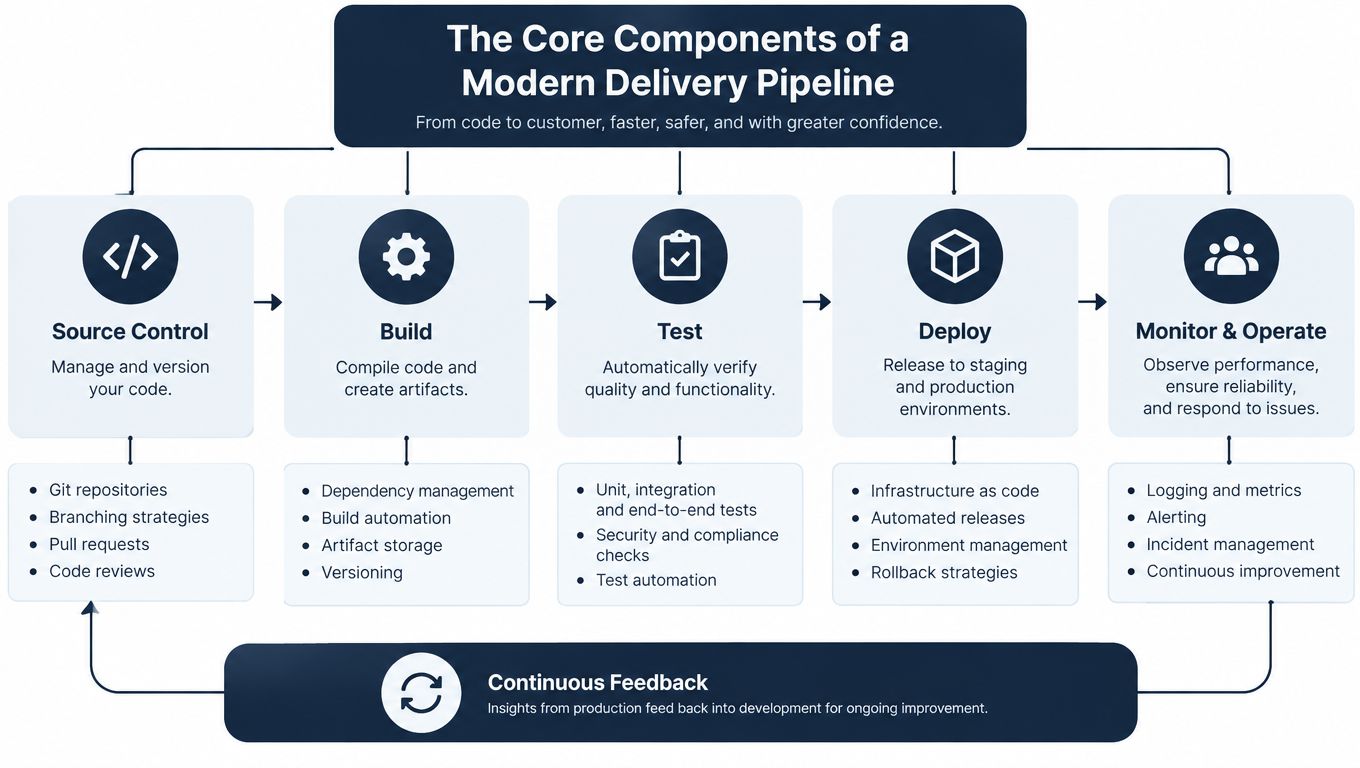
A modern delivery pipeline is a chain of controls, not a collection of tools. It starts with version control, creates a reproducible artifact, validates that artifact, promotes it through environments, and records enough evidence to explain the production result.
Start with an authoritative change record
Every change should begin in protected version control. A commit or pull request provides the identifier that connects source code to build output, tests, approvals, and deployment activity. Without that relationship, incident investigation becomes an exercise in reconstructing history from separate systems.
Continuous integration builds and tests changes as they enter the shared codebase. Continuous delivery keeps a validated build ready for production while preserving a release decision. Continuous deployment removes the final approval step and automatically sends every qualifying build to production. The 2022 State of DevOps Report explicitly distinguishes these practices: continuous delivery means a software build can be released to production at any time, while continuous deployment automatically sends every qualifying build to production.
That distinction matters in regulated environments. A finance platform or clinical workflow may use automated build, test, packaging, and staging steps while retaining a documented human approval for a high-risk production change.
Make infrastructure and tests reproducible
Infrastructure as code turns environment configuration into a versioned, reviewable change. It helps teams reduce undocumented differences between development, staging, and production, but it doesn't remove the need for access control, secret management, or environment-specific validation.
Testing should be layered rather than treated as one pass or fail event:
-
Unit tests validate local behavior quickly.
-
Integration tests check boundaries such as databases, identity services, message queues, and healthcare integrations.
-
Security checks inspect code, dependencies, secrets, and deployable artifacts.
-
Migration and compliance checks identify changes that need extra evidence or approval.
Production observability completes the chain. Deployment-aware logs, service metrics, traces, alerts, and incident records should make it possible to compare system behavior before and after a release. Teams strengthening this layer can use our guide to test automation methodologies for modern CI/CD pipelines as a practical reference point.
The pipeline's real output isn't only a deployable artifact. It's an evidence bundle containing a change identifier, approval record, test result, deployment timestamp, rollback or hotfix flag, and incident linkage. If one of those links is missing, the organization has automation, but not a dependable audit trail.
Measuring the ROI of Delivery Automation
The business case for software delivery automation should not rest on release volume. A CTO wants faster movement from product decision to customer value. Finance also needs visibility into rework, incident response, missed commitments, and engineering capacity consumed by preventable failures.
DORA's measurement model separates throughput from stability. Deployment frequency counts successful production deployments over a period. Change lead time measures the time from a change committed to version control until its successful production deployment. Change failure rate measures the proportion of deployments requiring immediate intervention, such as a rollback or hotfix. Failed-deployment recovery time measures how long recovery takes after a failed deployment. The definitions appear in DORA's guide to delivery metrics.
Compare speed with stability
The 2022 findings classify strong delivery performance as deployments ranging from multiple times per day to several times per week, lead times below one hour, change-failure rates of 0% to 15%, and restoration times below one hour. Low-performing teams deploy from once a month to once every six months, have lead times of one to six months, report change-failure rates of roughly 46% to 60%, and may take one week to one month to restore service. DORA metric context explains why release speed without stability produces a misleading ROI narrative.
| Metric | High Performers | Low Performers |
|---|---|---|
| Deployment frequency | Multiple times per day to several times per week | Once a month to once every six months |
| Lead time for changes | Less than one hour | One to six months |
| Change failure rate | 0% to 15% | Roughly 46% to 60% |
| Time to restore | Less than one hour | One week to one month |
These ranges are reference points, not universal targets. A medical-device integration and a stateless web service have different risk profiles, release constraints, and evidence requirements. Leaders should ask whether automation improves throughput and stability together, rather than rewarding activity alone.
A pipeline that deploys daily while increasing rollback volume can look productive in a dashboard. In practice, it converts delivery capacity into rework. ROI appears when small, well-tested changes reach users sooner, failures are identified quickly, service is restored, and the organization can explain what happened.
For healthtech, finance, and medical-device teams, that explanation is part of the output. AI-assisted delivery should therefore automate evidence alongside execution, linking changes, checks, approvals, deployments, and outcomes so faster delivery remains reviewable and audit-ready.
An AI-Augmented Implementation Roadmap
AI works best in delivery automation when it strengthens an existing safety system. It shouldn’t compensate for weak version control, poor test quality, unreviewed infrastructure changes, or missing production telemetry. I’d build the capability in stages, with each stage producing usable evidence before the next one adds more autonomy.
Establish the delivery foundation
Begin with protected repositories, consistent branching and review rules, reproducible builds, artifact versioning, and infrastructure as code. Instrument the basic links first. Every build should point to a source revision, every deployment should point to a build, and every production change should have an owner and outcome.
For a small team, the next quarter should focus on a narrow service or product slice rather than a platform rewrite. Add fast unit tests, critical integration tests, deployment health checks, and a rollback path that someone can execute under pressure.
Add risk-aware quality gates
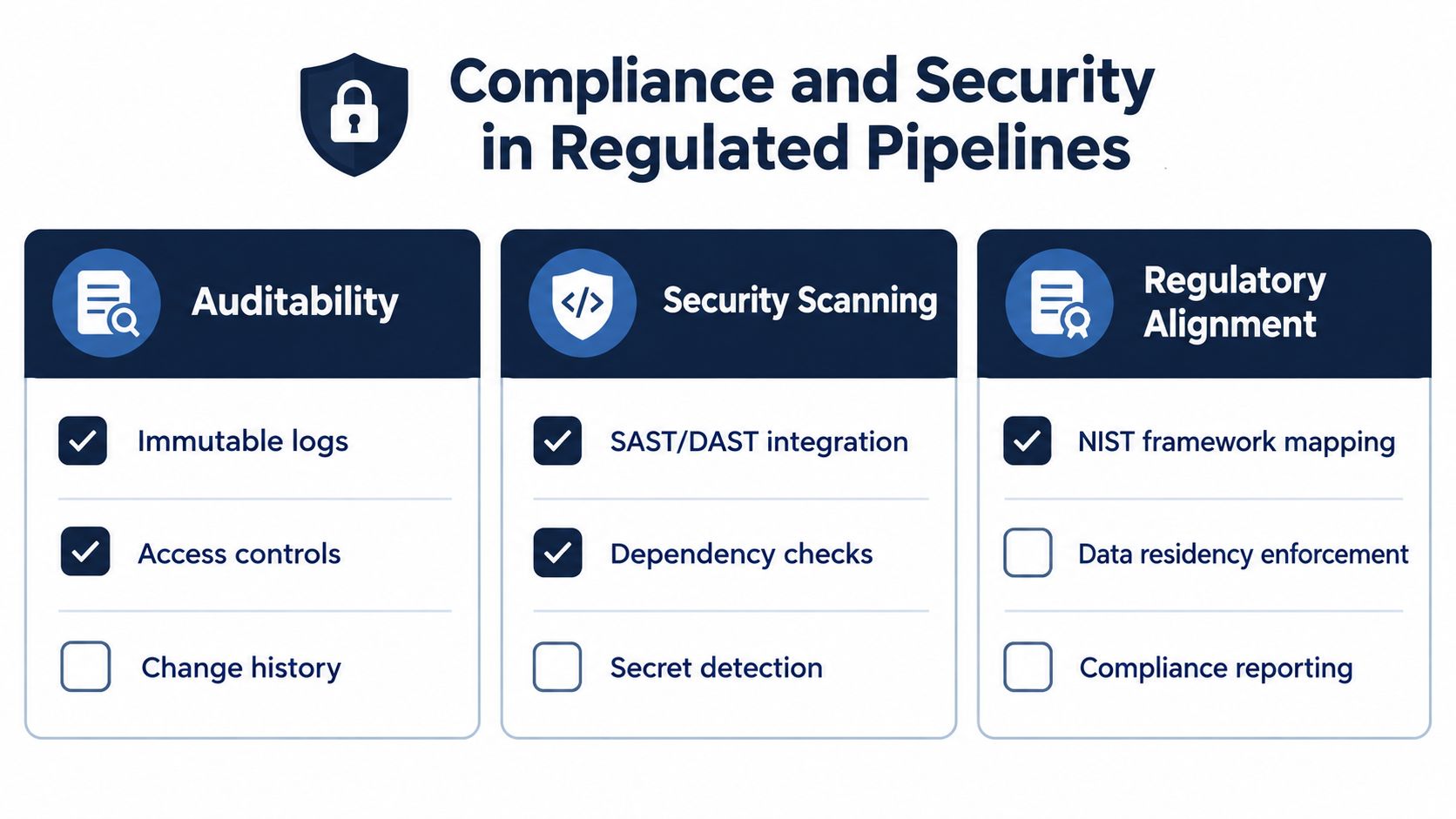
Security and policy checks should run before production promotion. Use dependency analysis, static and dynamic security testing where appropriate, secret detection, migration validation, and policy-as-code for controls that can be evaluated automatically. High-risk changes should trigger stronger review and evidence requirements than low-risk presentation changes.
The NIST Secure Software Development Framework organizes secure development around Prepare the Organization, Protect the Software, Produce Well-Secured Software, and Respond to Vulnerabilities. Those practice areas map naturally to pipeline controls, including protected repositories, component integrity, vulnerability triage, and remediation tracking.
Introduce AI with explicit boundaries
AI can help generate tests, summarize code changes, identify likely defects, suggest deployment risks, and support review preparation. It shouldn’t auto-approve high-impact changes or alter the evidence trail without disclosure. Record the model and prompt versions where relevant, the generated output, human review, validation results, exceptions, and post-release outcomes.
Teams exploring platform engineering and AI infrastructure can also review this startup infrastructure DevOps opening for a useful view of the skills involved in building delivery platforms around AI workloads. The lesson for enterprise teams is not to copy a job description. It’s to recognize that AI-assisted delivery needs platform, security, and operational disciplines together.
Progress toward progressive delivery
Feature flags, canary releases, automated rollback, and service-level monitoring create a safer path to broader autonomy. A year-long roadmap might add self-service environments, reusable pipeline templates, deployment intelligence, and automated evidence packets. The sequence matters. AI should amplify a reliable delivery system, not hide the absence of one.
For a broader perspective on this sequence, our article on AI in DevOps and software development operations connects AI assistance to the surrounding engineering operating model.
Compliance and Security in Regulated Pipelines
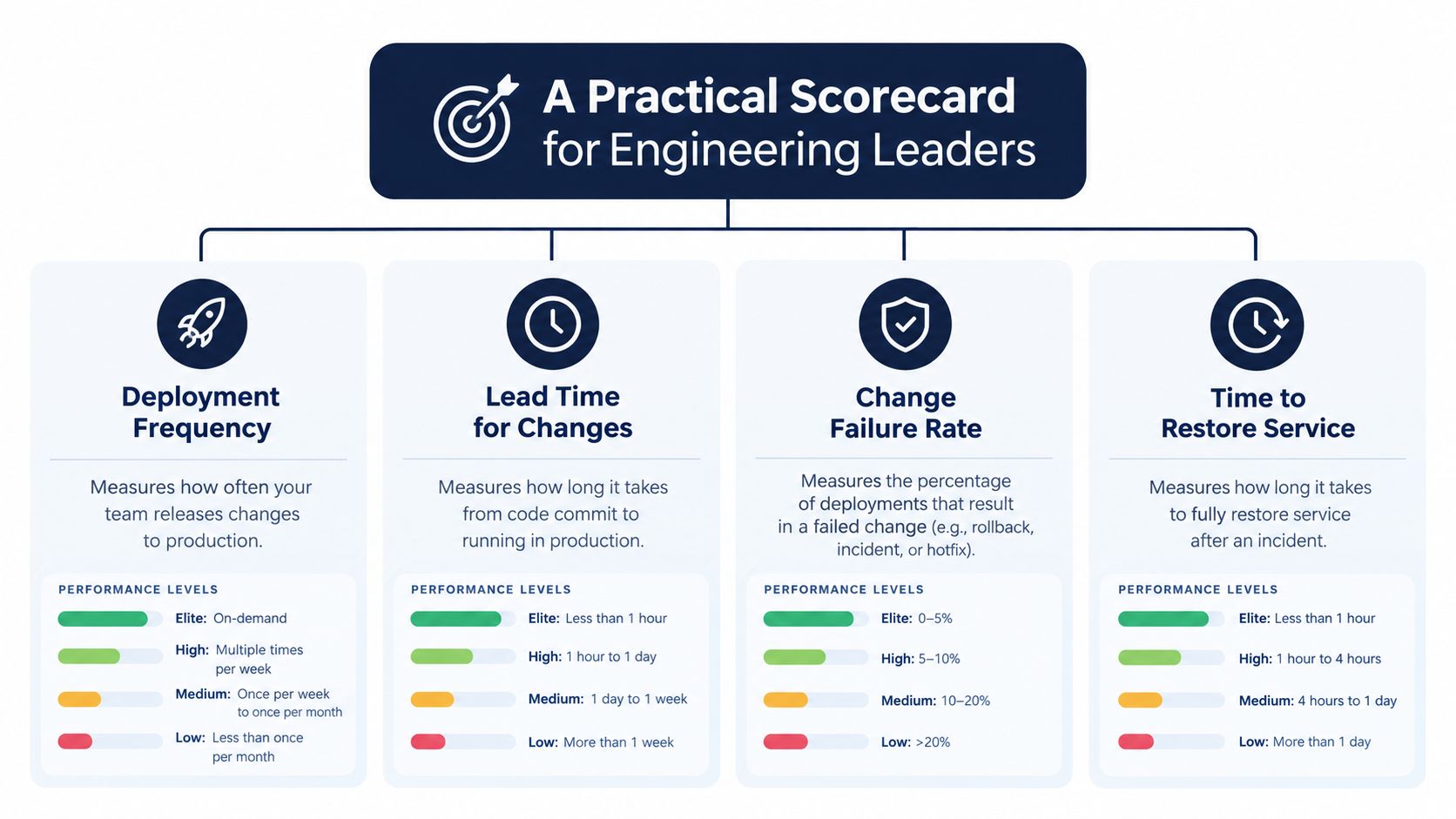
In regulated software, a successful deployment is only part of the outcome. The delivery system must also produce evidence showing what changed, who approved it, how it was validated, and what happened afterward. That record supports audits, incident reviews, and decisions about whether AI-assisted delivery remains within approved controls.
A clinical workflow change illustrates the pattern. Suppose a release changes how a care team records a patient assessment. The pipeline can assemble an audit packet containing the source revision and build provenance, the reviewer and risk decision, validation results for the workflow and migration, and production monitoring outcomes. Each artifact should map to a defined control practice, rather than forcing reviewers to interpret an undifferentiated export.
-
Provenance supports software integrity by connecting the deployed artifact to its source, dependencies, and infrastructure changes.
-
Approval evidence supports organizational control by recording the reviewer, policy decision, and any exception rationale.
-
Validation evidence supports secure production by preserving test results, security findings, and environment checks.
-
Operational evidence supports vulnerability response and ongoing risk management through deployment outcomes, rollback status, and incident links.
-
AI evidence records model and prompt versions, generated output, human review, validation results, and post-release observations when AI contributed.
This structure keeps compliance evidence close to the delivery event. It also separates throughput from stability. A pipeline may deploy quickly while still requiring a gate for clinical impact, financial authorization, protected data, or regulated AI behavior.
For high-risk AI systems, the European Commission’s AI regulatory framework describes obligations involving risk management, logging, data governance, technical documentation, human oversight, cybersecurity, accuracy, and information for deployers. The pipeline should connect those obligations to named artifacts and accountable reviewers, not treat a policy document as proof of execution.
Prefer evidence automation to total autonomy
“Fully automated” is a weak target for changes affecting patient safety, financial controls, protected data, or regulated AI. Evidence-automated delivery is more practical. Low-risk changes can pass automated gates, while high-impact changes pause for human review with a complete, machine-generated record.
That design turns compliance into a property of the delivery system. Auditors and risk teams receive a traceable account of the organization’s actions, decisions, validations, and outcomes.
A Practical Scorecard for Engineering Leaders
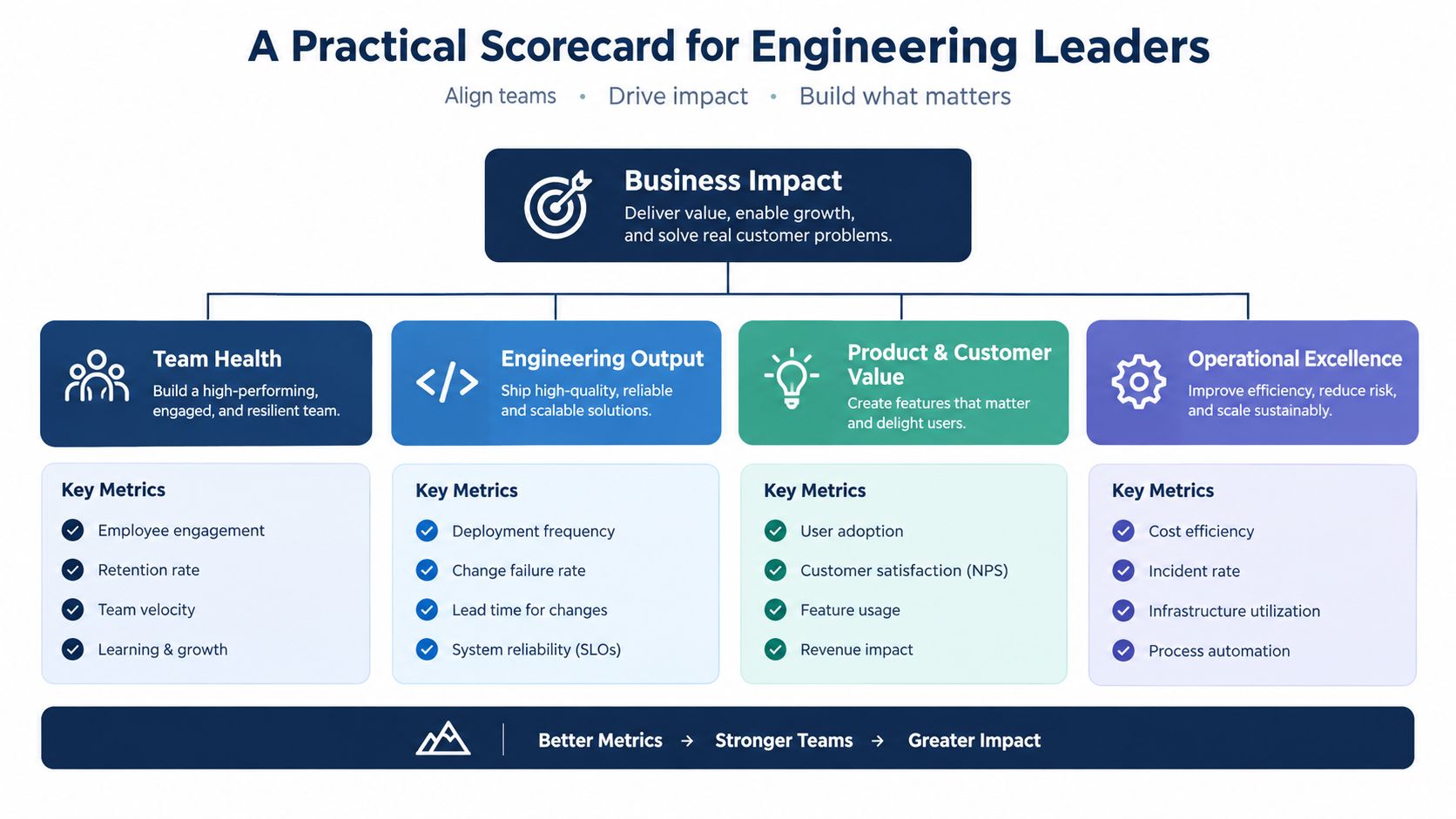
A scorecard should prevent leaders from confusing activity with performance. DORA’s four metrics provide the core: deployment frequency, change lead time, change failure rate, and failed-deployment recovery time. Review the first two as throughput, and the latter two as stability. Neither pair is sufficient alone.
Instrument the production event
For every production deployment, capture:
-
Commit identifier: The exact source revision included in the release.
-
Approval record: The person or policy that authorized promotion.
-
Test result: The checks that ran and their outcomes.
-
Deployment timestamp: When the validated artifact reached production.
-
Rollback or hotfix flag: Whether immediate intervention followed.
-
Incident linkage: The operational event associated with the change, if any.
Calculate change lead time from commit to successful production deployment, not from ticket creation. Ticket age measures planning and queue behavior. It doesn’t measure delivery performance as DORA defines it.
Segment before you compare
Review metrics by service, team, deployment type, and risk tier. A stateless web service may support frequent, low-blast-radius releases. A database migration may require compatibility planning, staged execution, and a stronger approval path. A medical-device integration may depend on external validation and operational coordination that a web-service deployment doesn’t need.
Consider a healthtech platform with separate release streams. The web interface might show short lead times and frequent successful deployments, while a patient-record migration has a longer lead time but a carefully controlled failure rate and rapid recovery procedure. Combining those streams into one average would conceal the risk profile that leaders need to manage.
Measurement discipline: A useful dashboard explains why a metric moved, which service changed it, and whether the business gained capacity or inherited more operational work.
The scorecard should also include qualitative review. Ask whether teams can reconstruct a release, whether rollback is tested rather than merely documented, whether alerts identify deployment-related regressions, and whether AI-generated changes receive review proportional to their potential impact. A mature scorecard makes these controls visible alongside the numbers.
Enterprise and Healthtech Patterns Worth Adopting
Patterns endure longer than pipeline products. The right design depends on risk, architecture, team capability, and regulatory obligations, but several patterns work across enterprise and healthtech environments.
Use risk-tiered workflows
A documentation-only change might pass through standard automated checks. A change affecting patient data handling, payment logic, identity, medical-device communication, or a database schema should invoke additional tests, policy checks, reviewer expertise, and deployment controls. The organization gets a single delivery system with different safeguards rather than one slow workflow for everyone.
Separate deployment from release
Feature flags allow teams to deploy code without exposing a feature immediately. That separation helps product leaders coordinate rollout, gives operations time to observe behavior, and supports controlled activation for selected users or workflows. Flags need ownership, expiry rules, and audit records; otherwise they become hidden configuration debt.
Make rollback operational
A rollback plan that requires several manual interventions isn’t a reliable control. Use versioned artifacts, reversible configuration, database compatibility strategies, health checks, and automated traffic switching where the architecture supports it. Tie rollback decisions to service health and business impact rather than to a fixed timer.
Build an internal platform around the common path
An internal developer platform can provide approved pipeline templates, environment provisioning, secrets integration, policy checks, deployment evidence, and service dashboards. That reduces cognitive load without forcing every team to design its own controls. Platform teams should still allow exceptions, but exceptions need owners and recorded rationale.
Let AI escalate rather than approve
AI-assisted review can summarize changes, identify affected services, suggest tests, and flag suspicious patterns. For high-risk changes, it should route the decision to a qualified human instead of approving automatically. That pattern respects the uneven trust in generated code identified by the 2025 DORA research while preserving useful acceleration.
These patterns fit a custom software development engagement because they can be introduced around the product’s actual architecture and risk profile. For a SaaS healthtech platform, the same design may also need SaaS product development and carefully managed healthcare integrations. The implementation should produce a traceable audit packet as part of normal delivery, not as a separate compliance project.
Turning Automation into an Audit-Ready Capability
The practical target isn’t maximum automation. It’s a delivery system that improves throughput and stability while generating credible evidence by default. Start with one service, instrument the four DORA measures, strengthen testing and rollback, then add AI assistance where the evidence chain is already dependable.
For teams planning broader adoption, an AI implementation roadmap can help connect use cases to governance and delivery foundations. Bridge Global also supports AI development services, enterprise AI solutions, and regulated software initiatives. Review relevant client cases to assess whether the delivery approach fits your product and operating context.
Bridge Global helps technology teams design custom delivery platforms, automate CI/CD and infrastructure controls, and introduce AI assistance without losing traceability. If you’re building healthtech, finance, insurance, or medical-device software, visit Bridge Global to discuss an evidence-automated delivery roadmap grounded in your release risks and compliance needs.

About Stephanie Cornelissen
Stephanie Cornelissen is a Technical Solutions Consultant with strong experience helping organizations navigate complex digital change. She works closely with teams to align business goals with practical, scalable technology solutions. With expertise in system architecture, integrations, and emerging technologies, she focuses on solving real-world problems through thoughtful execution. She enjoys working where technology meets business strategy and measurable growth.
View all posts by Stephanie Cornelissen →