



A Practical Guide to Patient Engagement Technology Solutions
Patient engagement technology isn’t just a buzzword; it’s a collection of digital tools, think apps, online portals, and virtual visit platforms, that bring patients off the sidelines and into the game as active players in their own healthcare. It’s a move away from the old, reactive way of doing things toward a genuine partnership between patients and their care teams.
What Is Patient Engagement Technology, Really?
The era of patients sitting passively in a waiting room, only engaging with their health for a few minutes during an annual check-up, is over. Healthcare is making a massive shift, and patient engagement technology solutions are the engine driving it. We’re moving toward a reality where patients can manage their health conditions using a simple app on their phone or get advice from their doctor without leaving the house.
This isn’t a futuristic dream; it’s happening right now. The market for these tools is booming, climbing from a value of $7.06 billion to a projected $9.39 billion. Why the surge? A combination of new healthcare regulations, a post-pandemic world that’s embraced remote options, and the simple fact that nearly everyone has a smartphone.

The Building Blocks of Modern Patient Care
So, what exactly are these tools? They’re a suite of digital solutions designed to close the communication and information gap between you and your healthcare provider. The goal is to make your care journey more transparent, convenient, and effective.
Here’s a quick look at the core components and what they bring to the table for both patients and the providers who care for them.
Key Components of Patient Engagement Technology Solutions
| Component | Primary Function | Benefit for Patients | Benefit for Providers |
|---|---|---|---|
| Patient Portals | Secure online dashboards for accessing health records, lab results, and appointments. | Puts health information directly in their hands, empowering them to take ownership. | Reduces administrative calls and automates routine tasks like appointment scheduling. |
| Telehealth Services | Virtual consultations and follow-ups via video or phone calls. | Offers incredible convenience, saves travel time, and provides access to specialists. | Increases appointment capacity, improves follow-up adherence, and allows for flexible care delivery. |
| Secure Messaging | Direct, encrypted communication channels between patients and care teams. | Provides a quick and easy way to ask non-urgent questions and get advice. | Streamlines communication, reduces phone tag, and creates a documented conversation trail. |
| Remote Patient Monitoring (RPM) | Wearable devices and at-home sensors that track vital signs (e.g., blood pressure, glucose). | Enables proactive management of chronic conditions from home, catching issues early. | Gives a real-time view of a patient's health, allowing for timely interventions. |
These technologies don't just exist in a vacuum. They build on foundational advancements, like the evolving role of technology in blood testing, which has made diagnostics faster and more accessible. And as we explored in our guide on mobile healthcare applications, these tools have put powerful health management capabilities into millions of pockets.
"It's a fundamental shift from the 'doctor-knows-best' mentality to a collaborative partnership. When you give patients the right information and easy-to-use tools, they are far more likely to stick with their treatment plans and see better health outcomes in the long run.
What Makes Modern Patient Engagement Technology Tick?
To really get what patient engagement technology solutions are all about, you have to look under the hood. The features that power these platforms aren't just bells and whistles; they are the gears and levers that create a more connected and collaborative healthcare experience. Each piece works together to build a system where patients feel like active partners in their health, not just passengers.
Think of it like this: a great patient engagement platform is the digital command center for a person's entire health journey. In the same way online banking gives you a complete, real-time view of your finances, these platforms pull everything into one place: health records, provider messages, appointments, and treatment plans. It's a huge shift from the old, fragmented way of doing things.
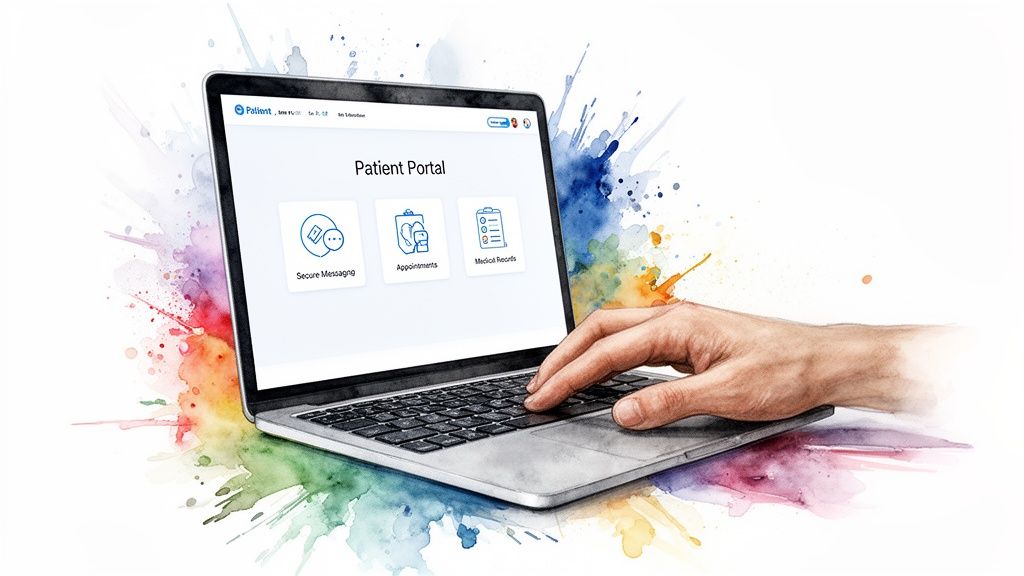
The Patient Portal: Your Personal Health Hub
The patient portal is usually the heart of the whole system. It's a secure website that gives patients 24/7 access to their health information. No more waiting on hold for lab results or trying to recall a doctor's instructions from a month ago. Everything is right there.
A good portal is a multi-tool that makes life easier for everyone:
-
Access to Medical Records: Patients can instantly pull up their health history, see lab results, and check their medication lists. This simple access gives them a much clearer picture of their own health.
-
Appointment Management: Scheduling, changing, or canceling appointments becomes a quick, self-service task. This alone frees up a massive amount of time for front-desk staff.
-
Bill Pay and Financials: Many portals now handle the financial side, letting patients view statements and pay bills online. It removes a major point of friction in the healthcare process.
Thanks to the widespread adoption of EHRs, this is now a reality for many. Data from the ONC shows that 57% of individuals have been offered access to a patient portal. This single feature changes the dynamic, turning a patient from a passive recipient into an informed participant.
Secure Messaging and Telehealth: A Direct Line to Your Doctor
Good healthcare runs on good communication, but the old game of phone tag is slow, frustrating, and inefficient. This is where secure messaging and telehealth come in, opening up direct lines of communication.
Secure messaging gives patients a direct, HIPAA-compliant way to chat with their care team. It's perfect for those non-urgent questions: clarifying a prescription, asking about a minor symptom, or sending a quick follow-up. It saves time on both ends and creates a documented conversation right in the patient's chart.
Telehealth takes it to the next level with virtual visits. The benefits here are huge:
-
Better Access: Patients in rural areas or those with mobility challenges can see specialists without the stress and cost of travel.
-
Serious Convenience: Follow-ups and routine check-ins can happen from home or the office, which means fewer missed appointments and less time off work.
-
Continuous Care: It keeps patients and providers connected, which is absolutely critical for managing chronic conditions effectively.
The real magic of these tools is how they make healthcare feel immediate and accessible. When a patient knows they can easily reach their provider, they’re far more likely to stick with their treatment plan and stay engaged in their care.
Remote Patient Monitoring: Proactive Care for Chronic Conditions
For anyone managing a chronic condition like diabetes, hypertension, or heart disease, constant monitoring is the key to staying healthy. Remote Patient Monitoring (RPM) technology brings the clinic into the patient's home, using connected devices like blood pressure cuffs, glucose meters, and smart scales.
These devices automatically send vital health data back to the care team, giving them a real-time window into the patient's health between office visits. It’s a proactive approach that lets clinicians spot worrying trends and step in early, often preventing an emergency room visit or hospitalization. Getting this right often involves expert custom software development to ensure the monitoring tools are perfectly suited to a specific patient group's needs.
How AI Supercharges Patient Engagement
Think of traditional patient engagement tools as a basic highway system for communication. Now, imagine adding an intelligent navigation system that anticipates traffic, finds shortcuts, and customizes the route for every single driver. That’s what Artificial Intelligence does for healthcare.
AI turns passive systems into proactive partners in a patient's care journey. It’s the engine that powers a shift from generic, one-size-fits-all messages to smart, personalized interactions that genuinely resonate with individuals. This is possible because AI algorithms can learn from patient data: things like appointment history, communication habits, and health metrics, to figure out what works best for each person.
Unlocking Personalized Care with Predictive Analytics
One of the most powerful ways AI is changing the game is through predictive analytics. By sifting through mountains of data from electronic health records, wearable devices, and patient feedback, AI can spot patterns that a human might miss. It can identify patients who are at a higher risk for certain conditions long before they become an emergency.
For example, an AI model could flag a patient with diabetes whose recent glucose readings and activity levels point to a high risk of a hyperglycemic event. This gives the care team a heads-up to intervene proactively, maybe with a quick telehealth call or a simple medication tweak. This is a huge leap from reactive treatment to genuinely preemptive care, preventing a dangerous and expensive trip to the ER.
NLP and Chatbots: The New Front Door to Healthcare
Natural Language Processing (NLP) is the magic behind making computers understand and respond to everyday human language. In healthcare, we see this most clearly with the rise of intelligent chatbots and virtual health assistants. Forget the clunky, rule-based bots of the past; these modern tools are sophisticated enough to manage a wide range of patient needs around the clock.
AI is making patient interactions feel more human, enabling personalized support through advanced tools like a Free AI assistant. These modern chatbots are adept at handling real-world tasks:
-
Answering Common Questions: They provide instant, 24/7 answers to queries about appointment times, potential medication side effects, or post-op care instructions.
-
Symptom Triage: They can guide a patient through a series of questions to assess symptoms and suggest the right next step, whether that's scheduling a virtual visit or heading to an urgent care clinic.
-
Appointment Scheduling: They can manage complex scheduling requests, finding a time that works for both the patient and the provider without anyone needing to pick up the phone.
These conversational tools aren't just about making things more efficient. They create a healthcare experience that feels more accessible and responsive. To dive deeper, as we explored in our guide, you can see how AI chatbots are transforming the healthcare industry and what it means for patient care.
AI-powered engagement isn't about replacing human clinicians. It's about augmenting their abilities. It automates the routine, administrative tasks so doctors and nurses can focus on what they do best: providing empathetic, high-quality care to the patients who need them most.
By thoughtfully integrating AI, healthcare providers can build a system that is not only more efficient but also deeply in tune with the unique needs of every single patient.
Measuring the ROI of Engagement Technology
Any time you're talking about a significant tech investment, it all boils down to one question: what's the return? When it comes to patient engagement technology solutions, the answer is pretty convincing, impacting nearly every part of a healthcare organization. The value isn't just about the bottom line; it's also about healthier patients and smoother, more efficient clinical workflows.
This kind of investment is quickly moving from a "nice-to-have" to a strategic must. The market for these platforms is already valued at $31.0 billion and is expected to explode to $149.2 billion by 2031; that's a huge 17.0% compound annual growth rate. Real-time communication tools are leading the charge, making up 68.0% of the revenue. Just look at telehealth and remote monitoring, which have already proven they can cut no-show rates by 30-50% in pilot programs. You can find more details on this explosive growth from Future Market Insights.
The Clinical Payoff: Better Outcomes and Adherence
From a clinical standpoint, the ROI is measured in healthier patients. It’s simple, really: when patients are actively involved in their own care, they're far more likely to stick to their treatment plans, which leads to better management of chronic diseases.
-
Improved Medication Adherence: Think about automated reminders sent straight to a patient's phone. These simple nudges can dramatically increase the odds that someone takes their medication correctly, which is a game-changer for conditions like hypertension and diabetes.
-
Lower Readmission Rates: With remote monitoring tools, clinical teams can spot trouble early, long before a small issue becomes a full-blown emergency. This proactive care helps sidestep those costly and often preventable hospital readmissions.
-
Enhanced Chronic Disease Management: Consistent, easy communication keeps patients with long-term conditions feeling connected and supported by their care teams. The result is more stable health and a much better quality of life.
The Business Case: Operational Excellence and Loyalty
Beyond the exam room, these technologies deliver some serious business advantages that directly boost an organization's financial health. They help streamline how things get done, cut down on administrative waste, and forge stronger, lasting relationships with patients.
The business ROI of patient engagement is clear: it cuts operational costs while simultaneously building the patient loyalty that is essential for long-term growth. It's a rare win-win that improves both the bottom line and the quality of care.
A well-designed engagement platform drives efficiency everywhere you look:
-
Reduced No-Show Rates: Automated appointment reminders, whether by text or email, are a proven way to slash no-shows. This creates a more reliable revenue stream and makes sure clinicians' time is used effectively.
-
Greater Staff Efficiency: By automating routine work like scheduling appointments or handling frequently asked questions, these platforms free up your administrative and clinical staff. They can then focus on more complex patient needs where they can add the most value.
-
Alignment with Value-Based Care: The entire industry is shifting away from fee-for-service and toward value-based care. Patient engagement tech is essential for this transition, providing the tools and data needed to hit quality metrics and deliver better outcomes at a lower cost.
Before we move on, let's look at some hard numbers. The table below shows the kind of concrete improvements healthcare organizations often see when they get patient engagement right.
Impact of Patient Engagement Tech on Key Healthcare Metrics
| Metric | Typical Improvement | Business/Clinical Impact |
|---|---|---|
| Medication Adherence | 15-25% increase | Reduces complications from chronic diseases, leading to fewer ER visits and hospitalizations. |
| Appointment No-Show Rate | 30-50% reduction | Maximizes provider schedules, increases revenue, and improves continuity of care. |
| Hospital Readmissions | 10-20% reduction | Lowers costs associated with penalties and improves patient outcomes post-discharge. |
| Staff Administrative Time | 20-30% decrease | Frees up staff for high-value tasks, reduces burnout, and improves operational efficiency. |
| Patient Satisfaction Scores | 10-15% improvement | Boosts patient loyalty and retention, which is critical for growth in a competitive market. |
As you can see, the benefits are tangible and spread across both clinical and operational areas. This data reinforces that investing in specialized healthcare software development isn’t just about adding new gadgets. It’s about building a more resilient, patient-focused, and financially stable organization for the long haul.
A Strategic Roadmap for Successful Implementation
Choosing the right technology is just the beginning. The real magic happens during the rollout; that’s what turns a promising investment into a genuine asset that actually improves patient care. Implementing patient engagement technology solutions demands a clear, strategic roadmap. Without one, even the most impressive platform can fail to get off the ground, leading to wasted money and frustrated teams.
A well-thought-out plan ensures the technology fits your organization’s specific goals, slides smoothly into existing workflows, and, most importantly, gets used by both staff and patients. The best way to tackle this is to break the journey down into manageable phases.
Phase 1: Discovery and Strategy
Before you even think about looking at software, you need to look inward. This first phase is all about defining what success means for your organization. You have to get crystal clear on your main objectives. Are you trying to cut down on costly hospital readmissions? Maybe you want to slash your appointment no-show rates or get a specific group of patients to be better about taking their medication.
During this phase, it’s critical to:
-
Identify Key Pain Points: Get a handle on the current challenges in your patient communication. Where are the biggest bottlenecks? What frustrates your staff and patients the most?
-
Define Clear Goals and KPIs: Set specific, measurable, achievable, relevant, and time-bound (SMART) goals. For instance, a great goal would be to “reduce patient no-show rates by 15% within six months of going live.”
-
Assess Technical Readiness: Take a hard look at your current setup, especially your Electronic Health Record (EHR) system. You need to understand what it will take to integrate a new system and what roadblocks you might hit.
Phase 2: Vendor Selection and Partnership
With a clear strategy in hand, you can start the search for a vendor. Think of this less like buying a product and more like finding a long-term partner. Your ideal partner will be an expert not just in technology, but specifically in the world of healthcare. As you evaluate vendors, check out their client cases to see if they have a track record with organizations like yours.
This market is booming. The patient engagement solutions space is expected to reach $51.69 billion, growing at a healthy 12.0% CAGR. Providers are leading the charge, investing heavily to improve communication and lower readmissions. In fact, 70% of hospitals now say interoperability is a top priority. You can dig deeper into these market trends in this detailed analysis.
Phase 3: Integration and Technical Setup
Now we get to the nuts and bolts. A seamless integration with your EHR isn’t just a nice-to-have; it’s a dealbreaker. A disconnected system creates information silos and forces your staff into clumsy workarounds, completely undermining the point of the new tech.
Here’s what happens in this phase:
-
Technical Scoping: You’ll work closely with your vendor to map out how data will flow between the new platform and your EHR, using standards like HL7 and FHIR.
-
Configuration and Customization: This is where you tailor the platform to fit your specific clinical workflows and communication style.
-
Security and Compliance Validation: You must rigorously confirm that all data handling meets the strict requirements of HIPAA and other regulations.
Phase 4: Rollout and Training
A successful launch is all about your people. You need to get your clinical and administrative staff excited about the new system by showing them how it will make their jobs easier and help them provide better care. Solid, comprehensive training is the key to building their confidence and getting them to actually use the platform.
A great way to start is with a pilot program in a single department. This lets you iron out any kinks before a full-scale launch. You can gather real-world feedback, fine-tune your training, and identify internal champions who can help spread the word and get others on board.
Phase 5: Measurement and Continuous Improvement
Implementation doesn’t end on launch day. To truly get the most out of your investment, you have to constantly monitor how you’re doing against the KPIs you set back in the discovery phase. Keep an eye on metrics like patient portal adoption rates, the volume of secure messages, and patient satisfaction scores.
This data is gold. It tells you what’s working, what isn’t, and where you can make tweaks. It ensures your patient engagement strategy doesn’t just sit on a shelf; it evolves and gets stronger over time.
Ensuring Security and Compliance in Digital Health
When you’re dealing with something as personal as health data, trust is everything. For any patient engagement technology solutions to succeed, they must be built on an unshakable foundation of security and regulatory compliance. Innovation is exciting, but in healthcare, it simply can’t come at the expense of patient privacy.
Protecting sensitive patient information isn’t just good practice; it’s a legal and ethical mandate. Regulations like the Health Insurance Portability and Accountability Act (HIPAA) in the United States and the General Data Protection Regulation (GDPR) in Europe set the ground rules for how organizations handle personal data. These aren’t just bureaucratic hoops to jump through; they are essential safeguards that build patient confidence and shield organizations from catastrophic data breaches.
Core Safeguards for Protecting Patient Data
A secure digital health platform is non-negotiable. It’s the only way to avoid costly penalties and, more importantly, maintain the trust your patients place in you. Several key security measures are now standard practice for any reputable healthcare software.
Think of these safeguards as multiple layers of defense:
-
End-to-End Encryption: This scrambles all data, from a simple message to a doctor to a blood pressure reading sent from a remote device, making it completely unreadable to anyone without authorization. Encryption protects information both while it’s in transit and when it’s sitting on a server.
-
Secure Access Controls: Not everyone in a hospital needs to see all patient information. Role-based access control is crucial, as it ensures clinicians and staff can only view the specific data necessary for their jobs. This dramatically minimizes the risk of unauthorized snooping.
-
Regular Security Audits: Technology and threats evolve constantly. That’s why frequent, independent security audits and vulnerability checks are critical. They help you find and fix potential weaknesses before they can be exploited.
Building a secure platform isn’t a one-and-done task; it’s an ongoing commitment. It means weaving a culture of data security into every single step, from the first line of code to daily operations.
For a deeper dive into this critical area, we recommend reading our guide on HIPAA-compliant software development.
Ultimately, a robust security posture is what makes patients feel safe enough to use these powerful tools. When patients trust that their information is protected, they are far more likely to actually engage with the technology. This, in turn, leads to the improved health outcomes everyone is aiming for, making security the true enabler of effective patient engagement.
Frequently Asked Questions (FAQ)
What is the primary purpose of patient engagement technology?
The main goal is to empower patients to become active participants in their own healthcare. By providing digital tools like patient portals, secure messaging, and telehealth, these solutions improve communication, increase access to health information, and encourage proactive health management, ultimately leading to better outcomes.
How do patient engagement solutions improve healthcare outcomes?
They improve outcomes by increasing medication adherence through automated reminders, reducing hospital readmission rates via remote patient monitoring, and facilitating better management of chronic conditions through continuous communication. Engaged patients are more likely to follow treatment plans and seek timely care.
Are these technology solutions secure and HIPAA compliant?
Yes, security is a top priority. Reputable patient engagement solutions use end-to-end encryption, role-based access controls, and regular security audits to protect sensitive health information. They are designed to be fully compliant with regulations like HIPAA to ensure patient data privacy and build trust.
How can a healthcare organization measure the success of these solutions?
Success is measured using both clinical and financial metrics. Key performance indicators (KPIs) include patient portal adoption rates, reductions in appointment no-show rates, lower hospital readmission rates, improved medication adherence, and higher patient satisfaction scores.
Common Questions on Patient Engagement
Stepping into the world of patient engagement technology naturally brings up a lot of questions. Let’s tackle some of the most common ones to clear up the goals, the process, and the real value these tools bring to healthcare.
What’s the Real Goal of Patient Engagement Technology?
At its core, the goal is to turn patients into active, confident partners in their own health. It’s about giving them easy-to-use tools to communicate with their care team, access their own information, and track their progress.
When you do that, you see better health outcomes and happier patients. You’re fundamentally shifting healthcare from a reactive, “fix-it-when-it’s-broken” model to a proactive and collaborative one.
How Does This Technology Connect with Our Existing EHR?
This is a make-or-break question. For these tools to be effective, they have to integrate smoothly with your existing Electronic Health Record (EHR) system.
This connection usually happens through secure APIs and relies on interoperability standards like HL7 and FHIR. Getting this right means that every piece of patient data, from a secure message sent at midnight to a blood pressure reading from a home device, flows straight into the official record. This creates a single source of truth, kills off disconnected data silos, and saves your clinicians from the headache of duplicate data entry.
An experienced AI solutions partner can be invaluable here, ensuring this tricky integration is done right from day one.
What Are the Very First Steps to Get Started?
You don’t just jump in and buy software. The first step is always a discovery phase where you get strategic. Start by defining what success looks like for you. Do you want to reduce patient no-shows by 15%? Or maybe improve medication adherence for your diabetic patients? Be specific.
Next, take an honest look at your current workflows and tech infrastructure. What are you already good at, and where are the gaps? This groundwork helps you prioritize the features that will deliver the biggest bang for your buck right away and ensures the solution you build actually solves your unique problems. For truly unique needs, a team that does custom software development can build a solution that fits like a glove.
Key Takeaway: Don’t start by looking for a tool; start by defining the problem. A crystal-clear goal will guide every decision you make, from choosing a vendor to training your team.
How Do You Actually Measure the ROI?
You can measure the return on investment (ROI) by looking at both the numbers on your balance sheet and the health of your patients. It’s a mix of financial and clinical metrics.
-
On the Financial Side: Look for things like reduced operational costs from automated workflows, lower hospital readmission rates (which helps you avoid penalties), and a drop in revenue lost from no-shows.
-
On the Clinical Side: Track improvements in patient outcomes. Are more patients sticking to their treatment plans? Are chronic conditions being managed more effectively? Are your patient satisfaction scores climbing?
By tracking these KPIs before and after you roll out the new technology, you get a clear, data-backed picture of its impact on your organization’s financial health and the quality of care you provide.
At Bridge Global, we don’t just build software; we build intelligent, secure, and genuinely helpful patient engagement solutions. Our deep experience in healthcare software development and AI development services means your platform will be both innovative and compliant. Curious to see what AI for your business can look like? Check out our client cases to see the results we’ve delivered for organizations like yours.

About Shreesha Chandrabose
Shreesha Chandrabose is a commerce graduate with a growing passion for content writing and digital media. With a curious mind and a creative approach, she enjoys transforming ideas into simple, relatable, and engaging narratives. She loves poetry, photography, and editing, and enjoys bringing ideas to life through words and visuals.
View all posts by Shreesha Chandrabose →