



A Guide to Modern Healthcare Software Development
Welcome to a new era in medicine, where software is becoming as critical as the stethoscope. We’re talking about more than just code; we’re talking about building digital lifelines. From AI that helps doctors spot diseases earlier to apps that let patients monitor their health from home, these tools are changing the very fabric of healthcare delivery.
The real challenge? Creating solutions that are secure, compliant, and genuinely easy for both patients and clinicians to use. It’s all about improving outcomes and making the entire system work smarter.
The New Era of Healthcare Software Development
This guide is your roadmap through the entire process, from getting a handle on complex regulations like HIPAA to putting artificial intelligence to work. We’ll look at how modern healthtech is built on a non-negotiable foundation of patient safety, data security, and operational clarity. Think of it as the blueprint for building software that doesn’t just keep up, but sets the pace.
The process of healthcare software development isn’t just a technical exercise; it demands a deep understanding of the medical world. This blend of skills is what ensures every tool not only meets strict regulatory standards but also addresses the real-world needs of patients and providers.

Why Quality Development Matters
In healthcare, a software bug isn’t just an annoyance; it can have serious, real-world consequences. On the flip side, a well-built system can completely change how care is delivered for the better. The core goals of any modern healthtech project boil down to a few key areas:
-
Enhancing Patient Care: This means building tools that deliver more accurate diagnostics, enable truly personalized treatment plans, and keep patients actively involved in their own health journey.
-
Improving Operational Efficiency: Think about automating the endless paperwork, simplifying clinical workflows, and freeing up doctors and nurses to focus on patients, not administrative tasks.
-
Ensuring Data Security: Protecting sensitive patient data isn’t optional. It requires robust security measures and a steadfast commitment to compliance.
-
Driving Innovation: This is where things get exciting. Integrating technologies like AI can help us uncover new medical insights, predict health risks before they become critical, and shift from reactive to proactive care.
Our goal is to show you how a complex idea can become a secure, scalable, and genuinely impactful product. We’ll help you see regulatory hurdles not as obstacles, but as opportunities to build trust and create a competitive edge. As an experienced AI solutions partner, we’re here to walk you through every step.
By focusing on getting this foundation right, you can build software that truly makes a difference.
Understanding the Healthtech Market Landscape
Before you can build great healthcare software, you have to get a feel for the world it will live in. Right now, the healthtech market is absolutely booming, think of it like the fintech explosion that completely changed banking a decade ago. This isn’t just a passing trend; it’s a deep, fundamental shift in how we manage and deliver medical care.
What’s behind this massive surge? A couple of big things. The global shift to telehealth and remote patient monitoring has kicked demand for new digital tools into high gear. At the same time, there’s an undeniable push for healthcare to be more data-driven, using analytics to shape clinical decisions, improve patient results, and finally automate processes that have been stuck in the past.
Key Drivers of Market Expansion
This digital wave in healthcare is being pushed forward by a perfect storm of new technology and changing patient attitudes. The core drivers are pretty clear:
-
The Need for Efficiency: Hospitals and clinics are buried under administrative work. Good software can automate the painful parts: billing, scheduling, records, and let clinical staff actually focus on treating people.
-
Empowered Patients: People today expect easy access to their health info. They want to message their doctors, see their lab results on their phones, and have tools to manage their own health. This has lit a fire under the development of patient portals and mobile health apps.
-
The Shift to Value-Based Care: The old model of “pay for every procedure” is slowly being replaced by a system that rewards providers for good patient outcomes. This simply can’t happen without smart software to track data, measure results, and keep everyone on the same page.
These forces are creating a huge appetite for innovation, making high-quality healthcare software development an essential investment, not just a nice-to-have.
Mapping the Primary Market Segments
The healthtech market isn’t just one big blob. It’s made up of several distinct areas, each packed with opportunity. The two biggest players are enterprise systems and Software as a Service (SaaS). Think of enterprise platforms like sprawling Electronic Health Record (EHR) systems – the digital nervous system for a large hospital. SaaS, on the other hand, offers nimble, subscription-based tools for specific jobs like telemedicine or practice management.
The growth in SaaS is especially telling. The market is exploding, fueled by the demand for affordable, scalable tools that can handle everything from keeping patients engaged to monitoring them from afar.
The numbers speak for themselves, showcasing a market ripe with opportunity.
Healthcare IT Market Growth Projections
This table breaks down some of the key market segments and their projected growth, painting a clear picture of the immense potential in healthcare software.
| Market Segment | Value (2025) | Projected Value (by 2030/2034) | Projected CAGR |
|---|---|---|---|
| Global Healthcare SaaS | USD 38.50 billion | USD 102.98 billion (by 2035) | 10.34% |
These figures, especially the double-digit growth in SaaS, signal a sustained demand for innovative, cloud-based solutions that solve real-world healthcare challenges.
Getting a handle on this landscape is the first real step in building a solid business case for your project. The data shows a market that’s hungry for innovation, where the right software can deliver huge value to both providers and patients.
This context is your foundation. It justifies the investment and sets the stage for the more technical discussions to come. When you align your product with these powerful market currents, you’re setting yourself up for success from the very beginning.
Navigating the Maze of Healthcare Compliance
In healthtech, compliance isn’t just a bureaucratic hurdle; it’s the very foundation of patient trust. Any software that touches sensitive health information has to operate within a dense framework of rules designed to protect people. Get this wrong, and you’re looking at crippling fines, legal battles, and a reputation that’s nearly impossible to rebuild.
Think of it like building a digital bank vault. You don’t just put up thick walls and call it a day. You need audited access logs, multiple layers of encryption, and airtight protocols that govern who gets the keys and why. This isn’t something you can add on later; security and privacy have to be baked into the design from the very beginning. For any healthcare software development project, this is non-negotiable.
Understanding the Core Regulations
While the rulebook can feel a mile long, two major regulations set the stage for most of the healthcare data privacy landscape today. Getting a handle on what they do is the first, most critical step.
-
HIPAA (Health Insurance Portability and Accountability Act): In the United States, this is the big one. HIPAA establishes the national standard for protecting Protected Health Information (PHI) – a broad category that covers everything from a patient’s name and address to their diagnosis and insurance ID.
-
GDPR (General Data Protection Regulation): Don’t let its European Union origins fool you; GDPR has a long reach. If your app or platform handles the data of any EU citizen, you have to play by its strict rules on consent, data processing, and an individual’s “right to be forgotten.”
These frameworks are about more than just preventing data leaks. They’re about giving patients control over their most sensitive, personal information.
The core principle behind healthcare compliance is simple yet profound: patient data is not a commodity. It is a sacred trust, and the software handling it must be designed to honor and protect that trust at all costs.
A Practical Compliance Checklist for Development
Trying to bolt on compliance at the end of a project is a recipe for disaster. It has to be woven into the development lifecycle from day one. Understanding regulations like HIPAA is paramount for ensuring the security and privacy of patient data. For instance, a service like Bluenotary makes a point of advertising that it is HIPAA compliant, which signals a serious commitment to these standards.
Here’s a checklist of actions you should be integrating into your workflow:
-
Implement Strict Access Controls: Use role-based access control (RBAC) to enforce the principle of least privilege. A billing specialist, for example, has no reason to see a patient’s detailed clinical history, and your system should make that impossible.
-
Enforce End-to-End Encryption: All PHI must be encrypted, period. That means it needs to be protected both at rest (while sitting in a database) and in transit (as it moves across a network). This step renders the data useless to anyone who might intercept it.
-
Maintain Comprehensive Audit Trails: Your software must keep a detailed log of every single interaction with patient data. Who accessed it? When did they access it? What did they do? These logs are absolutely essential for security audits and for tracing the source of any potential breach.
-
Sign Business Associate Agreements (BAAs): If you rely on any third-party services, like a cloud hosting provider or an analytics platform, that will handle PHI, you must have a BAA in place. This is a formal, legally binding contract that holds your vendors to the same strict HIPAA standards you follow.
When you build these controls directly into your application’s architecture, compliance stops being a burden. It becomes a powerful feature that shows your dedication to patient safety and trust—a true hallmark of quality custom software development.
Choosing the Right Architecture and Tech Stack
Building dependable healthcare software is a lot like designing a modern hospital. Your architecture is the blueprint. It dictates how every department, from admissions to the ER, connects and functions. A shaky blueprint can lead to bottlenecks, downtime, and operational chaos. A smart one, on the other hand, ensures the entire system runs smoothly, efficiently, and safely.
This foundational decision truly defines your application’s success. It influences everything from its ability to scale with patient load to how easily it can adapt to new regulations and security threats. Get it right, and you save on development headaches and long-term maintenance costs.
Monolithic vs. Microservices Architectures
In the past, most applications were built using a monolithic architecture. Think of it as a single, massive building where every hospital service is tightly interconnected under one roof. The problem? If the plumbing fails in one wing, the entire hospital might have to shut down. In the software world, a single bug in a monolithic app can bring the whole system down – a risk no one can afford in healthcare.
Today, we often lean toward a microservices architecture, especially for complex systems. This is more like a campus of specialized clinics. Each service: patient registration, billing, and lab results, is its own independent building. If the billing office has a technical glitch, the emergency room and patient portal keep running without a hitch. This distributed approach delivers superior resilience, which is non-negotiable for any system where downtime isn’t an option.
This separation of tasks doesn’t just improve stability. It also lets teams update or scale individual services independently. That means you can roll out a new feature for your patient scheduling module without disrupting the core electronic health record system.
Selecting the Right Technologies
Once you’ve settled on the architectural blueprint, it’s time to choose the building materials – your technology stack. Every component has a specific job, and picking the best tools is crucial for creating a high-performing, user-friendly platform. The global market for healthcare enterprise software is expected to hit USD 158.63 billion by 2034, growing at a 13.8% CAGR. This growth is largely driven by the need for effective and compliant tools like EHRs.
Here’s a look at some typical technology choices:
-
Frontend Frameworks: This is the “lobby” and “patient rooms” of your application – what users see and interact with. Frameworks like React or Angular are fantastic for building intuitive, responsive patient portals and clinician dashboards that work beautifully on any device.
-
Backend Languages: This is the engine room, handling all the data processing, business logic, and security. Languages like Python are a great fit for AI-driven data analysis, while Java or .NET offer the robust, enterprise-grade performance needed for large-scale systems.
-
Database Solutions: This is the secure vault where all sensitive patient data is stored. Options range from traditional SQL databases like PostgreSQL for structured data to NoSQL databases like MongoDB for managing huge volumes of unstructured information, like notes from medical imaging.
The diagram below shows how trust in healthcare software is built on a foundation of critical compliance standards.
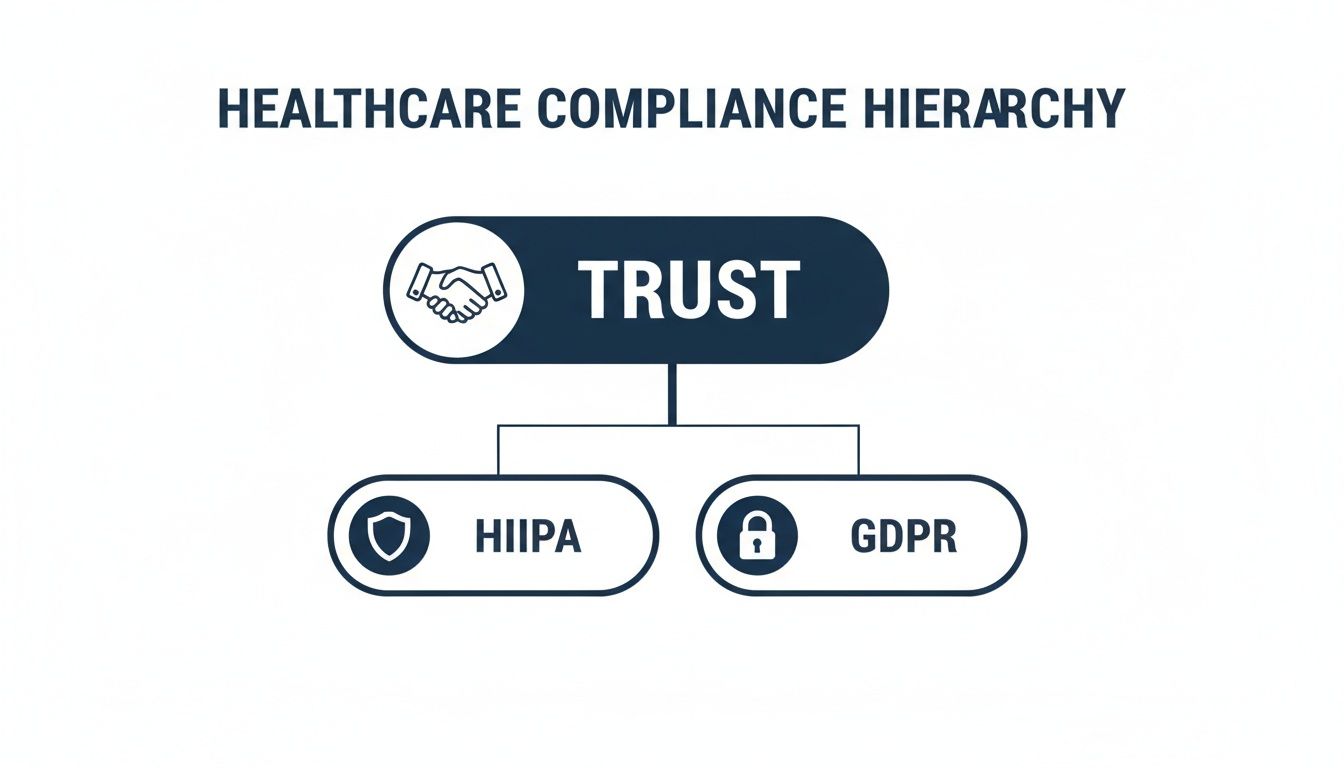
This hierarchy makes it clear that regulations like HIPAA and GDPR aren’t just bureaucratic hurdles. They are the essential pillars that support the trust patients and providers place in digital health tools.
The Critical Role of Interoperability
In healthcare, no system is an island. A hospital’s EHR has to talk to pharmacies, labs, insurance providers, and other specialists. This is where interoperability standards become so important.
Think of FHIR (Fast Healthcare Interoperability Resources) as a universal translator for health data. It uses a modern, API-based approach that lets different medical systems speak the same language, sharing information securely and instantly. Unlike older, more rigid standards, FHIR was designed for the web, making it far easier to build apps that can pull and push data from multiple sources in real-time.
As you can imagine, building these sophisticated, interconnected platforms is a complex job. It requires deep expertise in custom software development to ensure that every piece, from the user interface to the backend services and third-party integrations, works in perfect harmony to deliver a secure, reliable, and compliant solution.
4. Integrating AI to Build Smarter Healthcare Solutions
Artificial Intelligence (AI) and Machine Learning (ML) have officially moved out of the research lab and into the clinic. For a long time, the idea of AI in healthcare felt like science fiction, but today it’s a practical tool for building software that can predict outcomes, personalize patient care, and make workflows far more efficient.
The real magic happens when AI enhances, not replaces, human expertise. Think of it as giving a doctor a superpower – the ability to sift through millions of data points in seconds to make a more confident diagnosis or treatment plan. From predicting disease outbreaks to simply making a hospital run more smoothly, AI is what’s behind the next wave of medical innovation.

Practical Applications of AI in Healthtech
Forget the hype for a moment and look at the real-world problems AI is already solving. The growth numbers tell a compelling story: the healthcare IT market, valued at USD 480.49 billion in 2025, is on track to hit USD 961.26 billion by 2030. That’s a staggering 14.9% CAGR, with AI being one of the biggest drivers of that expansion.
Here’s where the technology is making a tangible difference:
-
Predictive Analytics for Population Health: ML models can comb through public health data to spot trends, like an impending flu season or a neighborhood with a high risk for diabetes. This allows health systems to get ahead of the curve, launching prevention campaigns and directing resources where they’re needed most.
-
Natural Language Processing (NLP) for Clinical Notes: Doctors are drowning in paperwork. NLP tools can instantly summarize long patient histories, transcribe conversations, and pull critical data from unstructured notes. This frees them up to spend less time typing and more time with patients.
-
Generative AI for Patient Support: Smart chatbots can now offer 24/7 assistance to patients. They can answer common questions, help book appointments, or send medication reminders, improving the patient experience while taking a huge administrative burden off the clinical staff.
Key Considerations for AI Integration
Just having a cool algorithm isn’t enough. A successful AI implementation starts with a clear strategy and a deep understanding of the problem you’re trying to solve. You can’t just sprinkle AI on a broken process and expect it to work.
The goal of AI in healthcare isn’t to replace clinicians. It’s to give them intelligent tools that handle the data-heavy lifting, so they can focus on what only a human can provide: empathy, expertise, and compassionate care.
This is where finding the right partner becomes essential. A team that specializes in AI development services can help you pinpoint the best use cases, ensuring your solution is both technically sound and compliant with all the necessary healthcare regulations.
It’s also worth thinking about how AI can help build the software itself. Learning how AI for code can boost your software can reveal ways to speed up development and improve the quality of your final product. This kind of strategic thinking is the first step toward building healthcare solutions that are truly intelligent, effective, and safe.
How to Choose Your Healthtech Development Partner
Picking the right technology partner is arguably the most critical decision you’ll make. This isn’t just about hiring a team to write code; it’s about finding a strategic ally who gets the high-stakes, high-compliance world of healthcare.
Think of them as more than just developers. The right partner acts as a consultant, a guide who can navigate you through the technical minefields and regulatory mazes. They’re there to de-risk the entire project and get you to market faster.
Get this choice wrong, and you’re looking at budget blowouts, compliance nightmares, and a product that fizzles out before it ever finds its audience. But a great partner? They become a true extension of your team, bringing the specialized expertise that makes your product secure, scalable, and genuinely useful.
Core Competencies to Look For
When you start talking to potential partners, you need to zero in on a few non-negotiable skills. These are the things that separate a dedicated healthcare software development firm from a generalist agency that just happens to have a healthcare project or two under its belt.
-
Proven Healthtech Experience: Don’t just take their word for it. Ask to see a portfolio brimming with successful healthcare projects. Dig into their client cases to understand the real-world problems they’ve solved, whether for a hospital, a clinic, or directly for patients.
-
Deep Regulatory Knowledge: Your potential partner needs to live and breathe HIPAA and GDPR. They should be able to clearly explain how compliance is baked into every single step of their process, from the initial architecture discussions to the specific data encryption protocols they use.
-
Modern Technology Command: Are they fluent in the tools of the trade? Expertise with cloud platforms like AWS or Azure, modern microservices architectures, and interoperability standards like FHIR is a must. And as we’ve seen, a solid grasp of AI and machine learning is quickly becoming a non-negotiable.
-
A Consultative, Strategic Approach: The best partners don’t just wait for instructions. They push back. They challenge your assumptions, suggest better ways to solve a problem, and help you build a product roadmap that actually ties back to your business goals.
Vetting Your Potential Partner: A Checklist
As you move through the evaluation process, use this checklist to make sure you’re asking the right questions. It’ll help you get past the sales pitch and into the stuff that really matters for a successful, long-term relationship.
-
Assess Their Discovery Process: How do they start a project? A top-tier partner will insist on a comprehensive discovery workshop. This is where they dig in to understand your vision, sniff out potential risks, and help you model a realistic ROI.
-
Evaluate Their Security-First Mindset: Security can’t be an afterthought. Ask them directly about their process for penetration testing, vulnerability scanning, and secure coding practices. You’re listening for a culture where security is proactive, not just a box to tick at the end.
-
Inquire About AI and Innovation: How are they pushing the envelope? A forward-thinking AI solutions partner should be able to show you how they can apply AI for your business to create a real competitive edge, whether that’s through predictive analytics, intelligent automation, or something else entirely.
-
Confirm Their Agile Methodology: Do they work in an agile way? In a market that moves as fast as healthcare, you need an iterative approach that lets you adapt to new information and deliver value in small, frequent increments.
Choosing your custom software development partner is the single biggest investment you can make in your project’s success. By focusing on proven experience, a security-obsessed culture, and a truly consultative mindset, you’ll find a team that doesn’t just build your software; they help you build a thriving business around it.
Your Questions, Answered: A Healthcare Software Development FAQ
As we wrap up, let’s tackle a few common questions that pop up when teams dive into healthcare software development. These are the things people often wonder about, and getting clear answers can make all the difference.
What Is the Biggest Challenge in Healthcare Software Development?
Hands down, the biggest hurdle is getting regulatory compliance right. We’re talking about navigating the maze of rules like HIPAA in the U.S. and GDPR in Europe.
In most other industries, a compliance slip-up might mean a fine. In healthcare, it’s a whole different ballgame. A mistake could expose sensitive patient data, leading to massive legal fallout and a complete loss of trust. It’s why every single feature, from how data is stored to who can access it, has to be built with these rules in mind from day one. This isn’t just about ticking boxes; it’s about fostering a “security-first” mindset, which is something a seasoned AI solutions partner brings to the table.
How Long Does It Typically Take to Develop a Healthcare Application?
That’s a classic “it depends” question, but here’s a realistic breakdown. A straightforward Minimum Viable Product (MVP), maybe for a simple wellness app, could come together in about 4-6 months.
But if you’re building something more complex, like a custom EHR or a full-blown telemedicine platform with AI diagnostics, you’re looking at a timeline of 12-18 months, or even longer. The schedule really hinges on the feature list, the number of integrations you need (with labs, pharmacies, etc.), and the depth of security testing required. Adopting an agile approach to custom software development is a smart way to get value into users’ hands faster, which is a pattern you’ll see in many of our client cases.
How Can AI Improve Existing Healthcare Software?
This is where things get exciting. You can layer AI onto existing software to solve very specific, high-impact problems. For example, you could integrate a machine learning model into an EHR that analyzes patient history to flag individuals at high risk for readmission, letting care teams step in proactively.
Another great use case is Natural Language Processing (NLP), which can sift through thousands of patient survey responses to spot trends in care quality that a human might miss. The trick is to avoid a “boil the ocean” approach. Start with a clear problem you want to solve, like cutting down on paperwork or making diagnoses more accurate, and then bring in expert AI development services to build a solution that delivers real, measurable improvements. Seeing what AI for your business can do is the first step.
What Is the Difference Between FHIR and HL7?
This one comes up all the time. Here’s a simple way to think about it:
HL7 is like the old-school, detailed paper form for sharing health information. It was foundational and set the original rules, but it can be rigid and clunky.
FHIR is the modern equivalent – a flexible, real-time API. It lets different systems “talk” to each other seamlessly using the same web technologies that power the rest of the internet.
While HL7 laid the groundwork, FHIR makes the actual data exchange faster, simpler, and far better suited for today’s cloud and mobile apps. For any new development, the focus is almost always on FHIR because it’s simply better for building the kind of connected health ecosystem patients and providers now expect.
Ready to build the future of healthcare? Bridge Global combines deep industry expertise with cutting-edge AI to deliver secure, compliant, and scalable software solutions that make a real difference.

About Stephanie Cornelissen
Stephanie Cornelissen is a Technical Solutions Consultant with strong experience helping organizations navigate complex digital change. She works closely with teams to align business goals with practical, scalable technology solutions. With expertise in system architecture, integrations, and emerging technologies, she focuses on solving real-world problems through thoughtful execution. She enjoys working where technology meets business strategy and measurable growth.
View all posts by Stephanie Cornelissen →