



Healthcare Interoperability Solutions: An Explanation
A patient arrives at an emergency department with a medication list from one EHR, imaging stored in another system, laboratory results held by an outside network, and dental or behavioral health information that never reaches the medical record. The clinician may have access to several systems, but access isn't the same as usable information. Staff still search, reconcile, copy, interpret, and sometimes call another organization before they can act.
That gap is why healthcare interoperability solutions have become a core technology concern for CTOs and product leaders. The question has moved beyond whether two applications can exchange data. The harder question is whether the right data arrives in the right context, with reliable meaning, appropriate permissions, and enough workflow integration to support a decision at the point of care.
Introduction to Healthcare Interoperability Solutions
A practical interoperability solution connects the systems involved in a patient journey, such as an EHR, laboratory platform, imaging archive, payer, pharmacy, medical device, patient application, and health information exchange. It handles more than transport. It helps organizations send, receive, find, and integrate information across institutional boundaries.
Those four domains provide a useful test:
-
Sending: Can the organization transmit a clinical record, result, referral, or administrative transaction?
-
Receiving: Can the destination accept the information without rejecting it or forcing staff to re-enter it?
-
Finding: Can an authorized clinician query outside sources for information that isn't already local?
-
Integrating: Can the receiving system incorporate the information into the patient record without manual entry?
The U.S. hospital trajectory shows why interoperability now belongs in the infrastructure layer. In 2014, 23% of non-federal acute care hospitals reported activity across all four domains. By 2023, that share had reached 70%, while the percentage of hospitals engaging in all four domains rose from 46% in 2018 to 70% in 2023. In the same 2023 benchmark, 92% could send data, 87% could receive it, 84% could query outside data, and 78% could integrate outside information without manual entry.
Routine use is a more demanding measure. In 2023, 43% of hospitals were routinely interoperable, while 27% were sometimes interoperable and 30% weren't fully interoperable. The distinction matters. A system can exchange a document occasionally and still fail when a clinician needs structured medication history during a busy encounter.

Who benefits from usable exchange
Clinicians get a more complete view of the patient. Operations teams spend less time reconciling records, chasing documents, and correcting routing failures. Product teams can add partner workflows without building a separate interpretation layer for every connection.
For a healthtech company, interoperability also affects product velocity. A canonical data model, consistent terminology service, identity resolution, consent controls, and observable interfaces make new integrations easier to test and govern. Teams evaluating a healthtech software development partner should therefore assess more than coding capacity. Ask how the partner handles legacy messages, FHIR versioning, clinical semantics, auditability, and workflow adoption.
The sections ahead focus on the CTO checklist that matters: standards coverage, architecture fit, governance, implementation risk, measurable value, and the blind spots that connectivity metrics often hide.
Core Standards That Make Systems Speak the Same Language
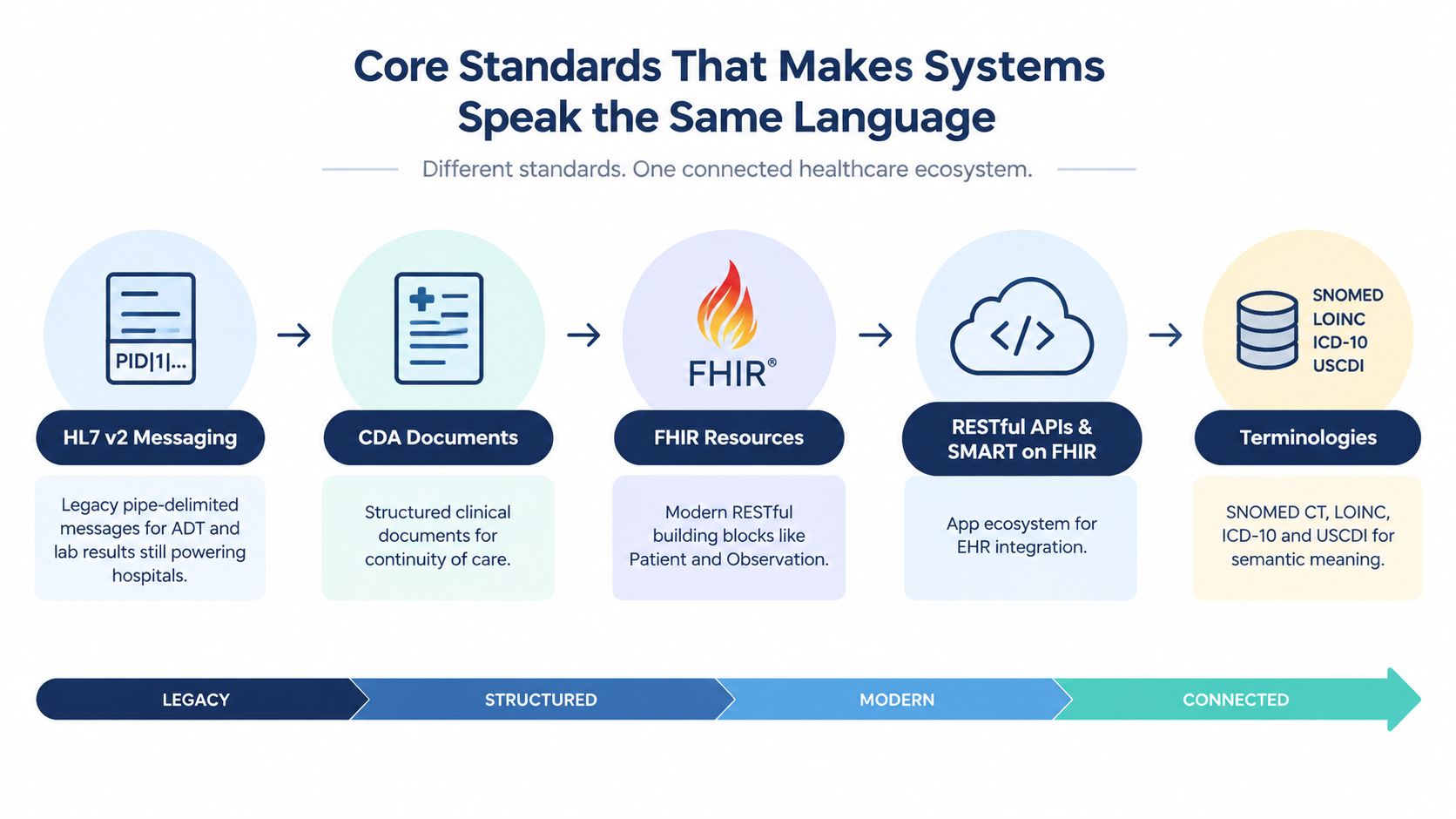
Healthcare systems don't share information through one universal format. They use a layered standards environment, with older messaging conventions still operating beside modern APIs, clinical documents, imaging standards, and terminology systems.
Start with HL7 v2. Hospitals and laboratories use it for event-driven messages such as admissions, discharges, transfers, orders, and results. Its pipe-delimited structure can look dated beside web APIs, but it remains embedded in operational systems. Replacing it isn't automatically safer or cheaper. A modern platform often needs to ingest, validate, transform, and acknowledge HL7 v2 messages while exposing newer interfaces to external applications.
CDA and C-CDA package clinical information into structured documents. A discharge summary, referral packet, or continuity-of-care document can travel across organizations even when the receiving system can't support a detailed API exchange. Documents are useful for broad clinical context, but they can become difficult to search or convert into discrete workflow actions if the receiving application treats the file as a static attachment.
Why FHIR changes the integration model
FHIR provides reusable resources, such as Patient, Observation, Medication, and Encounter, and defines exchange mechanisms through RESTful interfaces, messaging, and documents. That combination makes it well-suited to modern integrations involving providers, payers, patients, and researchers.
A helpful analogy is a set of standardized building blocks. HL7 v2 often resembles a stream of specialized operational notifications. CDA resembles a structured envelope containing a clinical story. FHIR provides smaller, addressable components that applications can request, update, and combine within a workflow.
CMS and ONC identify HL7 FHIR Release 4.0.1 as the foundational standard for secure API-based exchange, and CMS connects patient data access policy to standardized FHIR APIs rather than proprietary formats. Supporting FHIR R4 as a stable canonical layer can reduce integration drift while a platform adds endpoints and partner workflows.
The standards that complete the picture
DICOM governs medical imaging and related metadata. It isn't a substitute for FHIR or HL7 v2. It addresses a different domain, where images, studies, modalities, reports, and viewers must work together.
IHE profiles define how standards should be applied to particular cross-enterprise workflows. They help procurement and engineering teams move from “supports HL7” to a more precise question, such as which exchange profile, transaction, security behavior, and acknowledgement pattern the product supports.
Terminologies provide meaning. SNOMED CT, LOINC, ICD-10, and USCDI help systems interpret diagnoses, observations, procedures, and other data consistently. Without terminology mapping, two systems may exchange the same field while assigning different meanings to its value.
As we explored in our guide to healthcare integrations, standards coverage should be evaluated against the workflow, not listed as a logo collection. A product that supports only FHIR may still need HL7 v2, CDA, DICOM, IHE profiles, and terminology services to operate across a real healthcare environment.
TEFCA reinforces that practical reality. Its initial exchange model relies heavily on CDA or C-CDA and IHE profiles such as XCPD and XCA, while facilitated FHIR exchange is being introduced with a security profile for scalable registration, authentication, and authorization. Vendors need dual support for document workflows and FHIR APIs if they want near-term coverage and a credible path toward API-centric exchange.
Architectures and Integration Patterns for Connected Health Data
Standards describe the language. Architecture determines where translation, routing, security, monitoring, and responsibility live.
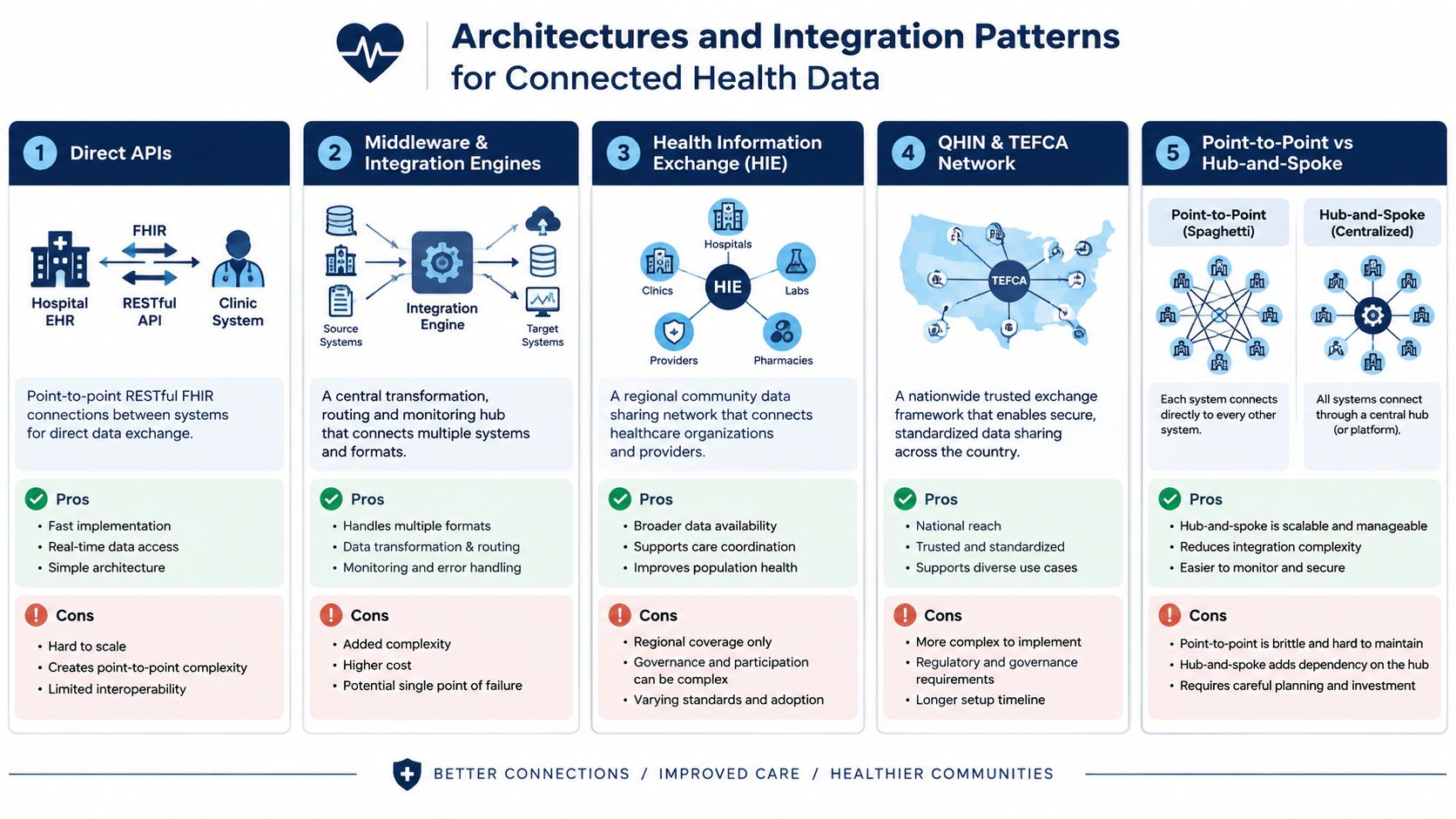
A direct API connection can be the fastest path between two systems. A provider application may call a payer's FHIR endpoint, or a patient app may retrieve authorized resources from an EHR. This pattern keeps the data path short and can reduce intermediary infrastructure. It also creates a maintenance burden when every new partner introduces a separate authentication model, data profile, error pattern, and release schedule.
Middleware and integration engines place a transformation and routing layer between systems. The engine can translate HL7 v2 into a canonical representation, route messages by event, apply validation rules, monitor acknowledgements, and isolate partner-specific behavior. The trade-off is operational ownership. Someone must manage mappings, retries, queues, certificates, observability, and upgrades.
Comparing the main patterns
A regional health information exchange supports community-level sharing across organizations that may not have direct agreements or technical capacity for one-off integrations. A QHIN and TEFCA network extends the trust and exchange model across a national framework. Neither removes the need for local data quality, identity matching, consent, or workflow design.
Point-to-point connections suit a small, stable set of high-value relationships. Hub-and-spoke models centralize integration and governance, but the hub becomes a critical operational dependency. API-led connectivity supports reusable services and product ecosystems, yet it still depends on consistent profiles and partner behavior.
Choosing Your Interoperability Architecture
| Pattern | Best For | Trade Offs | Governance Need |
|---|---|---|---|
| Direct APIs | A focused payer, EHR, or patient-app connection | Fast to launch, difficult to scale across many partners | Partner contracts, API version control, access policies |
| Middleware and integration engines | Mixed legacy and modern environments | Centralized monitoring and transformation add platform overhead | Mapping ownership, queue management, incident response |
| Regional HIE | Community-wide provider exchange | Participation and data coverage vary by region | Data-use agreements, identity resolution, stewardship |
| QHIN and TEFCA network | Nationwide trusted exchange | Framework participation doesn't guarantee usable local workflows | Trust, authentication, performance, and permitted-purpose controls |
| Hub and spoke | Organizations seeking centralized integration operations | The hub can become a bottleneck or dependency | Central change control, service levels, resilience planning |
A CTO comparing custom healthcare software development options should map each integration to its required latency, data type, partner count, and failure tolerance. A laboratory result may need reliable event processing. A patient app may need responsive API access. A historical document query may prioritize coverage and provenance over real-time performance.
For teams dealing with aging platforms, Vision’s blueprint for ops teams offers useful context on organizing legacy integration work around ownership, observability, and controlled change. The same operational discipline applies to healthcare, where a failed interface can affect a clinical workflow rather than only a business transaction.
As we explored in healthcare integration architecture, the right pattern is rarely the most modern diagram. It’s the design that makes failure visible, limits blast radius, and gives people a clear path to resolve exceptions. Teams assessing broader custom software development should make those operational requirements part of the initial architecture decision.
Data Governance, Privacy, and Compliance Foundations
Connectivity creates an opportunity for exchange. Governance determines whether people can trust and lawfully use what arrives.
A healthcare interoperability solution needs controls for identity, consent, authorization, provenance, auditability, retention, and data quality. These controls aren’t paperwork added after an interface goes live. They shape the interface itself. A patient match must be explainable. A clinician should see why a record was retrieved. A downstream application should know when a result was authored, transformed, corrected, or imported.
Privacy requirements also vary by context. HIPAA obligations influence handling of protected health information in the U.S., while GDPR principles affect organizations processing personal data within its scope. The implementation question is practical: what data is necessary for this purpose, who may access it, how is consent represented, and how can the organization demonstrate what happened?
FHIR doesn’t solve meaning by itself
A FHIR endpoint can be technically conformant while still producing unreliable clinical decisions. Profiles may differ, multiple FHIR versions may coexist, codes may be incomplete, and an organization may expose resources without integrating them into a clinician’s workflow.
A 2025 global FHIR survey reported that 79% of respondents had a national FHIR implementation guide, but only 20% said it was widely used. The finding illustrates the distinction between adoption on paper and operational interoperability. A platform needs profile validation, terminology services, normalization rules, and clear ownership for exceptions.
Governance test: If a clinician can’t tell where a value came from, when it changed, and whether it has been normalized, the exchange is connected but not decision-ready.
Identity resolution deserves special attention. Organizations should define matching rules, confidence thresholds, duplicate handling, and escalation paths for uncertain matches. Consent management should support purpose limitation and revocation where applicable. Audit trails should record access and administrative changes without exposing more information than the audit function requires.
AI may help with normalization, classification, and risk review, but it shouldn’t replace stewardship. Teams considering AI development services or enterprise AI solutions should establish human review, evaluation datasets, explainability expectations, and rollback procedures before placing AI-assisted outputs into clinical or payer workflows.
For a deeper treatment of ownership, lifecycle controls, and accountability, the healthcare data governance guide is a useful companion. The architecture should make compliance observable, not merely assert it in a vendor questionnaire.
Implementation Roadmap Risks and How to Mitigate Them
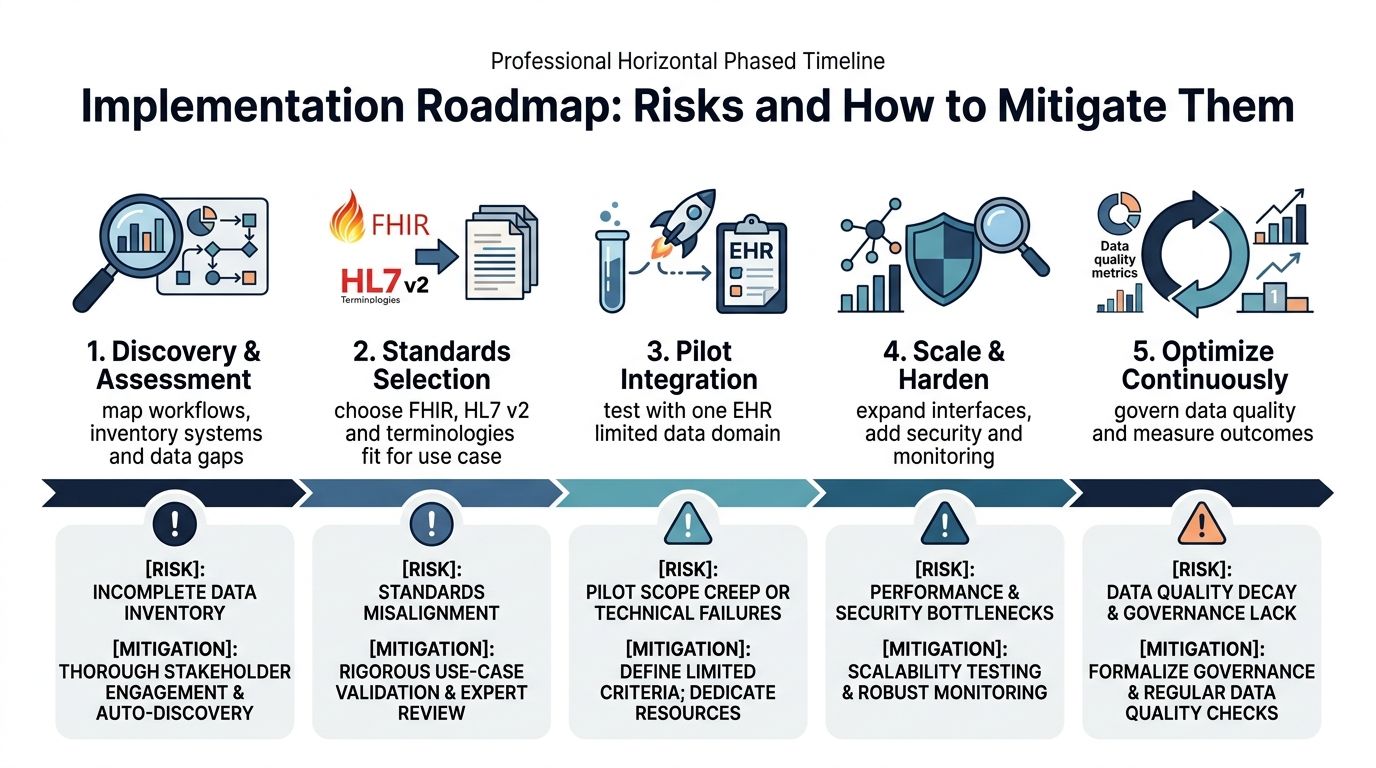
Interoperability projects fail when teams start with interfaces instead of workflows. A phased roadmap creates checkpoints where product, clinical, security, operations, and partner teams can challenge assumptions before the scope expands.
Phase one: Discovery and assessment
Inventory systems, owners, data domains, interfaces, current workarounds, and failure points. Follow a real patient or administrative journey from source creation to point-of-care use. Record where staff re-key data, where imaging disappears, where payer requests pause treatment, and where a document arrives without structured fields.
Exit criterion: stakeholders agree on the first workflow, its data contract, its permitted users, and the outcome that will define success.
Phase two: Standards selection
Choose the standards that fit the data rather than forcing every use case into one format. FHIR R4 may serve API access, HL7 v2 may remain necessary for hospital events and laboratory messaging, CDA or C-CDA may support document exchange, and DICOM may carry imaging content. Select terminology bindings, identifier rules, security profiles, and error behavior at the same time.
The common risk is version drift. Mitigate it with implementation guides, contract tests, capability statements, and a compatibility policy. Teams selecting software development service models should ensure the delivery model includes standards ownership, not only feature delivery.
Phase three: Pilot integration
Start with one EHR and a limited data domain. Test normal flows, missing data, duplicate patients, revoked access, delayed messages, invalid codes, downtime, and reconciliation. Include clinicians and operations staff in usability testing. A technically successful exchange that adds clicks or hides urgent information isn’t a successful pilot.
Phase four: Scale and harden
Expand partner coverage only after monitoring, alerting, retry handling, security review, and incident ownership are clear. Legacy HL7 v2 environments need careful remediation, because a parser that accepts malformed messages can pass errors downstream. Smaller and resource-limited organizations may need managed components, reusable connectors, and a narrower first scope rather than a large transformation program.
Phase five: Continuous optimization
Measure data completeness, match confidence, exception volume, time to resolve failed exchanges, clinician adoption, and the percentage of exchanged information that reaches the intended workflow. Revisit blind spots as the product matures. Imaging, dental data, behavioral health, and prior authorization often require different partners, permissions, and user experiences.
An AI implementation roadmap can help structure AI-related additions, but interoperability remains the prerequisite. An automated review process is only as dependable as the data, provenance, and workflow controls around it. The healthcare data interoperability challenges guide provides additional context for planning around legacy systems, inconsistent semantics, and organizational constraints.
Selecting the Right Solution and Proving ROI With Real-World Evidence
Vendor selection should begin with evidence that the product can support your workflows, not with a list of protocol names.
Ask whether the platform supports FHIR R4, document exchange, HL7 v2, DICOM where relevant, terminology mapping, identity resolution, consent, and audit trails. For payer-provider workflows, verify support for the relevant Da Vinci implementation guides. ONC finalized adoption of Coverage Requirements Discovery, Documentation Templates and Rules, Prior Authorization Support, CARIN Blue Button, PDex US Drug Formulary, Plan Net, and Clinical Data Exchange guides in the CMS FY2027 IPPS final rule.
The CMS 2024 Interoperability and Prior Authorization final rule requires impacted Medicare Advantage organizations, Medicaid and CHIP agencies and managed care entities, and qualified health plan issuers on the Federally-facilitated Exchanges to implement and maintain Provider Access, Patient Access, and Payer-to-Payer FHIR APIs. That makes payer connectivity an operating requirement for affected organizations, not a distant product idea.
Evidence from exchange networks
TEFCA offers a useful view of scale. Health records exchanged through the framework grew from roughly 10 million in January 2025 to nearly 500 million by February 2026, then to more than 1 billion by June 2026 (Becker’s Health IT coverage of TEFCA). Abu Dhabi’s Malaffi HIE reached 3.5 billion clinical records across 12.7 million unique patient profiles in August 2025, showing how regional exchange layers can support very large populations (the same Becker’s report).
The market signal is also substantial. The health data interoperability market is projected to reach US$459.6 billion by 2034 from US$112 billion in 2026, with a forecast CAGR of 19.3%. Treat that projection as an investment signal, not a guaranteed return for an individual buyer.
Build an ROI case around operations
Track measurable indicators tied to the selected workflow:
-
Clinical usability: Time for a clinician to find a relevant result, medication, or document.
-
Data quality: Unmatched identities, rejected messages, missing required fields, and correction volume.
-
Operational flow: Prior authorization cycle friction, referral completion, manual transcription, and exception resolution.
-
Adoption: Active users, workflow completion, and the percentage of exchanges that reach the intended application.
-
Economic value: Avoided interface maintenance, reduced rework, faster partner onboarding, and lower support burden.
A healthcare SaaS platform may need reusable tenancy, observability, and partner configuration, while a provider may prioritize a narrower integration with fast clinical adoption. Teams evaluating SaaS product development should test those operating assumptions early. Reviewing relevant client cases can help a buyer understand how a delivery partner approaches integration complexity, although every ROI case still needs organization-specific baselines.
Practical Checklist and Next Steps for Product Leaders
Use this checklist before approving an interoperability program:
-
Workflow: Can the team name the clinical or administrative decision the exchange must improve?
-
Standards: Does the design cover FHIR R4 plus the required HL7 v2, CDA, DICOM, IHE, and terminology needs?
-
Architecture: Is the selected pattern appropriate for partner count, latency, failure tolerance, and ownership?
-
Governance: Are identity, consent, authorization, provenance, audit, retention, and data stewardship defined?
-
Usability: Does information appear inside the workflow where a person acts on it?
-
Testing: Are malformed messages, duplicate identities, missing codes, downtime, and revoked permissions included?
-
Measurement: Are quality, adoption, exception, operational, and economic metrics assigned to named owners?
-
Delivery: Does the team have a release, support, monitoring, and version-management model?
Start with a focused workflow, but don’t create a disposable interface. A small pilot should establish reusable contracts, canonical representations, test data, observability, and governance patterns that later integrations can inherit. Imaging and dental data deserve explicit scope decisions, because a general clinical exchange strategy may leave those domains disconnected.
Frequently Asked Questions
Can FHIR and HL7 v2 coexist?
Yes. FHIR can provide modern API access while HL7 v2 continues to handle hospital events, laboratory transactions, and other established workflows. Use translation and validation at a managed integration boundary rather than assuming one standard will replace the other immediately.
Does TEFCA mean every application automatically has nationwide access?
No. TEFCA provides a trusted exchange framework and technical requirements for participating networks. An application still needs appropriate identity, authentication, authorization, permitted purpose, agreements, and workflow integration.
How should teams handle imaging gaps?
Treat imaging as its own interoperability workstream. Define DICOM exchange, study and patient matching, report linkage, viewer access, storage, and fallback procedures. Don’t assume that a clinical document exchange automatically carries the image or makes it usable.
Should AI be added before data governance is mature?
Usually not. First establish data quality, provenance, access controls, evaluation criteria, and human accountability. AI can then support carefully bounded normalization or review workflows without becoming an opaque substitute for governance.
For production, use clean, non-watermarked cinematic imagery with realistic people, modern clinical environments, premium lighting, and subtle technology elements. Avoid cropped visuals, cartoons, flat illustrations, and generic stock photography.
Bridge Global helps healthtech teams design and build standards-based integrations across EHRs, clinical systems, medical devices, and digital platforms, with support for healthcare software, FHIR, HL7, and DICOM workflows. If you’re ready to turn connectivity into usable point-of-care data, visit Bridge Global to discuss your interoperability architecture and delivery plan.

About Stephanie Cornelissen
Stephanie Cornelissen is a Technical Solutions Consultant with strong experience helping organizations navigate complex digital change. She works closely with teams to align business goals with practical, scalable technology solutions. With expertise in system architecture, integrations, and emerging technologies, she focuses on solving real-world problems through thoughtful execution. She enjoys working where technology meets business strategy and measurable growth.
View all posts by Stephanie Cornelissen →