



A Guide to Healthcare Analytics Implementation
Putting a healthcare analytics solution in place is more than a technology upgrade; it’s a fundamental business transformation. It’s how organizations finally move from a reactive, “treat-the-symptom” model to one that’s proactive and predictive. At its core, this is about using data to improve patient outcomes, streamline operations, and get a handle on financial pressures in a fiercely competitive market. Frankly, this shift isn’t just an option anymore; it’s essential for survival and growth.
Why Healthcare Analytics Is a Strategic Necessity
When we talk about a healthcare analytics implementation, we’re not just talking about a new dashboard or software. This is about rewiring the entire organization’s DNA to make data-driven decisions part of the everyday workflow. For CTOs and CIOs, this is the master key to unlocking the incredible value locked away in your data systems. You can turn all that dormant information into real, actionable insights that produce tangible improvements.
This means getting beyond simple historical reporting. The goal is to start predicting patient risks, optimizing how you allocate precious resources, and personalizing treatments in ways that were impossible just a decade ago.
The market growth alone tells a compelling story. Valued at USD 64.49 billion in 2025, the global healthcare analytics market is expected to rocket to nearly USD 369.66 billion by 2034. That’s a compound annual growth rate (CAGR) of 21.41%. With North America holding a massive 48.62% market share, the message is loud and clear: if you’re not investing heavily in your data capabilities, you’re already falling behind.
From Reactive Treatments to Proactive Care
For decades, healthcare has been stuck in a reactive loop; we wait for patients to get sick, then we treat them. Analytics completely flips that script on its head. By pulling together and analyzing massive datasets from EHRs, patient wearables, and even genomic information, providers can start spotting the subtle patterns and risk factors that show up long before a person gets sick.
This proactive approach opens up a world of possibilities:
- Early Intervention: You can pinpoint high-risk patient groups and enroll them in preventive care programs, dramatically cutting down the incidence of costly chronic diseases.
- Personalized Medicine: Treatment plans can be tailored to a patient’s specific genetic profile and lifestyle data, which makes them far more effective.
- Operational Efficiency: Imagine being able to accurately predict surges in patient admissions. You could optimize staffing and bed management, leading to shorter wait times and lower operational costs.
The proof is in the results. Just look at Kaiser Permanente’s AI success in reducing mortality; it’s a powerful real-world example of how data-driven tools save lives and make the entire system run better. As we explored in our guide to healthcare AI, these technologies are quickly becoming the backbone of modern clinical practice.
The ultimate aim is to build a learning health system. One where insights from data are constantly fed back into the clinical workflow, creating a virtuous cycle of improvement for both patient care and operational excellence.
Navigating this complex journey isn’t easy. It requires a partner who understands the nuances of healthcare and can help translate your ambitious goals into a tangible, scalable, and compliant analytics platform.
Laying the Groundwork for Your Analytics Initiative
Every successful healthcare analytics implementation starts with a strategic foundation, not a technology shopping spree. Before you even think about data architecture or machine learning models, you have to get your stakeholders aligned, define what you’re trying to achieve, and make a rock-solid case for the change. Skipping this groundwork is a recipe for a high-tech project that has zero real-world impact.
This all begins with a real, boots-on-the-ground needs assessment. Get out there and talk to your frontline clinicians, department heads, and administrative staff. What are their biggest headaches? Are patient wait times in the ER through the roof? Are readmission rates for heart failure patients way too high? Pinpointing these tangible problems gives your analytics effort a clear, meaningful target.
This is all about making the fundamental shift from reactive to predictive care – a move that a well-planned analytics project makes possible.
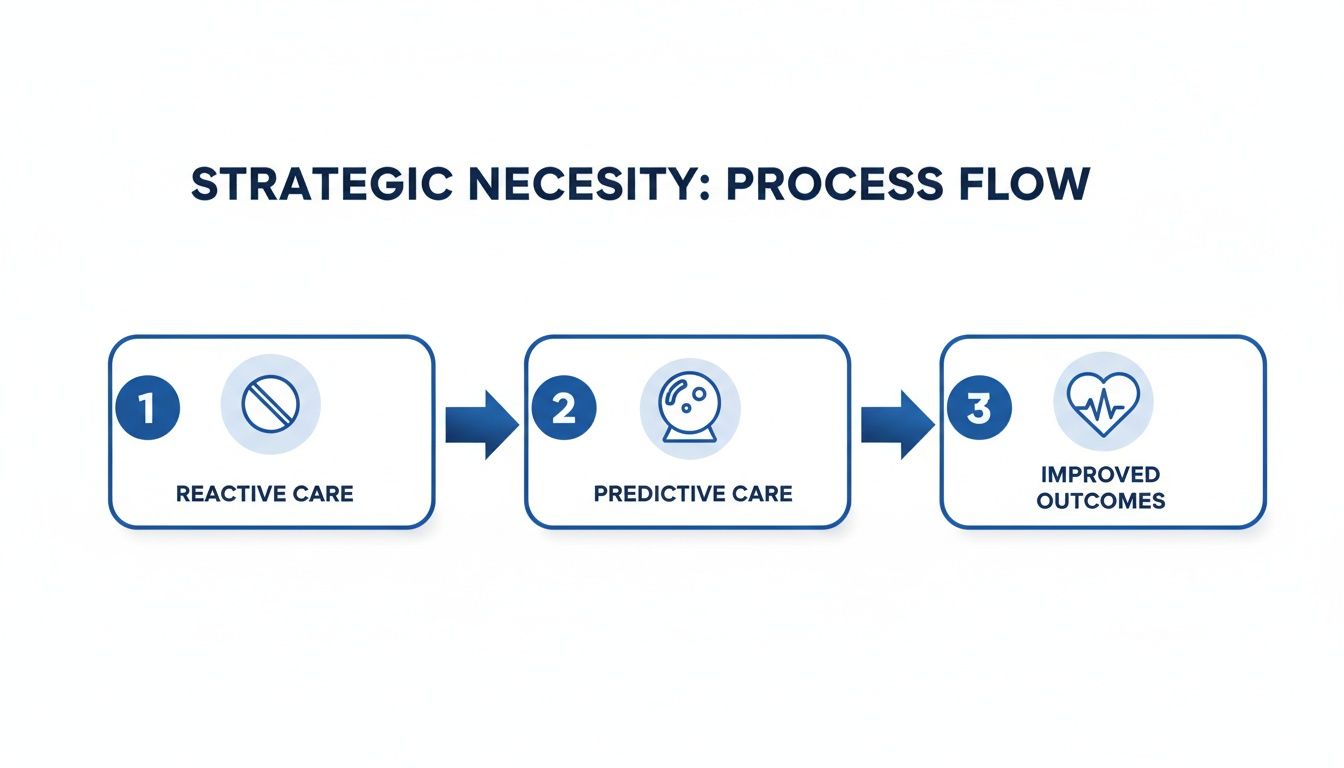
As you can see, the goal is to get ahead of problems. Instead of just treating conditions as they appear (Reactive Care), we want to anticipate patient needs before they become critical (Predictive Care). That’s how you drive truly better health outcomes.
Getting the Right People in the Room
Let’s be clear: an analytics project can’t be an IT-only affair. It will fail. Building a dedicated, cross-functional team isn’t just a good idea; it’s absolutely essential. This team is the engine for the entire implementation, blending different skills and perspectives to keep the project grounded and on track.
Your core team should look something like this:
- Clinical Champion: A respected physician or nurse leader who lives and breathes the clinical workflow. They are your advocate on the floor and are crucial for getting other clinicians on board.
- Executive Sponsor: A C-suite leader: think CIO, CMIO, or COO, who can provide air cover, secure the budget, and cut through organizational red tape.
- Data Architect: Your technical guru. This person designs the data infrastructure, obsesses over data quality, and maps out how information flows through your systems.
- Compliance Officer: Your HIPAA and security expert. They ensure every single part of the project is buttoned up from a privacy and regulatory standpoint.
- Project Manager: The conductor of the orchestra. They manage the timeline, budget, and keep everyone talking to each other.
Having this team is a great start, but they need a North Star. That means setting goals you can actually measure. Vague ambitions like “improve patient care” are useless. You need specific, quantifiable targets.
A well-defined goal isn’t just a target; it’s a communication tool. It tells everyone involved exactly what success looks like, making it easier to secure buy-in and measure the project’s ultimate impact.
For example, say your hospital is battling chaos in the emergency department (ED). A powerful goal would be to reduce average patient wait times by 20% within six months. This specific KPI gives everyone a clear benchmark for success and focuses the team on a tangible outcome, like building models that predict patient arrivals to optimize staffing. This is where you see the real AI for your business, turning a fuzzy idea into a measurable result.
Making the Business Case to Leadership
Once your team and goals are in place, it’s time to get unwavering support from the top. You do this by building a business case that speaks the language of the C-suite: ROI, efficiency, and clinical outcomes. You have to frame this project as a strategic investment, not just another line item on the IT budget.
Let’s go back to our ED throughput example. The business case would hit on three key points:
- Financial Impact: Show the numbers. Calculate the potential revenue from increased patient capacity and the cost savings from slashing staff overtime.
- Clinical Quality: Connect the dots between shorter wait times, better patient satisfaction scores (which often affect reimbursements), and a lower risk of adverse clinical events.
- Operational Benefits: Explain how predictive staffing doesn’t just help patients; it creates a more balanced workload for clinicians, which can be a game-changer for reducing burnout and staff turnover.
When you present this with a clear roadmap, realistic timelines, and a detailed resource plan, you’re showing you’ve done your homework. The conversation shifts from “Can we afford this?” to “How soon can we start?” Teaming up with an experienced AI solutions partner can be a huge help here, as they can bring industry best practices and proven client cases to make your business case even more compelling.
Alright, you’ve got your strategy and your stakeholders are on board. Now it’s time to roll up your sleeves and get into the technical weeds: building the data and analytics architecture. This is the engine room of your entire initiative. The choices you make here will dictate how scalable, flexible, and powerful your analytics capabilities will be for years to come.
Think of your architecture as the central nervous system for your data. It needs to handle an incredible mix of information. You’ve got structured billing codes from your EHR, messy, unstructured notes from clinicians, real-time data streaming from patient monitors, and even massive medical imaging files.
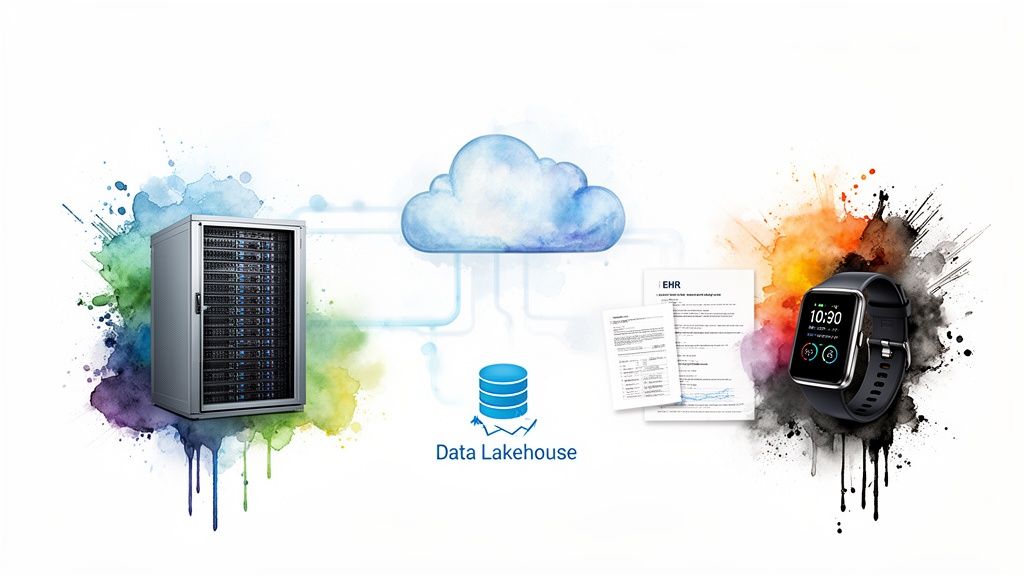
Given this complexity, a cookie-cutter approach just won’t cut it. The right design depends entirely on what you’re trying to achieve, the data you have, and the questions you need to answer.
What’s the Right Architectural Model for You?
The first big decision is picking an architectural model that actually fits your needs. Frankly, the old-school, rigid data warehouse is often too clunky and slow for the fast-paced demands of modern healthcare. Today, we’re seeing a clear shift toward more agile and adaptable models.
- Data Lake: This is essentially a giant, centralized pool where you can dump vast amounts of raw data in its original format. It’s a playground for data scientists who need to dig into unstructured information, but without strict governance, it can quickly turn into a messy, unusable “data swamp.”
- Data Warehouse: This is a highly structured, organized repository perfect for business intelligence and standard reporting. All data is cleaned and formatted before it gets stored, which guarantees quality but sacrifices the flexibility needed for deep, exploratory analysis.
- Data Lakehouse: This is the modern, hybrid approach that’s quickly becoming the standard. It gives you the low-cost, flexible storage of a data lake combined with the smart data management and structure of a warehouse. It really is the best of both worlds for handling diverse analytics workloads.
For most healthcare organizations I’ve worked with, a data lakehouse is the clear winner. It provides the solid foundation you need for reliable operational reports while also giving your data science teams the freedom to innovate with raw, complex datasets for building predictive models.
To truly build a modern healthcare analytics platform, you need to understand its core layers. Each piece has a distinct job, from data ingestion to providing actionable insights.
The table below breaks down the essential components you’ll need to consider for your own architecture.
Core Components of a Modern Healthcare Analytics Platform
| Component Layer | Primary Function | Key Technologies & Tools | Critical Considerations |
|---|---|---|---|
| Data Ingestion | Collecting raw data from diverse sources (EHRs, IoT, labs). | Apache NiFi, Kafka, AWS Kinesis, Fivetran | Scalability for high-volume data streams; security during transit; support for standards like HL7v2 and FHIR. |
| Data Storage | Storing structured, semi-structured, and unstructured data efficiently. | Amazon S3, Azure Data Lake Storage (ADLS), Google Cloud Storage | Cost-effectiveness for petabyte-scale storage; tiering for hot/cold data; robust security and access controls. |
| Data Processing & Transformation | Cleaning, standardizing, and preparing data for analysis (ETL/ELT). | Apache Spark, Databricks, Snowflake, dbt (data build tool) | Processing power for large-scale transformations; data quality validation steps; orchestration and scheduling. |
| Data Governance & Security | Ensuring data quality, compliance (HIPAA), and security. | Collibra, Alation, Privacera, Immuta | Master Data Management (MDM); data lineage tracking; role-based access control (RBAC); data masking and encryption. |
| Analytics & BI | Running queries, creating dashboards, and generating reports. | Tableau, Power BI, Qlik, Looker | User-friendly interface for business users; performance on large datasets; embedding capabilities for other apps. |
| Machine Learning & AI | Building, training, and deploying predictive models. | TensorFlow, PyTorch, scikit-learn, Amazon SageMaker, Azure ML | MLOps for model lifecycle management; feature stores for reusability; explainability and bias detection tools. |
Choosing the right tools for each layer is just the start. The real magic happens when they are integrated seamlessly, creating a cohesive platform that turns raw data into life-saving insights.
Mastering the Flow: From Raw Data to Actionable Insight
Once you’ve settled on a model, it’s time to map out the entire data journey. This involves several critical stages, and each one comes with its own set of very real challenges.
It all starts with data ingestion – the process of actually getting data from point A to point B. In healthcare, this means pulling information from dozens of isolated systems: EHRs, Laboratory Information Systems (LIS), Picture Archiving and Communication Systems (PACS), and a constantly growing flood of IoT devices. Building secure, reliable data pipelines isn’t just a nice-to-have; it’s a fundamental requirement.
Next up is data processing. Raw data is almost never clean enough for analysis. It needs to be scrubbed, standardized, and transformed into a usable format. This is where you’ll tackle missing values, fix inaccuracies, and translate different data standards (like HL7 and FHIR) into a common language. I can’t sugarcoat it: this is often the most time-consuming part of the whole project, but it’s where data quality is truly forged. As we’ve detailed in our guide on digital health platform engineering, a well-designed platform is essential for wrangling these complex data flows.
Poor data quality is the silent killer of analytics projects. If clinicians can’t trust the data, they won’t trust the insights, and your entire implementation will fail to gain traction.
Finally, you need a rock-solid plan for data storage and access. This means setting up your data lakehouse, defining a logical way to organize the data, and implementing strict, role-based access controls. The goal is simple: users should only ever see the specific data they are authorized to view.
This entire process is complex, but it’s the bedrock of a successful program. When you’re looking to streamline parts of this, especially on the front end, platforms like Microsoft Power Platform can offer valuable tools for data visualization and workflow automation that complement your core architecture. Building these kinds of tailored, robust data solutions is what we do best; it’s where our experience can help you design the data pipelines and quality frameworks needed to power your analytics from day one.
Navigating Data Governance and Compliance
Once you have a blueprint for your architecture, you have to tackle what is arguably the most critical part of any healthcare analytics project: data governance and compliance. This is so much more than a HIPAA checkbox. We’re talking about building a fortress of trust around patient data, ensuring it’s protected, used ethically, and handled with absolute integrity. Get this wrong, and even the most sophisticated analytics platform becomes a massive liability.
Effective governance isn’t about writing vague policies that sit on a shelf. It’s a hands-on, practical approach to managing the entire data lifecycle. This means you need to get specific. Who owns the clinical data? Who owns the financial data? We have to define exactly who can access what information and create clear, enforceable rules for how that data is used and shared.
Make no mistake, this is a major hurdle. It’s one of the biggest reasons why only 30% of health systems globally are using generative AI at scale in some capacity. According to Deloitte’s 2026 outlook, navigating the maze of regulations like HIPAA and GDPR is a huge barrier to adoption, demanding security controls that many aren’t prepared for.
Building Your Governance Framework
The very first thing you need to do is formally define who is responsible for what. And this isn’t just an IT job. A real governance committee needs clinical leaders, compliance officers, and data stewards from across the organization at the table. This group’s job is to create and enforce the rules of the road for data.
Here’s what that framework must include:
- Data Ownership: Assign a specific person or team as the “owner” for each major data domain (clinical, financial, operational, etc.). They are ultimately accountable for the quality and security of their data.
- Role-Based Access Controls (RBAC): This is where you implement a strict “least privilege” principle. A clinician needs different data than an analyst, who needs different data than an administrator. No one should have access to more than the absolute minimum they need to do their job.
- Data Usage Policies: Put it in writing. Create crystal-clear guidelines that spell out the acceptable uses of patient data for analytics, research, and quality improvement. This removes any ambiguity and slashes the risk of misuse.
A strong data governance framework does more than just ensure compliance; it builds a culture of responsibility around data. When everyone understands their role in protecting patient information, the entire organization becomes more secure.
For a much deeper dive into the nuts and bolts of regulatory adherence, our guide on HIPAA-compliant software development covers the specific technical and administrative safeguards you need to protect sensitive health information.
Implementing Technical Safeguards
Policies are just words on a page without the technical controls to back them up. This is where your security and engineering teams come in, building a secure-by-design environment from the ground up.
These are the non-negotiable technical safeguards:
- End-to-End Encryption: All protected health information (PHI) must be encrypted. Period. This means when it’s just sitting on a server (at rest) and when it’s moving between systems (in transit).
- Anonymization and De-identification: For a lot of analytics work, researchers don’t need to know who the patient is. Use established techniques to strip out direct identifiers like names and social security numbers to create de-identified datasets. This dramatically minimizes privacy risks.
- Auditing and Monitoring: You absolutely must be able to track who accessed what data and when. Comprehensive audit logs are your first line of defense for detecting and responding to potential security incidents.
Unlocking Data with Interoperability
Finally, governance has to solve for interoperability, the ability to get different systems to talk to each other securely. We all know healthcare data is notoriously stuck in silos, fragmented across incompatible EHRs and departmental systems. This is precisely the problem standards like Fast Healthcare Interoperability Resources (FHIR) were created to solve.
By adopting FHIR APIs, you can start building a unified, longitudinal view of each patient, pulling their complete history from all the different places it lives. This is not only essential for running advanced analytics but is also a game-changer for improving care coordination. Building these kinds of compliant, interoperable solutions is the bedrock of a modern health system.
Putting Analytics and AI Models into Practice
Now for the exciting part. Once your data architecture is humming and your governance is locked down, you can finally move from building the plumbing to deploying real intelligence. This is the moment your healthcare analytics implementation starts creating tangible value, turning raw data into predictive insights that you can put right into a clinician’s hands.
This journey almost always progresses through three stages of analytical maturity. Each one builds on the last, taking you from basic understanding to genuinely changing how you deliver care.

From Hindsight to Foresight
It all starts with descriptive analytics. This is about answering the fundamental question, “What happened?” Think of your standard dashboards and reports tracking things like hospital readmission rates or patient wait times. It’s absolutely essential for knowing where you stand, but it’s purely retrospective.
The real magic begins with predictive analytics, which tackles the question, “What is likely to happen?” This is where machine learning models enter the picture. A classic clinical example is a model that crunches real-time patient data: vitals, lab results, demographics, to flag patients at high risk of developing sepsis.
The final step is prescriptive analytics, which aims to answer, “What should we do about it?” Taking our sepsis example, a prescriptive system wouldn’t just flag the at-risk patient. It would go a step further and recommend a specific, evidence-based treatment protocol directly within the EHR.
This isn’t a niche field anymore; it’s exploding. The healthcare predictive analytics market is on track to jump from USD 16.7 billion in 2025 to a massive USD 50.4 billion by 2030. That’s a staggering 24.7% CAGR. Why the sudden rush? It’s largely fueled by the widespread adoption of EHRs, which finally give us the rich, digitized data needed to build these models. You can read the full research about the predictive analytics market growth to see what’s driving this trend.
The Lifecycle of a Machine Learning Model
Here’s something many people miss: building a predictive model isn’t a one-and-done project. For a model to be reliable in a clinical setting, you need a disciplined, cyclical process called MLOps (Machine Learning Operations). This framework ensures your model is accurate on day one and stays that way over time.
Think of the MLOps process in a few key stages:
- Model Training and Validation: First, data scientists feed historical data to the model, training it to spot complex patterns. Then, it’s tested against a completely separate dataset it’s never seen to prove it can generalize its findings to new, real-world situations.
- Deployment: Once validated, the model goes live. This could mean embedding it directly into the EHR to fire off real-time alerts or connecting it to a BI tool to help with things like staffing or resource allocation.
- Monitoring and Retraining: After deployment, the work isn’t over. You have to constantly monitor the model’s performance. Over time, things like new treatment protocols or shifts in patient populations can cause model drift, making it less accurate. A good MLOps system automatically detects this drift and can trigger a retraining process with fresh data to keep it sharp.
MLOps is the assembly line for your AI factory. It provides the automation and governance needed to build, deploy, and manage machine learning models reliably and at scale, turning a data science experiment into an enterprise-grade clinical tool.
Integrating Insights into Clinical Workflows
Ultimately, an analytics model is only valuable if it influences a decision at the point of care. A predictive alert that a clinician never sees, or doesn’t trust, is completely worthless. That’s why seamless integration into existing clinical workflows is probably the single most critical step of the whole process.
Success means making the insights impossible to ignore and easy to act on. For that sepsis prediction model, a great integration would generate a clear, concise alert directly within the patient’s EHR chart – right where the physician is already working. It shouldn’t just show a risk score; it should also list the key factors that contributed to it. This builds trust and gives the clinician crucial context.
Getting this right requires tight collaboration between your data scientists and the clinical end-users, plus a real understanding of the human side of care delivery. This is where our expertise in both AI development services and healthcare software development really makes a difference. We specialize in building these integrations, making sure powerful AI models aren’t just technically impressive but are woven thoughtfully into the fabric of daily clinical practice. As our client cases show, turning data into action is how you truly realize the AI advantage for your business.
Driving Adoption and Managing Change
Let’s be blunt: even the most sophisticated analytics platform is a multimillion-dollar paperweight if clinicians don’t trust it or won’t use it. The real success of any healthcare analytics implementation has less to do with the technology and everything to do with the people. This is where change management stops being a buzzword and becomes the single most important part of your strategy.
Think about it. A brilliant algorithm that predicts patient deterioration is completely useless if nurses find the alerts intrusive or don’t understand the data behind the recommendation. The goal is to weave these new tools into their daily workflow so seamlessly that they become indispensable, not just another frustrating administrative chore. This requires a thoughtful, empathetic approach from day one.
Communicating Value and Building Trust
First things first: stop talking about technology. Start talking about patient care. Clinicians are driven by outcomes, not dashboards. You have to clearly and consistently articulate the “why” behind the project. How will this help them catch sepsis earlier? How will it cut down on their charting time, giving them more precious moments with patients?
Here are a few ways to make that connection real:
- Tailored Training, Not a Lecture: A physician, a nurse, and a department manager all have different jobs. Don’t throw them all into the same generic training session. Show each role exactly how the tool solves their specific problems and fits into their workflow.
- Show, Don’t Just Tell: Use real, anonymized patient data during training. Walk through a scenario they’d recognize and demonstrate how the analytics could have flagged a risk or improved an outcome. This builds immediate credibility and makes the value tangible.
- Lean on Your Clinical Champions: As we’ve mentioned before, getting respected peers to advocate for the new system is a game-changer. An endorsement from a trusted fellow clinician carries infinitely more weight than any memo from IT or the C-suite.
Fostering a Data-Driven Culture
Getting people to use a new tool is one thing; getting them to think differently is another. True, long-term adoption means making data part of your organization’s DNA. This isn’t a one-and-done project; it’s a fundamental cultural shift.
The real objective is to move from a culture of “this is how we’ve always done it” to one of “what does the data suggest we do next?” This takes patience, persistence, and a willingness to celebrate the small victories along the way.
You have to actively nurture this shift. When a predictive model helps prevent a single patient readmission, broadcast that success story far and wide. Showcasing these tangible wins reinforces the value of the new approach and builds incredible momentum.
It’s also critical to create robust feedback loops. Give users an easy, frictionless way to report issues, ask questions, or suggest improvements. When clinicians feel heard and actually see their feedback reflected in platform updates, they transform from passive users into active partners. This iterative cycle ensures your analytics tools continue to evolve to meet the real-world demands of patient care, which is how you’ll ultimately see the improvements in efficiency and outcomes you were aiming for all along.
FAQs on Healthcare Analytics Implementation
How long does a healthcare analytics implementation take?
A full-scale implementation typically takes between 6 to 18 months. The timeline depends on factors like the scope of the project, the quality of existing data, and system interoperability. A phased approach, starting with a 6-9 month pilot project, is often recommended to demonstrate value and refine the process before a full enterprise rollout.
How do you measure the ROI of a healthcare analytics project?
ROI should be measured through both financial and clinical metrics. Financial ROI can be seen in reduced operational costs, shorter patient lengths of stay, and optimized supply chain management. Clinical ROI is measured by improved patient outcomes, lower readmission rates, and better adherence to care protocols. It’s crucial to establish baseline metrics before implementation to accurately track improvements.
What are the biggest challenges in healthcare analytics implementation?
The most significant hurdles are typically related to data and people, not the technology itself. Common data challenges include poor data quality, siloed systems hindering interoperability, and ensuring strict HIPAA compliance. On the people side, challenges include gaining clinician trust, managing workflow disruptions, and providing effective training to drive user adoption. A strong change management strategy is essential to overcome these obstacles.
Ready to turn your healthcare data into your most powerful asset? Bridge Global is the expert AI solutions partner you need to guide you through every stage, from initial strategy and custom software development to full-scale implementation.

About Stephanie Cornelissen
Stephanie Cornelissen is a Technical Solutions Consultant with strong experience helping organizations navigate complex digital change. She works closely with teams to align business goals with practical, scalable technology solutions. With expertise in system architecture, integrations, and emerging technologies, she focuses on solving real-world problems through thoughtful execution. She enjoys working where technology meets business strategy and measurable growth.
View all posts by Stephanie Cornelissen →