


Future of Software Engineering: A Guide for Leaders
The future of software engineering isn't a story about replacing developers. It's a story about who verifies the output, who owns the risk, and who can keep shipping when AI turns coding into the easy part.
That's the part many teams are missing. AI already compresses implementation time, but review, testing, governance, and release control don't collapse with it. In regulated software, that gap is the whole game, because the organization that can validate faster than it generates will win.
Why the Future of Software Engineering Is Not About Replacing Developers
The wrong question is whether AI replaces engineers. The key question is whether your team can absorb AI-generated work without breaking review, compliance, or ownership. Gartner's projection says that by 2028, 90% of enterprise software engineers will use AI code assistants, up from less than 14% in early 2024, and at least 55% of software engineering teams will be actively building LLM-based features by 2027. This represents a structural change in how engineering organizations operate.
AI is moving from helper to infrastructure
Once AI becomes baseline infrastructure, the role changes with it. Prompt fluency, model evaluation, and agent orchestration stop being side skills and start becoming part of the job description. CI/CD, observability, and security pipelines also have to treat AI output as a first-class artifact to test, sign, and audit, because generated code is still code, and it still ships risk.
That shift has procurement consequences too. Platform teams need internal AI gateways, not just more licenses. Leaders in healthcare, finance, and insurance need controls that let AI run inside existing governance, not outside it. The engineering function is moving upward into systems design, oversight, and policy. For a parallel debate in another discipline, see whether AI replaces creative designers.
Practical rule: If AI can write the change faster than your team can explain it, your process is underbuilt, not your headcount.
Here's the comparison leaders need to think about.
| Dimension | AI as Assistant (2023-2024) | AI as Infrastructure (2026) |
|---|---|---|
| Main value | Faster drafting | Faster delivery pipelines |
| Core skill | Prompting for snippets | Orchestrating systems and review |
| Risk profile | Localized mistakes | Downstream verification overload |
| Team pressure | Individual productivity | Governance, integration, ownership |
| Operating model | Optional tool use | Embedded engineering standard |
Signal is adoption speed. A 2026 Futurum survey summary reports that 76.6% of organizations are already actively using AI in development workflows, and another 20.4% are evaluating implementation, which means AI is approaching universal uptake in many orgs. That is why procurement, platform sizing, and internal enablement now matter as much as developer tooling.
For leaders, the next move is to build the four capabilities that let AI scale without wrecking quality.
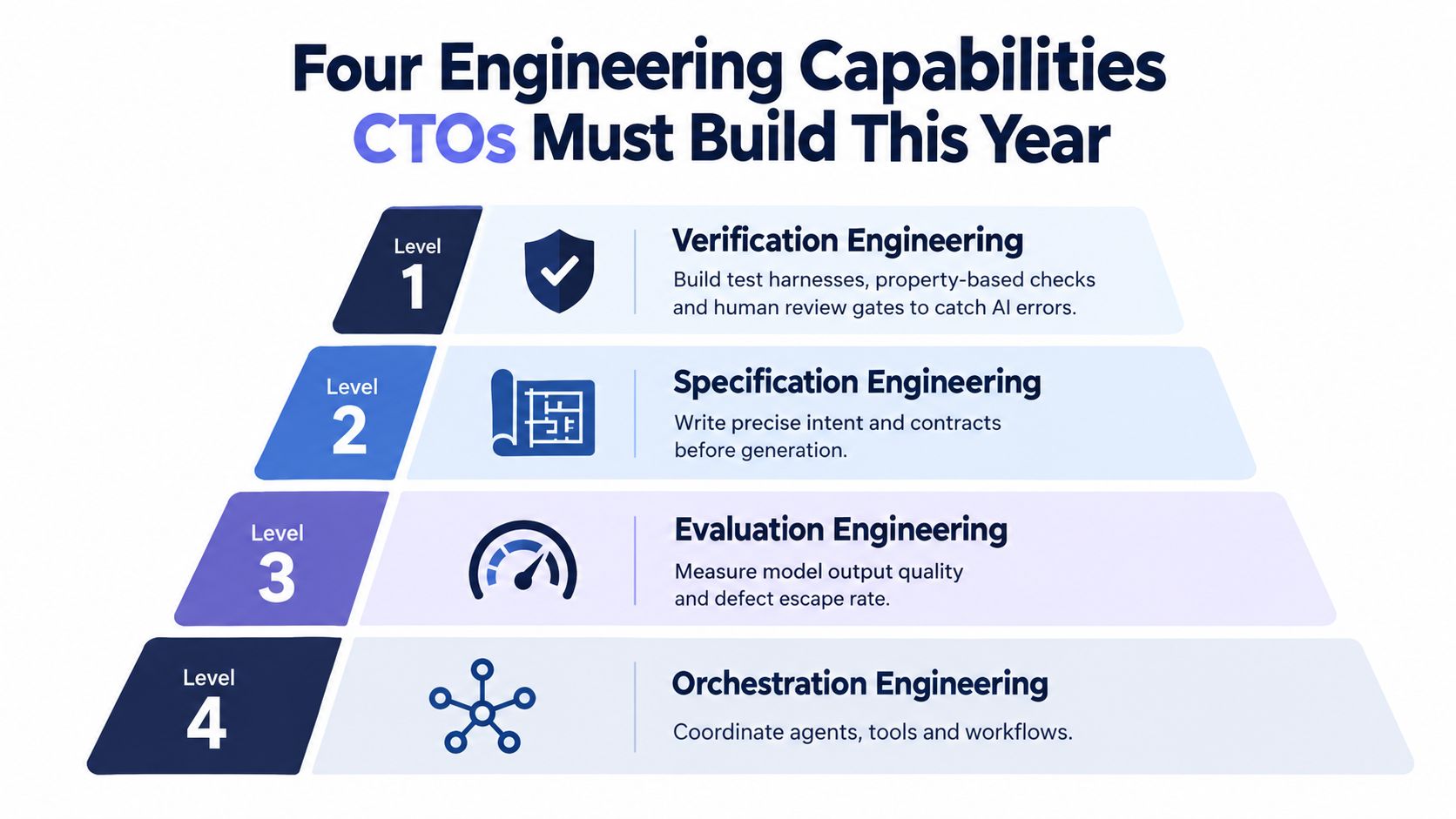
Four Engineering Capabilities CTOs Must Build This Year
Verification engineering
This is the first spend. Teams need stronger test harnesses, property-based checks, and review gates sized to AI throughput, not human typing speed. If your engineers can generate more code than your reviewers can inspect, the system is wrong.
Specification engineering
Write intent before generation. That means contracts, acceptance criteria, data boundaries, and behavioral rules that agents can't ignore. If you don't define the desired system up front, AI will happily fill the gap with plausible nonsense.
Evaluation engineering
Quality has to be measurable. Build evaluation suites that score model output, track defect escape rate, and expose when AI is making the team faster only on paper. The output should be judged against the product's real failure modes, not against a demo prompt.
Orchestration engineering
Someone has to coordinate agents, tools, and workflows. That role is part technical lead, part traffic controller, part risk manager. As we explored in our guide to AI development services, the point isn't to automate everything; it's to wire the automation into a system that still knows how to recover when it fails.
Put owners on these four capabilities this quarter. If no leader is accountable, the org is just buying AI and hoping for control.
If you need a practical operating model to align those owners, the software development service models page is a useful place to map delivery responsibilities to governance responsibilities. The framework matters because these capabilities don't emerge naturally. They need staffing, funding, and a definition of done.
The Verification Bottleneck No One Is Talking About
The bottleneck isn't code generation anymore. It's the capacity to inspect, test, and approve what AI creates before it moves downstream. A 2026 telemetry study covering 22,000 developers and 4,000 teams found task completion rose 33.7%, and epics completed per developer rose 66.2%, but median PR review time increased 441.5%, bugs per developer rose 54%, and incidents per PR more than tripled. That's the pattern leaders need to internalize immediately.
More output means more review pressure
If one engineer used to ship one AI-assisted PR and now ships three, the review burden doesn't spread out. It stacks up on the same reviewers, the same security gates, and the same release approvers. Integration testing, compliance sign-off, and change control are usually the first places the queue forms, because those teams don't get AI throughput for free.
The gap is simple. Generation is cheap. Verification is expensive. That's why the new performance problem is not “how fast can we code,” it's “how fast can we prove the code is safe enough to merge.” The teams that scale AI without fixing review capacity just move the bottleneck from typing to triage.
Here's the operating comparison.
| Activity | Pre-AI Throughput | Post-AI Throughput | Review Capacity Needed |
|---|---|---|---|
| Small feature changes | Human-paced | Faster local output | Higher reviewer availability |
| Pull requests | Steady queue | Much larger queue | Tighter triage and ownership |
| Security checks | Integrated but manageable | More frequent and urgent | More scanning coverage |
| Compliance review | Occasional | Continuous | More evidence automation |
The lesson is blunt. AI increases local throughput faster than the organization can absorb downstream change, so the solution is to expand verification and governance before you expand usage. If you want a deeper testing playbook, our discussion of generative AI in software testing is the right companion read.
AI Autonomy Versus Human-AI Pairing: What the Evidence Shows
Autonomous agents are real, but they're not universal. They work best when the task is well-scoped, scaffolded, and test-heavy. Human-AI pairing still wins when the work is ambiguous, legacy-heavy, or risky. The future of software engineering is not full autonomy; it's selective autonomy with hard constraints.
The evidence points in that direction. One GitHub Copilot experiment found developers completed an HTTP server task 55.8% faster with AI assistance, but later studies of experienced developers reported 19% longer issue completion times when AI was allowed. That doesn't mean AI is bad. It means task structure matters.
Why the contradiction exists
Autonomy breaks down when context is messy. Prompt overhead, verification friction, and codebase unfamiliarity can eat the gains from raw generation. Pairing helps because a human can catch architectural mistakes, security issues, and product drift before they harden into defects.
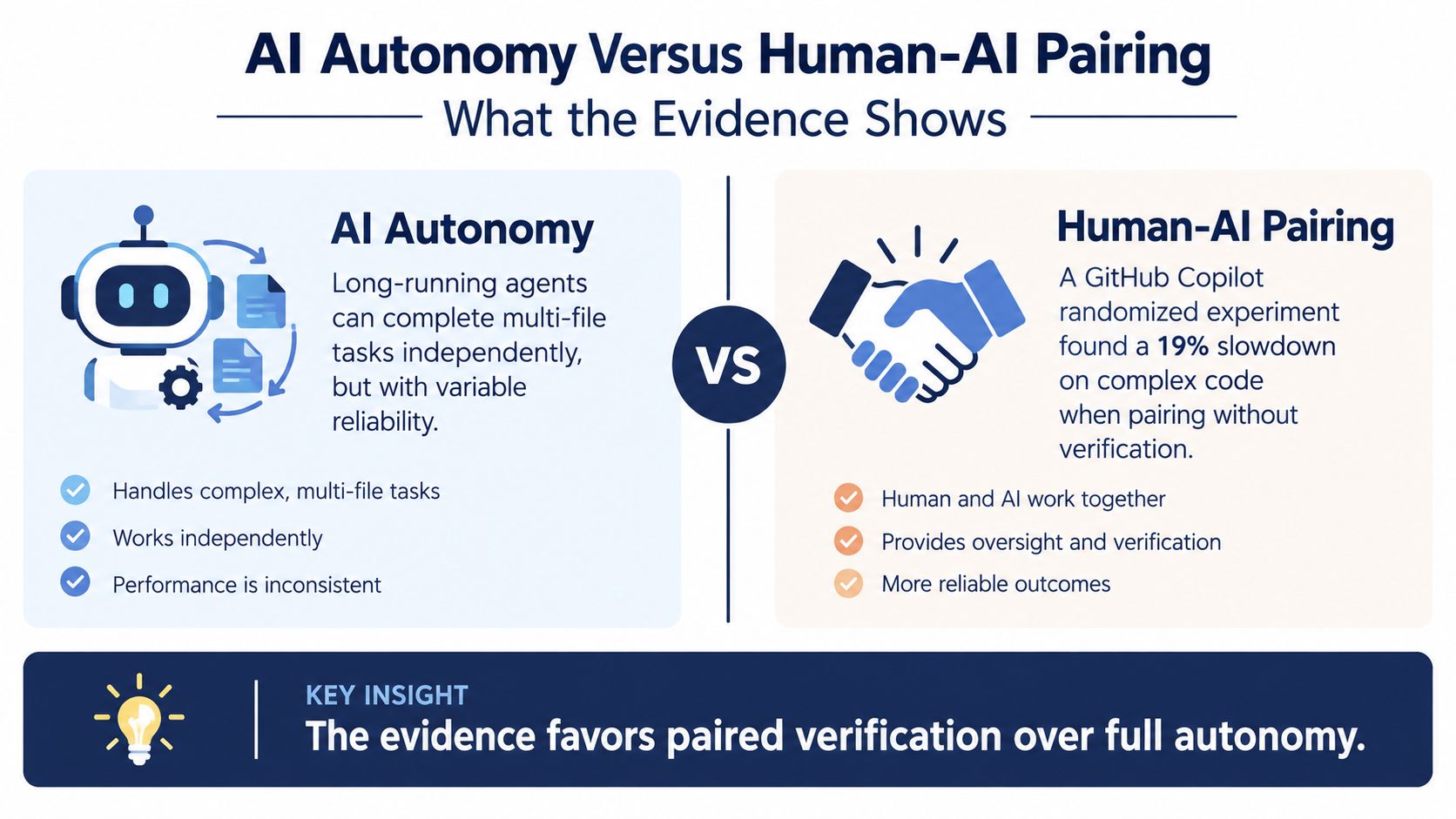
The rule is straightforward. Use autonomy for greenfield code, isolated services, boilerplate, and test-saturated work. Keep humans in the loop for refactors, legacy systems, security-sensitive paths, and anything where the review cost is higher than the generation cost. If a team can't explain why the agent produced the change, the agent shouldn't be allowed to ship it.
That's the line. Not “AI or humans.” AI where the structure is strong, humans where judgment still carries the risk.
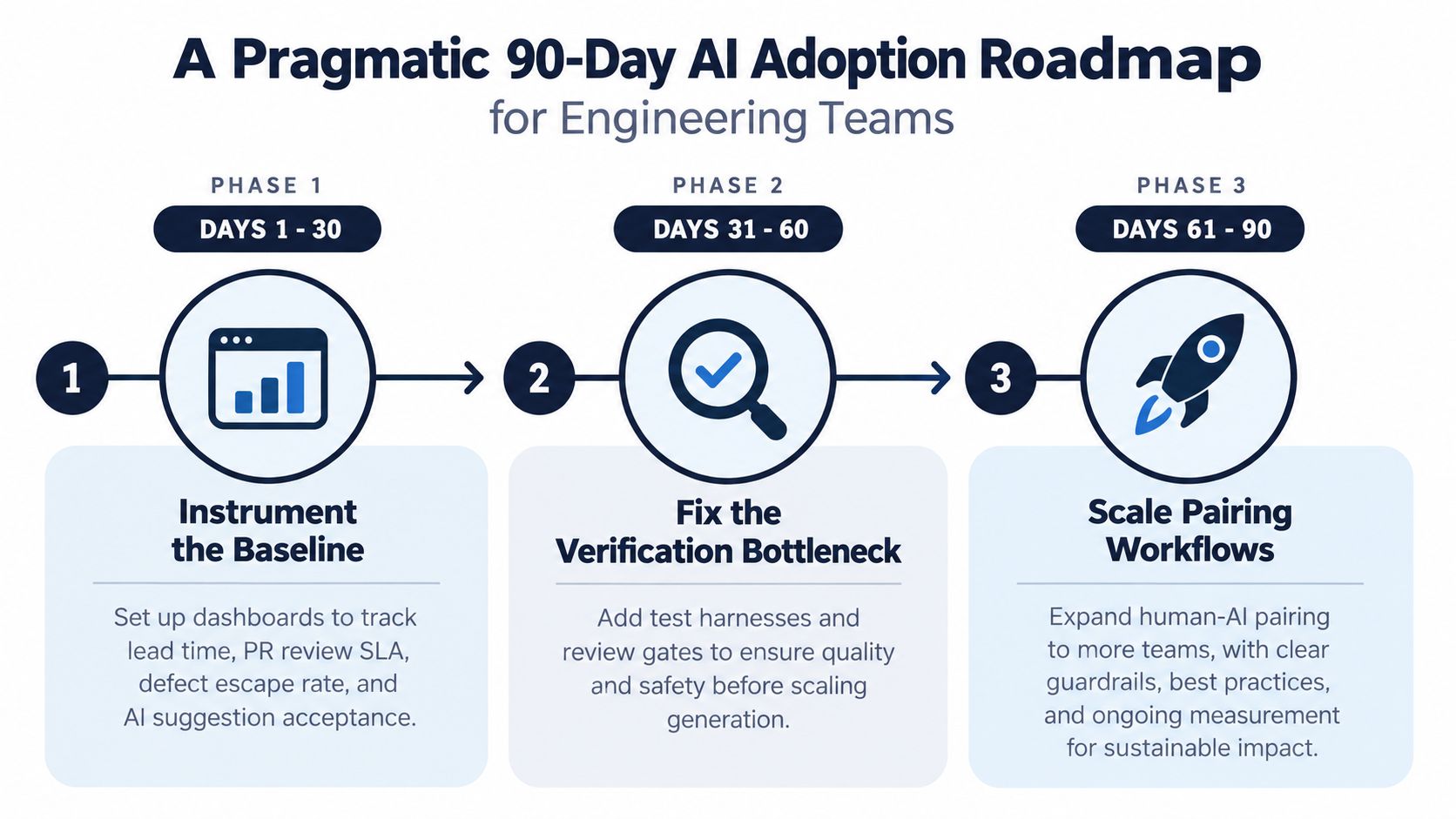
A Pragmatic 90-Day AI Adoption Roadmap for Engineering Teams
The fastest way to get value from AI is to treat adoption like an engineering rollout, not a culture campaign. Start with the verification bottleneck, then expand only after the controls are in place.
Days 1 to 30
Instrument the baseline. Track lead time, PR review SLA, defect escape rate, and AI suggestion accept rate. Pick two pilot teams and codify guardrails for allowed use cases, data classification, and prompt logging. If you can't measure the current state, you're not piloting AI; you're guessing.
Days 31 to 60
Expand into cross-team use, but only with a dedicated AI review pod. That pod should own merge-queue triage, security scanning, and compliance checks, and it should update the Definition of Done to include AI provenance.
Days 61 to 90
Measure delta, lock in role changes, and publish an internal policy on model selection, fallback procedures, and audit trails. This is the point where titles get real. A prompt engineer, an AI QA lead, or a verification owner only matters if the company gives that person decision rights.
For a more practical rollout mindset, the AI readiness practical guide is worth pairing with this plan. Use it to pressure-test where your team is ready and where it's still fragile.
How Software Teams Must Be Redesigned Around AI Agents
Shrinking headcount is the lazy response to AI throughput gains. It's also the wrong one. If AI increases generation speed, the team has to be redesigned so juniors still learn, reviewers stay effective, and ownership doesn't evaporate into a pile of co-authored commits.
Apprenticeship has to become explicit
Junior engineers can't just absorb knowledge through ticket queues anymore. Seniors need dedicated review and pairing time, because the pipeline for junior talent is getting weaker, not stronger. If you hollow out that layer, the company saves time this quarter and pays for it when the seniors are gone.
Review has to become risk-tiered
Stop pretending all pull requests deserve the same process. Agents can generate; humans can verify against test evidence, compliance artifacts, and behavioral contracts. Low-risk changes can move fast, but security-sensitive or regulated paths need stronger gates and clearer sign-off.
Ownership has to stay human
One engineer should remain accountable for each service surface, not each commit. That keeps incident response sane and protects on-call quality when agents, tools, and humans all touch the same codebase. If the team gets large enough to split, create a builder pod that generates and a verifier pod that approves, then keep ownership anchored to service boundaries rather than activity volume.
If the junior pipeline disappears, the team doesn't get leaner. It gets brittle.
A related example of this shift is visible in the rise of Donely's AI employee platform, which shows how quickly companies are formalizing agent workflows into operational roles. The important point isn't the tool itself; it's the need to define who supervises it and who is accountable when it fails.
Sector Implications: Healthtech, Finance, and Ecommerce
The same AI trend lands differently across sectors, and leaders need to read their own constraints. In healthtech, the procurement reality is now shaped by interoperability. Firely's 2026 State of FHIR report says 62% of respondents report active FHIR use cases in their country, and 20% say FHIR is their primary interoperability standard. A separate 2026 Black Book Global Healthcare IT Survey summary reports 92% of respondents rank FHIR/API interoperability as a top-three requirement for new platform decisions.
Healthtech
Healthtech teams need audit trails, tight logging, and clinical boundaries that AI agents can't cross. The right role here is a clinical-engineering liaison who can translate product decisions into safe integration and data handling rules. If the company can't meet interoperability and evidence expectations, AI just adds speed to the wrong architecture.
Finance
Finance shifts the emphasis to model risk management, explainability, and deterministic replay for regulatory review. Agent execution should be sandboxed, and any AI-generated change that affects credit, underwriting, or reporting needs a traceable path back to evidence. In this sector, compliance isn't a layer on top of development; it's part of the architecture.
Ecommerce
Ecommerce cares about catalog velocity and personalization latency, so AI can add obvious value there. The risk is content provenance and brand safety, because automated updates can spread mistakes across storefronts very quickly. That's why teams need guardrails on product copy, merchandising logic, and content approval before they let agents touch production systems.
| Dimension | Healthtech | Finance | Ecommerce |
|---|---|---|---|
| Primary constraint | Interoperability and auditability | Model risk and traceability | Velocity and brand safety |
| Agent usage | Safer inside clinical boundaries | Safer in sandboxes | Safer in controlled content flows |
| Key control | Clinical-engineering liaison | Deterministic replay | Content provenance checks |
If your organization is modernizing healthcare software, Bridge Global’s custom healthcare software development and healthcare integrations pages map well to this reality. For broader product work, the same logic applies to custom software development and SaaS product development, especially when AI has to fit into existing compliance and integration layers.
Success Metrics and Next Steps for Product Leaders
The metrics that matter are the ones that expose whether AI is helping the system or just flooding it. Track verified change lead time, defect escape rate per AI-assisted commit, and human review hours per feature shipped. Add policy violation rate and time-to-revert on agent-generated changes, because governance failures are often the first sign that adoption is outrunning control.
What to do over the next twelve weeks
Weeks one and two are for baseline measurement of the verification bottleneck. Weeks three through six should pilot a single workflow with a verifier pod and hard review gates. Weeks seven through ten extend the model to a second squad, and weeks eleven through twelve formalize the team redesign.
That cadence forces one decision at each stage. Tooling selection comes first, then ownership rewrites, then policy. External partners can accelerate workflow design and implementation, but internal investment is essential for review standards, compliance rules, and release authority.
A good companion read here is AI in product management, because product leaders face the same shift in judgment, not just in tooling. The lesson is consistent across disciplines. AI changes the shape of the work, but the organization still has to decide who approves it.
The three questions leaders ask next
Should you hire fewer engineers? No. Keep headcount steady, shift composition toward verification, security, and platform roles, and let attrition do the balancing.
How should regulated teams pilot AI? Start with internal developer tooling, sandboxed services, and documentation generation before touching patient-facing or trading code. In healthtech and finance, put FHIR or SOC 2 evidence gates in place from day one.
What KPI comes first? Track lead time for changes together with escaped defect rate. Lines of code and commit count won’t show whether AI is improving the engineering system or just creating a faster queue.
If you want a partner that can design around those trade-offs, Bridge Global works across AI-assisted software delivery, healthcare integrations, and audit-ready product engineering. Visit Bridge Global to talk through your roadmap, your compliance constraints, and the delivery model that fits your team.

About Stephanie Cornelissen
Stephanie Cornelissen is a Technical Solutions Consultant with strong experience helping organizations navigate complex digital change. She works closely with teams to align business goals with practical, scalable technology solutions. With expertise in system architecture, integrations, and emerging technologies, she focuses on solving real-world problems through thoughtful execution. She enjoys working where technology meets business strategy and measurable growth.
View all posts by Stephanie Cornelissen →