



Ecommerce Scalability Consulting: A Growth Guide
Your revenue graph is moving up. Your storefront feels slower. Support tickets are getting angrier. Inventory counts don’t match what customers can buy. Marketing wants to launch another campaign, but engineering is already firefighting.
That’s the point where growth stops feeling like a win and starts exposing every weak decision in your stack.
Ecommerce scalability consulting exists for this exact moment. Not to apply surface-level fixes, but to help you decide what must be re-architected, what should be automated, and what technical debt is now expensive enough to justify paying down. If you’re a CTO, the primary question isn’t whether your platform can survive next quarter. It’s whether it can grow without forcing a rushed replatform, a bloated engineering team, or a steady leak of margin through bad operations.
You also need to look past infrastructure alone. The hidden blockers are often harder to solve: weak personalization capabilities, fragmented data, and teams that can’t operationalize analytics fast enough. That’s where a strong AI solutions partner matters. You need technical foresight, not just extra hands.
When Explosive Growth Becomes a Problem
A fast-growing ecommerce brand usually sees the warning signs in the same order.
First, the site slows down during a campaign. Then checkout gets inconsistent. Then the inventory sync starts lagging between the storefront, warehouse, and marketplaces. After that, the support team becomes your monitoring system because customers report failures before your dashboards do.

This isn’t a niche problem. The global ecommerce market reached $36.21 trillion in 2026 and is projected to grow to $77.58 trillion by 2031 at a 16.46% CAGR, according to Swell’s ecommerce infrastructure statistics. More demand means more stress on every system behind the storefront.
Growth exposes design shortcuts
Most ecommerce systems work fine at a moderate scale. They break when success piles more traffic, more SKUs, more channels, and more integrations onto an architecture that was never built for that load.
A storefront can look stable while the back end is brittle. You see it in patterns like these:
-
Campaign success causes outages: Promotions drive demand, but your stack can’t absorb the surge.
-
Catalog expansion slows everything down: Search, filtering, pricing logic, and product APIs all get heavier.
-
Operational complexity multiplies: New geographies, payment methods, tax logic, and fulfillment rules create hidden failure points.
-
Teams get trapped in reaction mode: Engineers spend more time patching than improving.
Practical rule: If growth forces your team to postpone releases, manually reconcile orders, or overprovision infrastructure “just in case,” you already have a scalability problem.
Why consulting matters at this stage
You don’t bring in scalability experts because servers are busy. You bring them in because your business model now depends on technology that must behave predictably under stress.
That work usually involves hard choices. Keep the monolith and optimize it. Split critical services. Move to API-first patterns. Fix inventory events before redesigning checkout. Rebuild the data layer before attempting AI-driven personalization. Sequence matters.
A good advisor won’t start with vendor recommendations. They’ll start by identifying where growth turns into loss: conversions, fulfillment reliability, engineering throughput, or customer trust.
Identifying the Breaking Points in Your Ecommerce Operation
Most CTOs don’t need help recognizing symptoms. They need help locating the actual constraint.
A slow site isn’t always a frontend issue. Missed SLAs in fulfillment might come from poor event handling, not warehouse labor. In ecommerce, one bottleneck usually creates noise everywhere else.
Frontend and performance failures
The first breaking point is often customer-facing performance. That’s where revenue loss becomes visible.
A 1-second page load delay reduces conversions by 7%, and slow-loading sites can lead to the loss of 53% of mobile users, according to Bloom Consulting Group’s ecommerce performance guide. If your team still treats page speed as a UX detail instead of a board-level metric, that’s a mistake.
Common patterns include:
-
Heavy frontend bundles: JavaScript-rich storefronts that look modern but punish mobile performance.
-
Unoptimized media delivery: Product imagery, scripts, and third-party widgets competing for bandwidth.
-
Fragile checkout flows: Too many synchronous calls, validation steps, and external dependencies.
-
Search and filter lag: Faceted navigation that degrades sharply as the catalog grows.
When these issues pile up, marketing pays for traffic your platform can’t convert.
Architecture debt hiding in the back end
Technical debt becomes dangerous when it blocks scale. That’s the line CTOs should care about.
Look for architectural stress in these areas:
-
Database contention: Read-heavy catalog traffic and write-heavy checkout workflows hitting the same bottlenecks.
-
Tight coupling: Pricing, promotions, checkout, inventory, and shipping logic all deployed as one unit.
-
Release fear: Teams avoid changes before major sales periods because one regression can take down the whole platform.
-
Integration sprawl: ERP, CRM, payment, tax, shipping, and marketplace connectors creating cascading failures.
These aren’t abstract engineering concerns. They affect revenue timing, customer confidence, and your ability to launch.
A platform that can’t change safely is already struggling to scale, even if uptime still looks acceptable.
Operational bottlenecks that masquerade as tech issues
Some of the worst scalability failures happen outside the storefront.
Order routing might rely on manual checks. Inventory updates might batch too slowly. Customer service may lack visibility into order state because systems don’t agree with each other. None of that gets fixed by adding more app servers.
Watch for these warning signs:
-
Manual fulfillment workarounds: Staff exporting spreadsheets to resolve what systems should handle automatically.
-
Inventory mismatches: Stock levels differing across channels, warehouses, and customer touchpoints.
-
Complaint-driven diagnosis: Support surfaces system defects before engineering does.
-
Third-party fragility: One failing external API degrading the customer experience across the site.
The self-diagnosis question that matters
Ask one blunt question.
Where does growth create friction first?
If the answer is customer-facing speed, you likely have a performance and delivery issue. If the answer is deployment risk, architecture debt is driving the problem. If the answer is order accuracy, delays, or support escalation, your operations and systems integration need attention first.
That’s why generic platform advice is rarely enough. Most scaling problems require custom ecommerce solutions specific to your architecture, workflows, and growth model.
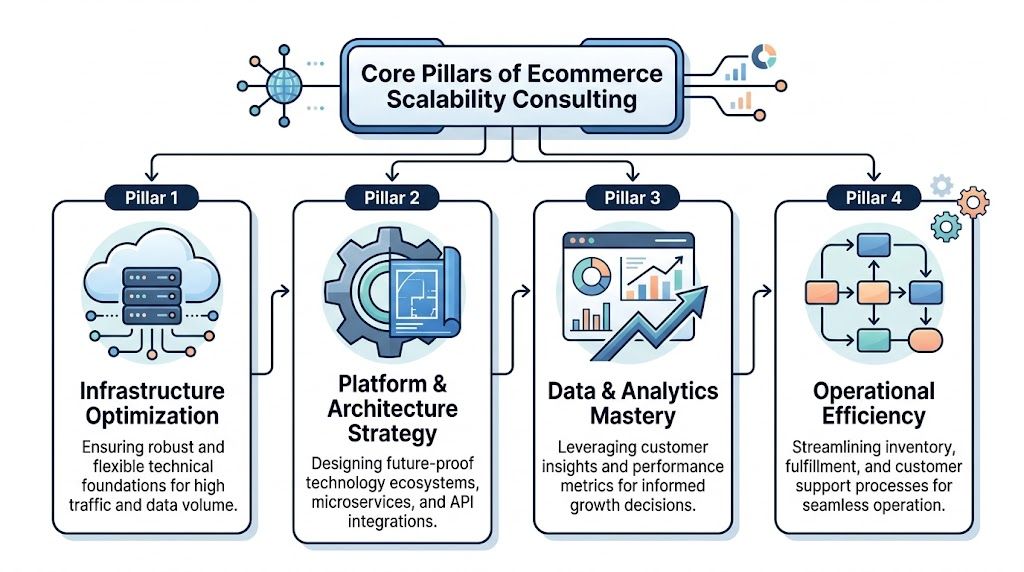
Core Pillars of Ecommerce Scalability Consulting
The strongest ecommerce scalability consulting engagements don’t revolve around one big migration. They focus on a few structural disciplines that make growth cheaper, faster, and less risky.
Future-proofing technical architecture
If your platform still scales by adding more pressure to the same application tier, fix that first.
Consultants usually start by deciding what should remain centralized and what should be separated. In practice, that often means moving toward API-first patterns, decoupled frontends, service boundaries around high-change domains, and cloud-native deployment models. Not because those are trendy, but because tightly coupled commerce stacks become expensive to change.
Microservices aren’t always the answer. But service isolation around catalog, pricing, checkout, inventory, and promotions often gives teams more control over release risk and scale behavior. Headless commerce can also make sense when multiple channels need different customer experiences on top of shared commerce logic.
For teams weighing these tradeoffs, this Bridge Global article on technology capability scaling is worth reviewing because it frames scaling as both an engineering and operating model problem.
A strong architecture plan should answer:
-
Which services need independent scaling
-
Which integrations require event-driven patterns instead of synchronous dependence
-
Which parts of the stack block release speed
-
Which technical debt items are now business-critical
Automating workflows and operations
Many ecommerce systems fail under growth because humans are compensating for bad system design.
That shows up in order exceptions handled in email, stock adjustments fixed by spreadsheet, and support teams piecing together answers from disconnected tools. Consultants should target those workflows aggressively.
What gets automated depends on your stack, but the recurring themes are clear:
-
Order orchestration: Route orders based on fulfillment rules without manual intervention.
-
Inventory synchronization: Push updates across channels fast enough to avoid overselling.
-
Deployment pipelines: Use CI/CD so teams can ship changes safely and repeatedly.
-
Alerting and observability: Detect queue buildup, failed jobs, and integration errors before customers do.
When companies talk about scaling an ecommerce business, they often focus on storefront growth. The harder part is making sure internal workflows scale at the same pace. If they don’t, revenue growth just creates operational drag.
Optimizing performance where it actually matters
Performance work should be ruthless. Don’t optimize what looks interesting. Optimize what blocks buying.
That means consultants should isolate the highest-friction flows first:
| Focus area | What consultants examine | Business reason |
|---|---|---|
| Product discovery | Search latency, category rendering, filter performance | Customers leave before they find products |
| Product detail pages | Asset delivery, script weight, API calls | Slower pages weaken conversion intent |
| Cart and checkout | Validation flow, payment dependencies, error handling | Friction here directly kills orders |
| Platform under peak load | Caching strategy, queue behavior, database pressure | Sales events expose hidden failure points |
This work often includes CDN strategy, query optimization, caching, asynchronous processing, and frontend performance budgets. But tools only matter when tied to outcomes. Faster pages are useful because they preserve revenue. Lower infrastructure waste is useful because it protects the margin.
Don’t let teams celebrate technical wins that customers can’t feel and finance can’t see.
Leveraging data and AI
This is the pillar most companies underinvest in.
A lot of ecommerce scalability discussions stop at uptime, load balancing, and cloud architecture. Necessary, yes. Sufficient, no. Once a business reaches meaningful scale, the next bottleneck is usually decision quality: who gets what offer, which products should be replenished, which support requests need automation, and which segments need different journeys.
That’s where AI development services become relevant. Not as a novelty layer, but as a way to operationalize customer and operational data.
The strongest use cases usually sit in four areas:
-
Demand forecasting: Better inventory planning and replenishment signals.
-
Personalization engines: Recommendations, segmentation, and product ranking.
-
Search relevance: More accurate query understanding and merchandising.
-
Operational prediction: Risk detection for stockouts, delays, and support surges.
One high-value example comes from inventory planning. According to SWK Technologies, consultants deploy ML models such as Prophet or AWS Forecast on historical sales data to predict demand with 85-95% accuracy, and for a mid-market retailer, this reduced stockouts by 40% during holiday peaks.
That matters because sustainable scale isn’t just about surviving traffic. It’s about making better decisions at a larger volume without hiring proportionally larger teams.
Closing the organizational skills gap
A scalable architecture still fails if your team can’t operate it.
CTOs often focus on platform choices and miss the capability issue underneath. Do your engineers understand event-driven systems? Can product, marketing, operations, and data teams work from the same metrics? Does anyone own the logic behind personalization and forecasting? If not, you don’t just have a systems problem. You have a delivery model problem.
That’s why good consulting includes operating design, governance, and knowledge transfer. Otherwise, you inherit a better stack that your team can’t fully use.
Measuring the Business Impact of Scalability
Scalability work shouldn’t be funded as technical hygiene. It should be justified as a growth and margin decision.
If the only success criteria are uptime and server metrics, the engagement is too narrow. The right question is simpler: did the business become easier to grow?
The KPI mix that matters
A mature scalability program tracks technical and commercial outcomes together.
Use a scorecard like this:
| KPI category | What to measure | Why it matters |
|---|---|---|
| Experience | Page load time, checkout responsiveness, search performance | Customer friction appears here first |
| Reliability | Uptime, failed transactions, recovery speed | Revenue events depend on operational stability |
| Commerce | Conversion rate, cart abandonment, order completion trends | This shows whether technical improvements changed buying behavior |
| Operations | Fulfillment time, inventory accuracy, complaint patterns | Weak back-office processes destroy margin quietly |
| Cost efficiency | Infrastructure spend patterns, support overhead, engineering time lost to incidents | Scale should lower waste, not just absorb growth |
You should also compare the release throughput before and after the work. Teams that scale well usually ship with less fear.
What ROI actually looks like
ROI comes from multiple layers at once.
Some gains are immediate. Fewer failures during demand spikes. Better conversion from improved performance. Lower support burden because systems behave predictably. Other gains are slower but often more valuable: reduced technical debt, faster launches, easier integration of new channels, and less dependence on heroic engineers who understand fragile legacy code.
A useful way to frame the business case:
-
Revenue protection: Prevent failures during peak periods.
-
Revenue expansion: Improve speed, relevance, and conversion paths.
-
Cost control: Reduce operational overhead and inefficient infrastructure use.
-
Strategic flexibility: Launch new capabilities without destabilizing the platform.
The best scalability projects don’t just make systems faster. They make future decisions cheaper.
If you want to sanity-check what strong outcomes look like in practice, review relevant client cases. The point isn’t to copy someone else’s stack. It’s to see how technical changes translate into business results.
A Phased Approach to Your Scalability Project
A serious scalability engagement shouldn’t feel like a vague transformation program. It should run as a disciplined sequence of decisions, validations, and controlled implementation steps.
If a partner jumps straight to rebuilding your stack, be careful. That usually means they’re selling execution before proving they understand your constraints.
Phases one and two
The first phase is discovery and technical audit.
Consultants should inspect architecture, hosting behavior, deployment process, integration dependencies, data flows, operational workflows, and failure history. They need to know where latency originates, where jobs back up, where manual work creeps in, and where release risk is concentrated. This is also where teams separate urgent fixes from structural redesign.
The second phase is strategy and recommendation.
That output should include a prioritized roadmap, target architecture decisions, risk register, sequencing logic, and measurable success criteria. Sometimes the recommendation is a phased modernization. Sometimes it’s a narrower intervention around checkout, search, or inventory. Good advice is specific.
Phase three
Implementation is where a lot of projects lose discipline.
This phase may involve service extraction, API redesign, event-driven integration work, cloud reconfiguration, data model cleanup, and significant custom software development. It may also include headless patterns where channel flexibility matters. If that’s under consideration, this article on choosing a headless commerce implementation partner gives a useful lens for evaluating delivery readiness.
At this point, architecture diagrams aren’t enough. You need migration sequencing, rollback plans, environment parity, and release governance.
Phases four and five
After implementation, the platform needs to be proven under stress.
In scalability projects, consultants often implement cloud-based auto-scaling with load balancers to manage traffic surges. This is combined with CDNs, which can reduce latency by 50-70% for international users, and Infrastructure as Code tools like Terraform to automate provisioning, minimizing downtime from 30+ minutes to under 60 seconds.
Then comes the phase many teams skip: ongoing support and evolution.
That includes tuning scaling policies, refining observability, reviewing incident patterns, updating workflows, and extending automation as the business changes. Ecommerce doesn’t stand still. New channels, promotions, product models, and compliance needs all create fresh pressure.
A practical phased model looks like this:
-
Audit the current state: Find the underlying constraints, not just the visible symptoms.
-
Prioritize the roadmap: Sequence changes by business risk and payoff.
-
Implement with control: Modernize without creating migration chaos.
-
Test under realistic load: Validate behavior before peak demand does it for you.
-
Keep evolving: Treat scalability as an operating capability, not a one-off project.
Your Checklist for Evaluating Consulting Partners
Most CTOs know how to screen for engineering depth. Fewer screens for whether a partner can help the business absorb change.
That’s the mistake.
A scalability partner isn’t just there to tune infrastructure. They’re stepping into architecture, operations, the delivery process, and often internal capability gaps. If they can’t work across those layers, they’ll leave you with a cleaner diagram and the same organizational bottlenecks.
What strong partners do differently
The best partners are growth-oriented in a practical sense. They understand that scaling pressure doesn’t show up only in cloud bills and latency charts. It also shows up in team coordination, analytical maturity, release governance, and decision speed.
That’s why this point matters: successful companies select partners explicitly oriented towards growth, but often overlook the critical skills shortage in analytical thinking and data science. The right partner must address this organizational and skills transformation challenge, not just the technology infrastructure, as noted by Bain.
If you’re evaluating firms beyond pure platform work, this perspective on digital business transformation consulting is useful because it reinforces that transformation succeeds when technology and operating model change together.
Scalability Partner Evaluation Checklist
| Evaluation Criterion | Why It Matters | Your Rating (1-5) |
|---|---|---|
| Ecommerce architecture depth | They should understand monoliths, service boundaries, APIs, and platform tradeoffs in real commerce environments. | |
| Performance engineering capability | They need a track record in diagnosing checkout, search, frontend, and infrastructure bottlenecks. | |
| Integration experience | ERP, CRM, payment, tax, shipping, and marketplace systems usually create the hardest scaling issues. | |
| Operational workflow understanding | A good partner improves fulfillment, inventory, support flows, and exception handling. | |
| AI and data competence | They should know how to turn fragmented commerce data into forecasting, personalization, and decision support. | |
| Team enablement approach | Your internal teams must be able to operate the solution after handoff. | |
| Delivery governance | You need clarity on roadmap, ownership, communication, escalation, and release risk management. | |
| Long-term fit | The partner should support evolution, not just project completion. |
Questions worth asking in the first meeting
Don’t ask for a generic methodology deck. Ask questions that expose how they think.
-
How do you identify whether our main bottleneck is architecture, workflow, or analytics maturity?
-
How would you sequence improvements if we can’t afford broad disruption?
-
What do you expect our internal team to own during and after the engagement?
-
How do you handle knowledge transfer for new patterns like event-driven systems or AI-assisted operations?
-
Where have you seen personalization or forecasting fail because the organization wasn’t ready?
A credible partner will talk about tradeoffs, constraints, and ownership. A weak one will talk only about tools.
If you want a sharper lens on how strategic delivery partnerships should work, this guide on selecting a strategic software delivery partner is a useful companion read.
Don’t outsource judgment
The right partner expands your capacity to make better decisions. They shouldn’t replace it.
That’s especially true if you’re exploring AI for your business. AI in ecommerce only works when data quality, process design, and ownership are already being handled seriously. Otherwise, you automate noise.
Frequently Asked Questions
When should a CTO engage ecommerce scalability consulting?
Engage when growth starts creating operational instability, release fear, or customer-facing performance issues. Don’t wait for a major outage or a failed sales event.
You also should engage early if your roadmap includes multi-channel expansion, major catalog growth, headless commerce, or AI-driven personalization. Those moves increase complexity fast.
Is it too early if we’re still finding product-market fit?
Sometimes, yes.
If your business model, catalog structure, fulfillment approach, or channel strategy is still changing every month, a full scalability program may be premature. In that stage, targeted architecture advice is more useful than broad transformation work.
What’s the difference between hiring consultants and hiring more developers?
More developers won’t solve the wrong architecture. They usually accelerate it.
Scalability consultants bring diagnosis, sequencing, and pattern recognition. They help you decide what to rebuild, what to isolate, what to automate, and what to leave alone. After that, developers execute more effectively.
How long does a scalability project take?
It depends on the scope.
A focused audit and roadmap can move quickly. A broader modernization involving architecture changes, workflow redesign, and data or AI layers takes longer because it affects multiple systems and teams. The right approach is phased delivery, not a giant all-at-once rewrite.
How should we think about project cost?
Don’t evaluate cost in isolation. Evaluate cost against the losses you’re already absorbing.
That includes failed checkouts, conversion drag, operational workarounds, slow releases, support overhead, and delayed strategic moves. The cheapest project is often the one that leaves the expensive bottleneck in place.
What should the first engagement deliver?
Expect three things early.
-
A clear diagnosis: Where your actual constraints sit.
-
A prioritized roadmap: What to do first, what to defer, and why.
-
A business case: Which improvements protect revenue, reduce cost, or increase future flexibility.
Can scalability consulting help with personalization and AI, or is that separate?
It should be part of the same conversation.
Infrastructure and architecture give you the ability to scale. AI and analytics improve how you use that scale. If your customer data is fragmented or your teams can’t operationalize insights, growth gets more expensive than it should.
What internal team members should be involved?
At minimum, involve engineering, product, operations, and whoever owns data or analytics. In many ecommerce businesses, support and fulfillment leaders should also participate because they see failure patterns before executives do.
If those teams aren’t aligned, scalability work becomes a technical project with weak business adoption.
If your ecommerce platform is growing faster than your systems, processes, or teams can handle, Bridge Global can help you turn that pressure into a structured modernization plan. From architecture audits and platform redesign to AI-led personalization, forecasting, and long-term delivery support, Bridge Global works with CTOs and product leaders who need scalable systems without reckless replatforming.

About Stephanie Cornelissen
Stephanie Cornelissen is a Technical Solutions Consultant with strong experience helping organizations navigate complex digital change. She works closely with teams to align business goals with practical, scalable technology solutions. With expertise in system architecture, integrations, and emerging technologies, she focuses on solving real-world problems through thoughtful execution. She enjoys working where technology meets business strategy and measurable growth.
View all posts by Stephanie Cornelissen →