



Clinical Data Management Solutions: A Practical Guide
A Monday data-review meeting stalls on one field. The eCRF shows a lab result the site typed. The hospital EHR already held a different value for the same visit, and a protocol amendment created a second version of that variable. Neither system records which copy the statistician may use. Clinical data management software has to hold that history as controlled evidence, not as a pile of forms.
Clinical data management solutions capture, clean, validate, and lock clinical trial data under an audit trail and role-based access. Two components do most of the work. Electronic data capture (EDC) takes site entries into electronic case report forms. A clinical data management system (CDMS) runs the query workflow, reconciliation, coding, and database lock. Much of what a site types for a trial already sits in that hospital's electronic health record, so reconciliation is as large an engineering problem as capture. The control that matters is a named source of record, a test that the two copies match or diverge for a documented reason, and a contract clause that says who corrects the mismatch.
The ClinicalTrials.gov statistics page reports 612,025 registered studies across all 50 US states and 226 countries and territories, with study locations in every one of them. That inventory is why these platforms get judged on governance rather than form building. A study in six countries, with a central lab, an ePRO app, and a device feed, has five or six places an endpoint value can originate. Legacy extracts and post-amendment versions add more copies that still have to stay traceable through lock.
If you are building or buying this quarter, ask which system is the source of record for each data element, including older study versions. I would not sign off a source-of-record diagram until each flow names the control, the test that proves it, and who pays when two feeds disagree. A diagram that looks complete in the demo is often wrong for two of those flows once the first patient is in.
How Clinical Trial Data Moves From Protocol to Database Lock
Picture a site coordinator entering a systolic blood pressure of 1400 on an eCRF at 16:42 on a Tuesday. That keystroke is where six mechanisms either work in sequence or fail, and where a platform shows whether it holds evidence or just stores rows.
The stages run in one direction, and each one leaves a different record behind.
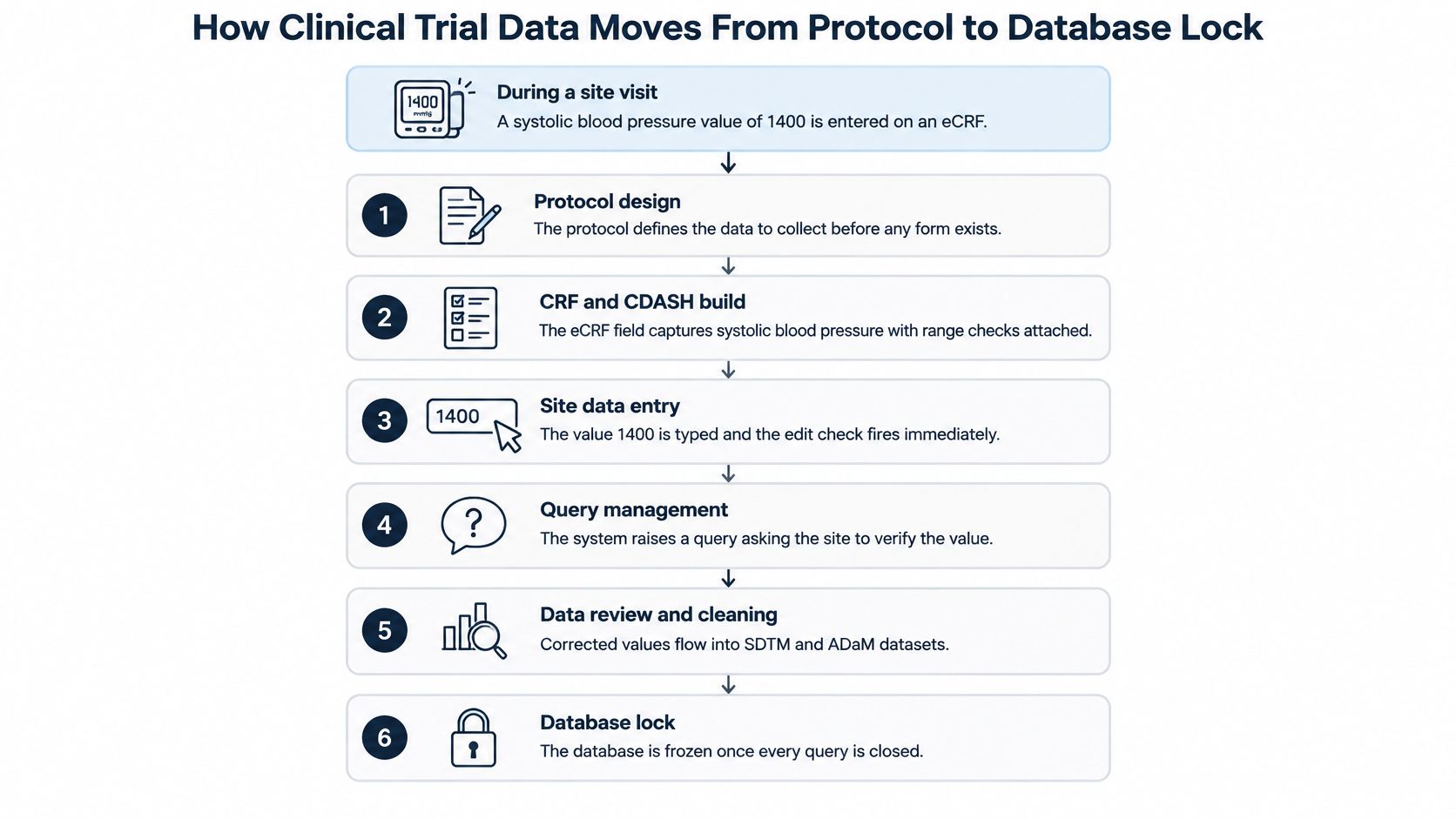
Protocol design sets the endpoints, the visit schedule and the data each visit must produce. Every field you argue about later exists because a protocol section demanded it.
CRF design turns each endpoint into eCRF fields with data types, units and allowed ranges. The systolic field gets an integer type and a plausible range before the first site is trained.
EDC go-live lets the coordinator type. The range check fires on entry, so 1400 is flagged at the moment of entry instead of in a listing three weeks later.
Data cleaning runs review listings and cross-form reconciliation, comparing the vitals form against the visit date and the eligibility record.
Query management sends the discrepancy to the site, records the reply, and closes the query with a reason. The coordinator corrects the value to 140.
Database lock freezes the dataset after final review and documented sign-off, so any later change needs a controlled reopening and a re-lock record.
At every stage, the audit trail has to hold the original entry, the new value, the actor, the timestamp, and the reason for change. That's the practical reading of the ICH Good Clinical Practice E6(R3) data-integrity chain of capture, verification, validation, review, correction, metadata and traceability, which treats data fit for interim and final analysis as the output of timely, reliable processes across all of them, with metadata attached to data from any source. The same logic governs any pipeline underneath, as we explored in our guide to healthcare data pipeline architecture.
Map your product features onto those six stages and mark where each stage holds evidence rather than a status flag. The gaps are usually stage four and the progression path in stage six.
Types of Clinical Data Management Solutions Compared
| Solution type | Core job | Typical data | Controls to verify |
|---|---|---|---|
| EDC | Captures site entries into eCRFs with edit checks at entry | Site case report form data | Audit trail, role-based access, configurable edit checks |
| CDMS | Query management, reconciliation, coding and database lock | Cleaned trial dataset and query history | Query workflow, metadata versioning, lock control |
| ePRO and eCOA | Captures patient-reported and clinician-observed outcomes directly | Diaries, scales and observer ratings | User and device identity, time-stamped entries, time zone handling |
| CTMS | Tracks sites, monitoring visits and milestones | Operational trial metadata and site status | Milestone traceability, role-based visibility |
| Data integration platform | Moves data from EHR, central lab, device and vendor feeds into study systems | Source feeds and transformation logs | Mapping rules, reconciliation logs, error handling and named ownership |
Read the table as a map of ownership. Most trials run three or four of these categories at once, and the question that decides architecture is which system is the source of record for each dataset and who is allowed to change it.
EDC and CDMS are often one product with two contracts. In a CRO setup, the sponsor may license the platform while the CRO owns the study build and the query workflow. Write that ownership down, including who can close a query and who can change an edit check mid-study.
ePRO and eCOA bring device identity into scope. Entries arrive from patient phones and clinic tablets, so timestamps, device identifiers, and time zone handling need validation, and a diary completed at 23:58 local time has to reconcile against a visit scheduled in another zone.
CTMS data is operational, but it drives clinical timing. Site activation and monitoring milestones decide when data arrives and when queries open, which is why a sponsor running its own CTMS while a CRO hosts EDC ends up reconciling site visit dates monthly.
The most underestimated category is the integration platform. A central lab feed arriving as a file with local units needs mapping rules, reconciliation logs, and a named owner who answers when a value doesn't match.
CDASH, SDTM and ADaM Standards in Practice
The three CDISC standards work as one chain, and each layer depends on the one before it. CDASH fixes how data are collected on the case report form, so variable names, formats and code lists stay consistent at the point of entry. SDTM organises collected values into tabulation domains such as demographics, adverse events and laboratory tests. ADaM builds analysis-ready datasets on top of SDTM, with derivations a statistician can trace back to the tabulation layer.
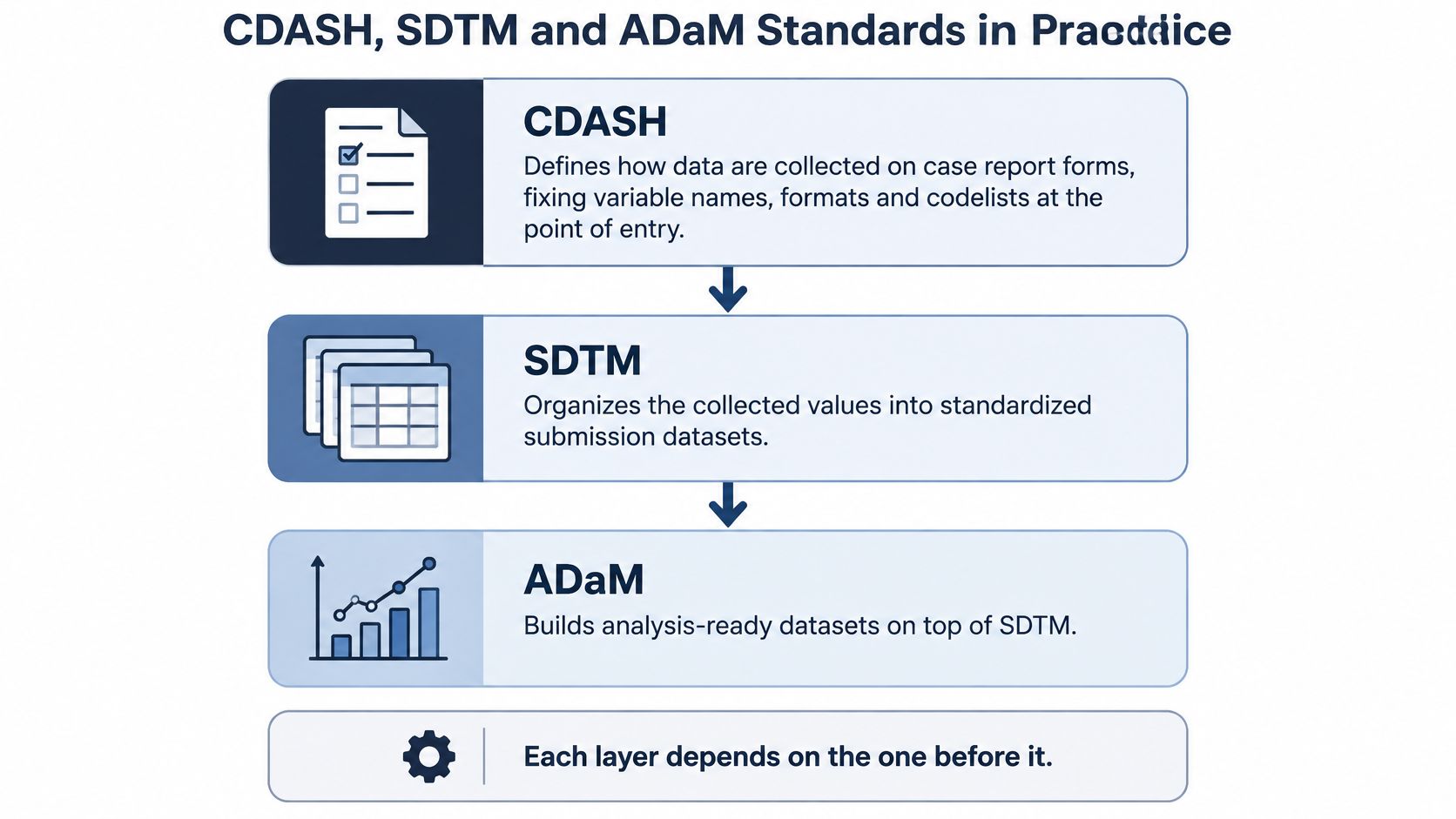
Take one adverse event. The start date is captured in a CDASH-aligned field with a defined format and date rule. It flows into the SDTM adverse event domain with the same concept and controlled terminology. It lands in an ADaM dataset where a treatment-emergent flag is derived under a documented rule. If any of those steps were done once by hand in a spreadsheet, you can't reproduce the flag six months later without the person who did it.
For U.S. submissions, this isn't optional polish. The Clinical Data Interchange Standards Consortium lists ADaM as one of the required standards for submissions to the U.S. Food and Drug Administration and Japan's PMDA, with FDA requirements defined through its Data Standards Catalog and applying to NDA, ANDA, and certain BLA submissions.
Inherited studies are where the chain usually breaks. FDA's March 2025 Technical Conformance Guide expects sponsors to document significant data issues, explain traceability and adjudications, retain all legacy CRF versions, and annotate both original and converted datasets where legacy data are converted. A platform that overwrites a legacy form version to fit a new template has destroyed the evidence the guide asks you to keep.
Architecturally, that means a metadata repository, versioned transformation rules, validation workflows, and export pipelines that reproduce derivations instead of approximating them. Run one test. Trace a primary endpoint from its eCRF field to its ADaM variable without opening a spreadsheet, and write down everything the trace needed.
Compliance Requirements Your Platform Must Meet
| Framework | What it covers | Control to evidence |
|---|---|---|
| ICH E6(R3) | Trial conduct and data reliability across the life cycle | Risk-based quality management records and documented deviations |
| FDA 21 CFR Part 11 | Electronic records and signatures in FDA-regulated studies | Audit trail, unique e-signatures, retention |
| EU GMP Annex 11 | Computerised systems in GMP environments | Change control, periodic review, risk assessment |
| GDPR | Personal data of people in the EU and EEA | Lawful basis, pseudonymisation, transfer safeguards |
| HIPAA | Protected health information held by covered entities and business associates in the US | Access controls, business associate agreements, breach process |
Under 21 CFR Part 11, covered electronic records include those created, modified, maintained, archived, retrieved, or transmitted electronically. The regulation requires secure, computer-generated, time-stamped audit trails that independently record the date and time of operator actions, changes that don't obscure earlier entries, audit documentation retained at least as long as the records themselves, and electronic signatures unique to one individual with identity verified before the signature is issued.
The FDA's 2013 guidance on electronic source data in clinical investigations set terms the market still works to, covering authorized source-data originators, data-element identifiers, audit trails, entry into eCRFs, and investigator responsibilities. On audit trail content specifically, FDA guidance asks for records that let an inspector reconstruct significant details of trial conduct and source-data collection, with source data attributable, legible, contemporaneous, original, and accurate.
EU scope adds a deadline that catches teams out. Sponsors generally must submit a summary of clinical trial results in CTIS within 12 months after the end of the trial, and within 6 months for trials involving paediatric populations, plus a lay summary in language the public can follow. Closeout status, results datasets and document versions have to be unambiguous in the system, not reconstructed from email.
A US site sending pseudonymised eCRF data to an EU sponsor crosses both GDPR and HIPAA scope, and each hop needs its own mapping. For that flow, the control set in our HIPAA-compliant software development guide is the place I'd start.
Validating Computerised Systems With a Risk-Based Approach
Validation is documented evidence that a system is fit for its intended use. It isn't a page count of test scripts, and a thick binder that tests everything equally tells an inspector nothing about where risk sits.
Classify each function by its impact on patient safety, data integrity, and the reliability of results, then scale testing to that classification. In GAMP 5 terms, a configured standard function needs configuration verification plus functional testing of the rules you set, while custom code needs deeper testing including design review and boundary challenge.
The contrasting pair makes it concrete. Edit checks guarding a primary endpoint are high risk, because a wrong range or a skipped cross-form check changes the analysis, so they get boundary-value testing with values just inside and just outside each limit. A cosmetic report layout is low risk and needs verification that it renders, nothing more.
FDA expectations run past the data-entry screen. Sponsors should document every electronic system used to create, modify, maintain, archive, retrieve, or transmit pertinent records, including system requirements and a diagram of data flow from creation to final storage. The same guidance names validation, change control, account setup and access controls, migration, retention, backup, recovery, contingency planning, audit trails, and interoperable data standards as inspection-relevant.
New data sources expand that scope rather than shrinking it. FDA's final E6(R3) GCP guidance issued in September 2025 supports flexible trial designs, broader data sources and technology while holding to quality by design, risk-based quality management and direct availability of essential records to regulators and auditors. Every integration you add inherits a validation obligation.
Working rule: a vendor audit pack reduces your effort and never transfers your responsibility. The sponsor or the developer still owns the risk assessment and the release decision.
Write a one-page validation plan listing each system, its risk rating, the evidence owner, and the release trigger that reopens validation. The trigger matters most, because most validation debt arrives through routine releases nobody classified as significant.
Our medical software quality assurance guide covers the testing depth behind these ratings.
Choosing Between Build, Buy and Integrate for Clinical Data Management
| Option | Best when | Main cost driver | Main risk |
|---|---|---|---|
| Build | The trial model is a differentiator and the team can sustain validation | Validation, maintenance and audit support over the product life | Long-term ownership and dependence on a small group of engineers |
| Buy | A standard trial portfolio with predictable data flows | Licence, configuration and vendor oversight | Vendor lock-in and limited customization |
| Integrate | A core EDC or CDMS must connect to EHR, lab or device data | Interface build, mapping, reconciliation and interface validation | Errors and data loss at each interface point |
| Hybrid | A vendor core system plus custom analytics or data pipelines | Two validation scopes and vendor coordination | Accountability gaps between internal and vendor teams |
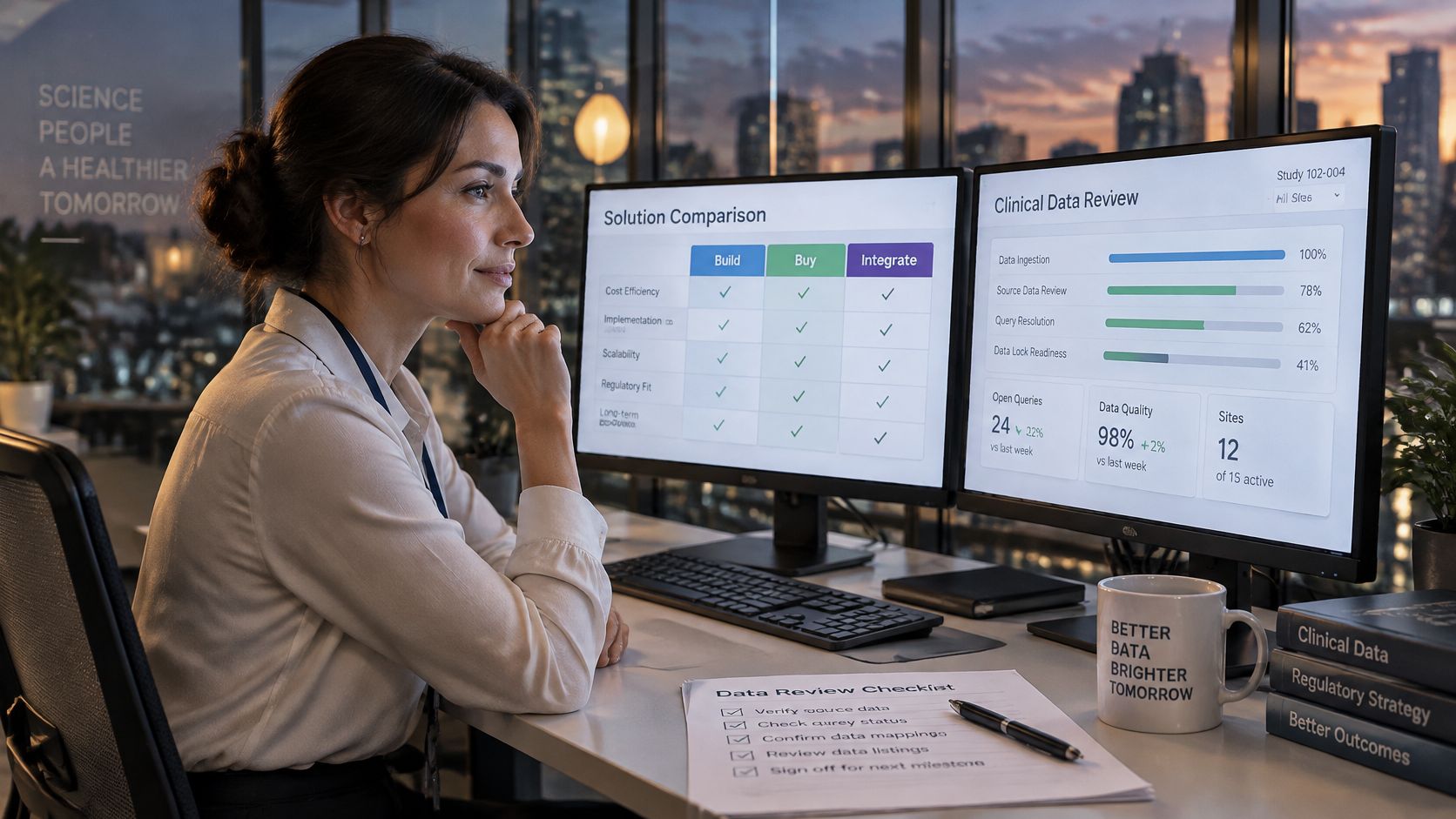
Build fits organisations whose trial design is the product and who can fund validation, audit support and key-person cover for years. Buy fits a standard portfolio where a vendor's validation package and release cadence are usable. Integrate keeps a core EDC or CDMS and connects EHR, central lab, device, and eCOA feeds through an interface layer.
Integration deserves early scoping because it multiplies reconciliation points, and each interface needs its own validation, error logging, and named owner. Say a medtech company builds a custom pipeline for device telemetry and buys its EDC. The interface between them is a system in its own right, with its own risk assessment and its own failure modes.
Cost drivers are consistent across all three paths. Validation effort scales with the number of interfaces and the number of significant changes per year, and support hours scale with how many sites and vendors participate. Most legacy source systems decide the sourcing path before any feature comparison happens, a pattern we covered in our guide to healthcare data modernization.
If the interface layer is the weak point, treat feed mapping as its own discipline. HL7, FHIR, DICOM, SNOMED CT and LOINC each bring separate validation and reconciliation work, which is the substance of healthcare integrations alongside hospital EHRs. Teams scaling a trial platform rather than a single study should weigh SaaS product development trade-offs early, and anyone who plans to build the data core in-house should scope the work like custom software development with validation built into the estimates.
Score each data source on ownership, change frequency, and validation burden. The source that scores worst on all three decides your path.
Clinical Data Management Selection Checklist
Score each item yes, partial, or no, and attach the evidence you were shown. Five of these are pass or fail. A vendor that fails any of them is out, whatever the price.
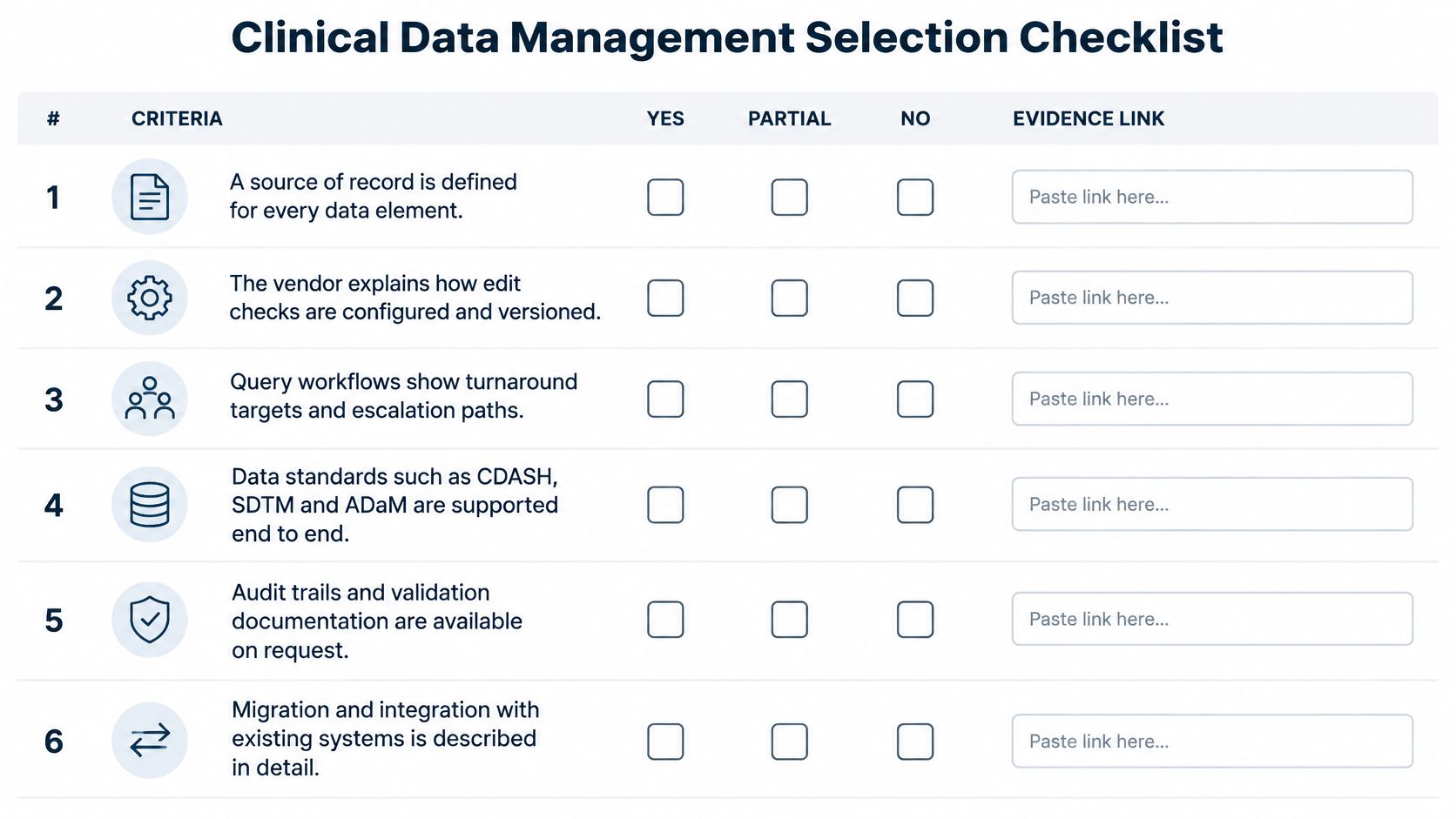
Source of record for every data element (must-have): One owning system and one named role that can change it, written down for each dataset.
Audit trail content and immutability (must-have): Original value, new value, actor, timestamp, and reason for change, with no per-study switch that turns the trail off.
Unique electronic signatures (must-have): One signature per person, identity verified before issue, no reuse or reassignment.
Versioned edit checks: Configurable checks with a change record for every rule edit, including who approved it.
CDASH-aligned forms with SDTM and ADaM exports: Metadata travels with the data and derivations can be reproduced from the export alone.
Interface validation and reconciliation: HL7, FHIR and file feeds validate inputs, log errors and show reconciliation status per feed.
Validation package: Risk assessment, requirements traceability and release evidence you can read without a call.
Residency and access controls: Data residency and transfer safeguards match the GDPR and HIPAA scope you mapped for each hop.
Archival and migration: Records stay readable for the required retention period, and migration keeps old versions linked to their conversions.
Contractual audit support (must-have): Documentation, audit assistance, and notification duties written into the agreement rather than promised in a call.
The scoring rule matters more than the scores. A vendor whose audit trail can be switched off per study fails item 2, and that failure doesn't get cheaper at renewal or easier to explain during an inspection.
Run the checklist in a live demo using your own scenario. Bring one edit check, one query that needs a reason for change, and one locked record you try to alter. You'll learn more in twenty minutes than from a security questionnaire.
Choose Your Clinical Data Management Path Before the Next Study
Before the next vendor call, produce two artefacts from this guide. The first is a source-of-record matrix listing every data element, its owning system, and the named role that may change it. The second is a compliance scope table mapping each data flow to ICH E6(R3), 21 CFR Part 11, EU GMP Annex 11, GDPR and HIPAA where they apply, with an owner per control.
Most later problems with query ownership, interface errors, and inspection findings trace back to an unclear source of record. That's why the matrix comes before the build, buy, or integrate decision, not after the contract.
Use the checklist scores to shortlist candidates, and treat any must-have failure as disqualifying. A platform with a beautiful analytics layer and a mutable audit trail is a liability with good dashboards.
Teams that want outside help scoping these decisions, from interface validation to the compliance scope table, can look at Bridge Global's healthcare practice.
Frequently Asked Questions
What is the difference between EDC and a CDMS?
EDC is the capture layer. It takes site entries into eCRFs with edit checks firing at entry, and it's where most of the data in a trial originates. A CDMS is the wider system that runs query management, reconciliation, coding, database lock, and the analysis-ready export. Many modern products combine both, so evaluate the whole workflow and confirm which system holds the source of record for each dataset.
Do CDM systems need both 21 CFR Part 11 and GDPR controls?
Only if your data flows cross both scopes, which most multinational studies do. Part 11 governs electronic records and signatures in FDA-regulated work, and it drives audit trail content, signature uniqueness, and retention. GDPR governs personal data of people in the EU and EEA, so it drives lawful basis, pseudonymisation and transfer safeguards. Map each data hop separately, because a single flow can trigger both.
Is ADaM required for every trial?
No. ADaM matters where you submit to a regulator that requires it, and CDISC lists it as one of the required standards for submissions to the FDA and Japan's PMDA, with FDA requirements defined through its Data Standards Catalog. A small exploratory study may never produce an ADaM dataset. A platform serving submission work should still maintain lineage from the eCRF field through SDTM to the ADaM derivation, because retrofitting that lineage later is expensive.
What does validation of a new CDM system involve?
Documented evidence that each function is fit for its intended use, scaled to risk. High-impact functions such as endpoint edit checks need boundary testing and requirements traceability, while low-impact presentation functions need verification only. The package should also cover change control, access reviews, migration, backup, recovery, contingency planning, and a clear release trigger that reopens validation when scope changes.
Should a small biotech buy a CDMS or integrate an EDC?
Buy the core and integrate selectively. A small team rarely has the capacity to run validation, audit support and key-person cover for a home-built system. Pick an EDC or CDMS whose validation package you can use, then build interfaces only where your trial design differs, and validate each interface as a system in its own right.
If you're modernising a trial platform or replacing a data layer that no longer holds its own provenance, Bridge Global builds regulated healthcare software with audit trails, role-based access and validated interfaces as foundations rather than add-ons. We work with teams on the whole path, from the source-of-record matrix and compliance scope table through to interface validation and release. Visit Bridge Global to start that conversation.

About Stephanie Cornelissen
Stephanie Cornelissen is a Technical Solutions Consultant with strong experience helping organizations navigate complex digital change. She works closely with teams to align business goals with practical, scalable technology solutions. With expertise in system architecture, integrations, and emerging technologies, she focuses on solving real-world problems through thoughtful execution. She enjoys working where technology meets business strategy and measurable growth.
View all posts by Stephanie Cornelissen →