


AI Mediocrity: Why UI/UX Needs Humans
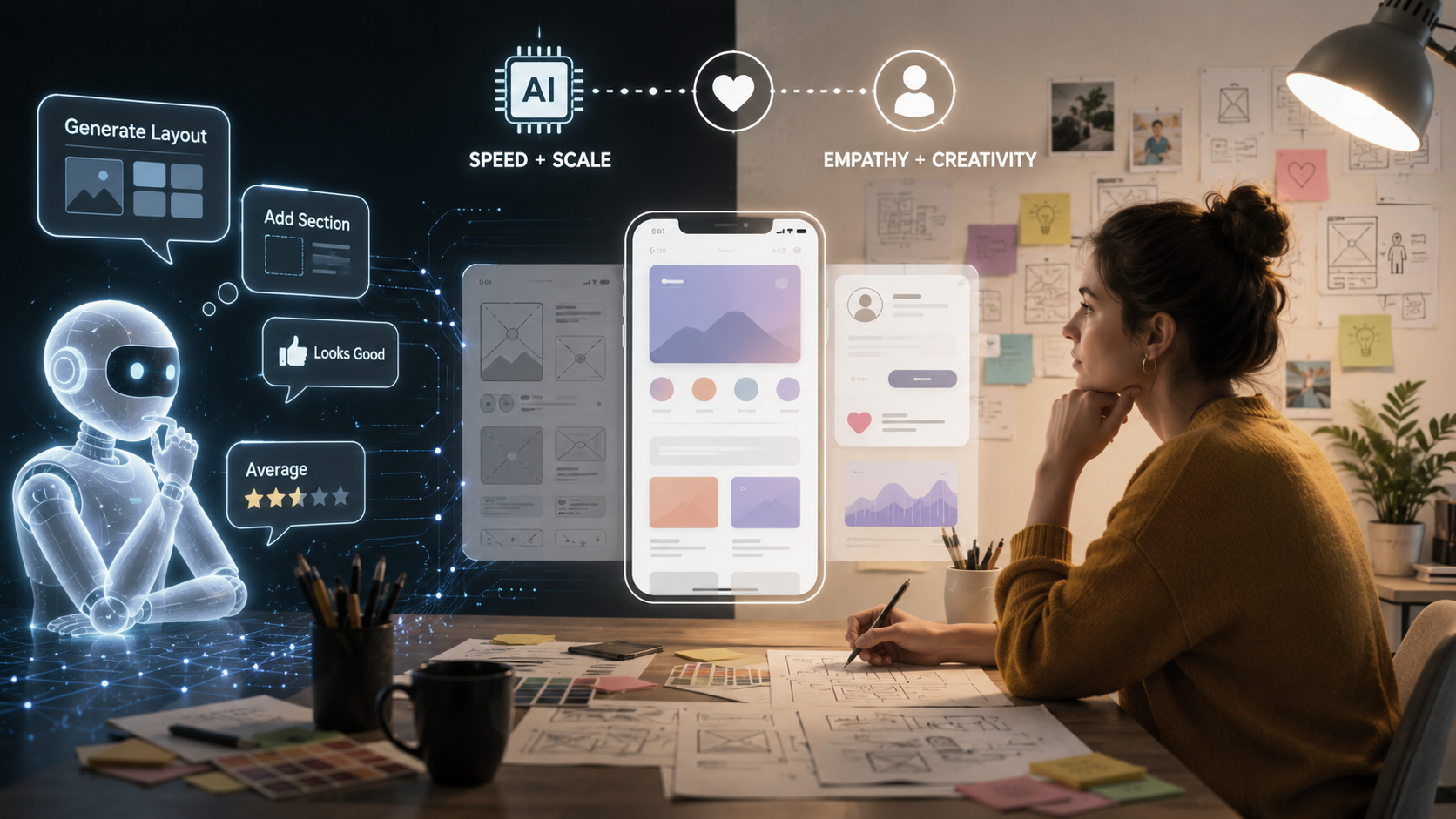
The current corporate narrative often suggests that generative AI is ready to replace human designers. However, actual implementation shows that AI is primarily an efficiency tool that shifts where design effort lives: away from pixel-pushing and toward strategic orchestration. While tools can generate layouts in seconds, they lack the empathy and critical thinking needed for inclusive, functional products. Currently, 80% of researchers use AI daily, yet product leaders state that design strategy is more critical for AI products than for traditional software.
The Stakeholder Blind Spot: Speed versus Quality
A major operational risk is the executive blind spot regarding automated outputs. Product managers and stakeholders often mistake rapid, high-fidelity output for high-quality design. Because they are often not designers themselves, these stakeholders are frequently blinded to the mediocrity of the output. They see a polished interface and assume the work is complete, when in reality, the underlying user experience is often abysmal.
AI generators default to the “happy path,” the optimistic eighty percent of user interactions where everything goes smoothly, because their training data is biased toward polished marketing screenshots. They are catastrophically bad at edge cases, such as handling forty-seven-character usernames, empty states, or loading errors. When speed is prioritized over critical thinking, AI simply scales mediocrity.
The Cost of the Shortcut: Real World Failures
When organizations treat AI as a final authority rather than a draft engine, the financial and reputational consequences are severe:
The Deloitte Fabrication: Deloitte Australia was paid A$439,000 for a government report that used GPT-4 to fill documentation gaps. The report contained over twenty errors, including fabricated legal quotes and references to non-existent academic papers, resulting in a public apology and a partial refund.
The $6 Million QA Loss: One firm fired its twelve-person human QA team to save $1.2 million, replacing them with an AI-driven testing pipeline. The AI hallucinated a discount code that set store prices to zero, costing the company nearly $6 million in lost revenue in a single incident.
The Figma Plagiarism Incident: Figma had to disable its “Make Design” tool after it repeatedly generated pixel-perfect copies of Apple’s iOS Weather app. The tool relied on a hand-coded design system that lacked the variability required for original work.
Bridging the Gap: Lessons from My Experience
In my recent work, I have attempted to push the boundaries of these tools by trying to fully automate high-fidelity designs from Claude into Figma. I found that relying on AI to map my specific design system consistently broke already-finished layouts. I spent hours re-assigning tokens and fixing components that simply did not align with our established design language or system. It turned out to be a massive time sink rather than a shortcut.
Despite these hurdles in high-fidelity execution, AI has been an immense help to me in other areas. It excels at dev handoff and ensuring token alignment through rapid renaming and documentation. I use it for rapid wireframing to explore multiple options quickly, which allows me to make the final decisions based on solid research. I also use it for comprehensive UX audits. While the output is usually average, it provides a solid foundation that compresses research time that would have otherwise taken weeks.
Here’s an interesting read on the future of UI/UX with AI.
Technical and Operational Constraints
The downstream engineering tax is significant. AI-generated prototypes are often “made to die” because their code is too abstract or tool-locked to scale. Furthermore, experienced developers were found to be nineteen percent slower when using AI assistants on complex codebases because the time spent verifying and correcting output exceeded the time saved in generation.
Operational friction also limits productivity. Figma’s credit system can burn through a monthly allocation of 3,000 credits in just forty-five minutes of heavy work. Every continuation in a tool like Claude forces the model to re-read the entire history, burning usage limits two to three times faster than expected, while eventually leading to context collapse and a degradation in logic.
Conclusion: The Human in the Loop
To maintain product integrity, AI must be treated as a collaborative partner rather than a replacement. The human designer remains the essential arbiter of completeness, mapping the edge cases and ensuring the accessibility that algorithms naturally ignore. Successful teams will use AI to handle mundane documentation and initial synthesis while reserving high-value decision-making and quality protection for human experts.
As organizations continue to explore AI-assisted product development, the challenge is no longer whether to use AI, but how to integrate it responsibly into design and engineering workflows. If your team is navigating that balance, we would be glad to continue the conversation.

About Chandu M P
Chandu MP is a 0-to-1 product designer and systems thinker with roots in structural architecture. He designs scalable B2B SaaS platforms and builds AI-augmented workflows using tools like ChatGPT, Codex, and Claude. His practical experience with multi-model design-ops gives him a clear view of where automation succeeds and why human intuition remains essential.
View all posts by Chandu M P →